Results by title
168 books match the query 'Poland' and 45 start with t
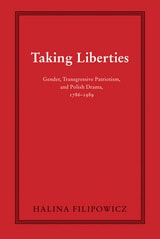
Taking Liberties
Gender, Transgressive Patriotism, and Polish Drama, 1786–1989Halina Filipowicz
Ohio University Press, 2014
As narrow, nationalist views of patriotic allegiance have become widespread and are routinely invoked to justify everything from flag-waving triumphalism to xenophobic bigotry, the concept of a nonnationalist patriotism has vanished from public conversation. Taking Liberties is a study of what may be called patriotism without borders: a nonnational form of loyalty compatible with the universal principles and practices of democracy and human rights, respectful of ethnic and cultural diversity, and, overall, open-minded and inclusive.
Moving beyond a traditional study of Polish dramatic literature, Halina Filipowicz turns to the plays themselves and to archival materials, ranging from parliamentary speeches to polemical pamphlets and verse broadsides, to explore the cultural phenomenon of transgressive patriotism and its implications for society in the twenty-first century.
In addition to recovering lost or forgotten materials, the author builds an innovative conceptual and methodological framework to make sense of those materials. The result is not only a significant contribution to the debate over the meaning and practice of patriotism, but a masterful intellectual history.
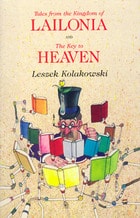
Tales from the Kingdom of Lailonia and The Key to Heaven
Leszek Kolakowski
University of Chicago Press, 1989
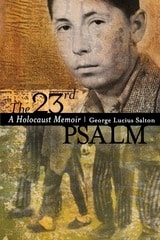
The 23rd Psalm
A Holocaust MemoirGeorge Lucius Salton, with Anna Salton Eisen
University of Wisconsin Press, 2004
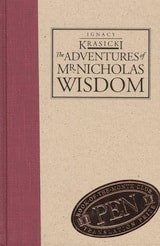
The Adventures of Mr. Nicholas Wisdom
Ignacy Krasicki
Northwestern University Press, 1992
Winner, 1993 PEN Book-of-the-Month Club Translation Prize
Published in 1776 and considered the first Polish novel ever written, The Adventures of Mr. Nicholas Wisdom is a picaresque tale following the naïve title character's coming of age. Having conquered (and fled) sophisticated Warsaw, Nicholas enjoys many adventures across Europe, South America, and the high seas. He finally lands among the natives of an unknown isle who reject his allegedly superior European ways and instead tutor him for an "enlightened" existence. Resonant with Enlightenment ideas, The Adventures of Mr. Nicholas Wisdom provides a sly portrait of the era's Polish society and a fascinating perspective on the broader problems of eighteenth-century European culture.
The Art of Economic Persuasion
Positive Incentives and German Economic DiplomacyPatricia A. Davis
University of Michigan Press, 2000
The Birch Grove and Other Stories
Jaroslaw Iwaszkiewicz
Central European University Press, 2002
The Black Seasons
Glowinski
Northwestern University Press, 2005
When six-year-old Michal Glowinski first heard the adults around him speak of the ghetto, he understood only that the word was connected with moving-and conjured up a fantastical image of a many-storied carriage pulled through the streets by some umpteen horses. He was soon to learn that the ghetto was something else entirely. A half-century later, Glowinski, now an eminent Polish literary scholar, leads us haltingly into Nazi-occupied Poland. Scrupulously attentive to the distance between a child's experience and an adult's reflection, Glowinski revisits the images and episodes of his childhood: the emaciated violinist playing a Mendelssohn concerto on the ghetto streets; his game of chess with a Polish blackmailer threatening to deliver him to the Gestapo; and his eventual rescue by Catholic nuns in an impoverished, distant convent. In language at once spare and eloquent, Glowinski explores the horror of those years, the fragility of existence, and the fragmented nature of memory itself.
The Career of Nicodemus Dyzma
A NovelTadeusz Dolega-Mostowicz; Translated from the Polish by Ewa Malachowska-Pasek and Megan Thomas and with an introduction by Benjamin Paloff
Northwestern University Press, 2020
Winner of the 2021 Found in Translation Award
First published in Polish in 1932, The Career of Nicodemus Dyzma was Tadeusz Dołęga-Mostowicz’s breakout novel. Dyzma is an unemployed clerk who crashes a swanky party, where he makes an offhand crass remark that sets him on a new course. Soon high society—from government ministers to drug-fueled aristocrats—wants a piece of him. As Dyzma’s status grows, his vulgarity is interpreted as authenticity and strength. He is unable to comprehend complicated political matters, but his cryptic responses are celebrated as wise introspection. His willingness to do anything to hold on to power—flip-flopping on political positions, inventing xenophobic plots, even having enemies assaulted—only leads to greater success.
Dołęga-Mostowicz wrote his novel in a newly independent Poland rampant with political corruption and populist pandering. Jerzy Kosinski borrowed heavily from the novel when he wrote Being There, and readers of both books will recognize similarities between their plots. This biting political satire—by turns hilarious and disturbing, contemptuous and sympathetic—is an indictment of a system in which money and connections matter above all else, bluster and ignorance are valorized, and a deeply incompetent man rises to the highest spheres of government.

The Church and the Left
Adam Michnik
University of Chicago Press, 1992
Years in advance of the collapse of communism in Eastern Europe, Poland underwent one of the most radical and painful social and political upheavals of our century. Through a wide body of writing and an unswerving political commitment that took him from prison to parliament, Adam Michnik was a central figure in these events—culminating in 1989 with his role in formulating the political deal that brought Solidarity to power. Michnik's writings, most of them smuggled out of prison, have been translated into many languages; but until now, only isolated essays have appeared in English.
In The Church and the Left, Michnik gives full expression to the ideas that have shaped the drama of Poland and of our time. The unlikely alliance of the Catholic Church and the dissident Left is one of the most fascinating and confusing features of the Polish revolutionary movement. No other book better explains the logic of this powerful coalition—or its future implications. In superb discussions of liberalism and nationalism, of secularism and clericalism, Michnik illuminates the unique makeup and direction of Poland's social revolution and, at the same time, offers unparalleled insight into the internal struggles still present in Eastern Europe.
Today, as religious revivals proliferate and secular progress, whether liberal or communist, comes under suspicion, the relationship of religion to politics has become a pressing issue far beyond the boundaries of Poland. As none has done before, Michnik's clear and thoughtful book gives us the means to understand this volatile mix as it has transformed Poland and as it figures in the future we see taking shape.
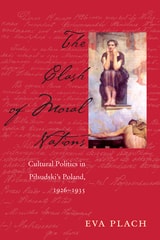
The Clash of Moral Nations
Cultural Politics in Pilsudski’s Poland, 1926–1935Eva Plach
Ohio University Press, 2006
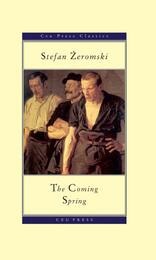
The Coming Spring
Stefan Zeromski
Central European University Press, 2007
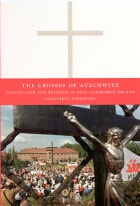
The Crosses of Auschwitz
Nationalism and Religion in Post-Communist PolandGeneviève Zubrzycki
University of Chicago Press, 2006
In the summer and fall of 1998, ultranationalist Polish Catholics erected hundreds of crosses outside Auschwitz, setting off a fierce debate that pitted Catholics and Jews against one another. While this controversy had ramifications that extended well beyond Poland’s borders, Geneviève Zubrzycki sees it as a particularly crucial moment in the development of post-Communist Poland’s statehood and its changing relationship to Catholicism.
In The Crosses of Auschwitz, Zubrzycki skillfully demonstrates how this episode crystallized latent social conflicts regarding the significance of Catholicism in defining “Polishness” and the role of anti-Semitism in the construction of a new Polish identity. Since the fall of Communism, the binding that has held Polish identity and Catholicism together has begun to erode, creating unease among ultranationalists. Within their construction of Polish identity also exists pride in the Polish people’s long history of suffering. For the ultranationalists, then, the crosses at Auschwitz were not only symbols of their ethno-Catholic vision, but also an attempt to lay claim to what they perceived was a Jewish monopoly over martyrdom.
This gripping account of the emotional and aesthetic aspects of the scene of the crosses at Auschwitz offers profound insights into what Polishness is today and what it may become.

The Doll
Boleslaw Prus
Central European University Press, 1997
The city of Warsaw, under Russian rule in the late 1870s, is the setting for this story. The middle-aged hero, Wokulski, bold and successful in business, is being destroyed by his obsessive love for the frigid, aristocratic society ‘doll’ Izabela. The embattled aristocracy, the new men of finance, Dickensian tradesmen and the urban poor all come vividly to life on the vast, superbly detailed canvas.
The Ethics of Witnessing
The Holocaust in Polish Writers' Diaries from Warsaw, 1939-1945Rachel Feldhay Brenner
Northwestern University Press, 2014
Winner, 2015 USC Book Award in Literary and Cultural Studies, for outstanding monograph published on Russia, Eastern Europe or Eurasia in the fields of literary and cultural studies
The Ethics of Witnessing investigates the reactions of five important Polish diaristswriters—Jaroslaw Iwaszkiewicz, Maria Dabrowska, Aurelia Wylezynska, Zofia Nalkowska, and Stanislaw Rembek—during the period when the Nazis persecuted and murdered Warsaw’s Jewish population. The responses to the Holocaust of these prominent prewar authors extended from insistence on empathic interaction with victims to resentful detachment from Jewish suffering. Whereas some defied the dehumanization of the Jews and endeavored to maintain intersubjective relationships with the victims they attempted to rescue, others selfdeceptively evaded the Jewish plight. The Ethics of Witnessing examines the extent to which ideologies of humanism and nationalism informed the diarists’ perceptions, proposing that the reality of the Final Solution exposed the limits of both orientations and ultimately destroyed the ethical landscape shaped by the Enlightenment tradition, which promised the equality and fellowship of all human beings.
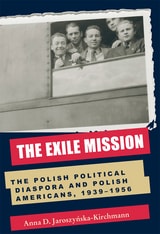
The Exile Mission
The Polish Political Diaspora and Polish Americans, 1939–1956Anna D. Jaroszynska-Kirchmann
Ohio University Press, 2009
At midcentury, two distinct Polish immigrant groups—those Polish Americans who were descendants of economic immigrants from the turn of the twentieth century and the Polish political refugees who chose exile after World War II and the communist takeover in Poland—faced an uneasy challenge to reconcile their concepts of responsibility toward the homeland.
The new arrivals did not consider themselves simply as immigrants, but rather as members of the special category of political refugees. They defined their identity within the framework of the exile mission, an unwritten set of beliefs, goals, and responsibilities, placing patriotic work for Poland at the center of Polish immigrant duties.
In The Exile Mission, an intriguing look at the interplay between the established Polish community and the refugee community, Anna Jaroszyńska–Kirchmann presents a tale of Polish Americans and Polish refugees who, like postwar Polish exile communities all over the world, worked out their own ways to implement the mission’s main goals. Between the outbreak of World War II and 1956, as Professor Jaroszyńska–Kirchmann demonstrates, the exile mission in its most intense form remained at the core of relationships between these two groups.
The Exile Mission is a compelling analysis of the vigorous debate about ethnic identity and immigrant responsibility toward the homeland. It is the first full–length examination of the construction and impact of the exile mission on the interactions between political refugees and established ethnic communities.
The Faithful River
Stefan Zeromski
Northwestern University Press, 1999
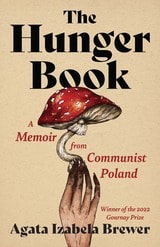
The Hunger Book
A Memoir from Communist PolandAgata Izabela Brewer
The Ohio State University Press, 2023
“A searing memoir about growing up behind the Iron Curtain, motherhood, addiction, and finding sustenance in the natural world.” —Kirkus
In The Hunger Book, Agata Izabela Brewer evokes her Polish childhood under Communism, where the warmth of her grandparents’ love and the scent of mushrooms drying in a tiny apartment are as potent as the deprivations and traumas of life with a terrifyingly unstable, alcoholic single mother. Brewer indelibly renders stories of foraging for food, homemade potato vodka (one of the Eastern Bloc’s more viable currencies), blood sausage, sparrows plucked and fried with linseed oil, and the respite of a country garden plot, all amid Stalinist-era apartment buildings, food shortages, martial law, and nuclear disaster in nearby Ukraine.
Brewer reflects on all of this from her immigrant’s vantage point, as she wryly tries to convince her children to enjoy the mushrooms she gathers from a roadside and grieves when they choose to go by Americanized versions of their Polish names. Hunting mushrooms, like her childhood, carried both reward and mortal peril. The Hunger Book, which includes recipes, is an unforgettable meditation on motherhood and addiction, resilience and love.
The Jews in Polish Culture
Aleksander Hertz
Northwestern University Press, 1988
The Jews of Poland Between Two World Wars
Edited by Yisrael Gutman
Brandeis University Press, 1991
The Last Consolation Vanished
The Testimony of a Sonderkommando in AuschwitzZalmen Gradowski
University of Chicago Press, 2022
On October 7, 1944, a group of Jewish prisoners in Auschwitz obtained explosives and rebelled against their Nazi murderers. It was a desperate uprising that was defeated by the end of the day. More than four hundred prisoners were killed. Filling a gap in history, The Last Consolation Vanished is the first complete English translation and critical edition of one prisoner’s powerful account of life and death in Auschwitz, written in Yiddish and buried in the ashes near Crematorium III.
Zalmen Gradowski was in the Sonderkommando (special squad) at Auschwitz, a Jewish prisoner given the unthinkable task of ushering Jewish deportees into the gas chambers, removing their bodies, salvaging any valuables, transporting their corpses to the crematoria, and destroying all evidence of their murders. Sonderkommandos were forcibly recruited by SS soldiers; when they discovered the horror of their assignment, some of them committed suicide or tried to induce the SS to kill them. Despite their impossible situation, many Sonderkommandos chose to resist in two interlaced ways: planning an uprising and testifying. Gradowski did both, by helping to lead a rebellion and by documenting his experiences. Within 120 scrawled notebook pages, his accounts describe the process of the Holocaust, the relentless brutality of the Nazi regime, the assassination of Czech Jews, the relationships among the community of men forced to assist in this nightmare, and the unbearable separation and death of entire families, including his own. Amid daily unimaginable atrocities, he somehow wrote pages that were literary, sometimes even lyrical—hidden where and when one would least expect to find them.
The October 7th rebellion was completely crushed and Gradowski was killed in the process, but his testimony lives on. His extraordinary and moving account, accompanied by a foreword and afterword by Philippe Mesnard and Arnold I. Davidson, is a voice speaking to us from the past on behalf of millions who were silenced. Their story must be shared.
The Last Eyewitnesses, Volume 2
The Children of the Holocaust SpeakJakub Gutenbaum and Agnieszka Latala
Northwestern University Press, 2005
This book serves as a memorial to loved ones who do not even have a grave, as well as a tribute to those who risked their lives and families to save a Jewish child. A wide variety of experiences during the Nazi occupation of Poland are related with wrenching simplicity and candor, experiences that illustrate horrors and deprivation, but also present examples of courage and compassion.
These recollections-whether of hiding in forests or camouflaged bunkers, fighting with groups of partisans, enduring the horrors of concentration camps, or living in fear under disguised identities-serve as eloquent testimony to the depth, diversity, and richness of humanity under siege and offer a powerful lesson for future generations. Written by people who remained in Poland after the war, these accounts convey a great immediacy; the authors are not removed from the environment in which these experiences took place. The psychological impact on these child survivors and the difficulties they encountered even after the war are very poignant. The passing years have brought urgency to the publication of these stories, as those who wrote them are the last surviving eyewitnesses of these tumultuous events.
The Last Eyewitnesses
Children of the Holocaust SpeakWiktoria Sliwowska
Northwestern University Press, 1998
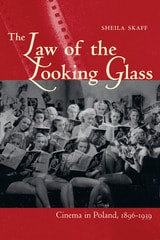
The Law of the Looking Glass
Cinema in Poland, 1896–1939Sheila Skaff
Ohio University Press, 2008
The Law of the Looking Glass: Cinema in Poland, 1896–1939 reveals the complex relationship between nationhood, national language, and national cinema in Europe before World War II. Author Sheila Skaff describes how the major issues facing the region before World War I, from the relatively slow pace of modernization to the desire for national sovereignty, shaped local practices in film production, exhibition, and criticism. She goes on to analyze local film production, practices of spectatorship in large cities and small towns, clashes over language choice in intertitles, and controversy surrounding the first synchronized sound experiments before World War I. Skaff depicts the creation of a national film industry in the newly independent country, the golden years of the silent cinema, the transition from silent to sound film—and debates in the press over this transition—as well as the first Polish and Yiddish “talkies.” She places particular importance on conflicts in majority-minority relations in the region and the types of collaboration that led to important films such as The Dybbuk and The Ghosts.
The Law of the Looking Glass: Cinema in Poland, 1896–1939 is the first comprehensive history of the country’s film industry before World War II. This history is characterized by alternating periods of multilingual, multiethnic production, on the one hand, and rejection of such inclusiveness, on the other. Through it all, however, runs a single unifying thread: an appreciation for visual imagery.
The Lublin Lectures and Works on Max Scheler
Karol Wojtyla
Catholic University of America Press, 2023
The Narrow Bridge
Beyond the HolocaustIsaac Neuman, with Michael Palencia-Roth
University of Illinois Press, 2000
As a boy studying Torah, Isaac Neuman learned to seek the spiritual lessons hidden in everyday life. Likewise, in this narrative of occupation and holocaust, he uncovers a core of human decency and spiritual strength that inhumanity, starvation, and even death failed to extinguish.
Unlike many Holocaust memoirs that focus on physical suffering and endurance, The Narrow Bridge follows a spiritual journey. Neuman describes the world of Polish Jewry before and during the Holocaust, recreating the strong religious and secular personalities of his childhood and early youth in Zdunska Wola, Poland: the outcast butcher, Haskel Traskalawski; the savvy criminal-turned-entrepreneur Nochem Ellia; the trusted Dr. Lemberg, liaison to the German occupation government; and Neuman's beloved teacher, Reb Mendel. Through their stories, Neuman reveals the workings of a community tested to the limits of faith and human dignity.
With his brother Yossel, Neuman was transported to the Poznan area, first to the Yunikowo work camp in May 1941, then on to St. Martin's Cemetery camp, where they removed gold jewelry and fillings from exhumed corpses. A string of concentration camps followed, each more oppressive than the last: Fürstenfelde, Auschwitz, Fünfteichen, Gross Rosen, Mauthausen, Wels, and Ebensee. In the midst of these horrors, the brothers kept their feet on the "narrow bridge" of life by holding to their faith, their memories, and each other. In the end, only Isaac survived.
The Narrow Bridge celebrates symbolic victories of faith over brute force. The execution of Zdunska Wola's Jewish spiritual and intellectual leaders is trumped by an act of breathtaking courage and conviction. A secret Passover Seder is cobbled together from hoarded bits of wax, piecemeal prayers, and matzoh baked in delousing ovens. A dying fellow inmate gives Neuman his warm coat as they both lie freezing on the ground.
Such rituals of faith and acts of kindness, combined with boyhood memories and a sense of spiritual responsibility, sustained Neuman through the Holocaust and helped him to reconstruct his life after the war. His story is a powerful testimony to an unquenchable faith and a spirit tried by fire.
The Origins of Modern Polish Democracy
M. B. B. Biskupski
Ohio University Press, 2010
The Origins of Modern Polish Democracy is a series of closely integrated essays that traces the idea of democracy in Polish thought and practice. It begins with the transformative events of the mid-nineteenth century, which witnessed revolutionary developments in the socioeconomic and demographic structure of Poland, and continues through changes that marked the postcommunist era of free Poland.
The idea of democracy survived in Poland through long periods of foreign occupation, the trials of two world wars, and years of Communist subjugation. Whether in Poland itself or among exiles, Polish speculation about the creation of a liberal-democratic Poland has been central to modern Polish political thought. This volume is unique in that is traces the evolution of the idea of democracy, both during the periods when Poland was an independent country—1918-1939—and during the periods of foreign occupation before 1918 through World War II and the Communist era. For those periods when Poland was not free, the volume discusses how the idea of democracy evolved among exile and underground Polish circles.
This important work is the only single-volume English-language history of modern Polish democratic thought and parliamentary systems and represents the latest scholarly research by leading specialists from Europe and North America.
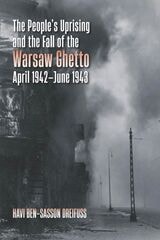
The People's Uprising and the Fall of the Warsaw Ghetto, April 1942–June 1943
Havi Ben-Sasson Dreifuss
Brandeis University Press, 2026
The People’s Uprising and the Fall of the Warsaw Ghetto, April 1942–June 1943 sheds light on the lives, choices, and experiences of the tens of thousands of Jews who were not part of the underground armed resistance but nonetheless supported the famed Warsaw Ghetto Uprising. This riveting and dramatic account focuses on the final year of the Warsaw ghetto, from the Great Deportation in the summer of 1942 through the suppression of the uprising in mid-1943. Drawing on powerful contemporary testimonies, diaries, and documents—many of them previously unexplored—Havi Ben-Sasson Dreifuss
reveals how members of the broader Jewish population struggled to survive, maintain family and community life, and make impossible moral decisions in the face of fear, hunger, and daily violence. Looking beyond the fighters themselves, the book offers a story of devastation, but also of resilience and human dignity.
Published in association with Yad Vashem.
The Plan for Perpetual Peace, On the Government of Poland, and Other Writings on History and Politics
Jean-Jacques Rousseau
Dartmouth College Press, 2011
The Polish Peasant in Europe and America
A CLASSIC WORK IN IMMIGRATION HISTORYWilliam I. Thomas and Florian Znaniecki
University of Illinois Press, 1984
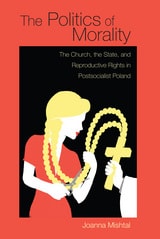
The Politics of Morality
The Church, the State, and Reproductive Rights in Postsocialist PolandJoanna Mishtal
Ohio University Press, 2015
After the fall of the state socialist regime and the end of martial law in 1989, Polish society experienced both a sense of relief from the tyranny of Soviet control and an expectation that democracy would bring freedom. After this initial wave of enthusiasm, however, political forces that had lain concealed during the state socialist era began to emerge and establish a new religious-nationalist orthodoxy. While Solidarity garnered most of the credit for democratization in Poland, it had worked quietly with the Catholic Church, to which a large majority of Poles at least nominally adhered. As the church emerged as a political force in the Polish Sejm and Senate, it precipitated a rapid erosion of women’s reproductive rights, especially the right to abortion, which had been relatively well established under the former regime.
The Politics of Morality is an anthropological study of this expansion of power by the religious right and its effects on individual rights and social mores. It explores the contradictions of postsocialist democratization in Poland: an emerging democracy on one hand, and a declining tolerance for reproductive rights, women’s rights, and political and religious pluralism on the other. Yet, as this thoroughly researched study shows, women resist these strictures by pursuing abortion illegally, defying religious prohibitions on contraception, and organizing into advocacy groups. As struggles around reproductive rights continue in Poland, these resistances and unofficial practices reveal the sharp limits of religious form of governance.
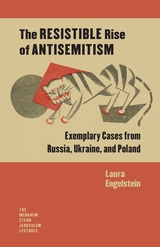
The Resistible Rise of Antisemitism
Exemplary Cases from Russia, Ukraine, and PolandLaura Engelstein
Brandeis University Press, 2020
Antisemitism as a political weapon did not stand unchallenged, even in Eastern Europe, where its consequences were particularly dire. In this region, Jewish leaders mobilized across national borders and in alliance with non-Jewish public figures on behalf of Jewish rights and in opposition to anti-Jewish violence. Antisemites were called to account and forced on the defensive. In Imperial and then Soviet Russia, in newly emerging Poland, and in aspiring Ukraine—notorious in the West as antisemitic hotbeds—antisemitism was sometimes a moral and political liability. These intriguing essays explore the reasons why, and they offer lessons from surprising places on how we can continue to fight antisemitism in our times.
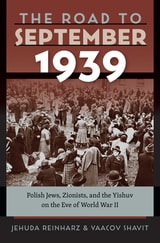
The Road to September 1939
Polish Jews, Zionists, and the Yishuv on the Eve of World War IIJehuda Reinharz and Yaacov Shavit
Brandeis University Press, 2018
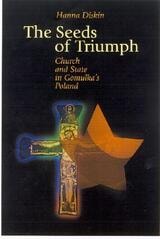
The Seeds of Triumph
Church and State in Gomulka's PolandHannah Diskin
Central European University Press, 2001
The Roman Catholic Church has played a unique role in the history of Poland in the twentieth century: the people and the Church drew closer and closer together during Nazi rule, the Stalinist period and the somewhat milder, though strongly anti-religious and repressive Gomulka regime (1956-1970). The power struggle between the Church and the communist government did in fact play a role in shaping world politics, the Polish Church having been the force behind the opposition movement in Poland. Against this background, a Polish pope appeared and made a major contribution to the collapse of communism.
The Seeds of Triumph, the most comprehensive recent book on the opposition of Church and State in post-war Poland, compares the characteristics and consequences of this relationship during three different periods: the first and second periods of Gomulka's rule, and the Stalinist era between the two Gomulka periods. It examines the balance of power, studying to what degree the Church and other factors in the political environment influenced governmental policy-making. The author disproves the common stereotype, held at the time, that domestic conditions played only a marginal role. In examining the regime's policies, she covers the legal background, the general policy characteristics, the specific policies implemented during the period, and the role of the individual actors, most notably the pivotal role of the two main protagonists, Cardinal Wyszynski and Wladislaw Gomulka.
In her landmark study, Diskin makes a significant contribution to the study of authoritarian systems and greatly enhances our understanding of the centrality of the Church in recent Polish history.
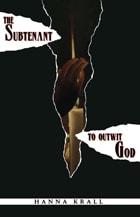
The Subtenant / To Outwit God
Hanna Krall
Northwestern University Press, 1992
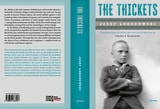
The Thickets
Józef Lobodowski
Central European University Press, 2026
In The Thickets, Lobodowski paints a stark, unforgettable portrait of the turmoil that engulfed the former Russian Empire after the fall of the Tsar and Kerensky’s government. For Stas, once a student at a classical gymnasium, survival now means peddling contraband on the black market. Through his eyes, the reader is plunged into the chaos of war, revolution, and occupation—rendered with visceral power and human urgency.
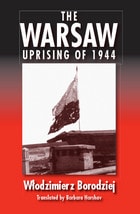
The Warsaw Uprising of 1944
Wlodzimierz Borodziej
University of Wisconsin Press, 2006
The Warsaw Uprising of 1944 dramatically tells the largely unknown story of the Warsaw resistance movement during World War II. Desperate to free themselves from German military oppression but also hoping to show the advancing Soviets that they could not impose easy rule upon the citizens of Warsaw, the Poles launched an almost hopeless attack against the Germans on August 1, 1944.
Wlodzimierz Borodziej presents an evenhanded account of what is commonly considered the darkest chapter in Polish history during World War II. In only sixty-three days, the Germans razed Warsaw to the ground and 200,000 people, mostly civilians, lost their lives. The result—a heroic and historically pivotal turning point—meant that the Poles would lose both their capital and an entire generation. This concise account of the trauma—little known to English-speaking readers—will appeal to anyone interested in the history of World War II in general and is a must-read for students of Polish history in particular.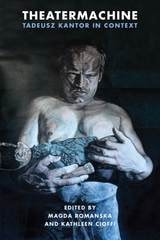
Theatermachine
Tadeusz Kantor in ContextEdited by Magda Romanska and Kathleen Cioffi
Northwestern University Press, 2019
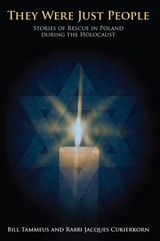
They Were Just People
Stories of Rescue in Poland During the HolocaustBill Tammeus & Rabbi Jacques Cukierkorn
University of Missouri Press, 2009
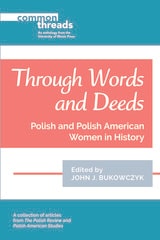
Through Words and Deeds
Polish and Polish American Women in HistoryEdited by John Bukowczyk
University of Illinois Press, 2021
A valuable and enlightening resource, Through Words and Deeds offers an introduction to the many facets of Polish and Polish American womanhood.
Contributors: Laura Anker, Robert Blobaum, Anna Brzezińska, John J. Bukowczyk, Halina Filipowicz, William J. Galush, Rita Gladsky, Thaddeus V. Gromada, Bożena Karwowska, Grażyna Kozaczka, Lynn Lubamersky, Karen Majewski, Nameeta Mathur, Lori A. Matten, Jan Molenda, James S. Pula, Władysław Roczniak, and Robert Szymczak
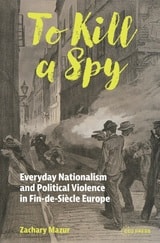
To Kill a Spy
Everyday Nationalism and Political Violence in Fin-de-Siecle EuropeZachary Mazur
Central European University Press, 2026
How does an ordinary, working-class man transform into a political executioner? And how does a society reach the tipping point where premeditated murder is celebrated as a civic duty?
This gripping historical investigation unravels the environment and conditions of radicalization in fin-de-siècle Europe. Societal shifts, mass political movements, the popular press and espionage paranoia all contributed to a fearful community, wary of outsiders and ready to do anything to defend itself.
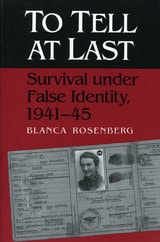
To Tell At Last
Survival under False Identity, 1941-45Blanca Rosenberg
University of Illinois Press, 1993
an even hand and understated prose, Ms. Rosenberg, now a New York City
psychotherapist, bravely depicts Nazi carnage in chilling detail."
-- Susan Shapiro, New York Times Book Review
"[A] harrowing account
of intrigue and danger with all the elements of a war movie adventure."
-- Miriam Rinn, The Forward
This memoir of how a Jewish
woman survived Nazi Germany by passing as an Aryan was selected as the
best book on Holocaust and Jewish Resistance Literature by the Israeli
committee of the Egit Grants.
Tormented Master
A Life of Rabbi Nahman of BratslavWritten by Arthur E. Green
University of Alabama Press, 1979
“If Hasidism begins in the life-enhancing spirituality of the Baal Shem Tov, it concludes in the tortuous, elitist and utterly fascinating career of Nahman of Bratslav (1722–1810) whose biography and teaching Arthur Green has set forth in his comprehensive, moving, and subtle study, Tormented Master.
“Arthur Green has managed to lead us through the thickets of the Bratslaver discourse with a grace and facility thus far unequaled in the English language literature on Hasidism. Tormented Master is a model of clarity and percipience, balancing awed respect and honor for its subject with a ruthless pursuit of documented truth. . . . Tormented Master is sufficiently open to the agonies of religion in general and the issues of modern religion in particular to make Nahman a thinker utterly relevant to our time.
“Nahman of Bratslav is unique in the history of Judaism, Green emphasizes, for having made the individual’s quest for intimacy with God the center of the religious way. He was a Kierkegaard before his time, believing in the utter abandon of the life of faith and the risk of paradoxicality. . . . He was, more than all others, the predecessor of Kafka, whose tales, like Nahman’s, have no explicit key and rankle, flush and irritate the spirit, compelling us—even in our failure to understand—to acknowledge their potency and challenge.”
—New York Times

Transnational Trajectories and Diaspora Policies
The Case of Czechia in Comparison to Poland, Hungary and SlovakiaEdited by Eva Janská
Karolinum Press, 2025
The book examines diaspora policy in Central European countries in the context of changes following their accession to the EU, utilizing the Czech Republic, Slovakia, Poland, and Hungary as case studies. With a focus on the previously underexplored new Czech diaspora (i.e., the emigration of Czechs/Czechoslovaks after 1990), individual case studies provide a comprehensive description of the contemporary Czech diaspora while also elucidating key inquiries directed towards its current character and specific needs.
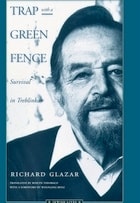
Trap with a Green Fence
Survival in TreblinkaRichard Glazar
Northwestern University Press, 1995
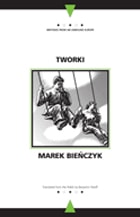
Tworki
Marek Bienczyk
Northwestern University Press, 2008
In Tworki, a village just southwest of Warsaw, there is a psychiatric hospital and in that hospital, the patients and their caretakers are hidden from the war just outside their iron gates. Our hero, Jurek, answers an ad in the paper for a job there and finds himself keeping the books alongside a knockout strawberry blonde named Sonia. They and their group of friends—vital young people like Marcel, an initial rival for Jurek; Olek, Sonia’s chosen love; and Janka, with whom Jurek becomes involved—do their jobs, picnic on the weekends, and dance in the gardens on the grounds of the hospital. Jurek speaks often of, and even in, verse, whether he is talking to his friends or in letters to a distant and admiring cousin. He and his friends live lives that defy the discord and destruction of the war in Europe, striving to rediscover or save whatever beauty they can. Much of this beauty is embodied by Sonia, who is beloved of all the friends and patients at the asylum. But the revitalizing spring they all hope will come for Poland is not to arrive this year. Despite the relative safety of their odd surroundings, the world and the war soon come for the friends. Olek’s absences are longer and unexplained. Marcel is not what he seems, and he and his wife mysteriously disappear, she says, to the gas. And the perfection that Sonia embodies cannot ultimately be kept, by the friends, by the nation, or even by Sonia herself.