81 books match the query 'Post-communism' and 21 start with t
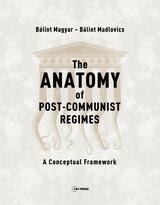
cover of The Anatomy of Post-Communist Regimes: A Conceptual Framework

The Anatomy of Post-Communist Regimes

A Conceptual Framework

Bálint Magyar

Central European University Press, 2021

Offering a single, coherent framework of the political, economic, and social phenomena that characterize post-communist regimes, this is the most comprehensive work on the subject to date. Focusing on Central Europe, the post-Soviet countries and China, the study provides a systematic mapping of possible post-communist trajectories.

At exploring the structural foundations of post-communist regime development, the work discusses the types of state, with an emphasis on informality and patronalism; the variety of actors in the political, economic, and communal spheres; the ways autocrats neutralize media, elections, etc. The analysis embraces the color revolutions of civil resistance (as in Georgia and in Ukraine) and the defensive mechanisms of democracy and autocracy; the evolution of corruption and the workings of “relational economy”; an analysis of China as “market-exploiting dictatorship”; the sociology of “clientage society”; and the instrumental use of ideology, with an emphasis on populism. Beyond a cataloguing of phenomena—actors, institutions, and dynamics of post-communist democracies, autocracies, and dictatorships—Magyar and Madlovics also conceptualize everything as building blocks to a larger, coherent structure: a new language for post-communist regimes.

While being the most definitive book on the topic, the book is nevertheless written in an accessible style suitable for both beginners who wish to understand the logic of post-communism and scholars who are interested in original contributions to comparative regime theory. The book is equipped with QR codes that link to www.postcommunistregimes.com, which contains interactive, 3D supplementary material for teaching.
[more]
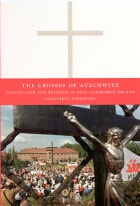
cover of The Crosses of Auschwitz: Nationalism and Religion in Post-Communist Poland

The Crosses of Auschwitz

Nationalism and Religion in Post-Communist Poland

Geneviève Zubrzycki

University of Chicago Press, 2006

In the summer and fall of 1998, ultranationalist Polish Catholics erected hundreds of crosses outside Auschwitz, setting off a fierce debate that pitted Catholics and Jews against one another. While this controversy had ramifications that extended well beyond Poland’s borders, Geneviève Zubrzycki sees it as a particularly crucial moment in the development of post-Communist Poland’s statehood and its changing relationship to Catholicism.

In The Crosses of Auschwitz, Zubrzycki skillfully demonstrates how this episode crystallized latent social conflicts regarding the significance of Catholicism in defining “Polishness” and the role of anti-Semitism in the construction of a new Polish identity. Since the fall of Communism, the binding that has held Polish identity and Catholicism together has begun to erode, creating unease among ultranationalists. Within their construction of Polish identity also exists pride in the Polish people’s long history of suffering. For the ultranationalists, then, the crosses at Auschwitz were not only symbols of their ethno-Catholic vision, but also an attempt to lay claim to what they perceived was a Jewish monopoly over martyrdom.

This gripping account of the emotional and aesthetic aspects of the scene of the crosses at Auschwitz offers profound insights into what Polishness is today and what it may become.
[more]
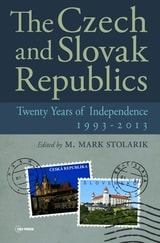
cover of The Czech and Slovak Republics: Twenty years of Independence, 1993–2013

The Czech and Slovak Republics

Twenty years of Independence, 1993–2013

M. Mark Stolarik

Central European University Press, 2017
The essays in the book compare the Czech Republic and Slovakia since the breakup of Czechoslovakia in 1993. The papers deal with the causes of the divorce and discuss the political, economic and social developments in the new countries. This is the only English-language volume that presents the synoptic findings of leading Czech, Slovak, and North American scholars in the field.The authors include two former Prime Ministers of the Czech Republic and Slovakia, eight leading scholars (four Czechs and four Slovaks), and eight knowledgeable commentators from North America. The most significant new insight is that in spite of predictions by various pundits in the Western World that Czechia would flourish after the breakup and Slovakia would languish, the opposite has happened. While the Czech Republic did well in its early years, it is now languishing while Slovakia, which had a rough start, is now doing very well. Anyone interested in the history of the Czech and Slovak Republics over the last twenty years will find gratification in reading this book.
[more]
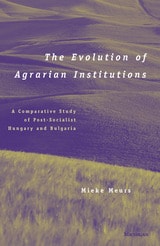
cover of The Evolution of Agrarian Institutions: A Comparative Study of Post-Socialist Hungary and Bulgaria

The Evolution of Agrarian Institutions

A Comparative Study of Post-Socialist Hungary and Bulgaria

Mieke Meurs

University of Michigan Press, 2001

The Evolution of Agrarian Institutions studies the unexpectedly slow and uneven growth of private agriculture in postsocialist East-Central Europe. Comparing developments in Hungary and Bulgaria, Mieke Meurs offers an explanation for this slow growth and examines its implications for efficiency and income distribution in postsocialist agriculture. With the collapse of the state socialist regimes in East-Central Europe, it was widely expected that collectivized agriculture would quickly be remade in the glowing image of China--a patchwork of small, privately run farms yielding rapid increases in output and incomes. However, the European experience has been quite different; while socialist collective farms have disappeared, collective forms of organization have persisted, and private farming has been slow to emerge. Meurs argues that an understanding of the causes of the slow emergence of private farming is essential to effective policy intervention in agriculture. This book contributes to such an understanding through analyzing variations in farm organization and rural market development and comparing agricultural restructuring in Hungary and Bulgaria. The Evolution of Agrarian Institutions is unique in its combination of original survey data, published data on land use, and published historical data. It also tests two institutionalist explanations for the pace and direction of change in agricultural organization. This book will be of interest to economists, political scientists, sociologists, scholars working in the area of rural development in emerging countries, and anyone with an interest in transitional economics. Mieke Meurs is Associate Professor of Economics, American University.
[more]
cover of The Left Side of History: World War II and the Unfulfilled Promise of Communism in Eastern Europe

The Left Side of History

World War II and the Unfulfilled Promise of Communism in Eastern Europe

Kristen Ghodsee

Duke University Press, 2015
In The Left Side of History Kristen Ghodsee tells the stories of partisans fighting behind the lines in Nazi-allied Bulgaria during World War II: British officer Frank Thompson, brother of the great historian E.P. Thompson, and fourteen-year-old Elena Lagadinova, the youngest female member of the armed anti-fascist resistance. But these people were not merely anti-fascist; they were pro-communist, idealists moved by their socialist principles to fight and sometimes die for a cause they believed to be right. Victory brought forty years of communist dictatorship followed by unbridled capitalism after the fall of the Berlin Wall in 1989. Today in democratic Eastern Europe there is ever-increasing despair, disenchantment with the post-communist present, and growing nostalgia for the communist past. These phenomena are difficult to understand in the West, where “communism” is a dirty word that is quickly equated with Stalin and Soviet labor camps. By starting with the stories of people like Thompson and Lagadinova, Ghodsee provides a more nuanced understanding of how communist ideals could inspire ordinary people to make extraordinary sacrifices.
[more]
cover of The Long 1989: Decades of Global Revolution

The Long 1989

Decades of Global Revolution

Kyrill Kunakhovich

Central European University Press, 2019

The fall of communism in Europe is now the frame of reference for any mass mobilization, from the Arab Spring to the Occupy movement to Brexit. Even thirty years on, 1989 still figures as a guide and motivation for political change. It is now a platitude to call 1989 a "world event," but the chapters in this volume show how it actually became one. 
The authors of these nine essays consider how revolutionary events in Europe resonated years later and thousands of miles away: in China and South Africa, Chile and Afghanistan, Turkey and the USA. They trace the circulation of people, practices, and concepts that linked these countries, turning local developments into a global phenomenon. At the same time, they examine the many shifts that revolution underwent in transit. All nine chapters detail the process of mutation, adaptation, and appropriation through which foreign affairs found new meanings on the ground. They interrogate the uses and understandings of 1989 in particular national contexts, often many years after the fact. Taken together, this volume asks how the fall of communism in Europe became the basis for revolutionary action around the world, proposing a paradigm shift in global thinking about revolution and protest.
[more]
cover of The Moon in Foil

The Moon in Foil

Zuska Kepplová

Seagull Books, 2023

A glimpse into the world of young people, modern nomads, roving in search of a new and promising life.

The Moon in Foil traces the stories of Petra, Natália, Anka, Mika, Juliana, and Jackie as they go out into the world in search of a better life—or maybe just a different one. In post-communist Europe, they have the freedom to study and work in places their parents couldn’t even have visited—Paris, London, Helsinki, and Budapest. But the reality of that “freedom,” they soon discover, is often nothing more than tedious work and poor living conditions. From close looks at the work of a housekeeper at a French hotel, a bartender at an Irish pub, a snowboarding instructor in Slovakia in the winter and an office worker in London in the summer, and a programmer in Helsinki, to explorations of larger topics such as marriage, divorce, and relationships, Zuska Kepplová’s novel is a millennials’ odyssey—a search for the self by the post–Cold War generation.
[more]
cover of The Origins Of Postcommunist Elites: From Prague Spring To The Breakup Of Czechoslovakia

The Origins Of Postcommunist Elites

From Prague Spring To The Breakup Of Czechoslovakia

Gil Eyal

University of Minnesota Press, 2003

How is it that Czechoslovakia’s separation into two countries in 1993 was accomplished so peacefully—especially when compared with the experiences of its neighbors Russia and Yugoslavia? This book provides a sociological answer to this question—and an empirical explanation for the breakup of Czechoslovakia—by tracing the political processes begun in the Prague Spring of 1968.

Gil Eyal’s main argument is that Czechoslovakia’s breakup was caused by a struggle between two fractions of what sociologists call the “new class,” which consisted primarily of intellectuals and technocrats. Focusing on the process of polarization that created these two distinct political elites, Eyal shows how, in response to the events of the ill-fated Prague Spring, Czech and Slovak members of the “new class” embarked on divergent paths and developed radically different, even opposed, identities, worldviews, and interests. Unlike most accounts of postcommunist nationalist conflict, this book suggests that what bound together each of these fractions—and what differentiated each from the other—were not national identities and nationalist sentiments per se, but their distinctive visions of the social role of intellectuals.
[more]
cover of The Political Economy of Dual Transformations: Market Reform and Democratization in Hungary

The Political Economy of Dual Transformations

Market Reform and Democratization in Hungary

David L. Bartlett

University of Michigan Press, 1997
In the early 1990s, scholars voiced skepticism about the capacity of Eastern Europe's new democracies to manage simultaneous political and economic reform. They argued that the surge of popular participation following democratization would thwart efforts by successor governments to enact market reforms that imposed high costs on major elements of post-Communist society. David Bartlett challenges the conventional wisdom regarding the hazards of "dual transformations": far from hindering marketization, democratization facilitated it. Bartlett argues that the transition to democracy in East Central Europe lowered the political barriers to market reforms by weakening the ability of actors most vulnerable to marketization to manipulate the existing institutional structure to stop or slow down the process.
Although the analysis focuses on Hungary, whose long history of market reforms makes it an ideal vehicle for assessing the impact of institutional change on reform policy, the author shows how his findings call into question the use of "shock therapy" and arguments, based on the experience in East Asia, that economic development and democratization are incompatible.
This book will appeal to economists, political scientists, and others interested in transition problems in formerly communist countries, democratic transitions, and the politics of stabilization and adjustment.
David L. Bartlett is Assistant Professor of Political Science, Vanderbilt University.
[more]
cover of The Political Economy of Protest and Patience: East European and Latin American Trasformations Compared

The Political Economy of Protest and Patience

East European and Latin American Trasformations Compared

Béla Greskovits

Central European University Press, 1998

Despite gloomy prophecies, democracy and the market economy seem to be taking root throughout Central and Eastern Europe, although set against a background of a recession deeper and longer than that of the Great Depression. How is this possible? Why did Eastern Europeans protest less about the brutal social consequences of systemic change than the people of Latin America a decade earlier? Why has the region-wide authoritarian or populist turnabout not occurred? Why has democracy in these countries proved to be crisis-proof? In what ways has economic crisis impacted on the politics of the region?

In addressing these questions, Béla Greskovits uses a comparative analysis of the structures, institutions, cultures, and actors shaping both the Eastern European and the Latin American transformations. He argues that structural, institutional, and cultural factors have put a brake on destabilizing collective actions and have paved the way for the emergence of the enduring, low-level equilibrium between incomplete democracy and imperfect market economy which seems set to characterize the Central and Eastern European experience for the foreseeable future.

[more]
cover of The Red Riviera: Gender, Tourism, and Postsocialism on the Black Sea

The Red Riviera

Gender, Tourism, and Postsocialism on the Black Sea

Kristen Ghodsee

Duke University Press, 2005

This compelling ethnography of women working in Bulgaria’s popular sea and ski resorts challenges the idea that women have consistently fared worse than men in Eastern Europe’s transition from socialism to a market economy. For decades western European tourists have flocked to Bulgaria’s beautiful beaches and mountains; tourism is today one of the few successful—and expanding—sectors of the country’s economy. Even at the highest levels of management, employment in the tourism industry has long been dominated by women. Kristen Ghodsee explains why this is and how women working in the industry have successfully negotiated their way through Bulgaria’s capitalist transformation while the fortunes of most of the population have plummeted. She highlights how, prior to 1989, the communist planners sought to create full employment for all at the same time that they steered women into the service sector. The women given jobs in tourism obtained higher educations, foreign language skills, and experiences working with Westerners, all of which positioned them to take advantage of the institutional changes eventually brought about by privatization.

Interspersed throughout The Red Riviera are vivid examinations of the lives of Bulgarian women, including a waitress, a tour operator, a chef, a maid, a receptionist, and a travel agent. Through these women’s stories, Ghodsee describes their employment prior to 1989 and after. She considers the postsocialist forces that have shaped the tourist industry over the past fifteen years: the emergence of a new democratic state, the small but increasing interest of foreign investors and transnational corporations, and the proliferation of ngos. Ghodsee suggests that many of the ngos, by insisting that Bulgarian women are necessarily disenfranchised, ignore their significant professional successes.

[more]
cover of The Reincarnation of Russia: Struggling with the Legacy of Communism, 1990–1994

The Reincarnation of Russia

Struggling with the Legacy of Communism, 1990–1994

John Löwenhardt

Duke University Press, 1995

In The Reincarnation of Russia, John Löwenhardt presents the first in-depth analysis of the initial and crucial stages of Russia’s new statehood. He examines Russia’s recent turbulent history—beginning with the explosive Declaration of State Sovereignty in June 1990, through the adoption of the Yeltsin constitution in the elections of December 1993 and concluding with the early months of 1994. His analysis of Russia’s struggle with the vestige of Soviet Communism and the attempt to create a more democratic form of government offers crucial insight into one of the critical turning points in contemporary history.
Building on analysis of the failure of the Soviet system, Löwenhardt compares the emergence of Russia as a newborn state with other countries that have undergone transitions from authoritarianism toward democracy. Although it is often claimed that Russia is a unique case, the author argues that the lessons of other nations are relevant to the Russian situation. In conjunction with this comparative analysis and with consideration of the significance of the communist and Russian past, Löwenhardt discusses political and economic developments—including both foreign and domestic policy concerns—in Russia over the last four years. He provides a better understanding of the Russian condition and a guarded optimism regarding the ongoing process taking place in Russia today.
The Reincarnation of Russia will be welcomed by scholars with specialized interests in the democratization of Russia, political leaders, journalists, and general readers concerned with the global impact of Russia’s changing status.
[more]
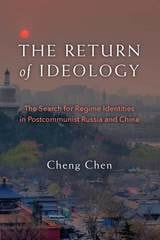
cover of The Return of Ideology: The Search for Regime Identities in Postcommunist Russia and China

The Return of Ideology

The Search for Regime Identities in Postcommunist Russia and China

Cheng Chen

University of Michigan Press, 2016

As a nation makes the transition from communism to democracy or another form of authoritarianism, its regime must construct not only new political institutions, but also a new political ideology that can guide policy and provide a sense of mission. The new ideology is crucial for legitimacy at home and abroad, as well as the regime’s long-term viability. In The Return of Ideology, Cheng Chen compares post-communist regimes, with a focus on Russia under Putin and post-Deng China, investigating the factors that affect the success of an ideology-building project and identifies the implications for international affairs.

Successful ideology-building requires two necessary—but not sufficient—conditions. The regime must establish a coherent ideological repertoire that takes into account the nation’s ideological heritage and fresh surges of nationalism. Also, the regime must attract and maintain a strong commitment to the emerging ideology among the political elite.

Drawing on rich primary sources, including interviews, surveys, political speeches, writings of political leaders, and a variety of publications, Chen identifies the major obstacles to ideology-building in modern Russia and China and assesses their respective long-term prospects. Whereas creating a new regime ideology has been a protracted and difficult process in China, it has been even more so in Russia. The ability to forge an ideology is not merely a domestic concern for these two nations, but a matter of international import as these two great powers move to assert and extend their influence in the world.
[more]
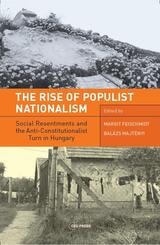
cover of The Rise of Populist Nationalism: Social Resentments and Capturing the Constitution in Hungary

The Rise of Populist Nationalism

Social Resentments and Capturing the Constitution in Hungary

Balázs Majtényi

Central European University Press, 2020
The authors of this book approach the emergence and endurance of the populist nationalism in post-socialist Eastern Europe, with special emphasis on Hungary. They attempt to understand the reasons behind public discourses that increasingly reframe politics in terms of nationhood and nationalism. Overall, the volume attempts to explain how the new nationalism is rooted in recent political, economic and social processes. The contributors focus on two motifs in public discourse: shift and legacy. Some focus on shifts in public law and shifts in political ethno-nationalism through the lens of constitutional law, while others explain the social and political roots of these shifts. Others discuss the effects of legacy in memory and culture and suggest that both shift and legacy combine to produce the new era of identity politics. Legal experts emphasize that the new Fundamental Law of Hungary is radically different from all previous Hungarian constitutions, and clearly reflects a redefinition of the Hungarian state itself. The authors further examine the role of developments in the fields of sociology and political science that contribute to the kind of politics in which identity is at the fore.
[more]
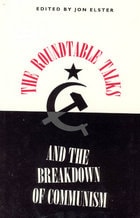
cover of The Roundtable Talks and the Breakdown of Communism

The Roundtable Talks and the Breakdown of Communism

Edited by Jon Elster

University of Chicago Press, 1996

In 1989 and 1990, Eastern European Communist regimes and opposition groups conducted a series of roundtable talks to peacefully negotiate the abolition of authoritarian rule and the transition to democratic governance. This volume documents that unprecedented process of national reinvention and constitution making.

These essays capture the historical circumstances of these countries—their traditions, customs, and the balance of influence between competing factions—that often took precedence over constitutional ideals. In five country-specific reports, senior scholars provide detailed accounts of the talks in Bulgaria, Poland, Hungary, Czechoslovakia, and the German Democratic Republic. Also included is an essay on the political factors underlying the failure of negotiations between reform groups and the Chinese regime, providing an illuminating counterpoint to the path taken in Eastern Europe.

This book is an invaluable resource for scholars of constitutional design and democratization and for specialists in Eastern Europe.
[more]
cover of The Roundtable Talks of 1989: The Genesis of Hungarian Democracy

The Roundtable Talks of 1989

The Genesis of Hungarian Democracy

András Bozóki

Central European University Press, 2002

This is the first book in English which provides comprehensive analysis and documentary history on the Roundtable talks, the major event of the “negotiated revolution” of Hungary. These negotiations occurred during the summer months of 1989 between the representatives of the Communist Party, the Opposition Roundtable, and the so-called Third Side (which brought some pro-Communist satellite organizations together).

The authors offer much more than just a detailed account on the negotiations: they also put the process of constitutional revolution into a comparative and historical perspective. They believe that the Roundtable Talks amounted to much more than just a sideshow and in fact they constituted the hub of the revolutionary transformation.
[more]
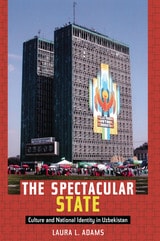
cover of The Spectacular State: Culture and National Identity in Uzbekistan

The Spectacular State

Culture and National Identity in Uzbekistan

Laura L. Adams

Duke University Press, 2010

Laura L. Adams offers unique insight into nation building in Central Asia during the post-Soviet era through an exploration of Uzbekistan’s production of national culture in the 1990s. As she explains, after independence the Uzbek government maintained a monopoly over ideology, exploiting the remaining Soviet institutional and cultural legacies. The state expressed national identity through tightly controlled mass spectacles, including theatrical and musical performances. Adams focuses on these events, particularly the massive outdoor concerts the government staged on the two biggest national holidays, Navro’z, the spring equinox celebration, and Independence Day. Her analysis of the content, form, and production of these ceremonies shows how Uzbekistan’s cultural and political elites engaged in a highly directed, largely successful program of nation building through culture.

Adams draws on her observations and interviews conducted with artists, intellectuals, and bureaucrats involved in the production of Uzbekistan’s national culture. These elites used globalized cultural forms such as Olympics-style spectacle to showcase local, national, and international aspects of official culture. While these state-sponsored extravaganzas were intended to be displays of Uzbekistan’s ethnic and civic national identity, Adams found that cultural renewal in the decade after Uzbekistan’s independence was not so much a rejection of Soviet power as it was a re-appropriation of Soviet methods of control and ideas about culture. The public sphere became more restricted than it had been in Soviet times, even as Soviet-era ideas about ethnic and national identity paved the way for Uzbekistan to join a more open global community.
[more]
cover of Thinking through Transition: Liberal Democracy, Authoritarian Pasts, and Intellectual History in East Central Europe After 1989

Thinking through Transition

Liberal Democracy, Authoritarian Pasts, and Intellectual History in East Central Europe After 1989

Michal Kopecek

Central European University Press, 2015
Thinking through Transition is the first concentrated effort to explore the most recent chapter of East Central European past from the perspective of intellectual history. Post-communism can be understood as a period of scarcity and preponderance of ideas, the dramatic eclipsing of the dissident legacy (as well as the older political traditions), and the rise of technocratic and post-political governance.  This book, grounded in empirical research sensitive to local contexts, proposes instead a history of adaptations, entanglements, and unintended consequences. In order to enable and invite comparison, the volume is structured around major domains of political thought, some of them generic (liberalism, conservatism, the Left), others (populism and politics of history) deemed typical for post-socialism. However, as shown by the authors, the generic often turns out to be heavily dependent on its immediate setting, and the typical resonates with processes that are anything but vernacular.
[more]
cover of Totalitarian Societies and Democratic Transition: Essays in Memory of Victor Zaslavsky

Totalitarian Societies and Democratic Transition

Essays in Memory of Victor Zaslavsky

Riccardo James Vargiu

Central European University Press, 2017
This book is a tribute to the memory of Victor Zaslavsky (1937–2009), sociologist, émigré from the Soviet Union, Canadian citizen, public intellectual, and keen observer of Eastern Europe. In seventeen essays leading European, American and Russian scholars discuss the theory and the history of totalitarian society with a comparative approach. They revisit and reassess what Zaslavsky considered the most important project in the latter part of his life: the analysis of Eastern European - especially Soviet societies and their difficult “transition” after the fall of communism in 1989–91. The variety of the contributions reflects the diversity of specialists in the volume, but also reveals Zaslavsky's gift: he surrounded himself with talented people from many different fields and disciplines. In line with Zaslavsky's work and scholarly method, the book promotes new theoretical and methodological approaches to the concept of totalitarianism for understanding Soviet and East European societies, and the study of fascist and communist regimes in general.
[more]
cover of Transnational Capitalism in East Central Europe's Heavy Industry: From Flagship Enterprises to Subsidiaries

Transnational Capitalism in East Central Europe's Heavy Industry

From Flagship Enterprises to Subsidiaries

Aleksandra Sznajder Lee

University of Michigan Press, 2016

Focusing on the steel industry during the post-communist transition from 1989 through 2009, Aleksandra Sznajder Lee traces the transformation of flagship state enterprises in the Czech Republic, Poland, Romania, and Slovakia into the subsidiaries of large, international corporations. By analyzing this transformation at the three levels of enterprise, sector, and national-international nexus, she identifies the players—from international investors and European Union members to national labor unions and local industry managers—in the political economy of reform. Even in the midst of the transition to a capitalist, democratic system, Sznajder Lee finds, the state plays a key role in mediating between domestic vested interests and external pressures from international financial markets and institutions, on the one hand, and regional institutions on the other. Whereas state power may be employed to require domestic firms to operate as capitalists in the international market, it may also be used to shield enterprises from market pressures in order to promote the political and personal preferences of the elite.

This book has broad implications for the political economy of reform because it illuminates the political determinants of privatization and the resources used to resist it. In addition, Sznajder Lee sheds new light on why some countries are more likely than others to be subject to external constraints, such as IMF conditionality, and how some allegedly pro-market reformers manage to maintain public ownership over certain industry sectors.

[more]
cover of Twenty-Five Sides of a Post-Communist Mafia State

Twenty-Five Sides of a Post-Communist Mafia State

Bálint Magyar

Central European University Press, 2017

The twenty-five essays accompany, illustrate and underpin the conceptual framework elaborated in Post-Communist Mafia State, published in conjunction with this volume. Leading specialists analyze the manifestations of the current political regime in Hungary from twenty-five angles. Topics discussed include the ideology, constitutional issues, social policy, the judiciary, foreign relations, nationalism, media, memory politics, corruption, civil society, education, culture and so on. Beyond the basic features of the economy the domains of taxation, banking system, energy policies and the agriculture are treated in dedicated studies. The essays are based on detailed empirical investigation about conditions in today's Hungary. They nevertheless contribute to the exploration of the characteristic features of post-communist authoritarian regimes, shared by an increasing number of countries in Europe and Central Asia.
[more]