Results by title
70 books match the query 'Postmodernism (Literature)' and 15 start with t
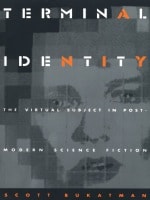
Terminal Identity
The Virtual Subject in Postmodern Science FictionScott Bukatman
Duke University Press, 1993
Drawing on a wide range of contemporary theories of the postmodern—including Fredric Jameson, Donna Haraway, and Jean Baudrillard—Bukatman begins with the proposition that Western culture is suffering a crisis brought on by advanced electronic technologies. Then in a series of chapters richly supported by analyses of literary texts, visual arts, film, video, television, comics, computer games, and graphics, Bukatman takes the reader on an odyssey that traces the postmodern subject from its current crisis, through its close encounters with technology, and finally to new self-recognition. This new "virtual subject," as Bukatman defines it, situates the human and the technological as coexistent, codependent, and mutally defining.
Synthesizing the most provocative theories of postmodern culture with a truly encyclopedic treatment of the relevant media, this volume sets a new standard in the study of science fiction—a category that itself may be redefined in light of this work. Bukatman not only offers the most detailed map to date of the intellectual terrain of postmodern technology studies—he arrives at new frontiers, providing a propitious launching point for further inquiries into the relationship of electronic technology and culture.

The Academic Postmodern and the Rule of Literature
A Report on Half-KnowledgeDavid Simpson
University of Chicago Press, 1995
Simpson examines defining features of postmodern thought—storytelling, autobiography, anecdote, and localism—and traces their unacknowledged roots in literature and literary criticism. Considering such examples as the conversational turn in philosophy led by Richard Rorty and the anecdotal qualities of the New Historicism, he argues that much of contemporary scholarship is literary in its terms, methods, and assumptions about knowledge; in their often unconscious adoption of literary approaches, scholars in philosophy, history, anthropology, and other disciplines have confined themselves to a traditional—and limited—way of looking at the world. Simpson is the first to uncover the largely unacknowledged ancestry of the key paradigms and sensibilities of the academic postmodern—tracing their roots to nineteenth-century Romanticism and to more general traditions of literature. He warns scholars against mistaking the migration of ideas from one discipline to another for a radically new response to the postmodern age.
In his nuanced and balanced assessment of the academic postmodern enterprise, Simpson recognizes that both the literary turn and the emphasis on local, subjective voices have done much to enrich knowledge. But he also identifies the danger in abandoning synthetic knowledge to particular truths, cautioning that "we would be foolish to pretend that little narratives are true alternatives to grand ones, rather than chips off a larger block whose shape we can no longer see because we are not looking."
The Big Question
David Lehman
University of Michigan Press, 1995
The Big Question leads off with a major essay explaining and exploring the concept of postmodernism. The next sections include pieces about poetry and fiction, lives and letters, and criticism and controversy.
Other "big questions" addressed include political correctness, the genre of literary biography, academic life and deconstruction. There is a humorous piece on poetry "slams" and the whole "downtown" poetry scene, a feisty op-ed column (on the deconstruction of the Gettysburg Address), a pair of wickedly satirical poems, as well as a group of exceptional book reviews.
The subjects covered range from Philip Larkin to Philip Roth- from the greatest poetry hoax of the twentieth century (which took place in Australia during World War II) to Charles Dickens's unfinished last novel- and from nineteenthth-century American poetry to the political career of Martin Heidegger.
David Lehman is a poet and author of Signs of the Times: Deconstruction and the Fall of Paul de Man. He is series editor of the celebrated Best American Poetry anthology.

The Chinese Postmodern
Trauma and Irony in Chinese Avant-Garde FictionXiaobin Yang
University of Michigan Press, 2002
The book seeks to redefine Chinese modernity and postmodernity through the analyses of both orthodox and avant-garde works. In doing so, the author draws on a number of theories, psychoanalysis and deconstruction in particular, revealing the hidden connection between the deconstructive mode of writing and the experience of history after trauma and showing how avant-garde literature brings about a varied literary paradigm that defies the dominant, subject-centered one in twentieth-century China.
The distinctiveness of The Chinese Postmodern is also found in its portrayal of the changes of literary paradigms in modern Chinese literature. By way of characterizing avant-garde fiction, it provides an overview of twentieth-century Chinese literature and offers a theorization of the intellectual history of modern China. Other issues concerning literary theory are explored, including the relationships between postmodernity and totalitarian discourse, between historical trauma and literary writing, and between psychic trauma and rhetorical irony. This book will appeal to readers in the fields of Chinese literature and culture, modern Chinese history, literary theory, and comparative literature.
Xiaobin Yang is Croft Assistant Professor, University of Mississippi.
The Cultural Logic of Late Capitalism
The Postmodernism EssayFredric Jameson. Introduction by Michael Hardt.
Duke University Press, 2026
The Dismemberment of Orpheus
Toward a Postmodern LiteratureIhab Hassan
University of Wisconsin Press, 1982
In this book, the first edition of which was published in 1971 by Oxford University Press, Ihab Hassan takes Orphic dismemberment and regeneration as his metaphor for a radical crisis in art and language, culture and consciousness, which prefigures postmodern literature. The modern Orpheus, he writes, “sings on a lyre without strings.” Thus, his sensitive critique traces a hypothetical line from Sade through four modern authors—Hemingway, Kafka, Genet, and Beckett—to a literature still to come. But the line also breaks into two Interludes, one concerning ’Pataphysics, Dada, and Surrealism, and the other concerning Existentialism and Aliterature.
Combining literary history, brief biography, and critical analysis, Hassan surrounds these authors with a complement of avant-garde writers whose works also foreshadow the postmodern temper. These include Jarry, Apollinaire, Tzara, Breton, Sartre, Camus, Nathalie Sarraute, Robbe-Grillet, and in America, Cage, Salinger, Ginsberg, Barth, and Burroughs. Hassan takes account also of related contemporary developments in art, music, and philosophy, and of many works of literary theory and criticism.
For this new edition, Hassan has added a new preface and postface on the developing character of postmodernism, a concept which has gained currency since the first edition of this work, and which he himself has done much to theorize.
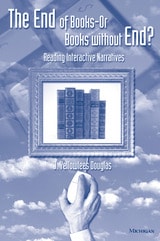
The End of Books--or Books Without End?
Reading Interactive NarrativesJ. Yellowlees Douglas
University of Michigan Press, 2001
The book examines criticism on interactive fiction from both proponents and skeptics and examines similarities and differences between print and hypertext fiction. It looks closely at critically acclaimed interactive works, including Stuart Moulthrop's Victory Garden and Michael Joyce's Afternoon: A Story that illuminate how these hypertext narratives "work." While she sees this as a still-evolving technology and medium, the author identifies possible developments for the future of storytelling from outstanding examples of Web-based fiction and CD-ROM narratives, possibilities that will enable narratives to both portray the world with greater realism an to transcend the boundaries of novels and films, character and plot alike.
Written to be accessible to a wide range of readers, this lively and accessibly-written volume will appeal to those interested in technology and cyberculture, as well as to readers familiar with literary criticism and modern fiction.
J. Yellowlees Douglas is the Director of the William and Grace Dial Center for Written and Oral Communication, University of Florida. She is the author of numerous articles and essays on the subject of hypertext and interactive literature.
The Illicit Joyce of Postmodernism
Reading Against the GrainKevin Dettmar
University of Wisconsin Press, 1996
For nearly three quarters of a century, the modernist way of reading has been the only way of reading James Joyce—useful, yes, and powerful but, like all frameworks, limited. This book takes a leap across those limits into postmodernism, where the pleasures and possibilities of an unsuspected Joyce are yet to be found.
Kevin J. H. Dettmar begins by articulating a stylistics of postmodernism drawn from the key texts of Roland Barthes, Mikhail Bakhtin, and Jean-François Lyotard. Read within this framework, Dubliners emerges from behind its modernist facade as the earliest product of Joyce’s proto-postmodernist sensibility. Dettmar exposes these stories as tales of mystery, not mastery, despite the modernist earmarks of plentiful symbols, allusions, and epiphanies. Ulysses, too, has been inadequately served by modernist critics. Where they have emphasized the work’s ingenious Homeric structure, Dettmar focuses instead upon its seams, those points at which the narrative willfully, joyfully overflows its self-imposed bounds. Finally, he reads A Portrait of the Artist and Finnegans Wake as less playful, less daring texts—the first constrained by the precious, would-be poet at its center, the last marking a surprising retreat from the constantly evolving, vertiginous experience of Ulysses.
In short, The Illicit Joyce of Postmodernism explores what happens when the extra-literary pronouncements of Eliot, Pound, and Joyce, as well as Joyce’s early critics, are set aside and a new, “unauthorized” Joyce is allowed to appear. This postmodern Joyce, more willful and less easily compartmentalized, stands as a counterpoint to the modernist Joyce who has perhaps become too familiar.
The Obligation Toward the Difficult Whole
Postmodernist Long PoemsBrian McHale
University of Alabama Press, 2003
Addressing subjects as wide-ranging as angelology, the court masque, pop art, caricature, the cult of the ruin, hip-hop, Spense’'s Irish policy, and the aesthetics of silence, Brian McHale pulls varied threads together to identify a repertoire of postmodernist elements characteristic of the long poems he examines.
As critic Jed Rasula explains, “McHale is wonderfully resourceful in changing the subject from chapter to chapter to fit the poems discussed, and while his approach adheres to the conventions of textual exegesis, the chapters really shine as orchestrations of issues. For instance, James Merrill’s The Changing Light at Sandover works unexpectedly well in raising the subject of found poetry and procedural composition; Melvin Tolso’'s Harlem Gallery and Edward Dorn's Gunslinger are effectively paired to demonstrate the period flavor of pastiche; Geoffrey Hill’s Mercian Hymns and Armand Schwerner’s The Tablets explode the modernist fixation with depth; John Ashbery’s work is given a nuanced reading as proto-theory; Letter to an Imaginary Friend by Thomas McGrath provides a lucid backdrop to raise the question of political efficacy in approaching language poet Bruce Andrews; and Susan Howe's The Europe of Trusts is explored for its intertextual tapestry.”
McHale shows how elements from these long poems overlap, interfere, pull in different directions, jar against, and even contradict each other; and he demonstrates how they also echo, amplify, and reinforce each other. They do not slot smoothly together like pieces in a jigsaw puzzle, but they do form (what else?) a difficult whole.
The Real, the True, and the Told
Postmodern Historical Narrative and the Ethics of RepresentationEric L. Berlatsky
The Ohio State University Press, 2011
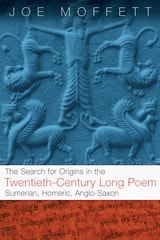
The Search for Origins in the Twentieth-Century Long Poem
Sumerian, Homeric, Anglo-SaxonJOE W. MOFFETT
West Virginia University Press, 2007
In this new, scholarly text—an ambitious study of contemporary poetics—Joe W. Moffett deciphers the twentieth-century long poem, searching for a better understanding of why long-poem writers are preoccupied with a search for origins.
Moffett focuses on issues like postcolonialism, nation, modernism, and postmodernism. He conceptualizes his theories by using what he calls “originiary moments”: historical periods or specific events from which a poet contends our culture descends. These moments enlighten and inspire the modern poet to use origin or “source” as a way to examine present culture and social conditions. The poems also encourage modern readers to question, revise, and repudiate. Moffett organizes his argument by arranging specific examples into three categories of originary moments: Sumerian, Homeric, and Anglo-Saxon.
According to Moffett, the long poem is appealing because it “lacks strict conventions that govern other genres.” Using a wide variety of poems to support his arguments, Moffett asks many stimulating questions and also provides provocative answers.
Questions of when and where It All Began have been off the critical agenda for some time now, embargoed by poststructuralism. Undeterred, Joe Moffett boldly revisits the search for cultural origins, which preoccupied major poets throughout the twentieth century. Capacious in his scope, eclectic in his choices, Moffett rounds up unusual subjects, including long poems by Armand Schwerner, Derek Walcott, Geoffrey Hill, and Judy Grahn, with excursions into Charles Olson, Seamus Heaney, and others. Nowhere will you find clearer, more intelligent, or better-informed readings of these poems than Moffett’s.
The Social Conscience of Latin American Writing
By Naomi Lindstrom
University of Texas Press, 1998
A CHOICE Outstanding Academic Book
Literature in Latin America has long been a vehicle for debates over the interpretation of social history, cultural identity, and artistic independence. Indeed, Latin American literature has gained international respect for its ability to present social criticism through works of imaginative creation.
In this comprehensive, up-to-the-minute survey of research and opinion by leading Latin American cultural and literary critics, Naomi Lindstrom examines five concepts that are currently the focus of intense debate among Latin American writers and thinkers. Writing in simple, clear terms for both general and specialist readers of Latin American literature, she explores the concepts of autonomy and dependency, postmodernism, literary intellectuals and the mass media, testimonial literature, and gender issues, including gay and lesbian themes. Excerpts (in English) from relevant literary works illustrate each concept, while Lindstrom also traces its passage from the social sciences to literature.
The Story of Fictional Truth
Realism from the Death to the Rise of the NovelPaul Dawson
The Ohio State University Press, 2023
The Tribe of Pyn
Literary Generations in the Postmodern PeriodDavid Cowart
University of Michigan Press, 2015
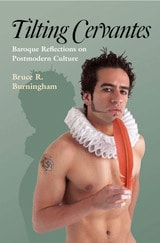
Tilting Cervantes
Baroque Reflections on Postmodern CultureBruce R. Burningham
Vanderbilt University Press, 2008