292 books match the query 'Power resources' and 16 start with t
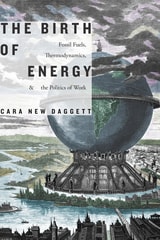
cover of The Birth of Energy: Fossil Fuels, Thermodynamics, and the Politics of Work

The Birth of Energy

Fossil Fuels, Thermodynamics, and the Politics of Work

Cara New Daggett

Duke University Press, 2019

In The Birth of Energy Cara New Daggett traces the genealogy of contemporary notions of energy back to the nineteenth-century science of thermodynamics to challenge the underlying logic that informs today's uses of energy. These early resource-based concepts of power first emerged during the Industrial Revolution and were tightly bound to Western capitalist domination and the politics of industrialized work. As Daggett shows, thermodynamics was deployed as an imperial science to govern fossil fuel use, labor, and colonial expansion, in part through a hierarchical ordering of humans and nonhumans. By systematically excavating the historical connection between energy and work, Daggett argues that only by transforming the politics of work—most notably, the veneration of waged work—will we be able to confront the Anthropocene's energy problem. Substituting one source of energy for another will not ensure a habitable planet; rather, the concepts of energy and work themselves must be decoupled.
[more]
cover of The Control Techniques Drives and Controls Handbook

The Control Techniques Drives and Controls Handbook

Bill Drury

The Institution of Engineering and Technology, 2009

Variable speed drives and the associated electrical motors play a central role in industry as well as the buildings in which we live, work and are entertained. They are arguably the most potent tool we have in the quest to save energy and thereby reduce our carbon footprint. Their rate of development has been rapid and today's product is in many ways unrecognisable from its ancestors of even twenty years ago. Development continues apace for the components used in the products, the products themselves and the ways in which the products are used.
[more]
cover of The Electric Car: Development and future of battery, hybrid and fuel-cell cars

The Electric Car

Development and future of battery, hybrid and fuel-cell cars

Mike H. Westbrook

The Institution of Engineering and Technology, 2001

This book covers the development of electric cars from their early days to pure electric, fuel-cell and new hybrid models in production. It covers the latest technological issues faced by automotive engineers working on electric cars, including charging, infrastructure, safety and costs, as well as making predictions about future developments and vehicle numbers. Considerable work has gone into electric car and battery development in the last ten years, with the prospect of substantial improvements in range and performance in battery cars as well as in hybrids and those using fuel cells. The book comprehensively covers this important subject and will be of particular interest to engineers working on electric vehicle design, development and use, as well as managers interested in the key business factors vital for the successful transfer of electric cars into the mass market.
[more]
cover of The Electric Grid of the Future

The Electric Grid of the Future

Paulo F. Ribeiro

The Institution of Engineering and Technology, 2027
The electric grid of the future is already taking shape, with many paradigm shifts driven by the integration of information and communication technology, the large deployment of renewable generation and large loads, and infrastructure changes. Power systems as we know them today are becoming increasingly multi-layered, shaped by physical constraints and advancements in grid technology. This means legacy systems need to adapt by implementing innovations such as decentralized control, adaptable infrastructure, and other smart grid solutions.
[more]
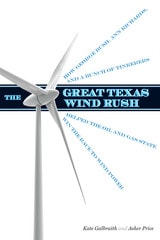
cover of The Great Texas Wind Rush: How George Bush, Ann Richards, and a Bunch of Tinkerers Helped the Oil and Gas State Win the Race to Wind Power

The Great Texas Wind Rush

How George Bush, Ann Richards, and a Bunch of Tinkerers Helped the Oil and Gas State Win the Race to Wind Power

By Kate Galbraith and Asher Price

University of Texas Press, 2013

In the late 1990s, West Texas was full of rundown towns and pumpjacks, aging reminders of the oil rush of an earlier era. Today, the towns are thriving as 300-foot-tall wind turbines tower above those pumpjacks. Wind energy has become Texas’s latest boom, with the Lone Star State now leading the nation. How did this dramatic transformation happen in a place that fights federal environmental policies at every turn? In The Great Texas Wind Rush, environmental reporters Kate Galbraith and Asher Price tell the compelling story of a group of unlikely dreamers and innovators, politicos and profiteers.

The tale spans a generation and more, and it begins with the early wind pioneers, precocious idealists who saw opportunity after the 1970s oil crisis. Operating in an economy accustomed to exploiting natural resources and always looking for the next big thing, their ideas eventually led to surprising partnerships between entrepreneurs and environmentalists, as everyone from Enron executives to T. Boone Pickens, as well as Ann Richards, George W. Bush and Rick Perry, ended up backing the new technology. In this down-to-earth account, the authors explain the policies and science that propelled the “windcatters” to reap the great harvest of Texas wind. They also explore what the future holds for this relentless resource that is changing the face of Texas energy.
[more]
cover of The Lightning Flash

The Lightning Flash

Vernon Cooray

The Institution of Engineering and Technology, 2003
This unique book provides the reader with a thorough background in almost every aspect of lightning and its impact on electrical and electronic equipment. The contents range from basic discharge processes in air through transient electromagnetic field generation and interaction with overhead lines and underground cables, to lightning protection and testing techniques. This book is of value to anyone designing, installing or commissioning equipment which needs to be secured against lightning strikes, as well as being a sound introduction to research students working in the field.
[more]
cover of The Lightning Flash

The Lightning Flash

Vernon Cooray

The Institution of Engineering and Technology, 2014
This updated and expanded new edition of Cooray's classic text provides the reader with a thorough background in almost every aspect of lightning and its impact on electrical and electronic equipment. The contents range from basic discharge processes in air through transient electromagnetic field generation and interaction with overhead lines and underground cables, to lightning protection and testing techniques. New to this edition are discussions of high-speed video recordings of lightning; rocket-and-wire triggered lightning experiments; tower initiated lightning discharges; upper atmospheric electrical discharges; attachment of lightning flashes to grounded structures; energetic radiation from thunderstorms and lightning; global lightning nitrogen oxides production; and lightning and global temperature change.
[more]
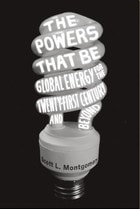
cover of The Powers That Be: Global Energy for the Twenty-first Century and Beyond

The Powers That Be

Global Energy for the Twenty-first Century and Beyond

Scott L. Montgomery

University of Chicago Press, 2010

Thirty years ago, our global energy landscape did not look remarkably different from what it does today. Three or four decades from now, it certainly will: dwindling oil reserves will clash with skyrocketing demand, as developing nations around the world lead their citizens into the modern energy economy, and all the while, the grave threat of catastrophic climate change looms ever larger. Energy worries are at an all-time high—just how will we power our future?

With The Powers That Be, Scott L. Montgomery cuts through the hype, alarmism, and confusion to give us a straightforward, informed account of where we are now, and a map of where we’re going. Starting with the inescapable fact of our current dependence on fossil fuels—which supply 80% of all our energy needs today—Montgomery clearly and carefully lays out the many alternative energy options available, ranging from the familiar, like water and solar, to such nascent but promising sources as hydrogen and geothermal power. What is crucial, Montgomery explains, is understanding that our future will depend not on some single, wondrous breakthrough; instead, we should focus on developing a more diverse, adaptable energy future, one that draws on a variety of sources—and is thus less vulnerable to disruption or failure.

An admirably evenhanded and always realistic guide, Montgomery enables readers to understand the implications of energy funding, research, and politics at a global scale. At the same time, he doesn’t neglect the ultimate connection between those decisions and the average citizen flipping a light switch or sliding behind the wheel of a car, making The Powers That Be indispensible for our ever-more energy conscious age.
[more]
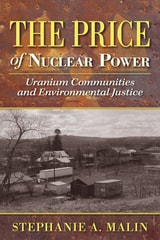
cover of The Price of Nuclear Power: Uranium Communities and Environmental Justice

The Price of Nuclear Power

Uranium Communities and Environmental Justice

Malin, Stephanie A.

Rutgers University Press, 2015

Rising fossil fuel prices and concerns about greenhouse gas emissions are fostering a nuclear power renaissance and a revitalized uranium mining industry across the American West. In The Price of Nuclear Power, environmental sociologist Stephanie Malin offers an on-the-ground portrait of several uranium communities caught between the harmful legacy of previous mining booms and the potential promise of new economic development. Using this context, she examines how shifting notions of environmental justice inspire divergent views about nuclear power’s sustainability and equally divisive forms of social activism. 
 
Drawing on extensive fieldwork conducted in rural isolated towns such as Monticello, Utah, and Nucla and Naturita, Colorado, as well as in upscale communities like Telluride, Colorado, and incorporating interviews with community leaders, environmental activists, radiation regulators, and mining executives, Malin uncovers a fundamental paradox of the nuclear renaissance: the communities most hurt by uranium’s legacy—such as high rates of cancers, respiratory ailments, and reproductive disorders—were actually quick to support industry renewal. She shows that many impoverished communities support mining not only because of the employment opportunities, but also out of a personal identification with uranium, a sense of patriotism, and new notions of environmentalism. But other communities, such as Telluride, have become sites of resistance, skeptical of industry and government promises of safe mining, fearing that regulatory enforcement won’t be strong enough. Indeed, Malin shows that the nuclear renaissance has exacerbated social divisions across the Colorado Plateau, threatening social cohesion. Malin further illustrates ways in which renewed uranium production is not a socially sustainable form of energy development for rural communities, as it is utterly dependent on unstable global markets. 
 
The Price of Nuclear Power is an insightful portrait of the local impact of the nuclear renaissance and the social and environmental tensions inherent in the rebirth of uranium mining.
 
 
[more]
cover of The Science of Energy: A Cultural History of Energy Physics in Victorian Britain

The Science of Energy

A Cultural History of Energy Physics in Victorian Britain

Crosbie Smith

University of Chicago Press, 1999

Although we take it for granted today, the concept of "energy" transformed nineteenth-century physics. In The Science of Energy, Crosbie Smith shows how a North British group of scientists and engineers, including James Joule, James Clerk Maxwell, William and James Thomson, Fleeming Jenkin, and P. G. Tait, developed energy physics to solve practical problems encountered by Scottish shipbuilders and marine engineers; to counter biblical revivalism and evolutionary materialism; and to rapidly enhance their own scientific credibility.

Replacing the language and concepts of classical mechanics with terms such as "actual" and "potential" energy, the North British group conducted their revolution in physics so astutely and vigorously that the concept of "energy"—a valuable commodity in the early days of industrialization—became their intellectual property. Smith skillfully places this revolution in its scientific and cultural context, exploring the actual creation of scientific knowledge during one of the most significant episodes in the history of physics.
[more]
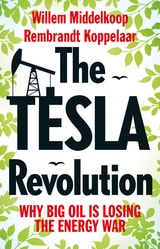
cover of The Tesla Revolution: Why Big Oil is Losing the Energy War

The Tesla Revolution

Why Big Oil is Losing the Energy War

Rembrandt Koppelaar

Amsterdam University Press, 2017

Though oil prices have been on a downward trajectory in recent months, that doesn't obscure the fact that fossil fuels are finite, and we will eventually have to grapple with the end of their dominance. At the same time, however, skepticism about the alternatives remains: we've never quite achieved the promised 'too cheap to meter' power of the future, be it nuclear, solar, or wind. And hydrogen and bio-based fuels are thus far a disappointment. So what does the future of energy look like? The Tesla Revolution has the answers.

In clear, unsensational style, Willem Middelkoop and Rembrandt Koppelaar offer a layman's tour of the energy landscape, now and to come. They show how rapid technological advances in batteries and solar technologies are already driving large-scale transformations in power supply, while economic and geopolitical changes, combined with a growing political awareness that there are alternatives to fossil fuels will combine in the coming years to bring an energy revolution ever closer. Within in our lifetimes, the authors argue, we will see changes that will reshape economics, the balance of political power, and even the most mundane aspects of our daily lives.

Determinedly forward-looking and optimistic, though never straying from hard facts, The Tesla Revolution paints a striking picture of our global energy future.
[more]
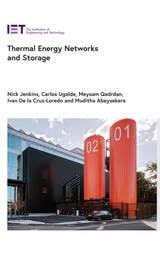
cover of Thermal Energy Networks and Storage

Thermal Energy Networks and Storage

Nick Jenkins

The Institution of Engineering and Technology, 2026
Scientists and policymakers worldwide recognise that continuing to use fossil fuels (coal, oil and gas) to produce useful energy with the inevitable emissions of CO2 and other greenhouse gasses is leading to changes in the world's climate with potentially catastrophic consequences. Both mitigation of the emissions of greenhouse gases as well as adaptation to the changing environment are urgently required to manage the worst effects of climate change.
[more]
cover of Thermal Power Plant Control and Instrumentation: The control of boilers and HRSGs

Thermal Power Plant Control and Instrumentation

The control of boilers and HRSGs

David Lindsley

The Institution of Engineering and Technology, 2018
Thermal Power Plant Control and Instrumentation describes the systems and equipment used for measuring and controlling boilers and heat-recovery steam-generators used in land and marine power plant and in process industries. It provides a practical guide to the design, installation, operation and maintenance of these systems. Starting with descriptions of how each area of the plant operates, it shows how the relevant control systems have evolved, how they are implemented in modern systems and how to evaluate the merits of alternative approaches.
[more]
cover of Thermal Power Plant Simulation and Control

Thermal Power Plant Simulation and Control

Damian Flynn

The Institution of Engineering and Technology, 2003

Significant changes over the past decade in computing technology, along with widespread deregulation of electricity industries, have impacted on power plant operations while affording engineers the opportunity to introduce monitoring and plant-wide control schemes that were previously unfeasible. Contributors of world-class excellence are brought together in Thermal Power Plant Simulation and Control to illustrate how current areas of research can be applied to power plant operation, leading to enhanced unit performance, asset management and plant competitiveness through intelligent monitoring and control strategies.
[more]
cover of Tidal Power

Tidal Power

A.C. Baker

The Institution of Engineering and Technology, 1991
The tides, generated by the revolution of the earth in the gravitational fields of the sun and moon, are an enormous resource of renewable energy. Moreover, the times and heights of tides can be accurately predicted well into the future. However, tidal ranges in the oceans vary from 50cm or less to over 10 m, and it is the largest tides that represent the best energy source. This book describes how large tides develop in particular places and how the energy could be extracted by building suitable barrages. The principal features of a barrage and possible methods of operation are described in detail. Although a tidal power barrage would be non-polluting, the resulting changes in the tidal regime would have important environmental effects. These are discussed together with the economics of tidal power. Methods of assessing the likely cost of electricity from any site are set out and applied to possible sites around the world.
[more]
cover of Transforming the Grid Towards Fully Renewable Energy

Transforming the Grid Towards Fully Renewable Energy

Oliver Probst

The Institution of Engineering and Technology, 2020

The need for a deep decarbonization of the energy sector and the associated opportunities are now increasingly recognized, with fossil fuel projects simultaneously becoming more risky business propositions. With large-scale wind and solar generation now being the cheapest options in many parts of the world, a deeply renewable electricity sector is predestined to become the main driver of this transition. Yet, misconceptions abound. In part, this can be traced back to the complexity of the electricity sector and the processes involved in its transformation, located at the intersection between grid design and operation, markets and regulations.
[more]