Results by title
52 books match the query 'Problems, exercises, etc' and 12 start with t

Teaching Information Literacy
50 Standards-Based Exercises for College StudentsJoanna M. Burkhardt
American Library Association, 2010
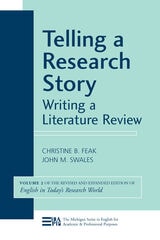
Telling a Research Story
Writing a Literature ReviewChristine B. Feak and John M. Swales
University of Michigan Press, 2009
Telling a Research Story: Writing a Literature Review is concerned with the writing of a literature review and is not designed to address any of the preliminary processes leading up to the actual writing of the literature review.
This volume represents a revision and expansion of the material on writing literature reviews that appeared in English in Today's Research World.
This volume progresses from general to specific issues in the writing of literature reviews. It opens with some orientations that raise awareness of the issues that surround the telling of a research story. Issues of structure and matters of language, style, and rhetoric are then discussed. Sections on metadiscourse, citation, and paraphrasing and summarizing are included.
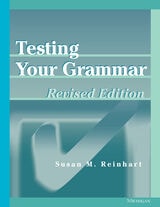
Testing Your Grammar, Revised Edition
Susan M. Reinhart
University of Michigan Press, 2002
With all units enlarged or significantly modified, the new and improved edition of Testing Your Grammar features reworked grammatical explanations and more example sentences so grammar points are easier to understand. Other features of the new edition:
- Explanations have been added to the answer key.
- A review test is found at the end of every two units.
- At the end of the book are four examinations that can be used for either pre-testing or post-testing.

The Article Book
Practice toward Mastering a, an, and theTom Cole
University of Michigan Press, 2000
A comprehensive guide and workbook for improving ESL/EFL students' understanding of English articles, The Article Book can be used as either a supplement to any ESL/EFL core text or as a self-study tool for intermediate through advanced learners. Cole involves students in "learning by doing" through an integrated approach to skill acquisition that includes other grammar structures, reading, vocabulary, and speaking. Each chapter of the book is organized into teachable units or lessons and includes presentation of a grammatical rule with examples, exercises, quizzes, and a comprehensive test. While the fifty rules (and fifteen exceptions) are taught to provide a logical framework for the text and serve as a handy reference, students will learn through guided practice instead of memorization.
The Challenge of Library Management
Leading with Emotional EngagementPixey Anne Mosley
American Library Association, 2011
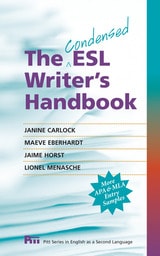
The Condensed ESL Writer's Handbook
Janine Carlock, Maeve Eberhardt, Jaime Horst, Lionel Menasche
University of Michigan Press, 2013
The CondensedESL Writer’s Handbook is a reference work for ESL students who are taking college-level courses. Because its purpose is to provide help with the broad variety of writing questions students may have when working on school assignments, the text focuses on English for Academic Purposes. Unlike other handbooks on the market, this book’s sole purpose is to address the issues of primary importance to language learners.
The Condensed Handbook complements a student writer’s dictionary, thesaurus, and grammar reference book. It would be suitable as a text for an advanced ESL writing course.
The Condensed Handbook is concise and easily navigated; is accessible, with clear and direct explanatory language; and limits its focus to the grammatical and style aspects of writing and reference material.
Included as special features in the Condensed Handbook are:
• The explanatory language is appropriate for ESL students, in contrast to the more complex and idiomatic language of other English handbooks.
• The level of detail is more manageable for ESL students, compared to what is in other English handbooks.
• Many of the examples of paragraphs and exercise sentences were written by ESL students; this encourages users of this Handbook to realize that they too can also become effective writers.
• Additional samples of MLA and APA reference entries.
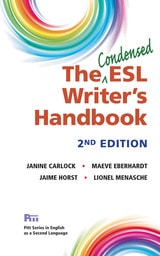
The Condensed ESL Writer's Handbook, 2nd Ed.
Janine Carlock, Maeve Eberhardt, Jaime Horst, and Lionel Menasche
University of Michigan Press, 2018
The Condensed version is concise and easily navigated; is accessible with clear and direct explanatory language; and limits its focus to the grammatical and style aspects of writing and reference material.
The 2nd Edition of The Condensed ESL Writer’s Handbook has been revised to better align with the exercises in Workbook for The ESL Writer’s Handbook, 2nd Ed.(978-0-472-03726-1). It also features an expanded Section 1 (to include more on pre-writing, drafting, revising, and editing), updated exercise items, and completely revised APA and MLA style guides (featuring MLA, 8th Edition). Overall, this handbook has these special features:
- The topic selection is based on ESL writers’ needs as observed by the authors over many years.
- The coverage of topics is more complete than the limited amount usually provided for ESL writers in first language or L1 handbooks.
- The explanatory language is appropriate for ESL students, in contrast to the more complex and idiomatic language of other English handbooks.
- Many of the text examples and exercise sentences were written by ESL students to help users realize that they too can become effective writers.
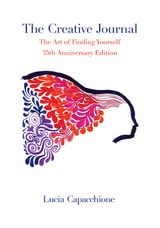
The Creative Journal
The Art of Finding Yourself: 35th Anniversary EditionLucia Capacchione
Ohio University Press, 2015
Originally released in 1980, Lucia Capacchione’s The Creative Journal has become a classic in the fields of art therapy, memoir and creative writing, art journaling, and creativity development. Using more than fifty prompts and vibrantly illustrated examples, Capacchione guides readers through drawing and writing exercises to release feelings, explore dreams, and solve problems creatively. Topics include emotional expression, healing the past, exploring relationships, self-inventory, health, life goals, and more. The Creative Journal introduced the world to Capacchione’s groundbreaking technique of writing with the nondominant hand for brain balancing, finding innate wisdom, and developing creative potential.
This thirty-fifth anniversary edition includes a new introduction and an appendix listing the many venues that have adopted Capacchione’s methods, including public schools, recovery programs, illness support groups, spiritual retreats, and prisons. The Creative Journal has become a mainstay text for college courses in psychology, art therapy, and creative writing. It has proven useful for journal keepers, counselors, and teachers. Through doodles, scribbles, written inner dialogues, and letters, people of all ages have discovered vast inner resources.
The ESL Writer's Handbook
Janine Carlock, Maeve Eberhardt, Jaime Horst, Lionel Menasche
University of Michigan Press, 2010
The ESL Writer’s Handbook is a reference work for ESL students who are taking college-level courses. Because its purpose is to provide help with the broad variety of writing questions students may have when working on school assignments, the text focuses on
English for Academic Purposes. Unlike other handbooks on the market, this book’s sole purpose is to address the issues of second language learners.
This spiral-bound Handbook complements a student writer’s dictionary, thesaurus, and grammar reference book. It would be suitable as a text for an advanced ESL writing course when used together with the companion Workbook (978-0-472-03404-8). The Handbook is concise and easily navigated; is accessible, with clear and direct explanatory language; features information on both APA and MLA styles (including a sample paper for each); and includes many examples from ESL student writers to provide realistic models.
Included as special features in the Handbook are:
• The topic selection is based on ESL writers’ needs as observed by the authors over many years.
• The coverage of topics is more complete than the limited amount usually provided for ESL writers in first language or L1 handbooks.
• The explanatory language is appropriate for ESL students, in contrast to the more complex and idiomatic language of other English handbooks.
• The level of detail is more manageable for ESL students, compared to what is in other English handbooks.
- Many of the examples of paragraphs, essays, research papers, and exercise sentences were written by ESL students; this encourages users of this Handbook to realize that they can also become effective writers.
The Medical Library Association Essential Guide to Becoming an Expert Searcher
Terry Ann Jankowski
American Library Association, 2008
The Writer's Diet
A Guide to Fit ProseHelen Sword
University of Chicago Press, 2016
Helen Sword dispenses with excessive explanations and overwrought analysis. Instead, she offers an easy-to-follow set of writing principles: use active verbs whenever possible; favor concrete language over vague abstractions; avoid long strings of prepositional phrases; employ adjectives and adverbs only when they contribute something new to the meaning of a sentence; and reduce your dependence on four pernicious “waste words”: it, this, that, and there.
Sword then shows the rules in action through examples from William Shakespeare, Emily Dickinson, Martin Luther King Jr., John McPhee, A. S. Byatt, Richard Dawkins, Alison Gopnik, and many more. A writing fitness test encourages you to assess your own writing and get immediate advice on addressing problem areas. While The Writer’s Diet is as sleek and concise as the writing ideals contained within, this slim volume packs a powerful punch.
With Sword’s coaching writers of all levels can strengthen and tone their sentences with the stroke of a pen or the click of a mouse. As with any fitness routine, adhering to the rules requires energy and vigilance. The results, however, will speak for themselves.
Try This
Research Methods for Writersedited by Jennifer Clary-Lemon, Derek Mueller, and Kate Pantelides
University Press of Colorado, 2022
This book is also available as an open access ebook through the WAC Clearinghouse.