Results by title
61 books match the query 'Propaganda' and 19 start with t
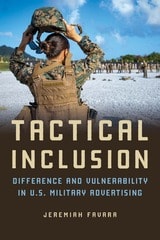
Tactical Inclusion
Difference and Vulnerability in U.S. Military AdvertisingJeremiah Favara
University of Illinois Press, 2024
Compelling and eye-opening, Tactical Inclusion combines original analysis with personal experience to chart advertising’s role in building the all-volunteer military.

Taking the Risk Out of Democracy
Corporate Propaganda versus Freedom and LibertyAlex Carey
University of Illinois Press, 1995

Tell Me Lies
Propaganda and Media Distortion in the Attack on IraqEdited by David Miller
Pluto Press, 2003
Did the US and UK governments lie about weapons of mass destruction to promote an attack on Iraq?
Did the media hold them to account or act as cheerleaders for war?
Tell me Lies reveals the systematic propaganda used by both the US and UK governments to convince us of the 'threat' from Iraq. It shows how we were deliberately misled into a war that has resulted in a humanitarian disaster in Iraq and threatens to create further instability and resentment of the US and UK throughout the Middle East.
Written by some of the world's leading journalists and commentators, it's a scathing indictment of the role of the mainstream media in legitimising government actions and undermining dissent. Critics, activists and journalists from both sides of the Atlantic explore alternatives such as the internet and Al Jazeera and provide analysis and guidance on resisting the media war.
Contributors include John Pilger, Noam Chomsky, Robert Fisk, Edward Herman, Mark Thomas, Mark Steel, Phillip Knightley, Tim Llewelyn (BBC Middle East Correspondent), Abdul Hadi Jiad (Iraqi journalist sacked by the BBC before the war), David Cromwell and David Edwards (Media Lens), Mark Curtis, John Stauber and Sheldon Rampton (PR Watch, and co-authors of Weapons of Mass Deception and Toxic Sludge is Good For You), Pat Holland, Norman Solomon (columnist and director of the Institute for Public Accuracy), Nancy Snow (California State University, Fullerton, author of Propaganda Inc. and Information War), Doug Kellner (UCLA), Julian Petley, Yvonne Ridley (Aljazeera.net and author of In the Hands of the Taliban), Tim Gopsill (Campaign for Press and Broadcasting Freedom), Faisal Bodi (UK Guardian, Aljazeera.net), Alistair Alexander (Stop the War Coalition), Greg Philo (Glasgow University Media Group), Steve Dorrill, Andy Rowell, Granville Williams and cartoonists Steve Bell, Steve Caplin and Polyp.
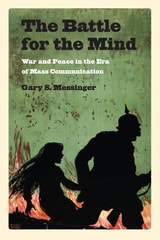
The Battle for the Mind
War and Peace in the Era of Mass CommunicationGary S. Messinger
University of Massachusetts Press, 2011
Most people typically think of armed conflict in physical terms, involving guns and bombs, ships and planes, tanks and missiles. But today, because of mass communication, war and the effort to prevent it are increasingly dependent on non-physical factors—the capacity to persuade combatants and citizens to engage in violence or avoid it, and the packaging of the information on which decision making is based. This book explores the many ways that mass communication has revolutionized international relations, whether the aim is to make war effectively or to prevent it.
Gary Messinger shows that over the last 150 years a succession of breakthroughs in the realm of media has reshaped the making of war and peace. Along with mass newspapers, magazines, books, motion pictures, radio, television, computer software, and telecommunication satellites comes an array of strategies for exploiting these media to control popular beliefs and emotions. Images of war now arrive in many forms and reach billions of people simultaneously. Political and military leaders must react to crowd impulses that sweep around the globe. Nation-states and nongovernmental groups, including terrorists, use mass communication to spread their portrayals of reality.
Drawing on a wide range of media products, from books and articles to films and television programs, as well as his own research in the field of propaganda studies, Messinger offers a fresh and comprehensive overview. He skillfully charts the path that has led us to our current situation and suggests where we might go next.
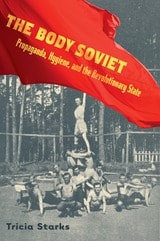
The Body Soviet
Propaganda, Hygiene, and the Revolutionary StateTricia Starks
University of Wisconsin Press, 2008
Health, though essential to the revolutionary vision and crucial to Soviet plans for utopia, has been neglected by traditional histories caught up in Cold War debates. The Body Soviet recovers this significant aspect of Soviet thought by providing a cross-disciplinary, comparative history of Soviet health programs that draws upon rich sources of health care propaganda, including posters, plays, museum displays, films, and mock trials. The analysis of propaganda makes The Body Soviet more than an institutional history; it is also an insightful critique of the ideologies of the body fabricated by health organizations.
"A masterpiece that will thoroughly fascinate and delight readers. Starks's understanding of propaganda and hygiene in the early Soviet state is second to none. She tells the stories of Soviet efforts in this field with tremendous insight and ingenuity, providing a rich picture of Soviet life as it was actually lived."— Elizabeth Wood, author of From Baba to Comrade: Gender and Politics in Revolutionary Russia
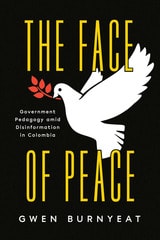
The Face of Peace
Government Pedagogy amid Disinformation in ColombiaGwen Burnyeat
University of Chicago Press, 2022
Colombia’s 2016 peace agreement with the FARC guerrillas sought to end fifty years of war and won President Juan Manuel Santos the Nobel Peace Prize. Yet Colombian society rejected it in a polarizing referendum, amid an emotive disinformation campaign. Gwen Burnyeat joined the Office of the High Commissioner for Peace, the government institution responsible for peace negotiations, to observe and participate in an innovative “peace pedagogy” strategy to explain the agreement to Colombian society. Burnyeat’s multi-scale ethnography reveals the challenges government officials experienced communicating with skeptical audiences and translating the peace process for public opinion. She argues that the fatal flaw in the peace process lay in government-society relations, enmeshed in culturally liberal logics and shaped by the politics of international donors. The Face of Peace offers the Colombian case as a mirror to the global crisis of liberalism, shattering the fantasy of rationality that haunts liberal responses to “post-truth” politics.
The First World War and Popular Cinema
1914 to the PresentParis, Michael
Rutgers University Press, 2000
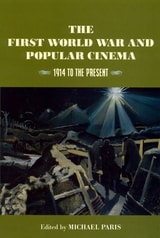
The Great War played an instrumental role in the development of cinema, so necessary was it to the mobilization efforts of the combatant nations. In turn, after the war, as memory began to fade, cinema continued to shape the war's legacy and eventually to determine the ways in which all warfare is imagined.
The First World War and Popular Cinema provides fresh insight into the role of film as an historical and cultural tool. Through a comparative approach, essays by contributors from Europe, Australia, Canada, and the United States enrich our understanding of cinematic depictions of the Great War in particular and combat in general. New historical research on both the uses of propaganda and the development of national cinemas make this collection one of the first to show the ways in which film history can contribute to our study of national histories. The contributors to the volume monitor popular perceptions of the war, the reshaping of the war's legacy, and the evolution of cinematic clichés that are perpetuated in filmmaking through the century. Some of the films they discuss are All Quiet on the Western Front, Gallipoli, The Grand Illusion, The Big Parade, Battle of the Somme, J'Accuse, Regeneration, and many more. The First World War and Popular Cinema is a vital addition to film studies and history, two fields only recently united in a productive way.
The Global Police State
William I Robinson
Pluto Press, 2020
"Karl Marx aspired to a world in which our animal needs would be satisfied and our human needs could be addressed. It is a realistic possibility now, as William Robinson outlines—or the alternative that is taking shape before our eyes: a 'global police state' controlled by narrowly concentrated capital with 'surplus humanity' left to survive somehow on its own. The choice is in our hands."
—Noam Chomsky, author of Who Rules the World?
As the world becomes ever more unequal, people become ever more “disposable.” Today, governments systematically exclude sections of their populations from society through heavy-handed policing. But it doesn't always go to plan.
William I. Robinson exposes the nature and dynamics of this out-of-control system, arguing for the urgency of creating a movement capable of overthrowing it. The global police state uses a variety of ingenious methods of control, including mass incarceration, police violence, US-led wars, the persecution of immigrants and refugees, and the repression of environmental activists.
He writes in his Introduction, “I offer a ‘big picture” of the emerging global police state in a short book that is eminently readable. The pages to follow may startle many readers and make them angry. I trust the work will serve as a warning of the dystopic future that is upon us. More importantly, by exposing the nature and dynamic of this out-of-control system, I hope it will contribute to the struggles to bring about an alternative future based on human freedom and liberation.”
Movements have emerged to combat the increasing militarization, surveillance and social cleansing; however, many of them appeal to a moral sense of social justice rather than addressing its root: global capitalism.
Using shocking data which reveals how far capitalism has become a system of repression, Robinson argues that the emerging megacities of the world are becoming the battlegrounds where the excluded and the oppressed face off against the global police state.
The Greater Good
Media, Family Removal, and TVA Dam Construction in North AlabamaLaura Beth Daws and Susan L. Brinson
University of Alabama Press, 2019
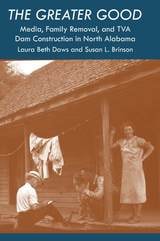
For poverty-stricken families in the Tennessee River Valley during the Great Depression, news of President Franklin D. Roosevelt’s New Deal plans to create the Tennessee Valley Authority—bringing the promise of jobs, soil conservation, and electricity—offered hope for a better life. The TVA dams would flood a considerable amount of land on the riverbanks, however, forcing many families to relocate. In exchange for this sacrifice for the “greater good,” these families were promised “fair market value” for their land. As the first geographic location to benefit from the electricity provided by TVA, the people of North Alabama had much to gain, but also much to lose.
In The Greater Good: Media, Family Removal, and TVA Dam Construction in North Alabama Laura Beth Daws and Susan L. Brinson describe the region’s preexisting conditions, analyze the effects of relocation, and argue that local newspapers had a significant impact in promoting the TVA’s agenda. The authors contend that it was principally through newspapers that local residents learned about the TVA and the process and reasons for relocation. Newspapers of the day encouraged regional cooperation by creating an overwhelmingly positive image of the TVA, emphasizing its economic benefits and disregarding many of the details of removal.
Using mostly primary research, the volume addresses two key questions: What happened to relocated families after they sacrificed their homes, lifestyles, and communities in the name of progress? And what role did mediated communication play in both the TVA’s family relocation process and the greater movement for the public to accept the TVA’s presence in their lives? The Greater Good offers a unique window into the larger impact of the New Deal in the South. Until now, most research on the TVA was focused on organizational development rather than on families, with little attention paid to the role of the media in garnering acceptance of a government-enforced relocation.
The Killing of Jane McCrea
An American Tragedy on the Revolutionary FrontierPaul Staiti
Westholme Publishing, 2027
FINALIST FOR THE 2026 GEORGE WASHINGTON PRIZE
Winner of the 2026 Book of the Year Award, George Washington American Revolution Round Table, Washington, DC
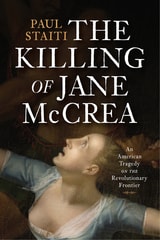
The killing of Jane McCrea on July 26, 1777, on the outskirts of a village in the northern Hudson Valley, would unexpectedly rupture the British advance from Canada that was meant to crush the American Revolution in one knockout blow. On that day, twenty-five-year-old McCrea, an unremarkable person preparing for an impending marriage, was assaulted, scalped, and killed by a group of Native Americans in the employ of British general John Burgoyne. Though the murder was but one of many civilian deaths in a fierce war zone, McCrea’s killing had far-reaching consequences for each of the three major parties involved in the Northern Campaign of 1777. In America, she became the great cause célèbre of the Revolution, the sympathetic female victim of the war symbolizing the righteousness of The Cause. In Britain, she was a human-rights tragedy that tarnished the polished surface of British honor and galvanized Whig politicians who shouted out her name in Parliament as an example of how low the nation had fallen. For Native peoples, recruited by both the British and the Americans, and caught in the middle of a war staged on ancestral grounds, McCrea’s killing was the opening salvo in a vicious chain of bloody retribution that led to the disintegration of the venerable Iroquois Confederacy and the obliteration of Native homelands. After the war, the nightmarish image of a young Jane McCrea slaughtered on the New York frontier would obsess white Americans who came to fear Native peoples as irredeemable savages. Her murder would help justify the expulsion of Indigenous tribes and open the doors for an expansionary United States that was fully intent on transforming the American continent into its own image.
The Killing of Jane McCrea: An American Tragedy on the Revolutionary Frontier by distinguished historian Paul Staiti undertakes for the first time a comprehensive investigation into McCrea’s life, death, and especially her long and strange afterlife. Using both visual arts and written records, the author reassembles the scattered fragments to illuminate a historical terrain long since shrouded in misinformation, mired in controversy, and relegated to mythology. Coming into view is a major portrait of the persons, cultures, actions, and motives that fatally converged on that hot July morning in 1777.
The Manufacture of Consent
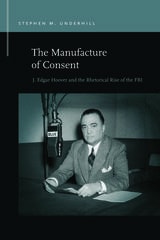
J. Edgar Hoover and the Rhetorical Rise of the FBIStephen M. Underhill
Michigan State University Press, 2020
The Media and the Rwanda Genocide
Edited by Allan Thompson
Pluto Press, 2007
This is the first book to explore both sides of the media equation. Examining how local radio was used as a tool of hate, encouraging neighbors to turn against each other, the book also presents a critique of international media coverage. Bringing together local reporters, high-profile Western journalists, and leading media theorists, this is the only book to identify the extent of the media's accountability. It also examines deliberations by the International Criminal Tribunal for Rwanda on the role of the media in the genocide. This book is a startling record of the negative influence that the media can have. The authors put forward suggestions for the future, outlining how we can avoid censorship and propaganda and they argue for a new responsibility in media reporting.
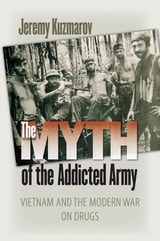
The Myth of the Addicted Army
Vietnam and the Modern War on DrugsJeremy Kuzmarov
University of Massachusetts Press, 2009
The image of the drug-addicted American soldier—disheveled, glassy-eyed, his uniform adorned with slogans of antiwar dissent—has long been associated with the Vietnam War. More specifically, it has persisted as an explanation for the U.S. defeat, the symbol of a demoralized army incapable of carrying out its military mission.
Yet as Jeremy Kuzmarov documents in this deeply researched book, popular assumptions about drug use in Vietnam are based more on myth than fact. Not only was alcohol the intoxicant of choice for most GIs, but the prevalence of other drugs varied enormously. Although marijuana use among troops increased over the course of the war, for the most part it remained confined to rear areas, and the use of highly addictive drugs like heroin was never as widespread as many imagined.
Like other cultural myths that emerged from the war, the concept of an addicted army was first advanced by war hawks seeking a scapegoat for the failure of U.S. policies in Vietnam, in this case one that could be linked to “permissive” liberal social policies and the excesses of the counterculture. But conservatives were not alone. Ironically, Kuzmarov shows, elements of the antiwar movement also promoted the myth, largely because of a presumed alliance between Asian drug traffickers and the Central Intelligence Agency. While this claim was not without foundation, as new archival evidence confirms, the left exaggerated the scope of addiction for its own political purposes.
Exploiting bipartisan concern over the perceived “drug crisis,” the Nixon administration in the early 1970s launched a bold new program of federal antidrug measures, especially in the international realm. Initially, the “War on Drugs” helped divert attention away from the failed quest for “peace with honor” in Southeast Asia. But once institutionalized, it continued to influence political discourse as well as U.S. drug policy in the decades that followed.
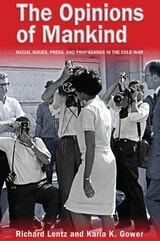
The Opinions of Mankind
Racial Issues, Press, and Propaganda in the Cold WarRichard Lentz and Karla K. Gower
University of Missouri Press, 2011
Throughout this period, the American press provided the foreign media with information about racially charged events in the United States. Such news coverage sometimes put Washington at a disadvantage, making it difficult for government officials to assuage foreign reactions to the injustices occurring on U.S. soil. Yet in other instances, the domestic press helped to promote favorable opinions abroad by articulating themes of racial progress. While still acknowledging racial abuses, these press spokesmen asserted that the situation in America was improving. Such paradoxical messages, both aiding and thwarting the efforts of the U.S. government, are the subject of The Opinions of Mankind: Racial Issues, Press, and Propaganda in the Cold War.
The study, by scholars Richard Lentz and Karla K. Gower, describes and analyzes the news discourse regarding U.S. racial issues from 1946 to 1965. The Opinions of Mankindnot only delves into the dissemination of race-related news to foreign outlets but also explores the impact foreign perceptions of domestic racism had on the U.S. government and its handling of foreign relations during the period. What emerges is an original, insightful contribution to Cold War studies. While other books examine race and foreign affairs during this period of American history, The Opinions of Mankind is the first to approach the subject from the standpoint of press coverage and its impact on world public opinion.
This exhaustively researched and compellingly written volume will appeal to media scholars, political historians, and general readers alike. By taking a unique approach to the study of this period, The Opinions of Mankind presents the workings behind the battles for public opinion that took place between 1946 and 1965.
The Propaganda Model Today
Filtering Perception and AwarenessJoan Pedro-Carañana, Daniel Broudy and Jeffery Klaehn
University of Westminster Press, 2018
While the individual elements of the propaganda system (or filters) identified by the Propaganda Model (PM) – ownership, advertising, sources, flak and anti-communism – have previously been the focus of much scholarly attention, their systematisation in a model, empirical corroboration and historicisation have made the PM a useful tool for media analysis across cultural and geographical boundaries.
Despite the wealth of scholarly research Herman and Chomsky’s work has set into motion over the past decades, the PM has been subjected to marginalisation, poorly informed critiques and misrepresentations. Interestingly, while the PM enables researchers to form discerning predictions as regards corporate media performance, Herman and Chomsky had further predicted that the PM itself would meet with such marginalisation and contempt.
In current theoretical and empirical studies of mass media performance, uses of the PM continue, nonetheless, to yield important insights into the workings of political and economic power in society, due in large measure to the model’s considerable explanatory power.
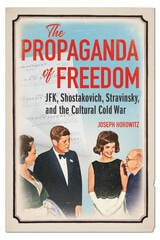
The Propaganda of Freedom
JFK, Shostakovich, Stravinsky, and the Cultural Cold WarJoseph Horowitz
University of Illinois Press, 2023
Eloquently extolled by President John F. Kennedy, the idea that only artists in free societies can produce great art became a bedrock assumption of the Cold War. That this conviction defied centuries of historical evidence--to say nothing of achievements within the Soviet Union--failed to impact impregnable cultural Cold War doctrine.
Joseph Horowitz writes: “That so many fine minds could have cheapened freedom by over-praising it, turning it into a reductionist propaganda mantra, is one measure of the intellectual cost of the Cold War.” He shows how the efforts of the CIA-funded Congress for Cultural Freedom were distorted by an anti-totalitarian “psychology of exile” traceable to its secretary general, the displaced Russian aristocrat/composer Nicolas Nabokov, and to Nabokov’s hero Igor Stravinsky.
In counterpoint, Horowitz investigates personal, social, and political factors that actually shape the creative act. He here focuses on Stravinsky, who in Los Angeles experienced a “freedom not to matter,” and Dmitri Shostakovich, who was both victim and beneficiary of Soviet cultural policies. He also takes a fresh look at cultural exchange and explores paradoxical similarities and differences framing the popularization of classical music in the Soviet Union and the United States. In closing, he assesses the Kennedy administration’s arts advocacy initiatives and their pertinence to today’s fraught American national identity.
Challenging long-entrenched myths, The Propaganda of Freedom newly explores the tangled relationship between the ideology of freedom and ideals of cultural achievement.
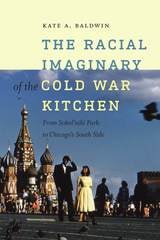
The Racial Imaginary of the Cold War Kitchen
From Sokol’niki Park to Chicago’s South SideKate A. Baldwin
Dartmouth College Press, 2016
Theater & Propaganda
By George H. Szanto
University of Texas Press, 1978
This original and insightful study explores the points at which theater and propaganda meet. Defining propaganda as a form of "activated ideology," George H. Szanto discusses the distortion of information that occurs in dramatic literature in its stage, film, and television forms.
Szanto analyzes the nature of "integration propaganda," which is designed to render the audience passive and to encourage the acceptance of the status quo, as opposed to "agitation propaganda," which aims to inspire the audience to action. In Szanto's view, most popular western theater is saturated, though usually not intentionally, with integration propaganda. The overall purpose of Theater and Propaganda is twofold: to analyze the nature of integration propaganda so that it becomes visible to western readers as a tool of the dominant class in society, and to examine the manner by which unself-conscious propagandistic methods have saturated dramatic presentation.
In discussing the importance of propaganda within and between technological states, the author examines the seminal work of Jacques Ellul. In this chapter he analyzes the function of integration propaganda in a relatively stable society. The following chapter defines and analyzes three theaters (in the sense of performance) of propaganda: the theater of agitation propaganda, of integration propaganda, and of dialectical propaganda. In this section he uses examples from a variety of plays, movies, and television commercials. In succeeding chapters Szanto discusses the role of integration propaganda in the medieval Wakefield mystery plays and the plays of Samuel Beckett. The appendix, "Contradiction and Demystification," provides a general model that suggests ways of breaking down and overcoming the propagandistic intentions of an artwork and discusses theater's possible role in this breakdown.
Thinker, Faker, Spinner, Spy
Corporate PR and the Assault on DemocracyEdited by David Miller and William Dinan
Pluto Press, 2007
Written by leading activists and writers, this book reveals the secrets of the PR trade including deception, the use of fake 'institutes', spying and dirty tricks. The impact can be devastating -- when the public is denied access to the truth, the results are rising inequality and environmental catastrophe.
Exposing the misdeeds of famous companies including Coca Cola, British Aerospace, Exxon and Monsanto, and revealing information about the covert funding of various apparently independent thinks tanks and institutes, the authors offer a guide to campaigns that can help us roll back corporate power and resist deceptive PR.