Results by title
62 books match the query 'Reality' and 18 start with t
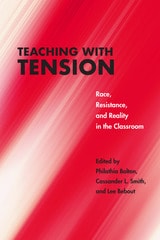
Teaching with Tension
Race, Resistance, and Reality in the ClassroomEdited by Philathia Bolton, Cassander L. Smith, and Lee Bebout
Northwestern University Press, 2019
Drawing together personal reflection, pedagogical strategies, and critical theory, Teaching with Tension offers concrete examinations that will foster student learning. The essays are organized into three thematic sections: "Teaching in Times and Places of Struggle" examines the dynamics of teaching race during the current moment, marked by neoconservative politics and twenty-first century freedom struggles. "Teaching in the Neoliberal University" focuses on how pressures and exigencies of neoliberalism (such as individualism, customer-service models of education, and online courses) impact the way in which race is taught and conceptualized in college classes. The final section, "Teaching How to Read Race and (Counter)Narratives," homes in on direct strategies used to historicize race in classrooms comprised of millennials who grapple with race neutral ideologies. Taken together, these sections and their constitutive essays offer rich and fruitful insight into the complex dynamics of contemporary race and ethnic studies education.

Tears of the Crocodile
From Rio to Reality in the Developing WorldNeil Middleton
Pluto Press, 1993
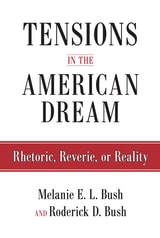
Tensions in the American Dream
Rhetoric, Reverie, or RealityRoderick Bush
Temple University Press, 2015
Tensions in the American Dream also addresses the relevancy of nation to empire in the context of the historical world capitalist system. The authors ask, is the American Dream a reality only questioned by those unwilling or unable to achieve it? What is the "good life" and how is it particularly "American"?
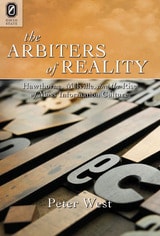
The Arbiters of Reality
Hawthorne, Melville, and the Rise of Mass Information CulturePeter West
The Ohio State University Press, 2008
Locating Hawthorne and Melville in vivid and overlooked contexts—the Salem Murder scandal of 1830, which transformed Hawthorne's quiet city into a media-manufactured spectacle, and Melville's New York City of 1846–47, where the American Telegraph was powerfully articulating a nation at war—West portrays the romance as a reactive, deeply rhetorical literary form and a rich historical artifact.
In the early twenty-first century, it has become a postmodern cliché to place the word “reality” in scare quotes. The Arbiters of Reality suggests that attending to the construction of the real in public life is more than simply a language of critique: it must also be understood as a specific kind of romantic self-invention.

The Future of Reality
Marine de Dardel
Diaphanes, 2026
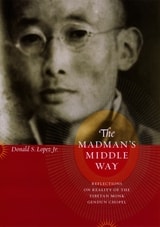
The Madman's Middle Way
Reflections on Reality of the Tibetan Monk Gendun ChopelDonald S. Lopez Jr.
University of Chicago Press, 2005
The Madman’s Middle Way presents the first English translation of this major Tibetan Buddhist work, accompanied by an essay on Gendun Chopel’s life liberally interspersed with passages from his writings. Donald S. Lopez Jr. also provides a commentary that sheds light on the doctrinal context of the Adornment and summarizes its key arguments. Ultimately, Lopez examines the long-standing debate over whether Gendun Chopel in fact is the author of the Adornment; the heated critical response to the work by Tibetan monks of the Dalai Lama’s sect; and what the Adornment tells us about Tibetan Buddhism’s encounter with modernity. The result is an insightful glimpse into a provocative and enigmatic workthatwill be of great interest to anyone seriously interested in Buddhism or Asian religions.

The Medieval Castle
Romance and RealityKathryn L. Reyerson and Faye Powe, Editors
University of Minnesota Press, 1991
The Medieval Castle was first published in 1991. Minnesota Archive Editions uses digital technology to make long-unavailable books once again accessible, and are published unaltered from the original University of Minnesota Press editions.
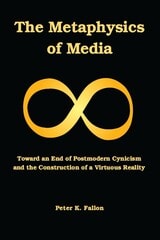
The Metaphysics of Media
Toward an End of Postmodern Cynicism and the Construction of a Virtuous RealityPeter K. Fallon
University of Scranton Press, 2009
In The Metaphysics of Media, award-winning media critic Peter K. Fallon tackles the complicated question of how a succession of dominant forms of media have supported—and even to some extent created—different conceptions of reality. To do so, he starts with the basics: a critical discussion of the very idea of objective reality and the various postmodern responses that have tended to dominate recent philosophical approaches to the subject. From there, he embarks on a survey of the evolution of communication through four major eras: orality; literacy; print; and electricity.
Within each era, Fallon argues, the dominant form of media supported particular ways of understanding the world, from the ascendance of reason that followed the development of alphabets to the obliteration of space and time that we associate with electronic communications. Fallon concludes with a hard look at the mass ignorance that prevails today despite (or perhaps because of) the sea of information with which contemporary life is surrounded.
A stirring, philosophically rich investigation, The Metaphysics of Media offers not only a clear picture of where our society has been but also a road map to a more engaged, informed, and fully human future.
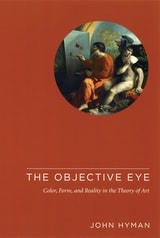
The Objective Eye
Color, Form, and Reality in the Theory of ArtJohn Hyman
University of Chicago Press, 2006
This, in a nutshell, is the central problem in the theory of art. It has fascinated philosophers from Plato to Wittgenstein. And it fascinates artists and art historians, who have always drawn extensively on philosophical ideas about language and representation, and on ideas about vision and the visible world that have deep philosophical roots.
John Hyman’s The Objective Eye is a radical treatment of this problem, deeply informed by the history of philosophy and science, but entirely fresh. The questions tackled here are fundamental ones: Is our experience of color an illusion? How does the metaphysical status of colors differ from that of shapes? What is the difference between a picture and a written text? Why are some pictures said to be more realistic than others? Is it because they are especially truthful or, on the contrary, because they deceive the eye?
The Objective Eye explores the fundamental concepts we use constantly in our most innocent thoughts and conversations about art, as well as in the most sophisticated art theory. The book progresses from pure philosophy to applied philosophy and ranges from the metaphysics of color to Renaissance perspective, from anatomy in ancient Greece to impressionism in nineteenth-century France. Philosophers, art historians, and students of the arts will find The Objective Eye challenging and absorbing.
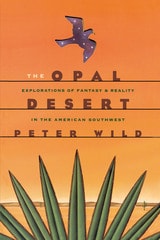
The Opal Desert
Explorations of Fantasy and Reality in the American SouthwestBy Peter Wild
University of Texas Press, 1999
The opalescent deserts of the American Southwest have become romantic icons in the public imagination through the words of writers, the images of artists and photographers, and the visual storytelling of filmmakers. In this spirited, personal, beautifully written book, Peter Wild explores the lives and works of sixteen writers whose words have shaped our visions of the opal desert.
Wild begins with Cabeza de Vaca, whose Relación of his desert wanderings sent treasure-hungry Spaniards searching for cities of gold. He goes on to discuss the works of both widely read and lesser-known nineteenth- and twentieth-century authors, including such luminaries as Mary Austin, Joseph Wood Krutch, Edward Abbey, Ann Zwinger, and Charles Bowden. He links all the writers as explorers of one kind or another, searching for tangible or intangible treasures, some finding and some losing their dreams in the opal desert.
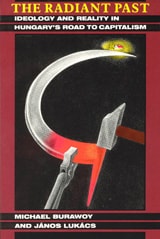
The Radiant Past
Ideology and Reality in Hungary's Road to CapitalismMichael Burawoy and János Lukács
University of Chicago Press, 1992
Michael Burawoy and Janos Lukacs consider this question from the standpoint of the Hungarian working class. Between 1983 and 1990 the authors carried out intensive studies in two core Hungarian industries, machine building and steel production, to produce the first extended participant-observation study of work and politics in state socialism.
"A fascinating and engagingly written eyewitness report on proletarian life in the waning years of goulash communism. . . . A richly rewarding book, one that should interest political scientists in a variety of subfields, from area specialists and comparativists to political economists, as well as those interested in Marxist and post-Marxist theory."—Elizabeth Kiss, American Political Science Review
"A very rich book. . . . It does not merely offer another theory of transition, but also presents a clear interpretive scheme, combined with sociological theory and vivid ethnographic description."—Ireneusz Bialecki, Contemporary Sociology
"Its informed skepticism of post-Communist liberal euphoria, its concern for workers, and its fine ethnographic details make this work valuable."—"àkos Róna-Tas, American Journal of Sociology
The Reality of Illusion
An Ecological Approach to Cognitive Film TheoryJoseph D. Anderson
Southern Illinois University Press, 1998
Anderson investigates how viewers, with their mental capacities designed for survival, respond to particular aspects of filmic structure—continuity, diegesis, character development, and narrative—and examines the ways in which rules of visual and aural processing are recognized and exploited by filmmakers. He uses Orson Welles’s Citizen Kane to disassemble and redefine the contemporary concept of character identification; he addresses continuity in a shot-by-shot analysis of images from Casablanca; and he uses a wide range of research studies, such as Harry F. Harlow’s work with infant rhesus monkeys, to describe how motion pictures become a substitute or surrogate reality for an audience. By examining the human capacity for play and the inherent potential for illusion, Anderson considers the reasons viewers find movies so enthralling, so emotionally powerful, and so remarkably real.
The Religion of Reality
Inquiry into the Self, Art, and TranscendenceDidier Maleuvre
Catholic University of America Press, 2006
The Symbolic Construction of Reality
The Legacy of Ernst CassirerEdited by Jeffrey Andrew Barash
University of Chicago Press, 2008
The Vital Lie
Reality and Illusion in Modern DramaAnthony S. Abbott
University of Alabama Press, 1988
The Vital Lie: Reality and Illusion in Modern Drama is a sweeping inquiry into the stories people tell themselves in order to endure, survive, and belong. Moving from Ibsen and Strindberg to Beckett, Pinter, and beyond, Anthony S. Abbott traces the uneasy traffic between actuality and self-invention that animates modern theater. Rather than offering a simple survey, he uncovers a recurring dramatic predicament: the cognitive dissonance that afflict people when the beliefs they hold about themselves collide with reality.
Anthony S. Abbott writes with the erudite observation of a critic and the curiosity of a participant. His book explores illusion, meaning, and human resilience, a perspective that lends unusual urgency to its readings of canonical playwrights. Abbott's scholarship is expansive without becoming academic in the pejorative sense; his arguments remain animated by large questions about purpose, dignity, and the imaginative structures that sustain ordinary lives.
Ideal for theater devotees, literary historians, students of modernism, philosophy-minded readers, directors, dramaturgs, and anyone fascinated by self-deception, mythmaking, and identity. Admirers of intellectual biography, cultural criticism, existential inquiry, and ambitious cross-author interpretation will find this volume especially rewarding. Those who relish fresh angles on familiar classics will discover a study that is probing, elegant, and unexpectedly memorable.
The Wealth of Reality
An Ecology of CompositionMargaret A. Syverson
Southern Illinois University Press, 1999
Margaret A. Syverson discusses the ways in which a theory of composing situations as ecological systems might productively be applied in composition studies. She demonstrates not only how new research in cognitive science and complex systems can inform composition studies but also how composing situations can provide fruitful ground for research in cognitive science.
Syverson first introduces theories of complex systems currently studied in diverse disciplines. She describes complex systems as adaptive, self-organizing, and dynamic; neither utterly chaotic nor entirely ordered, these systems exist on the boundary between order and chaos. Ecological systems are "metasystems" composed of interrelated complex systems. Writers, readers, and texts, together with their environments, constitute one kind of ecological system.
Four attributes of complex systems provide a theoretical framework for this study: distribution, embodiment, emergence, and enaction. Three case studies provide evidence for the application of these concepts: an analysis of a passage from an autobiographical poem by Charles Reznikoff, a study of first-year college students writing collaboratively, and a conflict in a computer forum of social scientists during the Gulf War. The diversity of these cases tests the robustness of theories of distributed cognition and complex systems and suggests possibilities for wider application.
Theory and Reality
An Introduction to the Philosophy of SciencePeter Godfrey-Smith
University of Chicago Press, 2003
Intended for undergraduates and general readers with no prior background in philosophy, Theory and Reality covers logical positivism; the problems of induction and confirmation; Karl Popper's theory of science; Thomas Kuhn and "scientific revolutions"; the views of Imre Lakatos, Larry Laudan, and Paul Feyerabend; and challenges to the field from sociology of science, feminism, and science studies. The book then looks in more detail at some specific problems and theories, including scientific realism, the theory-ladeness of observation, scientific explanation, and Bayesianism. Finally, Godfrey-Smith defends a form of philosophical naturalism as the best way to solve the main problems in the field.
Throughout the text he points out connections between philosophical debates and wider discussions about science in recent decades, such as the infamous "science wars." Examples and asides engage the beginning student; a glossary of terms explains key concepts; and suggestions for further reading are included at the end of each chapter. However, this is a textbook that doesn't feel like a textbook because it captures the historical drama of changes in how science has been conceived over the last one hundred years.
Like no other text in this field, Theory and Reality combines a survey of recent history of the philosophy of science with current key debates in language that any beginning scholar or critical reader can follow.
Theory and Reality
An Introduction to the Philosophy of Science, Second EditionPeter Godfrey-Smith
University of Chicago Press, 2021
Like no other text in this field, Theory and Reality combines a survey of recent history of the philosophy of science with current key debates that any beginning scholar or critical reader can follow. The second edition is thoroughly updated and expanded by the author with a new chapter on truth, simplicity, and models in science.