Results by title
828 books match the query 'Research' and 140 start with t
Taking Society's Measure
A Personal History of Survey ResearchHerbert Hyman
Russell Sage Foundation, 1991
Teaching Business Information Literacy
Genifer Snipes
American Library Association, 2022
At the same time, the resources, research techniques, and assignments that business students need to master often have little in common with a traditional research paper. Teaching Business Information Literacy provides guidance to new business specialists, generalists, and subject librarians in other disciplines being asked to teach business research classes for the first time. Featuring more than 40 practical, classroom-proven lesson plans for one-shot, embedded, and credit-bearing library classes, it’s divided into nine sections:
- Basic Business Research
- Finance and Accounting
- Entrepreneurship
- Management
- Marketing
- Specialty Subjects
- Data Literacy/Data Visualization
- Experiential Learning/Career
- Using Technology in the Classroom
Chapters cover such crucial topics as competitive intelligence, market research, financial analysis, ethics, intellectual property, accounting and auditing, supply chain management, job searching, and more. Each one guides you through the background of the topic and activity being taught, pre-class planning and preparation, a step-by-step lesson plan, how to adapt the activity for other institutional contexts, and learning outcomes. Additional supporting materials such as slide decks, worksheets, and game boards are freely available in the ACRL Sandbox (sandbox.acrl.org) and findable with the tag “#bizinfolit.”

Teaching Information Literacy Online
Trudi E. Jacobson
American Library Association, 2011

Teaching Information Literacy Threshold Concepts
LessonPatricia Bravender
Assoc of College & Research Libraries, 2015
Teaching Information Literacy Threshold Concepts
Lesson Plans for LibrariansPatricia Bravender
Assoc of College & Research Libraries, 2015
Teaching Information Literacy
50 Standards-Based Exercises for College StudentsJoanna M. Burkhardt
American Library Association, 2010
Teaching for Inquiry
Engaging the Learner WithinBarbara K. Stripling
American Library Association, 2012
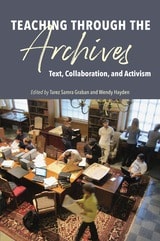
Teaching through the Archives
Text, Collaboration, and ActivismEdited by Tarez Samra Graban and Wendy Hayden
Southern Illinois University Press, 2022
Disruptive pedagogies for archival research
In a cultural moment when institutional repositories carry valuable secrets to the present and past, this collection argues for the critical, intellectual, and social value of archival instruction. Graban and Hayden and 37 other contributors examine how undergraduate and graduate courses in rhetoric, history, community literacy, and professional writing can successfully engage students in archival research in its many forms, and successfully model mutually beneficial relationships between archivists, instructors, and community organizations.
Combining new and established voices from related fields, each of the book’s three sections includes a range of form-disrupting pedagogies. Section I focuses on how approaching the archive primarily as text fosters habits of mind essential for creating and using archives, for critiquing or inventing knowledge-making practices, and for being good stewards of private and public collections. Section II argues for conducting archival projects as collaboration through experiential learning and for developing a preservationist consciousness through disciplined research. Section III details praxis for revealing, critiquing, and intervening in historic racial omissions and gaps in the archives in which we all work.
Ultimately, contributors explore archives as sites of activism while also raising important questions that persist in rhetoric and composition scholarship, such as how to decolonize research methodologies, how to conduct teaching and research that promote social justice, and how to shift archival consciousness toward more engaged notions of democracy. This collection highlights innovative classroom and curricular course models for teaching with and through the archives in rhetoric and composition and beyond.
Teaching with Primary Sources
Christopher Prom
Society of American Archivists, 2016
Teaching with Tension
Race, Resistance, and Reality in the ClassroomEdited by Philathia Bolton, Cassander L. Smith, and Lee Bebout
Northwestern University Press, 2019
Drawing together personal reflection, pedagogical strategies, and critical theory, Teaching with Tension offers concrete examinations that will foster student learning. The essays are organized into three thematic sections: "Teaching in Times and Places of Struggle" examines the dynamics of teaching race during the current moment, marked by neoconservative politics and twenty-first century freedom struggles. "Teaching in the Neoliberal University" focuses on how pressures and exigencies of neoliberalism (such as individualism, customer-service models of education, and online courses) impact the way in which race is taught and conceptualized in college classes. The final section, "Teaching How to Read Race and (Counter)Narratives," homes in on direct strategies used to historicize race in classrooms comprised of millennials who grapple with race neutral ideologies. Taken together, these sections and their constitutive essays offer rich and fruitful insight into the complex dynamics of contemporary race and ethnic studies education.
Techniques for Pollination Biologists
Carol A. Kearns
University Press of Colorado, 1993
This book presents techniques such as fluorescence microscopy to examine pollen tubes, high-pressure liquid chromatography for nectar analysis, and using particle counters to count pollen grains and nuclear magnetic resonance for floral odor analysis. In addition to these sophisticated methods, basic techniques are described for labeling plants, manipulating flowers, marking or excluding, and designing simple but elegant experiments with small budgets. The book also examines potential pitfalls for pollination studies and offers cautionary advice about designing and implementing different types of pollination experiments.
Technology and the Historian
Transformations in the Digital AgeAdam Crymble
University of Illinois Press, 2021
Historians have seen their field transformed by the digital age. Research agendas, teaching and learning, scholarly communication, the nature of the archive—all have undergone a sea change that in and of itself constitutes a fascinating digital history. Yet technology's role in the field's development remains a glaring blind spot among digital scholars.
Adam Crymble mines private and web archives, social media, and oral histories to show how technology and historians have come together. Using case studies, Crymble merges histories and philosophies of the field, separating issues relevant to historians from activities in the broader digital humanities movement. Key themes include the origin myths of digital historical research; a history of mass digitization of sources; how technology influenced changes in the curriculum; a portrait of the self-learning system that trains historians and the problems with that system; how blogs became a part of outreach and academic writing; and a roadmap for the continuing study of history in the digital era.
Telling Stories
Perspectives on Longitudinal Writing ResearchJenn Fishman
Utah State University Press, 2023
In Telling Stories, more than a dozen longitudinal writing researchers look beyond conventional project findings to story their work and, in doing so, offer otherwise unavailable glimpses into the logics and logistics of long-range studies of writing. The result is a volume that centers interrelations among people, places, and politics across two decades of praxis and an array of educational sites: two-year colleges, a senior military college, an adult literacy center, a small liberal arts college, and both public and private four-year universities.
Contributors share direct knowledge of longitudinal writing research, citing project data (e.g., interview transcripts, research notes, and journals), descriptions drawn from memory, and extended personal reflections. The resulting stories, tempered by the research and scholarship of others, convey a sense of longitudinal research as a lived activity as well as a prominent and consequential approach to inquiry. Yet Telling Stories is not a how-to guide, nor is it written for longitudinal researchers alone. Instead, this volume addresses issues about writing research that are germane to all who conduct or count on it. Such topics include building and sustaining good interpersonal research relations, ethically negotiating the institutional power dynamics that undergird writing research, effectively using knowledge from longitudinal studies to advocate for writers and writing educators, and improving both conceptual and concrete resources for long-range research in writing studies.
Telling a Research Story
Writing a Literature ReviewChristine B. Feak and John M. Swales
University of Michigan Press, 2009
Telling a Research Story: Writing a Literature Review is concerned with the writing of a literature review and is not designed to address any of the preliminary processes leading up to the actual writing of the literature review.
This volume represents a revision and expansion of the material on writing literature reviews that appeared in English in Today's Research World.
This volume progresses from general to specific issues in the writing of literature reviews. It opens with some orientations that raise awareness of the issues that surround the telling of a research story. Issues of structure and matters of language, style, and rhetoric are then discussed. Sections on metadiscourse, citation, and paraphrasing and summarizing are included.
Ten Steps for Recording Pictographs and Petroglyphs
Methods and TechnologiesLawrence Loendorf and Nancy Medaris Stone
University of Utah Press, 2024
Despite having survived for thousands of years, erosion, decay, and even vandalism are all threats to these important cultural sites. A field session involving documentation might be the only opportunity to record these unique and significant images. The ten steps laid out here by Loendorf and Stone offer a general overview of current best practices to maintain a scientific and professional documentation program.
The Affect Lab
The History and Limits of Measuring EmotionGrant Bollmer
University of Minnesota Press, 2023
Examines how our understanding of emotion is shaped by the devices we use to measure it
Since the late nineteenth century, psychologists have used technological forms of media to measure and analyze emotion. In The Affect Lab, Grant Bollmer examines the use of measurement tools such as electrical shocks, photography, video, and the electroencephalograph to argue that research on emotions has confused the physiology of emotion with the tools that define its inscription.
Bollmer shows that the psychological definitions of emotion have long been directly shaped by the physical qualities of the devices used in laboratory research. To investigate these devices, The Affect Lab examines four technologies related to the history of psychology in North America: spiritualist toys at Harvard University, serial photography in early American psychological laboratories, experiments on “psychopaths” performed with an instrument called an Offner Dynograph, and the development of the “electropsychometer,” or “E-Meter,” by Volney Mathison and L. Ron Hubbard.
Challenging the large body of humanities research surrounding affect theory, The Affect Lab identifies an understudied problem in formulations of affect: how affect is a construction inseparable from the techniques and devices used to identify and measure it. Ultimately, Bollmer offers a new critique of affect and affect theory, demonstrating how deferrals to psychology and neuroscience in contemporary theory and philosophy neglect the material of experimental, scientific research.
Retail e-book files for this title are screen-reader friendly with images accompanied by short alt text and/or extended descriptions.
The American Literature Scholar in the Digital Age
Edited by Amy E. Earhart and Andrew Jewell
University of Michigan Press, 2010
"By casting the collection explicitly as an outreach to the larger community of Americanists---not primarily those who self-identify as 'digital scholars'---Earhart and Jewell have made an important choice, and one that will likely make this a landmark publication."
---Andrew Stauffer, University of Virginia
The American Literature Scholar in the Digital Age, which features a wide range of practitioner-scholars, is the first of its kind: a gathering of people who are expert in American literary studies and in digital technologies, scholars uniquely able to draw from experience with building digital resources and to provide theoretical commentary on how the transformation to new technologies alters the way we think about and articulate scholarship in American literature. The volume collects articles from those who are involved in tool development, usability testing, editing and textual scholarship, digital librarianship, and issues of race and ethnicity in digital humanities, while also situating digital humanities work within the larger literary discipline. In addition, the volume examines the traditional structures of the fields, including tenure and promotion criteria, modes of scholarly production, the skill sets required for scholarship, and the training of new scholars.
The American Literature Scholar in the Digital Age will attract practitioners of digital humanities in multiple fields, Americanists who utilize digital materials, and those who are intellectually curious about the new movement and materials.
Amy E. Earhart is Assistant Professor in the Department of English at Texas A&M University.
Andrew Jewell is Associate Professor of Digital Projects, University Libraries, at the University of Nebraska–Lincoln.
Cover art: Book background ©iStockphoto.com/natashika
digitalculturebooks is an imprint of the University of Michigan Press and the Scholarly Publishing Office of the University of Michigan Library dedicated to publishing innovative and accessible work exploring new media and their impact on society, culture, and scholarly communication. Visit the website at www.digitalculture.org.
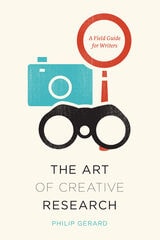
The Art of Creative Research
A Field Guide for WritersPhilip Gerard
University of Chicago Press, 2017
The Art of Creative Research helps writers take this natural inclination to explore and observe and turn it into a workable—and enjoyable—research plan. It shows that research shouldn’t be seen as a dry, plodding aspect of writing. Instead, it’s an art that all writers can master, one that unearths surprises and fuels imagination. This lends authenticity to fiction and poetry as well as nonfiction.
Philip Gerard distills the process into fundamental questions: How do you conduct research? And what can you do with the information you gather? He covers both in-person research and work in archives and illustrates how the different types of research can be incorporated into stories, poems, and essays using examples from a wide range of writers in addition to those from his own projects. Throughout, Gerard brings knowledge from his seasoned background into play, drawing on his experiences as a reporter and a writer of both fiction and nonfiction. His enthusiasm for adventure is infectious and will inspire writers to step away from the keyboard and into the world.
“Research can take you to that golden intersection where the personal meets the public, the private crosses the universal, where the best literature lives,” Gerard writes. With his masterly guidance, anyone can become an expert in artful investigation.
The Art of Teaching Speaking
Research and Pedagogy for the ESL/EFL ClassroomKeith S. Folse
University of Michigan Press, 2006
*Which tasks or activities really help build speaking fluency?
*What does the research show regarding speaking activities?
*What mistakes do ESL teachers often make in speaking activity design?
In this highly accessible and practical resource, Keith S. Folse provides a wealth of information to help ESL/EFL teachers design and use speaking tasks that will actually improve students' speaking fluency. The book presents and discusses the relevant research and assessment issues and includes case studies from twenty different settings and classrooms around the world so that readers learn from others about the problems and successes of using various speaking activities.
Teachers will find the chapters on Twenty Successful Activities and Ten Unsuccessful Activities particularly valuable. The successful activities are provided for classroom use and are reproducible. The book also contains five appendixes that explain what teachers need to know about vocabulary, pronunciation, and grammar and how they affect the teaching of speaking. Samples of successful lesson plans and a list of resources useful for teaching speaking are also included.
Keith S. Folse, Ph.D., is Coordinator, TESOL Programs, University of Central Florida (Orlando). He is the author of Vocabulary Myths (University of Michigan Press, 2004) and more than 35 second language textbooks, including texts on grammar, reading, speaking, listening, and writing.
The Art, Science, and Magic of the Data Curation Network
A Retrospective on Cross-Institutional CollaborationJake Carlson
Michigan Publishing Services, 2023
The Art, Science, and Magic of the Data Curation Network: A Retrospective on Cross Institutional Collaboration captures the results of a project retrospective meeting and describes the necessary components of the DCN’s sustained collaboration in the hopes that the insights will be of use to other collaborative efforts. In particular, the authors describe the successes of the community and challenges of launching a cross-institutional network. Additionally, this publication details the administrative, tool-based, and trust-based structures necessary for establishing this community, the “radical collaboration” that is the cornerstone of the DCN, and potential future collaborations to address shared challenges in libraries and research data management. This in-depth case study provides an overview of the critical work of launching a collaborative network and transitioning to sustainability. This publication will be of special interest to research librarians, data curators, and anyone interested in academic community building.
The Ascent of Affect
Genealogy and CritiqueRuth Leys
University of Chicago Press, 2017
Ruth Leys’s brilliant, much anticipated history, therefore, is a story of controversy and disagreement. The Ascent of Affect focuses on the post–World War II period, when interest in emotions as an object of study began to revive. Leys analyzes the ongoing debate over how to understand emotions, paying particular attention to the continual conflict between camps that argue for the intentionality or meaning of emotions but have trouble explaining their presence in non-human animals and those that argue for the universality of emotions but struggle when the question turns to meaning. Addressing the work of key figures from across the spectrum, considering the potentially misleading appeal of neuroscience for those working in the humanities, and bringing her story fully up to date by taking in the latest debates, Leys presents here the most thorough analysis available of how we have tried to think about how we feel.
The CSE Manual, Ninth Edition
Scientific Style and Format for Authors, Editors, and PublishersCouncil of Science Editors
University of Chicago Press, 2024
The CSE Manual: Scientific Style and Format for Authors, Editors, and Publishers delivers complete coverage of rules and best practices in scientific publishing. Since 1960, the esteemed Council of Science Editors has offered authoritative guidance on presenting scientific writing more clearly and effectively. In the ninth edition of The CSE Manual, this leading international association offers its most comprehensive recommendations yet, continuing to guide writers and editors through the ever-evolving world of scientific publishing. Available in print and by subscription online.
The Chicago Guide to Collaborative Ethnography
Luke Eric Lassiter
University of Chicago Press, 2005
The Chicago Guide to Collaborative Ethnography presents a historical, theoretical, and practice-oriented road map for this shift from incidental collaboration to a more conscious and explicit collaborative strategy. Luke Eric Lassiter charts the history of collaborative ethnography from its earliest implementation to its contemporary emergence in fields such as feminism, humanistic anthropology, and critical ethnography. On this historical and theoretical base, Lassiter outlines concrete steps for achieving a more deliberate and overt collaborative practice throughout the processes of fieldwork and writing. As a participatory action situated in the ethical commitments between ethnographers and consultants and focused on the co-construction of texts, collaborative ethnography, argues Lassiter, is among the most powerful ways to press ethnographic fieldwork and writing into the service of an applied and public scholarship.
A comprehensive and highly accessible handbook for ethnographers of all stripes, The Chicago Guide to Collaborative Ethnography will become a fixture in the development of a critical practice of anthropology, invaluable to both undergraduates, graduate students, and faculty alike.
The Chicago Guide to Fact-Checking
Brooke Borel
University of Chicago Press, 2016
Corrections such as this one from the Miami Herald have become a familiar sight for readers, especially as news cycles demand faster and faster publication. While some factual errors can be humorous, they nonetheless erode the credibility of the writer and the organization. And the pressure for accuracy and accountability is increasing at the same time as in-house resources for fact-checking are dwindling. Anyone who needs or wants to learn how to verify names, numbers, quotations, and facts is largely on their own.
Enter The Chicago Guide to Fact-Checking, an accessible, one-stop guide to the why, what, and how of contemporary fact-checking. Brooke Borel, an experienced fact-checker, draws on the expertise of more than 200 writers, editors, and fellow checkers representing the New Yorker, Popular Science, This American Life, Vogue, and many other outlets. She covers best practices for fact-checking in a variety of media—from magazine articles, both print and online, to books and documentaries—and from the perspective of both in-house and freelance checkers. She also offers advice on navigating relationships with writers, editors, and sources; considers the realities of fact-checking on a budget and checking one’s own work; and reflects on the place of fact-checking in today’s media landscape.
“If journalism is a cornerstone of democracy, then fact-checking is its building inspector,” Borel writes. The Chicago Guide to Fact-Checking is the practical—and thoroughly vetted—guide that writers, editors, and publishers need to maintain their credibility and solidify their readers’ trust.
The Chicago Guide to Fact-Checking, Second Edition
Brooke Borel
University of Chicago Press, 2023
- Recognize what information to fact-check
- Identify the quality and ranking of source materials
- Learn to fact-check a variety of media types: newspaper; magazine; social media; public and commercial radio and television, books, films, etc.
- Navigate relationships with editors, writers, and producers
- Recognize plagiarism and fabrication
- Discern conflicting facts, gray areas, and litigious materials
- Learn record keeping best practices for tracking sources
- Test your own fact-checking skills
Over the past few years, fact-checking has been widely touted as a corrective to the spread of misinformation, disinformation, conspiracy theories, and propaganda through the media. “If journalism is a cornerstone of democracy,” says author Brooke Borel, “then fact-checking is its building inspector.”
In The Chicago Guide to Fact-Checking, Borel, an experienced fact-checker, draws on the expertise of more than 200 writers, editors, and fellow checkers representing the New Yorker, Popular Science, This American Life, Vogue, and many other outlets. She covers best practices for editorial fact-checking in a variety of media—from magazine and news articles, both print and online, to books and podcasts—and the perspectives of both in-house and freelance checkers.
In this second edition, Borel covers the evolving media landscape, with new guidance on checking audio and video sources, polling data, and sensitive subjects such as trauma and abuse. The sections on working with writers, editors, and producers have been expanded, and new material includes fresh exercises and advice on getting fact-checking gigs. Borel also addresses the challenges of fact-checking in a world where social media, artificial intelligence, and the metaverse may make it increasingly difficult for everyone—including fact-checkers—to identify false information. The answer, she says, is for everyone to approach information with skepticism—to learn to think like a fact-checker.
The Chicago Guide to Fact-Checking is the practical—and thoroughly vetted—guide that writers, editors, and publishers continue to consult to maintain their credibility and solidify their readers’ trust.
The Chicago Guide to Your Career in Science
A Toolkit for Students and PostdocsVictor A. Bloomfield and Esam E. El-Fakahany
University of Chicago Press, 2008
Victor A. Bloomfield and Esam E. El-Fakahany, both well-known scientists with extensive experience as teachers, mentors, and administrators, have combined their knowledge to create a guidebook that addresses all of the challenges that today’s scientists-in-training face. They begin by considering the early stages of a career in science: deciding whether or not to pursue a PhD, choosing advisors and mentors, and learning how to teach effectively. Bloomfield and El-Fakahany then explore the skills essential to conducting and presenting research. The Chicago Guide to Your Career in Science offers detailed advice on how to pursue research ethically, manage time, and communicate effectively, especially at academic conferences and with students and peers. Bloomfield and El-Fakahany write in accessible, straightforward language and include a synopsis of key points at the end of each chapter, so that readers can dip into relevant sections with ease.
From students prepping for the GRE to postdocs developing professional contacts to faculty advisors and managers of corporate labs, scientists at every level will find The Chicago Guide to Your Career in Science an unparalleled resource.
The Colorado Plateau II
Biophysical, Socioeconomic, and Cultural ResearchEdited by Charles van Riper III and David J. Mattson
University of Arizona Press, 2005
The Colorado Plateau III
Integrating Research and Resources Management for Effective ConservationEdited by Charles van Riper III and Mark K. Sogge
University of Arizona Press, 2008
The Colorado Plateau V
Research, Environmental Planning, and Management for Collaborative ConservationEdited by Charles van Riper III, Miguel L. Villarreal, Carena J. van Riper, and Matthew J. Johnson
University of Arizona Press, 2012
This volume, the fifth from the University of Arizona Press and the tenth overall, focuses on adaptation of resource management and conservation to climate change and water scarcity, protecting biodiversity through restructured energy policies, ensuring wildlife habitat connectivity across barriers, building effective conservation networks, and exploring new opportunities for education and leadership in conservation science.
An informative read for people interested in the conservation and natural history of the region, the book will also serve as a valuable reference for those people engaged in the management of cultural and biological resources of the Colorado Plateau, as well as scientists interested in methods and tools for land and resource management throughout the West.
The Colorado Plateau
Cultural, Biological, and Physical ResearchCharles van Riper
University of Arizona Press, 2004
The Community-Based PhD
Complexities and Triumphs of Conducting CBPREdited by Sonya Atalay and Alexandra McCleary
University of Arizona Press, 2022
The Community-Based PhD brings together the experiences of PhD students from a range of disciplines discussing CBPR in the arts, humanities, social sciences, public health, and STEM fields. They write honestly about what worked, what didn’t, and what they learned. Essays address the impacts of extended research time frames, why specialized skill sets may be needed to develop community-driven research priorities, the value of effective relationship building with community partners, and how to understand and navigate inter- and intra-community politics.
This volume provides frameworks for approaching dilemmas that graduate student CBPR researchers face. They discuss their mistakes, document their successes, and also share painful failures and missteps, viewing them as valuable opportunities for learning and pushing the field forward. Several chapters are co-authored by community partners and provide insights from diverse community perspectives. The Community-Based PhD is essential reading for graduate students, scholars, and the faculty who mentor them in a way that truly crosses disciplinary boundaries.
Contributors: Anna S. Antoniou, Amy Argenal, Sonya Atalay, Stacey Michelle Chimimba Ault, Victoria Bochniak, Megan Butler, Elias Capello, Ashley Collier-Oxandale, Samantha Cornelius, Annie Danis, Earl Davis, John Doyle, Margaret J. Eggers, Cyndy Margarita García-Weyandt, R. Neil Greene, D. Kalani Heinz, Nicole Kaechele, Myra J. Lefthand, Emily Jean Leischner, Christopher B. Lowman, Geraldine Low-Sabado, Alexandra G. Martin, Christine Martin, Alexandra McCleary, Chelsea Meloche, Bonnie Newsom, Katherine L. Nichols, Claire Novotny, Nunanta (Iris Siwallace), Reidunn H. Nygård, Francesco Ripanti, Elena Sesma, Eric Simons, Cassie Lynn Smith, Tanupreet Suri, Emery Three Irons, Arianna Trott, Cecilia I. Vasquez, Kelly D. Wiltshire, Julie Woods, Sara L. Young
The Company We Keep
Interracial Friendships and Romantic Relationships from Adolescence to AdulthoodGrace Kao
Russell Sage Foundation, 2019
While research on interracial social ties has often focused on whites and blacks, Hispanics are the largest minority group and Asian Americans are the fastest growing racial group in the United States. The Company We Keep examines friendships and romantic relationships among blacks, whites, Hispanics, and Asian Americans to better understand the full spectrum of contemporary race relations. Using data from the National Longitudinal Study of Adolescent to Adult Health, the authors explore the social ties of more than 15,000 individuals from their first survey responses as middle and high school students in the mid-1990s through young adulthood nearly fifteen years later. They find that while approval for interracial marriages has increased and is nearly universal among young people, interracial friendships and romantic relationships remain relatively rare, especially for whites and blacks. Black women are particularly disadvantaged in forming interracial romantic relationships, while Asian men are disadvantaged in the formation of any romantic relationships, both as adolescents and as young adults. They also find that people in same-sex romantic relationships are more likely to have partners from a different racial group than are people in different-sex relationships. The authors pay close attention to how the formation of interracial friendships and romantic relationships depends on opportunities for interracial contact. They find that the number of students choosing different-race friends and romantic partners is greater in schools that are more racially diverse, indicating that school segregation has a profound impact on young people’s social ties.
Kao, Joyner, and Balistreri analyze the ways school diversity and adolescent interracial contact intersect to lay the groundwork for interracial relationships in young adulthood. The Company We Keep provides compelling insights and hope for the future of living and loving across racial divides.
The Connector
Living with Experimental NeuroprostheticsAlexandra Middleton
Duke University Press, 2026
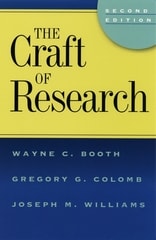
The Craft of Research
Wayne C. Booth, Gregory G. Colomb, and Joseph M. Williams
University of Chicago Press, 1995
This book is organized into four parts. Part One is a spirited introduction to the distinctive nature, values, and protocols of research. Part Two demystifies the art of discovering a topic. It outlines a wide range of sources, among them personal interests and passions. Parts Three and Four cover the essentials of argument—how to make a claim and support it—and ways to outline, draft, revise, rewrite, and polish the final report. Part Three is a short course in the logic, structure, uses, and common pitfalls of argumentation. The writing chapters in Part Four show how to present verbal and visual information effectively and how to shape sentences and paragraphs that communicate with power and precision.
"A well-constructed, articulate reminder of how important fundamental questions of style and approach, such as clarity and precision, are to all research."—Times Literary Supplement
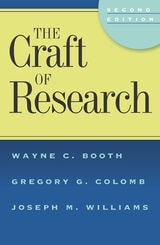
The Craft of Research, 2nd edition
Wayne C. Booth, Gregory G. Colomb, and Joseph M. Williams
University of Chicago Press, 2003
Like its predecessor, this new edition reflects the way researchers actually work: in a complex circuit of thinking, writing, revising, and rethinking. It shows how each part of this process influences the others and how a successful research report is an orchestrated conversation between a researcher and a reader. Along with many other topics, The Craft of Research explains how to build an argument that motivates readers to accept a claim; how to anticipate the reservations of thoughtful yet critical readers and to respond to them appropriately; and how to create introductions and conclusions that answer that most demanding question, "So what?"
Celebrated by reviewers for its logic and clarity, this popular book retains its five-part structure. Part 1 provides an orientation to the research process and begins the discussion of what motivates researchers and their readers. Part 2 focuses on finding a topic, planning the project, and locating appropriate sources. This section is brought up to date with new information on the role of the Internet in research, including how to find and evaluate sources, avoid their misuse, and test their reliability.
Part 3 explains the art of making an argument and supporting it. The authors have extensively revised this section to present the structure of an argument in clearer and more accessible terms than in the first edition. New distinctions are made among reasons, evidence, and reports of evidence. The concepts of qualifications and rebuttals are recast as acknowledgment and response. Part 4 covers drafting and revising, and offers new information on the visual representation of data. Part 5 concludes the book with an updated discussion of the ethics of research, as well as an expanded bibliography that includes many electronic sources.
The new edition retains the accessibility, insights, and directness that have made The Craft of Research an indispensable guide for anyone doing research, from students in high school through advanced graduate study to businesspeople and government employees. The authors demonstrate convincingly that researching and reporting skills can be learned and used by all who undertake research projects.
New to this edition:
Extensive coverage of how to do research on the internet, including how to evaluate and test the reliability of sources
New information on the visual representation of data
Expanded bibliography with many electronic sources
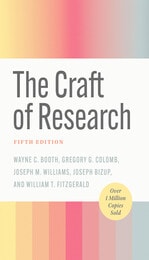
The Craft of Research, Fifth Edition
Wayne C. Booth, Gregory G. Colomb, Joseph M. Williams, Joseph Bizup, and William T. FitzGerald
University of Chicago Press, 2024
With more than a million copies sold since its first publication, The Craft of Research has helped generations of researchers at every level—from high-school students and first-year undergraduates to advanced graduate students to researchers in business and government. Conceived by seasoned researchers and educators Wayne C. Booth, Gregory G. Colomb, and Joseph M. Williams, this fundamental work explains how to choose significant topics, pose genuine and productive questions, find and evaluate sources, build sound and compelling arguments, and convey those arguments effectively to others.
While preserving the book’s proven approach to the research process, as well as its general structure and accessible voice, this new edition acknowledges the many ways research is conducted and communicated today. Thoroughly revised by Joseph Bizup and William T. FitzGerald, it recognizes that research may lead to a product other than a paper—or no product at all—and includes a new chapter about effective presentations. It features fresh examples from a variety of fields that will appeal to today’s students and other readers. It also accounts for new technologies used in research and offers basic guidelines for the appropriate use of generative AI. And it ends with an expanded chapter on ethics that addresses researchers’ broader obligations to their research communities and audiences as well as systemic questions about ethical research practices.
This new edition will be welcomed by a new and more diverse generation of researchers.
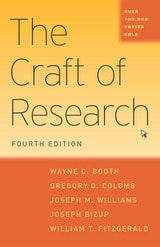
The Craft of Research, Fourth Edition
Wayne C. Booth, Gregory G. Colomb, Joseph M. Williams, Joseph Bizup and William T. FitzGerald
University of Chicago Press, 2016
With more than three-quarters of a million copies sold since its first publication, The Craft of Research has helped generations of researchers at every level—from first-year undergraduates to advanced graduate students to research reporters in business and government—learn how to conduct effective and meaningful research. Conceived by seasoned researchers and educators Wayne C. Booth, Gregory G. Colomb, and Joseph M. Williams, this fundamental work explains how to find and evaluate sources, anticipate and respond to reader reservations, and integrate these pieces into an argument that stands up to reader critique.
The fourth edition has been thoroughly but respectfully revised by Joseph Bizup and William T. FitzGerald. It retains the original five-part structure, as well as the sound advice of earlier editions, but reflects the way research and writing are taught and practiced today. Its chapters on finding and engaging sources now incorporate recent developments in library and Internet research, emphasizing new techniques made possible by online databases and search engines. Bizup and FitzGerald provide fresh examples and standardized terminology to clarify concepts like argument, warrant, and problem.
Following the same guiding principle as earlier editions—that the skills of doing and reporting research are not just for elite students but for everyone—this new edition retains the accessible voice and direct approach that have made The Craft of Research a leader in the field of research reference. With updated examples and information on evaluation and using contemporary sources, this beloved classic is ready for the next generation of researchers.
- Over 700,000 copies sold
- Every step of the academic research process, from the “why” of research through forming the research question, formulating an argument, and revision
- Helpful chapters on research ethics, formulation of writing assignments for teachers, and an appendix of research tools for both off and online
- Clear advice on building a strong argument in an age of false claims
- Careful attention to both the how and why of objective research-based writing
- Easy to follow, time-tested advice
- A must-have for any college or graduate student
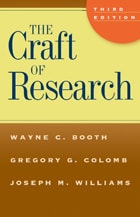
The Craft of Research, Third Edition
Wayne C. Booth, Gregory G. Colomb, and Joseph M. Williams
University of Chicago Press, 2008

The Critique of Scientific Reason
Kurt Hübner
University of Chicago Press, 1983
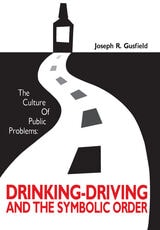
The Culture of Public Problems
Drinking-Driving and the Symbolic OrderJoseph R. Gusfield
University of Chicago Press, 1980
"A sophisticated and thoughtful critic. . . . Gusfield argues that the 'myth of the killer drunk' is a creation of the 'public culture of law.' . . . Through its dramatic development and condemnation of the anti-social character of the drinking-driver, the public law strengthens the illusion of moral consensus in American society and celebrates the virtues of a sober and orderly world."—James D. Orcutt, Sociology and Social Research
"Joseph Gusfield denies neither the role of alcohol in highway accidents nor the need to do something about it. His point is that the research we conduct on drinking-driving and the laws we make to inhibit it tells us more about our moral order than about the effects of drinking-driving itself. Many will object to this conclusion, but none can ignore it. Indeed, the book will put many scientific and legal experts on the defensive as they face Gusfield's massive erudition, pointed analysis and criticism, and powerful argumentation. In The Culture of Public Problems, Gusfield presents the experts, and us, with a masterpiece of sociological reasoning."—Barry Schwartz, American Journal of Sociology
This book is truly an outstanding achievement. . . . It is sociology of science, sociology of law, sociology of deviance, and sociology of knowledge. Sociologists generally should find the book of great theoretical interest, and it should stimulate personal reflection on their assumptions about science and the kind of consciousness it creates. They will also find that the book is a delight to read."—William B. Bankston, Social Forces
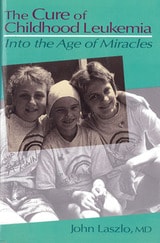
The Cure of Childhood Leukemia
Into the Age of MiraclesLaszlo, John
Rutgers University Press, 1995
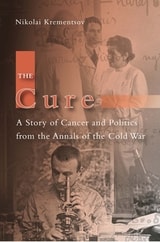
The Cure
A Story of Cancer and Politics from the Annals of the Cold WarNikolai Krementsov
University of Chicago Press, 2002
In 1946, Nina Kliueva and Grigorii Roskin announced the discovery of a preparation able to "dissolve" tumors in mice. Preliminary clinical trials suggested that KR, named after its developers, might work in humans as well. Media hype surrounding KR prompted the U.S. ambassador to the Soviet Union to seek U.S.-Soviet cooperation in perfecting the possible cure. But the escalating Cold War gave this American interest a double edge. Though it helped Kliueva and Roskin solicit impressive research support from the Soviet leadership, including Stalin, it also thrust the couple into the center of an ideological confrontation between the superpowers. Accused of divulging "state secrets" to America, the couple were put on a show trial, and their "antipatriotic sins" were condemned in Soviet stage and film productions.
Parlaying their notoriety into increased funding, Kliueva and Roskin continued their research, but envious colleagues discredited their work and took over their institute. For years, work on KR languished and ceased entirely with the deaths of Kliueva and Roskin. But recently, the Russian press reported that work on KR has begun again, reopening this illuminating story of the intersection among Cold War politics, personal ideals, and biomedical research.

The Dead Sea Scrolls in Scholarly Perspective
A History of ResearchDevorah Dimant
SBL Press, 2016
Now in paperback!
The volume covers Qumran scholarship in separate countries: the USA, Canada, Israel, France, Germany, Spain, the Netherlands, Scandinavia, Italy, and Eastern Europe. Each essay carries a detailed bibliography for the respective country. Biographies of all the major scholars active in the field are briefly given as well. This book thereby exhaustively surveys past and present Qumran research, outlining its particular development in various circumstances and national contexts. For the first time, perspectives and information not recorded in any other publication are highlighted.
Features:
The Demographics of Empire
The Colonial Order and the Creation of KnowledgeKarl Ittmann
Ohio University Press, 2010
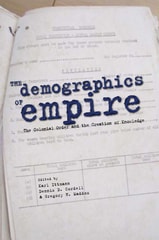
The Demographics of Empire is a collection of essays examining the multifaceted nature of the colonial science of demography in the last two centuries. The contributing scholars of Africa and the British and French empires focus on three questions: How have historians, demographers, and other social scientists understood colonial populations? What were the demographic realities of African societies and how did they affect colonial systems of power? Finally, how did demographic theories developed in Europe shape policies and administrative structures in the colonies? The essays approach the subject as either broad analyses of major demographic questions in Africa’s history or focused case studies that demonstrate how particular historical circumstances in individual African societies contributed to differing levels of fertility, mortality, and migration. Together, the contributors to The Demographics of Empire question demographic orthodoxy, and in particular the assumption that African societies in the past exhibited a single demographic regime characterized by high fertility and high mortality.
The Development of Linguistic Skill in Twins, Singletons with Siblings, and Only Children from Age Five to Ten Years
Edith Davis
University of Minnesota Press, 1937
The Discovery of Insulin
Enlarged EditionMichael Bliss
University of Chicago Press, 2021
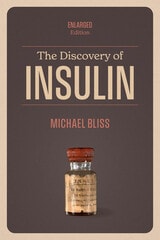
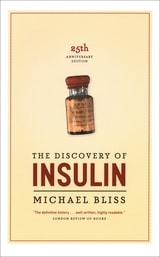
When insulin was discovered in the early 1920s, even jaded professionals marveled at how it brought starved, sometimes comatose patients with diabetes back to life. Defying the average timeline, the 1923 Nobel Prize in Physiology or Medicine was awarded for its discovery. To recount the fascinating story behind the discovery of insulin, in this classic work Michael Bliss draws on archival records and personal interviews with witnesses to the events. He unearths scientists’ memoirs and confidential appraisals of insulin by members of the Nobel Committee, bringing science to life and resolving a longstanding controversy about scientific collaboration at its most fractious and fascinating: who among the Canadian team of Frederick Banting, Charles Best, James Collip, and John Macleod ultimately deserves credit for the discovery of insulin? Or is credit due farther afield—to Georg Zuelzer in Berlin, E.L. Scott in Chicago, Israel Kleiner in New York, Nicolas Paulescu in Bucharest, John Murlin in Rochester?
Bliss’s life-and-death saga illuminates one of the most important breakthroughs in the history of medicine. With a new preface by the author and a foreword by historian Alison Li, this enlarged edition celebrates the lasting impact of insulin’s discovery and ongoing importance.
The Discovery of Insulin
Twenty-fifth Anniversary EditionMichael Bliss
University of Chicago Press, 2007
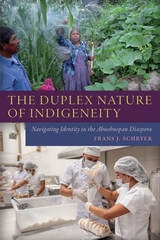
The Duplex Nature of Indigeneity
Navigating Identity in the Ahuehuepan DiasporaFrans J. Schryer
University Press of Colorado, 2025
Using a variety of sources, perspectives, and methods, Schryer takes a duplexity approach, which allows understanding the complexity of social reality and its complementary nature—it identifies fields, clusters, and layers as interconnected components of social life. The innovative methods consist of the combination of ethnographic description and an ethnohistorical census that provides information on every person going back to approximately 1850. That census is further examined with the use of inferential and non-inferential statistical techniques, archival research in locations not normally accessible to scholars, Facebook, phone interviews conducted over several years, and help from Nahuatl-speaking people whose perspectives on the findings generate additional information and insights.
Unique in this presentation, which dips into the lives of generations of people to draw insight on those who lay claim to transnational Indigeneity, Schryer’s work contributes to research and theoretical discussion in the field of migration and globalization studies through a close examination of one Indigenous community over the course of many years, utilizing a mix of qualitative and quantitative research methods in anthropology.
The Dynamics of Deterrence
Frank C. Zagare
University of Chicago Press, 1987
The Dynamics of Deterrence is the first comprehensive treatment of deterrence theory since the mid-1960s. Frank C. Zagare introduces a new theoretical framework for deterrence that is rigorous, consistent, and illuminating. By placing the deterrence relationship in a "theory of moves" framework, Zagare is able to remedy the defects of other models. His approach is illustrated by and applied to a number of complex deterrence situations: the Berlin crisis of 1948, the Middle East crises of 1967 and 1973, and The Falkland/Malvinas crisis of 1980. He also examines the strategic relationship between the United States and the Soviet Union from 1945 to the present.
Zagare studies the dynamics of both mutual and unilateral deterrence games in nuclear and non-nuclear situations, and the impact of credibility, capability, and power asymmetries on deterrence stability. He shows that his theory is applicable for analyzing deterrence situations between allies as well as between hostile states. One of the additional strengths of his model, however, is its general usefulness for other levels and settings, such as deterrence games played by husband and wife, parent and child, employer and employee, and the state and its citizens. With its lucid prose and illustrative examples, The Dynamics of Deterrence will be of interest to a wide audience in international relations, peace studies, and political science.
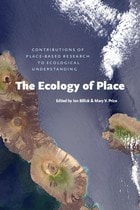
The Ecology of Place
Contributions of Place-Based Research to Ecological UnderstandingEdited by Ian Billick and Mary V. Price
University of Chicago Press, 2010
Ecologists can spend a lifetime researching a small patch of the earth, studying the interactions between organisms and the environment, and exploring the roles those interactions play in determining distribution, abundance, and evolutionary change. With so few ecologists and so many systems to study, generalizations are essential. But how do you extrapolate knowledge about a well-studied area and apply it elsewhere?
Through a range of original essays written by eminent ecologists and naturalists, The Ecology of Place explores how place-focused research yields exportable general knowledge as well as practical local knowledge, and how society can facilitate ecological understanding by investing in field sites, place-centered databases, interdisciplinary collaborations, and field-oriented education programs that emphasize natural history. This unique patchwork of case-study narratives, philosophical musings, and historical analyses is tied together with commentaries from editors Ian Billick and Mary Price that develop and synthesize common threads. The result is a unique volume rich with all-too-rare insights into how science is actually done, as told by scientists themselves.