Results by title
82 books match the query 'Revolution, 1775-1783' and 28 start with t
Taking Sides in Revolutionary New Jersey
Caught in the CrossfireMaxine N. Lurie
Rutgers University Press, 2022
Supplemental Instructor Resources for Taking Sides in Revolutionary New Jersey:
Questions (https://d3tto5i5w9ogdd.cloudfront.net/wp-content/uploads/2022/07/19144155/Taking-Sides-Supplementary-Instructor-Resources-Questions.pdf)
Bibliography (https://d3tto5i5w9ogdd.cloudfront.net/wp-content/uploads/2022/07/19144154/Taking-Sides-Supplementary-Instructor-Resources-Bibliography.pdf)
The American Revolution and the Press
The Promise of IndependenceCarol Sue Humphrey
Northwestern University Press, 2013
Carol Sue Humphrey’s The American Revolution and the Pressargues that newspapers played an important role during America’s struggle for independence by keeping Americans engaged in the war even when the fighting occurred in distant locales. From the moment that the colonials received word of Britain’s new taxes in 1764 until reports of the peace treaty arrived in 1783, the press constituted the major source of information about events and developments in the conflict with the mother country. Both Benjamin Franklin, one of the Revolution’s greatest leaders, and Ambrose Serle, a Loyalist, described the press as an “engine” that should be used to advance the cause. The efforts of Patriot printers to keep readers informed about the war helped ensure ultimate success by boosting morale and rallying Americans to the cause until victory was achieved. As Humphrey illustrates, Revolutionary-era newspapers provided the political and ideological unity that helped Americans secure their independence and create a new nation.

The American Revolution in New Jersey
Where the Battlefront Meets the Home FrontJames J. Gigantino II
Rutgers University Press, 2015
Battles were fought in many colonies during the American Revolution, but New Jersey was home to more sustained and intense fighting over a longer period of time. The nine essays in The American Revolution in New Jersey, depict the many challenges New Jersey residents faced at the intersection of the front lines and the home front.
The Articles of Confederation
An Interpretation of the Social-Constitutional History of the American Revolution, 1774-1781Merrill Jensen
University of Wisconsin Press, 1959
"An admirable analysis. It presents, in succinct form, the results of a generation of study of this chapter of our history and summarizes fairly the conclusions of that study."—Henry Steele Commager, New York Times Book Review
The Battle for the Fourteenth Colony
America’s War of Liberation in Canada, 1774–1776Mark R. Anderson
University Press of New England, 2013

The Birth of the Republic, 1763-89
Edmund S. Morgan
University of Chicago Press, 1992
In one remarkable quarter-century, thirteen quarrelsome colonies were transformed into a nation. Edmund S. Morgan's classic account of the Revolutionary period shows how the challenge of British taxation started the Americans on a search for constitutional principles to protect their freedom and eventually led to the Revolution.
Morgan demonstrates that these principles were not abstract doctrines of political theory but grew instead out of the immediate needs and experiences of the colonists. They were held with passionate conviction, and incorporated, finally, into the constitutions of the new American states and of the United States.
Though the basic theme of the book and his assessment of what the Revolution achieved remain the same, Morgan has updated the revised edition of The Birth of the Republic (1977) to include some textual and stylistic changes as well as a substantial revision of the Bibliographic Note.
The Birth of the Republic, 1763-89, Fourth Edition
Edmund S. Morgan
University of Chicago Press, 2012
A Pulitzer Prize winner's classic, compact, authoritative account of the origins of America
In The Birth of the Republic, 1763–89, Edmund S. Morgan shows how the challenge of British taxation started Americans on a search for constitutional principles to protect their freedom, and eventually led to the Revolution. By demonstrating that the founding fathers’ political philosophy was not grounded in theory, but rather grew out of their own immediate needs, Morgan paints a vivid portrait of how the founders’ own experiences shaped their passionate convictions, and these in turn were incorporated into the Constitution and other governmental documents. The Birth of the Republic is the classic account of the beginnings of the American government, and in this fourth edition the original text is supplemented with a new foreword by Joseph J. Ellis and a historiographic essay by Rosemarie Zagarri.This book is the perfect introduction for students or general readers wanting to learn more about the events that led to the American republic.

The Black Presence in the Era of the American Revolution
Sidney Kaplan and Emma Nogrady Kaplan
University of Massachusetts Press, 1989
The book is a revised and expanded edition of the authors' classic catalog that accompanied a pioneering exhibition mounted in 1973 by the National Portrait Gallery.
The British Soldier in America
A Social History of Military Life in the Revolutionary PeriodBy Sylvia R. Frey
University of Texas Press, 1981
In her investigation of the social history of the common British soldier in the era of the American Revolution, Sylvia Frey has extensively surveyed recruiting records, contemporary training manuals, statutes, and memoirs in an attempt to provide insight into the soldier's "life and mind." In the process she has discovered more about the common soldier than anyone thought possible: his social origins and occupational background, his size, age, and general physical condition, his personal economics and daily existence. Her findings dispel the traditional assumption that the army was made up largely of criminals and social misfits.
Special attention is given to soldiering as an occupation. Focusing on two of the major campaigns of the war—the Northern Campaign which culminated at Saratoga and the Southern Campaign which ended at Yorktown—Frey describes the human face of war, with particular emphasis on the physical and psychic strains of campaigning in the eighteenth century.
Perhaps the most important part of the work is the analysis of the moral and material factors which induced men to accept the high risks of soldiering. Frey rejects the traditional assumption that soldiers were motivated to fight exclusively by fear and force and argues instead that the primary motivation to battle was generated by regimental esprit, which in the eighteenth century substituted for patriotism. After analyzing the sources of esprit, she concludes that it was the sustaining force for morale in a long and discouraging war.
This book is a contribution to our understanding of the eighteenth century and should appeal not only to military historians but also to social and economic historians and to those interested in the history of medicine.
The Cassique of Kiawah
A Colonial RomanceWilliam Gilmore Simms
University of Arkansas Press, 2003

The Conquest of The Illinois
George Rogers Clark. Foreword by Rand Burnette
Southern Illinois University Press, 2001
Written only a decade after George Rogers Clark’s conquest of Illinois, this firsthand account shows the region as it existed in the 1770s, explains how British occupation affected Kentucky settlers, and exhibits Clark’s enormous diplomatic skills in convincing the French settlers and Indians along the rivers of Illinois that they were better off under the jurisdiction of the Americans rather than the British. In his new foreword to this book, Rand Burnette refers to Clark as a psychologist and an expert in human relations.
Believing the British responsible for Indian raids on the people of Kentucky, Clark determined to capture that area, which was claimed by his home state of Virginia. “His plan, which he presented to Governor Patrick Henry,” Burnette notes, “was to take possession of the Illinois country by defeating the British at Kaskaskia, win the support of the French in that area, and thus control both the Mississippi and the Ohio Rivers. The British support of the Indians, who raided the Kentucky settlements from the Illinois country, would be at an end.”
Clark’s stirring narrative—written between 1789 and 1791 and covering 1773–1779—chronicles the events in the Old Northwest in the second half of the eighteenth century. Life on the frontier was dangerous and uncertain at this time. As Clark points out and Milo Milton Quaife underlines in his footnotes, death came to many at the hands of Indians or in military battles and skirmishes.
First published in 1920 and long out of print, the Quaife edition of Clark’s The Conquest of The Illinois reprinted here is for the modern reader superior to the original. First, Quaife provided an index. Equally important for modern readers, he standardized Clark’s spelling. (Clark had little formal education, and his spelling was even more eccentric than that found in a typical eighteenth-century account.) Finally, Quaife’s footnotes often include biographical sketches of the people in the book.
The Contest for Liberty
Military Leadership in the Continental Army, 1775–1783Seanegan P. Sculley
Westholme Publishing, 2019
How American Colonial Ideals Shaped Command, Discipline, and Honor in the U.S. Armed Forces
In the summer of 1775, a Virginia gentleman-planter was given command of a New England army laying siege to British-occupied Boston. With his appointment, the Continental Army was born. Yet the cultural differences between those serving in the army and their new commander-in-chief led to conflicts from the very beginning that threatened to end the Revolution before it could start. The key challenge for General George Washington was establishing the standards by which the soldiers would be led by their officers. What kind of man deserved to be an officer? Under what conditions would soldiers agree to serve? And how far could the army and its leaders go to discipline soldiers who violated those enlistment conditions? As historian Seanegan P. Sculley reveals in Contest for Liberty: Military Leadership in the Continental Army, 1775–1783, these questions could not be determined by Washington alone. His junior officers and soldiers believed that they too had a part to play in determining how and to what degree their superior officers exercised military authority and how the army would operate during the war. A cultural negotiation concerning the use of and limits to military authority was worked out between the officers and soldiers of the Continental Army; although an unknown concept at the time, it is what we call leadership today. How this army was led and how the interactions between officers and soldiers from the various states of the new nation changed their understandings of the proper exercise of military authority was finally codified in General Friedrich Wilhelm von Steuben’s The Regulations for the Order and Discipline of the Troops of the United States, first published in 1779. The result was a form of military leadership that recognized the autonomy of the individual soldiers, a changing concept of honor, and a new American tradition of military service.
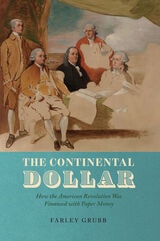
The Continental Dollar
How the American Revolution Was Financed with Paper MoneyFarley Grubb
University of Chicago Press, 2023
The Continental Dollar is a revelatory history of how the fledgling United States paid for its first war. Farley Grubb upends the common telling of this story, in which the United States printed cross-colony money, called Continentals, to serve as an early fiat currency—a currency that is not tied to a commodity like gold, but rather to a legal authority. As Grubb details, the Continental was not a fiat currency, but a “zero-coupon bond”—a wholly different species of money. As bond payoffs were pushed into the future, the money’s value declined, killing the Continentals’ viability years before the Revolutionary War would officially end.
Drawing on decades of exhaustive mining of eighteenth-century records, The Continental Dollar is an essential origin story of the early American monetary system, promising to serve as the benchmark for critical work for decades to come.
The Forayers
or The Raid of the Dog DaysWilliam Gilmore Simms
University of Arkansas Press, 2003

The Georgia Florida Contest
Martha C. Searcy
University of Alabama Press, 1985
Almost from the time of Georgia’s settlement by Oglethorpe in 1733, both Georgians and Carolinians had made periodic unsuccessful attempts to conquer the Spanish Castillo San Marcos in St. Augustine; and during the American Revolution (in 1776, 1777, and 1778) the rebels tried without success to take the fortification, which was then a British stronghold. Each of the three expeditions was less successful than the preceding one, and between the formal campaigns vicious partisan warfare between loyalists and rebels devastated much of the area between the Altamaha and St. Johns rivers.
This book presents a detailed history of the three Georgia-Florida campaigns. Indecisive and lacking the glamour of either the contemporary campaigns in the North, or the later campaigns in the South, they appeared isolated from the mainstream of the revolutionary struggle. The rebels were handicapped by divided command, personal quarrels, difficult terrain, and miserable weather. While Searcy emphasizes the military aspects of the period, she also treats the conflict between civil and military authorities, the effects of war on the civilian populace, and the interaction of economic matters with military affairs. Her work clarifies the importance of these military activities in the subsequent British strategy in the occupation of Georgia and the Carolinas.
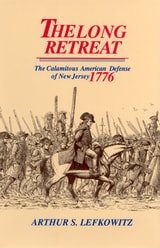
The Long Retreat
The Calamitous Defense of New Jersey, 1776Lefkowitz, Arthur S
Rutgers University Press, 1999
On the morning of November 20, 1776, General Charles Cornwallis overran patriot positions at Fort Lee, on the New Jersey side of the Hudson River. The attack threw George Washington's army into turmoil. Thus began an American retreat across the state, which ended only after the battered rebels crossed the Delaware river at Trenton on December 7. It was a three-week campaign that marked the most dramatic and desperate period of the War for Independence. In The Long Retreat, Arthur Lefkowitz has written the first book-length study of this critical campaign. He adds compelling new detail to the narrative, and offers the most comprehensive account in the literature of the American retreat to the Delaware and of the British pursuit. What emerges is a history misconceptions about the movements of the armies, the intentions of their leaders, and the choices available to rebel commanders and their British counterparts. Lefkowitz presents a patriot military pounded into desperate straights by the forces of the Crown, but in the end more resilient and wily than most previous scholarship has allowed. If brought low over November and December of 1776, Washington's battalions were still a force to reckon with as they pulled away from the advancing British. Despite serious losses in material and personnel, Washington managed to keep his units operational; and even while making mistakes, he sought to consolidate patriot regiments and longed for a chance to counterattack. The Christmas night riposte at Trenton, a dramatic reversal of fortune in any case, stemmed from measures the rebel Commander-in-Chief had initiated even as he completed his retrograde across New Jersey. How all of this came about emerges and crisp narrative of The Long Retreat. It is the definitive book on a crucial chapter in the history of American Arms.

The Partisan
A Romance of RevolutionWilliam Gilmore Simms
University of Arkansas Press, 2011

The Pennsylvania Associators, 1747–1777
Joseph Seymour
Westholme Publishing, 2024
The First Complete History of the Military Force of Colonial Pennsylvania, a Volunteer Body Created as a Practical Response to the Ideal of Pacifism
Known at various times as the Military Association of Pennsylvania, the Pennsylvania Association, or simply Associators, this long-neglected organization represented a new constituency in Pennsylvania politics and by extension, a new American response to arbitrary rule. Organized on December 7, 1747, at Philadelphia, the Military Association, an all-volunteer military establishment pledged to the defense of Pennsylvania, served as the de facto armed force for Pennsylvania, a colony whose leadership, a loose coalition of Quaker and German pacifists, land barons, and merchants, foreswore military preparedness on religious and ideological grounds. For the Associators, including their most noted supporter, Benjamin Franklin, a defenseless colony was no longer practical. During the War of Austrian Succession and again in the Seven Years’ War, Associators organized defense efforts in defiance of the Pennsylvania colonial leadership. Associators also helped defend American Indian refugees against the infamous Paxton Boys in 1764. By 1775, Associators found themselves as the colony’s only legitimate military leadership and, by capitalizing on electoral gains in the lead up to the American Revolution, Associators assumed offices vacated by former officials. During the critical battles of 1776, the Associators in their distinctive round hats and brown coats proved a decisive asset to the Continental Army.
In The Pennsylvania Associators, 1747–1777, historian Joseph Seymour has painstakingly researched primary source materials in order to write the first comprehensive history of this influential organization. Seymour demonstrates that while the Pennsylvania Associators contributed to success in the campaigns in which they fought, particularly the battles of Trenton and Princeton, a more fascinating and important investigation are the concerns that motivated these men. Associators considered military service in defense of their religious and civil liberties as a natural right. For three decades, Associators demonstrated that belief in and out of uniform. In a colony founded on religious exceptionalism, Associators saw themselves as faithful soldiers and active agents against leadership by entitlement, a principle guiding our government today.
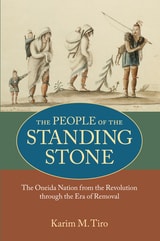
The People of the Standing Stone
The Oneida Nation from the Revolution through the Era of RemovalKarim M. Tiro
University of Massachusetts Press, 2011
The Oneidas' physical, political, and emotional division persists to this day. Even for those who stayed put, their world changed more in cultural, ecological, and demographic terms than at any time before or since. Oneidas of the post-Revolutionary decades were reluctant pioneers, undertaking more of the adaptations to colonized life than any other generation. Amid such wrenching change, maintaining continuity was itself a creative challenge. The story of that extraordinary endurance lies at the heart of this book.
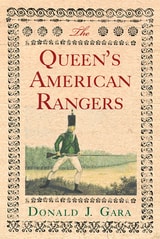
The Queen's American Rangers
Donald J. Gara
Westholme Publishing, 2015
Prior to the British attack on Long Island in August 1776, French and Indian War hero Robert Rogers organized a regiment to join the fight—but not on the side of his native New Hampshire. Named in honor of Queen Charlotte, the wife of King George III, Rogers’s regiment recruited the bulk of its soldiers from the large number of Loyalist refugees on Staten Island who had fled from New York. Rogers’s command of the unit was short-lived, however, after a humiliating defeat in late October by a surprise attack on his headquarters. Under new leadership, the unit played a decisive role and suffered heavy casualties at the battle of Brandywine that brought them their first favorable attention from the British high command. With this performance, and under the able leadership of John Graves Simcoe, the Queen’s American Rangers—sometimes known as “Simcoe’s Rangers”—were frequently assigned to serve alongside British regular troops in many battles, including Monmouth, Springfield, Charleston, and Yorktown. Receiving frequent high praise from Lieutenant General Sir Henry Clinton, the Commander in Chief of the British Army in America, the unit was placed on the American Establishment of the British Army in May 1779, a status conferred on provincial units that had performed valuable services during the war, and was renamed the 1st American Regiment. Before the end of the war, the rangers were fully incorporated into the British regular army, one of only four Loyalist units to be so honored.
The Queen’s American Rangers by historian Donald J. Gara is the first book-length account of this storied unit. Based on extensive primary source research, the book traces the complete movements, command changes, and battle performances of the rangers, from their first muster to their formal incorporation into the British Army and ultimate emigration to Canada on land grants conferred by a grateful British crown.
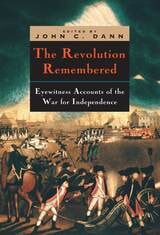
The Revolution Remembered
Eyewitness Accounts of the War for IndependenceJohn C. Dann
University of Chicago Press, 1980
"In a book fairly bursting with feats of daring, perhaps the most spectacular accomplishment of them all is this volume's transformation of its readers into the grandchildren of Revolutionary War soldiers. . . . An amazing gathering of 79 surrogate Yankee grandparents who tell us in their own words what they saw with their own eyes."—Elaine F. Weiss, Christian Science Monitor
"Fascinating. . . . [The soldiers'] details fill in significant shadows of history."—Henry Kisor, Chicago Sun-Times
"It's still good fun two centuries later, overhearing these experiences of the tumult of everyday life and seeing a front-lines view of one of the most unusual armies ever to fight, let alone win."—Richard Martin, Wall Street Journal
"One of the most important primary source discoveries from the era. A unique and fresh perspective."—Paul G. Levine, Los Angeles Times
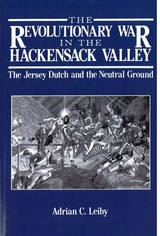
The Revolutionary War in the Hackensack Valley
The Jersey Dutch and the Neutral Ground, 1775-1783Leiby, Adrian C.
Rutgers University Press, 1980
Adrian Leiby offers an exciting narrative of the people of Dutch New Jersey and New York during this conflict. Historians will find colorful details about the Revolutionary War, and genealogists will find much previously unpublished material on hundreds of men and women of Dutch New Jersey and New York in the 1700s.
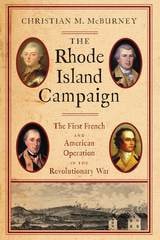
The Rhode Island Campaign
The First French and American Operation in the Revolutionary WarChristian M. McBurney
Westholme Publishing, 2011
The Marquis de Lafayette and the French Navy join Nathanael Green, John Sullivan, and a Continental Army to Attach a British Stronghold in New England
On July 29, 1778, a powerful French naval squadron sailed confidently to the entrance of Narragansett Bay. Its appearance commenced the first joint French and American campaign of the Revolutionary War. The new allies’ goal was to capture the British garrison at Newport, Rhode Island. With British resolve reeling from the striking patriot victory at Saratoga the previous autumn, this French and American effort might just end the war.
As the French moved into the bay, surprised British captains scuttled or burned many of their vessels rather than risk capture, resulting in the most significant loss of warships suffered by the British navy during the war. French Admiral Comte d’Estaing then turned to sea to engage the main British fleet but his ships were scattered and damaged by a huge storm. After his flagship and two other ships were attacked, d’Estaing’s squadron was taken out of the campaign. The American army under General John Sullivan, meanwhile, was stranded on a small island near Newport without the expected French naval support. When they tried to retreat off the island, British and Hessian regulars were sent to destroy Sullivan’s army; instead of a rout, a running battle ensued that lasted for more than six hours. Continentals, brimming with confidence after their training during the winter of Valley Forge, once more proved that they were an effective fighting force. While the Rhode Island Campaign ended in failure for the Americans and French, there were positive signs for the future of the alliance and the Revolution.
The Rhode Island Campaign: The First French and American Operation of the Revolutionary War unravels one of the most complex and multi-faceted events of the war, one which combined land and sea strategies and featured controversial decisions on both sides. Many prominent patriots participated, including Nathanael Greene, Marquis de Lafayette, John Hancock, and Paul Revere. Most important, while the campaign’s failure led to harsh criticism of the French in some quarters, leaders such as Greene, Lafayette, and George Washington steadfastly worked to ensure that the alliance would remain intact, knowing that the next joint operation could well succeed. Relying on in-depth research from American, French, British, and German original sources, author Christian McBurney has written the most authoritative book on this fascinating episode in American history.

The Saratoga Campaign
Uncovering an Embattled LandscapeEdited by William A. Griswold and Donald W. Linebaugh
University Press of New England, 2016

The Scots Irish of Early Pennsylvania
A Varied PeopleJudith A. Ridner
Temple University Press, 2018
The Scots Irish were one of early Pennsylvania’s largest non-English immigrant groups. They were stereotyped as frontier ruffians and Indian haters. In The Scots Irish of Early Pennsylvania, historian Judith Ridner insists that this immigrant group was socio-economically diverse. Servants and free people, individuals and families, and political exiles and refugees from Ulster, they not only pioneered new frontier settlements, but also populated the state’s cities—Philadelphia and Pittsburgh—and its towns, such as Lancaster, Easton, and Carlisle.
Ridner provides a much-overdue synthesis and reassessment of this immigrant group, tracing a century of Scotch-Irish migration from 1720 to 1820. These men and women brought their version of Ulster to the colonies in their fierce commitments to family, community, entrepreneurship, Presbyterianism, republican politics, and higher education. The settlements they founded across the state, including many farms, businesses, meetinghouses, and colleges, ensured that Pennsylvania would be their cradle in America, and these settlements stand as powerful testaments to their legacy to the state’s history and development.
The Unvarnished Doctrine
Locke, Liberalism, and the American RevolutionSteven M. Dworetz
Duke University Press, 1990

This Destructive War
The British Campaign in the Carolinas, 1780-1782John S. Pancake
University of Alabama Press, 1985
An exciting and accurate portrayal of the military action in the southern colonies that led to a new American nation
Following up the success of his 1777: The Year of the Hangman about the northern theaters of the American Revolutionary War, historian John Pancake now cover the war in the South, from General Clinton's attack on Charleston in the spring of 1780 to Cornwallis's surrender at Yorktown in October 1781.
Pancake expertly takes the reader back and forth between British and American headquarters to provide a brisk and sharp view from both sides of the conflict. His artful analysis also adds insights to the familiar narrative of the British losing because of their mistakes, American victory thanks to tenacity (particularly in the person of southern Continental forces commander Nathanael Greene), and British failure to overcome logistical problems of geography. Readers enjoy Pancake's wide-ranging knowledge of military history as applied to the Revolution as where, for example, he cites that tests conducted by the US Navy in World War II demonstrated that gun crews that were 100 percent efficient in training lost 35 percent of their efficiency in their first performance in combat.
Pancake has a writer's eye for telling details, and he creates characters sketches of the main players in the conflict that readers will always remember. This Destructive War includes a number of figures as well as detailed maps of the region where battle took place. General readers as well as scholars and students of the American Revolution will welcome anew this classic, definitive study of the campaign in the Carolinas.
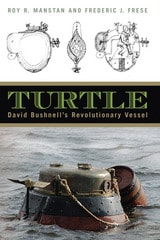
Turtle
David Bushnell's Revolutionary VesselRoy R. Manstan
Westholme Publishing, 2010
The Remarkable History and Reconstruction of the First Operational Submarine
At the onset of the American Revolution, the British expected to quell the rebellion quickly with a show of overwhelming force. In an experiment in asymmetric warfare, David Bushnell created the first submarine vessel designed specifically “for the destruction of vessels of war.” On a quiet September night in 1776, sergeant Ezra Lee maneuvered Bushnell’s strange little craft out from Manhattan and into the midst of the greatest naval fleet ever assembled in the Americas. Lee’s goal was to sink the British flagship HMS Eagle by attaching a powerful explosive to its hull. Although the mission was unsuccessful, Bushnell’s concept of submarine warfare was considered by George Washington to have been “an effort of genius.”
David Bushnell was raised in the town of Saybrook at the mouth of the Connecticut River. More than two centuries later, another Turtle would be launched into the same river within sight of Bushnell’s first forays with his vessel during the summer of 1775. Under the direction of technical arts teacher Frederic J. Frese, students at Old Saybrook High School created a working replica of Bushnell’s submarine, facilitated through an education partnership with the Naval Undersea Warfare Center in Newport, Rhode Island, where Roy R. Manstan was a mechanical engineer and Navy trained diver. With twenty-first century submariners at the helm, the Turtle replica was subjected to a series of operational tests at the Mystic Seaport Museum in Mystic, Connecticut.
In Turtle: David Bushnell’s Revolutionary Vessel, the authors provide new insight into Bushnell’s “engine of devastation,” tracing the history of undersea warfare before Bushnell and the origin of the many innovations Bushnell understood would be necessary for conducting a covert submarine attack. The knowledge gained from testing the Turtle replica enabled the authors to speculate as to what America’s first submariner Ezra Lee experienced that September night and what may have caused the attack to fail.