Results by title
51 books match the query 'Rights' and 12 start with t

The Bill of Rights in the Modern State
Edited by Geoffrey R. Stone, Richard A. Epstein, and Cass R. Sunstein
University of Chicago Press, 1992
The contributors to this volume are among the most prominent constitutional scholars in the country. Most of the essays are grouped in pairs, each of which offers conflicting positions on current constitutional controversies, including property rights, freedom of religion, freedom of speech, levels of generality in constitutional interpreation, and unemumerated rights.
The contributors are: Bruce Ackerman, Mary E. Becker, Ronald Dworkin, Frank H. Easterbrook, Richard A. Epstein, Charles Fried, Mary Ann Glendon, Philip B. Kurland, Frank J. Michaelman, Michael W. McConnell, Richard A. Posner, Kathleen M. Sullivan, John Paul Stevens, David A. Strauss, and Cass R. Sunstein.
"A thoughtful and well coordinated set of exchanges between leading modern constitutional theorists about the most significant issues related to the Bill of Rights and the Welfare State. These issues are debated through penetrating essays by opposing theorists who get to the heart of these issues and provide significant answers to their debate opponents' points."—Thomas R. Van Dervort, Southeastern Political Review
The Community of Rights
Alan Gewirth
University of Chicago Press, 1997

The Defender
The Battle to Protect the Rights of the Accused in PhiladelphiaEdward W. Madeira Jr. and Michael D. Schaffer
Temple University Press, 2020
Long before the Supreme Court ruled that impoverished defendants in criminal cases have a right to free counsel, Philadelphia’s public defenders were working to ensure fair trials for all. In 1934, when penniless defendants were routinely railroaded through the courts without ever seeing a lawyer, Philadelphia attorney Francis Fisher Kane helped create the Voluntary Defender Association, supported by charity and free from political interference, to represent poor people accused of crime.
When the Supreme Court’s 1963 decision Gideonv. Wainwright mandated free counsel for indigent defendants, the Defender (as it is now known) became more essential than ever, representing at least 70 percent of those caught in the machinery of justice in the city. Its groundbreaking work in juvenile advocacy, homicide representation, death-row habeas corpus petitions, parole issues, and alternative sentencing has earned a national reputation.
In The Defender, Edward Madeira, past president of the Defender’s Board of Directors, and former Philadelphia Inquirer journalist Michael Schaffer chart the 80-plus-year history of the organization as it grew from two lawyers in 1934 to a staff of nearly 500 in 2015.
This is a compelling story about securing justice for those who need it most.
The Elusive Promise of Indigenous Development
Rights, Culture, StrategyKaren Engle
Duke University Press, 2010
Conceiving indigenous rights as cultural rights, Engle argues, has largely displaced or deferred many of the economic and political issues that initially motivated much indigenous advocacy. She contends that by asserting static, essentialized notions of indigenous culture, indigenous rights advocates have often made concessions that threaten to exclude many claimants, force others into norms of cultural cohesion, and limit indigenous economic, political, and territorial autonomy.
Engle explores one use of the right to culture outside the context of indigenous rights, through a discussion of a 1993 Colombian law granting collective land title to certain Afro-descendant communities. Following the aspirations for and disappointments in this law, Engle cautions advocates for marginalized communities against learning the wrong lessons from the recent struggles of indigenous peoples at the international level.
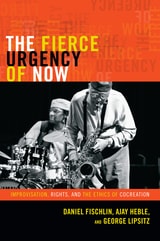
The Fierce Urgency of Now
Improvisation, Rights, and the Ethics of CocreationDaniel Fischlin, Ajay Heble, and George Lipsitz
Duke University Press, 2013
Improvisation is the creation and development of new, unexpected, and productive cocreative relations among people. It cultivates the capacity to discern elements of possibility, potential, hope, and promise where none are readily apparent. Improvisers work with the tools they have in the arenas that are open to them. Proceeding without a written score or script, they collaborate to envision and enact something new, to enrich their experience in the world by acting on it and changing it. By analyzing the dynamics of particular artistic improvisations, mostly by contemporary American jazz musicians, the authors reveal improvisation as a viable and urgently needed model for social change. In the process, they rethink politics, music, and the connections between them.
The Politics of Rights
Lawyers, Public Policy, and Political ChangeStuart A. Scheingold
University of Michigan Press, 2004
"Scheingold presents a clear, thoughtful discussion of the ways in which rights can both empower and constrain those seeking change in American society. While much of the writing on rights is abstract and obscure, The Politics of Rights stands out as an accessible and engaging discussion."
-Gerald N. Rosenberg, University of Chicago
"This book has already exerted an enormous influence on two generations of scholars. It has had an enormous influence on political scientists, sociologists, and anthropologists, as well as historians and legal scholars. With this new edition, this influence is likely to continue for still more generations. The Politics of Rights has, I believe, become an American classic."
-Malcolm Feeley, Boalt Hall School of Law, University of California, Berkeley, from the foreword
Stuart A. Scheingold is Professor Emeritus of Political Science at the University of Washington.
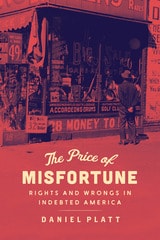
The Price of Misfortune
Rights and Wrongs in Indebted AmericaDaniel Platt
University of Chicago Press, 2023
What can be taken from someone who has borrowed money and cannot repay? What do the victims of misfortune owe to their lenders, and what can they keep for themselves? The answers to those questions, immensely important for debtors, creditors, and society at large, have changed over time. The Price of Misfortune examines the cause of debtors’ rights in the modern United States and the struggles of reformers who fought to establish financial freedoms in law.
Daniel Platt shows how, in the wake of the Civil War, a range of advocates drew potent analogies between slavery, imprisonment for debt, and the experiences of wage garnishment and property foreclosure. He traces the ways those analogies were used to campaign for bold new protections for debtors, keeping them secure in their labor, property, and personhood. Yet, as Platt demonstrates, those reforms tended to assume as their ideal borrower someone who was white, propertied, and male. In subsequent decades, the emancipatory promise of debtors’ rights would be tested as women, wage earners, and African Americans seized on their language to challenge other structural inequalities: the dependency of marriage, the exploitation of industrial capitalism, and the oppression of Jim Crow. By reconstructing these forgotten developments—and recovering the experiences of indebted farmwives, sharecroppers, and wage workers—The Price of Misfortune narrates a new history of inequality, coercion, and law amid the early financialization of American capitalism.
The Price of Misfortune
Rights and Wrongs in Indebted AmericaDaniel Platt
University of Chicago Press, 2023
A history of the struggle for debtors’ rights from the Civil War to the Great Depression
What can be taken from someone who has borrowed money and cannot repay? What do the victims of misfortune owe to their lenders, and what can they keep for themselves? The answers to those questions, immensely important for debtors, creditors, and society at large, have changed over time. The Price of Misfortune examines the cause of debtors’ rights in the modern United States and the struggles of reformers who fought to establish financial freedoms in law.
Daniel Platt shows how, in the wake of the Civil War, a range of advocates drew potent analogies between slavery, imprisonment for debt, and the experiences of wage garnishment and property foreclosure. He traces the ways those analogies were used to campaign for bold new protections for debtors, keeping them secure in their labor, property, and personhood. Yet, as Platt demonstrates, those reforms tended to assume as their ideal borrower someone who was white, propertied, and male. In subsequent decades, the emancipatory promise of debtors’ rights would be tested as women, wage earners, and African Americans seized on their language to challenge other structural inequalities: the dependency of marriage, the exploitation of industrial capitalism, and the oppression of Jim Crow. By reconstructing these forgotten developments—and recovering the experiences of indebted farmwives, sharecroppers, and wage workers—The Price of Misfortune narrates a new history of inequality, coercion, and law amid the early financialization of American capitalism.

The Rights of Communication
Beyond Free SpeechAmit M. Schejter
University of Westminster Press, 2027
Freedom of expression has long been regarded as the cornerstone of democratic theory, communication law, and human rights. Yet many of the rights that shape contemporary communication, including the right to receive information, the right to be heard, privacy, anonymity, memory, and the governance of digital platforms, sit uneasily within an expression-centred framework. The Rights of Communication: Beyond Free Speech argues that a Right to Communication should instead serve as the normative foundation for rights that sustain communication.
Drawing on philosophy, communication theory, legal scholarship, and media policy, Amit M. Schejter develops a theory of a foundational Right to Communication from which a coherent family of Communication Rights emerges. Rather than treating these rights as isolated doctrines or as extensions of free speech, the book shows how they protect the people, institutions, and conditions that make meaningful human communication possible.
The book examines rights associated with senders, receivers, media and platforms, the integrity of communication, information, privacy, non-communication, and memory, arguing that together they constitute a coherent architecture of Communication Rights. Combining normative theory with constitutional analysis and comparative perspectives from the United States, Europe, and international human rights law, it offers a new way of thinking about the relationship between communication and human rights.
The Rights of Communication: Beyond Free Speech will be of interest to scholars and students of communication, media, law, political science, and human rights, as well as policymakers and legal practitioners concerned with the future of democratic communication.

The Rights of Nature and the Testimony of Things
Literature and Environmental Ethics from Latin AmericaMark Anderson
Vanderbilt University Press, 2024
Drawing Native Amazonian thought into productive tension with a variety of posthumanist theoretical frameworks—ranging from Derrida’s conceptualization of passive decision and hospitality to biosemiotics, Karen Barad’s theorization of intra-activity, and Isabelle Stengers’ proposal for cosmopolitical diplomacy—Anderson analyzes literary works by Julio Cortázar, Clarice Lispector, José Eustasio Rivera, and Davi Kopenawa that reframe environmental ethics in terms of collective, multispecies work and reciprocal care and politics as a cosmopolitics of friendship rooted in diplomacy across difference. Finally, Anderson examines the points of connection and divergences between Latin American relational ontologies and Euro American posthumanist theories within Indigenous Latin American remodernization projects that reappropriate and repurpose ancestral practices as well as develop new technologies with the goal of forging alternative modernities compatible with a livable future for all species.

The Rights of Nature
A History of Environmental EthicsRoderick Frazier Nash
University of Wisconsin Press, 1989
Charting the history of contemporary philosophical and religious beliefs regarding nature, Roderick Nash focuses primarily on changing attitudes toward nature in the United States. His work is the first comprehensive history of the concept that nature has rights and that American liberalism has, in effect, been extended to the nonhuman world.
“A splendid book. Roderick Nash has written another classic. This exploration of a new dimension in environmental ethics is both illuminating and overdue.”—Stewart Udall
“His account makes history ‘come alive.’”—Sierra
“So smoothly written that one almost does not notice the breadth of scholarship that went into this original and important work of environmental history.”—Philip Shabecoff, New York Times Book Review
“Clarifying and challenging, this is an essential text for deep ecologists and ecophilosophers.”—Stephanie Mills, Utne Reader

The Rights of the Defenseless
Protecting Animals and Children in Gilded Age AmericaSusan J. Pearson
University of Chicago Press, 2011
In 1877, the American Humane Society was formed as the national organization for animal and child protection. Thirty years later, there were 354 anticruelty organizations chartered in the United States, nearly 200 of which were similarly invested in the welfare of both humans and animals. In The Rights of the Defenseless, Susan J. Pearson seeks to understand the institutional, cultural, legal, and political significance of the perceived bond between these two kinds of helpless creatures, and the attempts made to protect them.
Unlike many of today’s humane organizations, those Pearson follows were delegated police powers to make arrests and bring cases of cruelty to animals and children before local magistrates. Those whom they prosecuted were subject to fines, jail time, and the removal of either animal or child from their possession. Pearson explores the limits of and motivation behind this power and argues that while these reformers claimed nothing more than sympathy with the helpless and a desire to protect their rights, they turned “cruelty” into a social problem, stretched government resources, and expanded the state through private associations. The first book to explore these dual organizations and their storied history, The Rights of the Defenseless will appeal broadly to reform-minded historians and social theorists alike.