Results by title
110 books match the query 'Romanticism' and 34 start with t
Teaching the Eighteenth Century Now
Pedagogy as Ethical EngagementKate Parker
Bucknell University Press, 2024
Published by Bucknell University Press. Distributed worldwide by Rutgers University Press.
The Ambiguity of Taste
Freedom and Food in European RomanticismJocelyne Kolb
University of Michigan Press, 1995
In The Ambiguity of Taste, Jocelyne Kolb attempts to define changes in genre and metaphorical usage by undertaking close readings of six authors. She looks first at Molière and Fielding, whose culinary allusions herald poetic revolution but whose works do not themselves escape the limits of a neoclassical aesthetic. Byron and Heine, known as renegades, are treated in separate chapters and in the greatest detail. The penultimate chapter joins Goethe and Hugo as champions of poetic freedom, and in the final chapter Kolb briefly considers Thomas Mann and Proust, whose works display the gains of poetic revolution.
This book will be savored by students of comparative literature and European Romanticism. Its accessible style will tempt nonspecialists and food enthusiasts as well.
Jocelyne Kolb is Professor of German Studies, Smith College. This book was the winner of the 1995 American Conference on Romanticism Book Prize.
The Arbiters of Reality
Hawthorne, Melville, and the Rise of Mass Information CulturePeter West
The Ohio State University Press, 2008
Locating Hawthorne and Melville in vivid and overlooked contexts—the Salem Murder scandal of 1830, which transformed Hawthorne's quiet city into a media-manufactured spectacle, and Melville's New York City of 1846–47, where the American Telegraph was powerfully articulating a nation at war—West portrays the romance as a reactive, deeply rhetorical literary form and a rich historical artifact.
In the early twenty-first century, it has become a postmodern cliché to place the word “reality” in scare quotes. The Arbiters of Reality suggests that attending to the construction of the real in public life is more than simply a language of critique: it must also be understood as a specific kind of romantic self-invention.
The Art of Authorial Presence
Hawthorne's Provincial TalesG. R. Thompson
Duke University Press, 1993
By focusing on the provincial tales as they were originally conceived--as a narrative cycle--Thompson is able to recover intertextual references that reveal Hawthorne's preoccupation with framing strategies and variations on authorial presence. The author shows how Hawthorne deliberately constructs sentimental narratives, only to deconstruct them. Thompson's analysis provides a new aesthetic context for understanding the whole shape of Hawthorne's career as well as the narrative, ethical, and historical issues within individual works.
Revisionary in its view of one of America's greatest authors, The Art of Authorial Presence also offers invaluable insight into the problems of narratology and historiography, ethics and psychology, romanticism and idealism, and the cultural myths of America.
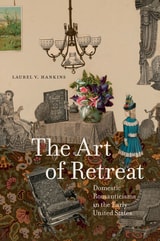
The Art of Retreat
Domestic Romanticisms in the Early United StatesLaurel V. Hankins
Bucknell University Press, 2025
The political and cultural fantasy of home as a retreat from the pressures of the world first emerged in the U.S. alongside two major nineteenth-century literary movements: Romanticism and domestic fiction. Upending accepted gendered narratives from this period, The Art of Retreat posits that these movements originated from a domestic culture already in transition, in which home was frequently a more complicated site of self-interested pleasure, coerced labor, creole social reproduction, homosocial intimacy, bachelor whimsy, petty tyranny, racial abuse, and transgender capacity. The early national periodicals, sketches, and novels examined here lend themselves to this interpretation. Hankins argues that the literary tradition emerging from these decades—one that aligned creative genius with domestic retreat—reminds us that a politics that appeals to private feeling must reckon with new interpretations of labor, kinship, and reform in exchange for the promise of consensual citizenship.
Published by Bucknell University Press. Distributed worldwide by Rutgers University Press.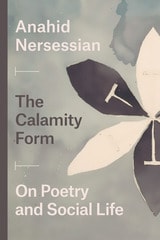
The Calamity Form
On Poetry and Social LifeAnahid Nersessian
University of Chicago Press, 2020
Anahid Nersessian explores works by Friedrich Hölderlin, William Wordsworth, John Keats, and others to argue that as the human and ecological costs of industry became clear, Romantic poetry adopted formal strategies—among them parataxis, the setting of elements side by side in a manner suggestive of postindustrial dissonance, and apostrophe, here an address to an absent or vanishing natural environment—as it tried and failed to narrate the calamities of capitalism. These tropes reflect how Romantic authors took their bewilderment and turned it into a poetics: a theory of writing, reading, and understanding poetry as an eminently critical act. Throughout, Nersessian pushes back against recent attempts to see literature as a source of information on par with historical or scientific data, arguing instead for an irreducibility of poetic knowledge. Revealing the ways in which these Romantic works are of their time but not about it, The Calamity Form ultimately exposes the nature of poetry’s relationship to capital—and capital’s ability to hide how it works.
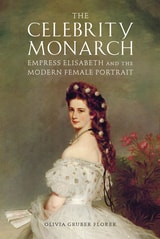
The Celebrity Monarch
Empress Elisabeth and the Modern Female PortraitOlivia Gruber Florek
University of Delaware Press, 2023
The Dangerous Lover
Gothic Villains, Byronism, and the Nineteenth-Century Seduction NarrativeDeborah Lutz
The Ohio State University Press, 2006
The dangerous lover has haunted our culture for over two hundred years; English, American, and European literature is permeated with his erotic presence. The Dangerous Lover takes seriously the ubiquity of the brooding romantic hero—his dark past, his remorseful and rebellious exile from comfortable everyday living. Deborah Lutz traces the recent history of this figure, through the melancholy iconoclasm of the Romantics, the lost soul redeemed by love of the Brontës, and the tormented individualism of twentieth-century love narratives. Arguing for this character’s central influence not only in literature but also in the history of ideas, this book places the dangerous lover firmly within the philosophy of Martin Heidegger, the Modernism of Georg Lukács, and Roland Barthes’s theories on love and longing. Working with canonical authors such as Ann Radcliffe, Charles Maturin, Lord Byron, Charles Dickens, George Eliot, and Oscar Wilde, and also with non-canonical texts such as contemporary romance, The Dangerous Lover combines a lyrical, essayistic style with a depth of inquiry that raises questions about the mysteries of desire, death, and eroticism.
The Dangerous Lover is the first book-length study of this pervasive literary hero; it also challenges the tendency of sophisticated philosophical readings of popular narratives and culture to focus on male-coded genres. In its conjunction of high and low literary forms, this volume explores new historical and cultural framings for female-coded popular narratives.
The Economy of Character
Novels, Market Culture, and the Business of Inner MeaningDeidre Shauna Lynch
University of Chicago Press, 1998
Although the story of this shift is usually told in terms of the "rise of the individual," Deidre Shauna Lynch proposes an ingenious alternative interpretation. Elaborating a "pragmatics of character," Lynch shows how readers used transactions with characters to accommodate themselves to newly commercialized social relations. Searching for the inner meanings of characters allowed readers both to plumb their own inwardness and to distinguish themselves from others. In a culture of mass consumption, argues Lynch, possessing a belief in the inexpressible interior life of a character rendered one's property truly private.
Ranging from Defoe and Smollett to Burney and Austen, Lynch's account will interest students of the novel, literary historians, and anyone concerned with the inner workings of consumer culture and the history of emotions.
The Feeling of History
Islam, Romanticism, and AndalusiaCharles Hirschkind
University of Chicago Press, 2021
Against this xenophobic tendency, The Feeling of History examines the idea of Andalucismo—a modern tradition founded on the principle that contemporary Andalusia is connected in vitally important ways with medieval Islamic Iberia. Charles Hirschkind explores the works and lives of writers, thinkers, poets, artists, and activists, and he shows how, taken together, they constitute an Andalusian sensorium. Hirschkind also carefully traces the various itineraries of Andalucismo, from colonial and anticolonial efforts to contemporary movements supporting immigrant rights. The Feeling of History offers a nuanced view into the way people experience their own past, while also bearing witness to a philosophy of engaging the Middle East that experiments with alternative futures.
The Global Wordsworth
Romanticism Out of PlaceBergren, Katherine
Bucknell University Press, 2019
Published by Bucknell University Press. Distributed worldwide by Rutgers University Press.
The Limits of Familiarity
Authorship and Romantic ReadersLindsey Eckert
Bucknell University Press, 2022
What did Wordsworth wear, and where did he walk? Who was Byron’s new mistress, and how did his marriage fare? Answers—sometimes accurate, sometimes not—were tantalizingly at the ready in the Romantic era, when confessional poetry, romans à clef, personal essays, and gossip columns offered readers exceptional access to well-known authors. But at what point did familiarity become overfamiliarity? Widely recognized as a social virtue, familiarity—a feeling of emotional closeness or comforting predictability—could also be dangerous, vulgar, or boring. In The Limits of Familiarity, Eckert persuasively argues that such concerns shaped literary production in the Romantic period. Bringing together reception studies, celebrity studies, and literary history to reveal how anxieties about familiarity shaped both Romanticism and conceptions of authorship, this book encourages us to reflect in our own fraught historical moment on the distinction between telling all and telling all too much.
The Living Dead
A Study of the Vampire in Romantic LiteratureJames B. Twitchell
Duke University Press, 1981
The Longing for Myth in Germany
Religion and Aesthetic Culture from Romanticism to NietzscheGeorge S. Williamson
University of Chicago Press, 2004
Through readings of key intellectuals ranging from Herder and Schelling to Wagner and Nietzsche, Williamson highlights three crucial factors in the emergence of the German engagement with myth: the tradition of Philhellenist neohumanism, a critique of contemporary aesthetic and public life as dominated by private interests, and a rejection of the Bible by many Protestant scholars as the product of a foreign, "Oriental" culture. According to Williamson, the discourse on myth in Germany remained bound up with problems of Protestant theology and confessional conflict through the nineteenth century and beyond.
A compelling adventure in intellectual history, this study uncovers the foundations of Germany's fascination with myth and its enduring cultural legacy.
The Orphaned Imagination
Melancholy and Commodity Culture in English RomanticismGuinn Batten
Duke University Press, 1998
Building on the theoretical insights of Slavoj Zizek, Judith Butler, Julia Kristeva, and Eve Kosofsky Sedgwick, Batten interweaves the discourses of psychoanalysis, economics, biography, sexuality, melancholy, value, and exchange to question accepted ideas of how Romantic poetry works. She asserts that poetic labor is in fact paradigmatic of the kinds of production—and the kinds of desire—that capitalist culture renders invisible. If symbolic exchange, in cash or in words, requires the surrender of a beloved object, if healthy mourning requires an orphan to “work through” emotional loss through the consolation of art or a love for the living, then the rebellious Romantic poet, Batten contends, possessed unique insight into the alternative authority of a poetic language that renounced a culture of denial. Batten urges that scholars move beyond critical approaches condemning allegedly regressive forms of pleasure, recognizing that they, too, are haunted by melancholic attachments to dead poets as they conduct their work.
The Orphaned Imagination will interest anyone concerned with the claims of the English Romantic poets to a distinctive, valuable form of knowledge and those who may wonder about the power of contemporary theory to illuminate a traditional field.
The Part and the Whole in Early American Literature, Print Culture, and Art
Matthew Pethers
Bucknell University Press, 2024
The essays in this pathbreaking collection consider the significance of varied early American fragmentary genres and practices—from diaries and poetry, to almanacs and commonplace books, to sermons and lists, to Indigenous ruins and other material shards and fragments—often overlooked by critics in a scholarly privileging of the “whole.” Contributors from literary studies, book history, and visual culture discuss a host of canonical and non-canonical figures, from Edward Taylor and Washington Irving to Mary Rowlandson and Sarah Kemble Knight, offering insight into the many intellectual, ideological, and material variations of “form” that populated the early American cultural landscape. As these essays reveal, the casting of the fragmentary as aesthetically eccentric or incomplete was a way of reckoning with concerns about the related fragmentation of nation, society, and self. For a contemporary audience, they offer new ways to think about the inevitable gaps and absences in our cultural and historical archive.
The Poet Without a Name
Gray's Elegy and the Problem of HistoryHenry Weinfield
Southern Illinois University Press, 1991
Henry Weinfield offers a new reading not only of the Elegy itself but also of its place in English literary history. His central argument is that in Gray’s Elegy the thematic constellation of poverty, anonymity, alienation, and unfulfilled potential—or what Weinfield calls the "problem of history"—is fully articulated for the first time, and that, as a result, the Elegy represents an important turning-point in the history of English poetry.
The Poetics of Unremembered Acts
Reading, Lyric, PedagogyBrian McGrath
Northwestern University Press, 2012
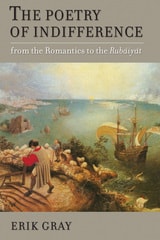
The Poetry of Indifference
From the Romantics to the RubaiyatErik Irving Gray
University of Massachusetts Press, 2005
of poetic indifference began to emerge.
The Poetry of Indifference analyzes nineteenth-century works by Wordsworth, Keats, Byron, Tennyson, Robert Browning, and Edward FitzGerald, among others—works that do not merely declare themselves to be indifferent but formally enact the indifference they describe. Each poem consciously disregards some aspect of poetry that is usually considered to be crucial or definitive, even at the risk of seeming "indifferent" in the sense of "mediocre." Such gestures discourage critical attention, since the poetry of indifference refuses to make claims for itself.
This is particularly true of FitzGerald's Rubáiyát, one of the most popular poems of the nineteenth century, but one that recent critics have almost entirely ignored. In concentrating on this underexplored mode of poetry, Gray not only traces a major shift in recent literary history, from a Romantic poetics of sympathy to a Modernist poetics of alienation, but also considers how this literature can help us understand the sometimes embarrassing but unavoidable presence of indifference in our lives.
The Progress of Romance
Literary Historiography and the Gothic NovelDavid H. Richter
The Ohio State University Press, 1900
The Rescue of Romanticism
Walter Pater and John RuskinKenneth Daley
Ohio University Press, 2001
Valuable and timely in its long historical and critical perspective on the legacy of romanticism to Victorian art and thought, The Rescue of Romanticism is the first book-length study of the close intellectual relationship between Walter Pater and John Ruskin, the two most important Victorian critics of art. Kenneth Daley explores the work and thought of both writers in context with other Victorian writers, and enlarges the issues at stake between them, connecting these issues to ongoing artistic, cultural, and political concerns of the modern world.
Professor Daley gives a more finely honed picture than ever before of romanticism’s emergence as a literary concept in Victorian England, detailing the political differences that characterize the opposition between John Ruskin and his younger contemporary, Walter Pater, over the nature of romanticism. Individual chapters reassess the Victorian reception of such romantic figures as Wordsworth, Dante Gabriel Rossetti, Leonardo, and Michelangelo.
Daley demonstrates how Pater’s “modern” reading of romanticism emerged from Ruskin’s distrust of romanticism and from Ruskin’s arguments and examples defining pathetic fallacy. His discussion of Ruskin’s Oxford lectures and their timing in Pater’s developing career refresh the intersections of the two bodies of work and the portrait of the Victorian period in general.
The Romantic Conception of Life
Science and Philosophy in the Age of GoetheRobert J. Richards
University of Chicago Press, 2002
Integrating Romantic literature, science, and philosophy with an intimate knowledge of the individuals involved—from Goethe and the brothers Schlegel to Humboldt and Friedrich and Caroline Schelling—Richards demonstrates how their tempestuous lives shaped their ideas as profoundly as their intellectual and cultural heritage. He focuses especially on how Romantic concepts of the self, as well as aesthetic and moral considerations—all tempered by personal relationships—altered scientific representations of nature. Although historians have long considered Romanticism at best a minor tributary to scientific thought, Richards moves it to the center of the main currents of nineteenth-century biology, culminating in the conception of nature that underlies Darwin's evolutionary theory.
Uniting the personal and poetic aspects of philosophy and science in a way that the German Romantics themselves would have honored, The Romantic Conception of Life alters how we look at Romanticism and nineteenth-century biology.
The Romantic Ideology
A Critical InvestigationJerome McGann
University of Chicago Press, 1983
In the course of his study, McGann analyzes both the predominant theories of Romanticism (those deriving from Coleridge, Hegel, and Heine) and the products of its major English practitioners. Words worth, Coleridge, Shelley, and Byron are considered in greatest depth, but the entire movement is subjected to a searching critique. Arguing that poetry is produced and reproduced within concrete historical contexts and that criticism must take these contexts into account, McGann shows how the ideologies embodied in Romantic poetry and theory have shaped and distorted contemporary critical activities.
The Romantic Machine
Utopian Science and Technology after NapoleonJohn Tresch
University of Chicago Press, 2012
In the years immediately following Napoleon’s defeat, French thinkers in all fields set their minds to the problem of how to recover from the long upheavals that had been set into motion by the French Revolution. Many challenged the Enlightenment’s emphasis on mechanics and questioned the rising power of machines, seeking a return to the organic unity of an earlier age and triggering the artistic and philosophical movement of romanticism. Previous scholars have viewed romanticism and industrialization in opposition, but in this groundbreaking volume John Tresch reveals how thoroughly entwined science and the arts were in early nineteenth-century France and how they worked together to unite a fractured society.
Focusing on a set of celebrated technologies, including steam engines, electromagnetic and geophysical instruments, early photography, and mass-scale printing, Tresch looks at how new conceptions of energy, instrumentality, and association fueled such diverse developments as fantastic literature, popular astronomy, grand opera, positivism, utopian socialism, and the Revolution of 1848. He shows that those who attempted to fuse organicism and mechanism in various ways, including Alexander von Humboldt and Auguste Comte, charted a road not taken that resonates today.
Essential reading for historians of science, intellectual and cultural historians of Europe, and literary and art historians, The Romantic Machine is poised to profoundly alter our understanding of the scientific and cultural landscape of the early nineteenth century.
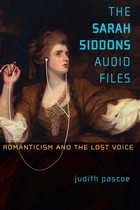
The Sarah Siddons Audio Files
Romanticism and the Lost VoiceJudith Pascoe
University of Michigan Press, 2013
“The theatre scholar’s daunting but irresistible quest to recover some echoes of performance of the past has never been more engagingly presented than in Pascoe’s account of tracing the long-silenced voice of Sarah Siddons. Her report is a warm, witty, and highly informative exploration of the methodology and the pleasures of historical research.”
—Marvin Carlson, author of The Haunted Stage: The Theatre as Memory Machine
During her lifetime (1755–1831), English actress Sarah Siddons was an international celebrity acclaimed for her performances of tragic heroines. We know what she looked like—an endless number of artists asked her to sit for portraits and sculptures—but what of her famous voice, reported to cause audiences to hyperventilate or faint? In The Sarah Siddons Audio Files, Judith Pascoe takes readers on a journey to discover how the actor’s voice actually sounded. In lively and engaging prose, Pascoe retraces her quixotic search, which leads her to enroll in a “Voice for Actors” class, to collect Lady Macbeth voice prints, and to listen more carefully to the soundscape of her life.
Bringing together archival discoveries, sound recording history, and media theory, Pascoe shows how romantic poets’ preoccupation with voices is linked to a larger cultural anxiety about the voice’s ephemerality. The Sarah Siddons Audio Files contributes to a growing body of work on the fascinating history of sound and will engage a broad audience interested in how recording technology has altered human experience.
The Saving Lie
Harold Bloom and DeconstructionAgata Bielik-Robson
Northwestern University Press, 2011
Bloom is indeed a party of one, a truly strong poet of his own mode of religious-literary criticism, who, in a typically Emersonian manner, makes his own circumstances and sheds influences by incorporating them into his idiosyncratic theory.In this unprecedented full-length study on Harold Bloom, Agata Bielik-Robson explores the many facets of Bloom’s critical writings and career. In his work, she argues, Bloom draws on a variety of disparate traditions—Judaism, gnosis, Romanticism, American pragmatism, and Freudianism, but also, especially recently, Victorian aestheticism—that comprise a dialectical, difficult whole in a constant quarrel with itself. Yet, this is precisely the image of "life-in-antithesis," which constitutes Bloom’s highest speculative achievement, she observes. The Saving Lie brings all these "Blooms" together and, despite their own tendencies toward dissociation, lets them speak unisono: in one almost harmonious voice that will clearly utter the principles of a new speculative position—Bloom’s antithetical vitalism. This study of Bloom and his contributions will not soon be surpassed.
The Shadowed Country
Claude McKay and the Romance of the VictoriansGosciak, Josh
Rutgers University Press, 2006
One of the most important voices of the Harlem Renaissance, Claude McKay is largely recognized for his work during the 1920s, which includes a major collection of poems, Harlem Shadows, as well as a critically acclaimed novel, Home to Harlem. But McKay was never completely comfortable with his literary reputation during this period. Throughout his world travels, he saw himself as an English lyricist.
In this compelling examination of the life and works of this complex poet, novelist, journalist, and short story writer, Josh Gosciak sheds light on McKay’s literary contributions beyond his interactions with Harlem Renaissance artists and writers. Working within English literary traditions, McKay crafted a verse out of hybridity and diaspora. Gosciak shows how he reinvigorated a modern pastoral through his encounters with some of the major aesthetic and political movements of the late Victorian and early modern periods.
Exploring new archival material as well as many of McKay’s lesser known poetic works, TheShadowed Country provides a unique interpretation of the writings of this major author.
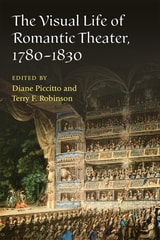
The Visual Life of Romantic Theater, 1780-1830
Edited by Diane Piccitto and Terry F. Robinson
University of Michigan Press, 2023
The Visual Life of Romantic Theater examines the dynamism and vibrancy of stage spectacle and its impact in an era of momentous social upheaval and aesthetic change. Situating theatrical production as key to understanding visuality ca. 1780-1830, this book places the stage front and center in Romantic scholarship—a field in a period long defined by its focus on poetry—by reenvisioning traditional approaches to artistic and social production. How, it asks, did dramaturgy and stagecraft influence aesthetic and sociopolitical concerns? How does a focus on visuality expand our understanding of the historical experience of theatergoing? In what ways did stage performance converge with visual culture beyond the theater? How did extra-theatrical genres engage with theatrical sight and spectacle? Finally, how does a focus on dramatic vision change the way we conceive of Romanticism itself? The volume’s essays by emerging and established scholars provide exciting and suggestive answers to these questions, along with a more capacious conception of Romantic theater as a locus of visual culture that reached well beyond playhouse walls.

Theory as Practice
A Critical Anthology of Early German Romantic WritingsJochen Schulte-Sasse, Haynes Horne, Elizabeth Mittman, Lisa C. Roetzel, Andreas Michel, Assenka Oksiloff, and Mary R. Strand, EditorsTranslated by Jochen Schulte-Sasse
University of Minnesota Press, 1997
Theory as Practice was first published in 1997. Minnesota Archive Editions uses digital technology to make long-unavailable books once again accessible, and are published unaltered from the original University of Minnesota Press editions.
In light of recent, dramatic revisions in criticism of European-particularly German-Romanticism, this anthology brings together key texts of the movement, especially those written in the last quarter of the eighteenth century by a small, influential circle centered at Jena.
In their introductory essays, the editors locate writings by Fichte, Schelling, Novalis, August Wilhelm Schlegel, and Friedrich Schlegel, among others, in this context. The selections include extensive excerpts from the correspondence of the Jena Romantics, their commentaries on each other's work, their most pertinent essays, fragments, and dialogues as well as diary entries and reviews. These works, together with the editors' articulation and elaboration of their significance, provide a new perspective on the provenance of postmodern thought and literary theory.
Jochen Schulte-Sasse is professor of German and comparative literature at the University of Minnesota and coeditor (with Wlad Godzich) of the Theory and History of Literature series at the University of Minnesota Press. Haynes Horne (University of Alabama), Andreas Michel (Indiana University), Assenka Oksiloff (New York University), Elizabeth Mittman (Michigan State University), Lisa C. Roetzel (University of Rochester), and Mary R. Strand each received a Ph.D. from the University of Minnesota.
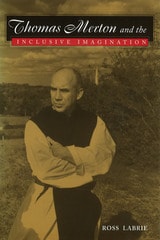
Thomas Merton and the Inclusive Imagination
Ross Labrie
University of Missouri Press, 2001
Thomas Merton (1915-1968) was a Roman Catholic priest, a Trappist monk, a social activist, and a poet. Author of the celebrated autobiography The Seven Storey Mountain, Merton has been described as the most important American religious writer of the past hundred years. One of the notable characteristics of Merton's writing, both in poetry and in prose, was his seamless intermingling of religious and Romantic elements, an intermingling that, because of his gifts as a writer and because of his enormous influence, has had the effect of making widespread a distinctive form of religious thought and expression. In Thomas Merton and the Inclusive Imagination, Ross Labrie reveals the breadth of Merton's intellectual reach by taking an original and systematic look at Merton's thought, which is generally regarded as eclectic and unsystematic.
What captured Merton's attention about Romanticism and mysticism and what held his attention virtually all his life was his consciousness of the ontological significance of unity and wholeness. Even though he was far from being a systematic thinker, Merton's writings form a coherent whole when considered from the point of view of his emphasis on unity and wholeness. Labrie skillfully examines Merton's letters, journals, and individual works to show the full expanse of his contribution. By using insights from the Romantic literary tradition and from the mystical tradition, the author is able to make sense of Merton's writings from all periods of his life. Although Labrie covers such sweeping topics as consciousness, self, being, nature, time, myth, culture, and individuation, remaining focused on Merton's specific, unique contributions in each area.
This thought-provoking work, which takes into account material from the recent full publication of Merton's journals and from his Columbia University notebooks on Romanticism, not only shows Merton's intellectual growth but provides a look at his expansive interests as well. Thomas Merton and the Inclusive Imagination will make a significant contribution to Merton studies.
Time of Beauty, Time of Fear
The Romantic Legacy in the Literature of ChildhoodJames Holt McGavran, Jr.
University of Iowa Press, 2012
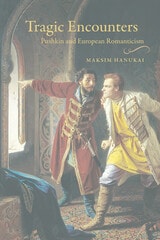
Tragic Encounters
Pushkin and European RomanticismMaksim Hanukai
University of Wisconsin Press, 2023
Many of Pushkin’s works move seamlessly between the closed world of traditional tragedy and the open world of Romantic tragic drama, and yet they follow neither the cathartic program prescribed by Aristotle nor the redemptive mythologies of the Romantics. Instead, the idiosyncratic and artistically mercurial Pushkin seized upon the newly unstable tragic mode to develop multiple, overlapping tragic visions. Providing new, innovative readings of such masterpieces as The Gypsies, Boris Godunov, The Little Tragedies, and The Bronze Horseman, Hanukai sheds light on an unexplored aspect of Pushkin’s work, while also challenging reigning theories about the fate of tragedy in the Romantic period.
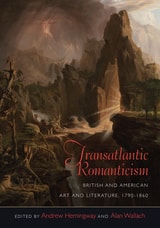
Transatlantic Romanticism
British and American Art and Literature, 1790-1860Andrew Hemingway
University of Massachusetts Press, 2014
In the book's introduction, Andrew Hemingway—building on the theoretical work of Michael Lowy and Robert Sayre—proposes that we need to remobilize the concept of Weltanschauung, or comprehensive worldview, in order to develop the kind of synthetic history of arts and ideas the phenomenon of Romanticism demands. The essays that follow focus on the London and New York art worlds and such key figures as Benjamin West, Thomas Bewick, John Vanderlyn, Washington Allston, John Martin, J. M. W. Turner, Thomas Cole, James Fenimore Cooper, George Catlin, Edgar Allan Poe, Harriet Beecher Stowe, and Herman Melville. Taken together, these essays plot the rise of a romantic anti-capitalist Weltanschauung as well as the dialectic between Romanticism's national and international manifestations.
In addition to the volume editors, contributors include Matthew Beaumont, David Bindman, Leo Costello, Nicholas Grindle, Wayne Franklin, Janet Koenig, William Pressly, Robert Sayre, William Truettner, Dell Upton, and William Vaughan.

Transcendental Wordplay
America’s Romantic Punsters and the Search for the Language of NatureMichael West
Ohio University Press, 2000
Throughout the first half of the nineteenth century, America was captivated by a muddled notion of “etymology.” New England Transcendentalism was only one outcropping of a nationwide movement in which schoolmasters across small-town America taught students the roots of words in ways that dramatized religious issues and sparked wordplay.
Shaped by this ferment, our major romantic authors shared the sensibility that Friedrich Schlegel linked to punning and christened “romantic irony.” Notable punsters or etymologists all, they gleefully set up as sages, creating jocular masterpieces from their zest for oracular wordplay. Their search for a primal language lurking beneath all natural languages provided them with something like a secret language that encodes their meanings. To fathom their essentially comic masterpieces we must decipher it.
Interpreting Thoreau as an ironic moralist, satirist, and social critic rather than a nature-loving mystic, Transcendental Wordplay suggests that the major American Romantics shared a surprising conservatism. In this award-winning study, Professor West rescues the pun from critical contempt and allows readers to enjoy it as a serious form of American humor.