Results by title
111 books match the query 'Science Fiction' and 27 start with t
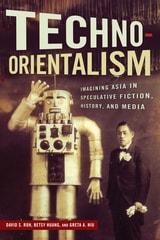
Techno-Orientalism
Imagining Asia in Speculative Fiction, History, and MediaRoh, David S.
Rutgers University Press, 2015
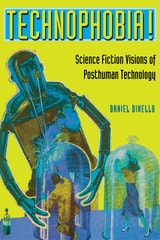
Technophobia!
Science Fiction Visions of Posthuman TechnologyBy Daniel Dinello
University of Texas Press, 2006
Techno-heaven or techno-hell? If you believe many scientists working in the emerging fields of twenty-first-century technology, the future is blissfully bright. Initially, human bodies will be perfected through genetic manipulation and the fusion of human and machine; later, human beings will completely shed the shackles of pain, disease, and even death, as human minds are downloaded into death-free robots whereby they can live forever in a heavenly "posthuman" existence. In this techno-utopian future, humanity will be saved by the godlike power of technology.
If you believe the authors of science fiction, however, posthuman evolution marks the beginning of the end of human freedom, values, and identity. Our dark future will be dominated by mad scientists, rampaging robots, killer clones, and uncontrollable viruses. In this timely new book, Daniel Dinello examines "the dramatic conflict between the techno-utopia promised by real-world scientists and the techno-dystopia predicted by science fiction."
Organized into chapters devoted to robotics, bionics, artificial intelligence, virtual reality, biotechnology, nanotechnology, and other significant scientific advancements, this book summarizes the current state of each technology, while presenting corresponding reactions in science fiction. Dinello draws on a rich range of material, including films, television, books, and computer games, and argues that science fiction functions as a valuable corrective to technological domination, countering techno-hype and reflecting the "weaponized, religiously rationalized, profit-fueled" motives of such science. By imaging a disastrous future of posthuman techno-totalitarianism, science fiction encourages us to construct ways to contain new technology, and asks its audience perhaps the most important question of the twenty-first century: is technology out of control?
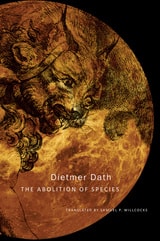
The Abolition of Species
Dietmar Dath
Seagull Books, 2012
Cyrus the Lion sends the wolf Dmitri Stepanovich on a diplomatic mission, and in the course of his journey he discovers truths about natural history, war, and politics for which he was unprepared. The subsequent war that breaks out in The Abolition of Species will come to span three planets and thousands of years—encompassing treachery and massacres, music and mathematics, savagery and decadence, as well as the terraformation of Mars and Venus and the manipulation of time itself. By turns grandiose, horrific, erotic, scathing, and visionary, The Abolition of Species is a tale of love and war after the fall of man and an epic meditation on the theory of evolution unlike any other.
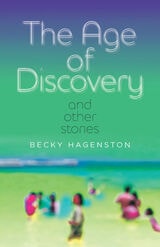
The Age of Discovery and Other Stories
Becky Hagenston
The Ohio State University Press, 2021
“These ingenious stories are so funny and sparkling and slyly inventive that their pain catches you by surprise, like a sunburn after a day at the beach.”—Eric Puchner
Winner, 2022 Mississippi Institute for Arts and Letters Prize for Best Fiction
In Becky Hagenston’s fourth collection, the real and the fantastic collide in stories that span from Mississippi to Europe, and from the recent past to the near future. The characters are sex-toy sellers, internet trolls, parents, students, and babysitters—all trying to make sense of a world where nothing is quite what it appears to be. A service robot makes increasingly disturbing requests. A middle school teacher is accused of witchcraft—and realizes the accusations might be true. Two college students devise a way to avoid getting hit on in bars. A baker finds bizarre anomalies in his sourdough. A librarian follows her dead ex-husband through the Atlanta airport. In these stories, men and women confront grief, danger, loneliness, and sometimes—the strangest discovery of all—unexpected joy. Hagenston delivers a collection that is, at its weird and shining heart, about people discovering what—for better or worse—they are capable of.

The Blond Box
Toby Olson
University of Alabama Press, 2003

The Chain of Chance
Stanislaw Lem
Northwestern University Press, 2000
On a trail leading across Europe, the ex-astronaut barely escapes numerous attempts on his life. Having set himself up as a potential victim, he realizes that he may now be the target of a conspiracy--and that the conspiracy is not the work of a criminal mind, but a manifestation of the laws of nature. Certain patterns have begun to emerge from the chaos of modern society. Some of those patterns can be fatal. . .
The Chimeras
A NovelJoe Fletcher
University of Alabama Press, 2026
Blending literary fiction, speculative fiction, and lyric prose, The Chimeras explores how communities create meaning in the wake of radical uncertainty. At its core, the novel is concerned with enduring human questions of belonging, family, memory, and faith in language itself. The book will appeal to readers of contemporary literary fiction, speculative literature, and works that push the boundaries of narrative form.
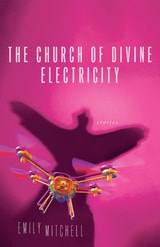
The Church of Divine Electricity
Emily Mitchell
University of Wisconsin Press, 2025
Whether being held by a giant and comforting machine, allowing micro-drones to record one’s every moment for a year to win prize money, or choosing self-mutilation in exchange for a bionic hand, these characters navigate technological and social change. The familiar can turn unrecognizable and disorienting—sometimes in a flash, sometimes gradually. Lyrical, haunting, and often funny, these stories ask us to consider what—and who—gets left out of a seemingly utopian future of technological advancements. Finely observed, thoughtful, and vivid, Mitchell’s stories get under your skin. It’s not that the best-laid plans could lead us astray—it’s that they may already have.
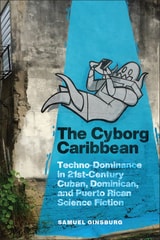
The Cyborg Caribbean
Techno-Dominance in Twenty-First-Century Cuban, Dominican, and Puerto Rican Science FictionSamuel Ginsburg
Rutgers University Press, 2023
The Cyborg Caribbean examines a wide range of twenty-first-century Cuban, Dominican, and Puerto Rican science fiction texts, arguing that authors from Pedro Cabiya, Alexandra Pagan-Velez, and Vagabond Beaumont to Yasmin Silvia Portales, Erick Mota, and Yoss, Haris Durrani, and Rita Indiana Hernandez, among others, negotiate rhetorical legacies of historical techno-colonialism and techno-authoritarianism. The authors span the Hispanic Caribbean and their respective diasporas, reflecting how science fiction as a genre has the ability to manipulate political borders. As both a literary and historical study, the book traces four different technologies—electroconvulsive therapy, nuclear weapons, space exploration, and digital avatars—that have transformed understandings of corporality and humanity in the Caribbean. By recognizing the ways that increased technology may amplify the marginalization of bodies based on race, gender, sexuality, and other factors, the science fiction texts studied in this book challenge oppressive narratives that link technological and sociopolitical progress.
The Doom of the Great City; Being the Narrative of a Survivor, Written A.D. 1942
William Delisle Hay
West Virginia University Press, 2025
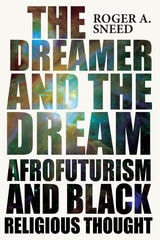
The Dreamer and the Dream
Afrofuturism and Black Religious ThoughtRoger A. Sneed
The Ohio State University Press, 2021
In The Dreamer and the Dream: Afrofuturism and Black Religious Thought, Roger A. Sneed illuminates the interplay of Black religious thought with science fiction narratives to present a bold case for Afrofuturism as an important channel for Black spirituality. In the process, he challenges the assumed primacy of the Black church as the arbiter of Black religious life. Incorporating analyses of Octavia Butler’s Parable books, Janelle Monáe’s Afrofuturistic saga, Star Trek’s Captain Benjamin Sisko, Marvel’s Black Panther, and Sun Ra and the Nation of Islam, Sneed demonstrates how Afrofuturism has contributed to Black visions of the future. He also investigates how Afrofuturism has influenced religious scholarship that looks to Black cultural production as a means of reimagining Blackness in the light of the sacred. The result is an expansive new look at the power of science fiction and Afrofuturism to center the diversity of Black spirituality.

The End of the World
Eric S Rabkin
Southern Illinois University Press, 1983
The essays selected by the editors to explore these apocalyptic visions are: “The Remaking of Zero: Beginning at the End,” by Gary K. Wolfe; “The Lone Survivor,” by Robert Plank; “Ambiguous Apocalypse: Transcendental Versions of the End,” by Robert Galbreath; “World’s End: The Imagination of Catastrophe,” by W. Warren Wagar; “Man-Made Catastrophes,” by Brian Stableford; and “The Rebellion of Nature,” by W. Warren Wagar.
Wolfe sees in these postholocaust narratives a central attraction—“the mythic power inherent in the very conception of a remade world.” This power derives from three sources: the emergence of a new order from the ashes of the old system, and thus a kind of denial of death; the reinforcement of one set of values as opposed to another; and as something always replaces whatever was destroyed, a promise that nothing can annihilate humanity.

The Fixed Period
Anthony Trollope
University of Michigan Press, 1990
Trollope’s satiric portrayal of the statisticians who calculate the savings to be realized by putting the old people away before they become an expensive catastrophic burden, and the ironic presentation of the narrator’s justification of euthanasia by appeal to Christian practice and doctrine, will delight contemporary readers. Trollope’s strong dislike of government bureaucracy is evident throughout, as is his awareness of the dangers to the world of an imagined weapon of destruction not unlike (in its effect) the atomic bomb.
In making accessible the complete text of this work with corrections from the original manuscript, Super has performed an invaluable service for Trollope scholars and enthusiasts.
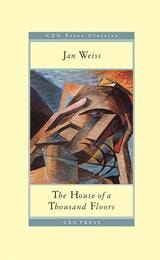
The House of a Thousand Floors
Jan Weiss
Central European University Press, 2017
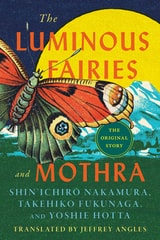
The Luminous Fairies and Mothra
Takehiko Fukunaga
University of Minnesota Press, 2026
The original story that hatched Mothra, one of the most beloved monsters in the “kaijuverse”—available in English for the first time
Mystical and benevolent, the colossal lepidopteran Mothra has been one of the most beloved kaiju since 1961, when The Luminous Fairies and Mothra was originally published in Japanese. Commissioned by Tōhō Studios from three of Japan’s most prominent postwar literary writers (Shin’ichirō Nakamura, Takehiko Fukunaga, and Yoshie Hotta), the novella formed the basis for the now-classic monster film Mothra, with a protagonist second only to Godzilla in number of film appearances by a kaiju. Finally available in its first official English translation, The Luminous Fairies and Mothra will captivate ardent, longtime fans of the films as well as newcomers.
Written just months after the largest political demonstrations Japan had ever seen, The Luminous Fairies and Mothra reflects the rebellious spirit of the time. In this original story, explorers visit a South Pacific island and capture a group of fairies, inciting the fury of the goddess Mothra, who sets out for Japan on a mission of rescue and revenge. Expressing a powerful social stance about Japan’s need to chart its own foreign policy during the Cold War, the novella’s political message was ultimately toned down in the Tōhō Studios film. Through this translation, Anglophone audiences will discover Mothra as a figure of protest fiction intricately reflecting the complex geopolitical situation in early 1960s Japan.
The Luminous Fairies and Mothra is translated into lively prose by Jeffrey Angles, who also wrote an extensive afterword about the novella’s cultural context, the unusual story of its composition, and the development of the 1961 film. Following Angles’s best-selling translation of the original Godzilla novellas, this new work will once again delight kaiju fans everywhere.
Retail e-book files for this title are screen-reader friendly with images accompanied by short alt text and/or extended descriptions.

The Motion Of Light In Water
Sex And Science Fiction Writing In The East VillageSamuel R. Delany
University of Minnesota Press, 2004
Winner of the Hugo Award for Non-fiction
The unexpurgated edition of the award-winning autobiography
Born in New York City’s black ghetto Harlem at the start of World War II, Samuel R. Delany married white poet Marilyn Hacker right out of high school. The interracial couple moved into the city’s new bohemian quarter, the Lower East Side, in summer 1961. Through the decade’s opening years, new art, new sexual practices, new music, and new political awareness burgeoned among the crowded streets and cheap railroad apartments. Beautifully, vividly, insightfully, Delany calls up this era of exploration and adventure as he details his development as a black gay writer in an open marriage, with tertiary walk-ons by Bob Dylan, Stokely Carmichael, W. H. Auden, and James Baldwin, and a panoply of brilliantly drawn secondary characters.

The Religion of Science Fiction
Frederick A. Kreuziger
University of Wisconsin Press, 1986
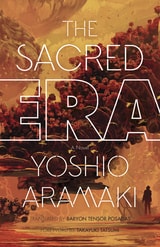
The Sacred Era
A NovelAramaki Yoshio
University of Minnesota Press, 2017
The magnum opus of a Japanese master of speculative fiction, and a book that established Yoshio Aramaki as a leading representative of the genre, The Sacred Era is part post-apocalyptic world, part faux-religious tract, and part dream narrative. In a distant future ruled by a new Papal Court serving the Holy Empire of Igitur, a young student known only as K arrives at the capital to take The Sacred Examination, a text that will qualify him for metaphysical research service with the court. His performance earns him an assignment in the secret Planet Bosch Research Department; this in turn puts him on the trail of a heretic executed many years earlier, whose headless ghost is still said to haunt the Papal Court, which carries him on an interplanetary pilgrimage across the Space Taklamakan Desert to the Planet Loulan, where time stands still, and finally to the mysterious, supposedly mythical Planet Bosch, a giant, floating plant-world that once orbited Earth but has somehow wandered 1,000 light years away.
K’s journey to this strange world, seemingly sprung from Hieronymus Bosch’s Garden of Earthly Delights, is a journey into inner and outer space, as the novel traffics in mystic and metaphysical questions only to transform them into technical and astrophysical problems, translating the substance of religious and mythic texts into the language of science fiction.
The Science Fiction of Kris Neville
Barry N. Malzberg
Southern Illinois University Press, 1984
Other stories in this anthology are “Old Man Henderson,” “The Hunter,” “Underground Movement,” “The Forest of Zil,” and “From the Government Printing Office.”
In most of the stories Neville writes of loneliness, isolation, alienation, intolerance of anything or anyone different, and of insanity created by the pressures of living. Along with madness of various kinds, his stories explore the essence of human nature and individuals interacting with one another as well as with society. As Malzberg notes, Neville, unlike many science fiction writers, was a serious author interested in “Big ideas.”
The Science Fiction of Mark Clifton
Edited by Barry N. Malzberg and Martin H. Greenberg.
Southern Illinois University Press, 1980
This collection of the best short stories of Mark Clifton makes these fine tales readily available for the first time in two decades.
Winner with Frank Riley of the 1955 Hugo Award for They’d Rather Be Right,Clifton has for a variety of reasons unrelated to the quality of his writing all but disappeared from the awareness of today’s science fiction audience. Never a prolific writer he had published only about twenty-five short stories before his death in 1963.But with those stories and his three novels he irrevocably altered the course of contemporary science fiction.
Almost single-handedly he introduced the full range of psychological insights to the commonly occurring themes of the genre—alien invasion, expanding technology, revolution against political theocracy, and space exploration and colonization—to ever more truthfully portray how humanity would react to a future that could be either mindless or intellectually stunning.
With his first published story, “What Have I Done?” Clifton initiated the theme of a starkly realistic world in which, at its best, humanity is inalterably vile—a theme that became an inextricable part of all his subsequent works. In his later works Clifton occasionally clothed his bitter indictment in the garb of comedy.
The stories collected here include “What Have I Done?” “Star, Bright,” “Crazy Joey,” “What Thin Partitions,” “Sense from Thought Divide,” “How Allied,” “Remembrance and Reflection,” “Hide! Hide! Witch!” “Clerical Error,” “What Now, Little Man?” and “Hang Head, Vandal!”
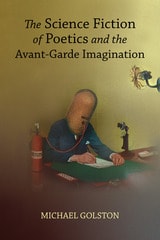
The Science Fiction of Poetics and the Avant-Garde Imagination
Michael Golston
University of Alabama Press, 2024
This insightful, playful monograph from Golston does exactly what it advertises: modeling poetics based on how poetry (and some parallel artistic endeavors) has filtered through a century-plus of science fiction. This is not a book about science fiction in and of itself, but it is a book about the resonances of science-fiction tropes and ideas in poetic language.
The germ of Golston’s project is a throwaway line in Robert Smithson’s Entropy and the New Monuments about how cinema supplanted nature as inspiration for many of his fellow artists: “The movies give a ritual pattern to the lives of many artists, and this induces a kind of ‘low budget’ mysticism, which keeps them in a perpetual trance.” Golston charts how the demotic appeal of sci-fi, much like that of the B-movie, cross-pollinated into poetry and other branches of the avant garde.
Golston creates what he calls a “regular Rube Goldberg machine” of a critical apparatus, drawing on Walter Benjamin, Roman Jakobson, and Gilles Deleuze. He starts by acknowledging that, per the important work of Darko Suvin to situate science fiction critically, the genre is premised on cognitive estrangement. But he is not interested in the specific nuts and bolts of science fiction as it exists but rather how science fiction has created a model not only for other poets but also for musicians and landscape artists.
Golston’s critical lens moves around quite a bit, but he begins with familiar enough subjects: Edgar Rice Burroughs, Mina Loy, William S. Burroughs. From there he moves into more “alien” terrain: Ed Dorn’s long poem Gunslinger, the discombobulated work of Clark Coolidge. Sun Ra, Ornette Coleman, and Jimi Hendrix all come under consideration. The result of Golston’s restless, rich scholarship is the first substantial monograph on science fiction and avant-garde poetics, using Russian Formalism, Frankfurt School dialectics, and Deleuzian theory to show how the avant-garde inherently follows the parameters of sci fi, in both theme and form.

The Songs of Betty Baach
Glenn Taylor
University of Massachusetts Press, 2023
Finalist for the 2023 Weatherford Fiction Award
Some called her the Everywhen Woman. She claimed to be 321 years of age. In 2038, after the big storm and the great flood and the bad times, Betty Baach wrote these words down and sometimes spoke them aloud, at her homeplace on Freon Hill. She referred to them as songs. All stories are songs, she’d always say.
Set in West Virginia, The Songs of Betty Baach is a magical guide to resisting despair and a compendium of wisdom and rhythms by which to fortify oneself. The lives of the Baaches of Keystone and the Knoxes of Mosestown twist and connect in a tale of survival and retribution that crosses three centuries—moving from Betty’s girlhood in colonial America to a future warped by environmental collapse and political unrest. Refusing the erasure of the lives of women, Indigenous peoples, and Black people who have always called this region home, this eloquent and distinctive novel is a necessary remedy for the continued distortion of a land and its inhabitants.
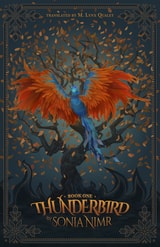
Thunderbird
Book OneSonia Nimr, translated by M. Lynx Qualey
University of Texas Press, 2022
Shortlisted for the 2023 Saif Ghobash Banipal Prize for Arabic Literary Translation, Society of Authors
A Palestinian girl travels to the past in a magical quest to save the world.
The Thunderbird trilogy is a fast-paced time-traveling fantasy adventure centered on Noor, a young orphaned Palestinian girl who starts in the present and must go back in time to get four magical bird feathers and save the world. Aided by a djinn cat and girls who look identical to Noor and who each have one of the bird’s powers, in this initial volume Noor begins her journey through different historical periods, striving to keep the wall between worlds intact.
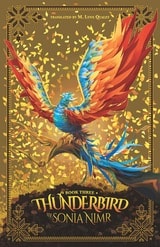
Thunderbird
Book ThreeSonia Nimr, translated by M. Lynx Qualey
University of Texas Press, 2024
The third book in a fast-paced time-traveling fantasy adventure trilogy centered on a young orphaned Palestinian girl who starts in the present and must go back in time to save the world.
In the third and final book of the Thunderbird trilogy, Noor finds herself in Byzantine Jerusalem, in the year 638 CE, where the city is under siege. She is joined by Sabeeka, the djinn who takes the form of a cat, and meets the twins Helena and Julian, who have the power of healing. The four team up to find the thunderbird. But before they can, they are swallowed by a giant wormlike creature called a bakasola, which takes them to the world beyond the wall that separates the world of the djinn from our ordinary human world. From the terrifying, dark, gloomy world of the bakasola, Noor and her friends are rescued and delivered to the colorful and peaceful world of the sakarik, where they discover the bakasola are stealing the golden liquid that keeps the sakarik alive. Will Noor and her friends rescue the sakarik and return to the human world in time to find the last two thunderbird feathers that will save the world?
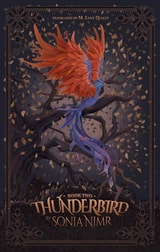
Thunderbird
Book TwoSonia Nimr, translated by M. Lynx Qualey
University of Texas Press, 2022
Shortlisted for the 2023 Saif Ghobash Banipal Prize for Arabic Literary Translation, Society of Authors
A Palestinian girl travels to the past in a magical quest to save the world.
The Thunderbird trilogy is a fast-paced time-traveling fantasy adventure centered on Noor, a young orphaned Palestinian girl who starts in the present and must go back in time to get four magical bird feathers and save the world.
In this second installment, Noor finds herself in the year 1177 in Jerusalem, during the Crusades. With the help of Sabeeka, Zainab, a girl who has the power to become invisible, and her local resistance group, Noor must once again find a feather belonging to the thunderbird before it burns, in order to prevent the world of the djinn from collapsing into the human world. Along the way, Noor helps the resistance group save hundreds of books and manuscripts from being burned. Like the first book in the Thunderbird trilogy, Book Two combines the magical with real events from Palestinian history to take the reader on a wild and adventurous ride through time.

Time Gifts
Zoran Zivkovic
Northwestern University Press, 2000
Tomorrowing
Terry Bisson
Duke University Press, 2024