Results by title
53 books match the query 'Secondary' and 13 start with t

Teens, Digital Media, and the Chicago Public Library
Penny Bender Sebring, Eric R. Brown, Kate M. Julian, Stacy B. Ehrlich, Susan E. Sporte, Erin Bradley, and Lisa Meyer
University of Chicago Press, 2013
Consortium on Chicago School Research finds.
-Illuminates how the design of YOUmedia shapes youth participation
-Describes the teens that YOUmedia serves, their patterns of participation, and the activities in which they engage
-Provides examples of the benefits youth perceive from their participation
-Characterizes the roles adults play in engaging teens and the ways programmatic choices have shifted
-Offers suggestions for organizations intending to launch similar initiatives
-Illustrates how YOUmedia instantiates elements of the emerging Connected Learning Model
The Black Model Minority Student
African Immigrants and the Contradictions of Race in AmericaMercy Agyepong
University of Chicago Press, 2027
Explores the contradictory perceptions of African immigrant students in New York City and reveals how anti-Blackness persists even within predominantly Black and Brown schools.
African immigrant students are often celebrated in the United States as academically successful and culturally disciplined. But what happens when praise itself becomes part of a racial hierarchy? In The Black Model Minority Student, sociologist of education Mercy Agyepong traces the complex experiences of West African immigrant students attending public high schools in New York City.
Using ethnographic and interview data from predominantly Black and Brown schools in the Bronx, Agyepong shows that African immigrant students are often viewed through two competing yet coexisting narratives: as intellectually capable and hardworking, yet also as uncivilized or socially inferior. These perceptions are not incidental, but central to how anti-Blackness operates and how racial hierarchies are sustained in the United States. While the model minority stereotype shaped their experiences in Black and Brown high schools, West African immigrant students found that this seemingly favorable stereotype mattered less once they graduated and entered the white spaces of higher education and other social settings. At every step, African students—regardless of their national origins—were disadvantaged by racial stereotypes.
Theoretically grounded yet deeply human, The Black Model Minority Student offers an important new perspective on race, immigration, and education in contemporary America.
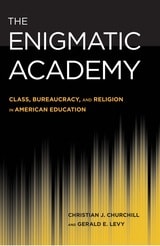
The Enigmatic Academy
Class, Bureaucracy, and Religion in American EducationChristian J. Churchill
Temple University Press, 2012
The Enigmatic Academy is a provocative look at the purpose and practice of education in America. Authors Christian Churchill and Gerald Levy use three case studies—a liberal arts college, a boarding school, and a Job Corps center—to illustrate how class, bureaucratic, and secular-religious dimensions of education prepare youth for participation in American foreign and domestic policy at all levels.
The authors describe how schools contribute to the formation of a bureaucratic character; how middle and upper class students are trained for leadership positions in corporations, government, and the military; and how the education of lower class students often serves more powerful classes and institutions.
Exploring how youth and their educators encounter the complexities of ideology and bureaucracy in school, The Enigmatic Academy deepens our understanding of the flawed redemptive relationship between education and society in the United States. Paradoxically, these three studied schools all prepare students to participate in a society whose values they oppose.
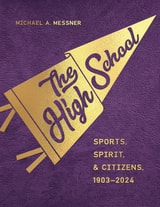
The High School
Sports, Spirit, and Citizens, 1903-2024Michael A. Messner
Rutgers University Press, 2025
In The High School, acclaimed sociologist Michael A. Messner reads through 120 years of El Gabilan, the yearbook from his own alma mater, Salinas High School in California, where his father taught and coached. Treating the yearbooks as a historical archive, Messner makes surprising discoveries about the school he thought he knew so well. For example, over fifty years before Title IX, the earliest yearbooks gave equal spotlights to boys’ and girls’ athletics, while the cheerleaders were all boys.
Tracing American life and culture from 1903 to 2024, Messner illuminates shifts in social practices at his high school that reflect broader changes in American culture across the twentieth century. The High School spotlights how the meanings and iconography of certain activities have changed radically over the decades, even as the “sports spirit complex”—involving athletes, cheerleaders, band members, and community boosters—has remained a central part of the high school experience. By exploring evolving sports cultures, socioeconomic conditions, racial demographics, and gender norms, Messner offers a fresh perspective on a defining feature of American teenage life.
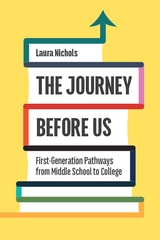
The Journey Before Us
First-Generation Pathways from Middle School to CollegeLaura Nichols
Rutgers University Press, 2020
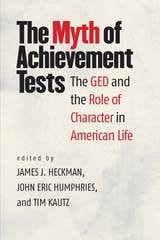
The Myth of Achievement Tests
The GED and the Role of Character in American LifeEdited by James J. Heckman, John Eric Humphries, and Tim Kautz
University of Chicago Press, 2013
The Myth of Achievement Tests shows that achievement tests like the GED fail to measure important life skills. James J. Heckman, John Eric Humphries, Tim Kautz, and a group of scholars offer an in-depth exploration of how the GED came to be used throughout the United States and why our reliance on it is dangerous. Drawing on decades of research, the authors show that, while GED recipients score as well on achievement tests as high school graduates who do not enroll in college, high school graduates vastly outperform GED recipients in terms of their earnings, employment opportunities, educational attainment, and health. The authors show that the differences in success between GED recipients and high school graduates are driven by character skills. Achievement tests like the GED do not adequately capture character skills like conscientiousness, perseverance, sociability, and curiosity. These skills are important in predicting a variety of life outcomes. They can be measured, and they can be taught.
Using the GED as a case study, the authors explore what achievement tests miss and show the dangers of an educational system based on them. They call for a return to an emphasis on character in our schools, our systems of accountability, and our national dialogue.
Contributors
Eric Grodsky, University of Wisconsin–Madison
Andrew Halpern-Manners, Indiana University Bloomington
Paul A. LaFontaine, Federal Communications Commission
Janice H. Laurence, Temple University
Lois M. Quinn, University of Wisconsin–Milwaukee
Pedro L. Rodríguez, Institute of Advanced Studies in Administration
John Robert Warren, University of Minnesota, Twin Cities
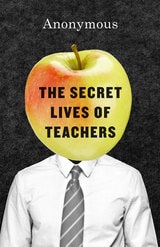
The Secret Lives of Teachers
Anonymous
University of Chicago Press, 2015
This is not a how-to manual. Rather, the author explores the dimensions of teaching that no one else has, those private thoughts few would dare put into a book but that form an important part of the day-to-day experience of a teacher. We see him ponder the clothes that people wear, think frankly about money (and the imbalance of its distribution), get wrangled by parents, provide on-the-fly psychotherapy, drape niceties over conversations that are actually all-out warfare, drop an f-bomb or two, and deal with students who are just plain unlikeable. We also see him envy, admire, fear, and hope; we see him in adulation and uncertainty, and in energy and exhaustion. We see him as teachers really are: human beings with a complex, rewarding, and very important job.
There has been no shortage of commentary on the teaching profession over the decades, but none quite like this. Unflinching, wry, and at times laugh-out-loud funny, it’s written for every teacher out there who has ever scrambled, smirked, or sighed—and toughed it out nonetheless.
The Sex Education Debates
Nancy Kendall
University of Chicago Press, 2012
There Has to Be a Better Way
Lessons from Former Urban TeachersMawhinney, Lynnette
Rutgers University Press, 2019
Teacher attrition has long been a significant challenge within the field of education. It is a commonly-cited statistic that almost fifty percent of beginning teachers leave the field within their first five years, to the detriment of schools, students, and their own career development. There Has to be a Better Way offers an essential voice in understanding the dynamics of teacher attrition from the perspective of the teachers themselves. Drawing upon in-depth qualitative research with former teachers from urban schools in multiple regions of the United States, Lynnette Mawhinney and Carol R. Rinke identify several themes that uncover the rarely-spoken reasons why teachers so often willingly leave the classroom. The authors go further to provide concrete recommendations for how school administrators can better support their practicing teachers, as well as how teacher educators might enhance preparation for the next generation of educators. Complete with suggested readings and discussion questions, this book serves as an indispensable resource in understanding and building an effective and productive educational workforce for our nation’s students.
These Kids
Identity, Agency, and Social Justice at a Last Chance High SchoolKysa Nygreen
University of Chicago Press, 2013
Top Student, Top School?
How Social Class Shapes Where Valedictorians Go to CollegeAlexandria Walton Radford
University of Chicago Press, 2013
Watch an interview of Alexandria Walton Radford discussing her book here: http://www.youtube.com/watch?v=F81c1D1BpY0
Toxic Schools
High-Poverty Education in New York and AmsterdamBowen Paulle
University of Chicago Press, 2013
When Bowen Paulle speaks of toxicity, he speaks of educational worlds dominated by intimidation and anxiety, by ambivalence, degradation, and shame. Based on six years of teaching and research in the South Bronx and in Southeast Amsterdam, Toxic Schools is the first fully participatory ethnographic study of its kind and a searing examination of daily life in two radically different settings. What these schools have in common, however, are not the predictable ideas about race and educational achievement but the tragically similar habituated stress responses of students forced to endure the experience of constant vulnerability. From both sides of the Atlantic Ocean, Paulle paints an intimate portrait of how students and teachers actually cope, in real time, with the chronic stress, peer group dynamics, and subtle power politics of urban educational spaces in the perpetual shadow of aggression.
Turning the Soul
Teaching through Conversation in the High SchoolSophie Haroutunian-Gordon
University of Chicago Press, 1991
One class, located in a private, racially integrated urban school, has had many conversations about the meaning of books. The second group, less advantaged students in a largely black urban school, has not. The reader watches as students in each group begin to draw upon experiences in their personal lives to speculate about events in the play. The students assist one another with the interpretation of complex passages, pose queries that help sustain the conversation, and struggle to "get Shakespeare right." Though the teachers suffer moments of intense frustration, they are rewarded by seeing their students learn to engage in meaningful exchange.
Because Turning the Soul draws on actual classroom conversations, it presents the range of difficulties that one encounters in interpretive discussion. The book describes the assumptions about learning that the use of such discussion in the classroom presupposes, and it offers a theoretical perspective from which to view the changes in both students and teachers.