Results by title
82 books match the query 'Semantics' and 18 start with t
The Construction of Meaning
Edited by David I. Beaver, Luis D. Casillas Martinez, Brady Z. Clark, and Stefan
CSLI, 2002
The Daily Lives of the Anglo-Saxons
Carole Biggam
Arizona Center for Medieval and Renaissance Studies, 2017
Insights into the lives of any group of historical people are provided by three main types of evidence: their language, their literature and their material culture. The contributors to this volume draw on all three types of evidence in order to present new research into the lives of the Anglo-Saxons. The particular focus is on daily life – the ordinary rather than the extraordinary, the normal rather than the exceptional. Rather than attempting an overview, the essays address individual scenarios in greater depth, but with an emphasis on shared experience.
The following scholars have contributed essays to this collection:
Martha Bayless
University of Oregon
Carole P. Biggam
University of Glasgow
Paul Cavill
University of Nottingham
Amy W. Clark
University of California, Berkeley
James Graham-Campbell
University College London
Antonina Harbus
Macquarie University, Sydney
Carole Hough
University of Glasgow
Daria Izdebska
Liverpool Hope University
Karen Louise Jolly
University of Hawai‘i at Mānoa
Alexandra Lester-Makin
University of Manchester
Elisabeth Okasha
University College, Cork
Phyllis Portnoy
University of Manitoba
Jane Roberts
University of London
The Generic Book
The Semantics of GenericsEdited by Gregory N. Carlson and Francis Jeffry Pelletier
University of Chicago Press, 1995
The Language Parallax
Linguistic Relativism and Poetic IndeterminacyBy Paul Friedrich
University of Texas Press, 1986
Humankind has always been fascinated and troubled by the way languages and dialects differ. Linguistically based differences in point of view have preoccupied many original minds of the past, such as Kant, and remain at the forefront of language study: in philosophy, anthropology, literary criticism, and other fields.
Paul Friedrich's The Language Parallax argues persuasively that the "locus and focus" of differences among languages lies not so much in practical or rational aspects as in the complexity and richness of more poetic dimensions—in the nuances of words, or the style and voice of an author. This poetic reformulation of what has been called "linguistic relativism" is grounded in the author's theory of the imagination as a main source of poetic indeterminacy. The reformulation is also based on the intimate relation of the concentrated language of poetry to the potential or possibilities for poetry in ordinary conversation, dreams, and other experiences. The author presents challenging thoughts on the order and system of language in their dynamic relation to indeterminacy and, ultimately, disorder and chaos.
Drawing on his considerable fieldwork in anthropology and linguistics, Friedrich interweaves distinct and provocative elements: the poetry of language difference, the indeterminacy in dialects and poetic forms, the discovery of underlying orders, the workings of different languages, the strength of his own poetry. The result is an innovative and organic whole.
The Language Parallax, then, is a highly original work with a single bold thesis. It draws on research and writing that has involved, in particular, English, Russian, and the Tarascan language of Mexico, as well as the personal and literary study of the respective cultures. Anthropologist, linguist, and poet, Friedrich synthesizes from his experience in order to interrelate language variation and structure, the creative individual, ideas of system-in-process, and questions of scientific and aesthetic truth. The result is a new view of language held to the light of its potentially creative nature.
The Many Faces of Agreement
Morphology, Syntax, Semantics, and Discourse Factors in Serbo-Croatian AgreementStephen Wechsler and Larisa Zlatic
CSLI, 2003
With this framework in place, the authors explore a number of factors that affect agreement processes. The theory even explains the striking cross-linguistic generalizations expressed in Corbett's Agreement Hierarchy. Agreement is shown to be a distributed phenomenon, manifesting its many faces among the various components of grammar.
The Projection of Arguments
Lexical and Compositional FactorsEdited by Miriam Butt and Wilhelm Geuder
CSLI, 1998
The Semantic Basis of Argument Structure
Stephen Wechsler
CSLI, 1995
The Semantics of Incorporation
From Argument Structure to Discourse TransparencyDonka F. Farkas and Henriëtte de Swart
CSLI, 2003
The analysis presented in this book has important consequences for a cross-linguistic theory of anaphora. Linguists and logicians interested in discourse structure, cross-linguistic semantics, and the relationship between morpho-syntax and meaning will find this an engaging and innovative work.

The Semantics of Syntax
A Minimalist Approach to GrammarDenis Bouchard
University of Chicago Press, 1995
The Semantics of Syntax is an elegant and powerful analysis of the relationship between syntax and semantics. Noting that meaning is underdetermined by form even in simple cases, Denis Bouchard argues that it is impossible to build knowledge of the world into grammar and still have a describable grammar. He thus proposes simple semantic representations and simple rules to relate linguistic levels. Focusing on a class of French verbs, Bouchard shows how multiple senses can be accounted for by the assumption of a single abstract core meaning along with background information about how objects behave in the world. He demonstrates that this move simplifies the syntax at no cost to the descriptive power of the semantics. In two important final chapters, he examines the consequences of his approach for standard syntactic theories.
The Semantics/Pragmatics Distinction
Edited by Claudia Bianchi
CSLI, 2005
The Syntactic Phenomena of English
James D. McCawley
University of Chicago Press, 1998
And now available from the author! Answers to Selected Exercises.
Instructors using James D. McCawley's The Syntactic Phenomena of English, Second Edition may request a complimentary copy of Answers to Selected Exercises in The Syntactic Phenomena of English by writing on their department's letterhead to the author, James D. McCawley, Department of Linguistics, 1010 E. 59th Street, Chicago, IL 60637. [Note: This material is available only from the author and is not available from the University of Chicago Press.]
The Syntax and Semantics of the Verb in Classical Greek
An Introduction: Third EditionAlbert Rijksbaron
University of Chicago Press, 2007
The verb is, in any language, the motor of all communication: no verb, no action. In Greek, verb forms change not only with person, number, tense, and voice, but in four possible moods as well. Available now in a special reprint for the North American market, The Syntax and Semantics of the Verb in Classical Greek is an incomparable resource to students and scholars charged with the considerable task of untangling the Greek language’s many complexities. With clear, concise instruction, Albert Rijksbaron shows how the various verb forms contribute to the richness of the Greek literature as we know it, in this essential guide for both novices and experienced practitioners.
“[This study] belongs in the library of any Hellenist and any linguist interested in ancient Greek.”—Classics Newsletter (Anzeiger für die Altertumswissenschaft)
“Every use is described with concision and clarity.”—Kratylos
“The book offers an example of how the empirical thoroughness of traditional Classical scholarship can be brought into contact with general linguistic theory.”—Language
The Tbilisi Symposium on Logic, Language and Computation
Selected PapersEdited by Jonathan Ginzburg, Zurab Khasidashvili, Carl Vogel, Jean-Jacques Lévy,
CSLI, 1998
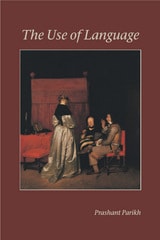
The Use of Language
Prashant Parikh
CSLI, 2001
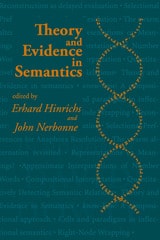
Theory and Evidence in Semantics
Edited by Erhard W. Hinrichs and John Nerbonne
CSLI, 2009
In Theory and Evidence in Semantics, editors Erhard W. Hinrichs and John Nerbonne present a series of state-of-the-art papers that investigate the interface of natural language semantics with other modules of grammar—such as morphology, syntax, and pragmatics—and pursue applications of semantic theory in computational linguistics. Written by some of the leading scholars in the field, and strongly influenced by the seminal work of David R. Dowty in model-theoretical semantics, the papers provide novel accounts of highly complex sets of semantic phenomena, including anaphora, coordination, ellipsis, interrogatives, and negative and collective predicates, as well as tense and aspect.
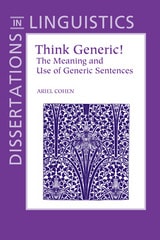
Think Generic!
The Meaning and Use of Generic SentencesAriel Cohen
CSLI, 1999

Three Demonstrations and a Funeral and Other Essays
Maria de Ponte, Kepa Korta, and John Perry
CSLI, 2024
The result of the collaboration between three distinguished philosophers, this book comprises the best sample of one of the most original theories in contemporary philosophy of language and communication—Critical Pragmatics. They present the development of the theory from its initial sprout, with “Three Demonstrations and a Funeral” (2006) as its first visible result, to a critical clarification of its tenets in “Critical Pragmatics: Nine Misconceptions” (2023). After Korta and Perry’s Critical Pragmatics (2011), this is the most important book on Critical Pragmatics, as it was conceived, developed and applied by its creators. Having de Ponte, Korta and Perry’s most important papers together on one place will be of great value to both philosophers and linguists.
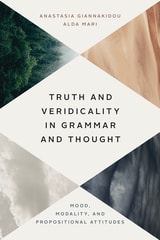
Truth and Veridicality in Grammar and Thought
Mood, Modality, and Propositional AttitudesAnastasia Giannakidou and Alda Mari
University of Chicago Press, 2021
Can language directly access what is true, or is the truth judgment affected by the subjective, perhaps even solipsistic, constructs of reality built by the speakers of that language? The construction of such subjective representations is known as veridicality, and in this book Anastasia Giannakidou and Alda Mari deftly address the interaction between truth and veridicality in the grammatical phenomena of mood choice: the indicative and subjunctive choice in the complements of modal expressions and propositional attitude verbs.
Combining several strands of analysis—formal linguistic semantics, syntactic theory, modal logic, and philosophy of language—Giannakidou and Mari’s theory not only enriches the analysis of linguistic modality, but also offers a unified perspective of modals and propositional attitudes. Their synthesis covers mood, modality, and attitude verbs in Greek and Romance languages, while also offering broader applications for languages lacking systematic mood distinction, such as English. Truth and Veridicality in Grammar and Thought promises to shape longstanding conversations in formal semantics, pragmatics, and philosophy of language, among other areas of linguistics.