Results by title
546 books match the query 'Semiotics & Theory' and 143 start with t
TEXT
Transactions of the Society for Textual Scholarship, Volume 7D. C. Greetham and W. Speed Hill, Editors
University of Michigan Press, 1994
Talk and Textual Production in Medieval England
Marisa Libbon
The Ohio State University Press, 2021
Tell Me a Story
Narrative and IntelligenceRoger C. Schank
Northwestern University Press, 1995
Territories and Trajectories
Cultures in CirculationDiana Sorensen, editor
Duke University Press, 2018
Contributors. Homi Bhabha, Jacqueline Bhabha, Lindsay Bremner, Finbarr Barry Flood, Rosario Hubert, Alina Payne, Kay Kaufman Shelemay, Shu-mei Shih, Diana Sorensen, Karen Thornber, Xiaofei Tian
Terror, Theory and the Humanities
Jeffrey R. Di Leo and Uppinder Mehan, editors
Michigan Publishing Services, 2012

Text
The Genealogy of an Antidisciplinary ObjectJohn Mowitt
Duke University Press, 1992
Beginning with the Tel Quel group in France in the sixties and seventies, Mowitt's study details how a certain interdisciplinary crisis prompted academics to rethink the conditions of cultural interpretation. Concentrating on three disciplinary projects—literary analysis, film studies, and musicology—Mowitt shows how textuality's emergence called into question not merely the relations among these disciplines, but also the cultural logic of disciplinary reason as such.
At once an effort to define "the text" and to explore and extend the theory of textuality, this book illustrates why the notion of interdisciplinary research has recently acquired such urgency. At the same time, by emphasizing the genealogical dimension of the textual object, Mowitt raises the issues of its "antidisciplinary" character, and by extension its immediate pertinence for the current debates over multiculturalism and Eurocentrism.
Textual Awareness
A Genetic Study of Late Manuscripts by Joyce, Proust, and MannDirk Van Hulle
University of Michigan Press, 2004
A key issue in both textual criticism and the so-called crisis of the novel is the tension between the finished and the unfinished. After a theoretical examination of the relationship between genetic and textual criticism, Dirk Van Hulle uses the three case studies to show how?at each stage in the writing process?the text still had the potential of becoming something entirely different; how and why these geneses proceeded the way they did; how Joyce, Proust, and Mann allowed contingencies to shape their work; how these authors recycled the words of their critics in order to inoculate their works against them; how they shaped an intertextual dimension through the processing of source texts and reading notes; and how text continually generated more text.
Van Hulle's exploration of process sheds new light on the remarkable fact that so many modernist authors protected their manuscripts, implying both the authors' urge to grasp everything and their awareness of the dangers of their encyclopedic projects. Textual Awareness offers new insights into the artificiality of the artifact?the novel?that are relevant to the study of literary modernism in general and the study of James Joyce, Marcel Proust, and Thomas Mann in particular.
Dirk Van Hulle is Assistant Professor of English and German Literature, University of Antwerp.

The Academic Postmodern and the Rule of Literature
A Report on Half-KnowledgeDavid Simpson
University of Chicago Press, 1995
Simpson examines defining features of postmodern thought—storytelling, autobiography, anecdote, and localism—and traces their unacknowledged roots in literature and literary criticism. Considering such examples as the conversational turn in philosophy led by Richard Rorty and the anecdotal qualities of the New Historicism, he argues that much of contemporary scholarship is literary in its terms, methods, and assumptions about knowledge; in their often unconscious adoption of literary approaches, scholars in philosophy, history, anthropology, and other disciplines have confined themselves to a traditional—and limited—way of looking at the world. Simpson is the first to uncover the largely unacknowledged ancestry of the key paradigms and sensibilities of the academic postmodern—tracing their roots to nineteenth-century Romanticism and to more general traditions of literature. He warns scholars against mistaking the migration of ideas from one discipline to another for a radically new response to the postmodern age.
In his nuanced and balanced assessment of the academic postmodern enterprise, Simpson recognizes that both the literary turn and the emphasis on local, subjective voices have done much to enrich knowledge. But he also identifies the danger in abandoning synthetic knowledge to particular truths, cautioning that "we would be foolish to pretend that little narratives are true alternatives to grand ones, rather than chips off a larger block whose shape we can no longer see because we are not looking."
The Affect Theory Reader
Melissa Gregg and Gregory J. Seigworth, eds.
Duke University Press, 2010
Contributors. Sara Ahmed, Ben Anderson, Lauren Berlant, Lone Bertelsen, Steven D. Brown, Patricia Ticineto Clough, Anna Gibbs,Melissa Gregg, Lawrence Grossberg, Ben Highmore, Brian Massumi, Andrew Murphie, Elspeth Probyn, Gregory J. Seigworth, Kathleen Stewart, Nigel Thrift, Ian Tucker, Megan Watkins
The Affect Theory Reader 2
Worldings, Tensions, FuturesGregory J. Seigworth and Carolyn Pedwell, editors
Duke University Press, 2023
Contributors. Lauren Berlant, Lisa Blackman, Rizvana Bradley, Ann Cvetkovich, Ezekiel J. Dixon-Román, Adam J. Frank, M. Gail Hamner, Omar Kasmani, Cecilia Macón, Hil Malatino, Erin Manning, Derek P. McCormack, Patrick Nickleson, Susanna Paasonen, Tyrone S. Palmer, Carolyn Pedwell, Jasbir K. Puar, Jason Read, Michael Richardson, Dylan Robinson, Tony D. Sampson, Kyla Schuller, Gregory J. Seigworth, Nathan Snaza, Kathleen Stewart, Elizabeth A. Wilson
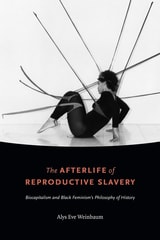
The Afterlife of Reproductive Slavery
Biocapitalism and Black Feminism’s Philosophy of HistoryAlys Eve Weinbaum
Duke University Press, 2019
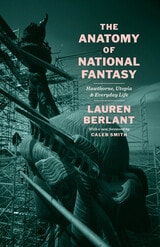
The Anatomy of National Fantasy
Hawthorne, Utopia, and Everyday LifeLauren Berlant
University of Chicago Press, 2026
A classic work that launched the career of one of the most influential scholars of their generation.
Lauren Berlant influenced generations of scholars in gender studies, affect theory, literary criticism, anthropology, sociology, and beyond. Her first book, The Anatomy of National Fantasy, was published in 1991, and it marked the start of an extraordinary career of groundbreaking essays, editorial collaborations, and monographs. This new edition reintroduces Berlant’s earliest work with a new foreword by Caleb Smith, who connects Berlant’s initial investigations as a scholar of nineteenth-century American literature to her more widely known interventions in how we understand the entanglements of national ideology, citizenship, affect, and everyday life.
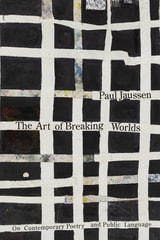
The Art of Breaking Worlds
On Contemporary Poetry and Public LanguagePaul Jaussen
Northwestern University Press, 2027
Showing how poetics provides a path for building new imagined possibilities
Drawing together a robust corpus of contemporary USAmerican poetry, The Art of Breaking Worlds explores social and political breaks: disasters, failures, and disruptions that simultaneously constitute and fracture the world. These breaks range from unsuccessful political movements and acts of resistance to mass incarceration and biopolitical violence, from anti-Black racism to the infrastructural catastrophes of climate collapse. Paul Jaussen shows how poetry responds to such disasters by incorporating public-facing genres and discourses into its literary practice, thereby rewriting into aesthetic form the public languages used to perpetuate or contain that rupture. This poetic integration of public language thus generates a third space, located between the rhetorical and the aesthetic, a literary practice of both world-breaking and world-making that transforms existing genres while also creating newly imagined modes of collectivity. Grounded in contemporary theory and close readings of works by poets such as Claudia Rankine, Juliana Spahr, and Ilya Kaminsky, this book proposes that these dynamics require a distinctive critical poetics, one simultaneously attuned to discourses of struggle and discourses of art, modeling a fresh approach to the relationship between politics and literature.
The Barbara Johnson Collective
Edited by Devin M. Garofalo and Nathan K. Hensley
Northwestern University Press, 2027
Collaboratively reassesses Barbara Johnson’s legacy as a reader and thinker with an eye to contemporary conditions
Across an archive of essays on abortion and race, Mallarmé and Melville, feminist philosophy, rhetorical device, and pedagogical method, Barbara Johnson built a legacy of thought whose energies reverberate into the present. This collected volume gathers writers and critics from a range of North American higher educational settings to engage with this essential but still often underappreciated critic in a time of renewed and deepening crisis.
In Zoom meetings and shared essays, across a virtualized map of today’s academic and para-academic worlds, the group assessed how the rolling catastrophes of late neoliberalism continue to stage the sort of analogy Johnson herself would highlight between patriarchy, capitalism, ecocide, and other forms of structural violence. Emerging from that assemblage, this experimental collection tracks Johnson’s efforts to link literary reading with concrete matters of personhood and care at a moment when the very system of higher education that enabled Johnson’s work in the 1980s and 1990s faces existential threat. The frozen record of a live experience, the book is an impure procedure, tangled in the idiom of its own unfolding: a temporary culmination of an ongoing collaborative undertaking that will always remain unfinished.

The Barbara Johnson Reader
The Surprise of OthernessBarbara Johnson
Duke University Press, 2014
Along with the classic essays that established her place in literary scholarship, this Reader makes available a selection of Johnson's later essays, brilliantly lucid and politically trenchant works exploring multilingualism and translation, materiality, ethics, subjectivity, and sexuality. The Barbara Johnson Reader offers a historical guide through the metamorphoses and tumultuous debates that have defined literary study in recent decades, as viewed by one of critical theory's most astute thinkers.
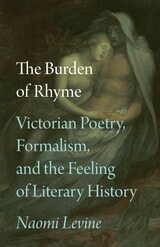
The Burden of Rhyme
Victorian Poetry, Formalism, and the Feeling of Literary HistoryNaomi Levine
University of Chicago Press, 2024
The Burden of Rhyme shows how the nineteenth-century search for the origin of rhyme shaped the theory and practice of poetry. For Victorians, rhyme was not (as it was for the New Critics, and as it still is for us) a mere technique or ahistorical form. Instead, it carried vivid historical fantasies derived from early studies of world literature. Naomi Levine argues that rhyme’s association with the advent of literary modernity and with a repertoire of medievalist, Italophilic, and orientalist myths about love, loss, and poetic longing made it a sensitive historiographic instrument. Victorian poets used rhyme to theorize both literary history and the most elusive effects of aesthetic form. This Victorian formalism, which insisted on the significance of origins, was a precursor to and a challenge for twentieth-century methods. In uncovering the rich relationship between Victorian poetic forms and a forgotten style of literary-historical thought, The Burden of Rhyme reveals the unacknowledged influence of Victorian poetics—and its repudiation—on the development of modern literary criticism.
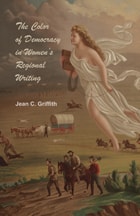
The Color of Democracy in Women's Regional Writing
Jean Carol Griffith
University of Alabama Press, 2009
Exploring how women writers used regional fiction to reimagine democracy, identity, and belonging in America.
American regionalism has become a contested subject in literary studies alongside the ubiquitous triad of race, class, and gender. The Color of Democracy in Women's Regional Writing enters into the heart of an ongoing debate in the field about the significance of regional fiction at the end of the 19th century. Jean Griffith presents the innovative view that regional writing provided Edith Wharton, Ellen Glasgow, and Willa Cather with the means to explore social transformation in a form of fiction already closely associated with women readers and writers.
Griffith provides new readings of texts by these authors; she places them alongside the works of their contemporaries, including William Faulkner and Langston Hughes, to show regionalism's responses to the debate over who was capable of democratic participation and reading regionalism's changing mediations between natives and strangers as reflections of the changing face of democracy.
This insightful work enriches the current debate about whether regionalism critiques hierarchies or participates in nationalist and racist agendas and will be of great interest to those invested in regional writing or the works of these significant authors.
The Comic Self
Toward DispossessionTimothy C. Campbell
University of Minnesota Press, 2023
A provocative and unconventional call to dispossess the self of itself
Challenging the contemporary notion of “self-care” and the Western mania for “self-possession,” The Comic Self deploys philosophical discourse and literary expression to propose an alternate and less toxic model for human aspiration: a comic self. Timothy Campbell and Grant Farred argue that the problem with the “care of the self,” from Foucault onward, is that it reinforces identity, strengthening the relation between I and mine. This assertion of self-possession raises a question vital for understanding how we are to live with each other and ourselves: How can you care for something that is truly not yours?
The answer lies in the unrepresentable comic self. Campbell and Farred range across philosophy, literature, and contemporary comedy—engaging with Socrates, Burke, Hume, Hegel, Marx, Nietzsche, Heidegger, Derrida, Deleuze, and Levinas; Shakespeare, Cervantes, Woolf, Kafka, and Pasolini; and Stephen Colbert, David Chappelle, and the cast of Saturday Night Live. They uncover spaces where the dispossession of self and, with it, the dismantling of the regime of self-care are possible. Arguing that the comic self always keeps a precarious closeness to the tragic self, while opposing the machinations of capital endemic to the logic of self-possession, they provide a powerful and provocative antidote to the tragic self that so dominates the tenor of our times.
The Creolization of Theory
Françoise Lionnet and Shu-mei Shih, eds.
Duke University Press, 2011
Contributors. Étienne Balibar, Dominique Chancé, Pheng Cheah, Leo Ching, Liz Constable, Anne Donadey, Fatima El-Tayeb, Julin Everett, Édouard Glissant, Barnor Hesse, Ping-hui Liao, Françoise Lionnet, Walter Mignolo, Andrea Schwieger Hiepko, Shu-mei Shih
The Cultural Logic of Contemporary Capitalism
Nico Baumbach, Damon R. Young, and Genevieve Yue, special issue editors
Duke University Press, 0
In 1984 Fredric Jameson wrote that “everything in our social life—from economic value and state power to practices and to the very structure of the psyche itself—can be said to have become ‘cultural’ in some original and yet untheorized sense.” The essays in this special issue track the status of this claim some thirty years later, inquiring into the relationship of art, aesthetics, and cultural production to political economy today. At a moment when interpretation (including “ideology critique” and “symptomatic reading”) has been variously supplanted by descriptivism, empiricism, and the return of metaphysics, contributors here pursue the possibilities for an engaged cultural criticism that is attentive to form while rejecting a depoliticized formalism. Spanning a wide range of cultural sites—from recent Hollywood cinema to post-broadcast television, manufactured landscape photography, contemporary West African art, and “new materialism” in philosophy—they ask what the “formal tendencies” of contemporary cultural production (including theory itself) can tell us about the cultural logic of contemporary capitalism. The collection includes a new interview with Jameson conducted by the editors.
Contributors: Jennifer Bajorek, Nico Baumbach, Jonathan Beller, Alexander R. Galloway, Fredric Jameson, Sulgi Lie, Alberto Toscano, Amy Villarejo, Damon R. Young, Genevieve Yue
The Cultural Logic of Late Capitalism
The Postmodernism EssayFredric Jameson. Introduction by Michael Hardt.
Duke University Press, 2026
The Darker Side of Western Modernity
Global Futures, Decolonial OptionsWalter D. Mignolo
Duke University Press, 2011
The Deaths of the Author
Reading and Writing in TimeJane Gallop
Duke University Press, 2011
The Deconstruction of Sex
Jean-Luc Nancy and Irving Goh
Duke University Press, 2021
The Deliverance of Others
Reading Literature in a Global AgeDavid Palumbo-Liu
Duke University Press, 2012
The influential literary critic David Palumbo-Liu suggests that we can arrive at a sense of responsibility toward others by reconsidering the discourses of sameness that deliver those unlike ourselves to us. Through virtuoso readings of novels by J. M. Coetzee, Nadine Gordimer, Kazuo Ishiguro, and Ruth Ozeki, he shows how notions that would seem to offer some basis for commensurability between ourselves and others—ideas of rationality, the family, the body, and affect—become less stable as they try to accommodate more radical types of otherness. For Palumbo-Liu, the reading of literature is an ethical act, a way of thinking through our relations to others.
The Dialogic Imagination
Four EssaysBy M. M. Bakhtin
University of Texas Press, 1982
These essays reveal Mikhail Bakhtin (1895-1975)—known in the West largely through his studies of Rabelais and Dostoevsky—as a philosopher of language, a cultural historian, and a major theoretician of the novel. The Dialogic Imagination presents, in superb English translation, four selections from Voprosy literatury i estetiki (Problems of literature and esthetics), published in Moscow in 1975. The volume also contains a lengthy introduction to Bakhtin and his thought and a glossary of terminology.
Bakhtin uses the category "novel" in a highly idiosyncratic way, claiming for it vastly larger territory than has been traditionally accepted. For him, the novel is not so much a genre as it is a force, "novelness," which he discusses in "From the Prehistory of Novelistic Discourse." Two essays, "Epic and Novel" and "Forms of Time and of the Chronotope in the Novel," deal with literary history in Bakhtin's own unorthodox way. In the final essay, he discusses literature and language in general, which he sees as stratified, constantly changing systems of subgenres, dialects, and fragmented "languages" in battle with one another.
The Difference Aesthetics Makes
On the Humanities “After Man”Kandice Chuh
Duke University Press, 2019
The Dreams of Interpretation
A Century down the Royal RoadCatherine Liu
University of Minnesota Press, 2007
Rethinking the importance of Sigmund Freud’s landmark book The Interpretation of Dreams a century after its publication in 1900, this work brings together psychoanalysts, philosophers, cultural theorists, film and visual theorists, and literary critics from several continents in a compilation of the best clinical and theoretical work being done in psychoanalysis today. It is unique in convening both theory and practice in productive dialogue, reflecting on the encounter between psychoanalysis and the tradition of hermeneutics. Collectively the essays argue that Freud’s legacy has shaped the way we think about not only psychology and the nature of the self but also our understanding of politics, culture, and even thought itself.
Contributors: Willy Apollon, Gifric; Karyn Ball, U of Alberta, Edmonton; Raymond Bellour, Centre National de la Recherche Scientifique; Patricia Gherovici, Philadelphia Lacan Study Group and Seminar; Judith Feher-Gurewich, New York U; Jonathan Kahana, New York U; A. Kiarina Kordela, Macalester College; Pablo Kovalovsky, Clinica de Borde; Jean Laplanche, U of Lausanne; Laura Marcus, U of Sussex; Andrew McNamara, Queensland U of Technology; Claire Nahon; Yun Peng, U of Minnesota; Gerard Pommier, Nantes U; Jean-Michel Rabaté, Princeton U; Laurence A. Rickels, U of California, Santa Barbara; Avital Ronell, New York U; Elke Siegel, Yale U; Rei Terada, U of California, Irvine; Klaus Theweleit, U of Freiburg-im-Breisgau; Paul Verhaege, U of Ghent, Belgium; Silke-Maria Weineck, U of Michigan.
Catherine Liu is associate professor of comparative literature and film and media studies at the University of California, Irvine. John Mowitt is professor and chair of cultural studies and comparative literature at the University of Minnesota. Thomas Pepper is associate professor of cultural studies and comparative literature at the University of Minnesota. Jakki Spicer received her Ph.D. in cultural studies and comparative literature from the University of Minnesota.
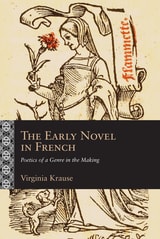
The Early Novel in French
Poetics of a Genre in the MakingVirginia Krause
Northwestern University Press, 2027
Examining the role of changes in print technologies and poetics in the early novel
Around the same time that Aristotle’s Poetics was reemerging from obscurity, Rabelais was composing his Pantagruel series, while a host of influential works in a chivalric, sentimental, or pastoral vein were being imported from Spain and Italy. From this emergent corpus, Rabelais’s is the only name to have unambiguously made it into our modern canon of literary history, where he appears to stand alone as an early pioneer of the novel. The Early Novel in French: Poetics of a Genre in the Making explores the literary, cultural, and eminently material soil in which these early forms of what we would come to know as the novel originally took root, showing how they were imaginatively responding to the practices and uncertainties of the literary texts of their own era as well as to works of classical antiquity.
Within the flowering of experimental fictional forms in mid-sixteenth-century France, Virginia Krause identifies historical subplots shaping the development of this genre. As rhetorical culture continued to animate fictions through an active literary tradition, print culture was changing the very fabric of books. The early novel was thus at once rhetorically fashioned and technologically manufactured. Meanwhile, the legacy of medieval romance adventure persisted, making the early novel in French both a new laboratory for Aristotelian immersion and a vehicle for a mysterious and fugitive romanesque. Krause sheds fresh light on this new and rapidly evolving genre: its lifelike personas or “person-fictions”; its material forms, from pocket-sized volumes to vast literary serials; its immersive powers; and its underappreciated role in the production of the modern author.
The Edge of Meaning
James Boyd White
University of Chicago Press, 2001
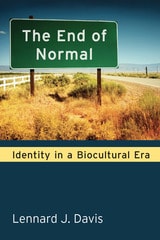
The End of Normal
Identity in a Biocultural EraLennard J. Davis
University of Michigan Press, 2014
In an era when human lives are increasingly measured and weighed in relation to the medical and scientific, notions of what is “normal” have changed drastically. While it is no longer useful to think of a person’s particular race, gender, sexual orientation, or choice as “normal,” the concept continues to haunt us in other ways. In The End of Normal, Lennard J. Davis explores changing perceptions of body and mind in social, cultural, and political life as the twenty-first century unfolds. The book’s provocative essays mine the worlds of advertising, film, literature, and the visual arts as they consider issues of disability, depression, physician-assisted suicide, medical diagnosis, transgender, and other identities.
Using contemporary discussions of biopower and biopolitics, Davis focuses on social and cultural production—particularly on issues around the different body and mind. The End of Normal seeks an analysis that works comfortably in the intersection between science, medicine, technology, and culture, and will appeal to those interested in cultural studies, bodily practices, disability, science and medical studies, feminist materialism, psychiatry, and psychology.
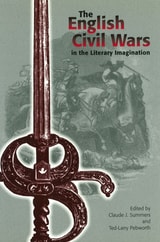
The English Civil Wars in the Literary Imagination
Edited by Claude J. Summers & Ted-Larry Pebworth
University of Missouri Press, 1999
The English civil wars loom large in seventeenth-century history and literature. This period, which culminated in the execution of a king, the dismantling of the Established Church, the inauguration of a commonwealth, and the assumption of rule by a lord protector, was one of profound change and disequilibrium. Focusing on writers as major as Milton, Marvell, Herrick, and Vaughan, and as misunderstood as Fane, Overton, and the poet Eliza, the fifteen essays in this collection discuss not only the representation of the civil wars but also the ways in which the civil wars were anticipated, refigured, and refracted in the century's literary imagination.
Although all of the essays are historically grounded and critically based, they vary widely in their historical perspectives and critical techniques, as well as in their scope and area of concentration. Six of the essays are on Royalist literary figures, six are on figures traditionally associated with the Parliamentarian side of the civil wars, two consider both, and the remaining essay examines how Royalist writers refashioned a puritan literary trope.
Unified through the contributors' concentration on "moderate" voices and their recurrent concerns with the ambiguities of literary response, The English Civil Wars in the Literary Imagination provides an important understanding of the English civil wars' manifold and sometimes indirect presence in the literature of the period.
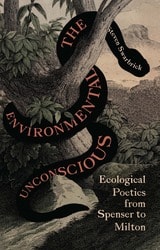
The Environmental Unconscious
Ecological Poetics from Spenser to MiltonSteven Swarbrick
University of Minnesota Press, 2023
Bringing psychoanalysis to bear on the diagnosis of ecological crisis
Why has psychoanalysis long been kept at the margins of environmental criticism despite the many theories of eco-Marxism, queer ecology, and eco-deconstruction available today? What is unique, possibly even traumatic, about eco-psychoanalysis? The Environmental Unconscious addresses these questions as it provides an innovative and theoretical account of environmental loss focused on the counterintuitive forms of enjoyment that early modern poetry and psychoanalysis jointly theorize.
Steven Swarbrick urges literary critics and environmental scholars fluent in the new materialism to rethink notions of entanglement, animacy, and consciousness raising. He introduces concepts from psychoanalysis as keys to understanding the force of early modern ecopoetics. Through close readings of Edmund Spenser, Walter Ralegh, Andrew Marvell, and John Milton, he reveals a world of matter that is not merely hyperconnected, as in the new materialism, but porous and off-kilter. And yet the loss these poets reveal is central to the enjoyment their works offer—and that nature offers.
As insightful as it is engaging, The Environmental Unconscious offers a provocative challenge to ecocriticism that, under the current regime of fossil capitalism in which everything solid interconnects, a new theory of disconnection is desperately needed. Tracing the propulsive force of the environmental unconscious from the early modern period to Freudian and post-Freudian theories of desire, Swarbrick not only puts nature on the couch in this book but also renews the psychoanalytic toolkit in light of environmental collapse.
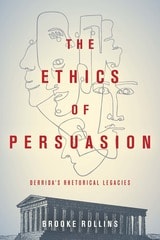
The Ethics of Persuasion
Derrida's Rhetorical LegaciesBrooke Rollins
The Ohio State University Press, 2020
Drawing on Derrida’s (non)definition of ethics and his pointed accounts of performativity, Rollins argues that this vital ethical component of many ancient theories, practices, and pedagogies of persuasion has been undertheorized for more than two millennia. Through deconstructive readings of some of these texts, she shows us that we are not simply sovereign beings who both wield and guard against linguistic techniques of rule. Our persuasive endeavors, rather, are made possible by an ethics—an always prior encounter with otherness that interrupts self-presence.
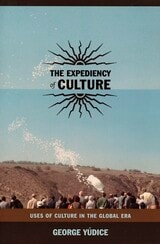
The Expediency of Culture
Uses of Culture in the Global EraGeorge Yúdice
Duke University Press, 2003
Yúdice contends that a new international division of cultural labor has emerged, combining local difference with transnational administration and investment. This does not mean that today’s increasingly transnational culture—exemplified by the entertainment industries and the so-called global civil society of nongovernmental organizations—is necessarily homogenized. He demonstrates that national and regional differences are still functional, shaping the meaning of phenomena from pop songs to antiracist activism. Yúdice considers a range of sites where identity politics and cultural agency are negotiated in the face of powerful transnational forces. He analyzes appropriations of American funk music as well as a citizen action initiative in Rio de Janeiro to show how global notions such as cultural difference are deployed within specific social fields. He provides a political and cultural economy of a vast and increasingly influential art event— insite a triennial festival extending from San Diego to Tijuana. He also reflects on the city of Miami as one of a number of transnational “cultural corridors” and on the uses of culture in an unstable world where censorship and terrorist acts interrupt the usual channels of capitalist and artistic flows.
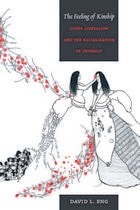
The Feeling of Kinship
Queer Liberalism and the Racialization of IntimacyDavid L. Eng
Duke University Press, 2010
Eng develops the concept of “queer diasporas” as a critical response to queer liberalism. A methodology drawing attention to new forms of family and kinship, accounts of subjects and subjectivities, and relations of affect and desire, the concept differs from the traditional notions of diaspora, theories of the nation-state, and principles of neoliberal capitalism upon which queer liberalism thrives. Eng analyzes films, documentaries, and literature by Asian and Asian American artists including Wong Kar-wai, Monique Truong, Deann Borshay Liem, and Rea Tajiri, as well as a psychoanalytic case history of a transnational adoptee from Korea. In so doing, he demonstrates how queer Asian migrant labor, transnational adoption from Asia, and the political and psychic legacies of Japanese internment underwrite narratives of racial forgetting and queer freedom in the present. A focus on queer diasporas also highlights the need for a poststructuralist account of family and kinship, one offering psychic alternatives to Oedipal paradigms. The Feeling of Kinship makes a major contribution to American studies, Asian American studies, diaspora studies, psychoanalysis, and queer theory.
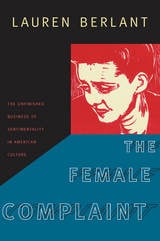
The Female Complaint
The Unfinished Business of Sentimentality in American CultureLauren Berlant
Duke University Press, 2008
Pairing literary criticism and historical analysis, Berlant explores the territory of this intimate public sphere through close readings of U.S. women’s literary works and their stage and film adaptations. Her interpretation of Uncle Tom’s Cabin and its literary descendants reaches from Harriet Beecher Stowe to Toni Morrison’s Beloved, touching on Shirley Temple, James Baldwin, and The Bridges of Madison County along the way. Berlant illuminates different permutations of the women’s intimate public through her readings of Edna Ferber’s Show Boat; Fannie Hurst’s Imitation of Life; Olive Higgins Prouty’s feminist melodrama Now, Voyager; Dorothy Parker’s poetry, prose, and Academy Award–winning screenplay for A Star Is Born; the Fay Weldon novel and Roseanne Barr film The Life and Loves of a She-Devil; and the queer, avant-garde film Showboat 1988–The Remake. The Female Complaint is a major contribution from a leading Americanist.
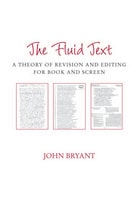
The Fluid Text
A Theory of Revision and Editing for Book and ScreenJohn Bryant
University of Michigan Press, 2002
The author develops his theory and its critical application drawing upon the example of Melville's Typee, using its various versions to present protocols for fluid text analysis. He shows how the mountain of scholarly material comprising the fluid text can be presented by a partnership of book and computer screen, in ways that offer new opportunities, insights,and pleasures for scholars and readers.
The Fluid Text: A Theory of Revision and Editing for Book and Screen is written in a clear and accessible style and will appeal to scholars and students in editorial theory, literary criticism and analysis, and anyone concerned with the information architecture of complex literary works in digital media.
John Bryant is Professor of English, Hofstra University. His most recent book is an edition of Melville's Tales, Poems, and Other Writings.
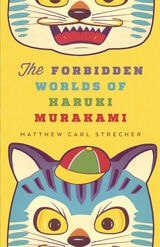
The Forbidden Worlds of Haruki Murakami
Matthew Carl Strecher
University of Minnesota Press, 2014
In an “other world” composed of language—it could be a fathomless Martian well, a labyrinthine hotel or forest—a narrative unfolds, and with it the experiences, memories, and dreams that constitute reality for Haruki Murakami’s characters and readers alike. Memories and dreams in turn conjure their magical counterparts—people without names or pasts, fantastic animals, half-animals, and talking machines that traverse the dark psychic underworld of this writer’s extraordinary fiction.
Fervently acclaimed worldwide, Murakami’s wildly imaginative work in many ways remains a mystery, its worlds within worlds uncharted territory. Finally in this book readers will find a map to the strange realm that grounds virtually every aspect of Murakami’s writing. A journey through the enigmatic and baffling innermost mind, a metaphysical dimension where Murakami’s most bizarre scenes and characters lurk, The Forbidden Worlds of Haruki Murakami exposes the psychological and mythological underpinnings of this other world. Matthew Carl Strecher shows how these considerations color Murakami’s depictions of the individual and collective soul, which constantly shift between the tangible and intangible but in this literary landscape are undeniably real.
Through these otherworldly depths The Forbidden Worlds of Haruki Murakami also charts the writer’s vivid “inner world,” whether unconscious or underworld (what some Japanese critics call achiragawa, or “over there”), and its connectivity to language. Strecher covers all of Murakami’s work—including his efforts as a literary journalist—and concludes with the first full-length close reading of the writer’s newest novel, Colorless Tsukuru Tazaki and His Years of Pilgrimage.
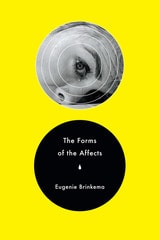
The Forms of the Affects
Eugenie Brinkema
Duke University Press, 2014
Offering a bold corrective to the emphasis on embodiment and experience in recent affect theory, Eugenie Brinkema develops a novel mode of criticism that locates the forms of particular affects within the specific details of cinematic and textual construction. Through close readings of works by Roland Barthes, Hollis Frampton, Sigmund Freud, Peter Greenaway, Michael Haneke, Alfred Hitchcock, Søren Kierkegaard, and David Lynch, Brinkema shows that deep attention to form, structure, and aesthetics enables a fundamental rethinking of the study of sensation. In the process, she delves into concepts as diverse as putrescence in French gastronomy, the role of the tear in philosophies of emotion, Nietzschean joy as a wild aesthetic of repetition, and the psychoanalytic theory of embarrassment. Above all, this provocative work is a call to harness the vitality of the affective turn for a renewed exploration of the possibilities of cinematic form.
The Gift of Freedom
War, Debt, and Other Refugee PassagesMimi Thi Nguyen
Duke University Press, 2012
The Gothic Family Romance
Heterosexuality, Child Sacrifice, and the Anglo-Irish Colonial OrderMargot Gayle Backus
Duke University Press, 1999
Backus uses contemporary theory, including that of Michel Foucault and Eve Kosofsky Sedgwick, to analyze texts by authors ranging from Richardson, Swift, Burke, Edgeworth, Stoker, and Wilde to contemporary Irish novelists and playwrights.
By charting the changing relations between the family and the British state, she shows how these authors dramatized a legacy of violence within the family cell and discusses how disturbing themes of child sacrifice and colonial repression are portrayed through irony, satire, “paranoid” fantasy, and gothic romance. In a reconceptualization of the Freudian family romance, Backus argues that the figures of the Anglo-Irish gothic embody the particular residue of childhood experiences within a settler colonial society in which biological reproduction represented an economic and political imperative.
Backus’s bold positioning of the nuclear family at the center of post-Enlightenment class and colonial power relations in England and Ireland will challenge and provoke scholars in the fields of Irish literature and British and postcolonial studies. The book will also interest students and scholars of women’s studies, and it has important implications for understanding contemporary conflicts in Ireland.
The Hall of Mirrors
Drafts & Fragments and the End of Ezra Pound's CantosPeter Stoicheff
University of Michigan Press, 1995
The Heretical Archive
Digital Memory at the End of FilmDomietta Torlasco
University of Minnesota Press, 2013
The Heretical Archive examines the relationship between memory and creation in contemporary artworks that use digital technology while appropriating film materials. Domietta Torlasco argues that these digital films and multimedia installations radically transform our memory of cinema and our understanding of the archive. Indeed, such works define a notion of archiving not as the passive preservation of audiovisual signs but as an intervention and the creative rearticulation of cinema’s perceptual and political textures.
Connecting psychoanalysis, phenomenology, and feminist theory in innovative ways, Torlasco analyzes cutting-edge digital works that engage with the past of European cinema and visual culture, including video installations by Monica Bonvicini (Destroy She Said) and Pierre Huyghe (The Ellipsis), Agnès Varda’s film The Gleaners and I, Marco Poloni’s multimedia installation The Desert Room, and Chris Marker’s CD-ROM Immemory.
Torlasco’s central claim is that if the archives of psychoanalysis and cinema have long privileged the lineage that runs from Oedipus to Freud, the archives of the digital age—what she calls the “heretical archive”—can help us imagine an unruly, porous, multifaceted legacy, one in which marginal figures return to speak of lost life as much as of life that demands to be lived.
The Historicity of Experience
Modernity, the Avant-Garde, and the EventKrysztof Ziarek
Northwestern University Press, 2001
The four poets Ziarek considers—Gertrude Stein, Velimir Khlebnikov, Miron Biaoszewski, and Susan Howe—demonstrate the broad reach of and variety of forms taken by the avant-garde revision of experience and aesthetics. Moreover, this quartet illustrates how the main operative concepts and strategies of the avant-garde underpinned the practices of canonical writers. A profound philosophical meditation on language, modernity, and the everyday, The Historicity of Experience offers a fundamental reconceptualization of the avant-garde in relation to experience.
The Hundreds
Lauren Berlant and Kathleen Stewart
Duke University Press, 2019
The Iconic Page in Manuscript, Print, and Digital Culture
George Bornstein and Theresa Tinkle, Editors
University of Michigan Press, 1998
The material features of texts as physical artifacts--their "bibliographic codes" --have over the last decade excited increasing interest in a variety of disciplines. The Iconic Page in Manuscript, Print, and Digital Culture gathers essays by an extraordinarily distinguished group of scholars to offer the most comprehensive examination of these issues yet, drawing on examples from literature, history, the fine arts, and philosophy.
Fittingly, the volume contains over two dozen illustrations that display the iconic features of the works analyzed--from Alfred the Great's Boethius through medieval manuscripts to the philosophy of C. S. Peirce and the dustjackets on works by F. Scott Fitzgerald and William Styron.
The Iconic Page in Manuscript, Print, and Digital Culture will be groundbreaking reading for scholars in a wide range of fields.
George Bornstein is C. A. Patrides Professor of English, University of Michigan. Theresa Tinkle is Associate Professor of English, University of Michigan.
The Idea of Indian Literature
Gender, Genre, and Comparative MethodPreetha Mani
Northwestern University Press, 2022
Indian literature is not a corpus of texts or literary concepts from India, argues Preetha Mani, but a provocation that seeks to resolve the relationship between language and literature, written in as well as against English. Examining canonical Hindi and Tamil short stories from the crucial decades surrounding decolonization, Mani contends that Indian literature must be understood as indeterminate, propositional, and reflective of changing dynamics between local, regional, national, and global readerships. In The Idea of Indian Literature, she explores the paradox that a single canon can be written in multiple languages, each with their own evolving relationships to one another and to English.
Hindi, representing national aspirations, and Tamil, epitomizing the secessionist propensities of the region, are conventionally viewed as poles of the multilingual continuum within Indian literature. Mani shows, however, that during the twentieth century, these literatures were coconstitutive of one another and of the idea of Indian literature itself. The writers discussed here—from short-story forefathers Premchand and Pudumaippittan to women trailblazers Mannu Bhandari and R. Chudamani—imagined a pan-Indian literature based on literary, rather than linguistic, norms, even as their aims were profoundly shaped by discussions of belonging unique to regional identity. Tracing representations of gender and the uses of genre in the shifting thematic and aesthetic practices of short vernacular prose writing, the book offers a view of the Indian literary landscape as itself a field for comparative literature.
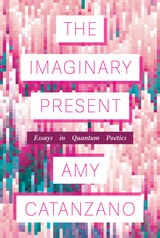
The Imaginary Present
Essays in Quantum PoeticsAmy Catanzano
University of Michigan Press, 2025
19th Annual National Indie Excellence Awards Poetry Finalist
The Imaginary Present by award-winning poet and professor Amy Catanzano explores cutting-edge scientific fields such as particle physics and astrophysics, and branches of physics such as quantum theory and relativity, through a poetic vision equally loyal to the imagination and rationality. Drawing upon her groundbreaking research and artist residencies at major scientific research centers like CERN and the U.S. National Science Foundation’s NOIRLab, as well as talks and poetry readings at esteemed institutions, Catanzano invites enthusiasts of poetry and science to consider what can be achieved through greater collaboration between these fields.
In linked chapters that fluidly blend lyric essay, literary and scientific analysis, poetry, theory, and memoir, The Imaginary Present offers refreshing new insights on a wide range of thinkers over the past 100 years, including poets Rae Armantrout and M. NourbeSe Philip, novelists Alfred Jarry and Virginia Woolf, comic book writer Grant Morrison, and physicists Albert Einstein and Werner Heisenberg. The introduction explores why poetry and physics are capable of jointly investigating our most fundamental questions about the universe and discusses the history of the art-science connection in addition to the author’s own journey. In searching for the groundbreaking ways that artists and scientists can collaborate, The Imaginary Present offers readers both reasoned grounding and poetic framing for an interdisciplinary poetics and praxis based on science.
The Intellective Space
Thinking beyond CognitionLaurent Dubreuil
University of Minnesota Press, 2015
The Intellective Space explores the nature and limits of thought. It celebrates the poetic virtues of language and the creative imperfections of our animal minds while pleading for a renewal of the humanities that is grounded in a study of the sciences.
According to Laurent Dubreuil, we humans both say more than we think and think more than we say. Dubreuil’s particular interest is the intellective space, a space where thought and knowledge are performed and shared. For Dubreuil, the term “cognition” refers to the minimal level of our mental operations. But he suggests that for humans there is an excess of cognition due to our extensive processing necessary for verbal language, brain dynamics, and social contexts. In articulating the intellective, Dubreuil includes “the productive undoing of cognition.”
Dubreuil grants that cognitive operations take place and that protocols of experimental psychology, new techniques of neuroimagery, and mathematical or computerized models provide access to a certain understanding of thought. But he argues that there is something in thinking that bypasses cognitive structures. Seeking to theorize with the sciences, the book’s first section develops the “intellective hypothesis” and points toward the potential journey of ideas going beyond cognition, after and before computation. The second part, “Animal Meditations,” pursues some of the consequences of this hypothesis with regard to the disparaged but enduring project of metaphysics, with its emphasis on categories such as reality, humanness, and the soul.