Results by title
51 books match the query 'Songs' and 11 start with t
Tales and Songs of Southern Illinois
Collected by Charles Neely
Southern Illinois University Press, 1998
First published in 1938, this lively collection of over 150 tales and songs runs the gamut from joy to woe, from horror to humor. In forming the collection, Charles Neely required only that the tales and songs—whether home grown or transplanted from the great body of world lore— had taken root somehow in the area of southern Illinois known as Egypt.
Notable tales include "Bones in the Well," "A Visit from Jesse James," "The Flight of the Naked Teamsters," "The Dug Hill Boger," and "How Death Came to Ireland"; among the songs and ballads are "Barbara Allen," "Hog and Hominy," "The Drunkard’s Lone Child," "The Belleville Convent Fire," "Shawneetown Flood," and "The Death of Charlie Burger."
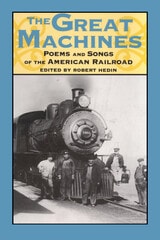
The Great Machines
Poems and Songs from the Age of the American RailroadRobert Hedin
University of Iowa Press, 1996
Here, for the first time, is a feast for anyone who has ever been beguiled by the trains that formerly thrummed through the landscapes of our lives. This entertaining and evocative anthology presents the amazing variety of poems and songs written about the American railroad in the last century and a half. Comprised of selections from both oral and written traditions, the volume celebrates the historical and cultural significance of this marvel of engineering skills. Hedin's anthology allows all readers, from the most avid railroad buff to anyone who has fond memories of train travel, to enjoy the romance of trains.
The Kinks
Songs of the Semi-DetachedMark Doyle
Reaktion Books, 2020

The Man That Got Away
The Life and Songs of Harold ArlenWalter Rimler
University of Illinois Press, 2018
A cantor's son, Arlen believed his music was from a place outside himself, a place that also sent tragedy. When his wife became mentally ill and was institutionalized he turned to alcohol. It nearly killed him. But the beautiful songs kept coming: "Blues in the Night," "My Shining Hour," "Come Rain or Come Shine," and "The Man That Got Away."
Walter Rimler drew on interviews with friends and associates of Arlen and on newly available archives to write this intimate portrait of a genius whose work is a pillar of the Great American Songbook.
The Singing Mountaineers
Songs and Tales of the Quechua PeopleCollected by José María Arguedas
University of Texas Press, 1957
The Quechua people, the "singing mountaineers" of Peru, still sing the songs that their Inca ancestors knew before the Spaniards invaded the Andes. Some of these songs, collected and translated into Spanish by José María Arguedas and María Lourdes Valladares from the Quechua language and the Huanca dialect, are now presented for the first time in English in the beautiful translations of Ruth Stephan, author of the recent prize-winning novel, The Flight. Also included in this rich collection are nine folk tales collected by Father Jorge A. Lira, translated into Spanish by Sr. Arguedas, and into English by Kate and Angel Flores.
The Song of Songs and the Ancient Egyptian Love Songs
Michael V. Fox
University of Wisconsin Press, 1985

The Song of Songs
Love Lyrics from the BibleMarcia Falk
Brandeis University Press, 2004
The Songs of Betty Baach
Glenn Taylor
University of Massachusetts Press, 2023
Finalist for the 2023 Weatherford Fiction Award
Some called her the Everywhen Woman. She claimed to be 321 years of age. In 2038, after the big storm and the great flood and the bad times, Betty Baach wrote these words down and sometimes spoke them aloud, at her homeplace on Freon Hill. She referred to them as songs. All stories are songs, she’d always say.
Set in West Virginia, The Songs of Betty Baach is a magical guide to resisting despair and a compendium of wisdom and rhythms by which to fortify oneself. The lives of the Baaches of Keystone and the Knoxes of Mosestown twist and connect in a tale of survival and retribution that crosses three centuries—moving from Betty’s girlhood in colonial America to a future warped by environmental collapse and political unrest. Refusing the erasure of the lives of women, Indigenous peoples, and Black people who have always called this region home, this eloquent and distinctive novel is a necessary remedy for the continued distortion of a land and its inhabitants.
The Songs of Blind Folk
African American Musicians and the Cultures of BlindnessTerry Rowden
University of Michigan Press, 2009
"Rowden has wedded ethnomusicology and disability studies to offer a fresh approach to the study of African American popular music. The Songs of Blind Folk undermines many of the defining mythologies and tropes of blind musicians, including the perception that they are successful because they compensate for the loss of vision."
---Mark Anthony Neal, Duke University
"Illuminates how the enduring phenomenon of blind African American musicians emerged from brutal conditions, how these musicians were deployed in the burgeoning American iconography of race and 'freakdom,' and how they negotiated this hazardous cultural terrain . . . the book is timely, well-historicized, and rich in insight."
---Kari Winter, University at Buffalo
The Songs of Blind Folk explores the ways that the lives and careers of blind and visually impaired African American musicians and singers have mirrored the changes in America's image of African Americans and the social positioning and possibilities of the entire black community. The book offers a historically grounded consideration of African American performers and their audiences, and the ways that blindness, like blackness, has affected the way the music has been produced and received. Author Terry Rowden considers the controversial nineteenth-century prodigy Blind Tom Bethune; blues singers and songwriters such as Blind Lemon Jefferson, who achieved an unprecedented degree of visibility and acceptance in the 1920s and '30s; spiritual and gospel musicians such as the Blind Boys of Alabama; celebrated jazz and rhythm and blues artists Art Tatum, Rahsaan Roland Kirk, and Ray Charles; and finally, perhaps the best known of all blind performers, Stevie Wonder.
Terry Rowden is Assistant Professor of English at the City University of New York, Staten Island. He is coeditor of Transnational Cinema: The Film Reader.
The Songs of Van Dyke Parks
Durable GoodsDale Carter
University of Illinois Press, 2027
Embracing the opportunity provided by his collaboration with Beach Boys leader Brian Wilson, the Mississippi-born Parks enjoyed a career whose many bases and low profile gave him space to explore his art. His songs blended musical passion, personal experience, and social concern on albums devoted to significant and timely themes while his broad creative palette enabled him to find inspiration in styles ranging from classical to Appalachian, and musical theater to calypso.
An illuminating portrait of a singular creative voice, The Songs of Van Dyke Parks takes readers inside the songwriting of a resolutely original American artist and his enduring voyage of musical discovery.
The Zeppelin Reader
Stories, Poems, and Songs from the Age Of AirshipsRobert Hedin
University of Iowa Press, 1998
Size is usually the first thing that comes to mind when we ponder the great airships. In war and peace, to most people they seem bigger than life itself, bright, wondrous, sometimes dangerous apparitions that engender a religious awe. They remain the largest crafts that have ever been launched into the sky. Tracing the history of the airship from its beginning in the nineteenth century to its fiery conclusion in 1937, Robert Hedin has gathered the finest stories, descriptions, poems, music, and illustrations about what the era was like in fact and in spirit.
Included are vivid accounts by such legendary figures as Count Ferdinand von Zeppelin, Hugo Eckener, and Alberto Santos-Dumont as well as memoirs, logs, journals, and diaries by Zeppelin commanders, crew, explorers, journalists, and survivors of ill-fated flights. The great airships inspired poets and writers old and new; here are works by such diverse writers as Robinson Jeffers, Kay Boyle, Bernard Shaw, D. H. Lawrence, Rita Dove, Richard Brautigan, and many others. There is a rich sampling of airship musical scores and lyrics; the music constitutes a kind of recovered history and helps recapture the emotional range of the era. Rounding out the gathering, The Zeppelin Reader is illustrated with stunning photographs, advertisements, drawings, and cartoons from the glorious age of airships.