Results by title
86 books match the query 'Soul' and 26 start with t
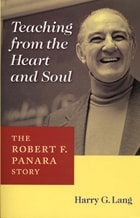
Teaching from the Heart and Soul
The Robert F. Panara StoryHarry G. Lang
Gallaudet University Press, 2007
The Sixth Volume in the Deaf Lives Series
Robert F. Panara lost his hearing from spinal meningitis in 1931 at the age of ten. However, he could read and write, and with his friends’ help, Bob (as he was known), made it through high school. His new solitude created a new passion – reading, reading, and reading. The stage was set for the emergence of one of the great deaf educators in modern time, a life fully captured in Harry G. Lang’s Teaching from the Heart and Soul: The Robert F. Panara Story.
Bob Panara’s many achievements began after his discovery of Gallaudet College in the 1940s. There, he wrote “The Significance of the Reading Problem,” which first expressed his belief that teaching “comes from the heart and soul.” The article secured him his first job at the New York School for the Deaf in White Plains. Bob returned to teach at Gallaudet College from 1948 until 1965, when he left to help found the National Technical Institute for the Deaf (NTID) and the National Theatre of the Deaf (NTD) — all in the same year. He continued to expand arts and literature at NTID until his retirement in 1987.
Bob Panara’s genius resides in the people he inspired with his vivacious teaching style. He believed ardently in involving students, that they should “be the book.” Former students tell story after story about his fabulous interpretations of drama and poetry, a legacy confirmed by his own story in Teaching from the Heart and Soul.
Territories of the Soul
Queered Belonging in the Black DiasporaNadia Ellis
Duke University Press, 2015
The Book of Commentary / Unquiet Garden of the Soul
Alexander Kluge
Seagull Books, 2023
The Book of Commentary / Unquiet Garden of the Soul confronts the reader with questions of existential meaning, questions rendered all the more potent by the backdrop of the Coronavirus pandemic: How fragile are we as human beings? How fragile are our societies? What is a “self,” an “I,” a “community”? How are we to orient ourselves? And what, if any, role does commentary play? In a fashion that will be familiar to longtime admirers of Alexander Kluge, the book stretches both back in time to the medieval glossators of Bologna and forward into interstellar space with imagined travel to the moon Europa. Kluge’s characteristic brief, vignette-like prose passages are interspersed with images from his own film work and QR codes, forming a highly engaging, thoroughly contemporary read.
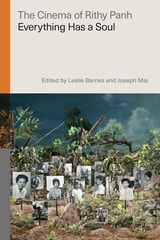
The Cinema of Rithy Panh
Everything Has a SoulLeslie Barnes
Rutgers University Press, 2022
Born in 1964, Cambodian filmmaker Rithy Panh grew up in the midst of the Khmer Rouge’s genocidal reign of terror, which claimed the lives of many of his relatives. After escaping to France, where he attended film school, he returned to his homeland in the late 1980s and began work on the documentaries and fiction films that have made him Cambodia’s most celebrated living director.
The fourteen essays in The Cinema of Rithy Panh explore the filmmaker’s unique aesthetic sensibility, examining the dynamic and sensuous images through which he suggests that “everything has a soul.” They consider how Panh represents Cambodia’s traumatic past, combining forms of individual and collective remembrance, and the implications of this past for Cambodia’s transition into a global present. Covering documentary and feature films, including his literary adaptations of Marguerite Duras and Kenzaburō Ōe, they examine how Panh’s attention to local context leads to a deep understanding of such major themes in global cinema as justice, imperialism, diaspora, gender, and labor.
Offering fresh takes on masterworks like The Missing Picture and S-21 while also shining a light on the director’s lesser-known films, The Cinema of Rithy Panh will give readers a new appreciation for the boundless creativity and ethical sensitivity of one of Southeast Asia’s cinematic visionaries.
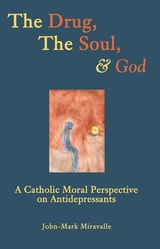
The Drug, the Soul, and God
A Catholic Moral Perspective on AntidepressantsJohn-Mark Miravalle
University of Scranton Press, 2010
With The Drug, the Soul, and God, John-Mark Miravelle examines the stance of the Catholic Church regarding the prescription and consumption of antidepressants. After a careful investigation of Catholic moral theology and philosophy, Miravelle argues that treating depression with medication alone fails to address the underlying causes of the depression and does not facilitate the cognitive, interpersonal, and environmental changes necessary for a patient’s long-term health. In addition, he suggests that such medication may deprive sufferers of providential opportunities for personal and communal conversion and sanctification. This controversial volume will engage theologians and medical professionals alike.
The Human Place in the Cosmos
Max Scheler; Translated from the German by Manfred S. Frings, Introduction by Eugene Kely
Northwestern University Press, 2009
The Immortality of the Soul; The Magnitude of the Soul; On Music; The Advantage of Believing; On Faith in Things Unseen
Saint Augustine
Catholic University of America Press, 1947
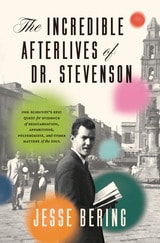
The Incredible Afterlives of Dr. Stevenson
One Scientist's Epic Quest for Evidence of Reincarnation, Apparitions, Poltergeists, and Other Matters of the SoulJesse Bering
University of Chicago Press, 2026
While Ian Stevenson (1918–2007) was an academic psychiatrist with a serious demeanor, right down to his three-piece suits and wingtip shoes, he made his name researching an unusual topic for a behavioral scientist: the afterlife. For over four decades, Stevenson traveled the globe investigating cases of reincarnation, apparitions, possessions, and near-death experiences. At the time of his death, Stevenson was widely regarded as one of the most influential figures in parapsychology, a field devoted to psychic phenomena and paranormal experiences.
Set against the colorful backdrop of parapsychology’s rise and fall, from Victorian séances to modern media spectacles, The Incredible Afterlives of Dr. Stevenson captures Stevenson’s relentless quest for evidence of consciousness beyond the grave. Jesse Bering, himself a psychologist, interweaves Stevenson’s research with vivid stories of the larger-than-life characters who shaped his path—from Eileen Garrett, the fearless medium, to Chester Carlson, the inventor of Xerox photocopying and Stevenson’s unlikely patron. Through never-before-seen letters and candid interviews with Stevenson’s surviving family members, readers glimpse the inner turmoil of a scientist struggling to balance his revolutionary ideas with the skepticism of his academic peers as well as those closest to him. Along the way, Bering, a researcher whose own trailblazing work on the psychology of afterlife beliefs had led him to believe it was all just an illusion, is forced to rethink his own worldview. Are psychic phenomena examples of our living brains giving credence to the absurd? Or tantalizing glimmers of life after death?
Equal parts scientific detective story and intimate biography, The Incredible Afterlives of Dr. Stevenson shines a light on a significant figure whose life and work have not yet been fully explored. Bering boldly confronts readers with the complicated legacy of a man who many see as a Galileo-like rebel with groundbreaking ideas, ones that still have the power to upend everything we know about what it means to be human.
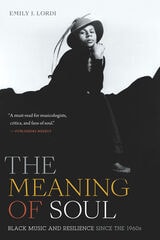
The Meaning of Soul
Black Music and Resilience since the 1960sEmily J. Lordi
Duke University Press, 2020
The Sciences of the Soul
The Early Modern Origins of PsychologyFernando Vidal
University of Chicago Press, 2011
Fernando Vidal’s trailblazing text on the origins of psychology traces the development of the discipline from its appearance in the late sixteenth century to its redefinition at the end of the seventeenth and its emergence as an institutionalized field in the eighteenth. Originally published in 2011, The Sciences of the Soul continues to be of wide importance in the history and philosophy of psychology, the history of the human sciences more generally, and in the social and intellectual history of eighteenth-century Europe.
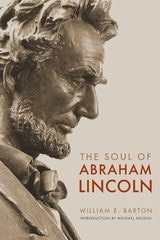
The Soul of Abraham Lincoln
William E. Barton. Introduction by Michael Nelson
University of Illinois Press, 2005
Modern secularists have been reluctant to recognize Abraham Lincoln's deep spirituality, in spite of the fact that he was often known as "Father Abraham" and has been described as one of the most deeply religious presidents the country has ever seen. Yet for all of his familiarity with the Bible, his invocation of Providence, and of the Almighty, he did not actively participate in a church or lend his name and authority to a denomination.
After more than fifty years of hagiographic and contradictory accounts of Abraham Lincoln's life, William Barton stepped boldly into the bedlam of claims and counterclaims about Lincoln's religion. Armed with an enormous collection of Lincoln materials and his own strict evidentiary rules, Barton worked to avoid partisan politicking over Lincoln's legacy and instead to simply "lay bare the facts."
To enable a better examination of the vexed questions surrounding Lincoln's faith and religious principles, Barton gathered Lincoln's most important writing and speeches about religion, and topically and chronologically assembled testimonies by his friends, family, and associates, about the most important and most debated issues. This volume, Barton's first and most important work on Lincoln, is introduced by Michael Nelson who provides a history of the literature on Lincoln's religion, the historical context of Barton's writing, and the details of the method that made Barton's approach to this American icon such a distinctive success.
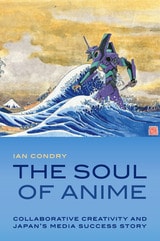
The Soul of Anime
Collaborative Creativity and Japan's Media Success StoryIan Condry
Duke University Press, 2013
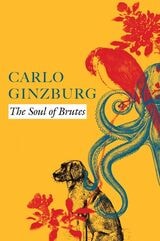
The Soul of Brutes
Carlo Ginzburg
Seagull Books, 2022
Carlo Ginzburg has been at the forefront of the discipline of microhistory ever since his earliest works were published to great acclaim in the 1970s. The Soul of Brutes brings together four of Ginzburg’s recent scintillating essays and lectures that testify to the diversity of his thoughts on history and philosophy.
“Civilization and Barbarism” resurrects a sixteenth-century debate between two thinkers in Spain about the humanness, or lack thereof, of Native Americans, and highlights the influence of classical thinkers, from Herodotus to Aristotle, and the iterations and interpretations through which their writings have traversed down to the Cinquecento. In “The Soul of Brutes” Ginzburg traces the genealogy of the debate on the rationality of animals and the limits of their imagination, from Plutarch and Aristotle to sixteenth-century thinkers like Pietro Pomponazzi and Girolamo Rorario. Following Montaigne, he provokes, are we to beasts as they seem to us? In “Calvino, Manzoni and the Grey Zone,” Carlo Ginzburg pithily writes about the mental dialogue between Holocaust survivor Primo Levi and two Italians who profoundly influenced Levi’s search for these “unexplored pockets of exception”—his contemporary Italo Calvino and the nineteenth-century novelist and philosopher Alessandro Manzoni. And finally, in “Schema and Bias”, he probes whether the historian can clearly see into the past, peering through the layers of bias, which include their own prejudices, or if relativism is the only path.
With several beautifully reproduced color illustrations, The Soul of Brutes will interest not only scholars of history, philosophy, and art, but also general intellectual readers.
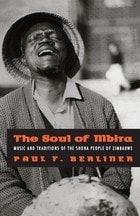
The Soul of Mbira
Music and Traditions of the Shona People of ZimbabwePaul F. Berliner
University of Chicago Press, 1993
"Paul Berliner's The Soul of Mbira is probably the best ethnography ever written about an African musical tradition. It is a complete classic . . . . I know of no other instrument with the range of the mbira, and the book is equal to the instrument."—John Chernoff
"[The Soul of Mbira] illustrates the fact that Shona mbira music in its beauty, subtlety, and virtuosity demands the same kind of respect that we might hold for any other classical music."—David Reck, Parabola
"The book is a model of ethnomusicological thinking and investigation and it suggests a specific way of approaching a complex socio-musical system."—John Baily, Popular Music
"When next someone asks 'What is ethnomusicology?' or 'What do ethnomusicologists do?' I shall suggest this book. . . . This is a landmark in ethnomusicological literature. Berliner succeeds in conveying both the joy that goes with mbira playing and the mystic relationship between the player and his instrument. In short, this is humanized ethnomusicology."—K.A. Gourlay, Ethnomusicology
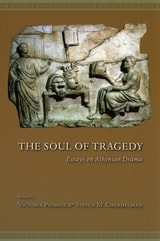
The Soul of Tragedy
Essays on Athenian DramaEdited by Victoria Pedrick and Steven M. Oberhelman
University of Chicago Press, 2005
Exemplary of the nature and scope of this book, the essays range from Simon Goldhill's comparative study of music, gender, and culture to Martha Nussbaum's inspection of "the comic soul." Through the critical lenses of psychoanalysis, gender, social history, and philology, this compilation looks at Greek tragedy's peculiar power to illuminate the workings of the human soul. Structures of tragic meaning, the relationship between character desire and spectator experience, and investigations of tragedy's extraordinary preoccupation with gender reveal the form's emotional core and explain its rapid ascent through the hierarchy of cultural practices in classical Greece. The Soul of Tragedy is a celebration and a model of collaboration that will be essential reading for scholars in classics, literature, and drama.
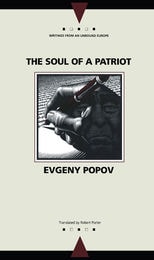
The Soul of a Patriot
Evgeny Popov, translated from the Russian by Robert Porter
Northwestern University Press, 1994
Freely parodying conformist Russian writing, this novel takes its lead as much from Sterne and Diderot as from the brilliant Russian satirist Mikhail Zoshchenko. In the offhand witticisms and jaunty humor speaks the spirit that survived the "era of stagnation" of Soviet literature.
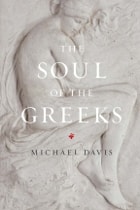
The Soul of the Greeks
An InquiryMichael Davis
University of Chicago Press, 2011
The understanding of the soul in the West has been profoundly shaped by Christianity, and its influence can be seen in certain assumptions often made about the soul: that, for example, if it does exist, it is separable from the body, free, immortal, and potentially pure. The ancient Greeks, however, conceived of the soul quite differently. In this ambitious new work, Michael Davis analyzes works by Homer, Herodotus, Euripides, Plato, and Aristotle to reveal how the ancient Greeks portrayed and understood what he calls “the fully human soul.”
Beginning with Homer’s Iliad, Davis lays out the tension within the soul of Achilles between immortality and life. He then turns to Aristotle’s De Anima and Nicomachean Ethics to explore the consequences of the problem of Achilles across the whole range of the soul’s activity. Moving to Herodotus and Euripides, Davis considers the former’s portrayal of the two extremes of culture—one rooted in stability and tradition, the other in freedom and motion—and explores how they mark the limits of character. Davis then shows how Helen and Iphigeneia among the Taurians serve to provide dramatic examples of Herodotus’s extreme cultures and their consequences for the soul. The book returns to philosophy in the final part, plumbing several Platonic dialogues—the Republic, Cleitophon, Hipparchus, Phaedrus, Euthyphro, and Symposium—to understand the soul’s imperfection in relation to law, justice, tyranny, eros, the gods, and philosophy itself. Davis concludes with Plato’s presentation of the soul of Socrates as self-aware and nontragic, even if it is necessarily alienated and divided against itself.
The Soul of the Greeks thus begins with the imperfect soul as it is manifested in Achilles’ heroic, but tragic, longing and concludes with its nontragic and fuller philosophic expression in the soul of Socrates. But, far from being a historical survey, it is instead a brilliant meditation on what lies at the heart of being human.
The Soul of the Helper
Seven Stages to Seeing the Sacred within Yourself So You Can See It in OthersHolly K. Oxhandler
Templeton Press, 2025
In their devotion to the well-being of others, caregivers routinely put their own well-being last and can unintentionally burn themselves out physically, emotionally, and spiritually. Their self-neglect, paired alongside a deep desire to help others, has the potential to stir up feelings of anger and resentment, leading to a sense of guilt and shame. They often believe that if they were to grant themselves any rest or grace, they would be at risk of failing in their duty.
In The Soul of the Helper, Dr. Holly K. Oxhandler shows caregivers and fellow helpers a more self-compassionate way to cope with their overwhelming responsibilities and to attend to their own needs, particularly when it comes to their mental health and spiritual journey. She invites them to pause and realize that if they let their personal resources run dry, they cannot possibly care for others as fully as they wish. In fact, their efforts are likely to cause more harm than good.
With a background in spiritually-integrated mental health, Dr. Oxhandler teaches helpers a seven-step process to slow down and reconnect with the stillness within themselves. It is in this space of stillness that Oxhandler guides helpers to reconnect with the “sacred spark” within their soul. By allowing themselves to enter that stillness, caregivers will recognize that they, too, are worthy of care. And with that realization, they will see anew the sacred spark that dwells inside everyone else, especially within those they’re helping.
As a social worker, researcher, and person of faith, Dr. Oxhandler writes in a warm and welcoming style, shares many relatable stories, and widens her scope to include believers of all faiths and spiritual traditions. Her book is for caregivers everywhere who sense the sacred spark within them saying, in effect: “Come to me, all you who are weary and burdened, and I will give you rest.”
The Soul of the Person
A Contemporary Philosophical PsychologyAdrian J. Reimers
Catholic University of America Press, 2006
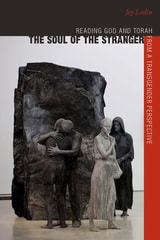
The Soul of the Stranger
Reading God and Torah from a Transgender PerspectiveJoy Ladin
Brandeis University Press, 2018
The Struggle for the Soul of Journalism
The Pulpit versus the Press, 1833-1923Ronald R. Rodgers
University of Missouri Press, 2018
The Vision of the Soul
James Matthew Wilson
Catholic University of America Press, 2017
Story-telling is foundational to the forms of the fine arts, but it is no less foundational to human reason. Human life in turn constitutes a specific kind of form—a story form. The ancient conception of human life as a pilgrimage to beauty itself is one that we can fully embrace only if we see the essential correlation between reason and story and the essential convertibility of truth, goodness and beauty in beauty. By turns a study in fundamental ontology, aesthetics, and political philosophy, Wilson’s book invites its readers to a renewal of the West’s intellectual tradition.
The War for the Heart and Soul of a Highland Maya Town
Revised EditionBy Robert S. Carlsen, with a contribution by Martín Prechtel
University of Texas Press, 2011
This compelling ethnography explores the issue of cultural continuity and change as it has unfolded in the representative Guatemala Mayan town Santiago Atitlán. Drawing on multiple sources, Robert S. Carlsen argues that local Mayan culture survived the Spanish Conquest remarkably intact and continued to play a defining role for much of the following five centuries. He also shows how the twentieth-century consolidation of the Guatemalan state steadily eroded the capacity of the local Mayas to adapt to change and ultimately caused some factions to reject—even demonize—their own history and culture. At the same time, he explains how, after a decade of military occupation known as la violencia, Santiago Atitlán stood up in unity to the Guatemalan Army in 1990 and forced it to leave town.
This new edition looks at how Santiago Atitlán has fared since the expulsion of the army. Carlsen explains that, initially, there was hope that the renewed unity that had served the town so well would continue. He argues that such hopes have been undermined by multiple sources, often with bizarre outcomes. Among the factors he examines are the impact of transnational crime, particularly gangs with ties to Los Angeles; the rise of vigilantism and its relation to renewed religious factionalism; the related brutal murders of followers of the traditional Mayan religion; and the apocalyptic fervor underlying these events.
To Know God and the Soul
Essays on the Thought of Saint AugustineRoland J. Teske
Catholic University of America Press, 2008
Transcendentalism and the Cultivation of the Soul
Barry M. Andrews
University of Massachusetts Press, 2017

Turning the Soul
Teaching through Conversation in the High SchoolSophie Haroutunian-Gordon
University of Chicago Press, 1991
One class, located in a private, racially integrated urban school, has had many conversations about the meaning of books. The second group, less advantaged students in a largely black urban school, has not. The reader watches as students in each group begin to draw upon experiences in their personal lives to speculate about events in the play. The students assist one another with the interpretation of complex passages, pose queries that help sustain the conversation, and struggle to "get Shakespeare right." Though the teachers suffer moments of intense frustration, they are rewarded by seeing their students learn to engage in meaningful exchange.
Because Turning the Soul draws on actual classroom conversations, it presents the range of difficulties that one encounters in interpretive discussion. The book describes the assumptions about learning that the use of such discussion in the classroom presupposes, and it offers a theoretical perspective from which to view the changes in both students and teachers.