Results by title
121 books match the query 'Space' and 31 start with t
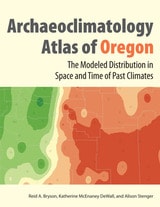
The Archaeoclimatology Atlas of Oregon
The Modeled Distribution in Space and Time of Past ClimatesReid A Bryson
University of Utah Press, 2009
The Macrophysical Climate Model (MCM) used for the atlas presents an innovative means of modeling past climate that has been rigorously tested and verified against field evidence worldwide. Broad-scale reconstructions of specific times in the past provide detailed site-specific graphs of precipitation, temperature, evaporation, and snowfall for more than 75 locations in Oregon.
Applications of the model and its implications for human populations in Oregon are explored for each region of the state, demonstrating the variability of human-climate interactions.
Supplemental Spatial Maps
The Archaeology of Place and Space in the West
Edited by Emily Dale and Carolyn L. White
University of Utah Press, 2021
Contributors tackle questions of how historical archaeologists theoretically and methodologically define the West, conveying the historical, mythological, and physical manifestations of placemaking. They confront issues of community and how diverse ethnic, racial, gendered, labor-based, and other demographic populations expressed their identities on and in the Western landscape. Authors also address the continued creation and re-creation of the West today, exploring the impact of the past on people in the present and its influence on modern conceptions of the American West.
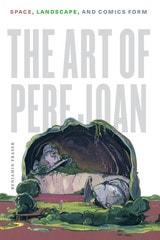
The Art of Pere Joan
Space, Landscape, and Comics FormBy Benjamin Fraser
University of Texas Press, 2019
Born in Mallorca, Pere Joan Riera (known professionally as Pere Joan) thrived in the underground comics world, beginning in the mid-1970s with the self-published collections Baladas Urbanas and MuŽrdago, both of which were released almost immediately after the death of the dictator Francisco Franco and Spain's transition to democracy. The first monograph in English on a comics artist from Spain, The Art of Pere Joan takes a topographical approach to reading comics, applying theories of cultural and urban geography to Pere Joan’s treatment of space and landscape in his singular body of work.
Balancing this goal with an exploration of specific works by Pere Joan, Benjamin Fraser demonstrates that looking at the thematic, structural, and aesthetic originality of the artist's landscape-driven work can help us begin to newly understand the representational properties of comics as a spatial medium. This in-depth examination reveals the resonance between the cultural landscapes of Mallorca and Pere Joan's metaphorical approach to both rural and urban environments in comics that weave emotional, ecological, and artistic strands in revolutionary ways.

The Black Cow's Footprint
Time, Space and Music in the Lives of the Kotas of South IndiaRichard K. Wolf
University of Illinois Press, 2006
The Boston Renaissance
Race, Space, and Economic Change in an American MetropolisBarry Bluestone
Russell Sage Foundation, 2000
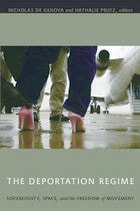
The Deportation Regime
Sovereignty, Space, and the Freedom of MovementNicholas De Genova and Nathalie Peutz, eds.
Duke University Press, 2010
Whether investigating the power that individual and corporate sponsors have over the fate of foreign laborers in Bahrain, the implications of Germany’s temporary suspension of deportation orders for pregnant and ill migrants, or the significance of the detention camp, the contributors reveal how deportation reflects and reproduces notions about public health, racial purity, and class privilege. They also provide insight into how deportation and deportability are experienced by individuals, including Arabs, South Asians, and Muslims in the United States. One contributor looks at asylum claims in light of an unusual anti-deportation campaign mounted by Algerian refugees in Montreal; others analyze the European Union as an entity specifically dedicated to governing mobility inside and across its official borders. The Deportation Regime addresses urgent issues related to human rights, international migration, and the extensive security measures implemented by nation-states since September 11, 2001.
Contributors: Rutvica Andrijasevic, Aashti Bhartia, Heide Castañeda , Galina Cornelisse , Susan Bibler Coutin, Nicholas De Genova, Andrew M. Gardner, Josiah Heyman, Serhat Karakayali, Sunaina Marr Maira, Guillermina Gina Nuñez, Peter Nyers, Nathalie Peutz, Enrica Rigo, Victor Talavera, William Walters, Hans-Rudolf Wicker, Sarah S. Willen
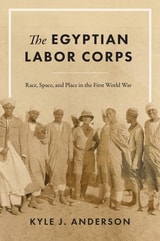
The Egyptian Labor Corps
Race, Space, and Place in the First World WarKyle J. Anderson
University of Texas Press, 2021
During World War I, the British Empire enlisted half a million young men, predominantly from the countryside of Egypt, in the Egyptian Labor Corps (ELC) and put them to work handling military logistics in Europe and the Middle East. British authorities reneged on their promise not to draw Egyptians into the war, and, as Kyle Anderson shows, the ELC was seen by many in Egypt as a form of slavery. The Egyptian Labor Corps tells the forgotten story of these young men, culminating in the essential part they came to play in the 1919 Egyptian Revolution.
Combining sources from archives in four countries, Anderson explores Britain’s role in Egypt during this period and how the ELC came to be, as well as the experiences and hardships these men endured. As he examines the ways they coped—through music, theater, drugs, religion, strikes, and mutiny—he illustrates how Egyptian nationalists, seeing their countrymen in a state akin to slavery, began to grasp that they had been racialized as “people of color.” Documenting the history of the ELC and its work during the First World War, The Egyptian Labor Corps also provides a fascinating reinterpretation of the 1919 revolution through the lens of critical race theory.
The Ethics of Space
Homelessness and Squatting in Urban EnglandSteph Grohmann
HAU, 2020
Set against the backdrop of economic crisis, austerity, and a disintegrating British state, Steph Grohmann tells the story of a flourishing squatter community in the city of Bristol and how it was eventually outlawed by the state. The first ethnography of homelessness done by a researcher who was formally homeless throughout fieldwork, this volume explores the intersection between spatial existence, subjectivity, and ethics. The result is a book that rethinks how ethical views are shaped and constructed through our own spatial existences.
The Hero's Place
Medieval Literary Traditions of Space and BelongingMolly Robinson Kelly
Catholic University of America Press, 2009
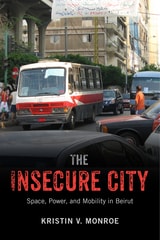
The Insecure City
Space, Power, and Mobility in BeirutMonroe, Kristin V
Rutgers University Press, 2016
Download open access ebook here.
The Nature of Space
Milton Santos
Duke University Press, 2021
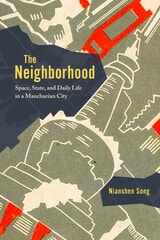
The Neighborhood
Space, State, and Daily Life in a Manchurian CityNianshen Song
University of Chicago Press, 2025
What can one neighborhood reveal about the making of a modern nation? The Neighborhood deciphers the unexpected significance of Xita, a half-square-mile quarter in Shenyang, in Northeast China. As the historian Nianshen Song shows, over nearly four centuries, Xita has been shaped and reshaped by empire, war, migration, and urban transformation. Remarkably, the history of this small area mirrors large-scale changes, including and especially China’s metamorphosis from a multiethnic Eurasian empire to a postindustrial society.
Song begins with Xita’s origins as a Qing-era Tibetan Buddhist center, following the lives of Mongol lamas and their imperial patrons. He tracks the neighborhood through the tumultuous twentieth century, when competing Russian and Japanese railway empires fueled its industrial growth, and Japanese colonizers turned it into a showcase for their imperial ambitions. Later, Xita became a vital enclave for Korea’s diaspora before emerging in the post-Mao era as a neon-lit hub of commerce and entertainment.
A thoroughly researched microhistory, The Neighborhood reveals how global forces play out in everyday spaces. By studying the emperors, warlords, merchants, laborers, and migrants who shaped Xita, Song presents a captivating and original perspective for understanding China’s past—not from the top down, but through the streets and people who lived it.
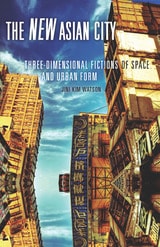
The New Asian City
Three-Dimensional Fictions of Space and Urban FormJini Kim Watson
University of Minnesota Press, 2011
Under Jini Kim Watson’s scrutiny, the Asian Tiger metropolises of Seoul, Taipei, and Singapore reveal a surprising residue of the colonial environment. Drawing on a wide array of literary, filmic, and political works, and juxtaposing close readings of the built environment, Watson demonstrates how processes of migration and construction in the hypergrowth urbanscapes of the Pacific Rim crystallize the psychic and political dramas of their colonized past and globalized present.
Examining how newly constructed spaces—including expressways, high-rises, factory zones, department stores, and government buildings—become figured within fictional and political texts uncovers how massive transformations of citizenries and cities were rationalized, perceived, and fictionalized. Watson shows how literature, film, and poetry have described and challenged contemporary Asian metropolises, especially around the formation of gendered and laboring subjects in these new spaces. She suggests that by embracing the postwar growth-at-any-cost imperative, they have buttressed the nationalist enterprise along neocolonial lines.
The New Asian City provides an innovative approach to how we might better understand the gleaming metropolises of the Pacific Rim. In doing so, it demonstrates how reading cultural production in conjunction with built environments can enrich our knowledge of the lived consequences of rapid economic and urban development.
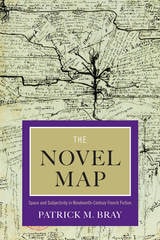
The Novel Map
Space and Subjectivity in Nineteenth-Century French FictionPatrick M. Bray
Northwestern University Press, 2013
Focusing on Stendhal, Gérard de Nerval, George Sand, Émile Zola, and Marcel Proust, The Novel Map: Mapping the Self in Nineteenth-Century French Fiction explores the ways that these writers represent and negotiate the relationship between the self and the world as a function of space in a novel turned map.
With the rise of the novel and of autobiography, the literary and cultural contexts of nineteenth-century France reconfigured both the ways literature could represent subjects and the ways subjects related to space. In the first-person works of these authors, maps situate the narrator within the imaginary space of the novel. Yet the time inherent in the text’s narrative unsettles the spatial self drawn by the maps and so creates a novel self, one which is both new and literary. The novel self transcends the rigid confines of a map. In this significant study, Patrick M. Bray charts a new direction in critical theory.
The Patchwork City
Class, Space, and Politics in Metro ManilaMarco Z. Garrido
University of Chicago Press, 2019
The Patchwork City illuminates how segregation, class relations, and democracy are all intensely connected. It makes clear, ultimately, that class as a social structure is as indispensable to the study of Manila—and of many other cities of the Global South—as race is to the study of American cities.
The Radical Bookstore
Counterspace for Social MovementsKimberley Kinder
University of Minnesota Press, 2021
Examines how radical bookstores and similar spaces serve as launching pads for social movements
How does social change happen? It requires an identified problem, an impassioned and committed group, a catalyst, and a plan. In this deeply researched consideration of seventy-seven stores and establishments, Kimberley Kinder argues that activists also need autonomous space for organizing, and that these spaces are made, not found. She explores the remarkably enduring presence of radical bookstores in America and how they provide infrastructure for organizing—gathering places, retail offerings that draw new people into what she calls “counterspaces.”
Kinder focuses on brick-and-mortar venues where owners approach their businesses primarily as social movement tools. These may be bookstores, infoshops, libraries, knowledge cafes, community centers, publishing collectives, thrift stores, or art installations. They are run by activist-entrepreneurs who create centers for organizing and selling books to pay the rent. These spaces allow radical and contentious ideas to be explored and percolate through to actual social movements, and serve as crucibles for activists to challenge capitalism, imperialism, white privilege, patriarchy, and homophobia. They also exist within a central paradox: participating in the marketplace creates tensions, contradictions, and shortfalls. Activist retail does not end capitalism; collective ownership does not enable a retreat from civic requirements like zoning; and donations, no matter how generous, do not offset the enormous power of corporations and governments.
In this timely and relevant book, Kinder presents a necessary, novel, and apt analysis of the role these retail spaces play in radical organizing, one that demonstrates how such durable hubs manage to persist, often for decades, between the spikes of public protest.
The Search for World Democracy
W. E. B. Du Bois and the Politics of SpaceAdam Dahl
University of Chicago Press, 2026
An incisive conceptual history of global democracy in the transnational political thought of W.E.B. Du Bois.
The Search for World Democracy traces the language of “world democracy” in W. E. B. Du Bois’s oeuvre, stretching from his early sociological writings to his later work on world peace and anticolonialism with and against the United Nations. Drawing on original archival research, several lesser-known writings, and most centrally Du Bois’s unpublished 1937 manuscript A World Search for Democracy, Adam Dahl places his unique approach to democratic theory within the transatlantic debates about the transformation of European imperial order in the twentieth century. Dahl shows how Du Bois’s vision of the spatial scale of democracy situated struggles for popular control, decolonization, industrial democracy, and racial enfranchisement in their shifting, multidimensional geographic contexts. Less a specific model of global governance than a radical politics of space and scale, Du Bois’s idea of world democracy challenges the boundaries between domestic and international politics by linking local sites of democratic struggle within and against the global color line. The Search for World Democracy shows how, for Du Bois, the radical transformation of the United States into a multiracial democracy would require an equally dramatic transformation of the imperial lineages of world politics.
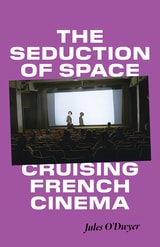
The Seduction of Space
Cruising French CinemaJules O'Dwyer
University of Minnesota Press, 2025
A bold and far-reaching new study of French queer cinema reimagines the relationship between sexuality and space
Spatiality has long been a crucial and potent lens for understanding French culture and aesthetics. While canonical greats of French cinema such as Jean-Luc Godard, Agnès Varda, and Louis Malle invoked the notion of flânerie to explore ideas of modernism, spatial exploration, and urban sociality, Jules O’Dwyer demonstrates how a more recent generation of French queer filmmakers continues to engage with—and contest—this legacy by focusing attention on the cognate practice of cruising.
Through the work of Jacques Nolot, Sébastien Lifshitz, Christophe Honoré, Vincent Dieutre, Alain Guiraudie, and others, The Seduction of Space draws film theory, queer studies, and spatial inquiry into close proximity to examine the politics of cruising and the gendering of space. Making the case that cinema not only documents the queer spaces of the past but continues to produce them, O’Dwyer maps the relationships between sex and spatiality as he takes up such varied topics as public sex in the porn theater, racial eroticization in the banlieue, and the ecocritical valences of rural cruising.
Foregrounding the crucial role that spatiality plays in shaping the parameters of France’s visual cultures and political imaginary, The Seduction of Space is both an urgent queer reconceptualization of this tradition and a clarion call for film scholars to tarry with the politics of sexuality in all its messiness.
Retail e-book files for this title are screen-reader friendly with images accompanied by short alt text and/or extended descriptions.
The Space In-Between
Essays on Latin American CultureSilviano Santiago
Duke University Press, 2001
Santiago’s work creates a theoretical field that transcends both the study of a specific national literature and the traditional perspectives of comparative literature. He examines the pedagogical and modernizing mission of Western voyagers from the conquistadors to the present. He deconstructs the ideas of “original” and “copy,” unpacking their implications for the notions of so-called dominant and dominated cultures. Santiago also confronts questions of cultural dependency and analyzes the problems involved in the imposition of an alien European history, the cultural displacements experienced by the Indians through their religious conversion, and the hierarchical suppression of native and Afro-Brazilian values.
Elegantly written and translated, The Space In-Between will provide insights and perspectives that will interest cultural and literary theorists, postcolonial scholars, and other students of contemporary culture.
The Space of Boredom
Homelessness in the Slowing Global OrderBruce O'Neill
Duke University Press, 2017
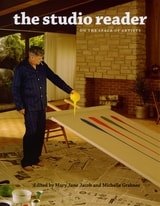
The Studio Reader
On the Space of ArtistsEdited by Mary Jane Jacob and Michelle Grabner
University of Chicago Press, 2010
The image of a tortured genius working in near isolation has long dominated our conceptions of the artist’s studio. Examples abound: think Jackson Pollock dripping resin on a cicada carcass in his shed in the Hamptons. But times have changed; ever since Andy Warhol declared his art space a “factory,” artists have begun to envision themselves as the leaders of production teams, and their sense of what it means to be in the studio has altered just as dramatically as their practices.
The Studio Reader pulls back the curtain from the art world to reveal the real activities behind artistic production. What does it mean to be in the studio? What is the space of the studio in the artist’s practice? How do studios help artists envision their agency and, beyond that, their own lives? This forward-thinking anthology features an all-star array of contributors, ranging from Svetlana Alpers, Bruce Nauman, and Robert Storr to Daniel Buren, Carolee Schneemann, and Buzz Spector, each of whom locates the studio both spatially and conceptually—at the center of an art world that careens across institutions, markets, and disciplines. A companion for anyone engaged with the spectacular sites of art at its making, The Studio Reader reconsiders this crucial space as an actual way of being that illuminates our understanding of both artists and the world they inhabit.
The Tewa World
Space, Time, Being and Becoming in a Pueblo SocietyAlfonso Ortiz
University of Chicago Press, 1972
The Thin Tear In The Fabric Of Space
Douglas Trevor
University of Iowa Press, 2005
The Thin Tear in the Fabric of Space gathers stories about coping with grief, trying to love people who have died, and—more broadly—leaving old versions of the self behind, sometimes by choice and sometimes out of necessity. In each of the nine stories, Douglas Trevor’s characters are forced to face uncomfortable realities. For Elena Gavrushnekov in the title story, that means admitting after the death of her beloved that she still longs for contact with other human bodies. For Peter in “Central Square,” it is realizing that, like his deceased father before him, he is drinking himself to death. Unable to confront his incapacitated mother and the memory of the plane crash that killed his father, Edwin Morris in “Saint Francis in Flint” is compelled to acknowledge that his saintly aspirations are not what they appear to be, while Sharon Mackaney in “The Surprising Weight of the Body's Organs” struggles with uncontrollable outbursts of rage in the wake of her young son’s death.
In moments of great pain and loss, when self-expression seems impossible and terribly useless, the characters in these stories nonetheless discover the tenderness of others. In “The River,” the narrator finds that the friendship he has forged with a French girl with whom he can only just communicate has bred intense, almost intuitive compassion, while in “Fellowship of the Bereaved,” the disconsolate brother of the deceased sister who occupies the empty center of the story uncovers not only anger in his parents but also empathy and humor. As these characters persevere in their own lives, they do so mindful of, and humanized by, the experiences of having seen people they know and love slip unexpectedly into the thin tear in the fabric of space: that quiet chasm that so resolutely separates the living from the dead.
The West Side of Any Mountain
Place, Space, and EcopoetryJ. Scott Bryson
University of Iowa Press, 2005
Informed in general by current thinking in environmental theory and specifically by the work of cultural geographer Yi-Fu Tuan, The West Side of Any Mountain participates in and furthers this scholarly attention by offering an overarching theoretical framework with which to approach the field.
One area that contemporary theorists have found problematic is the dualistic civilization/wilderness binary that focuses on the divisions between culture and nature, thereby increasing the modern sense of alienation. Tuan’s place-space framework offers a succinct vocabulary for describing the attitudes of ecological poets and other nature writers in a way that avoids setting up an adversarial relationship between place and space. Scott Bryson describes the Tuanian framework and employs it to offer fresh readings of the work of four major ecopoets: Wendell Berry, Joy Harjo, Mary Oliver, and W. S. Merwin.
The West Side of Any Mountain will be of great interest to scholars and teachers working in the field of contemporary nature poetry. It is recommended for nature-writing courses as well as classes dealing with 20th-century poetry, contemporary literary criticism, and environmental theory.
The Written World
Space, Literature, and the Chorological Imagination in Early Modern FranceJeffrey N. Peters
Northwestern University Press, 2018
In analyses of well-known authors such as Corneille, Molière, Racine, and Madame de Lafayette, Peters demonstrates that the apparent absence of physical space in seventeenth-century literary depiction indicates a subtle engagement with, rather than a rejection of, evolving principles of cosmological understanding. Space is not absent in these works so much as transformed in keeping with contemporaneous developments in early modern natural philosophy. The Written World will appeal to philosophers of literature and literary theorists as well as scholars of early modern Europe and historians of science and geography
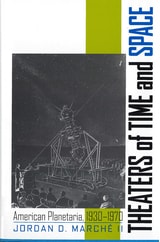
Theaters of Time and Space
American Planetaria, 1930-1970Marche, Jordan
Rutgers University Press, 2005
Every year, millions of Americans visit planetariums and are captivated by their strikingly realistic portrayal of the night sky. Today, it is indeed difficult to imagine astronomy education without these magnificent celestial theaters. But projection planetariums, first developed in Germany, have been a part of American museum pedagogy only since the early twentieth century and were not widespread until the 1960s.
In this unique social history,former planetarium director and historian of science Jordan D. Marché II offers the first complete account of the community of individuals and institutions that, during the period between 1930 and 1970, made planetariums the popular teaching aids they are today. Marché addresses issues such as the role of gender and social developments within the planetarium community, institutional patronage, and the popularization of science. He reveals how, at different times, various groups, including financial donors, amateur scientists, and government officials, viewed the planetarium as an instrument through which they could shape public understanding and perceptions of astronomy and space science.
Offering an insightful, wide-ranging look into the origins of an institution that has fascinated millions, Theaters of Timeand Space brings new perspectives to how one educational community changed the cultural complexion of science, helped shape public attitudes toward the U.S. space program, and even contributed to policy decisions regarding allocations for future space research.
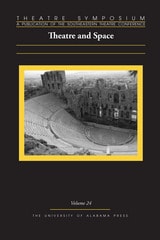
Theatre Symposium, Vol. 24
Theatre and SpaceEdited by Becky K. Becker
University of Alabama Press, 2016
Exploring the dynamic intersections of performance and place.
At a time when so many options exist for access to theatrical entertainments, it is no surprise that theatre practitioners and scholars are often preoccupied with the role of the audience. While space undoubtedly impacts the rehearsal and production processes, its greater significance seems to rest in the impact a specific location has on the audience.
This volume provides diverse viewpoints on theatre and space, as well as its relationship to the audience. Sebastian Trainor and Samuel T. Shanks offer contemporary perspectives on two ancient theatre spaces, while Lisa Marie Bowler describes the Globe Theatre, a replica of the original, as embodying a kind of absence despite its rich link to the past. Focusing on distinctly different periods and settings, both Andrew Gibb and Christine Woodworth describe a politics of space in which specific players gain prestige and power. Chase Bringardner identifies the audience as playing an important role in creating a space for parody in a historic Nashville venue, while Arnab Banerji describes an exhausting process for members of the Bengali group theatre who must continually move from space to space. Finally, Alicia Corts discusses virtual performance spaces and the degree to which participants are able to control their online identities within virtual performances. Bookending these eight essays are Marvin Carlson’s keynote presentation “Whose Space Is It Anyway?” and his closing remarks for the symposium, both of which allude to, and richly explicate, the ultimate arbiters of theatrical space: the audience.

Theatrical Reality
Space, Embodiment and Empathy in PerformanceCampbell Edinborough
Intellect Books, 2016
Toxic Timescapes
Examining Toxicity across Time and SpaceSimone M. Müller
Ohio University Press, 2022
An interdisciplinary environmental humanities volume that explores human-environment relationships on our permanently polluted planet.
While toxicity and pollution are ever present in modern daily life, politicians, juridical systems, media outlets, scholars, and the public alike show great difficulty in detecting, defining, monitoring, or generally coming to terms with them. This volume’s contributors argue that the source of this difficulty lies in the struggle to make sense of the intersecting temporal and spatial scales working on the human and more-than-human body, while continuing to acknowledge race, class, and gender in terms of global environmental justice and social inequality.
The term toxic timescapes refers to this intricate intersectionality of time, space, and bodies in relation to toxic exposure. As a tool of analysis, it unpacks linear understandings of time and explores how harmful substances permeate temporal and physical space as both event and process. It equips scholars with new ways of creating data and conceptualizing the past, present, and future presence and possible effects of harmful substances and provides a theoretical framework for new environmental narratives. To think in terms of toxic timescapes is to radically shift our understanding of toxicants in the complex web of life.
Toxicity, pollution, and modes of exposure are never static; therefore, dose, timing, velocity, mixture, frequency, and chronology matter as much as the geographic location and societal position of those exposed. Together, these factors create a specific toxic timescape that lies at the heart of each contributor’s narrative. Contributors from the disciplines of history, human geography, science and technology studies, philosophy, and political ecology come together to demonstrate the complex reality of a toxic existence. Their case studies span the globe as they observe the intersection of multiple times and spaces at such diverse locations as former battlefields in Vietnam, aging nuclear-weapon storage facilities in Greenland, waste deposits in southern Italy, chemical facilities along the Gulf of Mexico, and coral-breeding laboratories across the world.
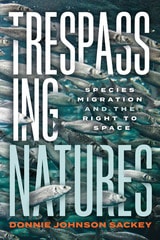
Trespassing Natures
Species Migration and the Right to SpaceDonnie Johnson Sackey
The Ohio State University Press, 2024
As old worlds become hostile and new spaces become hospitable, many species are shifting their ranges to live in locations where they have never previously existed. Biological and sociocultural realms collide and boundaries blur, making it increasingly difficult to mark definitively who belongs and who is a trespasser. In Trespassing Natures, Donnie Johnson Sackey troubles the idea of biological “invasion,” turning our attention away from scientific considerations and toward the discursive and rhetorical dimensions of this term—offering a new paradigm that recasts this issue as a question of what it means to live in multi-species communities. Presenting case studies on bed bugs, bighead carp, feral cats, and mackerel, Sackey argues that the identification of a species as an invader is not merely a scientific act, but a cultural and political one. By questioning issues around space, identity, and the institutions that make human participation apparent, Sackey redirects focus away from the belief that a single species threatens space. Ultimately, Trespassing Natures asks us to expand our idea of community and question who has the right to space.
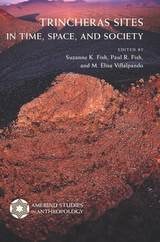
Trincheras Sites in Time, Space, and Society
Edited by Suzanne K. Fish, Paul R. Fish, and M. Elisa Villalpando
University of Arizona Press, 2008
This multi-author volume integrates a remarkable body of new data representing a textbook-like array of current research issues and methodologies in the archaeology of the region. Scholars from the United States and Mexico offer original research on trincheras sites in Chihuahua, Sonora, Arizona, and New Mexico. Scales of focus range from intensive intrasite sampling to the largest contiguous survey in the region. Authors incorporate spatial analyses, artifact studies, environmental and subsistence data, ethnographic analogs, ethnohistorical records, cross-cultural comparisons, archaeology, and archival resources.
The volume’s discussions contribute innovative approaches to worldwide interpretations of landscapes marked by hilltop sites. Contributors present meticulous research arguing that many trincheras sites were primarily used for habitation and ceremonial rites, in addition to previously predominant views of them as defensive refuges. Because trincheras occupations date from the late preceramic era to shortly before Spanish contact, authors relate them to early forms of agriculture, the emergence of village life, the appearance of differentiated settlement systems, and tendencies toward political and ritual centralization.
Detailed maps and figures illustrate the text, and close-up aerial photographs capture the visual essence of the sites, highlighted by a section that includes color photographs and an essay by renowned photographer Adriel Heisey.
Contributors:
Christian E. Downum
Paul R. Fish
Suzanne K. Fish
Robert J. Hard
Adriel Heisey
Stephen A. Kowalewski
Randall H. McGuire
Ben A. Nelson
John R. Roney
Judith Taylor
M. Elisa Villalpando
Joseph Vogel
Henry Wallace
David R. Wilcox
J. Scott Wood