Results by title
73 books match the query 'Style' and 19 start with t
Televisuality
Style, Crisis, and Authority in American TelevisionJohn T Caldwell
Rutgers University Press, 2020
The American Stravinsky
The Style and Aesthetics of Copland's New American Music, the Early Works, 1921-1938Gayle Murchison
University of Michigan Press, 2013
One of the country's most enduringly successful composers, Aaron Copland created a distinctively American style and aesthetic in works for a diversity of genres and mediums, including ballet, opera, and film. Also active as a critic, mentor, advocate, and concert organizer, he played a decisive role in the growth of serious music in the Americas in the twentieth century.
In The American Stravinsky, Gayle Murchison closely analyzes selected works to discern the specific compositional techniques Copland used, and to understand the degree to which they derived from European models, particularly the influence of Igor Stravinsky. Murchison examines how Copland both Americanized these models and made them his own, thereby finding his own compositional voice. Murchison also discusses Copland's aesthetics of music and his ideas about its purpose and social function.
The Body of Writing
An Erotics of Contemporary American FictionFlore Chevaillier
The Ohio State University Press, 2013
The Cast of Character
Style in Greek LiteratureBy Nancy Worman
University of Texas Press, 2003
Well before Aristotle's Rhetoric elucidated the elements of verbal style that give writing its persuasive power, Greek poets and prose authors understood the importance of style in creating compelling characters to engage an audience. And because their works were composed in predominantly oral settings, their sense of style included not only the characters' manner of speaking, but also their appearance and deportment. From Homeric epic to classical tragedy and oratory, verbal and visual cues work hand-in-hand to create distinctive styles for literary characters.
In this book, Nancy Worman investigates the development and evolution of ideas about style in archaic and classical literature through a study of representations of Odysseus and Helen. She demonstrates that, as liars and imitators, pleasing storytellers, and adept users of costume, these two figures are especially skillful manipulators of style. In tracing the way literary representations of them changed through time—from Homer's positive portrayal of their subtle self-presentations to the sharply polarized portrayals of these same subtleties in classical tragedy and oratory—Worman also uncovers a nascent awareness among the Greek writers that style may be used not only to persuade but also to distract and deceive.
The Chicago Manual of Style, 15th Edition
Edited by University of Chicago Press Staff
University of Chicago Press, 2003
In the 1890s, a proofreader at the University of Chicago Press prepared a single sheet of typographic fundamentals intended as a guide for the University community. That sheet grew into a pamphlet, and the pamphlet grew into a book—the first edition of the Manual of Style, published in 1906. Now in its fifteenth edition, The Chicago Manual of Style—the essential reference for authors, editors, proofreaders, indexers, copywriters, designers, and publishers in any field—is more comprehensive and easier to use than ever before.
Those who work with words know how dramatically publishing has changed in the past decade, with technology now informing and influencing every stage of the writing and publishing process. In creating the fifteenth edition of the Manual, Chicago's renowned editorial staff drew on direct experience of these changes, as well as on the recommendations of the Manual's first advisory board, composed of a distinguished group of scholars, authors, and professionals from a wide range of publishing and business environments.
Every aspect of coverage has been examined and brought up to date—from publishing formats to editorial style and method, from documentation of electronic sources to book design and production, and everything in between. In addition to books, the Manual now also treats journals and electronic publications. All chapters are written for the electronic age, with advice on how to prepare and edit manuscripts online, handle copyright and permissions issues raised by technology, use new methods of preparing mathematical copy, and cite electronic and online sources.
A new chapter covers American English grammar and usage, outlining the grammatical structure of English, showing how to put words and phrases together to achieve clarity, and identifying common errors. The two chapters on documentation have been reorganized and updated: the first now describes the two main systems preferred by Chicago, and the second discusses specific elements and subject matter, with examples of both systems. Coverage of design and manufacturing has been streamlined to reflect what writers and editors need to know about current procedures. And, to make it easier to search for information, each numbered paragraph throughout the Manual is now introduced by a descriptive heading.
Clear, concise, and replete with commonsense advice, The Chicago Manual of Style, fifteenth edition, offers the wisdom of a hundred years of editorial practice while including a wealth of new topics and updated perspectives. For anyone who works with words, whether on a page or computer screen, this continues to be the one reference book you simply must have.
What's new in the Fifteenth Edition:
* Updated material throughout to reflect current style, technology, and professional practice
* Scope expanded to include journals and electronic publications
* Comprehensive new chapter on American English grammar and usage by Bryan A. Garner (author of A Dictionary of Modern American Usage)
* Updated and rewritten chapter on preparing mathematical copy
* Reorganized and updated chapters on documentation, including guidance on citing electronic sources
* Streamlined coverage of current design and production processes, with a glossary of key terms
* Descriptive headings on all numbered paragraphs for ease of reference
* New diagrams of the editing and production processes for both books and journals, keyed to chapter discussions
* New, expanded Web site with special tools and features for Manual users at www.chicagomanualofstyle.org.
The Chicago Manual of Style, 16th Edition
Edited by University of Chicago Press Staff
University of Chicago Press, 2010
**The 16th edition of The Chicago Manual of Style has been superseded by the 17th edition.**
While digital technologies have revolutionized the publishing world in the twenty-first century, one thing still remains true: The Chicago Manual of Style is the authoritative, trusted source that writers, editors, and publishers turn to for guidance on style and process. For the sixteenth edition, every aspect of coverage has been reconsidered to reflect how publishing professionals work today. Though processes may change, the Manual continues to offer the clear, well-considered style and usage advice it has for more than a century.
The sixteenth edition offers expanded information on producing electronic publications, including web-based content and e-books. An updated appendix on production and digital technology demystifies the process of electronic workflow and offers a primer on the use of XML markup, and a revised glossary includes a host of terms associated with electronic as well as print publishing. The Chicago system of documentation has been streamlined and adapted for a variety of online and digital sources. Figures and tables are updated throughout the book—including a return to the Manual’s popular hyphenation table and new, comprehensive listings of Unicode numbers for special characters.
The Chicago Manual of Style, 17th Edition
The University of Chicago Press Editorial Staff
University of Chicago Press, 2017
In the seven years since the previous edition debuted, we have seen an extraordinary evolution in the way we create and share knowledge. This seventeenth edition of The Chicago Manual of Style has been prepared with an eye toward how we find, create, and cite information that readers are as likely to access from their pockets as from a bookshelf. It offers updated guidelines on electronic workflows and publication formats, tools for PDF annotation and citation management, web accessibility standards, and effective use of metadata, abstracts, and keywords. It recognizes the needs of those who are self-publishing or following open access or Creative Commons publishing models. The citation chapters reflect the ever-expanding universe of electronic sources—including social media posts and comments, private messages, and app content—and also offer updated guidelines on such issues as DOIs, time stamps, and e-book locators.
Other improvements are independent of technological change. The chapter on grammar and usage includes an expanded glossary of problematic words and phrases and a new section on syntax as well as updated guidance on gender-neutral pronouns and bias-free language. Key sections on punctuation and basic citation style have been reorganized and clarified. To facilitate navigation, headings and paragraph titles have been revised and clarified throughout. And the bibliography has been updated and expanded to include the latest and best resources available.
This edition continues to reflect expert insights gathered from Chicago’s own staff and from an advisory board of publishing experts from across the profession. It also includes suggestions inspired by emails, calls, and even tweets from readers. No matter how much the means of communication change, The Chicago Manual of Style remains the ultimate resource for those who care about getting the details right.
The Chicago Manual of Style, 18th Edition
The University of Chicago Press Editorial Staff
University of Chicago Press, 2024
Much has happened in the years since the publication of the seventeenth edition of The Chicago Manual of Style. The world has transformed, and the Manual has risen to meet the moment. The eighteenth edition of this classic guide for writers, editors, and publishers is the most extensive revision in two decades.
Every chapter has been reexamined with diversity and accessibility in mind, and major changes include updated and expanded coverage of pronoun use and inclusive language, revised guidelines on capitalization, a broader range of examples, new coverage of Indigenous languages, and expanded advice on making publications accessible to people with disabilities. The Manual’s traditional focus on nonfiction has been expanded to include fiction and other creative genres in coverage of topics such as punctuation and dialogue, and the needs of self-published authors receive wider attention.
The citation chapters have been thoroughly reorganized for the benefit of new and experienced users alike, and the key concepts for editing mathematics have been integrated into the chapters where they will be most useful to generalists. Evolving technologies—from open-access publishing models to AI—are covered throughout. And naturally, there are some well-considered updates to familiar rules, including changes intended to align the Manual’s recommendations more closely with real-world usage.
As with every new edition, devotees of the Manual will find much to discover and ponder.
The Dilemma of Style
Architectural Ideas from the Picturesque to the PostmodernJ. Mordaunt Crook
University of Chicago Press, 1987
This challenging book confronts one of the central problems of architectural theory: the nature—and necessity—of style.
The Economics of Attention
Style and Substance in the Age of InformationRichard A. Lanham
University of Chicago Press, 2006
With all the verve and erudition that have established his earlier books as classics, Richard A. Lanham here traces our epochal move from an economy of things and objects to an economy of attention. According to Lanham, the central commodity in our new age of information is not stuff but style, for style is what competes for our attention amidst the din and deluge of new media. In such a world, intellectual property will become more central to the economy than real property, while the arts and letters will grow to be more crucial than engineering, the physical sciences, and indeed economics as conventionally practiced. For Lanham, the arts and letters are the disciplines that study how human attention is allocated and how cultural capital is created and traded. In an economy of attention, style and substance change places. The new attention economy, therefore, will anoint a new set of moguls in the business world—not the CEOs or fund managers of yesteryear, but new masters of attention with a grounding in the humanities and liberal arts.
Lanham’s The Electronic Word was one of the earliest and most influential books on new electronic culture. The Economics of Attention builds on the best insights of that seminal book to map the new frontier that information technologies have created.
The Orient of Style
Modernist Allegories of ConversionBeryl Schlossman
Duke University Press, 1991
Toward the end of Remembrance of Things Past, the narrator describes the act of creating a work of art as a conversion of sensation into a spiritual equivalent. By means of such allegories of “conversion,” Schlossman shows, the modernist artist disappeared within the work of art and left behind the trace of his sublime vocation, a vocation in which he was transformed, in Schlossman’s words, “into a kind of priest kneeling at the altar of beauty before the masked divinity of representation.”
The author shows how allegory—the representation of the symbolic as something real—was adapted by modernist writers to reflect subjectivity while masking an authorial origin. She reveals how modernist allegory arose, as Walter Benjamin suggests, at the crossroads of history, sociology, economics, urban architecture, and art—providing a kind of map of capitalism—and was produced through the eyes of a melancholic gazing at a “monument of absence.”
The Proper Lady and the Woman Writer
Ideology as Style in the Works of Mary Wollstonecraft, Mary Shelley, and Jane AustenMary Poovey
University of Chicago Press, 1984
"The proper lady was a handy concept for a developing bourgeois patriarchy, since it deprived women of worldly power, relegating them to a sanctified domestic sphere that, in complex ways, nourished and sustained the harsh 'real' world of men. With care and subtle intelligence, Poovey examines this 'guardian and nemesis of the female self' through the ways it is implicated in the style and strategies of three very different writers."—Rachel M. Brownstein, The Nation
"The Proper Lady and the Woman Writer is a model of . . . creative discovery, providing a well-researched, illuminating history of women writers at the turn of the nineteenth century. [Poovey] creates sociologically and psychologically persuasive accounts of the writers: Wollstonecraft, who could never fully transcend the ideology of propriety she attacked; Shelley, who gradually assumed a mask of feminine propriety in her social and literary styles; and Austen, who was neither as critical of propriety as Wollstonecraft nor as accepting as Shelley ultimately became."—Deborah Kaplan, Novel
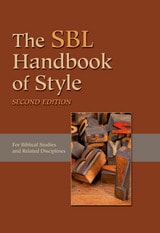
The SBL Handbook of Style
SBL Press, 2014
The definitive source for how to write and publish in the field of biblical studies
The long-awaited second edition of the essential style manual for writing and publishing in biblical studies and related fields includes key style changes, updated and expanded abbreviation and spelling-sample lists, a list of archaeological site names, material on qur’anic sources, detailed information on citing electronic sources, and expanded guidelines for the transliteration and transcription of seventeen ancient languages.
Features:
- Expanded lists of abbreviations for use in ancient Near Eastern, biblical, and early Christian studies
- Information for transliterating seventeen ancient languages
- Exhaustive examples for citing print and electronic sources
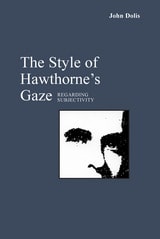
The Style of Hawthorne's Gaze
Regarding SubjectivityJohn Dolis
University of Alabama Press, 1993
Examining subjectivity and narrative perception in Hawthorne’s literary art.
The Style of Hawthorne’s Gaze is an unusual and insightful work that employs a combination of critical strategies drawn from art history, philosophy, psychoanalysis, and contemporary aesthetic and literary theory to explore Nathaniel Hawthorne’s narrative technique and his unique vision of the world. Dolis studies Hawthorne’s anti-technological and essentially Romantic view of the external world and examines the recurring phenomena of lighting, motion, aspectivity, fragmentation, and imagination as they relate to his descriptive techniques.
Dolis sets the world of Hawthorne’s work over and against the aesthetic and philosophical development of the world understood as a “view”, from its inception in the camera obscura and perspective in general, to its 19th-century articulation in photography. In light of this general technology of the image, and drawing upon a wide range of contemporary critical theories, Dolis begins his study of Hawthorne at the level of description, where the world of the work first arises in the reader’s consciousness. Dolis shows how the work of Heidegger, Merleau-Ponty, Freud, Lacan, and Derrida can provide fresh insights into the sophisticated style of Hawthorne’s perception of and system for representing reality.
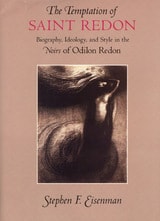
The Temptation of Saint Redon
Biography, Ideology, and Style in the Noirs of Odilon RedonStephen F. Eisenman
University of Chicago Press, 1992
Indeed, local tales and legends of witches, ghosts, one-eyed monsters, evil eyes, and wood fairies figure prominently in Redon's graphic works, which he called his noirs, or "blacks." After formal training at Bordeaux and Paris in the 1850s and 1860s, Redon began to chart his independent artistic course. Eisenman shows how, rejecting both naturalism and classicism, Redon, a prototypical Symbolist, found in grotesque and epic genres the expression of organic communities and precapitalist societies. He places Redon's desire for this imagined world of superstitious simplicity a desire manifest in his entire mature artistic practice in the context of contemporary avant-garde movements.
Redon's great noirs of the 1870s and 1880s, dreamlike configurations of seemingly irreconcilable elements from portraits, still lifes, and landscapes, show an increasingly subtle control of connotation and a complex indebtedness to caricature, allegory, and puns. Many of the noirs also visually interpret works by like-minded authors, including Baudelaire, Flaubert, Poe, and Mallarmé, one of Redon's close friends. Eisenman's analysis of the noirs underscores Redon's interest in creating an imaginative, even fantastic art, that could act directly on the human spirit. In addition to deepening our understanding of Redon and his art, The Temptation of Saint Redon exposes a link between place, politics, personal history, and the artistic imagination.

The Tenth Muse
Victorian Philology and the Genesis of the Poetic Language of Gerard Manley HopkinsBy Cary H. Plotkin
Southern Illinois University Press, 1989
With authority and sensitivity Plotkin traces the close relationship between Hopkins’s poetry and the theories of language suggested in his Journals and expounded by Victorian philologists such as Max Müller and George Marsh.
Plotkin seeks to determine what changed Hopkins’s perception of language between the writing of such early poems as "The Habit of Perfection" and "Nondum" (1866) and his creation of The Wreck of the Deutschland (1875–76). Did the language of the ode, and of Hopkins’s mature poetry generally, arise as spontaneously as it appears to have done, or does it have a traceable genesis in the ways in which language as a whole was conceived and studied in mid-century England? In answer, Plotkin fixes the development of Hopkins’s singular poetic language in the philological context of his time.
If one is to understand Hopkins’s writings and poetic language in the context in which they developed rather than in the terms of a present-day theory of history or textuality, then that movement in all of its complexity must be considered. Hopkins "translates" into the language of poetry patterns and categories common to Victorian language study.
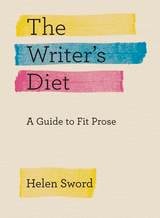
The Writer's Diet
A Guide to Fit ProseHelen Sword
University of Chicago Press, 2016
Helen Sword dispenses with excessive explanations and overwrought analysis. Instead, she offers an easy-to-follow set of writing principles: use active verbs whenever possible; favor concrete language over vague abstractions; avoid long strings of prepositional phrases; employ adjectives and adverbs only when they contribute something new to the meaning of a sentence; and reduce your dependence on four pernicious “waste words”: it, this, that, and there.
Sword then shows the rules in action through examples from William Shakespeare, Emily Dickinson, Martin Luther King Jr., John McPhee, A. S. Byatt, Richard Dawkins, Alison Gopnik, and many more. A writing fitness test encourages you to assess your own writing and get immediate advice on addressing problem areas. While The Writer’s Diet is as sleek and concise as the writing ideals contained within, this slim volume packs a powerful punch.
With Sword’s coaching writers of all levels can strengthen and tone their sentences with the stroke of a pen or the click of a mouse. As with any fitness routine, adhering to the rules requires energy and vigilance. The results, however, will speak for themselves.
The Writer's Reference Guide to Spanish
By David William Foster, Daniel Altamiranda, and Carmen de Urioste
University of Texas Press, 2000
Writers and editors of Spanish have long needed an authoritative guide to written language usage, similar to The MLA Style Manual and The Chicago Manual of Style. And here it is! This reference guide provides comprehensive information on how the Spanish language is copyedited for publication.
The book covers these major areas:
- Language basics: capitalization, word division, spelling, and punctuation.
- Language conventions: abbreviations, professional and personal titles, names of organizations, and nationalities.
- Bibliographic format, particularly how Spanish differs from English.
- Spanish language forms of classical authors' names.
- Literary and grammatical terminology.
- Linguistic terminology.
- Biblical names and allusions.
- A dictionary of grammatical doubts, including usage, grammatical constructions of particular words and phrases, verbal irregularities, and gender variations.
Theodore Roosevelt
A Literary LifeThomas Bailey and Katherine Joslin
University Press of New England, 2018