Results by title
75 books match the query 'Syntax' and 25 start with t
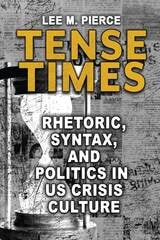
Tense Times
Rhetoric, Syntax, and Politics in US Crisis CultureLee M. Pierce
University of Alabama Press, 2023
American public culture is obsessed with crisis. Political polarization, economic collapse, moral decline—the worst seems always yet to come and already here. Tense Times argues that the ways we discuss these crises, especially through verb tenses, not only contribute to our perception and description of such crises but create them.
Past. Present. Future. These are the three principal verb tenses—the category of syntax that allows us to discuss time—that account for much of what is written about our crisis culture. Lee M. Pierce invites readers to expand their syntactic inventory beyond tense to include aspect (duration) and mood (attitude). Doing so opens new possibilities for understanding crisis discourse, as Pierce demonstrates with close readings of three syntaxes: the historical present, the past imperfective, and the retroactive subjunctive. Each mode produces a different experience of crisis and can help us understand our current political reality.
The book investigates a dozen widely circulated discourses from the past decade of US political culture, from Beyoncé’s controversial hit single “Formation” to the presidential campaign slogans of Hillary Clinton and Donald Trump, from the dueling rallies of Glenn Beck and Jon Stewart at the National Mall to the Ground Zero Mosque controversy and the 2007–2008 bailout. Taking a comparative approach that integrates theories of syntax from rhetorical, literary, affect, and cultural studies as well as linguistics, computer science, and Black studies, Tense Times suggests that the public’s conjuring of crisis is not inherently problematic. Rather, it is the openness of that crisis to contingency—the possibility that things could have been otherwise—that ought to concern anyone interested in language, politics, American culture, current events, or the direction this country is headed.
The Core and the Periphery
Data-Driven Perspectives on Syntax Inspired by Ivan A. SagEdited by Philip Hofmeister and Elisabeth Norcliffe
CSLI, 2013
The Dynamics of Lexical Interfaces
Ruth Kempson, Eleni Gregoromichelaki, Christine Howes
CSLI, 2011
Dynamic Syntax is a formal model of utterance description that attempts to articulate and substantiate the claim that human linguistic knowledge is essentially the ability to process language in context. The model provides an explicit demonstration of how interpretation is built up incrementally from the information provided by the words as they are encountered. Drawing from a range of analyses of natural language data, the authors use formal definitions, step-by-step derivations, and detailed lexical definitions to illustrate this new form of syntactic analysis and to show how the model can be applied to a broad range of constructions and languages.
The Generic Book
The Semantics of GenericsEdited by Gregory N. Carlson and Francis Jeffry Pelletier
University of Chicago Press, 1995

The Phonology-Syntax Connection
Edited by Sharon Inkelas and Draga Zec
University of Chicago Press, 1990
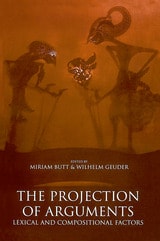
The Projection of Arguments
Lexical and Compositional FactorsEdited by Miriam Butt and Wilhelm Geuder
CSLI, 1998
The Semantic Basis of Argument Structure
Stephen Wechsler
CSLI, 1995
The Semantics of Syntax
A Minimalist Approach to GrammarDenis Bouchard
University of Chicago Press, 1995
The Semantics of Syntax is an elegant and powerful analysis of the relationship between syntax and semantics. Noting that meaning is underdetermined by form even in simple cases, Denis Bouchard argues that it is impossible to build knowledge of the world into grammar and still have a describable grammar. He thus proposes simple semantic representations and simple rules to relate linguistic levels. Focusing on a class of French verbs, Bouchard shows how multiple senses can be accounted for by the assumption of a single abstract core meaning along with background information about how objects behave in the world. He demonstrates that this move simplifies the syntax at no cost to the descriptive power of the semantics. In two important final chapters, he examines the consequences of his approach for standard syntactic theories.
The Structure of Complex Predicates in Urdu
Miriam Butt
CSLI, 1995
This book takes a detailed look at two differing complex predicates in the South Asian language Urdu. The Urdu permissive in particular brings into focus the problem of the syntax-semantics mismatch. An examination of the syntactic properties of this complex predicate shows that it is formed by the combination of two semantic heads, but that this combination is not mirrored in the syntax in terms of any kind of syntactic or lexical incorporation.
The Structure of English
Studies in Form and Function for Language TeachingJeanette S. DeCarrico
University of Michigan Press, 2000
With an emphasis on discourse function throughout, students are never expected to rely on lists of unrelated, constructed example sentences. Rather, when major points of grammar are presented, the structures are illustrated with rich, "real world" contexts excerpted from literature (mostly American), including novels, short stories, poems, essays, and drama. Exercises in the companion workbook are likewise based on naturally occurring stretches of discourse.
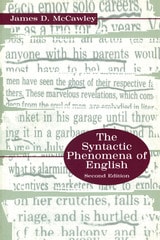
The Syntactic Phenomena of English
James D. McCawley
University of Chicago Press, 1998
And now available from the author! Answers to Selected Exercises.
Instructors using James D. McCawley's The Syntactic Phenomena of English, Second Edition may request a complimentary copy of Answers to Selected Exercises in The Syntactic Phenomena of English by writing on their department's letterhead to the author, James D. McCawley, Department of Linguistics, 1010 E. 59th Street, Chicago, IL 60637. [Note: This material is available only from the author and is not available from the University of Chicago Press.]
The Syntactic Phenomena of English, Volume 1
James D. McCawley
University of Chicago Press, 1988
And now available from the author! Answers to Selected Exercises.
Instructors using James D. McCawley's The Syntactic Phenomena of English, Second Edition may request a complimentary copy of Answers to Selected Exercises in The Syntactic Phenomena of English by writing on their department's letterhead to the author, James D. McCawley, Department of Linguistics, 1010 E. 59th Street, Chicago, IL 60637. [Note: This material is available only from the author and is not available from the University of Chicago Press.]
The Syntactic Phenomena of English, Volume 2
James D. McCawley
University of Chicago Press, 1988
And now available from the author! Answers to Selected Exercises.
Instructors using James D. McCawley's The Syntactic Phenomena of English, Second Edition may request a complimentary copy of Answers to Selected Exercises in The Syntactic Phenomena of English by writing on their department's letterhead to the author, James D. McCawley, Department of Linguistics, 1010 E. 59th Street, Chicago, IL 60637. [Note: This material is available only from the author and is not available from the University of Chicago Press.]
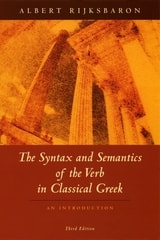
The Syntax and Semantics of the Verb in Classical Greek
An Introduction: Third EditionAlbert Rijksbaron
University of Chicago Press, 2007
The verb is, in any language, the motor of all communication: no verb, no action. In Greek, verb forms change not only with person, number, tense, and voice, but in four possible moods as well. Available now in a special reprint for the North American market, The Syntax and Semantics of the Verb in Classical Greek is an incomparable resource to students and scholars charged with the considerable task of untangling the Greek language’s many complexities. With clear, concise instruction, Albert Rijksbaron shows how the various verb forms contribute to the richness of the Greek literature as we know it, in this essential guide for both novices and experienced practitioners.
“[This study] belongs in the library of any Hellenist and any linguist interested in ancient Greek.”—Classics Newsletter (Anzeiger für die Altertumswissenschaft)
“Every use is described with concision and clarity.”—Kratylos
“The book offers an example of how the empirical thoroughness of traditional Classical scholarship can be brought into contact with general linguistic theory.”—Language

The Syntax of Spoken Brazilian Portuguese
Earl W. Thomas
Vanderbilt University Press, 1969
Very real differences do exist between what is spoken and what is written in virtually every language. In Brazilian Portuguese, especially, the gulf between the two is wide: In many cases, the most cultured Brazilian is unable to comprehend with ease Brazilian literature written only fifty years ago.
THE SYNTAX OF SPOKEN BRAZILIAN PORTUGUESE is the first thorough analysis of the spoken language of contemporary Brazil, in English, for students and teachers of the language. Useful as a text in advanced language courses, the work is intended primarily for reference and as a research aid to future authors of Portuguese language textbooks.
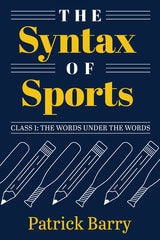
The Syntax of Sports, Class 1
The Words Under the WordsPatrick Barry
Michigan Publishing Services, 2019
The beginning of a multi-volume series, this initial book recreates the first day of class as it was taught to undergraduates at the University of Michigan. The examples are compelling. The dialogue is fast moving. The stories are ones you’ll want to return to and retell over and over again. There is a reason the actual students who took The Syntax of Sports said the following things about it:
“Every class I learned something new that I know I’ll actually use in my writing for years to come. Couldn’t be happier that I took a chance on Syntax of Sports.”
“Prof. Barry has structured the course so that it’s almost impossible not to learn something valuable to take with you to future classes and future career possibilities.”
“I have learned a ton of techniques for being a better writer in this class. I have also learned many life lessons that will undoubtedly guide how I act in the future.”
“I absolutely loved this course because the teacher was so awesome. I enjoyed sitting through class listening to Professor Barry and falling in love with his brain.”
The Syntax of Sports, Class 2
The Power of the ParticularPatrick Barry
Michigan Publishing Services, 2020
What can we learn from baseball great Ted Williams about how to improve our writing? What can we learn we from the iconic ESPN show SportsCenter about how to manage information? And are you sure you really know what the word “peruse” means?
Explore these and other questions in the second volume of The Syntax of Sports, a series designed to recreate a popular course at the University of Michigan. Here are a few things students have said about the experience of taking it.
-
“Patrick Barry is the best teacher I have ever had. I have never learned so much in a class. I hated English my whole life until I took this course.”
-
“I feel like this is and always will be the most valuable class I've ever taken here.”
-
“I genuinely wanted to show up to this class due to the amount I knew I would learn.”
-
“I'm going to severely SEVERELY miss this course.”
-
“Every student should try to take one of Prof. Barry’s classes if he or she wants to become a better writer.”
-
“My writing is now 113x better.”
The Syntax of Sports, Class 3
The Rule of ThreePatrick Barry
Michigan Publishing Services, 2021
It’s not an accident that hall of fame coaches, Pulitzer Prize-winning writers, and the marketing teams at the most innovative companies in the world often rely on a certain three-part structure when trying to communicate their ideas. This third volume of The Syntax of Sports series explores the mechanics of that structure and shows how it can add a compelling mix of clarity and sophistication to your writing.
Like in the previous volumes, the materials come from a popular course at the University of Michigan. Here are comments from students who have taken it:
“The quality of this course was fantastic!”
“Professor Barry really knows how to keep students engaged.”
“Professor Barry is very passionate about teaching, and his enthusiasm made me want to write and learn.”
“This course not only helps you become a better writer but also sheds light on how you might become a better person.”
The Syntax of Sports, Class 4
Parallel StructurePatrick Barry
Michigan Publishing Services, 2022
“Once you find the right structure, perhaps it will be easier to find the right content.” That’s one of the key insights from this fourth book in the series The Syntax of Sports. Others include:
- The importance of being “radically inclusive”
- The power of defining something by what it is not
- The creative elegance of the word “as”
So join Professor Patrick Barry as he continues to share lessons from the popular writing course at the University of Michigan on which The Syntax of Sports is based. You’ll learn about language. You’ll learn about advocacy. And you’ll get to explore some illuminating connections between everything from the speeches of Winston Churchill, to the paintings of Leonardo da Vinci, to—perhaps most surprisingly—the face of NFL legend (and former University of Michigan quarterback) Tom Brady.
The Syntax of Sports, Class 5
Rhetorical RepetitionPatrick Barry
Michigan Publishing Services, 2024
- "Fantastic"
- "Phenomenal"
- "Very engaging and informative:
- "Incredibly useful
- "Full of practical lessons for both my career and life generally"
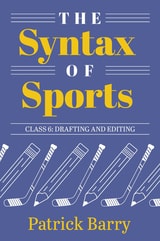
The Syntax of Sports, Class 6
Drafting and EditingPatrick Barry
Michigan Publishing Services, 2024
How do you start a piece of writing? How do you edit one? And what can be done to combat those pesky—and paralyzing—feelings of perfectionism that often derail our most important sentences and paragraphs?
This sixth volume of the Syntax of Sports series creatively uses the language of baseball, football, tennis, and many other sports to explore these questions. Based on a popular course at the University of Michigan, it captures the energy, originality, and discipline - crossing insights that make its author, Professor Patrick Barry, such a sought-after teacher and presenter.
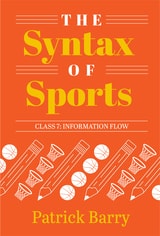
The Syntax of Sports, Class 7
Information FlowPatrick Barry
Michigan Publishing Services, 2025
The Syntax of Subjects
Koichi Tateishi
CSLI, 1994
The Unity of Unbounded Dependency Constructions
Robert D. Levine and Thomas E. Hukari
CSLI, 2006
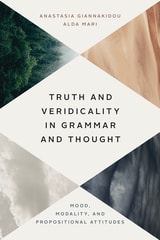
Truth and Veridicality in Grammar and Thought
Mood, Modality, and Propositional AttitudesAnastasia Giannakidou and Alda Mari
University of Chicago Press, 2021
Can language directly access what is true, or is the truth judgment affected by the subjective, perhaps even solipsistic, constructs of reality built by the speakers of that language? The construction of such subjective representations is known as veridicality, and in this book Anastasia Giannakidou and Alda Mari deftly address the interaction between truth and veridicality in the grammatical phenomena of mood choice: the indicative and subjunctive choice in the complements of modal expressions and propositional attitude verbs.
Combining several strands of analysis—formal linguistic semantics, syntactic theory, modal logic, and philosophy of language—Giannakidou and Mari’s theory not only enriches the analysis of linguistic modality, but also offers a unified perspective of modals and propositional attitudes. Their synthesis covers mood, modality, and attitude verbs in Greek and Romance languages, while also offering broader applications for languages lacking systematic mood distinction, such as English. Truth and Veridicality in Grammar and Thought promises to shape longstanding conversations in formal semantics, pragmatics, and philosophy of language, among other areas of linguistics.