Results by title
67 books match the query 'Technology Studies' and 11 start with t
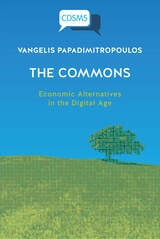
T?he Commons
Economic Alternatives in the Digital AgeVangelis Papadimitropoulos
University of Westminster Press, 2020
This book explores the potential creation of a broader collaborative economy through commons-based peer production (P2P) and the emergent role of information and communication technologies (ICTs). The book seeks to critically engage in the political discussion of commons-based peer production, which can be classified into three basic arguments: the liberal, the reformist and the anti-capitalist. This book categorises the liberal argument as being in favour of the coexistence of the commons with the market and the state. Reformists, on the other hand, advocate for the gradual adjustment of the state and of capitalism to the commons, while anti-capitalists situate the commons against capitalism and the state. By discussing these three viewpoints, the book contributes to contemporary debates concerning the future of commons-based peer production.
Further, the author argues that for the commons to become a fully operational mode of peer production, it needs to reach critical mass arguing that the liberal argument underestimates the reformist insight that technology has the potential to decentralise production, thereby forcing capitalism to transition to post-capitalism. Surveying the three main strands of commons-based peer production, this book makes the case for a post-capitalist commons-orientated transition that moves beyond neoliberalism.

Techno-Negative
A Long History of Refusing the MachineThomas Dekeyser
University of Minnesota Press, 2026
A radical history of technology told through acts of resistance, not progress
The history of technology is often told as a history of progress, moving optimistically and inevitably from one emancipatory invention to the next. Techno-Negative turns this story on its head, taking us on a journey to the critical junctures where people have pointedly rejected and tried to undo, rather than adopt, new technologies. Beginning with Archimedes’s decision to destroy his own war machines, this book explores the will to negate technology as a deep—but persistently condemned—current in history.
As he presents a new theory of technological power, Thomas Dekeyser argues that technologies, never neutral, operate as “ontological policing,” drawing the boundaries of humanness as they are unequally leveraged by select groups. Looking beyond the Luddites to medieval monks banning tools, seventeenth-century loom burners, revolutionary lantern smashers, and computer arsonists, Dekeyser shows how people have long recognized and resisted the machine as a violent, sometimes deadly force implicated in defining who counts as human and whose lives (and ways of life) are worth saving.
Against the ubiquitous demands to reform or accelerate technological “advancement” that have failed to disrupt our present, Dekeyser proposes a spirited alternative: abolition. He challenges us to rethink the terms of our technological present and future. In a time when Big Tech grows increasingly enmeshed with authoritarian control, Techno-Negative is a conceptual declaration, and source of inspiration, for those searching for a new paradigm of technological politics.
Retail e-book files for this title are screen-reader friendly.
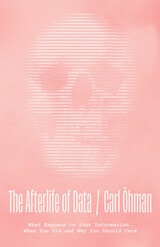
The Afterlife of Data
What Happens to Your Information When You Die and Why You Should CareCarl Öhman
University of Chicago Press, 2024
A short, thought-provoking book about what happens to our online identities after we die.
These days, so much of our lives takes place online—but what about our afterlives? Thanks to the digital trails that we leave behind, our identities can now be reconstructed after our death. In fact, AI technology is already enabling us to “interact” with the departed. Sooner than we think, the dead will outnumber the living on Facebook. In this thought-provoking book, Carl Öhman explores the increasingly urgent question of what we should do with all this data and whether our digital afterlives are really our own—and if not, who should have the right to decide what happens to our data.
The stakes could hardly be higher. In the next thirty years alone, about two billion people will die. Those of us who remain will inherit the digital remains of an entire generation of humanity—the first digital citizens. Whoever ends up controlling these archives will also effectively control future access to our collective digital past, and this power will have vast political consequences. The fate of our digital remains should be of concern to everyone—past, present, and future. Rising to these challenges, Öhman explains, will require a collective reshaping of our economic and technical systems to reflect more than just the monetary value of digital remains.
As we stand before a period of deep civilizational change, The Afterlife of Data will be an essential guide to understanding why and how we as a human race must gain control of our collective digital past—before it is too late.
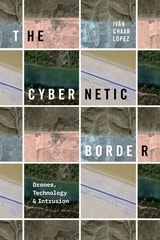
The Cybernetic Border
Drones, Technology, and IntrusionIván Chaar López
Duke University Press, 2024
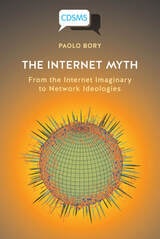
The Internet Myth
From the Internet Imaginary to Network IdeologiesPaolo Bory
University of Westminster Press, 2020
‘The Internet is broken and Paolo Bory knows how we got here. In a powerful book based on original research, Bory carefully documents the myths, imaginaries, and ideologies that shaped the material and cultural history of the Internet. As important as this book is to understand our shattered digital world, it is essential for those who would fix it.’ — Vincent Mosco, author of The Smart City in a Digital World
The Internet Myth retraces and challenges the myth laying at the foundations of the network ideologies – the idea that networks, by themselves, are the main agents of social, economic, political and cultural change. By comparing and integrating different sources related to network histories, this book emphasizes how a dominant narrative has extensively contributed to the construction of the Internet myth while other visions of the networked society have been erased from the collective imaginary. The book decodes, analyzes and challenges the foundations of the network ideologies looking at how networks have been imagined, designed and promoted during the crucial phase of the 1990s.
Three case studies are scrutinized so as to reveal the complexity of network imaginaries in this decade: the birth of the Web and the mythopoesis of its inventor; and the histories of two Italian networking projects, the infrastructural plan Socrate and the civic network Iperbole, the first to give free Internet access to citizens.
The Internet Myth thereby provides a compelling and hidden sociohistorical narrative in order to challenge one of the most powerful myths of our time.
This title has been published with the financial assistance of the Fondazione Hilda e Felice Vitali, Lugano, Switzerland.
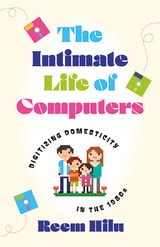
The Intimate Life of Computers
Digitizing Domesticity in the 1980sReem Hilu
University of Minnesota Press, 2024
A feminist perspective on the early history of personal computing, revealing how computers were integrated into the most intimate aspects of family life
The Intimate Life of Computers shows how the widespread introduction of home computers in the 1980s was purposefully geared toward helping sustain heteronormative middle-class families by shaping relationships between users. Moving beyond the story of male-dominated computer culture, this book emphasizes the neglected history of the influence of women’s culture and feminist critique on the development of personal computing despite women’s underrepresentation in the industry.
Proposing the notion of “companionate computing,” Reem Hilu reimagines the spread of computers into American homes as the history of an interpersonal, romantic, and familial medium. She details the integration of computing into family relationships—from helping couples have better sex and offering thoughtful simulations of masculine seduction to animating cute robot companions and giving voice to dolls that could talk to lonely children—underscoring how these computer applications directly responded to the companionate needs of their users as a way to ease growing pressures on home life.
The Intimate Life of Computers is a vital contribution to feminist media history, highlighting how the emergence of personal computing dovetailed with changing gender roles and other social and cultural shifts. Eschewing the emphasis on technologies and institutions typically foregrounded in personal-computer histories, Hilu uncovers the surprising ways that domesticity and family life guided the earlier stages of our all-pervasive digital culture.

The Legendary Douglas DC-3
A Pictorial TributeMichael S. Prophet
Amsterdam University Press, 2023
Many of these revolutions related to safety; thanks to the DC-3’s reputation for reliability, air travel insurance finally became available to the general public in 1937. This is the airliner that not only made flying respectable but enabled the emerging aviation industry to end its reliance on mail subsidies and profit from passenger journeys.
DC-3 is still flying eight decades after their first debut - this book is a tribute to its brilliant design.
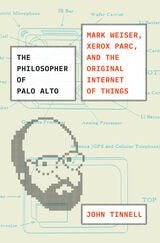
The Philosopher of Palo Alto
Mark Weiser, Xerox PARC, and the Original Internet of ThingsJohn Tinnell
University of Chicago Press, 2023
When developers and critics trace the roots of today’s Internet of Things—our smart gadgets and smart cities—they may single out the same creative source: Mark Weiser (1952–99), the first chief technology officer at Xerox PARC and the so-called “father of ubiquitous computing.” But Weiser, who died young at age 46 in 1999, would be heartbroken if he had lived to see the ways we use technology today. As John Tinnell shows in this thought-provoking narrative, Weiser was an outlier in Silicon Valley. A computer scientist whose first love was philosophy, he relished debates about the machine’s ultimate purpose. Good technology, Weiser argued, should not mine our experiences for saleable data or demand our attention; rather, it should quietly boost our intuition as we move through the world.
Informed by deep archival research and interviews with Weiser’s family and colleagues, The Philosopher of Palo Alto chronicles Weiser’s struggle to initiate a new era of computing. Working in the shadows of the dot-com boom, Weiser and his collaborators made Xerox PARC headquarters the site of a grand experiment. Throughout the building, they embedded software into all sorts of objects—coffeepots, pens, energy systems, ID badges—imbuing them with interactive features. Their push to integrate the digital and the physical soon caught on. Microsoft’s Bill Gates flagged Weiser’s Scientific American article “The Computer for the 21st Century” as a must-read. Yet, as more tech leaders warmed to his vision, Weiser grew alarmed about where they wished to take it.
In this fascinating story of an innovator and a big idea, Tinnell crafts a poignant and critical history of today’s Internet of Things. At the heart of the narrative is Weiser’s desire for deeper connection, which animated his life and inspired his notion of what technology at its best could be.
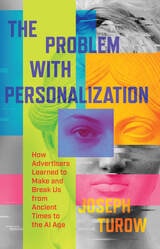
The Problem with Personalization
How Advertisers Learned to Make and Break Us from Ancient Times to the AI AgeJoseph Turow
University of Chicago Press, 2026
A respected voice on technology shows how seemingly simple ads help dismantle democracy and public discourse.
Whether you’re intentionally shopping or casually browsing social media, something is following you: ads. Their creators seem to know your income bracket, politics, age, location, medical conditions, and tastes in clothing, food, and romantic partners. As advertising firms use predictive AI to discover your hot buttons and generative AI to push them, your online world becomes an increasingly bespoke—and isolated—place. The fervid competition around personalization in digital marketing has given rise to an ecosystem of advertisers, media outlets, tech companies, and retailers who monetize your data while threatening the health of our media, discourse, and sense of community. In this urgent book, award-winning author Joseph Turow shows how we got here, and how to change direction.
The Problem with Personalization shatters common beliefs about advertising history by showing that individualized ads are not new. Today’s AI-enabled advertisers draw on past aspirations and assumptions about personalization while weaponizing data in unprecedented ways that drive social fragmentation and the disappearance of shared social reality. Informed by interviews with marketing insiders and covering the latest technology advances, Turow accessibly explains how artificial intelligence sifts through our data to tag and target us wherever we go with personalized videos, pictorial billboards, audio messages, and more. A logical next step for advertiser support is tailored entertainment and news, a shift that further destroys the common ground necessary for a functioning democracy.
A must-read for all who care about the future of public discourse, The Problem with Personalization reveals how targeted advertising has altered how we’re seen and what we see in return.
The Problem with Personalization
How Advertisers Learned to Make and Break Us from Ancient Times to the AI AgeJoseph Turow
University of Chicago Press, 2026
A respected voice on technology shows how seemingly simple ads help dismantle democracy and public discourse.
Whether you’re intentionally shopping or casually browsing social media, something is following you: ads. Their creators seem to know your income bracket, your tastes in clothing, food, location, politics, age, medical conditions, and romantic partners. As predictive AI tells firms what your hot buttons are and generative AI produces messages tailored to those buttons, your online world becomes an increasingly comfortable—and isolated—place. The fervid competition around personalization in digital marketing, now ubiquitous, has given rise to an ecosystem of advertisers, media outlets, tech companies, and retailers who monetize your data, while threatening the health of our media, our discourse, and our sense of community. In this urgent book, award-winning author Joseph Turow shows how we got here, and how to change direction.
The Problem with Personalization shatters common beliefs about advertising history by showing that individualizing ads is not new. Today’s high-velocity AI versions draw on past aspirations and assumptions about personalization while weaponizing it in unprecedented ways that drive social fragmentation and the disappearance of shared social reality. Informed by interviews with marketing insiders and covering the latest technology advances, Turow accessibly explains how artificial intelligence sifts our data to tag and target us wherever we go with personalized videos, pictorial billboards, audio messages, and more. A logical next step for advertiser support is tailored entertainment and news, a shift that further destroys the common ground necessary for a functioning democracy.
A must-read for all who care about the future of public discourse, The Problem with Personalization reveals how targeted advertising has altered how we’re seen and what we see in return.

The Racial Cage
ehlers
University of Minnesota Press, 2025
The potential of biohumanities as a foundation for antiracist critique of the human
The Racial Cage delivers a spirited and polyvocal analysis of how race is materialized through both metaphorical and literal cages. It theorizes the cage, fence, dragnet, and tube as material–semiotic sites for racialization and for iteratively redefining the human–animal boundary. A collaborative conversation across continents, this work examines the racial cage as an important part of the practice of social division and bodily containment. The deeply considered result is an empirical and theoretical approach to biohumanities that productively interrogates its linkages to critical theories of race and racism.