Results by title
65 books match the query 'Terror' and 19 start with t
Terror And Its Discontents
Suspect Words In Revolutionary FranceCaroline Weber
University of Minnesota Press, 2003
A timely exploration of the political uses of language and rhetoric
Camille Desmoulins, a journalist writing under the Montagnard regime of 1793-94, remarked that France’s government had replaced “the language of democracy” with “the cold poison of fear, which paralyzed thought in the bottom of people’s souls, and prevented it from pouring forth at the tribunal, or in writing.” How this happened, how the Reign of Terror reached even into the realms of thought and language, is the subject of Caroline Weber’s book, a revealing look into the paradoxical embargo on free expression that underpinned the Robespierrists’s self-proclaimed “despotism of liberty” during the French Revolution.
Weber examines Jean-Jacques Rousseau’s and the Robespierrists’s articulation of a series of initiatives designed to curtail and control the dissemination of alternative political and philosophical messages in the republic. Here Weber underscores the internal contradictions and limitations of an enterprise that promised universal freedom while oppressing particularism, and that railed against the very language that it was compelled to adopt as a principal political tool. The book then focuses on two eloquent contemporary critics of this phenomenon, Desmoulins and the Marquis de Sade, the infamous libertine author. Weber demonstrates how Desmoulins reconfigured the Montagnard regime’s rhetoric to conjure up a political system based on tolerance, not terror, and how Sade deftly parodied the Robespierrists’s brutality and hypocrisy, proposing a republic based on the ruthless elimination of dissident voices and on the unabashed celebration of despotism and bloodshed.A balanced account of how the “discourse of totality” actually restricted particular freedoms in the wake of the French Revolution, this book provides a highly original—and timely—exposition of the political uses of rhetoric and of the links between language and power.
Terror and History, Volume 2003
Van Gosse , ed.
Duke University Press, 0
Contributors. Joel Beinin, Lisa Brock, Horace Campbell, Duane J. Corpis, Belinda Davis, Allen Feldman, Ian Christopher Fletcher, Van Gosse, Joy James, J. Angus Johnston, Amy Kaplan, Thomas Miller Klubock, R. J. Lambrose, Jesse Lemisch, Deborah Levenson, Walter Benn Michaels, Donnacha Ó Beacháin, Deborah Poole, Vijay Prashad, David Prochaska, Gerardo Rénique, Cedric J. Robinson, Nikhil Pal Singh, Stephanie J. Smith, Akinyele O. Umoja, Verónica Valdivia Ortiz de Zárate, Jon Wiener, Marilyn B. Young, Joseba Zulaika
Terror and Territory
The Spatial Extent of SovereigntyStuart Elden
University of Minnesota Press, 2009
Today's global politics demands a new look at the concept of territory. From so-called deterritorialized terrorist organizations such as al-Qaeda to U.S.-led overthrows of existing regimes in the Middle East, the relationship between territory and sovereignty is under siege. Unfolding an updated understanding of the concept of territory, Stuart Elden shows how the contemporary "war on terror" is part of a widespread challenge to the connection between the state and its territory.
Although the importance of territory has been disputed under globalization, territorial relations have not come to an abrupt end. Rather, Elden argues, the territory/sovereignty relation is being reconfigured. Traditional geopolitical analysis is transformed into a critical device for interrogating hegemonic geopolitics after the Cold War, and is employed in the service of reconsidering discourses of danger that include "failed states," disconnection, and terrorist networks.
Looking anew at the "war on terror"; the development and application of U.S. policy; the construction and demonization of rogue states; events in Lebanon, Somalia, and Pakistan; and the wars continuing in Afghanistan and Iraq, Terror and Territory demonstrates how a critical geographical analysis, informed by political theory and history, can offer an urgently needed perspective on world events.

Terror and Violence
Imagination and the UnimaginableEdited by Pamela J. Stewart, Andrew Strathern, and Neil L. Whitehead
Pluto Press, 2005
Terror and Wonder
Architecture in a Tumultuous AgeBlair Kamin
University of Chicago Press, 2010
For more than twenty years now, Blair Kamin of the Chicago Tribune has explored how architecture captures our imagination and engages our deepest emotions. A winner of the Pulitzer Prize for criticism, Kamin treats his subjects not only as works of art but also as symbols of the cultural and political forces that inspire them. Terror and Wonder gathers the best of Kamin’s writings from the past decade along with new reflections on an era framed by the destruction of the World Trade Center and the opening of the world’s tallest skyscraper.
Assessing ordinary commercial structures as well as head-turning designs by some of the world’s leading architects, Kamin paints a sweeping but finely textured portrait of a tumultuous age torn between the conflicting mandates of architectural spectacle and sustainability. For Kamin, the story of our built environment over the past ten years is, in tangible ways, the story of the decade itself. Terror and Wonder considers how architecture has been central to the main events and crosscurrents in American life since 2001: the devastating and debilitating consequences of 9/11 and Hurricane Katrina; the real estate boom and bust; the use of over-the-top cultural designs as engines of civic renewal; new challenges in saving old buildings; the unlikely rise of energy-saving, green architecture; and growing concern over our nation’s crumbling infrastructure.
A prominent cast of players—including Santiago Calatrava, Frank Gehry, Helmut Jahn, Daniel Libeskind, Barack Obama, Renzo Piano, and Donald Trump—fills the pages of this eye-opening look at the astounding and extraordinary ways that architecture mirrors our values—and shapes our everyday lives.
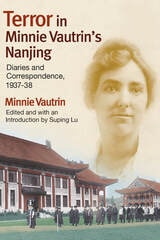
Terror in Minnie Vautrin's Nanjing
Diaries and Correspondence, 1937-38Minnie Vautrin. Edited and with an Introduction by Suping Lu
University of Illinois Press, 2007
In December of 1937, the Japanese Imperial Army marched into China's capital city of Nanjing and launched six weeks of carnage that would become known as the Rape of Nanjing. In addition to the deaths of Chinese POWs and civilians, tens of thousands of women were raped, tortured, and killed by Japanese soldiers. In this traumatic environment, both native and foreign-born inhabitants of Nanjing struggled to carry on with their lives.
This volume collects the diaries and correspondence of Minnie Vautrin, a farmgirl from Illinois who had dedicated herself to the education of Chinese women at Ginling College in Nanjing. Faced with the impending Japanese attack, she turned the school into a sanctuary for ten thousand women and girls. Vautrin's firsthand accounts of daily life in Nanjing and the intensifying threat of Japanese invasion reveal the courage of the occupants under siege--Chinese nationals as well as Western missionaries, teachers, surgeons and business people--and the personal costs of violence in wartime.
Thanks to Vautrin's painstaking effort in keeping a day-to-day account, present-day readers are able to examine this episode of history at close range through her eyes. With detailed maps, photographs, and carefully researched in-depth annotations, Terror in Minnie Vautrin's Nanjing: Diaries and Correspondence, 1937-38 presents a comprehensive and detailed daily account of the events and of life during the horror-stricken days within the city walls and in particular on the Ginling campus. Through chronologically arranged diaries, letters, reports, documents, and telegrams, Vautrin bears witness to those terrible events and to the magnitude of trauma that the Nanjing Massacre exacted on the populace.
Terror in the Countryside
Campesino Responses to Political Violence in Guatemala, 1954–1985Rachel A. May
Ohio University Press, 2001
The key to democratization lies within the experience of the popular movements. Those who engaged in the popular struggle in Guatemala have a deep understanding of substantive democratic behavior, and the experience of Guatemala’s civil society should be the cornerstone for building a meaningful formal democracy.
In Terror in the Countryside Rachel May offers an in-depth examination of the relationship between political violence and civil society. Focusing on Guatemala, Professor May develops a theoretical scheme that calls into question the more conventional understandings of both violence and civil society.
By elaborating a cyclical model of violence, and suggesting a typology of rural (campesino) popular organizations, Terror in the Countryside provides both a history and an analysis of late-twentieth-century violence and of the role of campesino organizations during the worst years of conflict in Guatemala.
This history details the way ideologies, organizational structures, and mobilization strategies evolved in response to the climate of terror, emphasizing the courage and sacrifice of those who worked for justice and human rights.
This book argues that the peace accords can be considered only as a first step to eliminate a violence that has become deeply rooted in the political life of the country.
Terror, Theory and the Humanities
Jeffrey R. Di Leo and Uppinder Mehan, editors
Michigan Publishing Services, 2012
The Businessman
A Tale of TerrorThomas M. Disch
University of Minnesota Press, 2010
The Dark Sahara
America's War on Terror in AfricaJeremy Keenan
Pluto Press, 2009
The US is keen to build a substantial military presence in Africa, citing the need to combat the growth of Al-Qaeda in Somalia, Algeria and other countries on the continent. This book reveals the secret US agenda behind the 'war on terror' in Africa and the shocking methods used to perpetuate the myth that the region is a hot-bed of Islamic terrorism.
Africa expert Jeremy Keenan points to overwhelming evidence suggesting that, from 2003, the Bush administration and Algerian government were responsible for hostage takings blamed on Islamic militants. This created a permissive public attitude, allowing the US to establish military bases in the region and pursue multiple imperial objectives in the name of security.
The shocking revelations in this book seriously undermine the mainstream view of Africa as a legitimate 'second front' in the 'war on terror'.
The Dying Sahara
US Imperialism and Terror in AfricaJeremy Keenan
Pluto Press, 2013
In The Dark Sahara (Pluto, 2009), Jeremy Keenan exposed the collusion between the US and Algeria in fabricating terrorism to justify a new ‘Saharan front’ in Washington’s War on Terror. Now, in The Dying Sahara, he reveals how the designation of the region as a ‘Terror Zone’ has destroyed the lives and livelihoods of thousands of innocent people.
Beginning in 2004, with what local people called the US ‘invasion’ of the Sahel, The Dying Sahara shows how repressive, authoritarian regimes - cashing in on US terrorism ‘rents’ - provoked Tuareg rebellions in both Niger and Mali. Further, he argues that US activity has unleashed a new, narco-trafficking branch of Al-Qaeda.
Keenan's chillingly detailed research shows that the US and its new combatant African command (AFRICOM) have created instability in a region the size of western Europe.
The Flowers of Tarbes
or, Terror in LiteratureJean Paulhan
University of Illinois Press, 2005
The Inferno
A Story of Terror and Survival in ChileLuz Arce; Translated by Stacey Alba Skar
University of Wisconsin Press, 2004
As a member of Salvador Allende’s Personal Guards (GAP), Luz Arce worked with leaders of the Socialist Party during the Popular Unity Government from 1971 to1973. In the months following the coup, Arce served as a militant with others from the Left who opposed the military junta led by Augusto Pinochet, which controlled the country from 1973 to1990. Along with thousands of others in Chile, Arce was detained and tortured by Chile’s military intelligence service, the DINA, in their attempt to eliminate alternative voices and ideologies in the country. Arce’s testimonial offers the harrowing story of the abuse she suffered and witnessed as a survivor of detention camps, such as the infamous Villa Grimaldi.
But when faced with threats made to her family, including her young son, and with the possibility that she could be murdered as thousands of others had been, Arce began to collaborate with the Chilean military in their repression of national resistance groups and outlawed political parties. Her testimonial thus also offers a unique perspective from within the repressive structures as she tells of her work as a DINA agent whose identifications even lead to the capture of some of her former friends and compañeros.
During Chile’s return to democracy in the early 1990s, Arce experienced two fundamental changes in her life that led to the writing of her story. The first was a deep spiritual renewal through her contacts with the Catholic Church whose Vicariate of Solidarity had fought for human rights in the country during the dictatorship. The second was her decision to participate within the legal system to identify and bring to justice those members of the military who were responsible for the crimes committed from 1973 to1990. Luz Arce’s book invites readers to rethink the definition of testimonial narrative in Latin America through the unique perspective of a survivor-witness-confessor.
The Terror of Natural Right
Republicanism, the Cult of Nature, and the French RevolutionDan Edelstein
University of Chicago Press, 2009
Natural right—the idea that there is a collection of laws and rights based not on custom or belief but that are “natural” in origin—is typically associated with liberal politics and freedom. In The Terror of Natural Right, Dan Edelstein argues that the revolutionaries used the natural right concept of the “enemy of the human race”—an individual who has transgressed the laws of nature and must be executed without judicial formalities—to authorize three-quarters of the deaths during the Terror. Edelstein further contends that the Jacobins shared a political philosophy that he calls “natural republicanism,” which assumed that the natural state of society was a republic and that natural right provided its only acceptable laws. Ultimately, he proves that what we call the Terror was in fact only one facet of the republican theory that prevailed from Louis’s trial until the fall of Robespierre.
A highly original work of historical analysis, political theory, literary criticism, and intellectual history, The Terror of Natural Right challenges prevailing assumptions of the Terror to offer a new perspective on the Revolutionary period.
The Terror of the Machine
Technology, Work, Gender, and Ecology on the U.S.-Mexico BorderBy Devon G. Peña
University of Texas Press, 1995
Born of thirteen years of field research, this interdisciplinary work explores the complex intersections of technology, class, gender, and ecology in the transnational milieu of Mexico's maquiladoras, foreign-owned assembly plants located along the U.S. border.
Devon Peña examines workplace and community struggles from the perspective of the women who work in the maquiladoras. He describes the workers' struggles for workplace democracy, social justice, and sustainable development. He also observes the circulation of struggle from the factory to the community, highlighting the efforts to establish worker-owned cooperatives in the border region during the 1970s and 1980s.
Female maquila workers are typically portrayed as passive, apolitical, and easily exploited. This book, however, presents an opposing view, investigating the "subaltern life of the shop floor"—the workers' informal methods of resistance to hazardous conditions, sexual harassment, and managerial tyranny. Using survey research, oral history, discourse analysis, and site ethnography, the author develops a cogent critique of labor-process theory, a critique grounded on his extensive study of actual workplace politics in the maquiladoras.
The Terror of the Machine is a trenchant analysis of the political, cultural, and environmental effects of maquila industrialization and an eloquent and persuasive call for alternatives in the direction of ecologically sustainable and culturally appropriate modes of development.
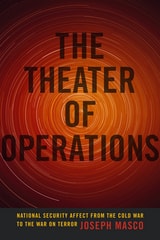
The Theater of Operations
National Security Affect from the Cold War to the War on TerrorJoseph Masco
Duke University Press, 2014
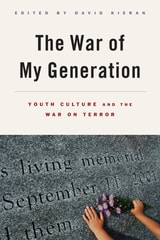
The War of My Generation
Youth Culture and the War on TerrorKieran, David
Rutgers University Press, 2015
The War of My Generation is the first essay collection to focus specifically on how the terrorist attacks and their aftermath have shaped these new generations of Americans. Drawing from a variety of disciplines, including anthropology, sociology, cultural studies, and literary studies, the essays cover a wide range of topics, from graphic war images in the classroom to computer games designed to promote military recruitment to emails from parents in the combat zone. The collection considers what cultural factors and products have shaped young people's experience of the 9/11 attacks, the wars that have followed, and their experiences as emerging citizen-subjects in that moment. Revealing how young people understand the War on Terror—and how adults understand the way young people think—The War of My Generation offers groundbreaking research on catastrophic events still fresh in our minds.
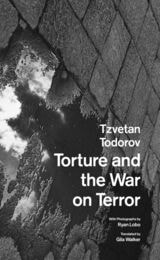
Torture and the War on Terror
Tzvetan Todorov
Seagull Books, 2009
One of the world's leading intellectuals dismantles the political and ethical justifications for institutional torture.
In the aftermath of 9/11, the US government approved interrogation tactics for enemy combatant detainees that could be defined as torture, which was outlawed in Europe in the eighteenth century and forbidden by the Geneva Conventions and the United Nations Convention Against Torture. In conjunction with these policies, the Bush administration vocally defended torture as a necessary tool in its Global War on Terror. Though the election of Barack Obama and his signing of the executive order to close the prison at Guantanamo Bay signaled a considerable shift away from the policies of the Bush era, the lessons to be learned from the Global War on Terror will remain relevant and necessary for many years to come.
In Torture and the War on Terror, Tzvetan Todorov argues that the use of the terms “war” and “terror” dehumanizes the enemy and permits treatment that would otherwise be impermissible. He examines the implications and corrupting impact of the attempt to impose “good” through violence and spread democratic values by unethical means. Todorov asks: Can violence overcome violence? Does the need to protect one’s own country justify violating human rights? Challenging one by one the political and ethical arguments in favor of torture, Todorov likens institutional torture to a cancer that is eroding our society and undermining the very fundamental democratic ideas of justice and right.
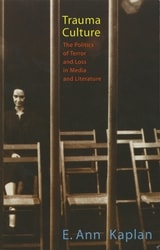
Trauma Culture
The Politics of Terror and Loss in Media and LiteratureKaplan, E. Ann
Rutgers University Press, 2005
In Trauma Culture, E. Ann Kaplan explores the relationship between the impact of trauma on individuals and on entire cultures and nations. Arguing that humans possess a compelling need to draw meaning from personal experience and to communicate what happens to others, she examines the artistic, literary, and cinematic forms that are often used to bridge the individual and collective experience. A number of case studies, including Sigmund Freud's Moses and Monotheism, Marguerite Duras' La Douleur, Sarah Kofman's Rue Ordener, Rue Labat, Alfred Hitchcock's Spellbound, and Tracey Moffatt's Night Cries, reveal how empathy can be fostered without the sensationalistic element that typifies the media.
From World War II to 9/11, this passionate study eloquently navigates the contentious debates surrounding trauma theory and persuasively advocates the responsible sharing and translating of catastrophe.