Results by title
265 books match the query 'To 1500' and 70 start with t

Tenahaha and the Wari State
A View of the Middle Horizon from the Cotahuasi ValleyEdited by Justin Jennings and Willy Yépez Álvarez
University of Alabama Press, 2015
Tenahaha and the Wari State contains a series of essays that challenge current beliefs about the Wari state and suggest a reassessment of this pivotal era in Andean history. In this collection, a picture emerges of Wari power projected across the region’s rugged and formidable topography less as a conquering empire than as a source of ideas, styles, and material culture voluntarily adopted by neighboring peoples.
Much of the previous fieldwork on Wari history took place in the Wari heartland and in Wari strongholds, not areas where Wari power and influence were equivocal. In Tenahaha and the Wari State, editors Justin Jennings and Willy Yépez Álvarez set out to test whether current theories of the Wari state as a cohesive empire were accurate or simply reflective of the bias inherent in studying Wari culture in its most concentrated centers. The essays in this collection examine instead life in the Cotahuasi Valley, an area into which Wari influence expanded during the Middle Horizon period.
Drawing on ten years of exhaustive field work both at the ceremonial site of Tenahaha and in the surrounding valley, Jennings and Yépez Álvarez posit that Cotahuasinos at Tenahaha had little contact with the Wari state. Their excavations and survey in the area tell the story of a region in flux rather than of a people conquered by Wari. In a time of uncertainty, they adopted Wari ideas and culture as ways to cope with change.
Textual Magic
Charms and Written Amulets in Medieval EnglandKatherine Storm Hindley
University of Chicago Press, 2023
Katherine Storm Hindley explores words at their most powerful: words that people expected would physically change the world. Medieval Europeans often resorted to the use of spoken or written charms to ensure health or fend off danger. Hindley draws on an unprecedented archive of more than a thousand such charms from medieval England—more than twice the number gathered, transcribed, and edited in previous studies and including many texts still unknown to specialists on this topic. Focusing on charms from 1100 to 1350 CE as well as previously unstudied texts in Latin, French, and English, Hindley addresses important questions of how people thought about language, belief, and power. She describes seven hundred years of dynamic, shifting cultural landscapes, where multiple languages, alphabets, and modes of transmission gained and lost their protective and healing power. Where previous scholarship has bemoaned a lack of continuity in the English charms, Hindley finds surprising links between languages and eras, all without losing sight of the extraordinary variety of the medieval charm tradition: a continuous, deeply rooted part of the English Middle Ages.
The Afterlife of Greek and Roman Sculpture
Late Antique Responses and PracticesTroels Myrup Kristensen and Lea Stirling, editors
University of Michigan Press, 2016
The Alchemical Body
Siddha Traditions in Medieval IndiaDavid Gordon White
University of Chicago Press, 1996
"White proves a skillful guide in disentangling historical and theoretical complexities that have thus far bedeviled the study of these influential aspects of medieval Indian culture."—Yoga World
"Anyone seriously interested in finding out more about authentic tantra, original hatha yoga, embodied liberation . . . sacred sexuality, paranormal abilities, healing, and of course alchemy will find White's extraordinary book as fascinating as any Tom Clancy thriller."—Georg Feuerstein, Yoga Journal
The Ambassador and the Courtesan
Political Bodies in Renaissance ItalyPaola De Santo
University of Delaware Press, 2026
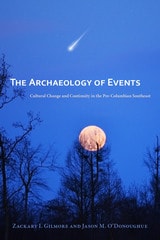
The Archaeology of Events
Cultural Change and Continuity in the Pre-Columbian SoutheastZackary I. Gilmore and Jason M. O'Donoughue
University of Alabama Press, 2015
Across the social sciences, gradualist evolutionary models of historical dynamics are giving way to explanations focused on the punctuated and contingent “events” through which history is actually experienced. The Archaeology of Events is the first book-length work that systematically applies this new eventful approach to major developments in the pre-Columbian Southeast.
Traditional accounts of pre-Columbian societies often portray them as “cold” and unchanging for centuries or millennia. Events-based analyses have opened up archaeological discourse to the more nuanced and flexible idea of context-specific, rapidly transpiring, and broadly consequential historical “events” as catalysts of cultural change.
The Archaeology of Events, edited by Zackary I. Gilmore and Jason M. O’Donoughue, considers a variety of perspectives on the nature and scale of events and their role in historical change. These perspectives are applied to a broad range of archeological contexts stretching across the Southeast and spanning more than 7,000 years of the region’s pre-Columbian history. New data suggest that several of this region’s most pivotal historical developments, such as the founding of Cahokia, the transformation of Moundville from urban center to vacated necropolis, and the construction of Poverty Point’s Mound A, were not protracted incremental processes, but rather watershed moments that significantly altered the long-term trajectories of indigenous Southeastern societies.
In addition to exceptional occurrences that impacted entire communities or peoples, southeastern archaeologists are increasingly recognizing the historical importance of localized, everyday events, such as building a house, crafting a pot, or depositing shell. The essays collected by Gilmore and O’Donoughue show that small-scale events can make significant contributions to the unfolding of broad, regional-scale historical processes and to the reproduction or transformation of social structures.
The Archaeology of Events is the first volume to explore the archaeological record of events in the Southeastern United States, the methodologies that archaeologists bring to bear on this kind of research, and considerations of the event as an important theoretical concept.
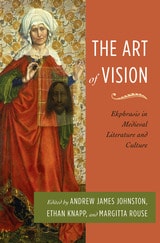
The Art of Vision
Ekphrasis in Medieval Literature and CultureEdited by Ethan Knapp, Andrew James Johnston, and Margitta Rouse
The Ohio State University Press, 2015
The essays in this volume highlight precisely the entanglements that ekphrasis suggests and/or rejects: not merely of word and image, but also of sign and thing, stasis and mobility, medieval and (early) modern, absence and presence, the rhetorical and the visual, thinking and feeling, knowledge and desire, and many more. The Art of Vision furthers our understanding of the complexities of medieval ekphrasis while also complicating later understandings of this device. As such, it offers a more diverse account of medieval ekphrasis than previous studies of medieval text–image relationships, which have normally focused on a single country, language, or even manuscript.
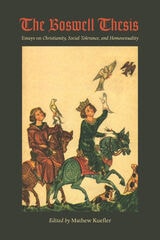
The Boswell Thesis
Essays on Christianity, Social Tolerance, and HomosexualityEdited by Mathew Kuefler
University of Chicago Press, 2005
The essays in this magnificent volume examine a variety of aspects of Boswell's interpretation of events in the development of sexuality from Classical Antiquity through the Middle Ages, including a Roman emperor's love letters to another man; suspicions of sodomy among medieval monks, knights, and crusaders; and the gender-bending visions of Christian saints and mystics. Also included are discussions of Boswell's career, including his influence among gay and lesbian Christians and his role in academic debates between essentialists and social constructionists.
Elegant and thought-provoking, this collection provides a fitting twenty-fifth anniversary tribute to the incalculable influence of Christianity, Social Tolerance, and Homosexuality and its author.
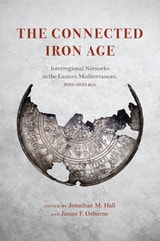
The Connected Iron Age
Interregional Networks in the Eastern Mediterranean, 900-600 BCEEdited by Jonathan M. Hall and James F. Osborne
University of Chicago Press, 2022
The early first millennium BCE marks one of the most culturally diverse periods in the history of the eastern Mediterranean. Surveying the region from Greece to Iraq, one finds a host of cultures and political formations, all distinct, yet all visibly connected in meaningful ways. These include the early polities of Geometric period Greece, the Phrygian kingdom of central Anatolia, the Syro-Anatolian city-states, the seafaring Phoenicians and the biblical Israelites of the southern Levant, Egypt’s Twenty-first through Twenty-fifth Dynasties, the Urartian kingdom of the eastern Anatolian highlands, and the expansionary Neo-Assyrian Empire of northern Mesopotamia. This volume adopts an interdisciplinary approach to understanding the social and political significance of how interregional networks operated within and between Mediterranean cultures during that era.
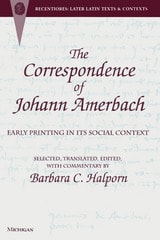
The Correspondence of Johann Amerbach
Early Printing in its Social ContextSelected, Translated, Edited, and with Commentary by Barbara C. Halporn
University of Michigan Press, 2000
Between 1478 and 1513 Amerbach published more than a hundred substantial works. He is best known for his monumental editions of the works of early church fathers. Crucial to his success was the information network he kept through correspondence with scholars, teachers, printers, booksellers, library curators, and other members of the literate community. The letters reveal how books were made, by whom, and for whom. The Correspondence of Johann Amerbach allows us to see the tensions in the new alliance between commerce and the republic of letters. Filling out the scene more fully, letters between the Amerbach children and their parents tell of the daily life, expectations, and aspirations of an intellectual bourgeois family at the end of the fifteenth century.
Barbara C. Halporn is Head of the Collection Development Department, Widener Library, Harvard University.
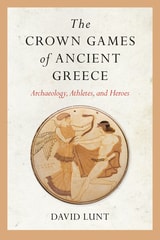
The Crown Games of Ancient Greece
Archaeology, Athletes, and HeroesDavid Lunt
University of Arkansas Press, 2022
The Crown Games were the apex of competition in ancient Greece. Along with prestigious athletic contests in honor of Zeus at Olympia, they comprised the Pythian Games for Apollo at Delphi, the Isthmian Games for Poseidon, and the Nemean Games, sacred to Zeus. For over nine hundred years, the Greeks celebrated these athletic and religious festivals, a rare point of cultural unity amid the fierce regional independence of the numerous Greek city-states and kingdoms.
The Crown Games of Ancient Greece examines these festivals in the context of the ancient Greek world, a vast and sprawling cultural region that stretched from modern Spain to the Black Sea and North Africa. Illuminating the unique history and features of the celebrations, David Lunt delves into the development of the contest sites as sanctuaries and the Panhellenic competitions that gave them their distinctive character. While literary sources have long been the mainstay for understanding the evolution of the Crown Games and ancient Greek athletics, archaeological excavations have significantly augmented contemporary understandings of the events. Drawing on this research, Lunt brings deeper context to these gatherings, which were not only athletics competitions but also occasions for musical contests, dramatic performances, religious ceremonies, and diplomatic summits—as well as raucous partying. Taken as a circuit, the Crown Games offer a more nuanced view of ancient Greek culture than do the well-known Olympian Games on their own. With this comprehensive examination of the Crown Games, Lunt provides a new perspective on how the ancient Greeks competed and collaborated both as individuals and as city-states.

The Danger of Romance
Truth, Fantasy, and Arthurian FictionsKaren Sullivan
University of Chicago Press, 2018
Yet is it possible that romance is expressing a truth—and a truth unrecognized by realist genres? The Arthurian literature of the Middle Ages, Karen Sullivan argues, consistently ventriloquizes in its pages the criticisms that were being made of romance at the time, and implicitly defends itself against those criticisms. The Danger of Romance shows that the conviction that ordinary reality is the only reality is itself an assumption, and one that can blind those who hold it to the extraordinary phenomena that exist around them. It demonstrates that that which is rare, ephemeral, and inexplicable is no less real than that which is commonplace, long-lasting, and easily accounted for. If romance continues to appeal to audiences today, whether in its Arthurian prototype or in its more recent incarnations, it is because it confirms the perception—or even the hope—of a beauty and truth in the world that realist genres deny.
The Differentiation of Authority
The Medieval Turn toward ExistenceJames Greenaway
Catholic University of America Press, 2012
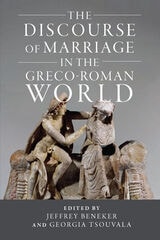
The Discourse of Marriage in the Greco-Roman World
Edited by Jeffrey Beneker and Georgia Tsouvala
University of Wisconsin Press, 2022
Through aesthetically informed and sensitive modes of analysis, these contributors examine a wealth of representations—including violence in weddings and spousal devotion after death. The Discourse of Marriage in the Greco-Roman World demonstrates the varying conceptions of an institution that was central to ancient social and political life—and remains prominent in the modern world. This volume will contribute to scholars' understanding of the era and fascinate anyone interested in historic depictions of marriage and the role and status of women in the late Hellenistic and early Imperial periods.
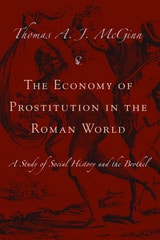
The Economy of Prostitution in the Roman World
A Study of Social History and the BrothelThomas A. J. McGinn
University of Michigan Press, 2004
The Faces of Time
Portrayal of the Past in Old French and Latin Historical Narrative of the Anglo-Norman RegnumJean Blacker
University of Texas Press, 1994
The twelfth century witnessed the sudden appearance and virtual disappearance of an important literary genre—the Old French verse chronicle. These poetic histories of the British kings, which today are treated as fiction, were written contemporaneously with Latin prose narratives, which are regarded as historical accounts. In this pathfinding study, however, Jean Blacker asserts that twelfth-century authors and readers viewed both genres as factual history.
Blacker examines four Old French verse chronicles—Gaimar's Estoire des Engleis (c. 1135), Wace's Roman de Brut (c. 1155) and Roman de Rou (c. 1160–1174), and Benoît de Sainte-Maure's Chronique des Ducs de Normandie (c. 1174–1180) and four Latin narratives—William of Malmesbury's Gesta Regum (c. 1118–1143) and Historia Novella (c. 1140–1143), Orderic Vitalis's Historia Ecclesiastica (c. 1118–1140), and Geoffrey of Monmouth's Historia Regum Britanniae (c. 1138). She compares their similarity in three areas—the authors' stated intentions, their methods of characterization and narrative development, and the possible influences of patronage and audience expectation on the presentation of characters and events.
This exploration reveals remarkable similarity among the texts, including their idealization of historical and even legendary figures, such as King Arthur. It opens fruitful lines of inquiry into the role these writers played in the creation of the Anglo-Norman regnum and suggests that the Old French verse chronicles filled political, psychic, and aesthetic needs unaddressed by Latin historical writing of the period.
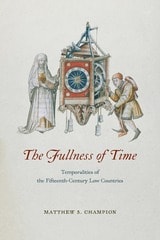
The Fullness of Time
Temporalities of the Fifteenth-Century Low CountriesMatthew S. Champion
University of Chicago Press, 2017
The Fullness of Time asks how the passage of time in the Low Countries was ordered by the rhythms of human action, from the musical life of a cathedral to the measurement of time by clocks and calendars, the work habits of a guildsman to the devotional practices of the laity and religious orders. Through a series of transdisciplinary case studies, it explores the multiple ways that objects, texts and music might themselves be said to engage with, imply, and unsettle time, shaping and forming the lives of the inhabitants of the fifteenth-century Low Countries. Champion reframes the ways historians have traditionally told the history of time, allowing us for the first time to understand the rich and varied interplay of temporalities in the period.
The Great Name
Ancient Egyptian Royal TitularyRonald J. Leprohon
SBL Press, 2013
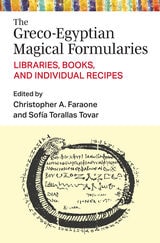
The Greco-Egyptian Magical Formularies
Libraries, Books, and Individual RecipesEdited by Christopher A. Faraone and Sofía Torallas Tovar
University of Michigan Press, 2022
In Greco-Roman Egypt, recipes for magical undertaking, called magical formularies, commonly existed for love potions, curses, attempts to best business rivals—many of the same challenges that modern people might face. In The Greco-Egyptian Magical Formularies: Libraries, Books, and Individual Recipes, volume editors Christopher Faraone and Sofia Torallas Tovar present a series of essays by scholars involved in a multiyear project to reedit and translate the various magical handbooks that were inscribed in the Roman period in the Greek or Egyptian languages. For the first time, the material remains of these papyrus rolls and codices are closely examined, revealing important information about the production of books in Egypt, the scribal culture in which they were produced, and the traffic in single recipes copied from them. Especially important for historians of the book and the Christian Bible are new insights in the historical shift from roll to codex, complicated methods of inscribing the bilingual papyri (in which the Greek script is written left to right and the demotic script right to left), and the new realization that several of the longest extant handbooks are clearly compilations of two or more shorter handbooks, which may have come from different places. The essays also reexamine and rethink the idea that these handbooks came from the personal libraries of practicing magicians or temple scriptoria, in one case going so far as to suggest that two of the handbooks had literary pretensions of a sort and were designed to be read for pleasure rather than for quotidian use in making magical recipes.
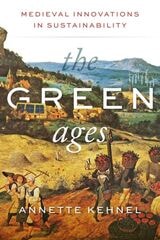
The Green Ages
Medieval Innovations in SustainabilityAnnette Kehnel
Brandeis University Press, 2024
In The Green Ages, historian Annette Kehnel explores sustainability initiatives from the Middle Ages, highlighting communities that operated a barter trade system on the Monte Subiaco in Italy, sustainable fishing at Lake Constance, common lands in the United Kingdom, transient grazing among Alpine shepherds in the south of France, and bridges built by crowdfunding in Avignon. Kehnel takes these medieval examples and applies their practical lessons to the modern world to prove that we can live sustainably—we’ve done it before!
From the garden economy in the mythical-sounding City of Ladies to early microcredit banks, Kehnel uncovers a world at odds with our understanding of the typical medieval existence. Premodern history is full of inspiring examples and concepts ripe for rediscovery, and we urgently need them as today’s challenges—finite resources, the twilight of consumerism, and growing inequality—threaten what we have come to think of as a modern way of living sustainably. This is a stimulating and revelatory look at a past that has the power to change our future.
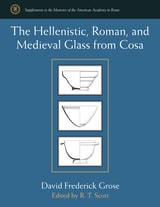
The Hellenistic, Roman, and Medieval Glass from Cosa
David Frederick Grose (R. T. Scott, editor)
University of Michigan Press, 2017
The research and analysis presented here are the work of the late David Frederick Grose, who began this project when no other city site excavations in Italy focused on ancient glass. He confirmed that the Roman glass industry began to emerge in the Julio-Claudian era, beginning in the principate of Augustus. His study traces the evolution of manufacturing techniques from core-formed vessels to free blown glass, and it documents changes in taste and style that were characteristic of the western glass industry throughout its long history.
At the time of Grose’s unexpected passing, his study was complete but not yet published. Nevertheless, the reputation of his work in this area has done much to establish the value and importance of excavating and researching Cosa’s glass. This volume, arranged and edited by R. T. Scott, makes Grose’s essential scholarship on the subject available for the first time.
The Hero's Place
Medieval Literary Traditions of Space and BelongingMolly Robinson Kelly
Catholic University of America Press, 2009

The History of Byzantine and Eastern Canon Law to 1500
Wilfried Hartmann
Catholic University of America Press, 2012
The History of Medieval Canon Law in the Classical Period, 1140-1234
From Gratian to the Decretals of Pope Gregory IX (History of Medieval Canon Law)Wilfried Hartmann
Catholic University of America Press, 2008
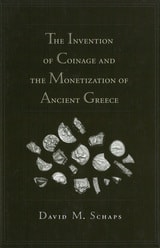
The Invention of Coinage and the Monetization of Ancient Greece
David M. Schaps
University of Michigan Press, 2015
The Jewish Middle Ages
Carol Bakhos
SBL Press, 2023
For many, the Middle Ages in general evokes a sense of the sinister and brings to mind a world of fear, superstition, and religious fanaticism. For Jews it was a period marked by persecutions, pogroms, and expulsions. Yet at the same time, the Middle Ages was also a time of lively cultural exchange and heightened creativity for Jews. In The Jewish Middle Ages, contributors explore the ways in which the stories of biblical women, including, Eve, Sarah, Hagar, Rebekah, Zipporah, Ruth, Esther, and Judith, make their way into the rich tapestry of medieval Jewish literature, mystical texts, and art, particularly in works emanating from Ashkenazic circles. Contributors include Carol Bakhos, Judith R. Baskin, Elisheva Baumgarten, Dagmar Börner-Klein, Constanza Cordoni, Rachel Elior, Meret Gutmann-Grün, Robert A. Harris, Yuval Katz-Wilfing, Sheila Tuller Keiter, Katrin Kogman-Appel, Gerhard Langer, Aurora Salvatierra Ossorio, and Felicia Waldman. These essays give us a glimpse into the role women played and the authority they assumed in medieval Jewish culture beyond the rabbinic centers of Palestine and Babylonia.
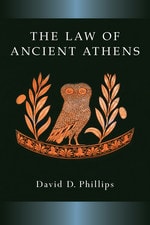
The Law of Ancient Athens
David D. Phillips
University of Michigan Press, 2013
The Law of Ancient Athens contains the principal literary and epigraphical sources, in English, for Athenian law in the Archaic and Classical periods, from the first known historical trial (late seventh century) to the fall of the democracy in 322 BCE.
This accessible and important volume is designed for teachers, students, and general readers interested in the ancient Greek world, the history of law, and the history of democracy, an Athenian invention during this period. Offering a comprehensive treatment of Athenian law, it assumes no prior knowledge of the subject and is organized in user-friendly fashion, progressing from the person to the family to property and obligations to the gods and to the state. David D. Phillips has translated all sources into English, and he has added significant introductory and explanatory material.
Topics covered in the book include homicide and wounding; theft; marriage, children, and inheritance; citizenship; contracts and commerce; impiety; treason and other offenses against the state; and sexual offenses including rape and prostitution. The volume’s unique feature is its presentation of the actual primary sources for Athenian laws, with many key or disputed terms rendered in transliterated Greek. The translated sources, together with the topical introductions, notes, and references, will facilitate both research in the field and the teaching of increasingly popular courses on Athenian law and law in the ancient world.
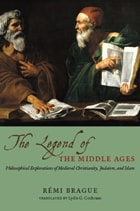
The Legend of the Middle Ages
Philosophical Explorations of Medieval Christianity, Judaism, and IslamRémi Brague
University of Chicago Press, 2009
This volume presents a penetrating interview and sixteen essays that explore key intersections of medieval religion and philosophy. With characteristic erudition and insight, RémiBrague focuses less on individual Christian, Jewish, and Muslim thinkers than on their relationships with one another. Their disparate philosophical worlds, Brague shows, were grounded in different models of revelation that engendered divergent interpretations of the ancient Greek sources they held in common. So, despite striking similarities in their solutions for the philosophical problems they all faced, intellectuals in each theological tradition often viewed the others’ ideas with skepticism, if not disdain. Brague’s portrayal of this misunderstood age brings to life not only its philosophical and theological nuances, but also lessons for our own time.

The Long Arm of Papal Authority
Late Medieval Christian Peripheries and Their Communications with the Holy SeeGerhard Jaritz
Central European University Press, 2005
The Making of Measure and the Promise of Sameness
Emanuele Lugli
University of Chicago Press, 2019
Measurement is all around us—from the circumference of a pizza to the square footage of an apartment, from the length of a newborn baby to the number of miles between neighboring towns. Whether inches or miles, centimeters or kilometers, measures of distance stand at the very foundation of everything we do, so much so that we take them for granted. Yet, this has not always been the case.
This book reaches back to medieval Italy to speak of a time when measurements were displayed in the open, showing how such a deceptively simple innovation triggered a chain of cultural transformations whose consequences are visible today on a global scale. Drawing from literary works and frescoes, architectural surveys, and legal compilations, Emanuele Lugli offers a history of material practices widely overlooked by historians. He argues that the public display of measurements in Italy’s newly formed city republics not only laid the foundation for now centuries-old practices of making, but also helped to legitimize local governments and shore up church power, buttressing fantasies of exactitude and certainty that linger to this day.
This ambitious, truly interdisciplinary book explains how measurements, rather than being mere descriptors of the real, themselves work as powerful molds of ideas, affecting our notions of what we consider similar, accurate, and truthful.
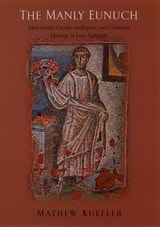
The Manly Eunuch
Masculinity, Gender Ambiguity, and Christian Ideology in Late AntiquityMathew Kuefler
University of Chicago Press, 2001
The cultural and demographic success of Christianity during this epoch lay in the ability of its leaders to recognize and respond to this crisis. Drawing on the tradition of gender ambiguity in early Christian teachings, which included Jesus's exhortation that his followers "make themselves eunuchs for the sake of the kingdom of heaven," Christian writers and thinkers crafted a new masculine ideal, one that took advantage of the changing social realities in Rome, inverted the Roman model of manliness, and helped solidify Christian ideology by reinstating the masculinity of its adherents.
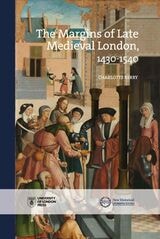
The Margins of Late Medieval London, 1430–1540
Charlotte Berry
University of London Press, 2022
The Margins of Late Medieval London seeks to unpack the complexity of urban life in the medieval age, offering a detailed and novel approach to understanding London beyond its grand institutions and social bodies. Using a combination of experimental digital, quantitative, and qualitative methodologies, the volume casts new light on urban life at the level of the neighborhood and considers the differences in economy, society, and sociability which existed in different areas of a vibrant premodern city. This book focuses on the dynamism and mobility that shaped city life, integrating the experiences of London’s poor and migrant communities and how they found their place within urban life. It describes how people found themselves marginalized in the city, and the strategies they would employ to mitigate that precarious position.
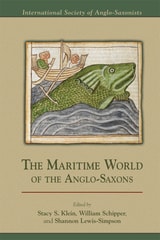
The Maritime World of the Anglo-Saxons
Stacy S. Klein
Arizona Center for Medieval and Renaissance Studies, 2014
The Masculine Self in Late Medieval England
Derek G. Neal
University of Chicago Press, 2008
Marshalling a wide array of colorful evidence—including legal records, letters, medical sources, and the literature of the period—Derek G. Neal here plumbs the social and cultural significance of masculinity during the generations born between the Black Death and the Protestant Reformation. He discovers that social relations between men, founded on the ideals of honesty and self-restraint, were at least as important as their domination and control of women in defining their identities. By carefully exploring the social, physical, and psychological aspects of masculinity, The Masculine Self in Late Medieval England offers a uniquely comprehensive account of the exterior and interior lives of medieval men.
The Medieval Imagination
Jacques Le Goff
University of Chicago Press, 1988
"Le Goff is one of the most distinguished of the French medieval historians of his generation . . . he has exercised immense influence."—Maurice Keen, New York Review of Books
"The whole book turns on a fascinating blend of the brutally materialistic and the generously imaginative."—Tom Shippey, London Review of Books
"The richness, imaginativeness and sheer learning of Le Goff's work . . . demand to be experienced."—M. T. Clanchy, Times Literary Supplement
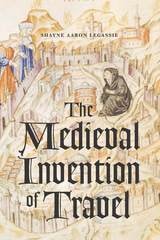
The Medieval Invention of Travel
Shayne Aaron Legassie
University of Chicago Press, 2017
Exploring this phenomenon, The Medieval Invention of Travel draws on an impressive array of sources to develop original readings of canonical figures such as Marco Polo, John Mandeville, and Petrarch, as well as a host of lesser-known travel writers. As Shayne Aaron Legassie demonstrates, the Middle Ages inherited a Greco-Roman model of heroic travel, which viewed the ideal journey as a triumph over temptation and bodily travail. Medieval travel writers revolutionized this ancient paradigm by incorporating practices of reading and writing into the ascetic regime of the heroic voyager, fashioning a bold new conception of travel that would endure into modern times. Engaging methods and insights from a range of disciplines, The Medieval Invention of Travel offers a comprehensive account of how medieval travel writers and their audiences reshaped the intellectual and material culture of Europe for centuries to come.

The Medieval Kitchen
Recipes from France and ItalyOdile Redon, Françoise Sabban, and Silvano Serventi
University of Chicago Press, 1998
"This book is a delight. It is not often that one has the privilege of working from a text this detailed and easy to use. It is living history, able to be practiced by novice and master alike, practical history which can be carried out in our own homes by those of us living in modern times."—Wanda Oram Miles, The Medieval Review
"The Medieval Kitchen, like other classic cookbooks, makes compulsive reading as well as providing a practical collection of recipes."—Heather O'Donoghue, Times Literary Supplement
The Merchant of Prato's Wife
Margherita Datini and Her World, 1360-1423Ann Crabb
University of Michigan Press, 2015
The Mind of the Middle Ages
An Historical SurveyFrederick B. Artz
University of Chicago Press, 1980
The Modulated Scream
Pain in Late Medieval CultureEsther Cohen
University of Chicago Press, 2010
In the late medieval era, pain could be a symbol of holiness, disease, sin, or truth. It could be encouragement to lead a moral life, a punishment for wrong doing, or a method of healing. Exploring the varied depictions and descriptions of pain—from martyrdom narratives to practices of torture and surgery—The Modulated Scream attempts to decode this culture of suffering in the Middle Ages.
Esther Cohen brings to life the cacophony of howls emerging from the written record of physicians, torturers, theologians, and mystics. In considering how people understood suffering, explained it, and meted it out, Cohen discovers that pain was imbued with multiple meanings. While interpreting pain was the province only of the rarified elite, harnessing pain for religious, moral, legal, and social purposes was a practice that pervaded all classes of Medieval life. In the overlap of these contradicting attitudes about what pain was for—how it was to be understood and who should use it—Cohen reveals the distinct and often conflicting cultural traditions and practices of late medieval Europeans. Ambitious and wide-ranging, The Modulated Scream is intellectual history at its most acute.
The Monarchia Controversy
An Historical Study with Accompanying Translations of Dante Alighieri's Monarchia, Guido Vernani's Refutation of the "Monarchia" Composed by Dante, and Pope John XXII's Bull Si fratrumAnthony K. Cassell
Catholic University of America Press, 2004
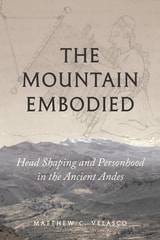
The Mountain Embodied
Head Shaping and Personhood in the Ancient AndesMatthew C. Velasco
University of Texas Press, 2025
A study of the ancient practice of Andean head shaping and its cultural connotations.
In the late sixteenth century, Spanish conquerors in Peru’s Colca Valley encountered the Collaguas and Cavanas, Indigenous people who undertook a striking form of body modification: Collaguas bound the heads of infants and children so that their skulls grew narrow and elongated, and Cavanas so that their skulls became wide and squat. Head shaping resulted in craniums that resembled two specific mountains associated with the groups. For Europeans, shaped skulls immediately and durably became a marker of territorialized ethnic difference.
The Mountain Embodied offers a more nuanced story. Having studied hundreds of samples of human remains, bioarchaeologist Matthew Velasco argues that reducing head shape to a mere ethnic marker is a colonial invention. Instead, the social significance of head shaping was protean and intersected with other structures of difference, such as gender, kinship, and status, influencing experience within the community. Head shaping, then, was one factor in the construction of a locally embedded kind of subjectivity. An outsider could deduce group identity from head shape, but for practitioners, head shaping reflected something else: nothing less than personhood itself.
The Play of Fictions
Studies in Ovid's Metamorphoses Book 2A. M. Keith
University of Michigan Press, 1992

The Profession of Widowhood
Widows, Pastoral Care, and Medieval Models of HolinessKatherine Clark Walter
Catholic University of America Press, 2018
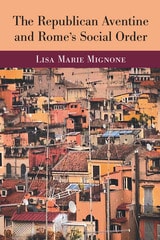
The Republican Aventine and Rome’s Social Order
Lisa Marie Mignone
University of Michigan Press, 2016
The myth of the “plebeian Aventine” became embedded not only in classical scholarship, but also in modern political and cultural consciousness; it has even been used by modern figures to support their political agenda. Yet The Republican Aventine and Rome’s Social Order makes bold new claims regarding the urban design and social history of ancient Rome and raises a significant question about ancient urbanism and social stability more generally: Did social integration reduce violence in premodern cities and promote urban concord?
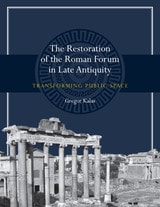
The Restoration of the Roman Forum in Late Antiquity
Transforming Public SpaceBy Gregor Kalas
University of Texas Press, 2015
In The Restoration of the Roman Forum in Late Antiquity, Gregor Kalas examines architectural conservation during late antiquity period at Rome’s most important civic center: the Roman Forum. During the fourth and fifth centuries CE—when emperors shifted their residences to alternate capitals and Christian practices overtook traditional beliefs—elite citizens targeted restoration campaigns so as to infuse these initiatives with political meaning. Since construction of new buildings was a right reserved for the emperor, Rome’s upper echelon funded the upkeep of buildings together with sculptural displays to gain public status. Restorers linked themselves to the past through the fragmentary reuse of building materials and, as Kalas explores, proclaimed their importance through prominently inscribed statues and monuments, whose placement within the existing cityscape allowed patrons and honorees to connect themselves to the celebrated history of Rome.
Building on art historical studies of spolia and exploring the Forum over an extended period of time, Kalas demonstrates the mutability of civic environments. The Restoration of the Roman Forum in Late Antiquity maps the evolution of the Forum away from singular projects composed of new materials toward an accretive and holistic design sensibility. Overturning notions of late antiquity as one of decline, Kalas demonstrates how perpetual reuse and restoration drew on Rome’s venerable past to proclaim a bright future.
The Scandal of the Fabliaux
R. Howard Bloch
University of Chicago Press, 1986
By showing how the medieval poet's obsession with the outrageous, the low, and the lewd was intimately bound to poetry, Bloch forces a revision of traditional approaches to Old French literature. His final chapter, on castration anxiety, fetishism, and the comic, links the fabliaux with the development of modern notions of the self and makes a case for the medieval roots of our own sense of humor.
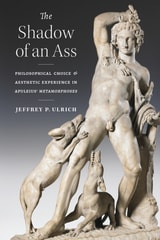
The Shadow of an Ass
Philosophical Choice and Aesthetic Experience in Apuleius' MetamorphosesJeffrey P. Ulrich
University of Michigan Press, 2024
Situating the novel in a long history of philosophical and literary conversations, Ulrich suggests that the Metamorphoses anticipates much of the philosophical burlesque we tend to associate with early modern fiction, from Don Quixote to Lewis Carroll.
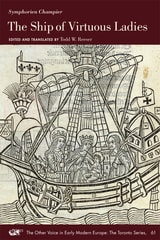
The Ship of Virtuous Ladies
Symphorien Champier
Iter Press, 2018
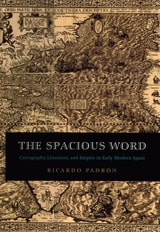
The Spacious Word
Cartography, Literature, and Empire in Early Modern SpainRicardo Padrón
University of Chicago Press, 2004
Padrón contends too that maps and geographic writings heavily influenced the Spanish imperial imagination. During the early modern period, the idea of "America" was still something being invented in the minds of Europeans. Maps of the New World, letters from explorers of indigenous civilizations, and poems dramatizing the conquest of distant lands, then, helped Spain to redefine itself both geographically and imaginatively as an Atlantic and even global empire. In turn, such literature had a profound influence on Spanish ideas of nationhood, most significantly its own.
Elegantly conceived and meticulously researched, The Spacious Word will be of enormous interest to historians of Spain, early modern literature, and cartography.