Results by title
53 books match the query 'Trial' and 19 start with t

TRIAL OF EBENEZER SCROOGE
Bruce Bueno de Mesquita
The Ohio State University Press, 2001
What happened to Ebenezer Scrooge after the night he was visited by the three spirits?
When we left Ebenezer Scrooge at the end of A Christmas Carol, he appeared to be a man transformed. But did he sincerely repent and earn admission to heaven? The Trial of Ebenezer Scrooge, written in Dickensian style and with tongue firmly lodged in cheek, follows Scrooge through the Court of Heavenly Justice, where his soul’s fate is to be determined. In this courtroom drama, using frequent flashbacks, the author uncovers startling evidence, much of it directly from Dickens’s classic, that reveals Scrooge to have lived a saintly life before being confronted by three Christmas ghosts. Evidence mounts that Mr. Scrooge struck a Faustian bargain with the Ghost of Christmas Yet to Come, a deal to extend his own mortality in exchange for yielding his soul as a tool for the forces of darkness to infiltrate heaven. Readers will enjoy the remaking of some of Dickens’s best-known characters. Tiny Tim emerges as a villain, while little Eppie, borrowed from George Eliot’s Silas Marner, is Scrooge’s protector and source of salvation. This new novel provides the much-needed redemption of Ebenezer Scrooge’s reputation and offers a welcome departure from the standard saccharine fare at Christmastime. Dickens buffs will have a merry time trying to find where Dickens’s voice ends and the author’s begins. All readers will puzzle over how we could have so misjudged Ebenezer Scrooge, or whether we judged Scrooge aright from the start.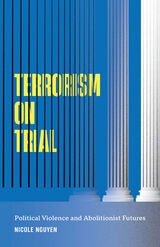
Terrorism on Trial
Political Violence and Abolitionist FuturesNicole Nguyen
University of Minnesota Press, 2023
A landmark sociological examination of terrorism prosecution in United States courts
Rather than functioning as a final arbiter of justice, U.S. domestic courts are increasingly seen as counterterrorism tools that can incapacitate terrorists, maintain national security operations domestically, and produce certain narratives of conflict. Terrorism on Trial examines the contemporary role that these courts play in the global war on terror and their use as a weapon of war: hunting, criminalizing, and punishing entire communities in the name of national security.
Nicole Nguyen advocates for a rethinking of popular understandings of political violence and its root causes, encouraging readers to consider anti-imperial abolitionist alternatives to the criminalization, prosecution, and incarceration of individuals marked as real or perceived terrorists. She exposes how dominant academic discourses, geographical imaginations, and social processes have shaped terrorism prosecutions, as well as how our fundamental misunderstanding of terrorism has led to punitive responses that do little to address the true sources of violence, such as military interventions, colonial occupations, and tyrannical regimes. Nguyen also explores how these criminal proceedings bear on the lives of defendants and families, seeking to understand how legal processes unevenly criminalize and disempower communities of color.
A retheorization of terrorism as political violence, Terrorism on Trial invites readers to carefully consider the role of power and politics in the making of armed resistance, addressing the root causes of political violence, with a goal of building toward a less violent and more liberatory world.
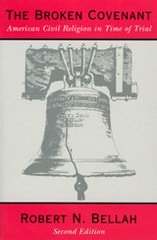
The Broken Covenant
American Civil Religion in Time of TrialRobert N. Bellah
University of Chicago Press, 1992
This edition includes his 1978 article "Religion and the Legitimation of the American Republic," and a new Preface.
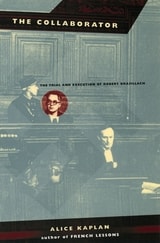
The Collaborator
The Trial and Execution of Robert BrasillachAlice Kaplan
University of Chicago Press, 2000
Was Brasillach in fact guilty of treason? Was he condemned for his denunciations of the resistance, or singled out as a suspected homosexual? Was it right that he was executed when others, who were directly responsible for the murder of thousands, were set free? Kaplan's meticulous reconstruction of Brasillach's life and trial skirts none of these ethical subtleties: a detective story, a cautionary tale, and a meditation on the disturbing workings of justice and memory, The Collaborator will stand as the definitive account of Brasillach's crime and punishment.
A National Book Award Finalist
A National Book Critics Circle Award Finalist
"A well-researched and vivid account."—John Weightman, New York Review of Books
"A gripping reconstruction of [Brasillach's] trial."—The New Yorker
"Readers of this disturbing book will want to find moral touchstones of their own. They're going to need them. This is one of the few works on Nazism that forces us to experience how complex the situation really was, and answers won't come easily."—Daniel Blue, San Francisco Chronicle Book Review
"The Collaborator is one of the best-written, most absorbing pieces of literary history in years."—David A. Bell, New York Times Book Review
"Alice Kaplan's clear-headed study of the case of Robert Brasillach in France has a good deal of current-day relevance. . . . Kaplan's fine book . . . shows that the passage of time illuminates different understandings, and she leaves it to us to reflect on which understanding is better."—Richard Bernstein, The New York Times
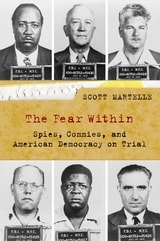
The Fear Within
Spies, Commies, and American Democracy on TrialMartelle, Scott
Rutgers University Press, 2011
Sixty years ago political divisions in the United States ran even deeper than today's name-calling showdowns between the left and right. Back then, to call someone a communist was to threaten that person's career, family, freedom, and, sometimes, life itself. Hysteria about the "red menace" mushroomed as the Soviet Union tightened its grip on Eastern Europe, Mao Zedong rose to power in China, and the atomic arms race accelerated. Spy scandals fanned the flames, and headlines warned of sleeper cells in the nation's midst--just as it does today with the "War on Terror."
In his new book, The Fear Within, Scott Martelle takes dramatic aim at one pivotal moment of that era. On the afternoon of July 20, 1948, FBI agents began rounding up twelve men in New York City, Chicago, and Detroit whom the U.S. government believed posed a grave threat to the nation--the leadership of the Communist Party-USA. After a series of delays, eleven of the twelve "top Reds" went on trial in Manhattan's Foley Square in January 1949.
The proceedings captivated the nation, but the trial quickly dissolved into farce. The eleven defendants were charged under the 1940 Smith Act with conspiring to teach the necessity of overthrowing the U.S. government based on their roles as party leaders and their distribution of books and pamphlets. In essence, they were on trial for their libraries and political beliefs, not for overt acts threatening national security. Despite the clear conflict with the First Amendment, the men were convicted and their appeals denied by the U.S. Supreme Court in a decision that gave the green light to federal persecution of Communist Party leaders--a decision the court effectively reversed six years later. But by then, the damage was done. So rancorous was the trial the presiding judge sentenced the defense attorneys to prison terms, too, chilling future defendants' access to qualified counsel.
Martelle's story is a compelling look at how American society, both general and political, reacts to stress and, incongruously, clamps down in times of crisis on the very beliefs it holds dear: the freedoms of speech and political belief. At different points in our history, the executive branch, Congress, and the courts have subtly or more drastically eroded a pillar of American society for the politics of the moment. It is not surprising, then, that The Fear Within takes on added resonance in today's environment of suspicion and the decline of civil rights under the U.S. Patriot Act.
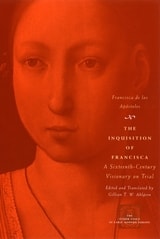
The Inquisition of Francisca
A Sixteenth-Century Visionary on TrialFrancisca de los Apóstoles
University of Chicago Press, 2005
This book contains what little is known about Francisca—the several letters she wrote as well as the transcript of her trial—and offers modern readers a perspective on the unique role and status of religious women in sixteenth-century Spain. Chronicling the drama of Francisca's interrogation and her spirited but ultimately unsuccessful defense, The Inquisition of Francisca—transcribed from more than three hundred folios and published for the first time in any language—will be a valuable resource for both specialists and students of the history and religion of Spain in the sixteenth century.
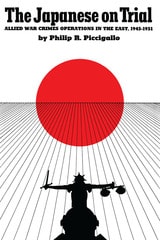
The Japanese On Trial
Allied War Crimes Operations in the East, 1945–1951By Philip R. Piccigallo
University of Texas Press, 1979
This comprehensive treatment of post–World War II Allied war crimes trials in the Far East is a significant contribution to a neglected subject. While the Nuremberg and, to a lesser degree, Tokyo tribunals have received considerable attention, this is the first full-length assessment of the entire Far East operation, which involved some 5,700 accused and 2,200 trials.
After discussing the Tokyo trial, Piccigallo systematically examines the operations of each Allied nation, documenting procedure and machinery as well as the details of actual trials (including hitherto unpublished photographs) and ending with a statistical summary of cases.
This study allows a completely new assessment of the Far East proceedings: with a few exceptions, the trials were carefully and fairly conducted, the efforts of defense counsel and the elaborate review procedures being especially noteworthy. Piccigallo’s approach to this emotion-filled subject is straightforward and evenhanded throughout. He concludes with a discussion of the broader implications of such war crimes trials, a matter of interest to the general reader as well as to specialists in history, law, and international affairs.
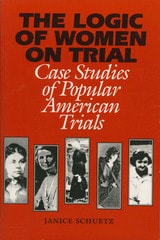
The Logic of Women on Trial
Case Studies of Popular American TrialsJanice Schuetz
Southern Illinois University Press, 1994
Janice Schuetz investigates the felony trials of nine American women from colonial Salem to the present: Rebecca Nurse, tried for witchcraft in 1692; Mary E. Surratt, tried in 1865 for assisting John Wilkes Booth in the assassination of Abraham Lincoln; Lizzie Andrew Borden, tried in 1892 for the ax murder of her father and stepmother; Margaret Sanger, tried in 1915, 1917, and 1929 for her actions in support of birth control; Ethel Rosenberg, tried in 1951 for aiding the disclosure of secrets of the atom bomb to the Soviets; Yvonne Wanrow, tried in 1974 for killing a man who molested her neighbor’s daughter; Patricia Campbell Hearst, tried in 1975 for bank robbery as a member of the Symbionese Liberation Army; Jean Harris, tried in 1982 for killing Herman Tarnower, the Diet Doctor; and Darci Kayleen Pierce, tried in 1988 for kidnapping and brutally murdering a pregnant woman, then removing the baby from the woman’s womb.
In her analysis, Schuetz is careful to define these trials as popular trials. Characteristically, popular trials involve persons, issues, or crimes of social interest that attract extensive public interest and involvement. Such trials make a contribution to the ongoing historical dialogue about the meaning of justice and the legal system, while reflecting the values of the time and place in which they occur.
Schuetz examines the kinds of communication that transpired and the importance of gender in the trials by applying a different current rhetorical theory to each trial text. In every chapter, she explains her chosen interpretive theory, compares that framework with the discourse of the trial, and makes judgments about the meaning of the trial texts based on the interpretive theory.
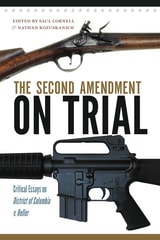
The Second Amendment on Trial
Critical Essays on District of Columbia v. HellerSaul A. Cornell
University of Massachusetts Press, 2013
On the final day of its 2008 term, a sharply divided U.S. Supreme Court issued a 5-to-4 decision striking down the District of Columbia's stringent gun control laws as a violation of the Second Amendment. Reversing almost seventy years of settled precedent, the high court reinterpreted the meaning of the “right of the people to keep and bear arms” to affirm an individual right to own a gun in the home for purposes of self-defense. The landmark ruling not only opened a new chapter in the contentious history of gun rights and gun control but also revealed both the strengths and problems of originalist constitutional theory and jurisprudence.
This volume brings together some of the best scholarship on the Heller case, with essays by legal scholars and historians representing a range of ideological viewpoints and applying different interpretive frameworks. Following the editors' introduction, which describes the issues involved and the arguments on each side, the essays are organized into four sections. The first includes two of the most important historical briefs filed in the case, while the second offers different views of the role of originalist theory. Section three presents opposing interpretations of the ruling and its relationship to modern constitutional doctrine. The final section explores historical research post-Heller, including new findings on patterns of gun ownership in colonial and Revolutionary America.
In addition to the editors, contributors include Nelson Lund, Joyce Lee Malcolm, Jack Rakove, Reva B. Siegel, Cass R. Sunstein, Kevin M. Sweeney, and J. Harvie Wilkinson III.
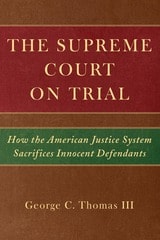
The Supreme Court on Trial
How the American Justice System Sacrifices Innocent DefendantsGeorge C. Thomas III
University of Michigan Press, 2011
The chief mandate of the criminal justice system is not to prosecute the guilty but to safeguard the innocent from wrongful convictions; with this startling assertion, legal scholar George Thomas launches his critique of the U.S. system and its emphasis on procedure at the expense of true justice.
Thomas traces the history of jury trials, an important component of the U.S. justice system, since the American Founding. In the mid-twentieth century, when it became evident that racism and other forms of discrimination were corrupting the system, the Warren Court established procedure as the most important element of criminal justice. As a result, police, prosecutors, and judges have become more concerned about following rules than about ensuring that the defendant is indeed guilty as charged. Recent cases of prisoners convicted of crimes they didn't commit demonstrate that such procedural justice cannot substitute for substantive justice.
American justices, Thomas concludes, should take a lesson from the French, who have instituted, among other measures, the creation of an independent court to review claims of innocence based on new evidence. Similar reforms in the United States would better enable the criminal justice system to fulfill its moral and legal obligation to prevent wrongful convictions.
"Thomas draws on his extensive knowledge of the field to elaborate his elegant and important thesis---that the American system of justice has lost sight of what ought to be its central purpose---protection of the innocent."
—Susan Bandes, Distinguished Research Professor of Law, DePaul University College of Law
"Thomas explores how America's adversary system evolved into one obsessed with procedure for its own sake or in the cause of restraining government power, giving short shrift to getting only the right guy. His stunning, thought-provoking, and unexpected recommendations should be of interest to every citizen who cares about justice."
—Andrew E. Taslitz, Professor of Law, Howard University School of Law
"An unflinching, insightful, and powerful critique of American criminal justice---and its deficiencies. George Thomas demonstrates once again why he is one of the nation's leading criminal procedure scholars. His knowledge of criminal law history and comparative criminal law is most impressive."
—Yale Kamisar, Distinguished Professor of Law, University of San Diego and Clarence Darrow Distinguished University Professor Emeritus of Law, University of Michigan
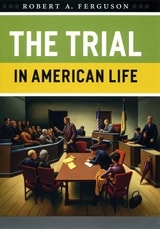
The Trial in American Life
Robert A. Ferguson
University of Chicago Press, 2006

The Trial of Charles I
A Documentary HistoryEdited by David Lagomarsino and Charles T. Wood
Dartmouth College Press, 1989
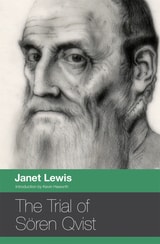
The Trial of Sören Qvist
Janet Lewis
Ohio University Press, 2013
Originally published in 1947, The Trial of Sören Qvist has been praised by a number of critics for its intriguing plot and Janet Lewis’s powerful writing. And in the introduction to this new edition, Swallow Press executive editor and author Kevin Haworth calls attention to the contemporary feeling of the story—despite its having been written more than fifty years ago and set several hundred years in the past. As in Lewis’s best-known novel, The Wife of Martin Guerre, the plot derives from Samuel March Phillips’s nineteenth-century study, Famous Cases of Circumstantial Evidence, in which this British legal historian considered the trial of Pastor Sören Qvist to be the most striking case.
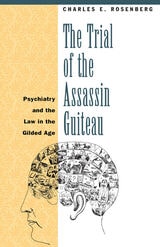
The Trial of the Assassin Guiteau
Psychiatry and the Law in the Gilded AgeCharles E. Rosenberg
University of Chicago Press, 1968
Although the role of genetics in behavior was widely accepted, these psychiatrists fiercely debated whether heredity had predisposed Guiteau to assassinate Garfield. Rosenberg's account allows us to consider one of the opening rounds in the controversy over the criminal responsibility of the insane, a debate that still rages today.
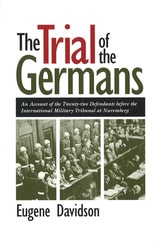
The Trial of the Germans
An Account of the Twenty-two Defendants before the International Military Tribunal at NurembergEugene Davidson
University of Missouri Press, 1997
The "definitive one-volume study of Nuremberg," The Trial of the Germans is now available in paperback. An astute observer of the Nuremberg trial, Eugene Davidson has struggled with the issues it raised: Was it a necessary response to the heinous crimes of the Third Reich? How were Germany and the Germans capable of such extraordinary evil? Was the trial just, given the claims that the defendants were simply serving their country, doing as they had been told to do? And if not just, was it nonetheless necessary as a warning to prevent future crimes against humanity? Davidson's approach to these and other large questions of justice is made through examination of each of the defendants in the trial. His reluctant, but firm, conclusion is: "In a world of mixed human affairs where a rough justice is done that is better than lynching or being shot out of hand, Nuremberg may be defended as a political event if not as a court." Some sentences may have seemed too severe, but none was harsher than the punishments meted out to innocent people by the regime these men served. "In a certain sense," says Davidson, "the trial succeeded in doing what judicial proceedings are supposed to do: it convinced even the guilty that the verdict against them was just."
Faulty as the trial was from the legal point of view, a catharsis of the pent-up emotions of millions of people had to be provided and a record of what had taken place duly preserved for whatever use later generations would make of it.
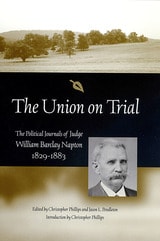
The Union on Trial
The Political Journals of Judge William Barclay Napton, 1829-1883Edited by Christopher Phillips & Jason L. Pendleton. Introduction by Christopher Phillips
University of Missouri Press, 2005
Transformative Justice
Israeli Identity on TrialLeora Bilsky
University of Michigan Press, 2004

Travesty
The Trial of Slobodan Milosevic and the Corruption of International JusticeJohn Laughland
Pluto Press, 2007
In this short book, Laughland gives a full account of the trial---the longest trial in history---from the moment the indictment was issued at the height of NATO's attack on Yugoslavia to the day of Milosevic's mysterious death in custody. "International justice" is supposed to hold war criminals to account, but---as the trials of both Milosevic and Saddam Hussein show---the indictments are politically motivated and the judicial procedures are irredeemably corrupt. Laughland argues that international justice is an impossible dream and that such show trials are little more than propaganda exercises designed to distract attention from the war crimes committed by Western states.
"Study this story. . . . The truth is hard to find, but in John Laughland we are fortunate to have a man blessed with the desire to find the truth."
---Ramsey Clark, from the Foreword
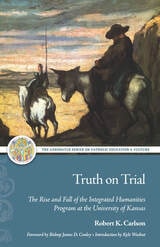
Truth on Trial
The Rise and Fall of the Integrated Humanities Program at the University of KansasRobert K. Carlson
Catholic University of America Press, 2026