Results by title
107 books match the query 'Water' and 13 start with t
The Entablo Manuscript
Water Rituals and Khipu Boards of San Pedro de Casta, PeruSarah Bennison
University of Texas Press, 2022
A unique study of an Andean community’s water rituals and the extraordinary document describing how they should be performed
In the dry season in the Andes, water from springs, lakes, reservoirs, and melting glaciers feeds irrigation canals that have sustained communities for thousands of years. Managing and maintaining these water infrastructures is essential, and in 1921, in the village of San Pedro de Casta, Peru, local authorities recorded their ritual canal-cleaning duties in a Spanish-language document called the Entablo. It is only the second book (along with the Huarochirí Manuscript) ever seen by scholars in which an Andean community explains its customs and ritual laws in its own words.
Sarah Bennison offers a critical introduction to the Entablo, a Spanish transcription of the document, and an English translation. Among its other revelations, the Entablo delves into the use of khipu boards, devices that meld the traditional knotted strings known as khipus with a written alphabet. Only in the Entablo do we learn that there were multiple khipu boards associated with a single canal-cleaning ritual, or that there were separate khipu records for men and women. The Entablo manuscript furnishes unparalleled insights into Andean rituals, religion, and community history at a historical moment when rural highland communities were changing rapidly.
The Gulf of California
Biodiversity and ConservationRichard C. Brusca
University of Arizona Press, 2010
Few places in the world can claim such a diversity of species as the Gulf of California (Sea of Cortez), with its 6,000 recorded animal species estimated to be half the number actually living in its waters. So rich are the Gulf's water that over a half-million tons of seafood are taken from them annually—and this figure does not count the wasted by-catch, which would triple or quadruple that tonnage. This timely book provides a benchmark for understanding the Gulf's extraordinary diversity, how it is threatened, and in what ways it is—or should be—protected.
In spite of its dazzling richness, most of the Gulf's coastline now harbors but a pale shadow of the diversity that existed just a half-century ago. Recommendations based on sound, careful science must guide Mexico in moving forward to protect the Gulf of California.
This edited volume contains contributions by twenty-four Gulf of California experts, from both sides of the U.S.-Mexico border. From the origins of the Gulf to its physical and chemical characteristics, from urgently needed conservation alternatives for fisheries and the entire Gulf ecosystem to information about its invertebrates, fishes, cetaceans, and sea turtles, this thought-provoking book provides new insights and clear paths to achieve sustainable use solidly based on robust science. The interdisciplinary, international cooperation involved in creating this much-needed collection provides a model for achieving success in answering critically important questions about a precious but rapidly disappearing ecological treasure.
The Keepers of Water and Earth
Mexican Rural Social Organization and IrrigationBy Kjell I. Enge and Scott Whiteford
University of Texas Press, 1989
Agrarian reforms transformed the Mexican countryside in the late twentieth century but without, in many cases, altering fundamental power relationships. This study of the Tehuacán Valley in the state of Puebla highlights different strategies to manipulate the local implementation of federal government programs. With their very differing successes in the struggle to regain and maintain control of land and water rights, these strategies raise important questions about the meaning of the phrase "locally controlled development."
Because Mexico is dependent on irrigation for 45 percent of its cash crop production, national policy has focused on developing vast government controlled and financed irrigation systems. In the Tehuacán Valley, however, the inhabitants have developed a complex irrigation system without government aid or supervision. Yet, in contrast to most parts of Mexico, water rights can be bought and sold as a commodity, leading to accumulation, stratification, and emergence of a regional elite whose power is based on ownership of land and water. The analysis provides an important contribution to the understanding of local control.
The findings of this study will be important to a wide audience involved in the study of irrigation, local agricultural systems, and the interplay between local power structures and the national government in developing countries. The book also presents unique material on gravity-fed, horizontal wells, known as qanat in the Middle East, which had been unknown in the literature on Latin America before this book.
The Last Drop
The Politics of WaterMike Gonzalez and Marianella Yanes
Pluto Press, 2015
This book looks at how we got here and what we can and should do next. Laying out the complex arguments surrounding water, its ownership and access to it, Mike Gonzalez and Marianella Yanes make the technical and scientific aspects of the discussion clear and accessible—and thereby enable themselves to make the political questions more urgent. Pushing back against the market fundamentalists, the authors argue that it is both possible and necessary that considerations of equity and social justice prevail in the debates about water. Powerful and polemical, The Last Drop will be a vital resource for water activists worldwide.
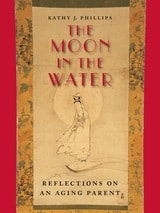
The Moon in the Water
Reflections on an Aging ParentKathy J. Phillips
Vanderbilt University Press, 2008
In a series of moving vignettes, the author begins by describing a particular representation of Water-Moon Kuan Yin, a Buddhist teacher and goddess associated with compassion, who often sits on a precarious overhang or floats on a flimsy petal. Then Kuan Yin steps out of the frame to join the author in the mundane challenges of caring for her father-transferring his health insurance, struggling with a wheelchair van, managing adult diapers, or playing in the fictions of dementia. From perplexed to poignant to funny, the vignettes record the working-class English of a fading but still wise dad, and they find other human versions of Kuan Yin in a doctor who will still make house calls or kind strangers in the street.
The book includes ten illustrations: both classical representations of Kuan Yin and also the author's own drawings, which adapt Kuan Yin in an act of practical spirituality, reading art through life and life through art. Each vignette invites the harried caregiver to take a deep breath and meditate on the trials and joys of caring for an aging parent.

The Motion Of Light In Water
Sex And Science Fiction Writing In The East VillageSamuel R. Delany
University of Minnesota Press, 2004
Winner of the Hugo Award for Non-fiction
The unexpurgated edition of the award-winning autobiography
Born in New York City’s black ghetto Harlem at the start of World War II, Samuel R. Delany married white poet Marilyn Hacker right out of high school. The interracial couple moved into the city’s new bohemian quarter, the Lower East Side, in summer 1961. Through the decade’s opening years, new art, new sexual practices, new music, and new political awareness burgeoned among the crowded streets and cheap railroad apartments. Beautifully, vividly, insightfully, Delany calls up this era of exploration and adventure as he details his development as a black gay writer in an open marriage, with tertiary walk-ons by Bob Dylan, Stokely Carmichael, W. H. Auden, and James Baldwin, and a panoply of brilliantly drawn secondary characters.
The Myth of Water
Poems from the Life of Helen KellerJeanie Thompson
University of Alabama Press, 2016
Thompson’s artfully concatenated vignettes form a mosaic that maps the insightful mind behind the elegant and enigmatic persona Keller projected. Thompson takes readers on the journey of Keller’s life, from some of the thirty-seven countries she visited, including the British Isles, Europe, and Japan to the wellsprings of her emotional awakening and insight. The poems are paired with fascinating biographical anecdotes from Keller’s life and samplings from her writing, which infuse the work with richly-rewarding biographical detail.
The poems in The Myth of Water reveal the discerning subtlety, resiliency, and complexity of the person Thompson perceives Helen Keller to have been. Through a combination of natural intuition, manual signs, Braille alphabets, and lip reading, Keller came to grasp the revolving tapestry of the seasons and the infinite colors of human relationships.
Not a biography or a fictional retelling, The Myth of Water attempts to unlock what moved Keller to her life of service and self-examination. This is a deeply personal story of coming through—not overcoming—a double disability to a fully realized life in which a woman gives her heart to the world.
The Politics of Water in Arizona
Dean E. Mann
University of Arizona Press, 1963

The Scars of Project 459
The Environmental Story of the Lake of the OzarksTraci Angel
University of Arkansas Press, 2014
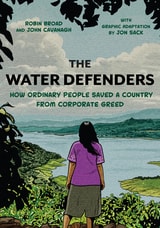
The Water Defenders
How Ordinary People Saved a Country from Corporate GreedRobin Broad and John Cavanagh with Graphic Adaptation by Jon Sack
The Ohio State University Press, 2026
Initially excited by the company’s promises of jobs and prosperity, farmer Vidalina Morales, brothers Marcelo and Miguel Rivera, and others soon realized that the trade-off was catastrophic contamination of El Salvador’s main source of fresh water. Facing corporate machinations and violence, the ordinary people of San Isidro and surrounding communities built a transnational coalition that prevailed over powerful adversaries to score an environmental victory with worldwide repercussions.
Broad and Cavanagh draw on over a decade of research, interviews, and experience as allies and experts in international development to recount the harrowing saga. A blueprint for civic bravery and local-to-global activism, as well as a rich history of Central America’s political conflicts and people’s fights against environmental and economic exploitation, this story will inspire anyone who feels helpless against corporate malfeasance.

Trails of Central Arkansas
A Guide to Central Arkansas' Land and Water TrailsJohnnie Chamberlin
Parkhurst Brothers, Inc., 2012
Trails of Central Arkansas delivers:
* Sixty trails in 36 parks or locations from Benton and Bryant to Cabot, from Wrightsville to Conway
* Color maps of every trail
* GPS coordinates for every trailhead
* Color-coded distinctions between paved and unpaved trails
* Level of difficulty ratings
* Scenery Scores
* Top-ten lists: Most Scenic, Trails for Kids, and Trails for Solitude
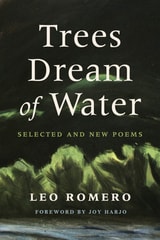
Trees Dream of Water
Selected and New PoemsLeo Romero; Foreword by Joy Harjo
University of Arizona Press, 2025
Leo Romero stands as a foundational figure in Latino letters. With six books of poetry and a book of short fiction to his name, Romero’s contribution to the literary canon is profound and enduring.
Bringing together for the first time his new and selected poems, Trees Dream of Water reflects Romero’s journey from youth to maturity as a person and a poet, and his deep connection to New Mexico and its culture. Traversed by memory, myth, and observation of the natural world, these poems explore family, community belonging and conflict, life as an artist, and the cycles of life and death. This lyrical anthology includes accompanying essays to illuminate Romero’s life and work for longtime admirers and new readers alike.
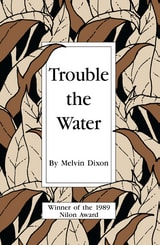
Trouble the Water
Melvin Dixon
University of Alabama Press, 1989
A haunting and poetic journey of memory, identity, and reconciliation in the heart of the Black South.
Winner of the Excellence in Minority Fiction Award
Trouble the Water moves among finely woven layers of time and place as it takes on a new and controversial theme in contemporary black writing, the search for family reconciliation. Twenty years after running away from home in Pee Dee, North Carolina, Jordan Henry believed he had found success, as a young college professor of history, a married man, and a resident of New England, whose colonial past he knew so well. When Jordan finds his career stymied by local prejudices, his world crumbles. Word of his grandmother's death reaches him, and he returns home to claim the ambiguous legacy of her farmland and face the consequences of his long absence.
Jordan's estranged father also returns to Pee Dee on a quest of his own restoring his good name in a community which blames him for Chloe Henry's death in childbirth. Chloe was Jordan's mother and his grandmother's only child. Unresolved hostility in the family and in the community breaks out, making Jordan the unsuspecting pawn in a plot of revenge against his father. Jordan may be the only one who can free his family from the past and the equally troubled present.
Trouble the Water gains resonance from its unflinching confrontation with dualities common in the Afro-American experience: reality and myth, folklore and sophistication, North and South, rural and cosmopolitan. While sacrificing none of its complexities for the sake of simplicity, it has the relentless movement of a fairy tale that reaches deep into the unconscious roots of behavior. It is intensely lyrical and dense in realism. Trouble the Water is magical in the way it reveals the Afro-American psyche and symbolizes fundamental truths about American life.