Results by title
1296 books match the query 'Women authors' and 235 start with t
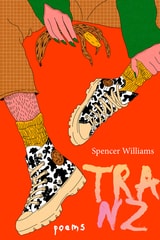
TRANZ
Spencer Williams
Four Way Books, 2024
Take Me with You, Wherever You're Going
Jessica Jacobs
Four Way Books, 2019
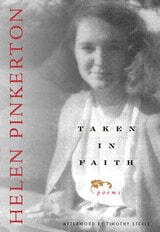
Taken In Faith
PoemsHelen Pinkerton
Ohio University Press, 2002
In 1967, Yvor Winters wrote of Helen Pinkerton, “she is a master of poetic style and of her material. No poet in English writes with more authority.” Unfortunately, in 1967 mastery of poetic style was not, by and large, considered a virtue, and Pinkerton’s finely crafted poems were neglected in favor of more improvisational and flashier talents. Though her work won the attention and praise of serious readers, who tracked her poems as they appeared in such journals as The Paris Review, The Sewanee Review, and The Southern Review, her verse has never been available in a trade book. Taken in Faith remedies that situation, bringing Pinkerton’s remarkable poems to a general audience for the first time.
Even her very earliest works embody a rare depth and seriousness. Primarily lyrical and devotional, they always touch on larger issues of human struggle and conduct. More recent poems, concerned in part with history, exhibit a stylistic as well as a thematic shift, moving away from the rhymed forms of her devotional works into a blank verse marked by a quiet flexibility and contemplative grace.
Like Virginia Adair, another poet who waited long for proper recognition, Pinkerton speaks as a woman who has lived fully and observed acutely and who has set the life and observations down in memorable verse. Taken in Faith represents a half-century of her poetic efforts.
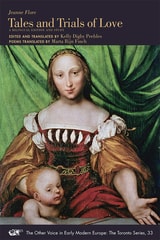
Tales and Trials of Love, Concerning Venus’s Punishment of Those Who Scorn True Love and Denounce Cupid’s Sovereignty
A Bilingual Edition and StudyJeanne Flore
Iter Press, 2014
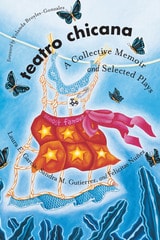
Teatro Chicana
A Collective Memoir and Selected PlaysEdited by Laura E. Garcia, Sandra M. Gutierrez, and Felicitas Nuñez
University of Texas Press, 2008
Winner, Susan Koppelman Award, Best Edited Volume in Women's Studies in Popular and American Culture, 2008
The 1970s and 1980s saw the awakening of social awareness and political activism in Mexican-American communities. In San Diego, a group of Chicana women participated in a political theatre group whose plays addressed social, gender, and political issues of the working class and the Chicano Movement. In this collective memoir, seventeen women who were a part of Teatro de las Chicanas (later known as Teatro Laboral and Teatro Raíces) come together to share why they joined the theatre and how it transformed their lives. Teatro Chicana tells the story of this troupe through chapters featuring the history and present-day story of each of the main actors and writers, as well as excerpts from the group's materials and seven of their original short scripts.
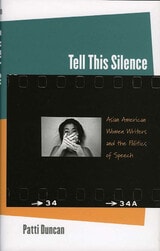
Tell This Silence
Asian American Women Writers And The Politics Of SpeechPatti Duncan
University of Iowa Press, 2004
However, as the writers discussed in Tell This Silence suggest, silence too has multiple meanings especially in contexts like the U.S., where speech has never been a guaranteed right for all citizens. Duncan argues that writers such as Maxine Hong Kingston, Mitsuye Yamada, Joy Kogawa, Theresa Hak Kyung Cha, Nora Okja Keller, and Anchee Min deploy silence as a means of resistance. Juxtaposing their “unofficial narratives” against other histories—official U.S. histories that have excluded them and American feminist narratives that have stereotyped them or distorted their participation—they argue for recognition of their cultural participation and offer analyses of the intersections among gender, race, nation, and sexuality.
Tell This Silence offers innovative ways to consider Asian American gender politics, feminism, and issues of immigration and language. This exciting new study will be of interest to literary theorists and scholars in women's, American, and Asian American studies.
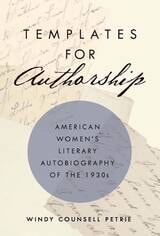
Templates for Authorship
American Women's Literary Autobiography of the 1930sWindy Counsell Petrie
University of Massachusetts Press, 2021
Windy Counsell Petrie considers twelve autobiographies from a diverse group of writers, ranging from highbrow modernists such as Gertrude Stein and Harriet Monroe to popular fiction writers like Edith Wharton and Edna Ferber, and lesser known figures such as Grace King and Carolyn Wells. Since there were few existing examples of women's literary autobiography, these writers found themselves marketed and interpreted within four cultural templates: the artist, the activist, the professional, and the celebrity. As they wrote their life stories, the women adapted these templates to counter unwanted interpretations and resist the sentimental feminine traditions of previous generations with innovative strategies of deferral, elision, comedy, and collaboration. This accessible study contends that writing autobiography offered each of these writers an opportunity to define and defend her own literary legacy.

Ten Women of Mystery
Edited by Earl F. Bargainnier
University of Wisconsin Press, 1981
This volume, which examines the special contributions of a number of women mystery writers, sheds light on this significant example of common interests in recreational reading among women and men and the reasons behind the early and continuing uncharacteristic near-equality of both sexes in this field of endeavor.

Tender Machines
J. Mae Barizo
Tupelo Press, 2023
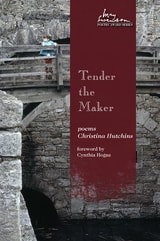
Tender the Maker
Christina Hutchins
Utah State University Press, 2015
"Again and again in Christina Hutchins’s exquisite Tender the Maker, poems startle us into awareness of the overlooked, the nearly always invisible (such as a library’s unused dictionary), and the marvelous, those aspects of life that come under the rubric of ‘mystery,’ in all senses of the word. Hutchins combines a pitch-perfect and precise lyricism with a postmodern sensibility of language’s materiality.”
—Cynthia Hogue, judge for the 2015 May Swenson Poetry Award
"An elegantly crafted, dense work that invites readers to travel on spiritual, philosophical, and historical journeys."
—Kirkus Reviews
"Tender the Maker revisits the age-old comparison between poet and deity, highlighting its blind spots, namely the times when creating also means losing, destroying, forgetting. . . . Each poem becomes a map where time and space intersect and unearth connections that help us confront the weight of history, whether our own or that of others."
—Fjords Review
"[T]hroughout the book, Hutchins guides me into her patient, fragile, complex vision. . . . Both the depth and the precision of Hutchins’s work arise from her exact attention to the 'motion-in-relation' of herself as an artist, which is also attention to the tools of her work and to her imagination’s duty to honor the seen and the not seen."
—Beloit Poetry Journal
The May Swenson Poetry Award is an annual competition named for May Swenson, one of America’s most provocative and vital writers. During her long career, Swenson was loved and praised by writers from virtually every school of American poetry. She left a legacy of fifty years of writing when she died in 1989. She is buried in her hometown of Logan, Utah.
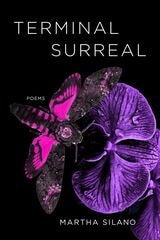
Terminal Surreal
PoemsMartha Silano
Acre Books, 2025
In her masterful poetry collection Terminal Surreal, Martha Silano confronts the reality of mortality with gorgeous attention to imagery and scene. The book follows a trajectory from early symptoms before diagnosis with amyotrophic lateral sclerosis (ALS) to full-blown illness and its effects on friends and family, including her children, who appear in poems like “After Dropping My Son Off at College” and “My Nineteen-Year-Old Daughter Is My Personal Assistant.”
With a devoted naturalist’s eye, Silano revels in birds, trees, and flowers in a way that reminds readers we are connected to the world around us. The book touches on the medical, the metaphysical, and even the cosmological (through encounters in medical offices and on a moon of Mars). With Nutter Butters and Lorna Doones, abecedarians and self-elegies, Silano’s singular, feisty, contemporary voice propels these poems of grief and acceptance as they explore the transformational power of art.
When I Learn Catastrophically
is an anagram of amyotrophic lateral sclerosis.
When I learn I probably have a couple years,
maybe (catastrophically) less, crossword puzzles
begin to feel meaningless, though not the pair
of mergansers, not the red cardinal of my heart.
The sky does all sorts of marvelously uncatastrophic
things that winter I shimmy between science
& song, between widgeons & windows, weather
& its invitation to walk. Walking, which becomes
my lose less, my less morsels, my lose smile
while more sore looms. . . .
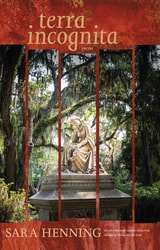
Terra Incognita
PoemsSara Henning
Ohio University Press, 2022
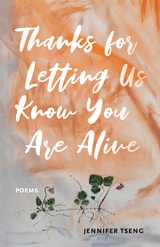
Thanks for Letting Us Know You Are Alive
PoemsJennifer Tseng
University of Massachusetts Press, 2024
Crafted with lines from her late father’s letters, Jennifer Tseng’s Thanks for Letting Us Know You Are Alive is a portrait of an immigrant, a rootless person whose unspoken loss—that of his native geography, family, traditions, language—underlies every word. Though her father’s first language was Mandarin, for more than twenty years he wrote these letters in English, so that she could understand them. Some are riddled with errors, some nearly unintelligible. Lines from his letters appear as titles and are scattered throughout the poems, blending voices of father and daughter. This collection enacts what it means to lose someone and commune with them simultaneously—the paradox of grief and all it gives us.
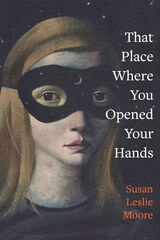
That Place Where You Opened Your Hands
Susan Leslie Moore
University of Massachusetts Press, 2020
Celebrating the tension between what we imagine and what we know the world to be, Susan Leslie Moore's debut collection moves between certainty and doubt, dead seriousness and determined playfulness. Exploring identity and the exterior and interior selves we create through the natural world, language, and relationships, the poems of That Place Where You Opened Your Hands bring the ordinary rhythms of life and motherhood into coexistence with wilder truths. As Moore writes, “If I can't be singular / in purpose, let me be quietly adrift,” but these are not quiet poems.
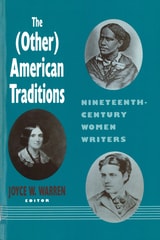
The (Other) American Traditions
Nineteenth-Century Women WritersWarren, Joyce W
Rutgers University Press, 1993
The American literary canon has been the subject of debate and change for at least a decade. As women writers and writers of color are being rediscovered and acclaimed, the question of whether they are worthy of inclusion remains open.
The (Other) American Traditions brings together for the first time in one place, essays on individual writers and traditions that begin to ask the harder questions. How do we talk about these writers once we get beyond the historical issues? How is their work related to their male counterparts? How is it similar: how is it different? Are differences related to gender or race or class? How has the selection of books in the literary canon (Melville, Hawthorne, Emerson, and James) led to a definition of the American tradition that was calculated to exclude women? Do we need a new critical vocabulary to discuss these works? Should we stop talking about a tradition and begin to talk about many traditions? How did black American women writers develop strategies for speaking out when they were doubly in jeopardy of being ignored as blacks and as women? The volume offers irrefutable proof that the writers, the critics who work on their texts, all these questions, and the expansion of the canon matter very much indeed.
Contributors: Nina Baym, Deborah Carlin, Joanne Dobson, Josephine Donovan, Judith Fetterley, Frances Smith Foster, Susan K. Harris, Karla F.C. Holloway, Paul Lauter, Diane Lichtenstein, Carla L. Peterson, Carol J. Singley, Jane Tompkins, Joyce W. Warren and Sandra A. Zagarell.
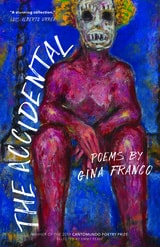
The Accidental
PoemsGina Franco
University of Arkansas Press, 2019
Cascading through each of the poems in Gina Franco’s The Accidental is a question: What does it mean to be human in a world where the soul is exalted but the body brutalized? Franco explores the terrain of the borderlands—not just the physical space of the American southwest, but the spaces where lines are drawn between body and soul, God and self, violence and ecstasy. Unfolding along these borders in a torrent of deep contemplation, Franco’s poems bring the reader to the line between accident and choice, delving into the role each plays in creating the lives we are born into and in determining how those lives end. A body caught in a tree after a flood—an accident—calls to mind deliberate violences: crucifixion and lynching.
Guided, even so, by a stark hopefulness, The Accidental makes a character of the soul and traces its pilgrimage from suffering toward transcendence. “The soul saw,” Franco writes, “that it saw through the wound.” This book tenders a creation myth steeped in existential philosophy and shimmering with the vernacular of the ecstatic.
The Afterlife of Sweetness
PoemsJaia Hamid Bashir
The Ohio State University Press, 2026
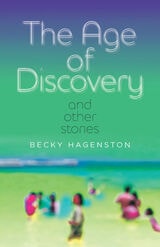
The Age of Discovery and Other Stories
Becky Hagenston
The Ohio State University Press, 2021
“These ingenious stories are so funny and sparkling and slyly inventive that their pain catches you by surprise, like a sunburn after a day at the beach.”—Eric Puchner
Winner, 2022 Mississippi Institute for Arts and Letters Prize for Best Fiction
In Becky Hagenston’s fourth collection, the real and the fantastic collide in stories that span from Mississippi to Europe, and from the recent past to the near future. The characters are sex-toy sellers, internet trolls, parents, students, and babysitters—all trying to make sense of a world where nothing is quite what it appears to be. A service robot makes increasingly disturbing requests. A middle school teacher is accused of witchcraft—and realizes the accusations might be true. Two college students devise a way to avoid getting hit on in bars. A baker finds bizarre anomalies in his sourdough. A librarian follows her dead ex-husband through the Atlanta airport. In these stories, men and women confront grief, danger, loneliness, and sometimes—the strangest discovery of all—unexpected joy. Hagenston delivers a collection that is, at its weird and shining heart, about people discovering what—for better or worse—they are capable of.
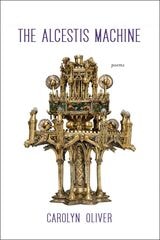
The Alcestis Machine
PoemsCarolyn Oliver
Acre Books, 2024
Inspired by the Greek myth of Alcestis, this poetry collection brings to life myriad voices who venture beyond the known world and exist between realities.
In Greek mythology, Alcestis descends to the mysterious kingdom of death in her beloved’s place. In The Alcestis Machine, Carolyn Oliver’s second poetry collection, loss and queer desire echo across the multiverse. “In another life, I’m a . . .” sea witch or swineherd, vampire or troubadour, florist or fossil or museum guard, Oliver writes. These parallel personas inhabit space stations and medieval villages, excavate the Devonian seabed, and plumb a subterranean Anthropocene. In possible futures and imagined pasts, they might encounter “all wrong turns and broken signs” or carry “a suitcase full of stars.”
Oliver’s poems are animated by lush, unsettling verse and forms both traditional and experimental. The Alcestis Machine demonstrates how very present absence can be and how desire knows no boundaries. In neighborhood subdivisions or the vast reaches of space, it’s impossible to know “whose time is slipping / again.” Anyone “could come loose / from gravity’s shine.”

The Andrew Wyeth Chronicles
Janée Baugher
Tupelo Press, 2026
The Andrew Wyeth Chronicles presents an imaginative narrative of the painter’s creative life, rife with both losses and pleasures. Janée J. Baugher employs the footnote form to write a book-length narrative of ekphrastic poetry in which the character of Andrew Wyeth chronicles his internal musings. The sixty-three Wyeth paintings that influenced these poems (dated 1938 through 2008) are the ones in which Baugher delighted in how the quotidian is made tender, like a white sheet drying outside on the line or sunflowers’ shadows against a house.
Studying the work of this particular artist was a decades-long meditative practice of deep looking, a method by which the author detaches from her ego. Wyeth’s paintings, drawings, and watercolors became portals through which she could imagine worlds beyond her immediate awareness and in which she could explore linguistic possibilities.
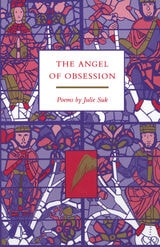
The Angel of Obsession
Julie Suk
University of Arkansas Press, 1992
Winner of the 1991 Arkansas Poetry Award, 1992 Roanoke-Chowan Poetry Award, and 1993 Bess Hokin Prize
Others may lament the uncertainties and disappointments of life, but Julie Suk, winner of the second annual Arkansas Poetry Award, embraces its tumult. Turning from the unsullied angels and the paradises captured by generations of artists, these poems focus instead on those who have abandoned heaven for the world of such mundane matters as family, loneliness, love, and loss. Rousing us to the passion and wonder that define our essential humanity, The Angel of Obsession celebrates the full, ragged canvas of living.
Suk’s poetry has previously appeared in The Georgia Review, The Midwest Quarterly, Southern Humanities Review, Poetry, and other important literary magazines. The Angel of Obsession was selected for publication from a field of more than five hundred entries by the poet John Stone.
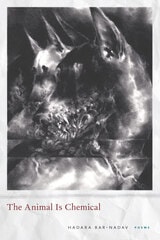
The Animal Is Chemical
Hadara Bar-Nadav
Four Way Books, 2024
Lyrically enacting the cognitive dissonance and embodied contradictions of our contemporary age, Hadara Bar-Nadav’s The Animal Is Chemical collects innovative poems that straddle the frontiers of language and scientific knowledge. She brilliantly draws on her own experience as a medical editor and her family’s history of Holocaust survival to write into the hybrid legacy of Western medicine: part clinical empiricism, part human fallibility and moral bankruptcy. Displaying a robust formal range, these poems move from feverish elegies to drug-pamphlet erasures, tangible articulations of Bar-Nadav’s epigenetic, cultural, and memorial inheritance as a writer navigating chronic illness and pain. In these pages, Nazi medical experiments, pharmaceutical literature, and manifestations of intergenerational trauma collide in the lyrical archive of Bar-Nadav’s latest collection, winner of the 2022 Four Way Books Levis Prize in Poetry. Just as she illuminates the paradox of time — that we may think of the past as something gone and yet always present in context and legacy — Bar-Nadav proves the enduring ambivalence of pharmakon, that antidote which poisons us, the medicine that kills. This febrile, fierce book casts spells and confronts illusions, ignites grief and awe, and challenges our assumptions about what it means to heal our bodies, our families, and our shared histories. Perhaps this work fulfills the specious salvation it describes in its opening pages, performing an exorcism of truth-telling that harnesses the heat of a “myth in which a god sets us / on fire and then sets us free.”
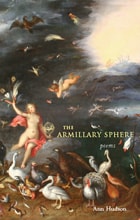
The Armillary Sphere
PoemsAnn Hudson
Ohio University Press, 2006
Taking the warp of dream, sometimes nightmare, and weaving it with the ordinary world, the poems of The Armillary Sphere, Ann Hudson’s award-winning debut collection, do not simplify the mystery but deepen it. Just as the interlocking rings of the armillary sphere of the title represent the great circles of the heavens, so do the poems herein demonstrate out of the beautiful, the extraordinary, and the cast off, a fresh scaffolding, a new way to see out from the center of our selves, a new measure of our relationship to the things of this world and the next.
Chosen from hundreds of manuscripts as this year’s winner of the Hollis Summers Poetry Prize, Ann Hudson’s The Armillary Sphere possesses, in the words of final judge Mary Kinzie,
“… a brightness of spirit and quickness of thought that are conveyed with extraordinary care as she frames moments of experience. Her style is unobtrusive—no fireworks of phrasing obscure the thing felt and seen. So simple a device as taking an intransitive verb transitively can shed strong light on the moment: “A fine sheen /of sweat glistens the cocktail glasses,”—and Hudson studies emotions with a brave restraint that resists cliché, while deftly joining together intuitions that bring contradictory or opposing charge.… Both circular and digressive, Hudson’s portrayal of beings of all ages poised on their varying thresholds brings a novelist’s sense of details unfolding into their future under the control of a fine poet’s pure and condensed language of likeness.”Insomnia
If you were awake too, I’d tell you
the whole story, how I dreamt
we never saw the child, how easily
we forgot. Instead I shuffle
to the porch to watch
traffic pass the house
and an occasional bat dive
under the streetlamps, ruthless
after its dark targets.
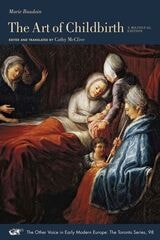
The Art of Childbirth
A Seventeenth-Century Midwife’s Epistolary Treatise to Doctor Vallant: A Bilingual EditionMarie Baudoin
Iter Press, 2022
In 1671, Marie Baudoin (1625–1700), head midwife and governor of the Hôtel-Dieu of Clermont-Ferrand, sent a treatise on the art of childbirth to her powerful Parisian patron, Dr. Vallant. The story of how Baudoin’s knowledge and expertise as a midwife came to be expressed, recorded, and archived raises the question: Was Baudoin exceptional because she was herself extraordinary, or because her voice has reached us through Vallant’s careful archival practices? Either way, Baudoin’s treatise invites us to reconsider the limits of what we thought we knew midwives “could be and do” in seventeenth-century France. Grounding Marie Baudoin’s text in a microanalysis of her life, work, and the Jansenist network between Paris and Clermont-Ferrand, this book connects historiographies of midwifery, Jansenism, hospital administration, public health, knowledge and record-keeping, and women’s work, underscoring both Baudoin’s capabilities and the archival accidents and intentions behind the preservation of her treatise in a letter.
The Barbara Johnson Collective
Edited by Devin M. Garofalo and Nathan K. Hensley
Northwestern University Press, 2027
Collaboratively reassesses Barbara Johnson’s legacy as a reader and thinker with an eye to contemporary conditions
Across an archive of essays on abortion and race, Mallarmé and Melville, feminist philosophy, rhetorical device, and pedagogical method, Barbara Johnson built a legacy of thought whose energies reverberate into the present. This collected volume gathers writers and critics from a range of North American higher educational settings to engage with this essential but still often underappreciated critic in a time of renewed and deepening crisis.
In Zoom meetings and shared essays, across a virtualized map of today’s academic and para-academic worlds, the group assessed how the rolling catastrophes of late neoliberalism continue to stage the sort of analogy Johnson herself would highlight between patriarchy, capitalism, ecocide, and other forms of structural violence. Emerging from that assemblage, this experimental collection tracks Johnson’s efforts to link literary reading with concrete matters of personhood and care at a moment when the very system of higher education that enabled Johnson’s work in the 1980s and 1990s faces existential threat. The frozen record of a live experience, the book is an impure procedure, tangled in the idiom of its own unfolding: a temporary culmination of an ongoing collaborative undertaking that will always remain unfinished.
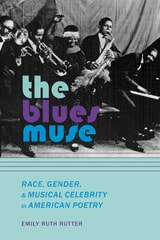
The Blues Muse
Race, Gender, and Musical Celebrity in American PoetryEmily Ruth Rutter
University of Alabama Press, 2018
A critical analysis of the poetic representations and legacies of five landmark blues artists
The Blues Muse: Race, Gender, and Musical Celebrity in American Poetry focuses on five key blues musicians and singers—Gertrude “Ma” Rainey, Bessie Smith, Billie Holiday, Robert Johnson, and Lead Belly—and traces the ways in which these artists and their personas have been invoked and developed throughout American poetry. This study spans nearly one hundred years of literary and musical history, from the New Negro Renaissance to the present.
Emily Ruth Rutter not only examines blues musicians as literary touchstones or poetic devices, but also investigates the relationship between poetic constructions of blues icons and shifting discourses of race and gender. Rutter’s nuanced analysis is clear, compelling, and rich in critical assessments of these writers’ portraits of the musical artists, attending to their strategies and oversights.

The Body Taken
PoemsLisa Beech Hartz
University of Massachusetts Press, 2027
A searing exploration of young womanhood in a culture of being seen
Inspired by an exhibit of vintage photographs by Francesca Woodman, whose work is often shocking in its exploration of a woman’s relationship with her body in a misogynistic culture, The Body Taken combines the confessional, the ekphrastic, and the erasure of women’s artistry. In a New York City gallery, Lisa Beech Hartz finds herself completely captivated and especially moved by how much the photographer’s self-portraits resemble a sort of mash-up of the poet and her dearest friend in their late teens, writing: “Mirrored in girlhood / recollection / and all our fables — / all the frazzled strands / of stories / I can never braid / complete / for lack of you.”
These poems grieve the poet’s deep youthful bond while also reflecting on each girl’s family life and their shared experiences: adventurous trips into the New York of the late seventies from their suburban town; encounters with distant, heavy-drinking parents; various medical and emotional challenges; and navigating the rampant and casual misogyny of the time. Memories are punctuated with examinations and interpretations of Francesca Woodman's photographs, attempting to decipher what the artist captured about her experience of being a young woman and what it meant to live inside a young woman’s body: “Francesca crouches / in her dotted dress seam- / split and gaping. Fingers / splayed across her face / she calculates her escape.”
The collection also includes erasures of critical responses to Woodman’s work which are sometimes respectful, even reverential, and other times reinforce the fascination with her suicide and her sexuality. Using provocative imagery, this collection serves as a love letter to lost girlhood, exploring themes of identity, loss, and the female body in the world.
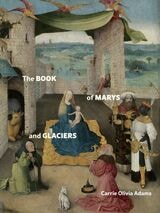
The Book of Marys and Glaciers
Carrie Olivia Adams
Tupelo Press, 2026
The poems collected in The Book of Marys and Glaciers traverse both the psychological and physical landscape to explore the too-muchness and overwhelm that categorizes our demand-driven age. The longest series, “Dust Cover,” is a meditation on deserts of all kinds—geographic, urban, celestial, domestic, and linguistic. The poems themselves enact their own ideas of space and emptiness, building to a work that grain after grain becomes heavy as a whole. In contrast, the title sequence “The Book of Marys and Glaciers” is an expansive work of feminist ecopoetics that asks questions about the role of women as mothers, religious figures, friends, and lovers in a society that rarely makes room for quietude anymore.
Altogether, the poems are controlled, precise investigations and interrogations of the ideas and images we take for granted.
The Book of a Thousand Eyes
Lyn Hejinian
Omnidawn, 2012
The Book of the Body Politic
Christine de Pizan
Iter Press, 2021
Christine de Pizan’s The Book of the Body Politic is the first political treatise written by a woman. It not only advises the prince, but nobles, knights, and common people as well. It promotes the ideals of interdependence and social responsibility. Rooted in the mindset of medieval Christendom, The Book of the Body Politic heralds the humanism of the Renaissance, highlighting classical culture and Roman civic virtues. This new edition and translation offers a faithful rendering of Christine de Pizan’s writing, as well as a thorough contextualization of her career as a political writer at the end of the Middle Ages in France. The Book of the Body Politic resounds to this day, urging for the need for probity in public life and the importance of responsibilities and rights.
The Book of the Mutability of Fortune
Christine de Pizan
Iter Press, 2017
Christine de Pizan (ca. 1364–ca. 1431) has long been recognized as France’s first professional woman of letters, and interest in her voluminous and wide-ranging corpus has been steadily rising for decades. During the tumultuous later years of the Hundred Years’ War, Christine’s lone but strong feminine voice could be heard defending women, expounding the highest ideals for good governance, and lamenting France’s troubled times alongside her own personal trials. In The Mutability of Fortune, Christine fuses world history with autobiography to demonstrate mankind’s subjugation to the ceaselessly changing, and often cruel, whims of Fortune. Now, for the first time, this poem is accessible to an English-speaking audience, further expanding our appreciation of this ground-breaking woman author and her extraordinary body of work.
The Buffoons, A Ridiculous Comedy
A Bilingual EditionMargherita Costa
Iter Press, 2018
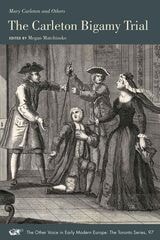
The Carleton Bigamy Trial
Mary Carleton
Iter Press, 2023
Mary Carleton was an ordinary woman from Canterbury who entered historical records when she was accused of bigamy. The seven pamphlets in this edition focus on the bigamy trial of Mary Carleton, in which the accused eloquently defends herself and is ultimately acquitted. Written in the early years of the English Restoration, they demonstrate that narratives presenting what “she said” and what “he said” can reveal, forcefully and painfully, how truth can be fragmented in the different arenas of law, love, and politics. Through their disparate accounts of a marriage gone wrong, these pamphlets reinforce the social status quo even while they radically shatter the very foundations that give it heft. In asking readers to question absolutes, they unmask the precarious relationship between words and the world.
The Certain Body
Julia Guez
Four Way Books, 2022
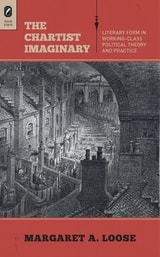
The Chartist Imaginary
Literary Form in Working-Class Political Theory and PracticeMargaret A. Loose
The Ohio State University Press, 2014
The Chartist Imaginary offers close readings of poems and fiction by Chartist figures from Ernest Jones and Thomas Cooper to W. J. Linton, Thomas Martin Wheeler, and Gerald Massey. It also draws on extensive archival research to examine, for the first time, working-class female Chartist poets Mary Hutton, E. L. E., and Elizabeth La Mont. Focusing on the literary form of these works, Loose strongly argues for the political power of the aesthetic in working-class literature.
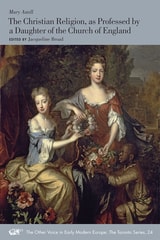
The Christian Religion, as Professed by a Daughter of the Church of England
Mary Astell
Iter Press, 2013
The Chronicle of Le Murate
Sister Giustina Niccolini
Iter Press, 2011
The Chronicles of Panchita Villa and Other Guerrilleras
Essays on Chicana/Latina Literature and CriticismBy Tey Diana Rebolledo
University of Texas Press, 2006
Although there have been substantial contributions to Chicana literature and criticism over the past few decades, Chicanas are still underrepresented and underappreciated in the mainstream literary world and virtually nonexistent in the canon. Writers like Sandra Cisneros, Ana Castillo, and Gloria Anzaldúa have managed to find larger audiences and critical respect, but there are legions of Chicana writers and artists who have been marginalized and ignored despite their talent. Even in Chicano anthologies, the focus has tended to be more on male writers. Chicanas have often found themselves without a real home in the academic world.
Tey Diana Rebolledo has been writing about Chicana/Latina identity, literature, discrimination, and feminism for more than two decades. In this collection of essays, she brings together both old and new works to give a state-of-the-moment look at the still largely unanswered questions raised by vigilant women of color throughout the last half of the twentieth century. An intimate introductory essay about Rebolledo's personal experiences as the daughter of a Mexican mother and a Peruvian father serves to lay the groundwork for the rest of the volume. The essays delve into the historical development of Chicana writing and its early narratives, the representation of Chicanas as seen on book covers, Chicana feminism, being a Chicana critic in the academy, Chicana art history, and Chicana creativity. Rebolledo encourages "guerrillera" warfare against academia in order to open up the literary canon to Chicana/Latina writers who deserve validation.
The Circuit of Apollo
Eighteenth-Century Women’s Tributes to WomenLaura Runge
University of Delaware Press, 2019
Published by University of Delaware Press. Distributed worldwide by Rutgers University Press.
The City-Women
Mallorie Sievert
Carnegie Mellon University Press, 2026
This debut play from Mallorie Sievert follows what happens after two nuns fall in love.
When two young nuns in a seventeenth-century cloistered convent discover their feelings for each other, they must decide whether to conform to the life that was chosen for them or forge their own path and discover who God truly wants them to be. Set against the backdrop of Latin America during the Counter-Reformation, The City-Women explores love, spirituality, and sisterhood, and seeks to redefine what it means to be queer in the eyes of God.
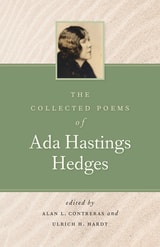
The Collected Poems of Ada Hastings Hedges
Ada Hastings Hedges
Oregon State University Press, 2020
Except for a twelve-year sojourn in southeastern Oregon and two years in Los Angeles, Hedges lived in Portland from 1910 until her death in 1980. She was assistant editor at Binfords & Mort Publishers and a supervising editor in the Works Progress Administration. She taught briefly at Warner Pacific College in the 1960s.
Hedges wrote in a style notable for precision, clarity, and smoothness of line. More than half of her poems in this collection are sonnets. A poet of the city as well as the desert, her work offers a compelling perspective on mid-century Portland life. In 1933 she published her only book, Desert Poems. That collection is reprinted here in its entirety, along with scores of additional poems published in a wide variety of venues, making this the first comprehensive collection of Hedges’s work.
A detailed introduction by the editors and annotations to the text provide information about revisions, publication dates, and notable features. Also included is an essay by Hedges asking “Can Poetry Be Taught?” In her afterword, Oregon poet Ingrid Wendt writes of her admiration for Hedges’s “fierceness of spirit, lack of sentimentality, and complex vision.”
For readers interested in women’s literature, Pacific Northwest poetry, and the literature of Eastern Oregon, this volume reintroduces a compelling regional voice.
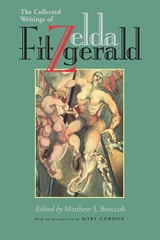
The Collected Writings of Zelda Fitzgerald
Zelda Fitzgerald
University of Alabama Press, 1997
The voice behind the legend—Zelda Fitzgerald in her own words.
Zelda Sayre Fitzgerald has long been perceived as the tragic "other half" of the Scott and Zelda legend. Born in Montgomery, Alabama, the high-spirited tomboy turned flapper was talented in dance, painting, and writing but lived in the shadow of her husband's success. Her writing can be experienced on its own terms in Matthew Bruccoli's meticulously edited The Collected Writings of Zelda Fitzgerald.
The collection includes Zelda's only published novel, Save Me the Waltz, an autobiographical account of the Fitzgeralds' adventures in Paris and on the Riviera; her celebrated farce, Scandalabra; eleven short stories; twelve articles; and a selection of letters to her husband, written over the span of their marriage, that reveals the couple's loving and turbulent relationship.
Zelda Sayre Fitzgerald has long been an American cultural icon. The Collected Writings affirms her place as a writer and as a symbol not only of the Lost Generation but of all generations as she struggled to define herself through her art.
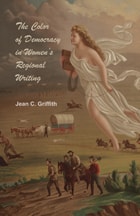
The Color of Democracy in Women's Regional Writing
Jean Carol Griffith
University of Alabama Press, 2009
Exploring how women writers used regional fiction to reimagine democracy, identity, and belonging in America.
American regionalism has become a contested subject in literary studies alongside the ubiquitous triad of race, class, and gender. The Color of Democracy in Women's Regional Writing enters into the heart of an ongoing debate in the field about the significance of regional fiction at the end of the 19th century. Jean Griffith presents the innovative view that regional writing provided Edith Wharton, Ellen Glasgow, and Willa Cather with the means to explore social transformation in a form of fiction already closely associated with women readers and writers.
Griffith provides new readings of texts by these authors; she places them alongside the works of their contemporaries, including William Faulkner and Langston Hughes, to show regionalism's responses to the debate over who was capable of democratic participation and reading regionalism's changing mediations between natives and strangers as reflections of the changing face of democracy.
This insightful work enriches the current debate about whether regionalism critiques hierarchies or participates in nationalist and racist agendas and will be of great interest to those invested in regional writing or the works of these significant authors.
The Color of Dusk
Robin Caton
Omnidawn, 2001
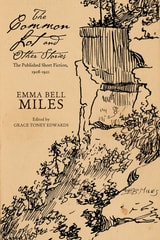
The Common Lot and Other Stories
The Published Short Fiction, 1908–1921Emma Bell Miles
Ohio University Press, 2016
The seventeen narratives of The Common Lot and Other Stories, published in popular magazines across the United States between 1908 and 1921 and collected here for the first time, are driven by Emma Bell Miles’s singular vision of the mountain people of her home in southeastern Tennessee. That vision is shaped by her strong sense of social justice, her naturalist’s sensibility, and her insider’s perspective.
Women are at the center of these stories, and Miles deftly works a feminist sensibility beneath the plot of the title tale about a girl caught between present drudgery in her father’s house and prospective drudgery as a young wife in her own. Wry, fiery, and suffused with details of both natural and social worlds, the pieces collected here provide a particularly acute portrayal of Appalachia in the early twentieth century.
Miles’s fiction brings us a world a century in the past, but one that will easily engage twenty-first-century readers. The introduction by editor and noted Miles expert Grace Toney Edwards places Miles in the literary context of her time. Edwards highlights Miles’s quest for women’s liberation from patriarchal domination and oppressive poverty, forces against which Miles herself struggled in making a name for herself as a writer and artist. Illustrations by the author and Miles family photographs complement the stories.
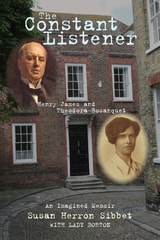
The Constant Listener
Henry James and Theodora Bosanquet—An Imagined MemoirSusan Herron Sibbet
Ohio University Press, 2017
In 1907, in a quiet English village, Theodora Bosanquet answered Henry James’s call for someone to transcribe his edits and additions to his formidable body of work. The aging James had agreed to revise his novels and tales into the twenty-four-volume New York Edition. Enter Bosanquet, a budding writer who would record the dictated revisions and the prefaces that would become a lynchpin of his legacy.
Embracing the role of amanuensis and creative counterpoint cautiously at first, Bosanquet kept a daily diary over the nine years that she worked with James, as their extraordinary partnership evolved. Bosanquet became the first audience for James’s compositions and his closest literary associate—and their relationship ultimately resulted in James’s famed “deathbed dictations.” At the same time, the homosexuality of each was an unspoken but important influence on their mutual support and companionship.
Susan Herron Sibbet’s posthumous novel gifts us with the voice of a young woman writer drawn into the intimate circle of an aging master, and is a moving addition to previous literary treatments of James and Bosanquet, even as it hews closer to fact than other works do. The Constant Listener is itself the work of an accomplished poet, and will speak to fans of James, historical fiction, and themes of art, love, sexuality, and identity.

The Country of the Pointed Firs and Other Stories
Sarah Orne Jewett
University of New Hampshire Press, 1997
The Country of the Pointed Firs (1896) is Sarah Orne Jewett's most popular book. In its elegantly constructed sketches, a worldly, anonymous writer spends the summer in a tiny Maine fishing village where she hopes to find peace and solitude. As she gains the acceptance and trust of her hosts, the community's power and complexity are slowly revealed. While its episodes portray the difficulty and loneliness of rural life, they also display its dignity and strength, particularly as expressed in the bonds between women: mothers, daughters, and friends.
This centennial edition contains a facsimile of the original text, thereby restoring the novel to Jewett's own version, which had been considerably altered in other published versions, plus four related stories. Further enhancing the importance of this volume is editor Sarah Way Sherman's introduction, which includes a sketch of Jewett's life and professional development, a commentary on textual accuracy, and a discussion of the book's themes and techniques as well as its historical context.
The Creative Crone
Aging and the Poetry of May Sarton and Adrienne RichSylvia Henneberg
University of Missouri Press, 2010
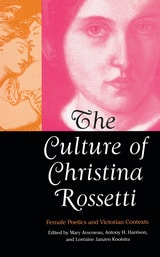
The Culture of Christina Rossetti
Female Poetics and Victorian ContextsMary Arseneau
Ohio University Press, 1999
The Culture of Christina Rossetti explores a “new” Christina Rossetti as she emerges from the scrutiny of the particular historical and cultural context in which she lived and wrote. The essays in this collection demonstrate how the recluse, saint, and renunciatory spinster of former studies was in fact an active participant in her society’s attempt to grapple with new developments in aesthetics, theology, science, economics, and politics.
The volume examines Rossetti’s poetry, fiction, and nonfiction from a variety of theoretical and critical perspectives in order to reevaluate her place in the Victorian world of art, literature, and ideas. The essays offer a radical rethinking of her best-known poems, retrieve neglected works, establish the diversity of her writing, and reposition Rossetti within a canon continually under formation.
Contributing to the ongoing retrieval of the nineteenth-century woman poet, The Culture of Christina Rossetti highlights Rossetti’s responses to both male and female literary traditions and explores her incorporation and revision of literary influences from medieval Italian sources to contemporary writers.
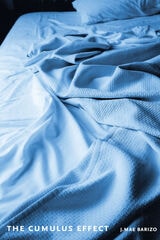
The Cumulus Effect
J. Mae Barizo
Four Way Books, 2015