53 books match the query 'Zionism' and 11 start with t
cover of Taboo Memories, Diasporic Voices

Taboo Memories, Diasporic Voices

Ella Shohat

Duke University Press, 2006

Taboo Memories, Diasporic Voices brings together for the first time a selection of trailblazing essays by Ella Shohat, an internationally renowned theorist of postcolonial and cultural studies of Iraqi-Jewish background. Written over the past two decades, these twelve essays—some classic, some less known, some new—trace a powerful intellectual trajectory as Shohat rigorously teases out the consequences of a deep critique of Eurocentric epistemology, whether to rethink feminism through race, nationalism through ethnicity, or colonialism through sexuality.

Shohat’s critical method boldly transcends disciplinary and geographical boundaries. She explores such issues as the relations between ethnic studies and area studies, the paradoxical repercussions for audio-visual media of the “graven images” taboo, the allegorization of race through the refiguring of Cleopatra, the allure of imperial popular culture, and the gender politics of medical technologies. She also examines the resistant poetics of exile and displacement; the staging of historical memory through the commemorations of the two 1492s, the anomalies of the “national” in Zionist discourse, the implications of the hyphen in the concept “Arab-Jew,” and the translation of the debates on orientalism and postcolonialism across geographies. Taboo Memories, Diasporic Voices not only illuminates many of the concerns that have animated the study of cultural politics over the past two decades; it also points toward new scholarly possibilities.
[more]
cover of The Challenges of Sovereignty: Essays on Israel and Zionism

The Challenges of Sovereignty

Essays on Israel and Zionism

David Ellenson

Brandeis University Press, 2026

Key essays by a notable scholar address some of the most pressing questions facing Israel today.

Over the course of his rich career, David Ellenson—one of the most outstanding Jewish scholars, intellectuals, and thinkers of our time—probed the tension between tradition and modernity, especially as reflected in the ceaseless reinterpretation of liturgical and halakhic texts. Alongside that scholarly interest, largely centered on European Jewry, Ellenson produced an impressive body of work on Zionism and Israel.

This volume follows the arc of this body of work from Ellenson’s early articles on the Zionism of American rabbis to his last essay on the struggle between Jewish and democratic impulses in Israeli society. He draws on familiar sources of inquiry—Jewish prayers and legal sources—to chart changes in Israeli religious life and to excavate its theological-political foundation. What emerges is a profound meditation on some of the most important questions that Israel faces today: what does it mean to be Jewish in the state? What role should Halakhah play in a self-defined Jewish state? How should the state treat its non-Jewish minority? How deeply rooted is democracy in the state and its foundational texts? And can the state ever escape seemingly irrepressible internal and external conflict?
[more]
cover of The Fragile Dialogue: New Voices of Liberal Zionism

The Fragile Dialogue

New Voices of Liberal Zionism

Rabbi Stanley M. Davids and Rabbi Lawrence A. Englander, DHL

Central Conference of American Rabbis, 2018
Israel has quickly become one of the most polarizing forces in the North American Jewish community. In a world already much too divided, how can we approach the subject of Zionism without widening the rifts? This book wrestles with and attempts to frame the very fragile dialogue surrounding Zionism and Israel in the 21st century Progressive Jewish community. Written from a multiplicity of views, the collection explores the many lenses through which this varied community approaches Zionism, not only set apart by political differences but also by geographical diversity, religious divisiveness, socio-economic policies, gender issues, the use and abuse of power, and more. The Fragile Dialogue is a conversation starter, meant to provide a basis for narrowing the rifts in our dialogue around Zionism today.
[more]
cover of The Holocaust Averted: An Alternate History of  American Jewry, 1938-1967

The Holocaust Averted

An Alternate History of American Jewry, 1938-1967

Gurock, Jeffrey S

Rutgers University Press, 2015

The increasingly popular genre of “alternative histories” has captivated audiences by asking questions like “what if the South had won the Civil War?” Such speculation can be instructive, heighten our interest in a topic, and shed light on accepted history. In The Holocaust Averted, Jeffrey Gurock imagines what might have happened to the Jewish community in the United States if the Holocaust had never occurred and forces readers to contemplate how the road to acceptance and empowerment for today’s American Jews could have been harder than it actually was.
 
Based on reasonable alternatives grounded in what is known of the time, places, and participants, Gurock presents a concise narrative of his imagined war-time saga and the events that followed Hitler’s military failures. While German Jews did suffer under Nazism, the millions of Jews in Eastern Europe survived and were able to maintain their communities. Since few people were concerned with the safety of European Jews, Zionism never became popular in the United States and social antisemitism kept Jews on the margins of society. By the late 1960s, American Jewish communities were far from vibrant.

This alternate history—where, among many scenarios, Hitler is assassinated, Japan does not bomb Pearl Harbor, and Franklin Delano Roosevelt is succeeded after two terms by Robert A. Taft—does cause us to review and better appreciate history. As Gurock tells his tale, he concludes every chapter with a short section that describes what actually happened and, thus, further educates the reader.


[more]
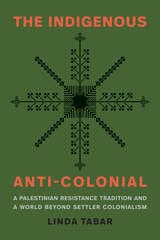
cover of The Indigenous Anti-Colonial: A Palestinian Resistance Tradition and a World Beyond Settler Colonialism

The Indigenous Anti-Colonial

A Palestinian Resistance Tradition and a World Beyond Settler Colonialism

Linda Tabar

Duke University Press, 2026
In The Indigenous Anti-Colonial, Linda Tabar explores the radical tradition in which Palestinians remain defiant and undeterred as they hold onto their world and resist settler colonialism. Using a living archive of memory and oral knowledges to trace this long tradition, Tabar outlines the way Palestinians refuse and counter Zionist efforts to erase Palestinian presence and history from the land with an unyielding resistance that is distinctly Indigenous, shaped by Palestinians’ bonds with the land and the world that they built with it. This Indigenous anticolonial radical tradition produces its own imaginaries of liberation that seek a world beyond settler colonialism, white supremacy, and capitalism, constructing alternative conditions for freedom. As Israeli settler colonialism accelerates its attempts to eradicate the Palestinian people and the horrors of its genocide in Gaza are broadcast to the world, Tabar puts Palestinian conceptions of liberation at the center of conversations around settler colonialism.
[more]
cover of The Individual in History: Essays in Honor of Jehuda Reinharz

The Individual in History

Essays in Honor of Jehuda Reinharz

Edited by ChaeRan Y. Freeze, Sylvia Fuks Fried, and Eugene R. Sheppard

Brandeis University Press, 2015

Jehuda Reinharz, born in Haifa in 1944, spent his childhood in Israel and his adolescence in Germany, and moved with his family to the United States when he was seventeen. These three diverse geographies and the experiences they engendered shaped his formative years and the future of a prolific scholar who devoted his life to the study of the central role of leadership as Jews faced the challenges of emancipation and integration in Germany, the rise of modern antisemitism, the formation of Zionist youth culture and politics, and the transformation of Jewish politics in Palestine and the State of Israel. In this volume, eminent scholars in their respective fields extend the lines of Reinharz’s research interests and personal activism by focusing on the ideological, political, and scholarly contributions of a diverse range of individuals in Jewish history. Essays are clustered around five central themes: ideology and politics; statecraft; intellectual, social and cultural spheres; witnessing history; and in the academy. This volume offers a panoramic view of modern Jewish history through engaging essays that celebrate Reinharz’s rich contribution as a path-breaking and prolific scholar, teacher, and leader in the academy and beyond.
[more]
cover of The Myths of Zionism

The Myths of Zionism

John Rose

Pluto Press, 2004

Ancient, medieval and modern, this book is a critical account of the historical, political and cultural roots of Zionism.

Scrutinising the roots of the myths of Zionism and mobilising recent scholarship, John Rose shows how many of these stories, as with other mythologies, have no basis in fact. However, because Zionism is a living political force and these myths have been used to justify very real and political ends - namely, the expulsion and continuing persecution of the Palestinians. John Rose separates fact from fiction presenting a detailed analysis of their origins and development. This includes a challenge to Zionism's biblical claims using very recent and very startling Israeli archaeological conclusions.

This book shows clearly how Zionism makes many false claims on Jewish religion and history.
[more]
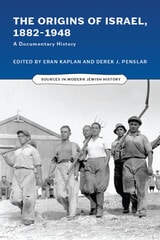
cover of The Origins of Israel, 1882–1948: A Documentary History

The Origins of Israel, 1882–1948

A Documentary History

Eran Kaplan

University of Wisconsin Press, 2011

In 1880 the Jewish community in Palestine encompassed some 20,000 Orthodox Jews; within sixty-five years it was transformed into a secular proto-state with well-developed political, military, and economic institutions, a vigorous Hebrew-language culture, and some 600,000 inhabitants. The Origins of Israel, 1882–1948: A Documentary History chronicles the making of modern Israel before statehood, providing in English the texts of original sources (many translated from Hebrew and other languages) accompanied by extensive introductions and commentaries from the volume editors.

This sourcebook assembles a diverse array of 62 documents, many of them unabridged, to convey the ferment, dissent, energy, and anxiety that permeated the Zionist project from its inception to the creation of the modern nation of Israel. Focusing primarily on social, economic, and cultural history rather than Zionist thought and diplomacy, the texts are organized in themed chapters. They present the views of Zionists from many political and religious camps, factory workers, farm women, militants, intellectuals promoting the Hebrew language and arts—as well as views of ultra-Orthodox anti-Zionists. The volume includes important unabridged documents from the origins of the Arab-Israeli conflict that are often cited but are rarely read in full. The editors, Eran Kaplan and Derek J. Penslar, provide both primary texts and informative notes and commentary, giving readers the opportunity to encounter voices from history and make judgments for themselves about matters of world-historical significance.


Best Special Interest Books, selected by the Public Library Reviewers

Best Books for General Audiences, selected by the American Association of School Librarians
[more]
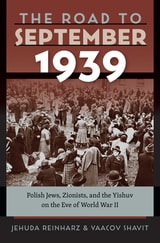
cover of The Road to September 1939: Polish Jews, Zionists, and the Yishuv on the Eve of World War II

The Road to September 1939

Polish Jews, Zionists, and the Yishuv on the Eve of World War II

Jehuda Reinharz and Yaacov Shavit

Brandeis University Press, 2018
In European and Holocaust historiography, it is generally believed that neither the Zionist movement nor the Yishuv were mindful of the plight of European Jews in the face of the Nazi threat during the 1930s. Drawing on a wide variety of memoirs, letters, and institutional reports by people from all walks of life, this volume sheds new light on a troubled period in Jewish history. Jehuda Reinharz and Yaacov Shavit trace Jewish responses to developments in Eastern and Central Europe, as well as reactions to British policy on the question of a Jewish homeland, to show that Zionists in the Yishuv worked tirelessly on the international stage on behalf of their coreligionists in Europe. Nevertheless, their efforts were all too often shattered by the realities of their powerlessness and lack of resources. Piercing to the heart of conversations about how or whether to save Jews in an increasingly hostile Europe, this volume provides a nuanced assessment of what could and could not be achieved in the years just prior to World War II and Holocaust.
[more]
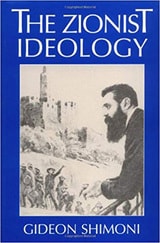
cover of The Zionist Ideology

The Zionist Ideology

Gideon Shimoni

Brandeis University Press, 1997
Winner of the Arnold Wiznitzer Prize, Hebrew University. This superb and highly nuanced study traces the development and ramifications of the ideology of Zionism from its roots in Europe to its full flowering in the establishment of the State of Israel. Gideon Shimoni begins by outlining the social origins of Zionism, including its debt to European nationalism and its subsequent emergence in the 1880s, precipitated by the pogroms in the Russian Empire. He then describes the various streams of Zionist thought, and concludes by examining both Zionism's connection with a secular Jewish identity and the nature of the Jewish claim to Eretz Israel. Throughout this comprehensive survey, Shimoni illuminates Zionism's common thread: the underlying axiom "that the Jews are a single, distinctive, entity possessing national, not just religious, attributes."
[more]
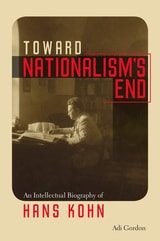
cover of Toward Nationalism's End: An Intellectual Biography of Hans Kohn

Toward Nationalism's End

An Intellectual Biography of Hans Kohn

Adi Gordon

Brandeis University Press, 2017

This intellectual biography of Hans Kohn (1891–1971) looks at theories of nationalism in the twentieth century as articulated through the life and work of its leading scholar and activist. Hans Kohn was born in late nineteenth-century Prague, but his peripatetic life took him from the Revolutionary-era Russia to interwar-era Palestine under the British Empire to the United States during the Cold War. Bearing witness to dramatic reconfigurations of national and political identities, he spearheaded an intellectual revolution that fundamentally challenged assumptions about the “naturalness” and the immutability of nationalism. Reconstructing Kohn’s long and fascinating career, Gordon uncovers the multiple political and intellectual trends that intersected with and shaped his theories of nationalism. Throughout his life, Kohn was not simply a theorist but also a participant in multiple and often conflicting movements: Zionism and anti-Zionism, pacifism, liberalism, and military interventionism. His evolving theories thus drew from and reflected fierce debates about the nature of internationalism, imperialism, liberalism, collective security, and especially the Jewish Question. Kohn’s scholarship was not an abstraction but a product of his lived experience as a Habsburg Jew, an erstwhile cultural Zionist, and an American Cold Warrior. As a product of the times, his concepts of nationalism reflected the changing world around him and evolved radically over his lifetime. His intellectual biography thus offers a panorama of the dynamic intellectual cornerstones of the twentieth century.
[more]