Results by title
4917 books match the query 'Philosophy' and 1267 start with t
The Indiscrete Image
Infinitude and Creation of the HumanThomas A. Carlson
University of Chicago Press, 2008
Framed in response to Martin Heidegger’s influential account of the relation between technological modernity and theological tradition, The Indiscrete Image builds an understanding of creativity as conditioned by insurmountable unknowing and incalculable possibility through alternative readings of Christian theological tradition and technological culture—and the surprising resonance between these two. Carlson concludes that the always ongoing work of world creation, tied essentially to human self-creation, implies neither an idol’s closure nor an icon’s transcendence, but the “indiscrete image” whose love makes possible—by keeping open—both the human and its world.
The Individual and the Cosmos in Renaissance Philosophy
Ernst Cassirer
University of Chicago Press, 2010
This provocative volume, one of the most important interpretive works on the philosophical thought of the Renaissance, has long been regarded as a classic in its field. Ernst Cassirer here examines the changes brewing in the early stages of the Renaissance, tracing the interdependence of philosophy, language, art, and science; the newfound recognition of individual consciousness; and the great thinkers of the period—from da Vinci and Galileo to Pico della Mirandola and Giordano Bruno. The Individual and the Cosmos in Renaissance Philosophy discusses the importance of fifteenth-century philosopher Nicholas Cusanus, the concepts of freedom and necessity, and the subject-object problem in Renaissance thought.
“This fluent translation of a scholarly and penetrating original leaves little impression of an attempt to show that a ‘spirit of the age’ or ‘spiritual essence of the time’ unifies and expresses itself in all aspects of society or culture.”—Philosophy

The Individual, Society, and Education
A HISTORY OF AMERICAN EDUCATIONAL IDEASClarence J. Karier
University of Illinois Press, 1986
and Education, which focuses on the concepts of human nature and community
throughout American educational history. For the new edition, Karier has
added chapters on the major movements in American education from World
War II to the present and on the major Supreme Court cases involving educational
policy during the same period.
"This classic volume remains a remarkable study in the history of
ideas into which the implications for American schooling have been deftly
woven. It is balanced, thorough, and intelligently challenging."
--- Ann M. Keppel, College of Education, University of Hawaii at
Manoa
"This new edition should have great use as a primary text at the
graduate and advanced undergraduate levels."
--- Peter A. Sola, School of Education, Howard University
The Influence of Darwin on Philosophy and Other Essays in Contemporary Thought
John Dewey. Edited by Larry A. Hickman. Introduction by Douglas Browning
Southern Illinois University Press, 2007
Presenting Dewey’s new view of philosophical inquiry
This critical edition of The Influence of Darwin on Philosophy and Other Essays in Contemporary Thought presents the results of John Dewey’s patient construction, throughout the previous sixteen years, of the radically new view of the methods and concerns of philosophical inquiry. It was a view that he continued to defend for the rest of his life.
In the 1910 The Influence of Darwin on Philosophy and Other Essays in Contemporary Thought—the first collection of Dewey’s previously published, edited essays—John Dewey provided readers with an overview of the scope and direction of his philosophical vision in one volume. The order in which the eleven essays were presented was a reverse chronology, with more recently published essays appearing first. The collection of eleven essays offered a detailed portrait of Dewey’s proposed reconstruction of the traditional concepts of knowledge and truth. It furthermore elaborated on how his new logic and his proposal regarding knowledge and truth fit comfortably together, not only with each other but also with a pragmatically proper understanding of belief, reality, and experience.
Because material in the Collected Works of John Dewey, 1882–1953 was published chronologically, however, the essays published together in the 1910 Darwin book have appeared in seven different volumes in the Collected Works. This new, critical edition restores a classic collection of essays authored and edited by John Dewey as they originally appeared in the volume. The edition is presented with ancillary materials, including responses by Dewey’s critics and an introduction by Douglas Browning.
The Inner Life of Race
Souls, Bodies, and the History of Racial PowerLeerom Medovoi
Duke University Press, 2024
The Inordinance of Time
Shaun Gallagher
Northwestern University Press, 1998
The Intellective Space
Thinking beyond CognitionLaurent Dubreuil
University of Minnesota Press, 2015
The Intellective Space explores the nature and limits of thought. It celebrates the poetic virtues of language and the creative imperfections of our animal minds while pleading for a renewal of the humanities that is grounded in a study of the sciences.
According to Laurent Dubreuil, we humans both say more than we think and think more than we say. Dubreuil’s particular interest is the intellective space, a space where thought and knowledge are performed and shared. For Dubreuil, the term “cognition” refers to the minimal level of our mental operations. But he suggests that for humans there is an excess of cognition due to our extensive processing necessary for verbal language, brain dynamics, and social contexts. In articulating the intellective, Dubreuil includes “the productive undoing of cognition.”
Dubreuil grants that cognitive operations take place and that protocols of experimental psychology, new techniques of neuroimagery, and mathematical or computerized models provide access to a certain understanding of thought. But he argues that there is something in thinking that bypasses cognitive structures. Seeking to theorize with the sciences, the book’s first section develops the “intellective hypothesis” and points toward the potential journey of ideas going beyond cognition, after and before computation. The second part, “Animal Meditations,” pursues some of the consequences of this hypothesis with regard to the disparaged but enduring project of metaphysics, with its emphasis on categories such as reality, humanness, and the soul.

The Intellectual Earthquake
How Pragmatism Leveled Philosophy, Caused French Theory, and Reinvented SelfhoodJames Livingston
University of Chicago Press, 0
A look at how pragmatism—a quintessentially “American” philosophy—was the vanguard of a cultural revolution that altered the entire world.
As shaped by William James, John Dewey, Jane Addams, and others, pragmatism is considered the most American of philosophical currents, brashly privileging action, experience, embodiment, contingency, and real-world impact. In The Intellectual Earthquake, James Livingston recaptures pragmatism’s initial scandalous vitality and its worldwide influence. Livingston ambitiously covers more than a century, showing pragmatist roots in countless strains of thought, and connecting seemingly far-flung and disparate thinkers. He also aims to explain how pragmatism has been steadily maligned and misunderstood, and he makes the case for fresh attention to its lineal influence on “French Theory.”
The Intellectual Legacy of Herman Dooyeweerd (1894-1977)
A Hopeful Philosophy for our TimeMaarten Verkerk
Amsterdam University Press, 2025
The work of Herman Dooyeweerd is currently attracting global interest. From the United States to Korea, from New Zealand to Brazil, and from the United Kingdom to South Africa, professionals across various disciplines—philosophers, engineers, politicians, economists, and others—are expanding upon his ideas within their respective fields. At the same time, his work is becoming increasingly relevant as contemporary society displays characteristics reminiscent of those observed in European culture a century ago. The Intellectual Legacy of Herman Dooyeweerd (1894-1977): A Hopeful Philosophy for our Time introduces his most significant concepts and numerous examples of their contemporary applications.
The Intellectual Legacy of Herman Dooyeweerd (1894-1977)
A Hopeful Philosophy for our TimeMaarten Verkerk
Amsterdam University Press, 2025
The work of Herman Dooyeweerd is currently attracting global interest. From the United States to Korea, from New Zealand to Brazil, and from the United Kingdom to South Africa, professionals across various disciplines—philosophers, engineers, politicians, economists, and others—are expanding upon his ideas within their respective fields. At the same time, his work is becoming increasingly relevant as contemporary society displays characteristics reminiscent of those observed in European culture a century ago. The Intellectual Legacy of Herman Dooyeweerd (1894-1977): A Hopeful Philosophy for our Time introduces his most significant concepts and numerous examples of their contemporary applications.
The Intellectual Life
A. G. Sertillanges
Catholic University of America Press, 1992
The Intelligence of a Machine
Jean Epstein
University of Minnesota Press, 2014
The advent of the cinema radically altered our comprehension of time, space, and reality. With his experience as a pioneering avant-garde filmmaker, Jean Epstein uses the universes created by the cinematograph to deconstruct our understanding of how time and space, reality and unreality, continuity and discontinuity, determinism and randomness function both inside and outside the cinema. Time, he says, should be regarded as the first, not the fourth, dimension—and the cinematograph allows us, for the first time, to manipulate it in directions and speeds of our choosing.
The theoretical work of Jean Epstein greatly influenced later generations of cinema philosophers, notably Gilles Deleuze and Jacques Rancière, but the bulk of his work remains unpublished. The Intelligence of a Machine, his first major title published in English, is one of the earliest philosophies of cinema.
The Intelligibility of Nature
How Science Makes Sense of the WorldPeter Dear
University of Chicago Press, 2006
In The Intelligibility of Nature, Peter Dear considers how science as such has evolved and how it has marshaled itself to make sense of the world. His intellectual journey begins with a crucial observation: that the enterprise of science is, and has been, directed toward two distinct but frequently conflated ends—doing and knowing. The ancient Greeks developed this distinction of value between craft on the one hand and understanding on the other, and according to Dear, that distinction has survived to shape attitudes toward science ever since.
Teasing out this tension between doing and knowing during key episodes in the history of science—mechanical philosophy and Newtonian gravitation, elective affinities and the chemical revolution, enlightened natural history and taxonomy, evolutionary biology, the dynamical theory of electromagnetism, and quantum theory—Dear reveals how the two principles became formalized into a single enterprise, science, that would be carried out by a new kind of person, the scientist.
Finely nuanced and elegantly conceived, The Intelligibility of Nature will be essential reading for aficionados and historians of science alike.
The Intentional Spectrum and Intersubjectivity
Phenomenology and the Pittsburgh Neo-HegeliansMichael D. Barber
Ohio University Press, 2011
World-renowned analytic philosophers John McDowell and Robert Brandom, dubbed “Pittsburgh Neo-Hegelians,” recently engaged in an intriguing debate about perception. In The Intentional Spectrum and Intersubjectivity Michael D. Barber is the first to bring phenomenology to bear not just on the perspectives of McDowell or Brandom alone, but on their intersection. He argues that McDowell accounts better for the intelligibility of empirical content by defending holistically functioning, reflectively distinguishable sensory and intellectual intentional structures. He reconstructs dimensions implicit in the perception debate, favoring Brandom on knowledge’s intersubjective features that converge with the ethical characteristics of intersubjectivity Emmanuel Levinas illuminates.
Phenomenology becomes the third partner in this debate between two analytic philosophers, critically mediating their discussion by unfolding the systematic interconnectionamong perception, intersubjectivity, metaphilosophy, and ethics.
The International Relations of Middle-earth
Learning from The Lord of the RingsAbigail E. Ruane and Patrick James
University of Michigan Press, 2012
Based on their successful undergraduate course at the University of Southern California, Abigail E. Ruane and Patrick James provide an introduction to International Relations using J. R. R. Tolkien's fantastically popular trilogy The Lord of the Rings. Because Tolkien's major themes---such as good versus evil and human agency versus determinism---are perennially relevant to International Relations, The Lord of the Rings is well suited for application to the study of politics in our own world. This innovative combination of social science and humanities approaches to illustrate key concepts engages students and stimulates critical thinking in new and exciting ways.
The Intimate Strangeness of Being
Metaphysics after DialecticWilliam Desmond
Catholic University of America Press, 2012
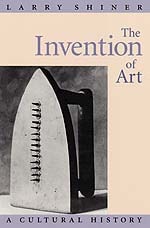
The Invention of Art
A Cultural HistoryLarry Shiner
University of Chicago Press, 2001
With The Invention of Art, Larry Shiner challenges our conventional understandings of art and asks us to reconsider its history entirely, arguing that the category of fine art is a modern invention—that the lines drawn between art and craft resulted from key social transformations in Europe during the long eighteenth century.
The Invention of World Religions
Or, How European Universalism Was Preserved in the Language of PluralismTomoko Masuzawa
University of Chicago Press, 2005
In this ambitious study, Tomoko Masuzawa examines the emergence of "world religions" in modern European thought. Devoting particular attention to the relation between the comparative study of language and the nascent science of religion, she demonstrates how new classifications of language and race caused Buddhism and Islam to gain special significance, as these religions came to be seen in opposing terms-Aryan on one hand and Semitic on the other. Masuzawa also explores the complex relation of "world religions" to Protestant theology, from the hierarchical ordering of religions typical of the Christian supremacists of the nineteenth century to the aspirations of early twentieth-century theologian Ernst Troeltsch, who embraced the pluralist logic of "world religions" and by so doing sought to reclaim the universalist destiny of European modernity.
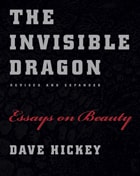
The Invisible Dragon
Essays on Beauty, Revised and ExpandedDave Hickey
University of Chicago Press, 2009
The Invisible Dragon made a lot of noise for a little book When it was originally published in 1993 it was championed by artists for its forceful call for a reconsideration of beauty—and savaged by more theoretically oriented critics who dismissed the very concept of beauty as naive, igniting a debate that has shown no sign of flagging.
With this revised and expanded edition, Hickey is back to fan the flames. More manifesto than polite discussion, more call to action than criticism, The Invisible Dragon aims squarely at the hyper-institutionalism that, in Hickey’s view, denies the real pleasures that draw us to art in the first place. Deploying the artworks of Warhol, Raphael, Caravaggio, and Mapplethorpe and the writings of Ruskin, Shakespeare, Deleuze, and Foucault, Hickey takes on museum culture, arid academicism, sclerotic politics, and more—all in the service of making readers rethink the nature of art. A new introduction provides a context for earlier essays—what Hickey calls his "intellectual temper tantrums." A new essay, "American Beauty," concludes the volume with a historical argument that is a rousing paean to the inherently democratic nature of attention to beauty.
Written with a verve that is all too rare in serious criticism, this expanded and refurbished edition of The Invisible Dragon will be sure to captivate a new generation of readers, provoking the passionate reactions that are the hallmark of great criticism.
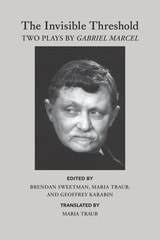
The Invisible Threshold
Two Plays by Gabriel MarcelGabriel Marcel
St. Augustine's Press, 2018
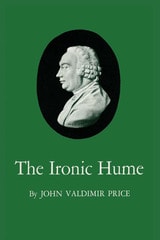
The Ironic Hume
By John Valdimir Price
University of Texas Press, 1965
Many of the seemingly bland assertions and bald statements of the eighteenth-century philosopher David Hume contain more than the mind immediately perceives. Author John Valdimir Price contends that an understanding of Hume's writings cannot be separated from an understanding of his life. By examining the works of Hume, Price shows the way in which an ironic way of seeing events and an ironic mode of expression permeated Hume's life and writings.
Price examines Hume's irony as it is exhibited in letters to his friends and in his writings concerned with morality, people, philosophy, politics, history, and above all religion. Hume's opinions on life in general are stated in works ranging from the Treatise of Human Nature and the Essays, Moral and Political, through the Enquiry concerning Human Understanding and the Enquiry concerning Principles of Morals, to the Dialogue and Four Dissertations of his maturity.
Price feels that Hume's recognition of the ironic in life came about from his perception of the disproportion between human hopes and human accomplishments. The rhetorical consequences of applying reason to a duality in human nature creates the ironic mode. Hume conceived man's opposing tendencies as his willingness to commit himself orally to a concept, a dogma, an idea, or an ideology, and his unwillingness to involve himself in the logical and rhetorical implications of articulating those principles.
Hume's use of the ironic mode in his writings provides him with a means of challenging certain dogmatic assumptions common to thought, particularly to traditional religious thought; it acts as a mask for his sceptical intentions, and it is an implied criticism of many ideas. In his political writing, Hume frequently implied that the question under argument was almost too ridiculous to deserve serious treatment. This tactic was effectively employed in the Account of Stewart, in which Hume came to the defense of a friend.
In his most profitable venture, the History of England, Hume not only used irony to advantage, but developed a new approach to the writing of history—the use of narrative. He presented history as a series of more or less connected events, not as a series of "right" or "wrong" attitudes.
The author believes that Hume's initial religious scepticism, combined with the predominant satiric-ironic mode in the literature of his time, led him to seek irony as a method of self expression. This scepticism, which permeated all of Hume's attitudes toward life, reached its most complete expression in the Dialogues concerning Natural Religion, which accepted reason as its guide, but also accepted experience as its master.
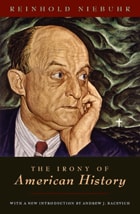
The Irony of American History
Reinhold Niebuhr
University of Chicago Press, 2008
“The supreme American theologian of the twentieth century.”—Arthur Schlesinger Jr., New York Times
“Niebuhr is important for the left today precisely because he warned about America’s tendency—including the left’s tendency—to do bad things in the name of idealism. His thought offers a much better understanding of where the Bush administration went wrong in Iraq.”—Kevin Mattson, The Good Society
“Irony provides the master key to understanding the myths and delusions that underpin American statecraft. . . . The most important book ever written on US foreign policy.”—Andrew J. Bacevich, from the Introduction
The Irreducibility of the Human Person
A Catholic SynthesisMark K. Spencer
Catholic University of America Press, 2022
The Jester and the Sages
Mark Twain in Conversation with Nietzsche, Freud, and MarxForrest G. Robinson, Gabriel Noah Brahm, Jr., and Catherine Carlstroem
University of Missouri Press, 2011
During their lifetimes, Twain, Nietzsche, Freud, and Marx witnessed massive upheavals in Western constructions of religion, morality, history, political economy, and human nature. The foundations of reality had been shaken, and one did not need to be a philosopher—nor did one even need to read philosophy—to weigh in on what this all might mean. Drawing on a wide range of primary and secondary materials, the authors show that Twain was well attuned to debates of the time. Unlike his Continental contemporaries, however, he was not as systematic in developing his views.
Brahm and Robinson’s chapter on Nietzsche and Twain reveals their subjects’ common defiance of the moral and religious truisms of their time. Both desired freedom, resented the constraints of Christian civilization, and saw punishing guilt as the disease of modern man. Pervasive moral evasion and bland conformity were the principal end result, they believed.
In addition to a continuing focus on guilt, Robinson discovers in his chapter on Freud and Twain that the two men shared a lifelong fascination with the mysteries of the human mind. From the formative influence of childhood and repression, to dreams and the unconscious, the mind could free people or keep them in perpetual chains. The realm of the unconscious was of special interest to both men as it pertained to the creation of art.
In the final chapter, Carlstroem and Robinson explain that, despite significant differences in their views of human nature, history, and progress, Twain and Marx were both profoundly disturbed by economic and social injustice in the world. Of particular concern was the gulf that industrial capitalism opened between the privileged elite property owners and the vast class of property-less workers. Moralists impatient with conventional morality, Twain and Marx wanted to free ordinary people from the illusions that enslaved them.
Twain did not know the work's of Nietzsche, Freud, and Marx well, yet many of his thoughts cross those of his philosophical contemporaries. By focusing on the deeper aspects of Twain’s intellectual makeup, Robinson, Brahm, and Carlstroem supplement the traditional appreciation of the forces that drove Twain’s creativity and the dynamics of his humor.
The Joyce of Everyday Life
Vicki Mahaffey
Bucknell University Press, 2024
Winner of the American Conference on Irish Studies’ Robert Rhodes Prize for Books on Literature
Part of James Joyce’s genius was his ability to find the poetry in everyday life. For Joyce, even a simple object like a table becomes magical, “a board that was of the birchwood of Finlandy and it was upheld by four dwarfmen of that country but they durst not move more for enchantment.” How might we learn to regain some of the childlike play with language and sense of delight in the ordinary that come so naturally to Joyce?
The Joyce of Everyday Life teaches us how to interpret seemingly mundane objects and encounters with openness and active curiosity in order to attain greater self-understanding and a fuller appreciation of others. Through a close examination of Joyce's joyous, musical prose, this book shows how language provides us with the means to revitalize daily experience and social interactions across a huge, diverse, and everchanging world.
Acclaimed Joyce scholar Vicki Mahaffey demonstrates how his writing might prompt us to engage in a different kind of reading, treating words and fiction as tools for expanding the boundaries of the self with humor and feeling. A book for everyone who loves language, The Joyce of Everyday Life is a lyrical romp through quotidian existence.
The Just
Paul Ricoeur
University of Chicago Press, 2000
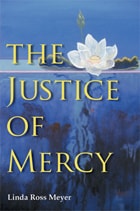
The Justice of Mercy
Linda Ross Meyer
University of Michigan Press, 2010
"The Justice of Mercy is exhilarating reading. Teeming with intelligence and insight, this study immediately establishes itself as the unequaled philosophical and legal exploration of mercy. But Linda Meyer's book reaches beyond mercy to offer reconceptualizations of justice and punishment themselves. Meyer's ambition is to rethink the failed retributivist paradigm of criminal justice and to replace it with an ideal of merciful punishment grounded in a Heideggerian insight into the gift of being-with-others. The readings of criminal law, Heideggerian and Levinasian philosophy, and literature are powerful and provocative. The Justice of Mercy is a radical and rigorous exploration of both punishment and mercy as profoundly human activities."
---Roger Berkowitz, Director of the Hannah Arendt Center for Ethical and Political Thinking, Bard College
"This book addresses a question both ancient and urgently timely: how to reconcile the law's call to justice with the heart's call to mercy? Linda Ross Meyer's answer is both philosophical and pragmatic, taking us from the conceptual roots of the supposed conflict between justice and mercy to concrete examples in both fiction and contemporary criminal law. Energetic, eloquent, and moving, this book's defense of mercy will resonate with philosophers, legal scholars, lawyers, and policymakers engaged with criminal justice, and anyone concerned about our current harshly punitive legal system."
---Carol Steiker, Harvard Law School
"Far from being a utopian, soft and ineffectual concept, Meyer shows that mercy already operates within the law in ways that we usually do not recognize. . . . Meyer's piercing insights and careful analysis bring the reader to think of law, justice, and mercy itself in a new and far more profound light."
---James Martel, San Francisco State University
How can granting mercy be just if it gives a criminal less punishment than he "deserves" and treats his case differently from others like it? This ancient question has become central to debates over truth and reconciliation commissions, alternative dispute resolution, and other new forms of restorative justice. The traditional response has been to marginalize mercy and to cast doubt on its ability to coexist with forms of legal justice.
Flipping the relationship between justice and mercy, Linda Ross Meyer argues that our rule-bound and harsh system of punishment is deeply flawed and that mercy should be, not the crazy woman in the attic of the law, but the lady of the house. This book articulates a theory of punishment with mercy and illustrates the implications of that theory with legal examples drawn from criminal law doctrine, pardons, mercy in military justice, and fictional narratives of punishment and mercy.
Linda Ross Meyer is Carmen Tortora Professor of Law at Quinnipiac University School of Law; President of the Association for the Study of Law, Culture and the Humanities; and Associate Editor of Journal of Law, Culture and the Humanities.
The Key to Natural Philosophy
Barbara Honorius Augustodunensis
Catholic University of America Press, 2026
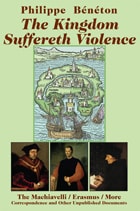
The Kingdom Suffereth Violence
The Machiavelli / Erasmus / More Correspondence and Other Unpublished DocumentsPhilippe Bénéton
St. Augustine's Press, 2012
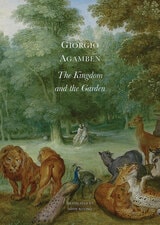
The Kingdom and the Garden
Giorgio Agamben
Seagull Books, 2020
What happened to paradise after Adam and Eve were expelled? The question may sound like a theological quibble, or even a joke, but in The Kingdom and the Garden, Giorgio Agamben uses it as a starting point for an investigation of human nature and the prospects for political transformation. In a tour-de-force reinterpretation of the Christian tradition, Agamben shows that the Garden of Eden has always served as a symbol of humanity’s true nature. Where earlier theologians viewed the expulsion as temporary, Augustine’s doctrine of original sin makes it permanent, reimagining humanity as the paradoxical creature that has been completely alienated from its own nature. From this perspective, there can be no return to paradise, only the hope for the messianic kingdom. Yet there have always been thinkers who rebelled against this idea, and Agamben highlights two major examples. The first is the early medieval philosopher John Scotus Eriugena, who argued for a radical unity of humanity with all living things. The second is Dante, whose vision of the earthly paradise points towards the possibility of genuine human happiness in this world. In place of the messianic kingdom, which has provided the model for modern revolutionary movements, Agamben contends that we should place our hopes for political change in a return to our origins, by reclaiming the earthly paradise.
The Knowable and the Unknowable
Modern Science, Nonclassical Thought, and the "Two Cultures"Arkady Plotnitsky
University of Michigan Press, 2002
Plotnitsky highlights those points at which the known gives way to the unknown (and unknowable). These points are significant, he argues, because they push the boundaries of thought and challenge the boundaries of disciplinarity. One of the book's most interesting observations is that key figures in science, in order to push toward a framing of the unknown, actually retreated into a conservative disciplinarity. Plotnitsky's informed, interdisciplinary approach is more productive than the disparaging attacks on postmodernism or scientism that have hitherto characterized this discourse.
Arkady Plotnitsky is Professor of English and Director, Theory and Cultural Studies Program, Purdue University. Trained in both mathematics and literary theory, he is author of several books, including In the Shadow of Hegel: Complementarity, History and the Unconscious and Reconfigurations: Critical Theory and General Economy.
The Labour of Spirit
Massimo Cacciari
Seagull Books, 2025
Between 1917 and 1919, Max Weber delivered two lectures titled Die geistige Arbeit als Beruf, which we might translate as The Labour of Spirit as Vocation. This weighty formula represented the hope that animated the world of bourgeois culture from the likes of Kant, Goethe, Schiller, Fichte, and Hegel and would later form the earliest threads of revolutionary thought from Feuerbach and Marx. The “labor of spirit” is creative, autonomous labor—human labor understood in its fully effectual power. To press for its realization is to liberate all activity from the condition of commanded or alienated work. But the dissolution of the labor of spirit into the capitalist form of production, into the universal machinism that swallows up that science which remains the true engine of development, also ends up delegitimating political authority, whose own foundation lies in the “promise of liberation.”
Massimo Cacciari takes up old questions and confronts them anew: Is the “iron cage” fated to imprison that “labor of spirit” that is political praxis? Will the spirit of capitalism end up completely undermining the space of the political? Or are relations between science and politics still thinkable that might free us from our “debt” as we proceed without means or ends within the techno-economic system?

The Land Is Our Community
Aldo Leopold’s Environmental Ethic for the New MillenniumRoberta L. Millstein
University of Chicago Press, 2024
Informed by his experiences as a hunter, forester, wildlife manager, ecologist, conservationist, and professor, Aldo Leopold developed a view he called the land ethic. In a classic essay, published posthumously in A Sand County Almanac, Leopold advocated for an expansion of our ethical obligations beyond the purely human to include what he variously termed the “land community” or the “biotic community”—communities of interdependent humans, nonhuman animals, plants, soils, and waters, understood collectively. This philosophy has been extremely influential in environmental ethics as well as conservation biology and related fields.
Using an approach grounded in environmental ethics and the history and philosophy of science, Roberta L. Millstein reexamines Leopold’s land ethic in light of contemporary ecology. Despite the enormous influence of the land ethic, it has sometimes been dismissed as either empirically out of date or ethically flawed. Millstein argues that these dismissals are based on problematic readings of Leopold’s ideas. In this book, she provides new interpretations of the central concepts underlying the land ethic: interdependence, land community, and land health. She also offers a fresh take on of his argument for extending our ethics to include land communities as well as Leopold-inspired guidelines for how the land ethic can steer conservation and restoration policy.
The Language Parallax
Linguistic Relativism and Poetic IndeterminacyBy Paul Friedrich
University of Texas Press, 1986
Humankind has always been fascinated and troubled by the way languages and dialects differ. Linguistically based differences in point of view have preoccupied many original minds of the past, such as Kant, and remain at the forefront of language study: in philosophy, anthropology, literary criticism, and other fields.
Paul Friedrich's The Language Parallax argues persuasively that the "locus and focus" of differences among languages lies not so much in practical or rational aspects as in the complexity and richness of more poetic dimensions—in the nuances of words, or the style and voice of an author. This poetic reformulation of what has been called "linguistic relativism" is grounded in the author's theory of the imagination as a main source of poetic indeterminacy. The reformulation is also based on the intimate relation of the concentrated language of poetry to the potential or possibilities for poetry in ordinary conversation, dreams, and other experiences. The author presents challenging thoughts on the order and system of language in their dynamic relation to indeterminacy and, ultimately, disorder and chaos.
Drawing on his considerable fieldwork in anthropology and linguistics, Friedrich interweaves distinct and provocative elements: the poetry of language difference, the indeterminacy in dialects and poetic forms, the discovery of underlying orders, the workings of different languages, the strength of his own poetry. The result is an innovative and organic whole.
The Language Parallax, then, is a highly original work with a single bold thesis. It draws on research and writing that has involved, in particular, English, Russian, and the Tarascan language of Mexico, as well as the personal and literary study of the respective cultures. Anthropologist, linguist, and poet, Friedrich synthesizes from his experience in order to interrelate language variation and structure, the creative individual, ideas of system-in-process, and questions of scientific and aesthetic truth. The result is a new view of language held to the light of its potentially creative nature.
The Language of Love
An Interpretation of Plato's PhaedrusStanley Rosen
St. Augustine's Press, 2016
Here Rosen’s argue for the possibility of philosophy or the retrieval of human self-knowledge on the basis of a renewed argument for the partial intelligibility of ordinary experience or, in other words, for the Platonic Ideas. His book on the Symposium was an important contribution to the subsequent sea change in Plato scholarship that returned attention to the dialogue form and to the poetic side of philosophy even in its quarrel with philosophy. That change allowed us search for understanding in the light of the whole, a whole which is otherwise, as Rosen has shown elsewhere, fragmented by the scientism of analytical philosophy or the historicism of “Continental” philosophy.
The Language of Love represents a missing key to Stanley Rosen’s work and, much more significantly, to the rediscovery of philosophy in our time. The title of the book is not merely a play on words. It points to the incommensurability between the constructed or historical nature of language or culture and the pre-discursive apprehension of things that is necessary if speech is to make sense and be understood, as opposed to being mere nonsense.
Among many valuable insights along the way, Rosen unites the dialogue in two parts, treating both eros and rhetoric, showing the linkage between eros and writing, as between myth and analysis. He connects the comic attempt to subject eros to diaeresis in the Phaedrus with the attempt to understand non-being as an eidos in the Sophist. In both cases, the inadequacy of a technical understanding of philosophy returns us to the pre-technical world of ordinary experience.
Rosen’s interpretation is an expression of the Socratic claim that we can’t speak beautifully without knowing the truth and that whatever truth we speak or write is a reflection of the silent invisibility of beauty as the unity of form. However, “Like every good teacher, it does not simply state that link for us to memorize. Instead, we must recollect it.”
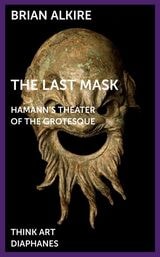
The Last Mask
Hamann's Theater of the GrotesqueBrian Alkire
Diaphanes, 2021
The Last Mask focuses on Hamann’s final work, Entkleidung und Verklärung (1786), which was consciously conceived of as an “Abschluss” of his “kleine Autorschaft” and a final defense against his critics. Equally philological and theoretical, it identifies a number of previously unnoticed manuscript alterations that help answer some long-standing questions in Hamann scholarship as well as open new doors for inquiry.
Importantly, the manuscripts show that Hamann is one of the earliest theorists of the virtual in our sense of the word today, using the word “virtualiter” to describe his own theory. He links this theory with the concept of the mask or disguise, and conceives of texts as fabrics or textiles composed of threads and strings. The philological focus is on Hamann’s understanding of intertextuality, and on the basis of his dominant string images his notion of virtuality is brought into conversation with Deleuze’s idea of a plane of immanence through the image of a skein of immanence, a knotted bundle of thread which solidifies into a three-dimensional virtual space—a new perspective in contemporary discussions surrounding the nature of virtuality.

The Last Walk
Reflections on Our Pets at the End of Their LivesJessica Pierce
University of Chicago Press, 2012
The product of a lifetime of loving pets, studying philosophy, and collaborating with scientists at the forefront of the study of animal behavior and cognition, The Last Walk asks—and answers—the toughest questions pet owners face. The result is informative, moving, and consoling in equal parts; no pet lover should miss it.
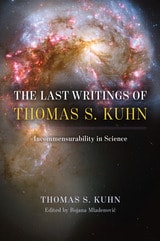
The Last Writings of Thomas S. Kuhn
Incommensurability in ScienceThomas S. Kuhn
University of Chicago Press, 2022
This book contains the text of Thomas S. Kuhn’s unfinished book, The Plurality of Worlds: An Evolutionary Theory of Scientific Development, which Kuhn himself described as a return to the central claims of The Structure of Scientific Revolutions and the problems that it raised but did not resolve. The Plurality of Worlds is preceded by two related texts that Kuhn publicly delivered but never published in English: his paper “Scientific Knowledge as Historical Product” and his Shearman Memorial Lectures, “The Presence of Past Science.” An introduction by the editor describes the origins and structure of The Plurality of Worlds and sheds light on its central philosophical problems.
Kuhn’s aims in his last writings are bold. He sets out to develop an empirically grounded theory of meaning that would allow him to make sense of both the possibility of historical understanding and the inevitability of incommensurability between past and present science. In his view, incommensurability is fully compatible with a robust notion of the real world that science investigates, the rationality of scientific change, and the idea that scientific development is progressive.
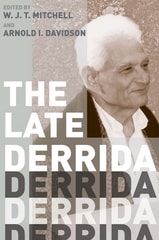
The Late Derrida
Edited by W. J. T. Mitchell and Arnold I. Davidson
University of Chicago Press, 2007
The rubric “The Late Derrida,” with all puns and ambiguities cheerfully intended, points to the late work of Jacques Derrida, the vast outpouring of new writing by and about him in the period roughly from 1994 to 2004. In this period Derrida published more than he had produced during his entire career up to that point. At the same time, this volume deconstructs the whole question of lateness and the usefulness of periodization. It calls into question the “fact” of his turn to politics, law, and ethics and highlights continuities throughout his oeuvre.
The scholars included here write of their understandings of Derrida’s newest work and how it impacts their earlier understandings of such classic texts as Glas and Of Grammatology. Some have been closely associated with Derrida since the beginning—both in France and in the United States—but none are Derrideans. That is, this volume is a work of critique and a deep and continued engagement with the thought of one of the most significant philosophers of our time. It represents a recognition that Derrida’s work has yet to be addressed—and perhaps can never be addressed—in its totality.
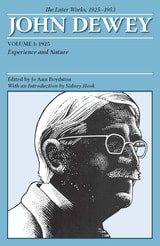
The Later Works of John Dewey, Volume 1, 1925 - 1953
1925, Experience and NatureJohn Dewey. Edited by Jo Ann Boydston
Southern Illinois University Press, 2008
John Dewey’s Experience and Nature has been considered the fullest expression of his mature philosophy since its eagerly awaited publication in 1925.Irwin Edman wrote at that time that “with monumental care, detail and completeness, Professor Dewey has in this volume revealed the metaphysical heart that beats its unvarying alert tempo through all his writings, whatever their explicit themes.” In his introduction to this volume, Sidney Hook points out that “Dewey’s Experience and Nature is both the most suggestive and most difficult of his writings.”
The meticulously edited text published here as the first volume in the series The Later Works of John Dewey, 1925–1953spans that entire period in Dewey’s thought by including two important and previously unpublished documents from the book’s history: Dewey’s unfinished new introduction written between 1947and 1949,edited by the late Joseph Ratner, and Dewey’s unedited final draft of that introduction written the year before his death. In the intervening years Dewey realized the impossibility of making his use of the word “experience” understood. He wrote in his 1951draft for a new introduction: “Were I to write (or rewrite) Experience and Nature today I would entitle the book Culture and Nature and the treatment of specific subject-matters would be correspondingly modified. I would abandon the term ‘experience’ because of my growing realization that the historical obstacles which prevented understanding of my use of ‘experience’ are, for all practical purposes, insurmountable. I would substitute the term ‘culture’ because with its meanings as now firmly established it can fully and freely carry my philosophy of experience.”
The Later Works of John Dewey, Volume 10, 1925 - 1953
1934, Art as ExperienceJohn Dewey. Edited by Jo Ann Boydston
Southern Illinois University Press, 2008
Art as Experience evolved from John Dewey’s Willam James Lectures, delivered at Harvard University from February to May 1931.
In his Introduction, Abraham Kaplan places Dewey’s philosophy of art within the context of his pragmatism. Kaplan demonstrates in Dewey’s esthetic theory his traditional “movement from a dualism to a monism” and discusses whether Dewey’s viewpoint is that of the artist, the respondent, or the critic.
The Later Works of John Dewey, Volume 11, 1925 - 1953
Essays, Reviews, Trotsky Inquiry, Miscellany, and Liberalism and Social ActionJohn Dewey. Edited by Jo Ann Boydston
Southern Illinois University Press, 2008
This volume includes ninety-two items from 1935, 1936, and 1937, including Dewey’s 1935 Page-Barbour Lectures at the University of Virginia, published as Liberalism and Social Action.
In essay after essay Dewey analyzed, criticized, and reevaluated liberalism. When his controversial Liberalism and Social Action appeared, asking whether it was still possible to be a liberal, Horace M. Kallen wrote that Dewey “restates in the language and under the conditions of his times what Jefferson’s Declaration of Independence affirmed in the language and under the conditions of his.”
The diverse nature of the writings belies their underlying unity: some are technical philosophy; other philosophical articles shade into social and political themes; social and political issues permeate the educational articles, which in turn involve Dewey’s philosophical ideas.
The Later Works of John Dewey, Volume 12, 1925 - 1953
1938, Logic: The Theory of InquiryJohn Dewey. Edited by Jo Ann Boydston
Southern Illinois University Press, 2008
Heralded as “the crowning work of a great career,” Logic: The Theory of Inquiry was widely reviewed. To Evander Bradley McGilvary, the work assured Dewey “a place among the world’s great logicians.”
William Gruen thought “No treatise on logic ever written has had as direct and vital an impact on social life as Dewey’s will have.”
Paul Weiss called it “the source and inspiration of a new and powerful movement.”
Irwin Edman said of it, “Most philosophers write postscripts; Dewey has made a program. His Logic is a new charter for liberal intelligence.”
Ernest Nagel called the Logic an impressive work. Its unique virtue is to bring fresh illumination to its subject by stressing the roles logical principles and concepts have in achieving the objectives of scientific inquiry.”
The Later Works of John Dewey, Volume 13, 1925 - 1953
1938-1939, Experience and Education, Freedom and Culture, Theory of Valuation, and EssaysJohn Dewey. Edited by Jo Ann Boydston
Southern Illinois University Press, 2008
This volume includes all Dewey’s writings for 1938 except for Logic: The Theory of Inquiry (Volume 12 of The Later Works), as well as his 1939 Freedom and Culture, Theory of Valuation, and two items from Intelligence in the Modern World.
Freedom and Culture presents, as Steven M. Cahn points out, “the essence of his philosophical position: a commitment to a free society, critical intelligence, and the education required for their advance.”
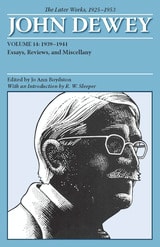
The Later Works of John Dewey, Volume 14, 1925 - 1953
1939 - 1941, Essays, Reviews, and MiscellanyJohn Dewey. Edited by Jo Ann Boydston
Southern Illinois University Press, 2008
This volume republishes forty-four essays, reviews, and miscellaneous pieces from 1939, 1940, and 1941.
In his Introduction, R. W. Sleeper characterizes the contents of this volume as “vintage Dewey. Ranging widely over problems of theory and practice, they reveal him commencing his ninth decade at the peak of his intellectual powers.”
“Nature in Experience,” Dewey’s reply to Morris R. Cohen and William Ernest Hocking, “is a model of clarity and responsiveness,” writes Sleeper, “perhaps his clearest statement of why it is that metaphysics does not play the fundamental role for him that it had regularly played for his predecessors.”
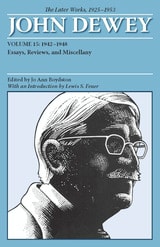
The Later Works of John Dewey, Volume 15, 1925 - 1953
1942 - 1948, Essays, Reviews, and MiscellanyJohn Dewey. Edited by Jo Ann Boydston
Southern Illinois University Press, 2008
This volume republishes sixty-two of Dewey’s writings from the years 1942 to 1948; four other items are published here for the first time.
A focal point of this volume is Dewey’s introduction to his collective volume Problems of Men. Exchanges in the Journal of Philosophy with Donald C. Mackay, Philip Blair Rice, and with Alexander Meiklejohn in Fortune appear here, along with Dewey’s letters to editors of various publications and his forewords to colleagues’ books. Because 1942 was the centenary of the birth of William James, four articles about James are also included in this volume.
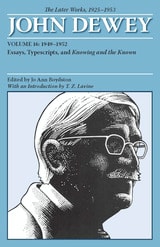
The Later Works of John Dewey, Volume 16, 1925 - 1953
1949 - 1952, Essays, Typescripts, and Knowing and the KnownJohn Dewey. Edited by Jo Ann Boydston
Southern Illinois University Press, 2008
Typescripts, essays, and an authoritative edition of Knowing and the Known, Dewey’s collaborative work with Arthur F. Bentley.
In an illuminating Introduction T. Z. Lavine defines the collaboration's three goals—the "construction of a new language for behavioral inquiry," "a critique of formal logicians, in defense of Dewey’s Logic," and "a critique of logical positivism." In Dewey’s words: "Largely due to Bentley, I’ve finally got the nerve inside of me to do what I should have done years ago."
"What Is It to Be a Linguistic Sign or Name?" and "Values, Valuations, and Social Facts,’ both written in 1945, are published here for the first time.
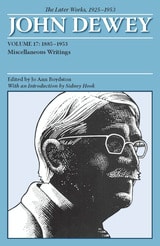
The Later Works of John Dewey, Volume 17, 1925 - 1953
1885 - 1953, Miscellaneous WritingsJohn Dewey. Edited by Jo Ann Boydston
Southern Illinois University Press, 2008
This is the final textual volume in The Collected Works of John Dewey, 1882–1953, published in 3 series comprising 37 volumes: The Early Works, 1882–1898 (5 vols.); The Middle Works, 1899–1924 (15 vols.); The Later Works, 1925–1953 (17 vols.).
Volume 17 contains Dewey’s writings discovered after publication of the appropriate volume of The Collected Works and spans most of Dewey’s publishing life. There are 83 items in this volume, 24 of which have not been previously published.
Among works highlighted in this volume are 10 “Educational Lectures before Brigham Young Academy,” early essays “War’s Social Results” and “The Problem of Secondary Education after the War,” and the previously unpublished “The Russian School System.”
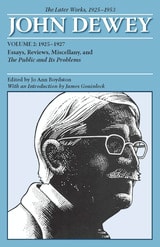
The Later Works of John Dewey, Volume 2, 1925 - 1953
1925-1927, Essays, Reviews, Miscellany, and The Public and Its ProblemsJohn Dewey. Edited by Jo Ann Boydston
Southern Illinois University Press, 2008
With the exception of Experience and Nature, (Volume 1 of the Later Works), this volume contains all of Dewey’s writings for 1925 and 1926, as well as his 1927 book, The Public and Its Problems. A Modern Language Association’s Committee on Scholarly Editions textual edition.
The first essay in this volume, “The Development of American Pragmatism,” is perhaps Dewey’s best-known article of these years, emphasizing the uniquely American origins of his own philosophical innovations. Other essays focus on Dewey’s continuing investigation of the “nature of intelligent conduct,” as, for example, his debate with David Wight Prall on the underpinnings of value, his study of sense-perception, and his support for outlawing of war. Also appearing here are Dewey’s final articles on the culture of the developing world, written for the New Republic after his travels to China, Turkey, and Mexico.
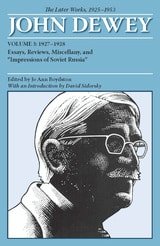
The Later Works of John Dewey, Volume 3, 1925 - 1953
1927-1928, Essays, Reviews, Miscellany, and "Impressions of Soviet Russia"John Dewey. Edited by Jo Ann Boydston
Southern Illinois University Press, 2008
All of Dewey’s writings for 1927 and 1928 with the exception of The Public and Its Problems, which appears in Volume 2, A Modern Language Association’s Committee on Scholarly Editions textual edition.
These essays are, as Sidorsky says in his Introduction, “framed, in great measure, by those two poles of his philosophical interest: looking backward, in a sense, to the defense of naturalistic metaphysics and moving forward to the justification and to the implications for practice of an empirical theory.”
Dewey’s five essays on education are evidence of his continued interest in that field. Among them is the frequently quoted “Why I Am a Member of the Teachers Union,” which is still used by the American Federation of Teachers in its recruiting efforts. Other highlights of this volume include the famous exchange between George Santayana and Dewey on Experience and Nature; an impassioned condemnation of the miscarriage of justice Dewey saw in the Sacco-Vanzetti trial; and a series of six articles on the Soviet Union based on Dewey’s trip to that country in 1928.