Results by title
4127 books match the query 'Science' and 980 start with t

The Humble Approach, Anniversary Edition
Scientists Discover GodJohn Marks Templeton
Templeton Press, 2027
For generations the discoveries of science tended to challenge the very existence of God. Templeton makes a striking argument for just the opposite point of view. He goes to the writings of many of the world's leading scientific thinkers—as diverse in background as Albert Einstein and Teilhard de Chardin—and discovers them in awe of the universe, perceiving the hand of Divine mystery at work.
The Humble Approach teaches that man can discover and comprehend only a few of the infinite aspects of God's nature, never enough to form a comprehensive theology. The humble approach may be a science still in its infancy, but it seeks to develop a way of knowing God appropriate to His greatness and our littleness.
The anniversary edition of this groundbreaking book features a new preface by His Holiness the Dalai Lama and a new introduction from Heather Dill, the director of the Templeton Prize. It also includes an updated list of the past winners of the Templeton Prize.
The Hunterian Lectures in Comparative Anatomy, May and June 1837
Richard Owen
University of Chicago Press, 1992
Now, for the first time, modern readers may consult the single sustained exposition of his views that Owen ever provided: his Hunterian Lectures. Phillip Reid Sloan has transcribed and edited the seven surviving lectures and has written an introduction and commentary that situate this work in the context of Owen's life and the scientific life of the time. The lectures survey some of the history of comparative anatomy since Aristotle and draw on work by some of Owen's contemporaries. Their chief value, however, lies in Owen's elucidation of his own view on the relationships among various groups of living things.
"Owen is one of the linchpin figures of Victorian science. The publication of these lectures is important, and Sloan is to be commended for a fine transcription."—Adrian Desmond, University College, London
The Huron River
Voices from the WatershedJohn Knott and Keith Taylor, Editors
University of Michigan Press, 2000
"The Huron River . . . was called 'Cos-scut-e-nong Sebee'. . . . [It] is a beautiful, transparent stream, passing alternatively through rich bottoms, openings, plains, and sloping woodlands, covered with heavy timber."
---History of Washtenaw County, Michigan, 1881
The Huron River---stretching 130 miles through three counties---has inspired numerous writers throughout the nineteenth and twentieth centuries. Contained here is a collection of new poems, essays, and stories, accompanied by maps, photographs, and illustrations that celebrate the Huron River. Over twenty locally and nationally known literary figures, including Alice Fulton and Charles Baxter, have contributed to this volume. In addition, the work of biologists, naturalists, and even an arche-ologist have been included to give a richer sense of the physical and cultural environment.
Each of these writers reminds us that our lives are more intertwined with the river and its watershed than we might think. The Huron River opens with these words: "Watersheds are the oldest and most durable markers of place. . . . These boundaries affect our lives by defining our natural environment, not only its topography but its soils, its plant and animal life, and to some extent its weather. The water that sustains most of us is the water that flows through our local watershed."
And the river's strength is wondrous unto itself. "The water will always be there, and it will always find its way down," writer Gary Snyder tells us. The river is sometimes visible, sometimes not; yet it "is alive and well under the city streets, running in giant culverts."
John Knott is Professor of English, University of Michigan. After working as a bookseller for twenty years, Keith Taylor now teaches writing part-time for the University of Michigan and works as a freelance writer.
The Huxleys
An Intimate History of EvolutionAlison Bashford
University of Chicago Press, 2022
Two hundred years of modern science and culture told through one family history.
This momentous biography tells the story of the Huxleys: the Victorian natural historian T. H. Huxley (“Darwin’s Bulldog”) and his grandson, the scientist, conservationist, and zoologist Julian Huxley. Between them, they communicated to the world the great modern story of the theory of evolution by natural selection. In The Huxleys, celebrated historian Alison Bashford writes seamlessly about these omnivorous intellects together, almost as if they were a single man whose long, vital life bookended the colossal shifts in world history from the age of sail to the Space Age, and from colonial wars to world wars to the cold war.
The Huxleys’ specialty was evolution in all its forms—at the grandest level of species, deep time, the Earth, and at the most personal and intimate. They illuminated the problems and wonders of the modern world and they fundamentally shaped how we see ourselves, as individuals and as a species.
But perhaps their greatest subject was themselves. Bashford’s engaging, brilliantly ambitious book interweaves the Huxleys’ momentous public achievements with their private triumphs and tragedies. The result is the history of a family, but also a history of humanity grappling with its place in nature. This book shows how much we owe—for better or worse—to the unceasing curiosity, self-absorption, and enthusiasm of a small, strange group of men and women.
The Icon Curtain
The Cold War's Quiet BorderYuliya Komska
University of Chicago Press, 2015
Yuliya Komska transports readers to the western edge of the Bohemian Forest, one of Europe’s oldest borderlands, where in the 1950s civilians set out to shape the so-called prayer wall. A chain of new and repurposed pilgrimage sites, lookout towers, and monuments, the prayer wall placed two long-standing German obsessions, forest and border, at the heart of the century’s most protracted conflict. Komska illustrates how civilians used the prayer wall to engage with and contribute to the new political and religious landscape. In the process, she relates West Germany’s quiet sylvan periphery to the tragic pitch prevalent along the Iron Curtain’s better-known segments.
Steeped in archival research and rooted in nuanced interpretations of wide-ranging cultural artifacts, from vandalized religious images and tourist snapshots to poems and travelogues, The Icon Curtain pushes disciplinary boundaries and opens new perspectives on the study of borders and the Cold War alike.
The Idea of the Sciences in the French Enlightenment
A ReinterpretationG. Matthew Adkins
University of Delaware Press, 2014
Published by University of Delaware Press. Distributed worldwide by Rutgers University Press.
The Impact of Global Warming on Texas
Second editionEdited by Jurgen Schmandt, Gerald R. North, and Judith Clarkson
University of Texas Press, 2011
When The Impact of Global Warming on Texas was first published in 1995, it discussed climate change as a likely future phenomenon, predicted by scientific studies. This entirely rewritten second edition presents evidence that early climate change impacts can now be observed and identifies the threats climate change will pose to Texas through the year 2050. It also offers the hopeful message that corrective action, if taken now, can avert unmanageable consequences.
The book begins with a discussion of climate science and modeling and the information that can be derived from these sources for Texas. The authors follow this with an analysis of actual climate trends in the various Texas climate regions, including a predicted rise in temperatures of 5.4 degrees F (plus or minus 1.8 F) by the end of the century. This could lead to less rainfall and higher evaporation, especially in regions that are already dry. Other important effects include possible changes in El Niño (climate variability) patterns and hurricane behaviors. Taking into account projected population growth, subsequent chapters explore likely trends with respect to water availability, coastal impacts, and biodiversity.
The authors then look at the issues from a policy perspective, focusing on Texas's importance to the national economy as an energy producer, particularly of oil and gas. They recommend that Texas develop its own climate change policy to serve the goals of reducing greenhouse gas emissions, increasing energy independence, ensuring regional security, and improving management of water, air, land, and wildlife.
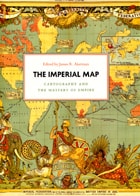
The Imperial Map
Cartography and the Mastery of EmpireEdited by James R. Akerman
University of Chicago Press, 2009
Critically reflecting on elements of mapping and imperialism from the late seventeenth century to the early twentieth century, the essays discuss the nature of the imperial map through a series of case studies of empires, from the Qing dynasty of China, to the Portuguese empire in South America, to American imperial pretensions in the Pacific Ocean, among others. Collectively, the essays reveal that the relationship between mapping and imperialism, as well as the practice of political and economic domination of weak polities by stronger ones, is a rich and complex historical theme that continues to resonate in our modern day.
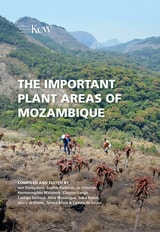
The Important Plant Areas of Mozambique
Edited by Iain Darbyshire, Sophie Richards, and Jo Osborne
Royal Botanic Gardens, Kew, 2023
The Important Plant Areas of Mozambique is based on the Mozambique TIPAs project run in collaboration between Royal Botanic Gardens, Kew, Mozambique’s Agricultural Research Institute (Instituto de Investigação Agrária de Moçambique – IIAM), and the University Eduardo Mondlane. Drawing on information from the TIPAs database, The Important Plant Areas of Mozambique includes color maps and photographs, site descriptions, and tables to present information on the botanical significance, habitat, and geology of the region. The book will also address conservation issues and ecosystem services to promote Mozambique’s critical plant sites and inform conservation leaders in government, NGOs, universities, and local communities about Mozambique’s threatened habitats.
The Individual and the Cosmos in Renaissance Philosophy
Ernst Cassirer
University of Chicago Press, 2010
This provocative volume, one of the most important interpretive works on the philosophical thought of the Renaissance, has long been regarded as a classic in its field. Ernst Cassirer here examines the changes brewing in the early stages of the Renaissance, tracing the interdependence of philosophy, language, art, and science; the newfound recognition of individual consciousness; and the great thinkers of the period—from da Vinci and Galileo to Pico della Mirandola and Giordano Bruno. The Individual and the Cosmos in Renaissance Philosophy discusses the importance of fifteenth-century philosopher Nicholas Cusanus, the concepts of freedom and necessity, and the subject-object problem in Renaissance thought.
“This fluent translation of a scholarly and penetrating original leaves little impression of an attempt to show that a ‘spirit of the age’ or ‘spiritual essence of the time’ unifies and expresses itself in all aspects of society or culture.”—Philosophy
The Infanticide Controversy
Primatology and the Art of Field ScienceAmanda Rees
University of Chicago Press, 2009
Infanticide in the natural world might be a relatively rare event, but as Amanda Rees shows, it has enormously significant consequences. Identified in the 1960s as a phenomenon worthy of investigation, infanticide had, by the 1970s, become the focus of serious controversy. The suggestion, by Sarah Hrdy, that it might be the outcome of an evolved strategy intended to maximize an individual’s reproductive success sparked furious disputes between scientists, disagreements that have continued down to the present day.
Meticulously tracing the history of the infanticide debates, and drawing on extensive interviews with field scientists, Rees investigates key theoretical and methodological themes that have characterized field studies of apes and monkeys in the twentieth century. As a detailed study of the scientific method and its application to field research, The Infanticide Controversy sheds new light on our understanding of scientific practice, focusing in particular on the challenges of working in “natural” environments, the relationship between objectivity and interpretation in an observational science, and the impact of the public profile of primatology on the development of primatological research. Most importantly, it also considers the wider significance that the study of field science has in a period when the ecological results of uncontrolled human interventions in natural systems are becoming ever more evident.
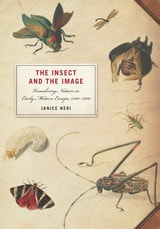
The Insect and the Image
Visualizing Nature in Early Modern Europe, 1500-1700Janice Neri
University of Minnesota Press, 2011
Once considered marginal members of the animal world (at best) or vile and offensive creatures (at worst), insects saw a remarkable uptick in their status during the early Renaissance. This quickened interest was primarily manifested in visual images—in illuminated manuscripts, still life paintings, the decorative arts, embroidery, textile design, and cabinets of curiosity. In The Insect and the Image, Janice Neri explores the ways in which such imagery defined the insect as a proper subject of study for Europeans of the early modern period.
It was not until the sixteenth century that insects began to appear as the sole focus of paintings and drawings—as isolated objects, or specimens, against a blank background. The artists and other image makers Neri discusses deployed this “specimen logic” and so associated themselves with a mode of picturing in which the ability to create a highly detailed image was a sign of artistic talent and a keenly observant eye. The Insect and the Image shows how specimen logic both reflected and advanced a particular understanding of the natural world—an understanding that, in turn, supported the commodification of nature that was central to global trade and commerce during the early modern era.
Revealing how sixteenth- and seventeenth-century artists and image makers shaped ideas of the natural world, Neri’s work enhances our knowledge of the convergence of art, science, and commerce today.
The Intelligibility of Nature
How Science Makes Sense of the WorldPeter Dear
University of Chicago Press, 2006
In The Intelligibility of Nature, Peter Dear considers how science as such has evolved and how it has marshaled itself to make sense of the world. His intellectual journey begins with a crucial observation: that the enterprise of science is, and has been, directed toward two distinct but frequently conflated ends—doing and knowing. The ancient Greeks developed this distinction of value between craft on the one hand and understanding on the other, and according to Dear, that distinction has survived to shape attitudes toward science ever since.
Teasing out this tension between doing and knowing during key episodes in the history of science—mechanical philosophy and Newtonian gravitation, elective affinities and the chemical revolution, enlightened natural history and taxonomy, evolutionary biology, the dynamical theory of electromagnetism, and quantum theory—Dear reveals how the two principles became formalized into a single enterprise, science, that would be carried out by a new kind of person, the scientist.
Finely nuanced and elegantly conceived, The Intelligibility of Nature will be essential reading for aficionados and historians of science alike.
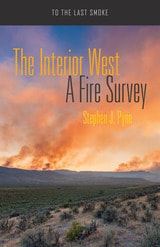
The Interior West
A Fire SurveyStephen J. Pyne
University of Arizona Press, 2018
In this collection of essays, fire historian Stephen J. Pyne explains the relevance of the Interior West to the national fire scene. This region offered the first scientific inquiry into landscape fire in the United States, including a map of Utah burns published in 1878 as part of John Wesley Powell’s Arid Lands report. Then its significance faded, and for most of the 20th century, the Interior West was the hole in the national donut of fire management. Recently the region has returned to prominence due to fires along its front ranges; invasive species, both exotics like cheatgrass and unleashed natives like mountain pine beetle; and fatality fires, notably at South Canyon in 1994.
The Interior West has long been passed over in national fire narratives. Here it reclaims its rightful place.
Included in this volume:
- A summary of 19th- and 20th-century fire history in the Interior West
- How this important region inspired U.S. studies of landscape fire
- Why the region disappeared from national fire management discussions
- How the expansion of invasive species and loss of native species has affected the region’s fire ecology
- The national significance of fire in the Interior West
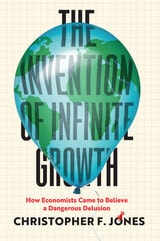
The Invention of Infinite Growth
How Economists Came to Believe a Dangerous DelusionChristopher F. Jones
University of Chicago Press, 2025
Most economists believe that growth is the surest path to better lives. This has proven to be one of humanity’s most powerful and dangerous ideas. It shapes policy across the globe, but it fatally undermines the natural ecosystems necessary to sustain human life. How did we get here? In The Invention of Infinite Growth, environmental historian Christopher F. Jones takes us through two hundred and fifty years of economic thinking to examine the ideal of growth, its powerful influence, and the crippling burdens many decisions made in its name have placed on us all. Jones argues that the pursuit of growth has never reflected its costs, because economists downplay environmental degradation. What’s worse, skyrocketing inequality and diminishing improvements in most people’s well-being mean growth too often delivers too little for too many. Jones urges economists to engage more broadly with other ways of thinking, as well as with citizens and governments to recognize and slow infinite growth’s impact on the real world.
Both accessible and eye-opening, The Invention of Infinite Growth offers hope for the future. Humans have not always believed that economic growth could or should continue, and so it is possible for us to change course. We can still create new ideas about how to promote environmental sustainability, human welfare, and even responsible growth, without killing the planet and ourselves.
The Journal of Geology, volume 130 number 4 (July 2022)
The University of Chicago Press
University of Chicago Press Journals, 2022
The Journal of Geology, volume 130 number 5 (September 2022)
The University of Chicago Press
University of Chicago Press Journals, 2022
The Journal of Geology, volume 130 number 6 (November 2022)
The University of Chicago Press
University of Chicago Press Journals, 2022
The Journal of Geology, volume 131 number 1 (January 2023)
The University of Chicago Press
University of Chicago Press Journals, 2023
The Journal of Geology, volume 131 number 2 (March 2023)
The University of Chicago Press
University of Chicago Press Journals, 2023
The Journal of Geology, volume 131 number 3 (May 2023)
The University of Chicago Press
University of Chicago Press Journals, 2023
The Journal of Geology, volume 131 number 4 (July 2023)
The University of Chicago Press
University of Chicago Press Journals, 2023
The Journal of Geology, volume 131 number 5 (September 2023)
The University of Chicago Press
University of Chicago Press Journals, 2023
The Journal of Geology, volume 131 number 6 (November 2023)
The University of Chicago Press
University of Chicago Press Journals, 2023
The Journal of Geology, volume 132 number 1-2 (March 2024)
The University of Chicago Press
University of Chicago Press Journals, 2024
The Journal of Geology, volume 132 number 3-4 (September 2024)
The University of Chicago Press
University of Chicago Press Journals, 2024
The Kew Plant Glossary
An Illustrated Dictionary of Plant TermsHenk Beentje
Royal Botanic Gardens, Kew, 2010
This accessible, comprehensive glossary covers all the descriptive terms for plants that one is likely to encounter in botanical writing, including everything from magazine articles to plant field guides, scientific papers, and monographs. An essential companion, it presents 3,600 botanical terms, accompanied by full definitions and detailed illustrations to aid in identification, all laid out in a clear, easy-to-use fashion. It will be indispensable for plant scientists, conservationists, horticulturists, gardeners, writers, and anyone working with plant descriptions, plant identification keys, floras, or field guides.
The Kew Plant Glossary
An Illustrated Dictionary of Plant Terms - Second EditionHenk Beentje
Royal Botanic Gardens, Kew, 2015
The Kew Plant Glossary is a comprehensive guide to the myriad of terms used in the identification and conservation of plants. This new edition adds more than four hundred new entries, including a vegetation-type section, bringing the total to 4,905 botanical terms and seven hundred illustrations. The terms are clearly explained, many with basic line drawings to further clarify a description. Henk Beentje consulted a host of botanical works as well as colleagues working in the field to create a glossary that is clear, easy to use, and free of confusion. He notes terms that are easily mixed up with others and points out phrases that are considered outside common usage.
This is an essential companion for anyone who finds themselves searching for the right word when writing about plants, who needs to clearly identify the pieces of their work, or who just wants to talk more authoritatively about the plants they love.

The Kew Temperate Plant Families Identification Handbook
Edited by Gemma Bramley, Anna Trias Blasi, and Richard Wilford
Royal Botanic Gardens, Kew, 2023
The Royal Botanic Gardens, Kew is a center of expertise for cultivating a range of plants from around the world. The Kew Temperate Plant Families Identification Handbook draws on the combined knowledge of those experts to create a guide to the commonly found plants of temperate regions—areas between the subtropics and the polar circles. In this book, Kew’s experts present unrivaled scientific and horticultural knowledge of the plants they encounter. The book describes one hundred plant families in detail, illustrating them with photographs showing the important identification characteristics, along with distribution maps, line drawings, and herbarium sheets. This book will be the primary resource for plant identification for those working in temperate regions around the world.
The Kew Tropical Plant Families Identification Handbook
Second EditionEdited by Timothy Utteridge and Gemma Bramley
Royal Botanic Gardens, Kew, 2015
This fully updated second edition adds seventeen new family and subfamily descriptions and includes updated research throughout. Each of the one hundred families is described in detail and richly illustrated with photographs that show important identification characteristics. The book’s emphasis on images and the foundations of identification means that both specialists and nonspecialists alike will be able to use this guide.
The Kew Tropical Plant Families Identification Handbook is a portable, easy-to-use resource, perfect for tropical botanists as well as students and conservation professionals.
The Knowable and the Unknowable
Modern Science, Nonclassical Thought, and the "Two Cultures"Arkady Plotnitsky
University of Michigan Press, 2002
Plotnitsky highlights those points at which the known gives way to the unknown (and unknowable). These points are significant, he argues, because they push the boundaries of thought and challenge the boundaries of disciplinarity. One of the book's most interesting observations is that key figures in science, in order to push toward a framing of the unknown, actually retreated into a conservative disciplinarity. Plotnitsky's informed, interdisciplinary approach is more productive than the disparaging attacks on postmodernism or scientism that have hitherto characterized this discourse.
Arkady Plotnitsky is Professor of English and Director, Theory and Cultural Studies Program, Purdue University. Trained in both mathematics and literary theory, he is author of several books, including In the Shadow of Hegel: Complementarity, History and the Unconscious and Reconfigurations: Critical Theory and General Economy.
The Knowledge of Nature and the Nature of Knowledge in Early Modern Japan
Federico Marcon
University of Chicago Press, 2015
The first book-length English-language study devoted to the important field of honzogaku, The Knowledge of Nature and the Nature of Knowledge in Early Modern Japan will be an essential text for historians of Japanese and East Asian science, and a fascinating read for anyone interested in the development of science in the early modern era.
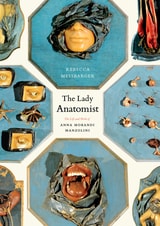
The Lady Anatomist
The Life and Work of Anna Morandi ManzoliniRebecca Messbarger
University of Chicago Press, 2010
Anna Morandi Manzolini (1714-74), a woman artist and scientist, surmounted meager origins and limited formal education to become one of the most acclaimed anatomical sculptors of the Enlightenment. The Lady Anatomist tells the story of her arresting life and times, in light of the intertwined histories of science, gender, and art that complicated her rise to fame in the eighteenth century.
Examining the details of Morandi’s remarkable life, Rebecca Messbarger traces her intellectual trajectory from provincial artist to internationally renowned anatomical wax modeler for the University of Bologna’s famous medical school. Placing Morandi’s work within its cultural and historical context, as well as in line with the Italian tradition of anatomical studies and design, Messbarger uncovers the messages contained within Morandi’s wax inscriptions, part complex theories of the body and part poetry. Widely appealing to those with an interest in the tangled histories of art and the body, and including lavish, full-color reproductions of Morandi’s work, The Lady Anatomist is a sophisticated biography of a true visionary.
The Land Is Our Community
Aldo Leopold’s Environmental Ethic for the New MillenniumRoberta L. Millstein
University of Chicago Press, 2024
Informed by his experiences as a hunter, forester, wildlife manager, ecologist, conservationist, and professor, Aldo Leopold developed a view he called the land ethic. In a classic essay, published posthumously in A Sand County Almanac, Leopold advocated for an expansion of our ethical obligations beyond the purely human to include what he variously termed the “land community” or the “biotic community”—communities of interdependent humans, nonhuman animals, plants, soils, and waters, understood collectively. This philosophy has been extremely influential in environmental ethics as well as conservation biology and related fields.
Using an approach grounded in environmental ethics and the history and philosophy of science, Roberta L. Millstein reexamines Leopold’s land ethic in light of contemporary ecology. Despite the enormous influence of the land ethic, it has sometimes been dismissed as either empirically out of date or ethically flawed. Millstein argues that these dismissals are based on problematic readings of Leopold’s ideas. In this book, she provides new interpretations of the central concepts underlying the land ethic: interdependence, land community, and land health. She also offers a fresh take on of his argument for extending our ethics to include land communities as well as Leopold-inspired guidelines for how the land ethic can steer conservation and restoration policy.
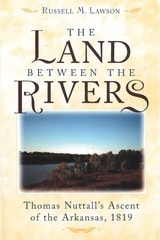
The Land between the Rivers
Thomas Nuttall's Ascent of the Arkansas, 1819Russell M. Lawson
University of Michigan Press, 2004
During the early nineteenth century, Nuttall explored the waters, valleys, plains, and mountains of the Great Lakes, Ohio River, Mississippi River, as well as the Missouri, Arkansas, Red, and Canadian river valleys of the former Louisiana Territory.
In this fascinating account of Nuttall's travels through the wilderness of the middle west, author Russell Lawson-using Nuttall's own journal-captures the sense of excitement of the early wanderer. As much a delight for the mind as the senses, The Land between the Rivers details the unremitting weather and rugged geography of uncharted lands within the Louisiana Territory. A sense of discovery pervades the narrative as Nuttall's odyssey builds to its climax in the prairie wilderness of what is now Oklahoma. Sickened by "ague"-in his case, malaria-Nuttall at times was barely able to go on; yet he continued to search for and catalog plants and animals.
The Land between the Rivers expands our knowledge of the work of one of the country's earliest botanists. We also learn a great deal about the early explorers, the inhabitants of the unsettled land, and about the land and culture of the times.

The Language of Genetics
An IntroductionDenis R. Alexander
Templeton Press, 2011
The Language of Genetics: An Introduction is the seventh title published in the Templeton Science and Religion Series, in which scientists from a wide range of fields distill their experience and knowledge into brief tours of their respective specialties. In this volume, Dr. Denis R. Alexander offers readers a basic toolkit of information, explanations, and ideas that can help us grasp something of the fascination and the challenge of the language of genetics.
Alexander surveys the big picture, covering such topics as the birth of the field; DNA: what it is, how it works, and how it was discovered; our genetic history; the role of genes in diseases, epigenetics, and genetic engineering. The book assumes the reader has little scientific background, least of all in genetics, and approaches these issues in a very accessible way, free of specialized or overly technical jargon. In the last chapter, Dr. Alexander explores some of the big questions raised by genetics: what are its implications for notions of human value and uniqueness? Is evolution consistent with religious belief? If we believe in a God of love, then how come the evolutionary process, utterly dependent upon the language of genetics, is so wasteful and involves so much pain and suffering? How far should we go in manipulating the human genome? Does genetics subvert the idea that life has some ultimate meaning and purpose?
Genetics is a rapidly advancing field; it seems new discoveries make headlines every other week. The Language of Genetics is intended to give the general reader the knowledge he or she needs to assess and understand the next big story
in genetics.
The Last 10,000 Years
A Fossil Pollen Record of the American SouthwestPaul S. Martin
University of Arizona Press, 1964

The Last Asylum
A Memoir of Madness in Our TimesBarbara Taylor
University of Chicago Press, 2015
The Last Asylum is Taylor’s breathtakingly blunt and brave account of those years. In it, Taylor draws not only on her experience as a historian, but also, more importantly, on her own lived history at Friern— once known as the Colney Hatch Lunatic Asylum and today the site of a luxury apartment complex. Taylor was admitted to Friern in July 1988, not long before England’s asylum system began to undergo dramatic change: in a development that was mirrored in America, the 1990s saw the old asylums shuttered, their patients left to plot courses through a perpetually overcrowded and underfunded system of community care. But Taylor contends that the emptying of the asylums also marked a bigger loss, a loss of community. She credits her own recovery to the help of a steadfast psychoanalyst and a loyal circle of friends— from Magda, Taylor’s manic-depressive roommate, to Fiona, who shares tips for navigating the system and stories of her boyfriend, the “Spaceman,” and his regular journeys to Saturn. The forging of that network of support and trust was crucial to Taylor’s recovery, offering a respite from the “stranded, homeless feelings” she and others found in the outside world.
A vivid picture of mental health treatment at a moment of epochal change, The Last Asylum is also a moving meditation on Taylor’s own experience, as well as that of millions of others who struggle with mental illness.
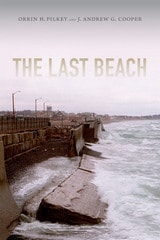
The Last Beach
Orrin H. Pilkey and J. Andrew G. Cooper
Duke University Press, 2014
After explaining beaches as dynamic ecosystems, Pilkey and Cooper assess the harm done by dense oceanfront development accompanied by the construction of massive seawalls to protect new buildings from a shoreline that encroaches as sea levels rise. They discuss the toll taken by sand mining, trash that washes up on beaches, and pollution, which has contaminated not only the water but also, surprisingly, the sand. Acknowledging the challenge of reconciling our actions with our love of beaches, the geologists offer suggestions for reversing course, insisting that given the space, beaches can take care of themselves and provide us with multiple benefits.
The Last Drop
The Politics of WaterMike Gonzalez and Marianella Yanes
Pluto Press, 2015
This book looks at how we got here and what we can and should do next. Laying out the complex arguments surrounding water, its ownership and access to it, Mike Gonzalez and Marianella Yanes make the technical and scientific aspects of the discussion clear and accessible—and thereby enable themselves to make the political questions more urgent. Pushing back against the market fundamentalists, the authors argue that it is both possible and necessary that considerations of equity and social justice prevail in the debates about water. Powerful and polemical, The Last Drop will be a vital resource for water activists worldwide.
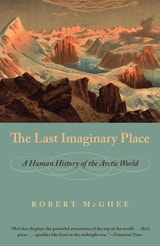
The Last Imaginary Place
A Human History of the Arctic WorldRobert McGhee
University of Chicago Press, 2007
The Arctic of towering icebergs and midnight sun, of flaming auroras and endless winter nights, has long provoked flights of the imagination. Now, in The Last Imaginary Place, renowned archeologist Robert McGhee lifts the veil to reveal the true Arctic world. Based on thirty years of work with native peoples of the Arctic and travel in the region, McGhee’s account dispels notions of the frozen land as an exotic, remote world that exists apart from civilization.
Between the frigid reality and lurid fantasy lies McGhee’s true interest, the people who throughout human history have called the Arctic home. He paints a vivid portrait of Viking farmers, entrepreneurial Inuit, and Western explorers who have been seduced by the natural wealth and haunting beauty of this land. From lively accounts of fur trading, ivory hunting, and whaling to white-knuckle tales of the first, doomed expeditions, McGhee takes the reader on a whirlwind journey across this disorienting, dreamlike terrain that has fascinated mankind for centuries.
“In prose infused by his position as curator of Arctic archaeology at the Canadian Museum of Civilization—which has taken him to sites in several countries—McGhee demolishes some persistent illusions about the white North . . . evocative.”—Times Literary Supplement
“[A] compelling account . . . [McGhee] believes that the Arctic is not so much a region as a dream—what he sees as a dream of a unique, attractive world . . . An archaeologist who has spent thirty years there, the author lets his love for the region shine through on every page.—Booklist
“McGhee displays the powerful attractions of the top of the world . . . [his] prose . . . sparkles like frost in the midnight sun.”—Financial Times
“McGhee has written a sensitive, fascinating and extremely important book.”—Canadian Geographic
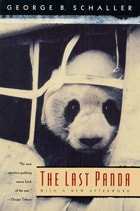
The Last Panda
George B. Schaller
University of Chicago Press, 1993
"No scientist is better at letting the rest of us in on just how the natural world works; no poet sees the world with greater clarity or writes about it with more grace. . . . Anyone who genuinely cares for wildlife cannot help being grateful to Schaller—both for his efforts to understand the panda and for the candor with which he reports what has gone so badly wrong in the struggle to save it from extinction."—Geoffrey C. Ward, New York Times Book Review
"Schaller's book is a unique mix of natural history and the politics of conservation, and it makes for compelling reading. . . . Having been in giant panda country myself, I found some of the descriptions of the animals and habitats breathtaking. Schaller describes the daily routines and personalities of the giant pandas he studied (as well as their fates thereafter) as though they were his blood relatives. . . . Schaller's brilliant presentation of the complexities of conservation makes his book a milestone for the conservation movement."—Devra G. Kleiman, Washington Post Book World
"George Schaller's most soulful work, written in journal style with many asides about a creature who evolved only two to three million years ago (about the same time as humans). . . . Here, conservation biology confronts an evil that grinds against hope and shatters the planet's diversity. Written with hope."—Whole Earth Catalog
"A nicely crafted blend of wildlife observation and political-cultural analysis. . . . The Last Panda is a sad chronicle of our failure, so far, to stem the decline of the animal that may be the most beloved on the planet."—Donald Dale Jackson, Smithsonian
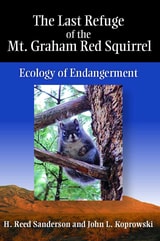
The Last Refuge of the Mt. Graham Red Squirrel
Ecology of EndangermentH. Reed Sanderson and John L. Koprowski
University of Arizona Press, 2009
This book is derived from a symposium on the Mt. Graham red squirrel and offers a comprehensive picture of the ecology of this red squirrel and the impacts on its mountain home. Forty contributors detail studies conducted to understand the natural history of the creature and the challenges and changing ecological conditions on Mt. Graham.
Each chapter tells a unique story that contributes to the mosaic of natural history knowledge about the endangered Mt. Graham red squirrel. They reflect diverse viewpoints on the problems of conserving the habitats and populations of the squirrel, showing how it was complicated by perspectives ranging from Native Americans’ concern over traditional lands to astronomers’ hope for a better view of space, and by issues ranging from forestry practices to climate change. Studies of such factors as squirrel middens, seed hoarding, and nest sites provide definitive research on the animal.
Ongoing censuses continue to track the squirrel’s population trends, and both Forest Service and Arizona Department of Transportation activities continue to be scrutinized by interested parties to determine their impact. This book represents an authoritative overview of this still-endangered species and its habitat.
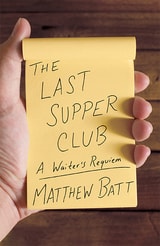
The Last Supper Club
A Waiter's RequiemMatthew Batt
University of Minnesota Press, 2023
A witty and humble tribute to the sometimes profane, sometimes profound world of waiting tables
During a year on sabbatical from his university position, Matthew Batt realized he needed money—fast—and it just so happened that one of the biggest breweries in the Midwest was launching a restaurant and looking to hire. So it was that the forty-something tenured professor found himself waiting tables at a high-end restaurant situated in a Minneapolis brewery. And loving it.
Telling the story of Batt’s early work in restaurants, from a red sauce joint possibly run by the mob to an ill-conceived fusion concept eatery, The Last Supper Club then details his experiences at the fine dining restaurant, a job that continued well past his sabbatical—that lasted, in fact, right up to the restaurant’s sudden and unceremonious closing three years later, shortly after it was named one of the best restaurants in the country by Food & Wine.
Batt’s memoir conveys the challenge—and the satisfaction—of meeting the demands of a frenzied kitchen and an equally expectant crowd. Through training mishaps, disastrous encounters with confused diners, struggles to keep pace with far more experienced coworkers, mandatory memorizations of laundry lists of obscure ingredients, and the stress of balancing responsibilities at home and at work, The Last Supper Club reveals the ups and downs of a waiter’s workday and offers an insightful perspective on what makes a job good, bad, or great. For Batt, this job turns out to be considerably more fun, and possibly more rewarding, than his academic career, and his insider’s view of waiting tables extols the significance of our food and the places where we gather to enjoy it—or serve it.
Told with sharp humor, humility, and a keen sense of what matters, The Last Supper Club is an ode to life in a high-pressure restaurant, the relationships that get you to the night’s close, and finding yourself through—or perhaps because of—the chaos of it all.

The Last Walk
Reflections on Our Pets at the End of Their LivesJessica Pierce
University of Chicago Press, 2012
The product of a lifetime of loving pets, studying philosophy, and collaborating with scientists at the forefront of the study of animal behavior and cognition, The Last Walk asks—and answers—the toughest questions pet owners face. The result is informative, moving, and consoling in equal parts; no pet lover should miss it.
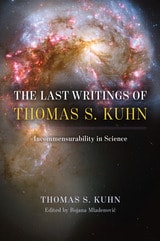
The Last Writings of Thomas S. Kuhn
Incommensurability in ScienceThomas S. Kuhn
University of Chicago Press, 2022
This book contains the text of Thomas S. Kuhn’s unfinished book, The Plurality of Worlds: An Evolutionary Theory of Scientific Development, which Kuhn himself described as a return to the central claims of The Structure of Scientific Revolutions and the problems that it raised but did not resolve. The Plurality of Worlds is preceded by two related texts that Kuhn publicly delivered but never published in English: his paper “Scientific Knowledge as Historical Product” and his Shearman Memorial Lectures, “The Presence of Past Science.” An introduction by the editor describes the origins and structure of The Plurality of Worlds and sheds light on its central philosophical problems.
Kuhn’s aims in his last writings are bold. He sets out to develop an empirically grounded theory of meaning that would allow him to make sense of both the possibility of historical understanding and the inevitability of incommensurability between past and present science. In his view, incommensurability is fully compatible with a robust notion of the real world that science investigates, the rationality of scientific change, and the idea that scientific development is progressive.
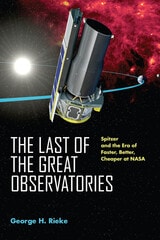
The Last of the Great Observatories
Spitzer and the Era of Faster, Better, Cheaper at NASAGeorge H. Rieke
University of Arizona Press, 2006
George Rieke played a key role in Spitzer and now relates the story of how that observatory was built and launched into space. Telling the story of this single mission within the context of NASA space science over two turbulent decades, he describes how, after a tortuous political trail to approval, Spitzer was started at the peak of NASA’s experiment with streamlining and downsizing its mission development process, termed “faster better cheaper.” Up to its official start and even afterward, Spitzer was significant not merely in terms of its scientific value but because it stood at the center of major changes in space science policy and politics. Through interviews with many of the project participants, Rieke reconstructs the political and managerial process by which space missions are conceived, approved, and developed. He reveals that by the time Spitzer had been completed, a number of mission failures had undermined faith in “faster-better-cheaper” and a more conservative approach was imposed. Rieke examines in detail the premises behind “faster better cheaper,” their strengths and weaknesses, and their ultimate impact within the context of NASA’s continuing search for the best way to build future missions.
Rieke’s participant’s perspective takes readers inside Congress and NASA to trace the progress of missions prior to the excitement of the launch, revealing the enormously complex and often disheartening political process that needs to be negotiated. He also shares some of the new observations and discoveries made by Spitzer in just its first year of operation. As the only book devoted to the Spitzer mission, The Last of the Great Observatories is a story at the nexus of politics and science, shedding new light on both spheres as it contemplates the future of mankind’s exploration of the universe.
The Laws of Cool
Knowledge Work and the Culture of InformationAlan Liu
University of Chicago Press, 2004
The Legumes of Texas
By B. L. Turner
University of Texas Press, 1959
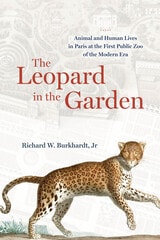
The Leopard in the Garden
Animal and Human Lives in Paris at the First Public Zoo of the Modern EraRichard W. Burkhardt, Jr.
University of Chicago Press, 2026
The Paris menagerie at the Paris Museum of Natural History has a special significance in the history of zoos. Founded in 1793–1794 at the height of the French Revolution, it was the model for the other great zoos of the nineteenth century that followed, beginning with London in 1828, Amsterdam in 1838, and Berlin in 1844.
Richard W. Burkhardt Jr. has written the definitive history of the Paris zoo and its early inhabitants, human and nonhuman. The book features narrative or thematic chapters interwoven with chapters focused on particular animals. Combining current scholarship with fresh discoveries gleaned from his immersion in the Paris Zoo’s extensive archive, Burkhardt shares historical treasures that illuminate not only the workings of the menagerie but also various dimensions of the golden age of French zoology (the years of Jean-Baptiste Lamarck, Geoffroy Saint-Hilaire, and Georges Cuvier). His history reconstructs the diverse sources of specimens, the growth of the collection over time, the efforts to make the menagerie scientifically significant, contemporary attitudes toward animals, and the lives of the animals themselves in colonial and diplomatic contexts.