Results by title
2817 books match the query 'Nature' and 595 start with t
The Whites Are Enemies of Heaven
Climate Caucasianism and Asian Ecological ProtectionMark W. Driscoll
Duke University Press, 2020
The Wild Cat Book
Everything You Ever Wanted to Know about CatsFiona Sunquist and Mel Sunquist
University of Chicago Press, 2014
Illustrated throughout with Terry Whittaker’s spectacular color photographs as well as unique photos from biologists in the field—some the highest quality images ever captured of exceptionally rare species—The Wild Cat Book not only tantalizes with the beauty of cats, but also serves as a valuable and accessible reference on cat behavior and conservation. Comprehensive entries for each of the thirty-seven cat species include color distribution maps and up-to-date information related to the species’ IUCN conservation and management statuses, while informative sidebars reveal why male lions have manes (and why dark manes are sexiest), how cats see with their whiskers, the truth behind our obsession with white lions and tigers, and why cats can’t be vegetarians. The Wild Cat Book also highlights the grave threats faced by the world’s wild cats—from habitat destruction to human persecution.
From the extraordinary acrobatics of the arboreal margay—able to cling to a tree branch by a single paw thanks to its unusually flexible ankles—to modern declines in African lion populations, The Wild Cat Book is an instructive and revealing ode to felines of every size and color. Combining science, behavioral observations, and stunning photography, this book will captivate cat fanciers the world over.
The Wildest Place on Earth
Italian Gardens and the Invention of WildernessJohn Hanson Mitchell
University Press of New England, 2015
The Windward Shore
A Winter on the Great LakesJerry Dennis
University of Michigan Press, 2012
If you have been enchanted by Jerry Dennis’s earlier work on sailing the Great Lakes, canoeing, angling, and the natural wonders of water and sky—or you have not yet been lucky enough to enjoy his engaging prose—you will want to immerse yourself in his powerful and insightful new book on winter in Great Lakes country.
Grounded by a knee injury, Dennis learns to live at a slower pace while staying in houses ranging from a log cabin on Lake Superior’s Keweenaw Peninsula to a $20 million mansion on the northern shore of Lake Michigan. While walking on beaches and exploring nearby woods and villages, he muses on the nature of time, weather, waves, agates, books, words for snow and ice, our complex relationship with nature, and much more.
From the introduction: “I wanted to present a true picture of a complex region, part of my continuing project to learn at least one place on earth reasonably well, and trusted that it would appear gradually and accumulatively—and not as a conventional portrait, but as a mosaic that included the sounds and scents and textures of the place and some of the plants, animals, and its inhabitants. Bolstered by the notion that a book is a journey that author and reader walk together, I would search for promising trails and follow them as far as my reconstructed knee would allow.”
The Winter Sailor
Francis R. Stebbins on Florida's Indian River, 1878-1888Edited by Carolyn Frances Baker Lewis
University of Alabama Press, 2004
A unique guide to Florida's frontier history along Indian River.
The Winter Sailor is a historical adventure that details the yearly winter travels of Francis R. Stebbins to Florida's Indian River. Stebbins, a writer from Michigan, visited Florida in March of 1878 and became entranced by its pristine beauty. Subsequently, Stebbins and his traveling companions made annual visits to Indian River—until 1888 when tragedy struck and ended Stebbins' yearly journeys.
Being an observant traveler, Stebbins began a series of descriptive articles for his hometown newspaper that chronicled his journeys to the Indian River area. Stebbins's articles tell of his own personal experiences during his leisurely visits, which included such activities as hunting and fishing, studying the natural surroundings, and excavating Indian mounds. What Stebbins enjoyed most was sailing down the river interviewing townspeople and examining local attractions as he went. His articles also detail the lifestyle of the region, food, fashion, industry, history, environment, and changes that occurred over time. Stebbins's articles not only entertained and informed but also became a travelogue for his readers. He inspired northern travelers to go south and visit Florida, which contributed to the beginnings of large-scale tourism in the region.
The Winter Sailor combines Stebbins's 49 articles along with three by his companions, to provide an enjoyable, historical guide. Unique among 19th-century travelogues, this fascinating look into Florida's past documents a decade of change to the Indian River wilderness and becomes Stebbins's gift to the present.
The World and the Wild
Expanding Wilderness Conservation Beyond its American RootsEdited by David Rothenberg and Marta Ulvaeus
University of Arizona Press, 2001
Foreword: Whither World Wilderness? / Vance G. Martin
Introduction: Wilderness in the Rest of the World / David Rothenberg
How Can Four Trees Make a Jungle? / Pramod Parajuli
The Unpaintable West / Zeese Papanikolas
Restoring Wilderness or Reclaiming Forests? / Sahotra Sarkar
For Indian Wilderness / Philip Cafaro and Monish Verma
In the Dust of Kilimanjaro / David Western
Why Conservation in the Tropics Is Failing / John Terborgh
"Trouble in Paradise": An Exchange / David Western and John Terborgh
Zulu History / Ian Player
Bruno Manser and the Penan / William W. Bevis
Roads Where There Have Long Been Trails / Kathleen Harrison
Volcano Dreams / Tom Vanderbilt
Recycled Rain Forest Myths / Antonio Carlos Diegues
The Park of Ten Thousand Waterfalls / Dan Imhoff
Mapping the Wild / Edward A. Whitesell
Earth Jazz / Evan Eisenberg
They Trampled on Our Taboos / Damien Arabagali
The World in Which We Occur
John Dewey, Pragmatist Ecology, and American Ecological Writing in the Twentieth CenturyNeil W. Browne
University of Alabama Press, 2007
Where nature meets democracy—John Dewey’s vision for a more connected world.
American philosopher John Dewey considered all human endeavors to be one with the natural world. In his writings, particularly Art as Experience (1934), Dewey insists on the primacy of the environment in aesthetic experience. Dewey’s conception of environment includes both the natural and the man-made. The World in Which We Occur highlights this notion in order to define “pragmatist ecology,” a practice rooted in the interface of the cultural and the natural. Neil Browne finds this to be a significant feature of some of the most important ecological writing of the last century.
To fully understand human involvement in the natural world, Browne argues that disciplinary boundaries must be opened, with profound implications for the practice of democracy. The degradation of the physical environment and democratic decay, for Browne, are rooted in the same problem: our persistent belief that humans are somehow separate from their physical environment.
Browne probes the work of a number of major American writers through the lens of Dewey’s philosophy. Among other texts examined are John Muir’s My First Summer in the Sierra (1911); Sea of Cortez (1941) by John Steinbeck and Edward Ricketts; Rachel Carson’s three books about the sea, Under the Sea-Wind (1941), The Sea Around Us (1951), and The Edge of the Sea (1955); John Haines’s The Stars, the Snow, the Fire (1989); Barry Lopez’s Arctic Dreams (1986); and Terry Tempest Williams’s Refuge (1991). Together, these texts—with their combinations of scientific observation and personal meditation—challenge the dichotomies that we have become accustomed and affirm the principles of a pragmatist ecology, one in which ecological and democratic values go hand in hand.
The World of Dinosaurs
An Illustrated TourMark A. Norell
University of Chicago Press, 2019
“Perhaps the easiest way to glimpse . . . all this new knowledge is to leaf through Norell’s The World of Dinosaurs. . . . One of the principal paleontologists of our time."—New York Review of Books
“A delight.”—Open Letters Review
“Possibly the best general audience dinosaur book of 2019.”—Paleoaerie
Dinosaurs have held sway over our imaginations since the discovery of their bones first shocked the world in the nineteenth century. From the monstrous beasts stalking Jurassic Park to the curiosities of the natural history museum, dinosaurs are creatures that unite young and old in awestruck wonder. Digging ever deeper into dinosaurs’ ancient past, science continues to unearth new knowledge about them and the world they inhabited, a fantastic time when the footprints of these behemoths marked the Earth that we humans now walk.
Who better to guide us through this ancient world than paleontologist Mark A. Norell? A world-renowned expert in paleontology, with a knowledge of dinosaurs as deep as the buried fossils they left behind, Norell is in charge of what is perhaps America’s most popular collection of dinosaur bones and fossils, the beloved displays at the American Museum of Natural History in New York. In The World of Dinosaurs, he leads readers through a richly illustrated collection detailing the evolution of these ancient creatures. From the horns of the Protoceratops to the wings of the Archaeopteryx, readers are invited to explore profiles of dinosaurs along with hundreds of color photographs, sketches, maps, and other materials—all rooted in the latest scientific discoveries—sure to both capture the imagination and satisfy a prehistoric curiosity. The World of Dinosaurs presents an astonishing collection of knowledge in an immersive visual journey that will fascinate any fan of Earth’s ancient inhabitants.

The X Catalogue
Notes on Madrid's LatinX Flora and FaunaClaudia Milian
University of Minnesota Press, 2026
A transatlantic, more-than-human exploration of LatinX presence, memory, and empire in the heart of Madrid
How does LatinXness begin in the Kingdom of Spain? In The X Catalogue, Claudia Milian offers a vade mecum of Madrid, exploring it as an ecological archive and former imperial metropolis. Approaching the “X” as metaphor, method, and philosophical practice, she extends inquiry beyond the human. Milian traces the “X” through transplanted life from the Americas: the roots of the ahuehuete tree (the Montezuma cypress), the engineering and renaming of the acocoxochitl (the dahlia), the “invasion” of the cotorras argentinas (Monk parakeets), and the exhibition of the caimán (the alligator) as a conquered object.
Critical theory and historical cultural studies meet to remap the Atlantic world through the “Xs” of arrival, circulation, and transformation. By examining how LatinXness inhabits the Spanish capital, Milian breaks open LatinX Spain and global LatinX studies. The X Catalogue resists containment, mirroring its objects of study and challenging categories such as native, foreign, or authentic. It advances a more-than-human, transatlantic understanding of LatinXness within empire studies, environmental humanities, and the critical study of tourism.
Retail e-book files for this title are screen-reader friendly with images accompanied by short alt text and/or extended descriptions.
The Yuma Reclamation Project
Irrigation, Indian Allotment, and Settlement Along the Lower Colorado RiverRobert Sauder
University of Nevada Press, 2009
In the arid American West, settlement was generally contingent on the availability of water to irrigate crops and maintain livestock and human residents. Early irrigation projects were usually the cooperative efforts of pioneer farmers, but by the early twentieth century they largely reflected federal intentions to create new farms out of the western public domain. The Yuma Reclamation Project, authorized in 1904, was one of the earliest federal irrigation projects initiated in the western United States and the first authorized on the Colorado River. Its story exemplifies the range of difficulties associated with settling the nation’s final frontier—the remaining irrigable lands in the arid West, including Indian lands—and illuminates some of the current issues and conflicts concerning the Colorado River. Author Robert Sauder’s detailed, meticulously researched examination of the Yuma Project illustrates the complex multiplicity of problems and challenges associated with the federal government’s attempt to facilitate homesteading in the arid West. He examines the history of settlement along the lower Colorado River from earliest times, including the farming of the local Quechan people and the impact of Spanish colonization, and he reviews the engineering problems that had to be resolved before an industrial irrigation scheme could be accomplished. The study also sheds light on myriad unanticipated environmental, economic, and social challenges that the government had to confront in bringing arid lands under irrigation, including the impact on the Native American population of the region.The Yuma Reclamation Project is an original and significant contribution to our understanding of federal reclamation endeavors in the West. It provides new and fascinating information about the history of the Yuma Valley and, as a case study of irrigation policy, it offers compelling insights into the history and consequences of water manipulation in the arid West.
The modeling of nature
philosophy of science and philosophy of nature in synthesisWilliam A Wallace
Catholic University of America Press, 1996
Their Blood Runs Cold
Adventures with Reptiles and AmphibiansWhit Gibbons
University of Alabama Press, 1983
Their Blood Runs Cold
Adventures with Reptiles and AmphibiansWhit Gibbons
University of Alabama Press, 2013
Enter the fascinating world of reptiles and amphibians through the eyes of a pioneering field scientist.
Their Blood Runs Cold is entertaining, informative reading that not only enhances our understanding of a unique group of animals, but also provides genuine insight into the mind and character of a research scientist.
Whit Gibbons possesses the rare talent of conveying the challenge and excitement of scientific inquiry. A research ecologist who specializes in the study of reptiles and amphibians, he gives accounts of work in the field that are as readable as good short stories.
From the dangers of being chased by an angry rattlesnake to the exhilaration of discovering a previously undescribed species, Gibbons brings to life the everyday experiences of the herpetologist as he chases down lizards, turtles, snakes, alligators, salamanders, and frogs in their natural habitats. With essays like “Turtles May Be Slow but They’re 200 Million Years Ahead of Us” and “How to Catch an Alligator in One Uneasy Lesson,” Their Blood Runs Cold both entertains and informs.
The thirtieth anniversary edition of Their Blood Runs Cold features a new prologue and epilogue, additions that address changes in the taxonomy and study of reptiles and amphibians that have occurred since the publication of the original edition and offer suggestions for further reading that highlight the explosion of interest in the topic.
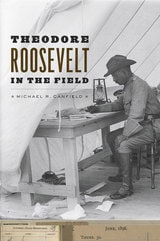
Theodore Roosevelt in the Field
Michael R. Canfield
University of Chicago Press, 2015
Drawing extensively on Roosevelt’s field notebooks, diaries, and letters, Canfield takes readers into the field on adventures alongside him. From Roosevelt’s early childhood observations of ants to his notes on ornithology as a teenager, Canfield shows how Roosevelt’s quest for knowledge coincided with his interest in the outdoors. We later travel to the Badlands, after the deaths of Roosevelt’s wife and mother, to understand his embrace of the rugged freedom of the ranch lifestyle and the Western wilderness. Finally, Canfield takes us to Africa and South America as we consider Roosevelt’s travels and writings after his presidency. Throughout, we see how the seemingly contradictory aspects of Roosevelt’s biography as a hunter and a naturalist are actually complementary traits of a man eager to directly understand and experience the environment around him.
As our connection to the natural world seems to be more tenuous, Theodore Roosevelt in the Field offers the chance to reinvigorate our enjoyment of nature alongside one of history’s most bold and restlessly curious figures.
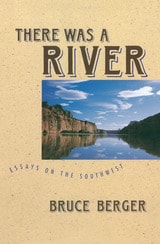
There Was a River
Bruce Berger
University of Arizona Press, 1994
The Southwest Berger sees is an unusual, even odd, place, with inhabitants that are just as strange. In this collection of essays he introduces us to people and places that define a region and a way of life. We meet eccentric desert dwellers like Cactus Pete, who claimed to have mapped the mountains of Venus long before NASA penetrated its clouds. We chart the canals of Phoenix, which have created a Martian landscape out of an irrigation system dating back to the ancient Hohokam; stay at a "wigwam" motel in Holbrook, whose kitsch appeals even to Hopis; and dim our lights for the International Dark-Sky Association's efforts to keep night skies safe for astronomy.
Focusing on the interaction of people with the environment, Berger reveals an original vision of the Southwest that encompasses both city and wilderness. In a concluding essay centering on the sale of his mother's estate in Phoenix, he concedes that "our intention to leave the desert alone has resulted, unwittingly, in loss after loss, simply by our being here." Sometimes there are losses—a canyon, a house—but Berger attunes us to the prodigies of change.
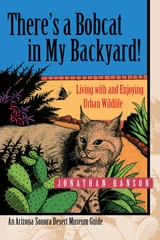
There's a Bobcat in My Backyard
Living with and Enjoying Urban WildlifeJonathan Hanson
University of Arizona Press, 2004
Human residents of the Sonoran Desert are sometimes not completely comfortable when confronted by the wild creatures with whom they share this fragile habitat. But have no fear—please! Not only do these critters mean you no harm, they can also be a source of immense delight.
In this entertaining guidebook, naturalist Jonathan Hanson introduces readers to the satisfaction of attracting and enjoying desert wildlife. Whether your home is deep within the city limits or on what is (currently) the edge of human settlement, you can turn your backyard into a miniature wildlife refuge by providing a simple combination of food, water, and habitat. An appropriately landscaped yard can become a home for a bevy of birds, beasts, and bugs, while even a condo patio can attract colorful hummingbirds and butterflies. Hanson advises you on what kind of birdseed to put out to attract the most interesting avian species, how to tell the difference between rabbits and jackrabbits, and when to worry about roving reptiles—which really isn't all that often. He'll even help you pick out a pair of binoculars to heighten your enjoyment.
Not all desert creatures offer people a positive experience, and Hanson tells how to cope with those that are sometimes considered pests—whether it's the Gila woodpecker announcing its presence on your roof at five in the morning, the rattlesnake slithering unconcerned across your porch, the coyote running amok with a taste for wandering housecats, or the aforementioned woodrat homesteading in a major appliance or car engine. From bears to bees to "creepy crawlies"—scorpions, spiders, and the like—he lets you know when you need to be cautious . . . and when you simply need to give a wild animal its space.
If you live in the desert, you're part of the desert. This book, generously laced with humor and brimming with helpful information, can turn you from a mere bystander into an active participant in an environment in which we all—people and wildlife—must coexist.
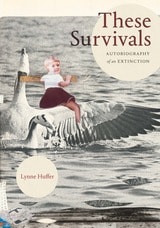
These Survivals
Autobiography of an ExtinctionLynne Huffer
Duke University Press, 2025
They Tell of Birds
Chaucer, Spenser, Milton, DraytonBy Thomas P. Harrison
University of Texas Press, 1956
Thomas P. Harrison here combines a lifelong interest in birds with a professional study of literature. This book, a study of birds as they are presented by four great English poets, inquires into the extent and sources of their knowledge of birds and analyzes the methods by which they adapted that knowledge for poetic purposes. The interrelationships of their poetry are also discussed, providing a new basis for comparison of four poets whose work is closely linked on other grounds remote from natural history.
The first chapter reviews representative figures and works of the centuries preceding the Renaissance and illustrates the medieval poetic conventions about birds that influenced the four poets. The remaining chapters treat each poet and his works in detail, comparing their use of this area of the natural world. The book concludes with an index of bird allusions in the works of the four poets, with occasional quotations illustrating the manner in which the traditional or observed habits of particular birds were put to poetic use. The book is illustrated with medieval and Renaissance illustrations of birds.
In this careful treatment of an important element of the poets’ works, Harrison has indicated the larger picture of their attitudes toward and use of the natural world about them. Accordingly, it might be said to constitute a chapter on the relationship of poetry and science at a crucial period in the history of thought.
For much of his material, Harrison journeyed to England, where, among other research activities, he visited museums of natural history and bird sanctuaries throughout the country.
Primarily intended for students of literature, They Tell of Birds will also be of interest to ornithologists in its presentation of the beliefs of antiquity and the Middle Ages about particular birds. For, as the distinguished ornithologist E. M. Nicholson has said: “We owe to poets a wealth of records of living wild birds long before scientific ornithology had started.”
Thinking Like a Mountain
Aldo Leopold and the Evolution of an Ecological Attitude toward Deer, Wolves, and ForestsSusan L. Flader
University of Wisconsin Press, 1994
When initially published more than twenty years ago, Thinking Like a Mountain was the first of a handful of efforts to capture the work and thought of America's most significant environmental thinker, Aldo Leopold. This new edition of Susan Flader's masterful account of Leopold's philosophical journey, including a new preface reviewing recent Leopold scholarship, makes this classic case study available again and brings much-deserved attention to the continuing influence and importance of Leopold today.
Thinking Like a Mountain unfolds with Flader's close analysis of Leopold's essay of the same title, which explores issues of predation by studying the interrelationships between deer, wolves, and forests. Flader shows how his approach to wildlife management and species preservation evolved from his experiences restoring the deer population in the Southwestern United States, his study of the German system of forest and wildlife management, and his efforts to combat the overpopulation of deer in Wisconsin. His own intellectual development parallels the formation of the conservation movement, reflecting his struggle to understand the relationship between the land and its human and animal inhabitants.
Drawing from the entire corpus of Leopold's works, including published and unpublished writing, correspondence, field notes, and journals, Flader places Leopold in his historical context. In addition, a biographical sketch draws on personal interviews with family, friends, and colleagues to illuminate his many roles as scientist, philosopher, citizen, policy maker, and teacher. Flader's insight and profound appreciation of the issues make Thinking Like a Mountain a standard source for readers interested in Leopold scholarship and the development of ecology and conservation in the twentieth century.
Thinking Plant Animal Human
Encounters with Communities of DifferenceDavid Wood
University of Minnesota Press, 2020
Collected essays by a leading philosopher situating the question of the animal in the broader context of a relational ontology
There is a revolution under way in our thinking about animals and, indeed, life in general, particularly in the West. The very words man, animal, and life have turned into flimsy conceptual husks—impediments to thinking about the issues in which they are embroiled. David Wood was a founding member of the early 1970s Oxford Group of philosophers promoting animal rights; he also directed Ecology Action (UK). Thinking Plant Animal Human is the first collection of this major philosopher’s influential essays on “animals,” bringing together his many discussions of nonhuman life, including the classic “Thinking with Cats.”
Exploring our connections with cats, goats, and sand crabs, Thinking Plant Animal Human introduces the idea of “kinnibalism” (the eating of mammals is eating our own kin), reflects on the idea of homo sapiens, and explores the place of animals both in art and in children’s stories. Finally, and with a special focus on trees, the book delves into remarkable contemporary efforts to rescue plants from philosophical neglect and to rethink and reevaluate their status. Repeatedly bubbling to the surface is the remarkable strangeness of other forms of life, a strangeness that extends to the human.
Wood shows that the best way of resisting simplistic classification is to attend to our manifold relationships with other living beings. It is not anthropocentric to focus on such relationships; they cast light in complex ways on the living communities of which we are part, and exploring them recoils profoundly on our understanding of ourselves.
This Contested Land
The Storied Past and Uncertain Future of America's National MonumentsMcKenzie Long
University of Minnesota Press, 2022
One woman’s enlightening trek through the natural histories, cultural stories, and present perils of thirteen national monuments, from Maine to Hawaii—now available in paperback
This land is your land. When it comes to national monuments, the sentiment could hardly be more fraught. Gold Butte in Nevada, Organ Mountains–Desert Peaks in New Mexico, Katahdin Woods and Waters in Maine, Cascade–Siskiyou in Oregon and California: these are among the thirteen natural sites McKenzie Long visits in This Contested Land, an eye-opening exploration of the stories these national monuments tell, the passions they stir, and the controversies surrounding them today.
Starting amid the fragrant sagebrush and red dirt of Bears Ears National Monument on the eve of the Trump Administration’s decision to reduce the site by 85 percent, Long climbs sandstone cliffs, is awed by Ancestral Pueblo cliff dwellings and is intrigued by 4,000-year-old petroglyphs. She hikes through remote pink canyons recently removed from the boundary of Grand Staircase–Escalante, skis to a backcountry hut in Maine to view a truly dark night sky, snorkels in warm Hawaiian waters to plumb the meaning of marine preserves, volunteers near the most contaminated nuclear site in the United States, and witnesses firsthand the diverse forms of devotion evoked by the Rio Grande. In essays both contemplative and resonant, This Contested Land confronts an unjust past and imagines a collaborative future that bears witness to these regions’ enduring Indigenous connections.
From hazardous climate change realities to volatile tensions between economic development and environmental conservation, practical and philosophical issues arise as Long seeks the complicated and often overlooked—or suppressed—stories of these incomparable places. Her journey, mindfully undertaken and movingly described, emphasizes in clear and urgent terms the unique significance of, and grave threats to, these contested lands.
This Ecstatic Nation
The American Landscape and the Aesthetics of PatriotismTerre Ryan
University of Massachusetts Press, 2011
Terre Ryan examines this phenomenon by exploring the overlapping trails of national mythology, landscape aesthetics, patriotic discourse, and public policy. Tracing her journeys around bombing grounds in Nevada, logging sites in Oregon, and energy fields in Wyoming, she argues that business and government agencies often frame commercial projects and national myths according to nineteenth-century beliefs about landscape and bounty. Advertisements and political promotional materials following this aesthetic framework perpetuate frontier-era ideas about the environment as commodity, scenery, and cultural trashlands. Transmitted through all types of media, nineteenth-century perspectives on landscape continue to inform mainstream perceptions of the environment, environmental policies, and representations of American patriotism.
Combining personal narrative with factual reportage, political and cultural critique, and historical analysis, Ryan reframes the images we see every day and places them into a larger national narrative.
This Is Our Land
Grassroots Environmentalism in the Late Twentieth CenturyFerguson, Cody
Rutgers University Press, 2015
This Land Is Your Land
The Story of Field Biology in AmericaMichael J. Lannoo
University of Chicago Press, 2018
Lannoo illuminates characters such as John Wesley Powell, William Temple Hornaday, and Olaus and Adolph Murie—homegrown midwestern field biologists who either headed east to populate major research centers or went west to conduct their fieldwork along the frontier. From the pioneering work of Victor Shelford, Henry Chandler Cowles, and Aldo Leopold to contemporary insights from biologists such as Jim Furnish and historians such as William Cronon, Lannoo’s unearthing of American—and particularly midwestern—field biologists reveals how these scientists influenced American ecology, conservation biology, and restoration ecology, and in turn drove global conservation efforts through environmental legislation and land set-asides. This Land Is Your Land reveals the little-known legacy of midwestern field biologists, whose ethos and discoveries have enabled us to preserve and understand not just their land, but all lands.
This Magnetic North
Candid Conversations on a Changing Northern MichiganTim Mulherin
Michigan State University Press, 2025
This book explores a phenomenon occurring around Michigan’s Great Lakes and other high-demand scenic locations across the country: natural landscapes are undergoing profound human and climatological change as people pick up their lives and move to bucolic locations. The Grand Traverse region in northwest lower Michigan has been one of the most impacted regions in the state, with the population increase accelerated by the pandemic and climate change. The impact of this growth is explored through field observations and interviews involving dozens of born-and-raised locals, “boomerangers” (those who grew up, left, then returned), and relocators. The author explores the tensions between newcomers and “natives.” Interviewees include tourist industry leaders, conservationists, business owners, public safety officials, tribal members, Sleeping Bear Dunes National Lakeshore officials, and more. These voices characterize the region’s diverse views, providing insight into how one of the most popular vacation destinations in the country is attempting to balance environmental preservation with an influx of people. Northwest lower Michigan’s story of transformation, as tradition collides with progress, holds many lessons and will resonate with everyone who has ever lived in or visited such an enchanting place and dreams of calling it home.
This Radical Land
A Natural History of American DissentDaegan Miller
University of Chicago Press, 2018
But if you know where to look, you can uncover a different history, one of vibrant resistance, one that’s been mostly forgotten. This Radical Land recovers that story. Daegan Miller is our guide on a beautifully written, revelatory trip across the continent during which we encounter radical thinkers, settlers, and artists who grounded their ideas of freedom, justice, and progress in the very landscapes around them, even as the runaway engine of capitalism sought to steamroll everything in its path. Here we meet Thoreau, the expert surveyor, drawing anticapitalist property maps. We visit a black antislavery community in the Adirondack wilderness of upstate New York. We discover how seemingly commercial photographs of the transcontinental railroad secretly sent subversive messages, and how a band of utopian anarchists among California’s sequoias imagined a greener, freer future. At every turn, everyday radicals looked to landscape for the language of their dissent—drawing crucial early links between the environment and social justice, links we’re still struggling to strengthen today.
Working in a tradition that stretches from Thoreau to Rebecca Solnit, Miller offers nothing less than a new way of seeing the American past—and of understanding what it can offer us for the present . . . and the future.
This Tender Place
The Story of a Wetland YearLaurie Lawlor
University of Wisconsin Press, 2007
After the deaths of her father and father-in-law, Laurie Lawlor discovers an unlikely place for healing and transformation in a wetland in southeastern Wisconsin—a landscape of abundant and sometimes inaccessible beauty that has often been ignored, misunderstood, and threatened by human destruction. In her decade-long personal wetland journey, she examines the sky, delves underwater, and peers between sedges in all seasons and all times of day.
This Tender Place is a celebration of nature, the elements, and humanity. From the wetland’s genesis during the ice age to its survival in the twenty-first century, Lawlor chronicles the universal ties among people, wild places, and healthy wetlands.
An engaging and deeply intimate record, This Tender Place is at its heart a story of refuge and renewal refracted through the lens of life within the wetlands—one of the most productive, yet most endangered, ecosystems in the world.
This Vast Book of Nature
Writing the Landscape of New Hampshire’s White Mountains, 1784–1911Pavel Cenkl
University of Iowa Press, 2006
Starting with an exploration of Jeremy Belknap’s 1784 expedition to Mount Washington, which Cenkl links to the origins of tourism in the White Mountains, to the transformation of touristic and residential relationships to landscape, This Vast Book of Nature explores the ways competing visions of the landscape have transformed the White Mountains culturally and physically, through settlement, development, and—most recently—preservation, a process that continues today.
Thoreau beyond Borders
New International Essays on America's Most Famous Nature WriterFrançois Specq
University of Massachusetts Press, 2020
Henry David Thoreau spent his life as an intellectual vagrant, jumping fences, pushing boundaries, and crossing borders. How, why, and to what end are the questions asked by contributors to this new volume of essays, whose work crosses national and disciplinary borders to think about Thoreau anew.
Deliberately invoking Thoreau's commitment to “living a border life,” a life located between the world of nature and that of the polis, these varied essays explore the writer's thinking and writing as situated not merely against, but across and beyond borders and boundaries—whether geographic, temporal, or spiritual. Arguing that literary texts are governed by mediation and dialogue, lines of force becoming lines of connection that entail complex patterns and interweavings, the contributors draw on methodologies that freely combine literary and philosophical approaches with cultural and political ones—in turn moving us beyond borders.
Contributors include the volume editors as well as Kristen Case, Danielle Follett, Rochelle Johnson, John J. Kucich, Daniel S. Malachuk, Henrik Otterberg, Sandra Harbert Petrulionis, Benjamin Pickford, David M. Robinson, Christa Holm Vogelius, and Michael C. Weisenburg.
Thoreau's Journal Drawings
The Power of the VisualKathleen Coyne Kelly
University of Massachusetts Press, 2026
Examining journal drawings as an integral—and often delightful—feature of Thoreau’s work
In 1850, Henry David Thoreau began to draw in his Journal—a hedgehog’s quill, a locust’s wing, a goldenrod leaf. The sketches reflect his efforts to train his eye to observe more carefully, to look closely enough that he could see what was in front of him—with intention and attention. As Thoreau worked to combine the vivid language of a writer with the precision of a scientist, his drawings became more vital to the process. For him, writing and drawing were not separate activities; they were part of the same active, hands-on process of learning about the natural world.
Thoreau’s Journal Drawings offers a sustained examination of an understudied aspect of the Journal, emphasizing visual as well as textual analysis. It places Thoreau’s illustrated entries in the broader context of nineteenth-century scientific illustration, nature writing, and visual culture, while also offering close readings of key passages in which text and image work in tandem. The book opens up new possibilities for interpretation—both within the Journal and in the larger project of Thoreau’s thinking.
Ultimately, Thoreau’s illustrated Journal offers a case study in the complexities of representing the natural world through both language and image. His practice raises enduring questions about how we document, interpret, and mediate the more-than-human world across different forms of expression. To read the later volumes of Henry David Thoreau’s Journal without attending to his drawings is to overlook a vital dimension of his practice as both writer and observer.
Thoreaus Sense of Place
Essays in American Environmental WritingRichard J. Schneider
University of Iowa Press, 2000
The contributors to this stimulating collection address the ways in which Thoreau and his successors attempt to cope with the basic epistemological split between perceiver and place inherent in writing about nature; related discussions involve the kinds of discourse most effective for writing about place. They focus on the impact on Thoreau and his successors of culturally constructed assumptions deriving from science, politics, race, gender, history, and literary conventions. Finally, they explore the implications surrounding a writer's appropriation or even exploitation of places and objects.
Threads from the Web of Life & The Shark and the Jellyfish
Stories in Natural HistoryStephen Daubert
Vanderbilt University Press, 2019
One niche moves across a world of flowers that reaches its earliest peak bloom in the low valleys and then peaks later among the slopes of the foothills—a rolling habitat. Another hop-scotches across the ocean floor, compelling its occupants to migrate from the fallen body of one dead whale to the next. Yet another appears in the aftermath of typhoons, requiring its inhabitants to search the tropical coastline for the latest storm landfall.
These tales are filled with no less intrigue than other literary works, but they transpire out of the sight of most readers. Once known only to ecologists, in Threads from the Web of Life and The Shark and the Jellyfish, available for the first time in a single deluxe paperback, these stories become accessible to everyone with an interest in natural history.
Threads from the Web of Life
Stories in Natural HistoryStephen Daubert
Vanderbilt University Press, 2006
In sixteen stories Steve Daubert pulls the reader into the mystery and immediacy of ecological processes spanning a range from microscopic to tectonic, from microscopic to cosmic forces. Each tale brings the reader into the moment to witness an episode of survival in the wild first-hand. The material is presented on a level of intimacy and detail not usually encountered in other styles of natural history writing.
These creative non-fiction stories provide not just a bird's eye view (though that's true for the owls, warblers, condors, and hummingbirds in the book), but a wasp's eye view, a mouse's, a sea turtle's, a squid's. Sometimes the focus is as small as the detritus on the forest floor, or a single beat of the wing of a gull. Other stories range across evolutionary time. From whales and dinosaurs to creatures invisible to the naked eye, author and illustrator bring to life the dynamic interplay of living, evolving creatures and the natural forces that have shaped their worlds.
The book includes chapter notes that document the scientific basis for each story and describe the controversies still surrounding some of them -- a splendid resource for families to read and share.
Through Amazonian Eyes
The Human Ecology of Amazonian PopulationsEmilio F. Moran
University of Iowa Press, 1993
In this well-written, comprehensive, reasonable yet passionate volume, Emilio Moran introduces us to the range of human and ecological diversity in the Amazon Basin. By describing the complex heterogeneity on the Amazon's ecological mosaic and its indigenous populations' conscious adaptations to this diversity, he leads us to realize that there are strategies of resource use which do not destroy the structure and function of ecosystems. Finally, and most important, he examines ways in which we might benefit from the study of human ecology to design and implement a balance between conservation and use.
Through a Green Lens
Fifty Years of Writing for NatureRobert Michael Pyle
Oregon State University Press, 2016
Thus began a life path devoted to natural history, nature conservation, and the language, and how they all meet in the literature of the land. Working in a succession of far-flung jobs in biological conservation, teaching, and field research, Pyle eventually threw in a regular paycheck in favor of a freelance existence devoted to his mutual passions for nature study and writing.
All along, he wrote, and wrote: to date, twenty books and hundreds of essays, stories, papers, and poems. But it is the occasional prose--the deeply personal essays that explored and indulged his immediate fascinations--that make up this selection of never-before-collected testimonies. Beginning with that 1965 cri de coeur written on mountain motel stationery, Through a Green Lens ranges across broad territory of topic, vehicle, geography, populace, and politics, concluding with powerful forewords for two 2015 books, Earth and Eros and Nerves and Numbers. Pyle's half-century long view, acute and uncommonly attuned to the physical world, gives readers a remarkable window on the natural setting of our life and times.
Through a Naturalist's Eyes
Exploring the Nature of New EnglandMichael J. Caduto
University Press of New England, 2016
Through a Vegan Studies Lens
Textual Ethics and Lived ActivismLaura Wright
University of Nevada Press, 2019
Veganism is a practice that allows for environmentally responsible consumer choices that are viewed, particularly in the West, as oppositional to an economy that is largely dependent upon big agriculture. This groundbreaking collection exposes this disruption, critiques it, and offers a new roadmap for navigating and reimaging popular culture representations on veganism. These essays engage a wide variety of political, historical, and cultural issues, including contemporary political and social circumstances, emergent veganism in Eastern Europe, climate change, and the Syrian refugee crisis, among other topics.
Through a Vegan Studies Lens significantly furthers the conversation of what a vegan studies perspective can be and illustrates why it should be an integral part of cultural studies and critical theory. Vegan studies is inclusive, refusing to ignore the displacement, abuse, and mistreatment of nonhuman animals. It also looks to ignite conversations about cultural oppression.
Tidal Wetlands Primer
An Introduction to Their Ecology, Natural History, Status, and ConservationRalph W. Tiner
University of Massachusetts Press, 2013
Illustrated with maps, photographs, and diagrams, this volume provides a clear account of the factors that make these habitats unique and vulnerable. It discusses their formation, the conditions affecting their plant and animal life, and the diversity of types across North America, as well as their history, use by wildlife and humans, current status, conservation, restoration, and likely future. The emphasis is on vegetated wetlands—marshes and swamps—with additional discussion of eelgrass meadows, rocky shores, beaches, and tidal flats.
Ralph Tiner's previous field guides to coastal wetland plants in the Northeast and Southeast have been widely praised. Tidal Wetlands Primer joins Tiner's earlier publications as an authoritative and user-friendly guide that should appeal to anyone with a serious interest in coastal habitats.
Tiger Beetles of the Southeastern United States
A Field GuideGiff Beaton, R. Stephen Krotzer, and Brian D. Holt
University of Alabama Press, 2021
Combines current data and taxonomic classifications for tiger beetles in the Southeast with stunning close-up photographs, flight season charts, and distribution maps
Tiger beetles are brightly colored and metallic beetles, often with ivory or cream-colored markings. They are most abundant and diverse in habitats near bodies of water with sandy or clay soils and can be found along rivers, on sea and lake shores, on sand dunes, around dry lakebeds, on clay banks, or on woodland paths. Conservatively estimated, the group comprises more than 2,600 species worldwide.
Tiger Beetles of the Southeastern United States identifies and describes 52 taxa (42 species and 10 additional subspecies) of tiger beetles that occur in Alabama, Florida, Georgia, Mississippi, North Carolina, South Carolina, and Tennessee. Stunning close-up photographs accompany current taxonomic and biological information in a volume designed for a growing audience of enthusiastic amateurs and professionals alike.
The authors provide an in-depth description of the anatomy, life cycle, and behavior of tiger beetles; an overview of the various southeastern habitats in which they occur; instructions for finding, identifying, and photographing them in the wild; and the conservation status of various species. The individual species accounts include stunning, detailed images, flight season charts, county-level regional distribution maps, and discussion of identifying features, habitat, similar species, and subspecies when applicable. The appendix includes two species previously found in Florida but no longer known to exist there.
The result is the most complete field guide to date on tiger beetles in the region. With more than 230 images of beetles and their habitats, as well as life history and distribution data, this book is essential for tiger beetle enthusiasts, naturalists of all kinds, photographers, biologists, and teachers throughout the region.
Tiger Moon
Tracking the Great Cats in NepalFiona Sunquist and Mel Sunquist
University of Chicago Press, 2003
Timber Rattlesnakes in Vermont & New York
Biology, History, and the Fate of an Endangered SpeciesJon Furman
University Press of New England, 2007
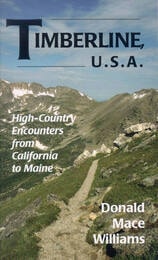
Timberline U.S.A.
High-Country Encounters from California to MaineDonald Mace Williams
Utah State University Press, 2003
As a youth in Denver, Donald Mace Williams developed an affection for high mountain country. After a journalistic career spent mostly on flat lands, he set out to rediscover what was special about country above timberline. He hiked the high alpine in four of America's major ranges-the Rockies, Sierra Nevada, Cascades, and northern Appalachians-and in his narrative of his travels, he tells us what he saw and learned and who he met. Having visited some of these areas when younger, Williams compares his psychological and physical responses as an older man and how his ideas about how to treat the environment have evolved. A recurring theme is the compromises that people such as he make between the pull of mountains and freedom and the responsibilities of making a living in the lowlands. Mainly, he observes and experiences what is distinctive about the timberline environment.
Throughout his book, Williams gently informs readers regarding timberline history, nature, weather, and archaeology; high altitude physiology; and environmental concerns. Frequently, he recounts encounters with interesting and varied people he meets on the trails: a young British hiking companion who has come back to Colorado to repeat a climb on which, a year previously, his two fellow climbers died; a pilot who climbs isolated peaks in the Sierra Nevada in search of bouillon-can scrolls signed by famous early mountaineers; a "Literate Farmer" who pauses on a mountain trail in Vermont to discuss Robert Frost.
Donald Mace Williams is a retired journalist who has worked for such newspapers as The Wichita Eagle, Newsday, and the Fort Worth Star-Telegram. He has a Ph.D. in English from the University of Texas, has published one previous book (Interlude in Umbarger: Italian POWs and a Texas Church); poems in Western Humanities Review, Iron Horse Literary Review, and South Dakota Review; and a short story in Southwest Review. He now lives in Texas.
Time of Grace
Thoughts on Nature, Family, and the Politics of Crime and PunishmentKen Lamberton
University of Arizona Press, 2007
Time of Grace is a remarkable book, written with great eloquence by a former science teacher who was incarcerated for twelve years for his sexual liaison with a teenage student. Far more than a “prison memoir,” it is an intimate and revealing look at relationships—with fellow humans and with the surprising wildlife of the Sonoran Desert, both inside and beyond prison walls. Throughout, Ken Lamberton reflects on human relations as they mimic and defy those of the natural world, whose rhythms calibrate Lamberton’s days and years behind bars. He writes with candor about his life, while observing desert flora and fauna with the insight and enthusiasm of a professional naturalist.
While he studies a tarantula digging her way out of the packed earth and observes Mexican freetail bats sailing into the evening sky, Lamberton ruminates on his crime and on the wrenching effects it has had on his wife and three daughters. He writes of his connections with his fellow inmates—some of whom he teaches in prison classes—and with the guards who control them, sometimes with inexplicable cruelty. And he unflinchingly describes a prison system that has gone horribly wrong—a system entrapped in a self-created web of secrecy, fear, and lies.
This is the final book of Lamberton’s trilogy about the twelve years he spent in prison. Readers of his earlier books will savor this last volume. Those who are only now discovering Lamberton’s distinctive voice—part poet, part scientist, part teacher, and always deeply, achingly human—will feel as if they are making a new friend.
Gripping, sobering, and beautifully written, Lamberton’s memoir is an unforgettable exploration of crime, punishment, and the power of the human spirit.
To Care for Creation
The Emergence of the Religious Environmental MovementStephen Ellingson
University of Chicago Press, 2016
To Care for Creation chronicles this movement and explains how it has emerged despite institutional and cultural barriers, as well as the hurdles posed by logic and practices that set religious environmental organizations apart from the secular movement. Ellingson takes a deep dive into the ways entrepreneurial activists tap into and improvise on a variety of theological, ethical, and symbolic traditions in order to issue a compelling call to arms that mobilizes religious audiences. Drawing on interviews with the leaders of more than sixty of these organizations, Ellingson deftly illustrates how activists borrow and rework resources from various traditions to create new meanings for religion, nature, and the religious person’s duty to the natural world.
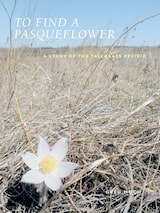
To Find a Pasqueflower
A Story of the Tallgrass PrairieGreg Hoch
University of Iowa Press, 2022
Hoch blends history, culture, and science into a unified narrative of the tallgrass prairie, with an emphasis on humans’ participation in its development and destruction. Hoch also demonstrates how variable and dynamic the prairie is, creating both challenges and opportunities for those who manage and restore and appreciate it.
To Know a Starry Night
Paul Bogard
University of Nevada Press, 2021
To Life
Jews Exploring NatureJoel Greenberg
Rutgers University Press, 2026
To Life explores the Jewish relationship with nature by illuminating significant Jewish thinkers who increased in important ways our understanding of various aspects of natural history. In eight compelling chapter-long biographies, naturalist Joel Greenberg demonstrates the diversity of both Jewish identity and the natural sciences.
Greenberg’s rich biographical sketches spotlight great Jewish scientists who not only made major contributions to the study of the natural world but also led rich and colorful lives: botanist and spy Aaron Aaronsohn, zoologist Libbie Henrietta Hyman, infamous ornithologist Nathan Leopold, mammalogist Philip Hershkovitz, arachnologist Herbert Levi, herpetologist Hymen Marx, public health entomologist Andrew Spielman, and ecologist Joan Ehrenfeld. These individuals manifested different aspects of Jewish identity—some observant, some secular—but all were affected in one way or another by their being Jewish.
By exploring the relationship between Jews and nature through the lives of these figures, Greenberg shares new and underrecognized aspects of Jewish and environmental history and opens new portals into the fields they studied.
To the Last Smoke
An AnthologyStephen J. Pyne
University of Arizona Press, 2020
From boreal Alaska to subtropical Florida, from the chaparral of California to the pitch pine of New Jersey, America boasts nearly a billion burnable acres. In nine previous volumes, Stephen J. Pyne has explored the fascinating variety of flame region by region. In To the Last Smoke: An Anthology, he selects a sampling of the best from each.
To the Last Smoke offers a unique and sweeping view of the nation’s fire scene by distilling observations on Florida, California, the Northern Rockies, the Great Plains, the Southwest, the Interior West, the Northeast, Alaska, the oak woodlands, and the Pacific Northwest into a single, readable volume. The anthology functions as a color-commentary companion to the play-by-play narrative offered in Pyne’s Between Two Fires: A Fire History of Contemporary America. The series is Pyne’s way of “keeping with it to the end,” encompassing the directive from his rookie season to stay with every fire “to the last smoke.”
Together, Alone
A Memoir of Marriage and PlaceBy Susan Wittig Albert
University of Texas Press, 2009
What does it mean to belong to a place, to be truly rooted and grounded in the place you call home? How do you commit to a marriage, to a full partnership with another person, and still maintain your own separate identity? These questions have been central to Susan Wittig Albert's life, and in this beautifully written memoir, she movingly describes how she has experienced place, marriage, and aloneness while creating a home in the Texas Hill Country with her husband and writing partner, Bill Albert.
Together, Alone opens in 1985, as Albert leaves a successful, if rootless, career as a university administrator and begins a new life as a freelance writer, wife, and homesteader on a patch of rural land northwest of Austin. She vividly describes the work of creating a home at Meadow Knoll, a place in which she and Bill raised their own food and animals, while working together and separately on writing projects. Once her sense of home and partnership was firmly established, Albert recalls how she had to find its counterbalance—a place where she could be alone and explore those parts of the self that only emerge in solitude. For her, this place was Lebh Shomea, a silent monastic retreat. In writing about her time at Lebh Shomea, Albert reveals the deep satisfaction she finds in belonging to a community of people who have chosen to be apart and experience silence and solitude.
Tongass Odyssey
Seeing the Forest Ecosystem through the Politics of TreesJohn Schoen
University of Alaska Press, 2020