Results by title
3027 books match the query 'Sociology' and 538 start with t
To Be an Immigrant
Kay Deaux
Russell Sage Foundation, 2006
To Care for Creation
The Emergence of the Religious Environmental MovementStephen Ellingson
University of Chicago Press, 2016
To Care for Creation chronicles this movement and explains how it has emerged despite institutional and cultural barriers, as well as the hurdles posed by logic and practices that set religious environmental organizations apart from the secular movement. Ellingson takes a deep dive into the ways entrepreneurial activists tap into and improvise on a variety of theological, ethical, and symbolic traditions in order to issue a compelling call to arms that mobilizes religious audiences. Drawing on interviews with the leaders of more than sixty of these organizations, Ellingson deftly illustrates how activists borrow and rework resources from various traditions to create new meanings for religion, nature, and the religious person’s duty to the natural world.
To Dwell among Friends
Personal Networks in Town and CityClaude S. Fischer
University of Chicago Press, 1982
To Flourish or Destruct
A Personalist Theory of Human Goods, Motivations, Failure, and EvilChristian Smith
University of Chicago Press, 2015
In his 2010 book What Is a Person?, Christian Smith argued that sociology had for too long neglected this fundamental question. Prevailing social theories, he wrote, do not adequately “capture our deep subjective experience as persons, crucial dimensions of the richness of our own lived lives, what thinkers in previous ages might have called our ‘souls’ or ‘hearts.’” Building on Smith’s previous work, To Flourish or Destruct examines the motivations intrinsic to this subjective experience: Why do people do what they do? How can we explain the activity that gives rise to all human social life and social structures?
Smith argues that our actions stem from a motivation to realize what he calls natural human goods: ends that are, by nature, constitutionally good for all human beings. He goes on to explore the ways we can and do fail to realize these ends—a failure that can result in varying gradations of evil. Rooted in critical realism and informed by work in philosophy, psychology, and other fields, Smith’s ambitious book situates the idea of personhood at the center of our attempts to understand how we might shape good human lives and societies.
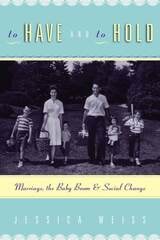
To Have and to Hold
Marriage, the Baby Boom, and Social ChangeJessica Weiss
University of Chicago Press, 2000
Jessica Weiss delves beneath these mythic images and paints a far more complex picture that reveals strong continuities between the baby boomers and their parents. Drawing on interviews with American couples from the 1950s to the 1980s, Weiss creates a dynamic portrait of family and social change in the postwar era. She pairs these firsthand accounts with a deft analysis of movies, television shows, magazines, and advice books from each decade, providing an unprecedented and intimate look at ordinary marriages in a time of sweeping cultural change.
Weiss shows how young couples in the 1950s attempted to combine egalitarian hopes with traditional gender roles. Middle-class women encouraged their husbands to become involved fathers. Midlife wives and mothers reshaped the labor force and the home by returning to work in the 1960s. And couples strove for fulfilling marriages as they dealt with the pressures of childrearing in the midst of the sexual and divorce revolutions of the 1960s and 1970s. By the 1980s, they were far more welcoming to the ideas of the women's movement than has often been assumed. More than simply changing with the times, the parents of the baby boom contributed to changing times themselves.
Weiss's excellent use of family interviews that span three decades, her imaginative examination of popular culture, and her incisive conclusions make her book an invaluable contribution not only to our understanding of the past but also to our understanding of men's and women's roles in today's family.
"Weiss has written an enlightening book that examines the dynamics of American families past and present. . . . Since Weiss is a historian, she provides analyses of her arguments that are factual rather than emotive, and her use of family interviews further contributes to a strong presentation. Overall, this is a unique works because its multidisciplinary approach informs but never preaches on the emotionally charged topic of the American family.—Sheila Devaney, Library Journal
Too Many Children Left Behind
The U.S. Achievement Gap in Comparative PerspectiveBRUCE BRADBURY is associate professor at the Social Policy Research Centre at the University of New South Wales, Australia. MILES CORAK is professor of economics at the Graduate School of Public and International Affairs at the University of Ottawa. JANE WALDFOGFEL is professor of social work and public affairs at the Columbia University School of Social Work and visiting professor at the Centre for Analysis of Social Exclusion at the London School of Economics and Political Science. ELIZABETH WASHBROOK is lecturer in Quantitative Methods for Education at the Graduate School of Education and a member of the Centre for Multilevel Modelling at the University of Bristol, United Kingdom.
Russell Sage Foundation, 2015
The belief that with hard work and determination, all children have the opportunity to succeed in life is a cherished part of the American Dream. Yet, increased inequality in America has made that dream more difficult for many to obtain. In Too Many Children Left Behind, an international team of social scientists assesses how social mobility varies in the United States compared with Australia, Canada, and the United Kingdom. Bruce Bradbury, Miles Corak, Jane Waldfogel, and Elizabeth Washbrook show that the academic achievement gap between disadvantaged American children and their more advantaged peers is far greater than in other wealthy countries, with serious consequences for their future life outcomes. With education the key to expanding opportunities for those born into low socioeconomic status families, Too Many Children Left Behind helps us better understand educational disparities and how to reduce them.
Analyzing data on 8,000 school children in the United States, the authors demonstrate that disadvantages that begin early in life have long lasting effects on academic performance. The social inequalities that children experience before they start school contribute to a large gap in test scores between low- and high-SES students later in life. Many children from low-SES backgrounds lack critical resources, including books, high-quality child care, and other goods and services that foster the stimulating environment necessary for cognitive development. The authors find that not only is a child’s academic success deeply tied to his or her family background, but that this class-based achievement gap does not narrow as the child proceeds through school.
The authors compare test score gaps from the United States with those from three other countries and find smaller achievement gaps and greater social mobility in all three, particularly in Canada. The wider availability of public resources for disadvantaged children in those countries facilitates the early child development that is fundamental for academic success. All three countries provide stronger social services than the United States, including universal health insurance, universal preschool, paid parental leave, and other supports. The authors conclude that the United States could narrow its achievement gap by adopting public policies that expand support for children in the form of tax credits, parenting programs, and pre-K.
With economic inequalities limiting the futures of millions of children, Too Many Children Left Behind is a timely study that uses global evidence to show how the United States can do more to level the playing field.
Top Student, Top School?
How Social Class Shapes Where Valedictorians Go to CollegeAlexandria Walton Radford
University of Chicago Press, 2013
Watch an interview of Alexandria Walton Radford discussing her book here: http://www.youtube.com/watch?v=F81c1D1BpY0
Tourism and the Metropolis
Exploring Conceptual and Geographical FrontiersEdited by Maria Gravari-Barbas, Sébastien Jacquot, Maja Jovic, and Johannes Novy
University of Westminster Press, 2026
What forms does tourism take in today’s metropolises and metropolitan regions? How do these forms differ from tourism in other urban contexts? Are these differences significant enough to warrant the classification of ‘metropolitan tourism’ as a distinct type of urban tourism? What are their implications for policy and planning processes? How do policy and planning processes in different metropolises and metropolitan regions differ from each other, and what can they learn from each other? And finally, how could tourism in metropolises and metropolitan regions be made more sustainable, resilient, and inclusive?
Given the importance widely attributed to major metropolises and metropolitan regions as contemporary engines of economic development, innovation, and change, the widespread portrayal of tourism as a leading economic and social force of the 21st century, and the fact that the world's large metropolitan areas are key recipients of tourism flows, it is surprising how little systematic attention is paid to tourism in metropolitan contexts. This book aims to fill these gaps.
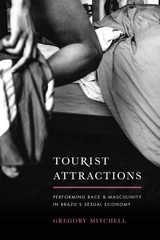
Tourist Attractions
Performing Race and Masculinity in Brazil's Sexual EconomyGregory Mitchell
University of Chicago Press, 2015
Mitchell takes us into the bath houses of Rio de Janeiro, where rent boys cruise for clients, and to the beaches of Salvador da Bahia, where African American gay men seek out hustlers while exploring cultural heritage tourist sites. His ethnography stretches into the Amazon, where indigenous fantasies are tinged with the erotic at eco-resorts, and into the homes of “kept men,” who forge long-term, long-distance, transnational relationships that blur the boundaries of what counts as commercial sex. Mitchell asks how tourists perceive sex workers’ performances of Brazilianness, race, and masculinity, and, in turn, how these two groups of men make sense of differing models of racial and sexual identity across cultural boundaries. He proposes that in order to better understand how people experience difference sexually, we reframe prostitution—which Marxist feminists have long conceptualized as sexual labor—as also being a form of performative labor. Tourist Attractions is an exceptional ethnography poised to make an indelible impact in the fields of anthropology, gender, and sexuality, and research on prostitution and tourism.
Toward Camden
Mercy Romero
Duke University Press, 2021
Duke University Press Scholars of Color First Book Award recipient
Toward a Pragmatist Sociology
John Dewey and the Legacy of C. Wright MillsRobert G. Dunn
Temple University Press, 2018
In Toward a Pragmatist Sociology, Robert Dunn explores the relationship between the ideas of philosopher and educator John Dewey and those of sociologist C. Wright Mills in order to provide a philosophical and theoretical foundation for the development of a critical and public sociology. Dunn recovers an intellectual and conceptual framework for transforming sociology into a more substantive, comprehensive, and socially useful discipline.
Toward a Pragmatist Sociology argues that Dewey and Mills shared a common vision of a relevant, critical, public sociology dedicated to the solution of societal problems. Dunn investigates the past and present state of the discipline, critiquing its dominant tendencies, and offering historical examples of alternatives to conventional sociological approaches.
By stressing the similar intellectual and moral visions of both men, Toward a Pragmatist Sociology provides an original treatment of two important American thinkers whose work offers a conception and model of a sociology with a sense of moral and political purpose and public relevance. It should liberate future sociologists and others to regard the discipline as not only a science but an intellectual, moral, and political enterprise.
Toward a Sociology of the Trace
Herman Gray
University of Minnesota Press, 2010
The contributors utilize empirically based studies of social policy, political economy, and social institutions to offer a new way of looking at the creation of meaning, representation, and memory. They scrutinize subjects such as narratives in the U.S. coal industry's change from digging mines to removing mountaintops; war-related redress policies in post-World War II Japan; views of masculinity linked to tequila, Pancho Villa, and the Mexican Revolution; and the politics of subjectivity in 1970s political violence in Thailand.
Contributors: Sarah Banet-Weiser, U of Southern California; Barbara A. Barnes, U of California, Berkeley; Marie Sarita Gaytán; Avery F. Gordon, U of California, Santa Barbara; Tanya McNeill, U of California, Santa Cruz; Sudarat Musikawong, Willamette U; Akiko Naono, U of Kyushu; Rebecca R. Scott, U of Missouri.
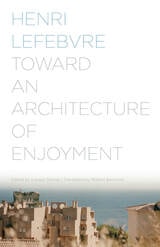
Toward an Architecture of Enjoyment
Henri Lefebvre
University of Minnesota Press, 2014
Toward an Architecture of Enjoyment is the first publication in any language of the only book devoted to architecture by Henri Lefebvre. Written in 1973 but only recently discovered in a private archive, this work extends Lefebvre’s influential theory of urban space to the question of architecture. Taking the practices and perspective of habitation as his starting place, Lefebvre redefines architecture as a mode of imagination rather than a specialized process or a collection of monuments. He calls for an architecture of jouissance—of pleasure or enjoyment—centered on the body and its rhythms and based on the possibilities of the senses.
Examining architectural examples from the Renaissance to the postwar period, Lefebvre investigates the bodily pleasures of moving in and around buildings and monuments, urban spaces, and gardens and landscapes. He argues that areas dedicated to enjoyment, sensuality, and desire are important sites for a society passing beyond industrial modernization.
Lefebvre’s theories on space and urbanization fundamentally reshaped the way we understand cities. Toward an Architecture of Enjoyment promises a similar impact on how we think about, and live within, architecture.
Towards a Cognitive Mode in Global Finance?
The Governance of a Knowledge-Based Financial SystemEdited by Torsten Strulik and Helmut Willke
Campus Verlag, 2007
Toxic Schools
High-Poverty Education in New York and AmsterdamBowen Paulle
University of Chicago Press, 2013
When Bowen Paulle speaks of toxicity, he speaks of educational worlds dominated by intimidation and anxiety, by ambivalence, degradation, and shame. Based on six years of teaching and research in the South Bronx and in Southeast Amsterdam, Toxic Schools is the first fully participatory ethnographic study of its kind and a searing examination of daily life in two radically different settings. What these schools have in common, however, are not the predictable ideas about race and educational achievement but the tragically similar habituated stress responses of students forced to endure the experience of constant vulnerability. From both sides of the Atlantic Ocean, Paulle paints an intimate portrait of how students and teachers actually cope, in real time, with the chronic stress, peer group dynamics, and subtle power politics of urban educational spaces in the perpetual shadow of aggression.
Tradition
Edward Shils
University of Chicago Press, 1981
"Shils is a man of fabled learning, whose mind purrs powerfully like the moth at dusk. I hesitate to use the word conservative of him because it misses the central concern of his work, which is not conservatism, but the conservation of those human resources and achievements which are richest, and matter most."—David A. Martin, Times Literary Supplement
"Tradition is the first comprehensive treatment of the subject that encompasses the totality of tradition in all its multifaceted variables and functions. . . . It is a landmark analytical and theoretical sociological study that not only fills a need but also provides a basic model and impetus for further research."—H. Leon Abrams Jr., Sociology
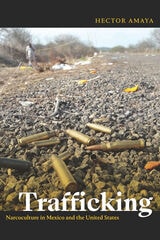
Trafficking
Narcoculture in Mexico and the United StatesHector Amaya
Duke University Press, 2020
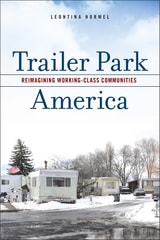
Trailer Park America
Reimagining Working-Class CommunitiesLeontina Hormel
Rutgers University Press, 2023
Transcommunality
From The Politics Of ConversionJohn Brown Childs
Temple University Press, 2003
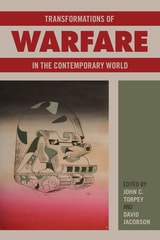
Transformations of Warfare in the Contemporary World
John C. Torpey
Temple University Press, 2016
Today’s warfare has moved away from being an event between massed national populations and toward small numbers of combatants using high-tech weaponry. The editors of and contributors to the timely collection Transformations of Warfare in the Contemporary World show that this shift reflects changes in the technological, strategic, ideological, and ethical realms.
The essays in this volume discuss:
·the waning connection between citizenship and soldiering;
·the shift toward more reconstructive than destructive activities by militaries;
·the ethics of irregular or asymmetrical warfare;
·the role of novel techniques of identification in military settings;
·the stress on precision associated with targeted killings and kidnappings;
·the uses of the social sciences in contemporary warfare.
In his concluding remarks, David Jacobson explores the extent to which the contemporary transformation of warfare is a product of a shift in the character of the combatants themselves.
Contributors include: Ariel Colonomos, Roberto J. González, Travis R. Hall, Saskia Hooiveld, Rob Johnson, Colonel C. Anthony Pfaff, Ian Roxborough, and the editors

Transformations
Art and the CityEdited by Elizabeth M. Grierson
Intellect Books, 2017
Transgender Voices
Beyond Women and MenLori B. Girshick
University Press of New England, 2009
Transient Becoming
Self-improvement and Capitalist Virtuousness in Contemporary ChinaGil Hizi
National University of Singapore Press, 2026
How do individuals seek to become better people in contemporary China? How do they navigate the complex demands of personal growth within the fragmentation of China's moral landscape, which celebrates rabid consumerism and requires political conformity; where a lively and expressive popular culture coexists with official narratives of nationalism, heteronormativity, and social hierarchy; and where a rigid, exam-driven mass educational system is preparation for an economy of great market disruption and employment uncertainty? Sociocultural anthropologist Gil Hizi's careful ethnography provides nuanced answers to these fraught questions by examining the pursuit and enactment of virtue, termed “capitalist virtuousness,” through the expanding genre of self-improvement.
Transient Becoming reveals how workshops in soft skills create heterotopian spaces—distinct moral imaginaries that offer participants transient optimism and virtue realization in compensation for the perceived futility of their ambitions and the socioeconomic uncertainties of their daily lives. Within these spaces, individuals experientially exceed their social reality and perform an idealized sense of self-worth and autonomy, even if these transformations remain short-lived.
Translating Childhoods
Immigrant Youth, Language, and CultureOrellana, Marjorie Faulstich
Rutgers University Press, 2009
Skilled in two vernaculars, children shoulder basic and more complicated verbal exchanges for non-English speaking adults. Readers hear, through children's own words, what it means be "in the middle" or the "keys to communication" that adults otherwise would lack. Drawing from ethnographic data and research in three immigrant communities, Marjorie Faulstich Orellana's study expands the definition of child labor by assessing children's roles as translators as part of a cost equation in an era of global restructuring and considers how sociocultural learning and development is shaped as a result of children's contributions as translators.

Translating the Ketubah
The Jewish Marriage Contract in America and EnglandBenjamin Steiner
University of Alabama Press, 2025
A groundbreaking exploration of the Jewish marriage contract and its evolution in English translation
Translating the Ketubah offers a fresh perspective on the ketubah, the Jewish marriage contract. Traditionally composed in Aramaic, ketubot have been examined in other books within the frameworks of Jewish law and Jewish art. Here, however, Benjamin Steiner shows how translations of the ketubah into English helped Jews adapt to changing social and economic circumstances across more than two centuries.
Steiner uses ketubot to trace the intricate relationship between religious law and secular law, the changing status of women within and outside Judaism, and the complex desire of Jews to be both authentically Jewish and fully acculturated. Steiner further shows how ketubah translation aided Jews to achieve different cultural goals. It has been used to uphold rabbinic law in communities where religious affiliation was voluntary to ensure women's economic security. It has also facilitated socialization with non-Jews and addressed perceived crises within the Jewish family.
Through a nuanced analysis of ketubah translations from England and various regions of the United States from the late eighteenth century to the present, Steiner offers a detailed look at how Jews have adapted ancient tradition to meet the challenges and opportunities of different historical contexts. His work sheds new light on the rich history of American and British Jewry.
Transnational Adoption, Volume 21
Toby Alice Volkman and Cindi Katz, eds.
Duke University Press, 0
In this special issue, scholars—several of whom are adoptive parents—from a variety of disciplines focus on the culture and politics of transnational adoption, exploring relationships between the sending and receiving nations. Until the mid-1970s, adoptive families were pressured to forget the child’s past and birth culture and to create “as if” biological families. Since then, the culture of adoption has moved dramatically toward openness, generating preoccupations with origins and loss, as well as new kinds of border-crossing movements such as orphanage visits, homeland journeys, and culture camps established by sending nations now eager to embrace the adoptees. This collection of essays examines the complex interplay of race, culture, identity, kinship, and belonging in this contemporary form of family building.
Contributors. Lisa Cartwright, Claudia Fonseca, Cindi Katz, Eleana Kim, Toby Alice Volkman, Barbara Yngvesson
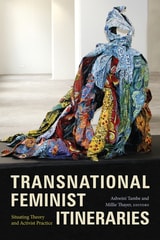
Transnational Feminist Itineraries
Situating Theory and Activist PracticeAshwini Tambe and Millie Thayer, editors
Duke University Press, 2021
Contributors. Mary Bernstein, Isabel Maria Cortesão Casimiro, Rafael de la Dehesa, Carmen L. Diaz Alba, Inderpal Grewal, Cricket Keating, Amy Lind, Laura L. Lovett, Kathryn Moeller, Nancy A. Naples, Jennifer C. Nash, Amrita Pande, Srila Roy, Cara K. Snyder, Ashwini Tambe, Millie Thayer, Catarina Casimiro Trindade
Transnational Intellectual Networks
Forms of Academic Knowledge and the Search for Cultural IdentitiesEdited by Christophe Charle, Jürgen Schriewer, and Peter Wagner
Campus Verlag, 2004
Transnational Marriage and Partner Migration
Constellations of Security, Citizenship, and RightsAnne-Marie D'Aoust
Rutgers University Press, 2022
Transnational Professionals and their Cosmopolitan Universes
Magdalena Nowicka
Campus Verlag, 2006
Tricks of the Trade
How to Think about Your Research While You're Doing ItHoward S. Becker
University of Chicago Press, 1998
Drawing on decades of experience as a researcher and teacher, Howard Becker brings to students and researchers the many valuable techniques for conducting research that he learned and taught. Tricks of the Trade will help students learn how to think about research projects. Assisted by Becker's sage advice, students can make better sense of their research and simultaneously generate fresh ideas on where to look next for new data. The tricks cover four broad areas of social science: the creation of the "imagery" to guide research; methods of "sampling" to generate maximum variety in the data; the development of "concepts" to organize findings; and the use of "logical" methods to explore systematically the implications of what is found. Becker's advice ranges from simple tricks such as changing an interview question from "Why?" to "How?" (as a way of getting people to talk without asking for a justification) to more technical tricks such as how to manipulate truth tables.
Becker has extracted these tricks from a variety of fields such as art history, anthropology, sociology, literature, and philosophy; and his dazzling variety of references ranges from James Agee to Ludwig Wittgenstein. Becker finds the common principles that lie behind good social science work, principles that apply to both quantitative and qualitative research. He offers practical advice, ideas students can apply to their data with the confidence that they will return with something they hadn't thought of before.
Trust Matters
Parsi Endowments in Mumbai and the Horoscope of a CityLeilah Vevaina
Duke University Press, 2023
Trust in Schools
A Core Resource for ImprovementAnthony Bryk
Russell Sage Foundation, 2002
Trust
Representatives and ConstituentsWilliam T. Bianco
University of Michigan Press, 1994
Why do constituents sometimes defer to their representative's judgment, rewarding her for acting as she thinks best, even when she ignores their demands? By making decisions about trust, constituents determine whether their representative is rewarded for implementing their demands or for using her judgment. These decisions shape legislator behavior and, through behavior, policy outcomes. Therefore, any attempt to explain or evaluate representative institutions such as the modern Congress requires an answer to a simple question: When do constituents trust their representative, and what is the basis of that trust?
This book is the first systematic analysis of constituent trust. It assumes that elected officials and ordinary citizens are rational actors. However, the book moves beyond the standard rational choice framework in three ways. It avoids narrow, unrealistic assumptions about motivations and information. It shows that many kinds of behavior not usually thought of as rational choices, such as a voter's desire to be represented by "someone like them," are the product of a systematic, predictable calculus---a calculus aimed at securing favorable policy outcomes. Finally, the book uses interviews with ninety-three members of the U.S. House of Representatives to test its predictions about trust.
Truth-Spots
How Places Make People BelieveThomas F. Gieryn
University of Chicago Press, 2018
In Truth-Spots, Gieryn gives readers an elegant, rigorous rendering of the provenance of ideas, uncovering the geographic location where they are found or made, a spot built up with material stuff and endowed with cultural meaning and value. These kinds of places—including botanical gardens, naturalists’ field-sites, Henry Ford’s open-air historical museum, and churches and chapels along the pilgrimage way to Santiago de Compostela in Spain—would seem at first to have little in common. But each is a truth-spot, a place that makes people believe. Truth may well be the daughter of time, Gieryn argues, but it is also the son of place.

Turkish Berlin
Integration Policy and Urban SpaceAnnika Marlen Hinze
University of Minnesota Press, 2013
The integration of immigrants into a larger society begins at the local level. Turkish Berlin reveals how integration has been experienced by second-generation Turkish immigrant women in two neighborhoods in Berlin, Germany. While the neighborhoods are similar demographically, the lived experience of the residents is surprisingly different.
Informed by first-person interviews with both public officials and immigrants, Annika Marlen Hinze makes clear that local integration policies—often created by officials who have little or no contact with immigrants—have significant effects on the assimilation of outsiders into a community and a society. Focusing on the Turkish neighborhoods of Kreuzberg and Neukölln, Hinze shows how a combination of local policy making and grassroots organizing have contributed to one neighborhood earning a reputation as a hip, multicultural success story and the other as a rougher neighborhood featuring problem schools and high rates of unemployment. Aided by her interviews, she describes how policy makers draw from their imaginations of urban space, immigrants, and integration to develop policies that do not always take social realities into consideration. She offers useful examples of how official policies can actually exacerbate the problems they are trying to help solve and demonstrates that a powerful history of grassroots organizing and resistance can have an equally strong impact on political outcomes.
Employing spatial theory as a tool for understanding the complex processes of integration, Hinze asks two related questions: How do immigrants perceive themselves and their experiences in a new culture? And how are immigrants conceived of by politicians and policy makers? Although her research highlights the German–Turk experience in Berlin, her answers have implications that resonate far beyond the city’s limits.
Twin Cities Sports
Games for All SeasonsSheldon Anderson
University of Arkansas Press, 2020

Two Kinds of Rationality
Kibbutz Democracy and Generational ConflictT.M.S. Evens
University of Minnesota Press, 1995
Two Kinds of Rationality was first published in 1995. Minnesota Archive Editions uses digital technology to make long-unavailable books once again accessible, and are published unaltered from the original University of Minnesota Press editions.
Beginning with a discussion of mind-body dualism in social anthropology, Evens presents a profound theory of human conduct that deploys notions of hierarchy and practice. He uses the case study of an Israeli kibbutz to address the central anthropological problem of rationality.
Of particular interest is Evens's interpretation of the Genesis myth, as well as his reading of Rousseau's revision of this myth, as paradigms of generational conflict and the kibbutz's logic of moral order. These interpretations are tied to Evens's detailed discussion of a controversial attempt to introduce secret balloting into a particular kibbutz's directly democratic process.
Two Kinds of Rationality distinguishes between instrumental and mythic rationality, picturing the latter as a value rationality. Projecting reality as basically ambiguous, Evens offers a critique of theoretical approaches to social action and a rethinking of contemporary notions of human agency. This revolutionary theoretical work will appeal to social and political theorists, anthropologists, and students of cultural studies, social movements, and Jewish studies.
T. M. S. Evens is professor of anthropology at the University of North Carolina, Chapel Hill. He is the author of numerous articles and coeditor of Transcendence in Society: Case Studies (1990), a comparative study of social movements.