Results by title
28250 books match the query 'history' and 6388 start with t
The third spring
G.K. Chesterton, Graham Greene, Christopher Dawson, and David JonesAdam Schwartz
Catholic University of America Press, 2005
The Ópatas
In Search of a Sonoran PeopleDavid A. Yetman
University of Arizona Press, 2010
David Yetman, a leading ethnobotanist who has traveled extensively in Sonora, consulted more than two hundred archival sources to answer this question. The result is an accessible ethnohistory of the Ópatas, one that embraces historical complexity with an eye toward Opatan strategies of resistance and assimilation. Yetman’s account takes us through the Opatans’ initial encounters with the conquistadors, their resettlement in Jesuit missions, clashes with Apaches, their recruitment as miners, and several failed rebellions, and ultimately arrives at an explanation for their “disappearance.”
Yetman’s account is bolstered by conversations with present-day residents of the Opatería and includes a valuable appendix on the languages of the Opatería by linguistic anthropologist David Shaul. One of the few studies devoted exclusively to this indigenous group, The Ópatas: In Search of a Sonoran People marks a significant contribution to the literature on the history of the greater Southwest.
Theater after Film
Martin Harries
University of Chicago Press, 2025
In Theater after Film, Martin Harries argues that after 1945, as cinema became omnipresent in popular culture, theater had to respond to cinema’s hegemony. Theater couldn’t break that hegemony, but it could provide a zone of contestation. Theater made film’s domination of the cultural field visible through hyperbole, refusal, and other strategies, thereby unsettling its power. Postwar theatrical experiment, Harries shows, often channeled and represented film’s mass cultural force, while knowing that it could never possess that force. Throughout the book, Harries brings critical theory into contact with theories of performance. Although Theater after Film treats the theatrical work of many figures, its central focus falls on Tennessee Williams, Samuel Beckett, and Adrienne Kennedy. Discussions of these dramatists consider their ways of addressing spectators, the politics of race between film and theater, and the place of the theatrical apparatus. Readings of these central figures in twentieth-century theater exemplify the book’s historical engagement with the media surround that drama confronted. This confrontation, Harries shows, was central to the development of some of the most continually compelling postwar drama.
Theater and Crisis
Myth, Memory, and Racial Reckoning in America, 1964-2020Patrice D. Rankine
Lever Press, 2024
Rather than approaching the problem of racial reckoning through history, where periodization and progress are dominant narratives, Theater and Crisis argues that myth and memory allow for better theorization about recurring events from the past, their haunting, and what these apparent ghosts ask of us. Building on the study of myth as active, processual storytelling, Rankine acknowledges that it grounds and orients groups toward significant events. Theater and Crisis aligns narratives about Emmett Till, Trayvon Martin, and George Floyd, among others, with ancient, mythic figures such as Christ, Dionysus, Oedipus, and Moses. As living and verbal visitations, these stories performed on stage encode the past through their epiphanies in the present, urging audiences toward shared meaning.
Rankine traces the cyclical hauntings of race through the refiguring of mythic stories across the past 75 years in the plays of James Baldwin, Ntozake Shange, Antoinette Nwandu, and many more, and in response to flashpoints in US racial history, such as the 1955 lynching of Emmett Till, the upheavals of the 1960s and 1970s, the wars on drugs and crime, and the continued violence against and disenfranchisement of Black people into the twenty-first century. Theater and Crisis explores the appearance of myth on the American stage and showcases the ongoing response by the theatrical establishment to transform the stage into a space for racial reckoning. This timely book is essential reading for scholars of theater studies, classics, and American studies.
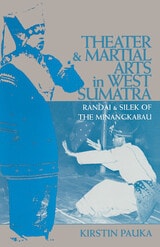
Theater and Martial Arts in West Sumatra
Randai and Silek of the MinangkabauKirstin Pauka
Ohio University Press, 1998
Randai, the popular folk theater tradition of the Minangkabau ethnic group in West Sumatra, has evolved to include influences of martial arts, storytelling, and folk songs. Theater and Martial Arts in West Sumatra describes the origin, development, and cultural background of randai and highlights two recent developments: the emergence of female performers and modern staging techniques.
This book also explores the indigenous martial arts form silek, a vital part of randai today. The strong presence of silek is illustrated in the martial focus of the stories that are told through randai, in its movement repertoire, and even in its costumes and musical accompaniment. As Kirstin Pauka shows, randai, firmly rooted in silek and Minangkabau tradition, is an intriguing mirror of the Minangkabau culture.
Theater and Society in the Classical World
Ruth Scodel, Editor
University of Michigan Press, 1993
Theater of the Mind
Imagination, Aesthetics, and American Radio DramaNeil Verma
University of Chicago Press, 2012
For generations, fans and critics have characterized classic American radio drama as a “theater of the mind.” This book unpacks that characterization by recasting the radio play as an aesthetic object within its unique historical context. In Theater of the Mind, Neil Verma applies an array of critical methods to more than six thousand recordings to produce a vivid new account of radio drama from the Depression to the Cold War.
In this sweeping exploration of dramatic conventions, Verma investigates legendary dramas by the likes of Norman Corwin, Lucille Fletcher, and Wyllis Cooper on key programs ranging from The Columbia Workshop, The Mercury Theater on the Air, and Cavalcade of America to Lights Out!, Suspense, and Dragnet to reveal how these programs promoted and evolved a series of models of the imagination.
With close readings of individual sound effects and charts of broad trends among formats, Verma not only gives us a new account of the most flourishing form of genre fiction in the mid-twentieth century but also presents a powerful case for the central place of the aesthetics of sound in the history of modern experience.
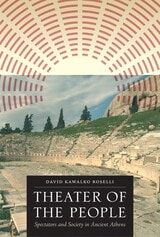
Theater of the People
Spectators and Society in Ancient AthensBy David Kawalko Roselli
University of Texas Press, 2011
Greek drama has been subject to ongoing textual and historical interpretation, but surprisingly little scholarship has examined the people who composed the theater audiences in Athens. Typically, scholars have presupposed an audience of Athenian male citizens viewing dramas created exclusively for themselves—a model that reduces theater to little more than a medium for propaganda. Women's theater attendance remains controversial, and little attention has been paid to the social class and ethnicity of the spectators. Whose theater was it?
Producing the first book-length work on the subject, David Kawalko Roselli draws on archaeological and epigraphic evidence, economic and social history, performance studies, and ancient stories about the theater to offer a wide-ranging study that addresses the contested authority of audiences and their historical constitution. Space, money, the rise of the theater industry, and broader social forces emerge as key factors in this analysis. In repopulating audiences with foreigners, slaves, women, and the poor, this book challenges the basis of orthodox interpretations of Greek drama and places the politically and socially marginal at the heart of the theater. Featuring an analysis of the audiences of Aeschylus, Sophocles, Euripides, Aristophanes, and Menander, Theater of the People brings to life perhaps the most powerful influence on the most prominent dramatic poets of their day.
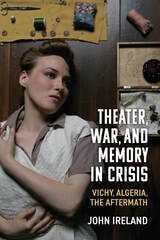
Theater, War, and Memory in Crisis
Vichy, Algeria, the AftermathJohn Ireland
University of Michigan Press, 2025
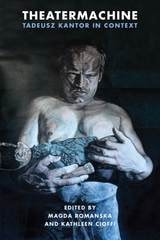
Theatermachine
Tadeusz Kantor in ContextEdited by Magda Romanska and Kathleen Cioffi
Northwestern University Press, 2019
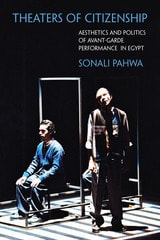
Theaters of Citizenship
Aesthetics and Politics of Avant-Garde Performance in EgyptSonali Pahwa
Northwestern University Press, 2020
In 2004, independent cultural institutions were sites for more democratic forms of youth organization and cultural participation than were Egyptian state theaters. Sonali Pahwa looks at identity formation within this infrastructure for new cultural production: festivals, independent troupes, workshops, and manifesto movements. Bringing institutional changes in dialogue with new performance styles on stages and streets, Pahwa conceptualizes performance culture as a school of citizenship. Independent theater incubated hope in times of despair and pointed to different futures for the nation’s youth than those seen in television and newspapers. Young dramatists countered their generation’s marginalization in the neoliberal economy, media, and political institutions as they performed alternative visions for the nation. An important contribution to the fields of anthropology and performance studies, Pahwa’s analysis will also interest students of sociology and Egyptian history.
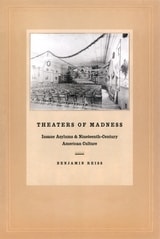
Theaters of Madness
Insane Asylums and Nineteenth-Century American CultureBenjamin Reiss
University of Chicago Press, 2008

Theaters of Occupation
Hollywood and the Reeducation of Postwar GermanyJennifer Fay
University of Minnesota Press, 2008
In the aftermath of total war and unconditional surrender, Germans found themselves receiving instruction from their American occupiers. It was not a conventional education. In their effort to transform German national identity and convert a Nazi past into a democratic future, the Americans deployed what they perceived as the most powerful and convincing weapon-movies.
In a rigorous analysis of the American occupation of postwar Germany and the military’s use of “soft power,” Jennifer Fay considers how Hollywood films, including Ninotchka, Gaslight, and Stagecoach, influenced German culture and cinema. In this cinematic pedagogy, dark fantasies of American democracy and its history were unwittingly played out on-screen. Theaters of Occupation reveals how Germans responded to these education efforts and offers new insights about American exceptionalism and virtual democracy at the dawn of the cold war.
Fay’s innovative approach examines the culture of occupation not only as a phase in U.S.–German relations but as a distinct space with its own discrete cultural practices. As the American occupation of Germany has become a paradigm for more recent military operations, Fay argues that we must question its efficacy as a mechanism of cultural and political change.
Jennifer Fay is associate professor and codirector of film studies in the Department of English at Michigan State University.
Theaters of Time and Space
American Planetaria, 1930-1970Marche, Jordan
Rutgers University Press, 2005
Every year, millions of Americans visit planetariums and are captivated by their strikingly realistic portrayal of the night sky. Today, it is indeed difficult to imagine astronomy education without these magnificent celestial theaters. But projection planetariums, first developed in Germany, have been a part of American museum pedagogy only since the early twentieth century and were not widespread until the 1960s.
In this unique social history,former planetarium director and historian of science Jordan D. Marché II offers the first complete account of the community of individuals and institutions that, during the period between 1930 and 1970, made planetariums the popular teaching aids they are today. Marché addresses issues such as the role of gender and social developments within the planetarium community, institutional patronage, and the popularization of science. He reveals how, at different times, various groups, including financial donors, amateur scientists, and government officials, viewed the planetarium as an instrument through which they could shape public understanding and perceptions of astronomy and space science.
Offering an insightful, wide-ranging look into the origins of an institution that has fascinated millions, Theaters of Timeand Space brings new perspectives to how one educational community changed the cultural complexion of science, helped shape public attitudes toward the U.S. space program, and even contributed to policy decisions regarding allocations for future space research.
Theaters of Translation
Cosmopolitan Vernaculars in Shakespeare's EnglandAndrew S. Keener
University of Alabama Press, 2025
Explores the profound influence of multilingual dictionaries, dialogues, and grammars on English Renaissance playwrights
In Theaters of Translation, Andrew S. Keener offers a fascinating account of the ways that plays by Thomas Kyd, Mary Sidney Herbert, Ben Jonson, and their fellow English contemporaries were shaped by and part of a multilingual Europe where dictionaries, grammars, and language-learning materials circulated widely. He proposes a fresh, multilingual approach to English Renaissance drama that challenges the histories of early modern European languages as sites of national and linguistic cohesion.
Covering the period between 1570 and 1640, when England’s drama and the English language itself were evolving, Keener uses the term “cosmopolitan vernaculars” to examine how nonclassical European languages modeled transnational forms of belonging for playgoers, readers, and authors in Renaissance England. Combining recent contributions to cosmopolitan theory and transnational studies of early modern literature and culture, Keener highlights both the ways in which cosmopolitanism manifests through Europe’s vernacular languages—in print and performance—and the ways languages themselves can exhibit cosmopolitanism for those who encounter them on the page or on the stage.
Theaters of Translation opens up new transnational interpretations of English Renaissance plays and casts fresh light on historical anecdotes, such as Jonson inscribing a copy of Pietro Aretino’s scandalous Italian dialogues or Shakespeare’s First Folio being advertised for sale in Germany before its London publication. It offers much of interest to readers and scholars of Renaissance Europe, early modern drama, and the development of national European languages.
Theaters of the American Revolution
Northern, Middle, Southern, Western, NavalJames Kirby Martin
Westholme Publishing, 2023
Identifying discrete geographical areas in order to better understand a conflict that moves across hundreds of thousands of square miles of land and water, such as the American Civil War and World War II, has been a valuable historical method. During this time of greater study of the war that made America, the authors of Theaters of the American Revolution take this approach for the first time. The result is a stimulating volume that will allow readers to see how the war flowed from region to region from 1775 to 1781, beginning in the Northern colonies and Canada, through the dark months in the Middle colonies, to a shift to the South and culmination at Yorktown. Simultaneously, the war raged up and down the western frontier, with the Patriots working to keep the British and their Indian allies from disrupting the main battle armies to the east. Equally important was the war at sea, where American privateers and a fledgling navy attempted to harass the British; but with the entrance of France to the conflict, the control of the sea took a much more balanced—and important— aspect. With specially commissioned maps and colorful descriptions of eighteenth century American terrain, settlements, and cities, as well as key battles, Theaters of the American Revolution provides an ideal introduction to understanding one of the most important wars in world history in its totality.
Contents
Introduction • James Kirby Martin and David L. Preston
The Northern Theater • James Kirby Martin
The Middle Theater • Edward G. Lengel and Mark Edward Lender
The Southern Theater • Jim Piecuch
The Western Theater • Mark Edward Lender
The Naval Theater • Charles Neimeyer
Theaters of the Everyday
Aesthetic Democracy on the American StageJacob Gallagher-Ross
Northwestern University Press, 2018
Offering both fresh reappraisals of canonical figures and movements and new examinations of theatrical innovators, Theaters of the Everyday reveals surprising affinities between artists often considered poles apart, such as John Cage and Lee Strasberg, and Thornton Wilder and the New York experimentalist Nature Theater of Oklahoma. Gallagher-Ross persuasively shows how these creators eschew conventional definitions of dramatic action and focus attention on smaller but no less profound dramas of perception, consciousness, and day-to-day life.
Gallagher-Ross traces some of the intellectual roots of the theater of the everyday to American transcendentalism, with its pragmatic process philosophy as well as its sense of ordinary experience as the wellspring of aesthetic awareness.
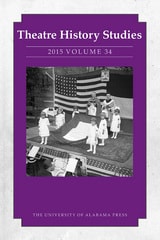
Theatre History Studies 2015, Vol. 34
Elizabeth Reitz Mullenix
University of Alabama Press, 2015
The five essays are arranged chronologically, starting with Alan Sikes’s discussion of the Abydos Passion Play. Sikes challenges the long-held interpretation of that ritualized annual reenactment of the death, dismemberment, and return to life of Egyptian god-king Osiris as the world’s first recorded dramatic production. In analyzing the “Passion Play”—Sikes argues the term is not apt—he applies semiotic theory using "sign and referent" to revise general concepts of mimesis, and in so doing clarifies the fundamental answer to the question, “What is theatre?”
In a pair of essays, Andrew Gibb and Nicole Berkin both explore theatre during America’s antebellum period. Gibb examines minstrelsy in antebellum California, exploding narrow definitions of minstrelsy as a primarily Eastern phenomenon and one reflecting a stark interaction of two races. Following the story of Jewish African Caribbean immigrant William Alexander Leidesdorff, Gibb demonstrates that national forms are always affected by their local productions and audiences. Berkin’s essay focuses on the struggles over cultural power that took place between popular entertainers and theatre managers. She examines how both parties used touring strategically to engage with antebellum notions of deception and fraud.
The last two essays, by Megan Geigner and Heide Nees, present findings from performance studies which, by examining a wide array of dramatic and performative texts, expands the interdisciplinary foundations of theatre history studies. This fascinating collection is rounded out by an expanded selection of insightful reviews of recent literature in the area.
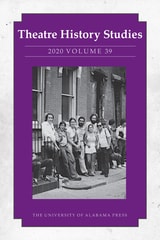
Theatre History Studies 2020, Vol. 39
Edited by Lisa Jackson-Schebetta
University of Alabama Press, 2020
Theatre History Studies (THS) is a peer-reviewed journal of theatre history and scholarship published annually since 1981 by the Mid-America Theatre Conference
Reframing the past to illuminate the future of performance.
Theatre History Studies is a peer-reviewed journal devoted to excellence in theatre historiography. Volume 38, edited by Lisa Jackson-Schebetta, features three distinct sections: foundational studies in theatre history, a special section on hemispheric historiographies, and award-winning essays from the Mid-America Theatre Conference. Contributors examine topics ranging from Shakespeare and racial antagonism to systemic dramaturgy, labor unions in regional theatre, and digital diasporic activism. The volume also includes visual histories and decolonial methodologies that challenge Eurocentric narratives and foreground Latinx, feminist, and socialist performance traditions. With 272 pages and 18 black-and-white figures, this edition is a rich resource for scholars seeking to expand the scope and methods of theatre history.
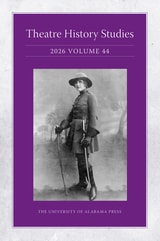
Theatre History Studies 2026, Vol 44
Edited by Jocelyn L. Buckner
University of Alabama Press, 2026
The official journal of the Mid-America Theatre Conference
Theatre History Studies (THS) is a peer-reviewed journal of theatre history and scholarship published annually since 1981 by the Mid-America Theatre Conference (MATC), a regional body devoted to theatre scholarship and practice. The conference is dedicated to the growth and improvement of all forms of theatre throughout a twelve-state region encompassing Illinois, Indiana, Iowa, Kansas, Michigan, Minnesota, Missouri, Nebraska, North Dakota, Ohio, South Dakota, and Wisconsin. The purposes of the conference are to unite people and organizations within the region and elsewhere who have an interest in theatre and to promote the growth and development of all forms of theatre. THS is a member of the Council of Editors of Learned Journals and is included in the MLA Directory of Periodicals. THS is cataloged in numerous periodical indexes and databases.
Along with sixteen book reviews on the latest publications from established and emerging voices in the field, this issue of Theatre History Studies contains four sections with two introductions and nine essays total. In the general section, three essays consider performance histories and reevaluations of historiographical approaches. The special section on queer historiographies responds to calls for a more expansive and inclusive understanding of trans histories and for centralizing contemporary queer performers. In part III, the Robert A. Schanke Research Award-winning paper from the 2024 MATC conference by Ali-Reza Mirsajadi addresses erasures in the theatrical archive and highlights the long legacy of queer, Southwest Asian, and North African representation in dramatic texts. Taken together, volume 44 captures how this journal serves theatre historians as scholars and laborers as they work to attend and tend to their field.
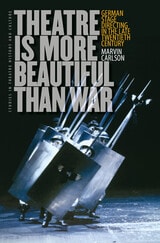
Theatre Is More Beautiful Than War
German Stage Directing in the Late Twentieth CenturyCarlson, Marvin
University of Iowa Press, 2009
In almost every area of production, German theatre of the past forty years has achieved a level of distinction unique in the international community. This flourishing theatrical culture has encouraged a large number of outstanding actors, directors, and designers as well as video and film artists. The dominant figure throughout these years, however, has remained the director. In this stimulating and informative book, noted theatre historian Marvin Carlson presents an in-depth study of the artistic careers, working methods, and most important productions of ten of the leading directors of this great period of German staging.
Beginning with the leaders of the new generation that emerged in the turbulent late 1960s—Peter Stein, Peter Zadek, and Claus Peymann, all still major figures today—Carlson continues with the generation that appeared in the 1980s, particularly after reunification—Frank Castorf, Anna Viebrock, Andrea Breth, and Christoph Marthaler—and concludes with the leading directors to emerge after the turn of the century, Stefan Pucher, Thomas Ostermeier, and Michael Thalheimer. He also provides information not readily available elsewhere in English on many of the leading actors and dramatists as well as the designers whose work, much of it for productions of these directors, has made this last half century a golden age of German scenic design.
During the late twentieth century, no country produced so many major theatre directors or placed them so high in national cultural esteem as Germany. Drawing on his years of regular visits to the Theatertreffen in Berlin and other German productions, Carlson will captivate students of theatre and modern German history and culture with his provocative, well-illustrated study of the most productive and innovative theatre tradition in Europe.
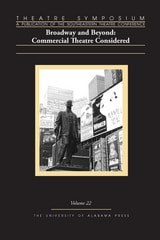
Theatre Symposium, Vol. 22
Broadway and Beyond: Commercial Theatre ConsideredDavid S. Thompson
University of Alabama Press, 2014
The eleven contributors to this fascinating collection illuminate many aspects of commercial theatre and how best to examine it. George Pate analyzes the high-stakes implication of a melodramatic legal battle. Christine Woodworth recounts the difficulties encountered by British actresses near the turn of the twentieth century, while Boone J. Hopkins considers newly found images of Margo Jones along with the commercial appeal they represent.
The volume continues with articles that follow developments with ties to commercial theatre, such as the interplay between Broadway companies and regional theatres, musical productions in communist Poland, and the influence of Korean popular culture on theatre and the unique production arrangements that have resulted. Other essays investigate alternative concepts related to commercial themes with regard to audience interaction and the burgeoning world of geek theatre.
Edited by David S. Thompson, this latest publication by the largest regional theatre organization in the United States collects the most current scholarship on theatre history and theory.
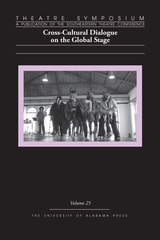
Theatre Symposium, Vol. 25
Cross-Cultural Dialogue on the Global StageEdited by Becky K. Becker
University of Alabama Press, 2017
Globalization may strike many as a phenomenon of our own historical moment, but it is truly as old as civilization: we need only look to the ancient Silk Road linking the Far East to the Mediterranean in order to find some of the earliest recorded impacts of people and goods crossing borders. Yet, in the current cultural moment, tensions are high due to increased migration, economic unpredictability, complicated acts of local and global terror, and heightened political divisions all over the world.
Thus globalization seems new and a threat to our ways of life, to our nations, and to our cultures. In what ways have theatre practitioners, educators, and scholars worked to support cross-cultural dialogue historically? And in what ways might theatre embrace the complexities and contradictions inherent in any meaningful exchange? The essays in Theatre Symposium, Volume 25 reflect on these questions.
Featured in Theatre Symposium, Volume 25
- “Theatre as Cultural Exchange: Stages and Studios of Learning” by Anita Gonzalez
- “Certain Kinds of Dances Used among Them: An Initial Inquiry into Colonial Spanish Encounters with the Areytos of the Taíno in Puerto Rico” by E. Bert Wallace
- “Gertrude Hoffmann’s Lawful Piracy: ‘A Vision of Salome’ and the Russian Season as Transatlantic Production Impersonations” by Sunny Stalter-Pace
- “Greasing the Global: Princess Lotus Blossom and the Fabrication of the ‘Orient’ to Pitch Products in the American Medicine Show” by Chase Bringardner
- “Dismembering Tennessee Williams: The Global Context of Lee Breuer’s A Streetcar Named Desire” by Daniel Ciba
- “Transformative Cross-Cultural Dialogue in Prague: Americans Creating Czech History Plays” by Karen Berman
- “Finding Common Ground: Lessac Training across Cultures” by Erica Tobolski and Deborah A. Kinghorn
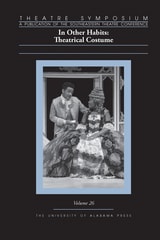
Theatre Symposium, Vol. 26
In Other Habits: Theatrical CostumeSarah McCarroll
University of Alabama Press, 2018
Stage costumes reveal character. They tell audiences who the character is or how a character functions within the world of the play, among other things. Theatrical costuming, however, along with other forms of theatre design, has often been considered merely a craft, rather than part of the deeply systemic creation of meaning onstage. In what ways do our clothes shape and reveal our habits of behavior? How do stage costumes work to reveal one kind of habit via the manipulation of another? How might theatre practitioners learn to most effectively exploit this dynamic? Theatre Symposium, Volume 26 analyzes the ways in which meaning is conveyed through costuming for the stage and explores the underlying assumptions embedded in theatrical practice and costume production.
THEATRE SYMPOSIUM, VOLUME 26
MICHELE MAJER
Plus que Reine: The Napoleonic Revival in Belle Epoque Theatre and Fashion
CAITLIN QUINN
Creating a Realistic Rendering Pedagogy: The Fashion Illustration Problem
ALY RENEE AMIDEI
Where'd I Put My Character?: The Costume Character Body and Essential Costuming for the Ensemble Actor
KYLA KAZUSCHYK
Embracing the Chaos: Creating Costumes for Devised Work
DAVID S. THOMPSON
Dressing the Image: Costumes in Printed Theatrical Advertising
LEAH LOWE
Costuming the Audience: Gentility, Consumption, and the Lady’s Theatre Hat in Gilded Age America
JORGE SANDOVAL
The RuPaul Effect: The Exploration of the Costuming Rituals of Drag Culture in Social Media and the Theatrical Performativity of the Male Body in the Ambit of the Everyday
GREGORY S. CARR
A Brand New Day on Broadway: The Genius of Geoffrey Holder’s Artistry and His Intentional Evocation of the African Diaspora
ANDREW GIBB
On the [Historical] Sublime: J. R. Planché’s King John and the Romantic Ideal of the Past
Theatre Things
Material Theories and HistoriesEdited by Andrew Friedman and Eero Laine
University of Michigan Press, 2026
Theatre Things: Material Theories and Histories considers key theatrical objects through a comparative approach, examining the uses and histories of different parts of the theatre throughout time and across culture and geography. The ten “theatre things” at the heart of the book are: entrances, tickets, programs, concessions, seats, lights, curtains, stages, trapdoors, and exits. For every object, three different scholars offer short chapters that examine it from different angles across eras, places, and performance traditions to result in a set of diverse and provocative accounts of the many ways objects have functioned throughout theatre history. Written in an accessible style, the book draws on real examples from theatre history around the world to reveal that even the smallest details—where you sit, how the lights shift, what the program says—carry meaning. Whether you’re a regular theatregoer or a curious fan, Theatre Things offers a fresh way to look at the spaces and objects that shape every night at the theatre—and makes them feel newly interesting long after the curtain call.
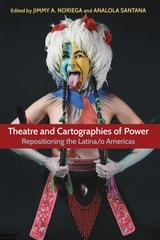
Theatre and Cartographies of Power
Repositioning the Latina/o AmericasEdited by Jimmy A. Noriega and Analola Santana
Southern Illinois University Press, 2018
Building on hemispheric and transnational models, this book demonstrates the capacity of theatre studies to challenge the up-down/North-South approach that dominates scholarship in the United States and presents a strong case for a repositioning of the Latina/o Americas in theatrical histories and practices.
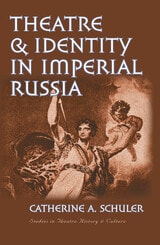
Theatre and Identity in Imperial Russia
Catherine A. Schuler
University of Iowa Press, 2009
Schuler draws upon contemporary journals written and published by the educated nobility and the intelligentsia—who represented the intellectual, aesthetic, and cultural groups of the day—as well as upon the laws of the Russian empire and upon theatrical memoirs. With fascinating detail, she spotlights the ideologically charged binaries ascribed to prominent actors—authentic/performed, primitive/civilized, Russian/Western—that mirrored the volatility of national identity from the Napoleonic Wars through the reign of Alexander II.
If the path traveled by Russian artists and audiences from the turn of the nineteenth century to the era of the Great Reforms reveals anything about Russian culture and society, it may be that there is nothing more difficult than being Russian in Russia. By exploring the ways in which theatrical administrators, playwrights, and actors responded to three tsars, two wars, and a major revolt, this carefully crafted book demonstrates the battle for the hearts and minds of the Russian people.
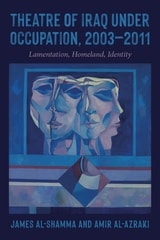
Theatre of Iraq Under Occupation, 2003-2011
Lamentation, Homeland, IdentityJames Al-Shamma
University of Iowa Press, 2025
However, in 2003, the United States invasion of Iraq propelled Iraqi theatre in an altogether different direction. Global media published photographs documenting the torture of Iraqi detainees by American soldiers and sectarian violence broke out, as Shiʿa and Sunni militias struggled for power. Theatre of Iraq Under Occupation examines the occupation’s impact on Iraqi theatre as eliciting lamentation over loss of homeland and identity, and as an assault on the Iraqi character itself. The first volume in English dedicated solely to theatre in Iraq, James Al-Shamma and Amir Al-Azraki’s insights don’t just offer a significant contribution to cultural studies, they bridge foreign policy and art in real time.
Theatre of the Real
Yeats, Beckett, and SondheimGina Masucci MacKenzie
The Ohio State University Press, 2008
Theatre, Community, and Civic Engagement in Jacobean London
Mark Bayer
University of Iowa Press, 2011
Taking to heart Thomas Heywood’s claim that plays “persuade men to humanity and good life, instruct them in civility and good manners, showing them the fruits of honesty, and the end of villainy,” Mark Bayer’s captivating new study argues that the early modern London theatre was an important community institution whose influence extended far beyond its economic, religious, educational, and entertainment contributions. Bayer concentrates not on the theatres where Shakespeare’s plays were performed but on two important amphitheatres, the Fortune and the Red Bull, that offer a more nuanced picture of the Jacobean playgoing industry. By looking at these playhouses, the plays they staged, their audiences, and the communities they served, he explores the local dimensions of playgoing.

Theatre, Time and Temporality
Melting Clocks and Snapped ElasticsDavid Ian Rabey
Intellect Books, 2016
Theatres of Independence
Drama, Theory, and Urban Performance in India since 1947Aparna Bhargava Dharwadker
University of Iowa Press, 2005
The first part of Dharwadker’s study deals with the new dramatic canon that emerged after 1950 and the variety of ways in which plays are written, produced, translated, circulated, and received in a multilingual national culture. The second part traces the formation of significant postcolonial dramatic genres from their origins in myth, history, folk narrative, sociopolitical experience, and the intertextual connections between Indian, European, British, and American drama. The book’s ten appendixes collect extensive documentation of the work of leading playwrights and directors, as well as a record of the contemporary multilingual performance histories of major Indian, Western, and non-Western plays from all periods and genres. Treating drama and theatre as strategically interrelated activities, the study makes post-independence Indian theatre visible as a multifaceted critical subject to scholars of modern drama, comparative theatre, theatre history, and the new national and postcolonial literatures.
Theatres of Struggle and the End of Apartheid
Belinda Bozzoli
Ohio University Press, 2004
A compelling study of the origins and trajectory of one of the legendary black uprisings against apartheid, Theatres of Struggle and the End of Apartheid draws on insights gained from the literature on collective action and social movements. It delves into the Alexandra Rebellion of 1986 to reveal its inner workings.
Belinda Bozzoli’s aim is to examine how the residents of Alexandra, a poverty-stricken segregated township in Johannesburg, manipulated and overturned the meanings of space, time, and power in their sequestered world. She explains how they used political theater to convey, stage, and dramatize their struggle and how young and old residents generated differing ideologies and tactics, giving rise to a distinct form of generational politics.
Theatres of Struggle and the End of Apartheid asks the reader to enter into the world of the rebels and to confront the moral complexity and social duress they experienced as they invented new social forms and violently attacked old ones. It is an important study of collective action that will be of great interest to sociologists and to scholars of Africa, particularly to those interested in the antiapartheid struggle.
Theatres of the Body
Dance and Discourse in Antebellum PhiladelphiaLynn Matluck Brooks
Temple University Press, 2025
Reviewing print culture in the 1840s, Brooks shows how newspapers, magazines, and popular fiction provided documentation of dancing in Philadelphia as well as the responses of dance commentators, practitioners, and moralists. Theatres of the Body also considers the interplay of science with dance in the 1850s, which impacted both dance practices and reception.
Providing an expansive historiography of these significant contributions to dance in the United States, Brooks deepens our understanding of antebellum culture and history.
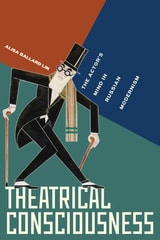
Theatrical Consciousness
The Actor’s Mind in Russian ModernismAlisa Ballard Lin
Northwestern University Press, 2025
Investigating late imperial Russian and early Soviet modernism’s reinvention of the actor
In this wide-ranging study, Alisa Ballard Lin argues that Russian theatrical theory and practice contributed to a broad pre- and postrevolutionary discourse about the mind, profoundly reshaping concepts of consciousness, perception, identity, and the constitution of the subject. Theatrical Consciousness: The Actor’s Mind in Russian Modernism examines efforts in Russian theater—from around the turn of the century through the mid-1930s—to stimulate, train, imagine, and ultimately understand the actor’s, as well as the spectator’s, mind. Discussing key figures of the period, including Nikolai Evreinov, Konstantin Stanislavsky, Vsevolod Meyerhold, and Alexander Tairov, Lin identifies an underappreciated dimension of humanism within Russian modernism: a humanism that resisted the pressures of an increasingly technologized, industrialized, and politicized modernity that challenged the place of the human within it.
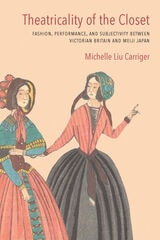
Theatricality of the Closet
Fashion, Performance, and Subjectivity between Victorian Britain and Meiji JapanMichelle Liu Carriger
Northwestern University Press, 2023
Clothing matters. This basic axiom is both common sense and, in another way, radical. It is from this starting point that Michelle Liu Carriger elucidates the interconnected ways in which gender, sexuality, class, and race are created by the everyday act of getting dressed. Theatricality of the Closet: Fashion, Performance, and Subjectivity between Victorian Britain and Meiji Japan examines fashion and clothing controversies of the nineteenth century, drawing on performance theory to reveal how the apparently superficial or frivolous deeply affects the creation of identity.
By interrogating a set of seemingly disparate examples from the same period but widely distant settings—Victorian Britain and Meiji-era Japan—Carriger disentangles how small, local, ordinary practices became enmeshed in a global fabric of cultural and material surfaces following the opening of trade between these nations in 1850. This richly illustrated book presents an array of media, from conservative newspapers and tabloids to ukiyo-e and early photography, that locate dress as a site where the individual and the social are interwoven, whether in the 1860s and 1870s or the twenty-first century.
Thedford II
A Paleo-Indian Site in the Ausable River Watershed of Southwestern OntarioD. Brian Deller and Christopher J. Ellis with a foreword by Henry T. Wright
University of Michigan Press, 1992
Their Day In The Sun
Ruth Howes
Temple University Press, 1999
The Manhattan Project also included women in every capacity. During World War II the manpower shortages opened the laboratory doors to women and they embraced the opportunity to demonstrate that they, too, could do "creative science." Although women participated in all aspects of the Manhattan Project, their contributions are either omitted or only mentioned briefly in most histories of the project. It is this hidden story that is presented in Their Day in the Sun through interviews, written records, and photographs of the women who were physicists, chemists, mathematicians, biologists, and technicians in the labs.
Authors Ruth H. Howes and Caroline L. Herzenberg have uncovered accounts of the scientific problems the women helped solve as well as the opportunities and discrimination they faced. Their Day in the Sun describes their abrupt recruitment for the war effort and includes anecdotes about everyday life in these clandestine improvised communities. A chapter about what happened to the women after the war and about their attitudes now, so many years later, toward the work they did on the bomb is included.

Their Day In The Sun
Women Of The Manhattan ProjectRuth H. Howes
Temple University Press, 2003

Their Determination to Remain
A Cherokee Community's Resistance to the Trail of Tears in North CarolinaLance Greene
University of Alabama Press, 2023
The remarkable story of a North Carolina Cherokee community who avoided forced removal on the Trail of Tears
During the 1838 forced Cherokee removal by the US government, a number of close-knit Cherokee communities in the Southern Appalachian Mountains refused to relinquish their homelands, towns, and way of life. Using a variety of tactics, hundreds of Cherokees avoided the encroaching US Army and remained in the region.
In his book Their Determination to Remain: A Cherokee Community’s Resistance to the Trail of Tears in North Carolina, Lance Greene explores the lives of wealthy plantation owners Betty and John Welch who lived on the southwestern edge of the Cherokee Nation. John was Cherokee and Betty was White. Although few Cherokees in the region participated in slavery, the Welches held nine African Americans in bondage.
During removal, the Welches assisted roughly 100 Cherokees hiding in the steep mountains. Afterward, they provided land for these Cherokees to rebuild a new community, Welch’s Town. Betty became a wealthy and powerful plantation mistress because her husband could no longer own land. Members of Welch’s Town experienced a transitional period in which they had no formal tribal government or clear citizenship yet felt secure enough to reestablish a townhouse, stickball fields, and dance grounds.
Greene’s innovative study uses an interdisciplinary approach, incorporating historical narrative and archaeological data, to examine how and why the Welches and members of Welch’s Town avoided expulsion and reestablished their ways of life in the midst of a growing White population who resented a continued Cherokee presence. The Welch strategy included Betty’s leadership in demonstrating outwardly their participation in modern Western lifestyles, including enslavement, as John maintained a hidden space—within the boundaries of their land—for the continuation of traditional Cherokee cultural practices. Their Determination to Remain explores the complexities of race and gender in this region of the antebellum South and the real impacts of racism on the community.
Their Sisters' Keepers
Women's Prison Reform in America, 1830-1930Estelle B. Freedman
University of Michigan Press, 1984
Them Goon Rules
Fugitive Essays on Radical Black FeminismMarquis Bey
University of Arizona Press, 2019
A series of essays that reads like a critical memoir, this work queries the function and implications of politicized Blackness, Black feminism, and queerness. Bey binds together his personal experiences with social justice work at the New York–based Audre Lorde Project, growing up in Philly, and rigorous explorations of the iconoclasm of theorists of Black studies and Black feminism. Bey’s voice recalibrates itself playfully on a dime, creating a collection that tarries in both academic and nonacademic realms.
Fashioning fugitive Blackness and feminism around a line from Lil’ Wayne’s “A Millie,” Them Goon Rules is a work of “auto-theory” that insists on radical modes of thought and being as a refrain and a hook that is unapologetic, rigorously thoughtful, and uncompromising.
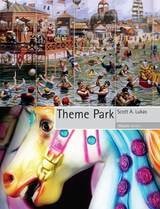
Theme Park
Scott A. Lukas
Reaktion Books, 2008
Theme Park takes the primitive amusements of pleasure gardens as its starting point and launches from there into a rich, in-depth investigation of the evolution of the theme park over the twentieth century. Lukas examines theme parks in countries around the world—including in the United States, Mexico, Europe, Japan, China, South Africa, and Australia—and how themed fairs and parks developed through diverse means and in a variety of settings. The book examines world-famous and lesser-known parks, including the early parks of Coney Island; Madrid’s Movieworld; a series of World Fairs and their luxurious exhibition halls; Six Flags parks and virtual theme parks today; and, of course, the unparalleled achievements of Disneyland and Disney World.
Lukas analyzes the theme park as a living entity that unexpectedly shapes people, their relationships, and the world around them. Theme parks have now become complex representations of the human mind itself, he contends, through its interpretations of books, feature films, video games, and Web sites. Ultimately, Theme Park reveals, the wider influence of theme parks can be found in the shopping malls, branded stores, and casinos that employ the tricks and techniques of amusement parks to dominate our entertainment world today.
Packed with captivating illustrations, Theme Park takes us on historical roller coaster ride that both reanimates the places that shaped our childhoods and anticipates the future of escapism and fantasy fun.
Themes in West Africa’s History
Emmanuel Kwaku Akyeampong
Ohio University Press, 2006
There has long been a need for a new textbook on West Africa’s history. In Themes in West Africa’s History, editor Emmanuel Kwaku Akyeampong and his contributors meet this need, examining key themes in West Africa’s prehistory to the present through the lenses of their different disciplines.
The contents of the book comprise an introduction and thirteen chapters divided into three parts. Each chapter provides an overview of existing literature on major topics, as well as a short list of recommended reading, and breaks new ground through the incorporation of original research. The first part of the book examines paths to a West African past, including perspectives from archaeology, ecology and culture, linguistics, and oral traditions. Part two probes environment, society, and agency and historical change through essays on the slave trade, social inequality, religious interaction, poverty, disease, and urbanization. Part three sheds light on contemporary West Africa in exploring how economic and political developments have shaped religious expression and identity in significant ways.
Themes in West Africa’s History represents a range of intellectual views and interpretations from leading scholars on West Africa’s history. It will appeal to college undergraduates, graduate students, and scholars in the way it draws on different disciplines and expertise to bring together key themes in West Africa’s history, from prehistory to the present.
Themistius and the Imperial Court
Oratory, Civic Duty, and Paideia from Constantius to TheodosiusJohn Vanderspoel
University of Michigan Press, 1995
Theodore Roosevelt in the Field
Michael R. Canfield
University of Chicago Press, 2015
Drawing extensively on Roosevelt’s field notebooks, diaries, and letters, Canfield takes readers into the field on adventures alongside him. From Roosevelt’s early childhood observations of ants to his notes on ornithology as a teenager, Canfield shows how Roosevelt’s quest for knowledge coincided with his interest in the outdoors. We later travel to the Badlands, after the deaths of Roosevelt’s wife and mother, to understand his embrace of the rugged freedom of the ranch lifestyle and the Western wilderness. Finally, Canfield takes us to Africa and South America as we consider Roosevelt’s travels and writings after his presidency. Throughout, we see how the seemingly contradictory aspects of Roosevelt’s biography as a hunter and a naturalist are actually complementary traits of a man eager to directly understand and experience the environment around him.
As our connection to the natural world seems to be more tenuous, Theodore Roosevelt in the Field offers the chance to reinvigorate our enjoyment of nature alongside one of history’s most bold and restlessly curious figures.
Theodore Roosevelt
A Literary LifeThomas Bailey and Katherine Joslin
University Press of New England, 2018
Theodoret of Cyrrhus
The Bishop and the Holy ManTheresa Urbainczyk
University of Michigan Press, 2002
With the conversion of Constantine and his subsequent championing of the Christian cause, the Church rapidly began to increase its wealth and status. As coins filled the coffers of God, some Christians came to feel that their religion had become corrupted. They fled to the desert wastes, seeking a purer, holier life. These recluses and ascetics are the subjects of Theodoret's Religious History. The Syrian bishop had known many of them, some for all his life.
Urbainczyk argues that Theodoret's work was not merely written as an act of piety, but was in fact a very political treatise, addressing the theological disputes of his day. The main tensions of the early fifth century lay between the sees of Syrian Antioch and Egyptian Alexandria. One of Theodoret's aims was to show that Syria had produced individuals as pious as those of Egypt, about whom much had already been written. Urbainczyk studies the social background of these Syrian ascetics, describes the relationship between Theodoret's heroes and the Church community, and investigates how Theodoret presents his own personal relationship with the holy men.
This book is the first to examine Theodoret's role in his own work. Urbainczyk argues that the intimate details of Theodoret's life were not let slip accidentally but were inserted deliberately to buttress his own threatened position and to show how these independent men of God deferred to no one but himself.
Theodoret of Cyrrhus is an invaluable study for students of late antiquity, scholars of early Church history, early medieval historiographers and hagiographers.
Theresa Urbainczyk is College Lecturer in Classics, University College, Dublin.
Theology and Literature in the Age of Johnson
Resisting SecularismMelvyn New
University of Delaware Press, 2012
Published by University of Delaware Press. Distributed worldwide by Rutgers University Press.
Theology and the Cartesian Doctrine of Freedom
Etienne Gilson
St. Augustine's Press, 2015