Results by title
28250 books match the query 'HISTORY' and 6388 start with t
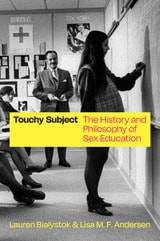
Touchy Subject
The History and Philosophy of Sex EducationLauren Bialystok and Lisa M. F. Andersen
University of Chicago Press, 2022
In the United States, sex education is more than just an uncomfortable rite of passage: it's a political hobby horse that is increasingly out of touch with young people’s needs. In Touchy Subject, philosopher Lauren Bialystok and historian Lisa M. F. Andersen unpack debates over sex education, explaining why it’s worth fighting for, what points of consensus we can build upon, and what sort of sex education schools should pursue in the future.
Andersen surveys the history of school-based sex education in the United States, describing the key question driving reform in each era. In turn, Bialystok analyzes the controversies over sex education to make sense of the arguments and offer advice about how to make educational choices today. Together, Bialystok and Andersen argue for a novel framework, Democratic Humanistic Sexuality Education, which exceeds the current conception of “comprehensive sex education” while making room for contextual variation. More than giving an honest run-down of the birds and the bees, sex education should respond to the features of young people’s evolving worlds, especially the digital world, and the inequities that put some students at much higher risk of sexual harm than others. Throughout the book, the authors show how sex education has progressed and how the very concept of “progress” remains contestable.
Touchy Subject
The History and Philosophy of Sex EducationLauren Bialystok and Lisa M. F. Andersen
University of Chicago Press, 2022
A case for sex education that puts it in historical and philosophical context.
In the United States, sex education is more than just an uncomfortable rite of passage: it's a political hobby horse that is increasingly out of touch with young people’s needs. In Touchy Subject, philosopher Lauren Bialystok and historian Lisa M. F. Andersen unpack debates over sex education, explaining why it’s worth fighting for, what points of consensus we can build upon, and what sort of sex education schools should pursue in the future.
Andersen surveys the history of school-based sex education in the United States, describing the key question driving reform in each era. In turn, Bialystok analyzes the controversies over sex education to make sense of the arguments and offer advice about how to make educational choices today. Together, Bialystok and Andersen argue for a novel framework, Democratic Humanistic Sexuality Education, which exceeds the current conception of “comprehensive sex education” while making room for contextual variation. More than giving an honest run-down of the birds and the bees, sex education should respond to the features of young people’s evolving worlds, especially the digital world, and the inequities that put some students at much higher risk of sexual harm than others. Throughout the book, the authors show how sex education has progressed and how the very concept of “progress” remains contestable.

Tough Love
Amazon Encounters in the English RenaissanceKathryn Schwarz
Duke University Press, 2000
Despite seeming to function as signs for what is outside the social—the alien, the exotic, the other—Amazons in sixteenth- and seventeenth-century texts were often represented in conventionally domestic roles, as mothers and lovers, wives and queens, Schwarz demonstrates. She traces this pattern in works by Shakespeare, Spenser, Sidney, Raleigh, and Jonson, as well as in such materials as conduct manuals, explorers’ accounts, court spectacles, and political tracts. Through readings of these texts, Schwarz shows that the Amazon myth provided a language both for setting forth and for challenging the terms of social logic. In representations of Amazon encounters, she argues, homosocial bonds became indistinguishable from heterosexual desires, masculine agency attached itself as logically to women as it did to men, and sexual difference was made nearly impossible to sustain or define. Schwarz’s analysis unveils the Amazon as a theoretical term, one that illuminates the tensions and paradoxes through which ideologies of the domestic take shape.
Tough Love contributes to the ongoing discussion of gendered identity and sexual desire in the early modern period. It will interest students of queer theory, cultural studies, early modern history, feminism, and literature.
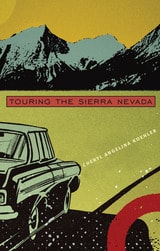
Touring The Sierra Nevada
Cheryl Angelina Koehler
University of Nevada Press, 2007
The complete guide to the entire Sierra Nevada
The Sierra Nevada is one of the most scenic, biologically diverse, and historically rich mountain ranges in North America. Touring the Sierra Nevada covers the entire range and its adjacent regions, exploring the Sierra Nevada from such world-famous sites as Lake Tahoe and Yosemite to picturesque mining towns, scenic alpine lakes, lush vineyards, and colorful hidden byways. Koehler offers suggestions for long tours and exciting daytrips, as well as detailed information about the history, geology, flora and fauna, economy, and unique features of places along the way. The book is illustrated with photographs and maps of the regions she describes. Koehler includes excursions for automobile travelers as well as backcountry adventures for hikers. She provides information about attractions in the Sierra’s two “jumping-off” cities, Sacramento and Reno, as well as in some of the major towns within the range. There is practical advice about contacting parks, museums, historical sites, visitors’ bureaus, U.S. Forest Service offices, and other agencies; finding lodging, campgrounds, and restaurants along the way; preparing for weather and altitude changes; and identifying further sources of information about the region in published guides and other books, as well as on websites. Koehler offers her readers the literary companionship of an experienced, charming, and vivacious guide through one of America’s most fascinating regions.

Touring the Screen
Tourism and New Zealand Film GeographiesAlfio Leotta
Intellect Books, 2011
Following the success of prominent feature films shot on location, including Tolkien’s wildly popular The Lord of the Rings, New Zealand boasts an impressive film tourism industry. This book examines the relationship between New Zealand’s cinematic representation—as both a vast expanse of natural beauty and a magical world of fantasy on screen—and its tourism imagery, including the ways in which savvy local tourism boards have in recent decades used the country’s film representations to sell New Zealand as a premiere travel destination. Focusing on the films that have had a strong impact on marketing strategies by local tourist boards, Touring the Screen will be of interest to all those working and studying in the fields of cinema, postcolonial history, and tourism studies.
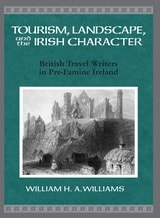
Tourism, Landscape, and the Irish Character
British Travel Writers in Pre-Famine IrelandWilliam H. A. Williams
University of Wisconsin Press, 2007
Picturesque but poor, abject yet sublime in its Gothic melancholy, the Ireland perceived by British visitors during the eighteenth and nineteenth centuries did not fit their ideas of progress, propriety, and Protestantism. The rituals of Irish Catholicism, the lamentations of funeral wakes, the Irish language they could not comprehend, even the landscapes were all strange to tourists from England, Wales, and Scotland. Overlooking the acute despair in England’s own industrial cities, these travelers opined in their writings that the poverty, bog lands, and ill-thatched houses of rural Ireland indicated moral failures of the Irish character.
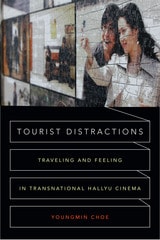
Tourist Distractions
Traveling and Feeling in Transnational Hallyu CinemaYoungmin Choe
Duke University Press, 2016
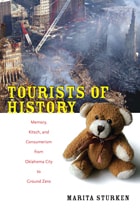
Tourists of History
Memory, Kitsch, and Consumerism from Oklahoma City to Ground ZeroMarita Sturken
Duke University Press, 2007
Sturken contends that a consumer culture of comfort objects such as World Trade Center snow globes, FDNY teddy bears, and Oklahoma City Memorial t-shirts and branded water, as well as reenactments of traumatic events in memorial and architectural designs, enables a national tendency to see U.S. culture as distant from both history and world politics. A kitsch comfort culture contributes to a “tourist” relationship to history: Americans can feel good about visiting and buying souvenirs at sites of national mourning without having to engage with the economic, social, and political causes of the violent events. While arguing for the importance of remembering tragic losses of life, Sturken is urging attention to a dangerous confluence—of memory, tourism, consumerism, paranoia, security, and kitsch—that promulgates fear to sell safety, offers prepackaged emotion at the expense of critical thought, contains alternative politics, and facilitates public acquiescence in the federal government’s repressive measures at home and its aggressive political and military policies abroad.
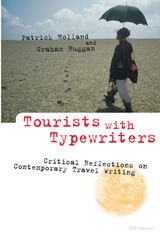
Tourists with Typewriters
Critical Reflections on Contemporary Travel WritingPatrick Holland and Graham Huggan
University of Michigan Press, 2000
The book maps new terrain in a growing area of critical study. Although critical of travel writing's complacency and its often unacknowledged ethnocentrism, the book recognizes its importance as both a literary and cultural form. While travel writing at its worst emerges as a crude expression of economic advantage, at its best it becomes a subtle instrument of cultural self-perception, a barometer for changing views of "other" (i.e., foreign, non-Western) cultures, and a trigger for the information circuits that tap us into the wider world.
Tourists with Typewriters gauges both the best and worst in contemporary travel writing, capturing the excitement of this most volatile--and at times infuriating--of literary genres. The book will appeal to general readers interested in a closer examination of travel writing and to academic readers in disciplines such as literary/cultural studies, geography, history, anthropology, and tourism studies.
"An eminently readable and informative study. It breathes tolerance and intelligence. It is critically perceptive and very au courant. It raises issues (coloniality, postmodernity, gender. . . ) and discusses books that readers of many different stripes will want to find out about." --Ross Chambers, University of Michigan
Patrick Holland, Associate Professor of English, University of Guelph, was born in New Zealand and educated in England, Australia, and Canada. Graham Huggan, Professor of English, University of Munich, was born in Hong Kong and educated in England and in British Columbia.
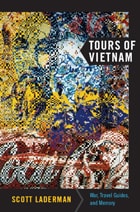
Tours of Vietnam
War, Travel Guides, and MemoryScott Laderman
Duke University Press, 2009
Tracing a history of ideological assertions embedded in travel discourse, Laderman analyzes the use of tourism in the Republic of Vietnam as a form of Cold War cultural diplomacy by a fledgling state that, according to one pamphlet published by the Vietnamese tourism authorities, was joining the “family of free nations.” He chronicles the evolution of the Defense Department pocket guides to Vietnam, the first of which, published in 1963, promoted military service in Southeast Asia by touting the exciting opportunities offered by Vietnam to sightsee, swim, hunt, and water-ski. Laderman points out that, despite historians’ ongoing and well-documented uncertainty about the facts of the 1968 “Hue Massacre” during the National Liberation Front’s occupation of the former imperial capital, the incident often appears in English-language guidebooks as a settled narrative of revolutionary Vietnamese atrocity. And turning to the War Remnants Museum in Ho Chi Minh City, he notes that, while most contemporary accounts concede that the United States perpetrated gruesome acts of violence in Vietnam, many tourists and travel writers still dismiss the museum’s display of that record as little more than “propaganda.”
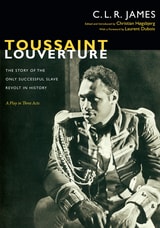
Toussaint Louverture
The Story of the Only Successful Slave Revolt in History; A Play in Three ActsC. L. R. James Edited and Introduced by Christian Høgsbjerg
Duke University Press, 2013

Tove Jansson
Life, Art, WordsBoel Westin
University of Minnesota Press, 2024
An in-depth, perceptive account of the unconventional life of the Moomins’ beloved creator, now available in the United States
Tove Jansson achieved fame as the creator of the Moomins, beloved by generations of readers around the world. Remarkably, the Moomins were only part of the prodigious creative output of this Finnish-Swedish writer and artist. Jansson’s work also includes short stories and five novels for adults, as well as paintings, murals, and book illustrations. In this acclaimed biography, Boel Westin relies on numerous conversations with Jansson and unprecedented access to her journals, letters, and personal archives to present an engrossing and comprehensive review of the life and world of Scandinavia’s best-loved author.
As Westin’s meticulous research makes clear, Jansson’s artistic and literary works reflected what was most important to her: the love of family and nature and the desire to pursue her art. Guided by her personal motto, “Love and work,” Jansson seized both with uncompromising joy. And while her romantic relationships with men proved unfulfilling, she found those with women—especially with her longtime partner, the artist Tuulikki Pietilä—both grounding and inspiring.
Westin weaves together the many threads of Jansson’s rich, complex life: an education interrupted to help her family; the bleak war years and her emergence as a painter; the decades of Moominmania across books, newspaper comic strips, merchandise, and adaptations; her later fictions, including her popular The Summer Book; and her time with Pietilä on the solitary island of Klovharu. Tove Jansson: Life, Art, Words offers fans and admirers around the world the most complete portrait of the writer Philip Pullman described as “a genius, a woman of profound wisdom and great artistry.”
Toward "Natural Right and History"
Lectures and Essays by Leo Strauss, 1937–1946Leo Strauss
University of Chicago Press, 2018
Previously unpublished in book form, Strauss’s lectures are presented here in a thematic order that mirrors Natural Right and History and with interpretive essays by J. A. Colen, Christopher Lynch, Svetozar Minkov, Daniel Tanguay, Nathan Tarcov, and Michael Zuckert that establish their relation to the work. Rounding out the book are copious annotations and notes to facilitate further study.
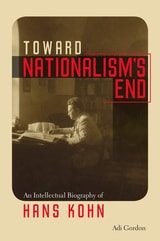
Toward Nationalism's End
An Intellectual Biography of Hans KohnAdi Gordon
Brandeis University Press, 2017
Toward Wiser Public Judgment
Daniel Yankelovich
Vanderbilt University Press, 2011
In his lead chapter, Dan Yankelovich urges us to move away from a "misleading model of public opinion" that "dominates the expert culture of our society, including journalists, scientists, business leaders, scholars, professional experts, and political leaders." He and the other contributors (Will Friedman, Keith Melville, Robert Kingston, Alison Kadlec, Steven A. Rosell, and Heidi Gantwerk) describe methods used by organizations like Public Agenda, National Issues Forums, and Viewpoint Learning, Inc., to advance the public's learning curve through various forms of civic engagement, education, dialogue and deliberation.
They provide case studies of education reform in Bridgeport, Connecticut, and math and science initiatives in the Kansas City area, and examples of programs that have focused on issues ranging from energy and health care to US-Muslim relations. One chapter is a dialogue between Yankelovich and Friedman.
While our political culture resonates to the public's desire for a stronger voice, it fails to ensure that this voice reflects anything more than the spin, spectacle, and excessive partisanship that dominate today's public discourse. Toward Wiser Public Judgment offers insights and strategies to counteract these troubling trends.
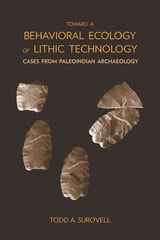
Toward a Behavioral Ecology of Lithic Technology
Cases from Paleoindian ArchaeologyTodd A. Surovell
University of Arizona Press, 2009
Because the fundamental processes of making, using, and discarding stone tools are, at root, exercises in problem solving, Todd Surovell asks what conditions favor certain technological solutions. Whether asking if a biface should be made thick or thin or if a flake should be saved or discarded, Surovell seeks answers that extend beyond a case-by-case analysis. One avenue for addressing these questions theoretically is formal mathematical modeling.
Here Surovell constructs a series of models designed to link environmental variability to human decision making as it pertains to lithic technology. To test the models, Surovell uses data from the analysis of more than 40,000 artifacts from five Rocky Mountain and Northern Plains Folsom and Goshen complex archaeological sites dating to the Younger Dryas stadial (ca. 12,600-11,500 years BP). The primary result is the production of powerful new analytical tools useful to the interpretation of archaeological assemblages.
Surovell's goal is to promote modeling and explore the general issues governing technological decisions. In this light, his models can be applied to any context in which stone tools are made and used.
Toward a Cooperative Commonwealth
The Transplanted Roots of Farmer-Labor Radicalism in TexasThomas Alter II
University of Illinois Press, 2022
A rare look at the German roots of radicalism in Texas, Toward a Cooperative Commonwealth illuminates the labor movements and populist ideas that changed the nation’s course at a pivotal time in its history.

Toward a Democratic New Order
David Bryn-Jones
University of Minnesota Press, 1945
Toward a Democratic New Order was first published in 1945. Minnesota Archive Editions uses digital technology to make long-unavailable books once again accessible, and are published unaltered from the original University of Minnesota Press editions.
We have succeeded, at a tremendous cost in human suffering, in preventing the imposition of a totalitarian new order upon the world. But our victory will be hollow and temporary unless democracy, in whose name we have fought, can gird itself to meet the challenges of a rapidly changing world. It cannot remain a static faith, whose triumph in its nineteenth-century form is taken for granted. It must be re-examined and redefined, not in terms of shibboleths and tenets a century old, but in the light of today's conditions and problems. That this redefinition is an urgent need of our time is the underlying conviction of Toward a Democratic New Order.
Men have not made the utmost sacrifice for a return to the world as it was before 1939. That world crashed because of its inherent weaknesses. Restored with inadequate modifications, it may well crash again. Can a stronger, more stable order be established within the democratic framework? Is democracy the best form of government? Can the normal processes of democratic government effect the far-reaching changes now necessary? Can the industrial problems of our age be solved on democratic lines? Can labor and management free themselves from the prejudices of an era that is now dead? Are we justified in believing the democratic order capable of securing and maintaining the welfare of the individual and society as a whole? Can democracy resolve the conflict between nationalistic claims on the one hand and conditions essential for economic stability and efficiency on the other?
These are some of the questions considered in this philosophical approach to world problems by David Bryn-Jones. His provocative analysis and interpretations make Toward a Democratic New Order truly significant reading for our postwar world.
Toward a Framework for Vietnamese American Studies
History, Community, and MemoryEdited by Linda Ho Peché, Alex-Thai Dinh Vo, and Tuong Vu
Temple University Press, 2023
The large number of Vietnamese refugees that resettled in the United States since the fall of Saigon have become America’s fastest growing immigrant group. Toward a Framework for Vietnamese American Studies traces the ideologies, networks, and cultural sensibilities that have long influenced and continue to transform social, political, and economic developments in Vietnam and the U.S.
Moving beyond existing approaches, the editors and contributors to this volume—the first to craft a working framework for researching, teaching, and learning about this dynamic community—present a new Vietnamese American historiography that began in South Vietnam. They provide deep-dive explorations into community development, political activism, civic participation and engagement, as well as entrepreneurial endeavors. Chapters offer new concepts and epistemological approaches to how legacy and memory is nurtured, produced and circulated in the Vietnamese diaspora.
Toward a Framework for Vietnamese American Studies seeks to better understand the rapidly changing landscape of Vietnamese American diaspora.
Contributors: Duyen Bui, Christian Collet, Wynn Gadkar-Wilcox, Elwing Suong Gonzalez, Tuan Hoang, Jennifer A. Huynh, Y Thien Nguyen, Nguyen Vu Hoang, Van Nguyen-Marshall, Thien-Huong Ninh, Hai-Dang Phan, Ivan V. Small, Quan Tue Tran, Thuy Vo Dang, and the editors
Toward a Geography of Art
Thomas DaCosta Kaufmann
University of Chicago Press, 2004
Toward a Geography of Art presents a historical overview of these complexities, debates contemporary concerns, and completes its exploration with a diverse collection of case studies. Employing the author's expertise in a variety of fields, the book delves into critical issues such as transculturation of indigenous traditions, mestizaje, the artistic metropolis, artistic diffusion, transfer, circulation, subversion, and center and periphery. What results is a foundational study that establishes the geography of art as a subject and forces us to reconsider assumptions about the place of art that underlie the longstanding narratives of art history.
Toward a Healthier Garden State
Beyond Cancer Clusters and COVIDMichael R. Greenberg
Rutgers University Press, 2023
This book uses the past fifty years of New Jersey history as a case study to illustrate just how much public policy decisions and other upstream factors can affect the health of a state’s citizens. It reveals how economic and racial disparities in health care were exacerbated by bad policies regarding everything from zoning to education to environmental regulation. The study further chronicles how New Jersey struggled to deal with public health crises like the AIDS epidemic and the crack epidemic. Yet it also explores how the state has developed some of the nation’s most innovative responses to public health challenges, and then provides policy suggestions for how we might build an even healthier New Jersey.

Toward a History of Applied Economics
2000 Supplement, Volume 32Jeff E. Biddle and Roger Backhouse, editors
Duke University Press, 0
This is the 2000 supplement to the journal History of Political Economy. All 2000 subscribers will receive a copy of this book as part of their annual subscription.
Toward a History of Game Theory, Volume 24
E. Roy Weintraub, ed.
Duke University Press, 0
Drawing on interviews with original members of the game theory community and on the Morgenstern diaries, the first section of the book examines early work in game theory. It focuses on the groundbreaking role of the von Neumann-Morgenstern collaborative work, The Theory of Games and Economic Behavior (1944). The second section recounts the reception of this new theory, revealing just how game theory made its way into the literatures of the time and thus became known among relevant communities of scholars. The contributors explore how game theory became a wedge in opening up the social sciences to mathematical tools and use the personal recollections of scholars who taught at Michigan and Princeton in the late 1940s to show why the theory captivated those practitioners now considered to be "giants" in the field. The final section traces the flow of the ideas of game theory into political science, operations research, and experimental economics.
Contributors. Mary Ann Dimand, Robert W. Dimand, Robert J. Leonard, Philip Mirowski, Angela M. O'Rand, Howard Raiffa, Urs Rellstab, Robin E. Rider, William H. Riker, Andrew Schotter, Martin Shubik, Vernon L. Smith
Toward a Just World
The Critical Years in the Search for International JusticeDorothy V. Jones
University of Chicago Press, 2002
A century ago, there was no such thing as international justice, and until recently, the idea of permanent international courts and formal war crimes tribunals would have been almost unthinkable. Yet now we depend on institutions such as these to air and punish crimes against humanity, as we have seen in the International Criminal Tribunal for Rwanda and the appearance of Serbian leader Slobodan Milosevic before the Tribunal for the Former Yugoslavia.
Toward a Just World tells the remarkable story of the long struggle to craft the concept of international justice that we have today. Dorothy V. Jones focuses on the first half of the twentieth century, the pivotal years in which justice took on expanded meaning in conjunction with ideas like world peace, human rights, and international law. Fashioning both political and legal history into a compelling narrative, Jones recovers little-known events from undeserved obscurity and helps us see with new eyes the pivotal ones that we think we know. Jones also covers many of the milestones in the history of diplomacy, from the Treaty of Versailles and the creation of the League of Nations to the Nuremberg war crimes tribunal and the making of the United Nations.
As newspapers continue to fill their front pages with stories about how to administer justice to al Qaeda and Saddam Hussein, Toward a Just World will serve as a timely reminder of how the twentieth century achieved one of its most enduring triumphs: giving justice an international meaning.

Toward a Natural Forest
The Forest Service in Transition (A Memoir)Jim Furnish
Oregon State University Press, 2015
The Forest Service stumbled in responding to a wave of lawsuits from environmental groups in the late 20th Century—a phenomenon best symbolized by the spotted owl controversy that shut down logging on public forests in the Pacific Northwest in the 1990s. The agency was brought to its knees, pitted between a powerful timber industry that had been having its way with the national forests for decades, and organized environmentalists who believed public lands had been abused and deserved better stewardship.
Toward a Natural Forest offers an insider’s view of this tumultuous time in the history of the Forest Service, presenting twin tales of transformation, both within the agency and within the author’s evolving environmental consciousness. While stewarding our national forests with the best of intentions, had the Forest Service diminished their natural essence and ecological values? How could one man confront the crisis while remaining loyal to his employer?
In this revealing memoir, Furnish addresses the fundamental human drive to gain sustenance from and protect the Earth, believing that we need not destroy it in the process. Drawing on the author’s personal experience and his broad professional knowledge, Toward a Natural Forest illuminates the potential of the Forest Service to provide strong leadership in global conservation efforts. Those interested in our public lands—environmentalists, natural resource professionals, academics, and historians—will find Jim Furnish’s story deeply informed, thought-provoking, and ultimately inspiring.
Toward a Theater of the Oppressed
The Dramaturgy of John ArdenJaved Malick
University of Michigan Press, 1995
Malick situates Arden's dramaturgy in the wider context of the radical alternative tradition in Western drama, drawing connections to Brecht, Piscator, the radical playwrights of the 1960s. He then explores the formal structure, ideological implications, and historical significance of Arden's work, treating his stage plays as one dramaturgically coherent opus- from the early Waters of Babylon to his and Margaretta D'Arcy's ambitious trilogy, The Island of the Mighty. Finally, he discusses the last phase of Arden and D'Arcy's political and artistic development, which led them to turn their backs on the professional theater circuit. He argues that Arden's rejection of the institutional stage was the logical outcome of his persistent search for alternative forms of political theater.
Toward a Theater of the Oppressed will be invaluable reading for those interested in modern drama, political theater, and popular performance, as well as students of contemporary British drama.
Javed Malick is Reader in English, Khalsa College, University of Delhi, India.
Toward the Final Solution
A History of European RacismGeorge L. Mosse, With a critical introduction by Christopher R. Browning
University of Wisconsin Press, 2020
Towards Better Reproductive Health in Eastern Europe
Concern, Commitment, and ChangeWHO Scientific Working Group WHO Scientific Working Group
Central European University Press, 1998
Documenting the latest statistical data on current problems related to reproductive health issues in Central and Eastern Europe, this text explores the reasons for these problems and recommends action based on the scientific evidence for improving reproductive health.
The main issues covered are: declining standards of reproductive health care; rising trends in the incidence of sexually transmitted diseases; low rates of use of modern contraceptives; high rates of induced abortion; high prevalence of infertility; and the needs of adolescents with regard to reproductive health.
Towards Defining the Prairies
Region, Culture, and HistoryRobert Wardhaugh
University of Manitoba Press, 2001
Towards a New Ethnohistory
Community-Engaged Scholarship among the People of the RiverKeith Thor Carlson
University of Manitoba Press, 2018
Towards a New Malaysia?
The 2018 Election and Its AftermathMeredith L. Weiss and Faizal S. Hazis
National University of Singapore Press, 2020
After the election, many Malaysians were optimistic about the possibility of a more representative, accountable, participatory, and equitable polity, but Meredith L. Weiss and Faisal S. Hazis do not see GE14 as a clear harbinger of full-on liberalization. While the political aftermath of the election continues to play out, the authors provide a clarion call for deeper, more critical, more comparative research on Malaysia’s politics. They upend commonly held beliefs about Malaysian politics and bring forward lesser-known theories, and they suggest agendas for empirically interesting, theoretically relevant further research. They also point to the broader insights Malaysia’s experience provides for the study of elections and political change in one-party dominant states around the world.
Town Meeting
Practicing Democracy in Rural New EnglandDonald L. Robinson
University of Massachusetts Press, 2011
At Gettysburg, Abraham Lincoln described government by the people as “the great task remaining before us.” Many citizens of modern America, frustrated and disheartened, are tempted to despair of realizing that ideal. Yet, it is a project still alive in parts of New England.
This book traces the origins of town-meeting democracy in Ashfield, a community of just under 2,000 people in the foothills of the Berkshires in western Massachusetts. Donald Robinson begins by recounting several crises at the town's founding in the eighteenth century that helped to shape its character. He shows how the town has changed since then and examines how democratic self-government functions in the modern context.
The picture is not pretty. Self-government carries no guarantees, and Ashfield is no utopia. Human failings are abundantly on display. Leaders mislead. Citizens don't pay attention and they forget hard-earned lessons.
But in this candid account of the operation of democracy in one New England town, Robinson demonstrates that for better and for worse, Ashfield governs itself democratically. Citizens control the actions of their government. Not everyone participates, but all may, and everyone who lives in the town must accept and obey what town meeting decides.
Town and Country
Race Relations in an Urban-Rural Context, Arkansas, 1865–1905John Graves
University of Arkansas Press, 1990
A thoroughly researched and extensively documented look at race relations in Arkansas druing the forty years after the Civil War, Town and Country focuses on the gradual adjustment of black and white Arkansans to the new status of the freedman, in both society and law, after generations of practicing the racial etiquette of slavery.
John Graves examines the influences of the established agrarian culture on the developing racial practices of the urban centers, where many blacks living in the towns were able to gain prominence as doctors, lawyers, successful entrepreneurs, and political leaders. Despite the tension, conflict, and disputes within and between the voice of the government and the voice of the people in an arduous journey toward compromise, Arkansas was one of the most progressive states during Reconstruction in desegregating its people.
Town and Country makes a significant contribution to the history of the postwar South and its complex engagement with the race issue.
Town in the Empire
Government, Politics, and Society in Seventeenth Century PopayánBy Peter Marzahl
University of Texas Press, 1979
During the seventeenth century, many of the fundamental characteristics of Spanish America were established. Peter Marzahl adds significantly to our understanding of this period with this study of Popayán, a town in what was then part of New Granada and is now Colombia. New Granada was something of a backwater of the empire, but very likely Popayán was more typical of everyday colonial life than the major centers that have drawn most attention from historians.
In the first part of his study, Marzahl describes both town and region, depicts economic activities (agriculture, gold mining, trade), and analyzes urban and rural society. Of particular interest is his discussion of the complex interaction among the different ethnic groups: Spaniards, Mestizos, Indians, and Blacks. In the longer second part he presents a detailed account of the makeup and operations of the town councils. His extensive research in primary sources makes possible a thorough examination of Popayán's administration and politics and their relationship to economic and social patterns. He also describes the councils' relations with the provincial governors, the viceregal authorities in Bogotá, and the Church. Because this study treats a neglected period and region and, in so doing, offers fresh materials and insights, it is an important contribution to our knowledge and comprehension of colonial Spanish America.

Town
Prints & Drawings of Britain before 1800Bernard Nurse
Bodleian Library Publishing, 2020
Towns and Temples Along the Mississippi
Edited by David H. Dye and Cheryl Anne Cox
University of Alabama Press, 1990
A Dan Josselyn Memorial Publication
Discover the stories, structures, and spirit that shaped life along America’s greatest river.
Specialists from archaeology, ethnohistory, physical anthropology, and cultural anthropology bring their varied points of view to this subject in an attempt to answer basic questions about the nature and extent of social change within the time period. The scholars' overriding concerns include presentation of a scientifically accurate depiction of the native cultures in the Central Mississippi Valley prior and immediately subsequent to European contact and the need to document the ensuing social and biological changes that eventually led to the widespread depopulation and cultural reorientation. Their findings lead to three basic hypotheses that will focus the scholarly research for decades to come.
Contributors include:
George J. Armelagos, Ian W. Brown, Chester B. DePratter, George F. Fielder, Jr., James B. Griffin, M. Cassandra Hill, Michael P. Hoffman, Charles Hudson, R. Barry Lewis, Dan F. Morse, Phyllis A. Morse, Mary Lucas Powell, Cynthia R. Price, James F. Price, Gerald P. Smith, Marvin T. Smith, and Stephen Williams
Towns between Empires
Good Governance and “Police” in Case Studies from Transylvania, Wallachia, and Moldavia, 1500s–1800sMária Pakucs
Central European University Press, 2025
The chapters in the volume capture the widest possible variety of political and administrative systems in the region. Transylvanian towns were structured and governed similarly to other small Central European urban centers, however significant diversity can be discerned following the Reformation. Moldavian and Wallachian towns in the 18th and 19th century are little known to international scholarship, and the chapters in this volume will fill this gap.
Townships
Michael Martone
University of Iowa Press, 1992
Townships establishes the Midwest as an important center of creativity, a region to be noted for more than corn and prairie and neat, square patches of land. The reverberations in sensibility that make their way through these essays speak to all midwesterners and to all those for whom a sense of place is a source of inspiration.

Toxic Exposures
Mustard Gas and the Health Consequences of World War II in the United StatesSmith, Susan L.
Rutgers University Press, 2019

Toxic Loves, Impossible Futures
Feminist Living as ResistanceIrmgard Emmelhainz
Vanderbilt University Press, 2021
These reflections and dialogues are an urgent attempt to resist the present in the company of the voices of women like bell hooks, Sara Ahmed, Leslie Jamison, Lina Meruane, Leanne Betasamosake Simpson, Chris Kraus, Alaíde Foppa, Lorena Wolffer, Sayak Valencia, Pip Day, Veronica Gonzalez Peña, Eimear McBride, Simone de Beauvoir, Elena Poniatowska, Susan Sontag, Margaret Randall, Simone Weil, Arundhati Roy, Marta Lamas, Paul B. Preciado, Dawn Marie Paley, Raquel Gutiérrez, Sara Eliassen, and Silvia Gruner. Toxic Loves, Impossible Futures continues the discussion on how to undo misogyny and dismantle heteropatriarchy's sublimating and denigrating tricks against women, which are intrinsically linked to colonialism and violence against the Earth.
Toxic Timescapes
Examining Toxicity across Time and SpaceSimone M. Müller
Ohio University Press, 2022
An interdisciplinary environmental humanities volume that explores human-environment relationships on our permanently polluted planet.
While toxicity and pollution are ever present in modern daily life, politicians, juridical systems, media outlets, scholars, and the public alike show great difficulty in detecting, defining, monitoring, or generally coming to terms with them. This volume’s contributors argue that the source of this difficulty lies in the struggle to make sense of the intersecting temporal and spatial scales working on the human and more-than-human body, while continuing to acknowledge race, class, and gender in terms of global environmental justice and social inequality.
The term toxic timescapes refers to this intricate intersectionality of time, space, and bodies in relation to toxic exposure. As a tool of analysis, it unpacks linear understandings of time and explores how harmful substances permeate temporal and physical space as both event and process. It equips scholars with new ways of creating data and conceptualizing the past, present, and future presence and possible effects of harmful substances and provides a theoretical framework for new environmental narratives. To think in terms of toxic timescapes is to radically shift our understanding of toxicants in the complex web of life.
Toxicity, pollution, and modes of exposure are never static; therefore, dose, timing, velocity, mixture, frequency, and chronology matter as much as the geographic location and societal position of those exposed. Together, these factors create a specific toxic timescape that lies at the heart of each contributor’s narrative. Contributors from the disciplines of history, human geography, science and technology studies, philosophy, and political ecology come together to demonstrate the complex reality of a toxic existence. Their case studies span the globe as they observe the intersection of multiple times and spaces at such diverse locations as former battlefields in Vietnam, aging nuclear-weapon storage facilities in Greenland, waste deposits in southern Italy, chemical facilities along the Gulf of Mexico, and coral-breeding laboratories across the world.

Toxic War
The Story of Agent OrangePeter Sills
Vanderbilt University Press, 2014
Originally introduced by Dow and other chemical companies as a herbicide in the United States and adopted by the military as a method of deforesting the war zone of Vietnam, in order to deny the enemy cover, Agent Orange also found its way into the systems of numerous active-duty soldiers. Sills argues that manufacturers understood the dangers of this compound and did nothing to protect American soldiers.
Toxic War takes the reader behind the scenes into the halls of political power and industry, where the debates about the use of Agent Orange and its potential side effects raged. In the end, the only way these veterans could seek justice was in the court of law and public opinion. Unprecedented in its access to legal, medical, and government documentation, as well as to the personal testimonies of veterans, Toxic War endeavors to explore all sides of this epic battle.
Traces Behind the Esmeraldas Shore
Warren DeBoer
University of Alabama Press, 1996
Although long famous for its antiquities—notably intricate goldwork, elaborate pottery, and earthen mounds—the Santiago-Cayapas region of coastal Ecuador has been relatively neglected from the standpoint of scientific archaeology. Until recently, no sound chronology was available, and even the approximate age of the region's most impressive monument, the large and much-looted site of La Tolita, remained in doubt.
Building on evidence obtained during the last decade, this book documents an eventful prehistory for Santiago-Cayapas that spans three millennia. A highlight of this prehistory was the reign of La Tolita as a regional center from 200 B.C. to A.D. 350. Archaeological data from
La Tolita's hinterland indicate a complex and changing social landscape in which La Tolita's hegemony was never absolute nor uncontested.
Abundantly illustrated and written in a crisp, witty, and occasionally irreverent style, Traces Behind the Esmeraldas Shore will stimulate debate and rankle interpretive conventions about those social formations that archaeologists gloss as 'chiefdoms.'
Traces of My Father
William Radice
Northwestern University Press, 2002
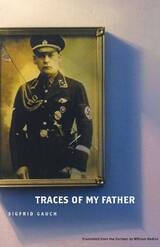
In 1979 Sigfrid Gauch published the groundbreaking Vaterspuren, (Traces of My Father), the first of the so-called father books about the relationships of postwar Germans with their parents. It inspired a new genre in German literature. Ever since, such writings have contributed greatly to Germany's ongoing struggle to overcome its own past.
This autobiographical novel is Gauch's attempt to come to terms with his father, Hermann Gauch, a physician who had joined the National Socialists in the 1920s, wrote six books of "race research" as a member of the SS, and to his dying day remained an unrepentant Nazi. The story alternates between the images of the elder Gauch's death and burial and the author's memories of childhood and adolescence.
Unlike many of the father books, however, Traces of My Father is less a political attack than a personal journey. Gauch, though honest about his father's monstrous actions and ideas, does not shirk their shared emotional bond. The result is a poignant attempt by a son to relive his father's notorious life and in doing so free himself from the man's influence.
Traces of the Past
Classics between History and ArchaeologyKaren Bassi
University of Michigan Press, 2016
Aimed at classicists, literary scholars, ancient historians, cultural historians, and archaeological theorists, the book combines three areas of research: time as a feature of narrative structure in literary theory; the concept of “the past itself” in the philosophy of history; and the ontological status of material objects in archaeological theory. Each of five central chapters explores how specific protoarchaeological narratives—from the fate of Zeus’ stone in Hesiod’s Theogony to the contest between words and objects in Aristophanes’ Frogs—both expose and attempt to bridge this gap. Throughout, the book serves as a response to Herodotus’ task in writing the Histories, namely, to ensure that “the past deeds of men do not fade with time.”
Traces of the Unseen
Photography, Violence, and Modernization in Early Twentieth-Century Latin AmericaCarolina Sá Carvalho
Northwestern University Press, 2023
Winner of the 2024 Roberto Reis Book Award
Winner of the LASA Environment Section Best Book of 2023
Winner of the LASA Amazonian Studies Section Best Book of 2024
Co-Winner of the LASA Book Award for the Visual Culture Studies 2024
A richly illustrated examination of photography as a technology for documenting, creating, and understanding the processes of modernization in turn-of-the-century Brazil and the Amazon
Photography at the turn of the twentieth century was not only a product of modernity but also an increasingly available medium to chronicle the processes of modernization. Traces of the Unseen: Photography, Violence, and Modernization in Early Twentieth-Century Latin America situates photography’s role in documenting the destruction wrought by infrastructure development and extractive capitalist expansion in the Amazon and outside the Brazilian metropole. Combining formal analysis of individual photographs with their inclusion in larger multimedia assemblages, Carolina Sá Carvalho explores how this visual evidence of violence was framed, captioned, cropped, and circulated. As she explains, this photographic creation and circulation generated a pedagogy of the gaze with which increasingly connected urban audiences were taught what and how to see: viewers learned to interpret the traces of violence captured in these images within the larger context of modernization.
Traces of the Unseen draws on works by Flavio de Barros, Euclides da Cunha, Roger Casement, Claude Lévi-Strauss, and Mario de Andrade to situate an unruly photographic body at the center of modernity, in all its disputed meanings. Moreover, Sá Carvalho locates historically specific practices of seeing within the geopolitical peripheries of capitalism. What emerges is a consideration of photography as a technology through which modern aspirations, moral inclinations, imagined futures, and lost pasts were represented, critiqued, and mourned.
Tracking Europe
Mobility, Diaspora, and the Politics of LocationGinette Verstraete
Duke University Press, 2009
In demystifying the old and new Europe across a multiplicity of texts, images, media, and cultural practices in various times and locations, Verstraete lays bare a territorial persistence in the European imaginary, one which has been differently tied up with the politics of inclusion and exclusion. Tracking Europe moves from policy papers, cultural tourism, and migration to philosophies of cosmopolitanism, nineteenth-century travel guides, electronic surveillance at the border, virtual pilgrimages to Spain, and artistic interventions in the Balkan region. It is a sustained attempt to situate current developments in Europe within a complex matrix of tourism, migration, and border control, as well as history, poststructuralist theory, and critical media and art projects.
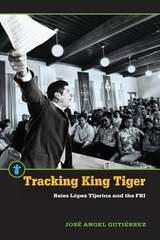
Tracking King Tiger
Reies López Tijerina and the FBIJosé Angel Gutiérrez
Michigan State University Press, 2019
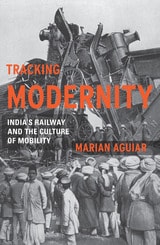
Tracking Modernity
India’s Railway and the Culture of MobilityMarian Aguiar
University of Minnesota Press, 2010
Since the colonial period in India, the railway has been idealized as a rational utopia—a moving box in which racial and class differences might be amalgamated under a civic, secular, and public order. Aguiar charts this powerful image into the postcolonial period, showing how the culture of mobility exposes this symbol of reason as surprisingly dynamic and productive. Looking in turn at the partition of India, labor relations, rituals of travel, works of literature and film, visual culture, and the Mumbai train bombings of 2006, Aguiar finds incongruities she terms “counternarratives of modernity” to signify how they work both with and against the dominant rhetoric. Revealing railways as a microcosm of tensions within Indian culture, Aguiar demonstrates how their representations have challenged prevailing ideas of modernity.

Tracking the Texas Rangers
The Nineteenth CenturyBruce A. Glasrud
University of North Texas Press, 2012