Results by title
3258 books match the query 'Art' and 634 start with t
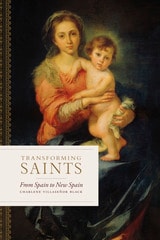
Transforming Saints
From Spain to New SpainCharlene Villaseñor Black
Vanderbilt University Press, 2022
The chapters here examine the rise of the cults of the lactating Madonna, St. Anne, St. Librada, St. Mary Magdalene, and the Suffering Virgin. Concerned with holy figures presented as feminine archetypes—images that came under Inquisition scrutiny—as well as with cults suspected of concealing Indigenous influences, Charlene Villaseñor Black argues that these images would come to reflect the empowerment and agency of women in viceregal Mexico. Her close analysis of the imagery additionally demonstrates artists' innovative responses to Inquisition censorship and the new artistic demands occasioned by conversion.
The concerns that motivated the twenty-first century protests against Chicana artists Yolanda López in 2001 and Alma López in 2003 have a long history in the Hispanic world, in the form of anxieties about the humanization of sacred female bodies and fears of Indigenous influences infiltrating Catholicism. In this context Black also examines a number of important artists in depth, including El Greco, Murillo, Jusepe de Ribera, Pedro de Mena, Baltasar de Echave Ibía, Juan Correa, Cristóbal de Villalpando, and Miguel Cabrera.
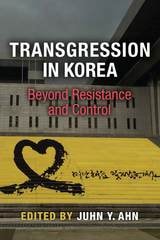
Transgression in Korea
Beyond Resistance and ControlEdited by Juhn Ahn
University of Michigan Press, 2018
Transgression in Korea challenges the popular conceptions of transgression as resistance to authority, the collapse of morality, and an attempt at self- empowerment. Examples of transgression from premodern, modern, and contemporary Korea are examined side by side to underscore the possibility of reading transgression in more ways than one. These examples are taken from a devotional screen from medieval Korea, trickster tales from the late Chosŏn period, reports about flesheating humans, newspaper articles about same- sex relationships from colonial Korea, and films about extramarital affairs, wayward youths, and a vengeful vigilante. Bringing together specialists from various disciplines such as history, art history, anthropology, premodern
literature, religion, and fi lm studies, the context- sensitive readings of transgression provided in this book suggest that transgression and authority can be seen as forming something other than an antagonistic relationship.
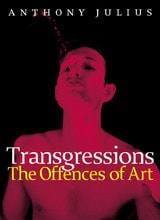
Transgressions
The Offences of ArtAnthony Julius
University of Chicago Press, 2002
Transgressions is the first book to address this controversial subject. Here Anthony Julius traces the history of subversion in art from the outraged response to Manet's Le Déjeuner sur l'Herbe to the scandal caused by the grant programs of the National Endowment for the Arts a century and a half later. Throughout the book, and supported by the work of such artists as Marcel Duchamp, the Chapman brothers, Andres Serrano, Damien Hirst, Gilbert & George, Paul McCarthy, Jeff Koons, Hans Haacke, and Anselm Kiefer, Julius shows how the modern period has been characterized by three kinds of transgressive art: an art that perverts established art rules; an art that defiles the beliefs and sentiments of its audience; and an art that challenges and disobeys the rules of the state.
The evidence assembled, Julius concludes his hard-hitting dissection of the landscapes of contemporary art by posing some important questions: what is art's future when its boundary-exceeding, taboo-breaking endeavors become the norm? And is anything of value lost when we submit to art's violation?
Transgressions is not a comfortable—still less a comforting—read, but it has a powerful urgency that makes it an essential document for anyone involved in our cultural life at the beginning of the twenty-first century.
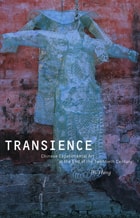
Transience
Chinese Experimental Art at the End of the Twentieth CenturyWu Hung
University of Chicago Press, 2006
These detailed essays on the artists and their works are now available in a revised edition of the exhibition catalog. Written by Wu Hung, a leading authority and the curator of the exhibit, Transience explores contemporary Chinese art through the themes of demystification, ruins, and transience, and represents an original perspective in the continuing discussion on Chinese experimental art.
Transit
Serpent Mound Crossing Space, Time, DiscourseChadwick Allen
University of Chicago Press, 2026
In Transit, Chadwick Allen chronicles the surprising history of how the ancient snake effigy known as Serpent Mound, located in what is now southern Ohio, traveled to Seattle, Washington in the 1970s, at the height of American Indian activism associated with the Red Power movement. Allen considers Indigenous earthworks built for thousands of years across the eastern half of the North American continent, questioning what it would mean if they were understood not as static entities fixed in space and time, but as animate forces with the ability to travel. Allen also looks at the origins of the “modern” effigy in the nineteenth century, when archaeologists reconstructed Serpent Mound’s deteriorating form to create a static icon suitable for touristic display within the confines of a settler state memorial.
Drawing from archival research, interviews, and site-specific encounters, Transit meditates on the significance of building an earthen effigy in the Pacific Northwest, as part of what became the Daybreak Star Indian Cultural Center, and on the complexity of the mound’s generative contexts. Allen’s research intersects the mid-twentieth century, when artist Robert Smithson created his iconic Spiral Jetty earth sculpture and when the Muscogee (Creek) Nation designed its innovative Mound Building. The story remains ongoing in the twenty-first century, as new mounds are rising in Oklahoma and artists, activists, and intellectuals are again asserting the power of Indigenous design.
Transition in Post-Soviet Art
The Collective Actions Group Before and After 1989Octavian Esanu
Central European University Press, 2013
Transmedium
Conceptualism 2.0 and the New Object ArtGarrett Stewart
University of Chicago Press, 2018
Garrett Stewart in Transmedium dubs this new approach Conceptualism 2.0, an allusion in part to the computer images that are so often addressed by these works. A successor to 1960s Conceptualism, which posited that a material medium was unnecessary to the making of art, Conceptualism 2.0 features artworks that are transmedial, that place the aesthetic experience itself deliberately at the boundary between often incommensurable media. The result, Stewart shows, is art whose forced convergences break open new possibilities that are wholly surprising, intellectually enlightening, and often uncanny.
Transplanetary Americas
Art, Outer Space, and the Latinx ImaginationRobb Hernández
Duke University Press, 2026
Travel & See
Black Diaspora Art Practices since the 1980sKobena Mercer
Duke University Press, 2016
Travels in Intermediality
ReBlurring the BoundariesEdited by Bernd Herzogenrath
Dartmouth College Press, 2012
Travels with Mina Loy
Navigating the Avant-GardeSuzanne W. Churchill, Linda A. Kinnahan, and Susan Rosenbaum
Lever Press, 2026
Artist and writer Mina Loy (1882-1966) traversed continents, participated in Futurism, Dada, and Surrealism, and depicted poetic and painterly vistas ranging from lunar landscapes to the gritty streets of the Bowery. Travels with Mina Loy: Navigating the Avant-Garde, a companion text to the award-winning, multi-authored web resource Mina Loy: Navigating the Avant-Garde, offers an illustrated tour of Mina Loy’s long and varied career, contextualized with in-depth explorations of key places that shaped her life and work. Shedding new light on Loy's poetic responses to Italy, her theatrical explorations in New York City, and her forays into the museums of Paris and New York, the book brings in newly discovered and critically overlooked Loy works, as well as fresh timelines and surveys of the critical corpus on her creative output. This essential guidebook to Mina Loy charts her migrations across geography, movements among artistic circles and people, and transit across arts to illuminate her evolving aesthetics, politics, and artistic commitments.
Treasured Possessions
Indigenous Interventions into Cultural and Intellectual PropertyHaidy Geismar
Duke University Press, 2013
Treasures of Herat
Two Manuscripts of the Khamsah of Nizami in the British LibraryBarbara Brend
Gingko, 2021
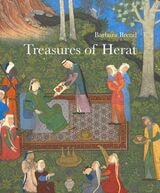
With this book, Barbara Brend provides thorough consideration of two celebrated Persian manuscripts housed in the British Library. These two copies of the Khamsah (Quintet) a set of five narrative poems by twelfth-century poet Nizami, a master of allegorical poetry in Persian literature, were produced in Herat in the fifteenth century, one of the greatest periods of Persian painting. Although well known, the manuscripts have never before been written about in relation to each other. Brend tells the story of each poem and the painting that illustrates it, and she formally analyzes the images, placing them in their historical and artistic context.
The images from both highly prized manuscripts are beautifully reproduced in color, and the ownership history of one of the manuscripts—recorded in the form of seal impressions and inscriptions— is also included. Ursula Sims-Williams provides a translation and commentary of these important marks of ownership which identify the Mughal rulers Akbar, Jahangir, Shah Jahan, and Aurangzeb, among many others.
Treasuring the Gaze
Intimate Vision in Late Eighteenth-Century Eye MiniaturesHanneke Grootenboer
University of Chicago Press, 2013
Tree Lines
Valerie P Cohen
University of Nevada Press, 2017
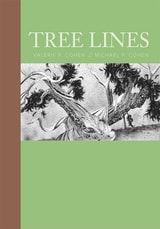
The drawings are black-and-white, pen-and-ink representations of high alpine ecosystems. The prose is stripped bare, abbreviated in an epigrammatic style that is poetic and spontaneous. Trees represented here are the Western Juniper or Sierra Juniper, the Limber, and the Bristlecone Pine—three species of long-lived, slow-growing conifers that grow across the Great Basin. While they represent only a small portion of the vegetative culture high in the western mountains, the Cohens use representation as abstraction as is utilized by writers and artists to convey a unique kind of microcosm of our natural environment. This book compares to such classics as Leopold’s A Sand County Almanac, and Berger’s Ways of Seeing, which open up lines of observation, analysis, and art for a new generation of readers.
Triumph of the Dead
American World War II Cemeteries, Monuments, and Diplomacy in FranceKate Clarke Lemay
University of Alabama Press, 2018
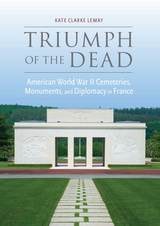
Between 1948 and 1956, the United States government planned an enormous project to build fourteen permanent overseas military cemeteries in Europe. These park-like burial grounds eventually would hold the graves of approximately 80,000 American soldiers and nurses who died during or immediately after World War II. Five of these cemeteries are located in France, more than any other nation: two in Normandy; one in Provence; and two in Lorraine.
In Triumph of the Dead: American World War II Cemeteries, Monuments, and Diplomacy in France, Kate Clarke Lemay explores the relationship between art, architecture, war memory, and Franco-American relations. She addresses the many functions, both original and more recent, that the American war cemeteries have performed, such as: war memorials, diplomatic gestures, Cold War political statements, prompts for debate about Franco-American relations, and the nature of French identity itself. Located on or near former battlefields, the American war cemeteries are at once history lessons, sites of memory, and commemorative monuments. As places of mourning, war cemeteries are considerably different than civic cemeteries in their rituals, designs, and influences on collective memory. As transatlantic sites, the cemeteries both construct and sustain an American memory of World War II for a Francophile and European audience.
The book features ten color photographs, fifty black and white photographs, and four maps. Scholars as well as enthusiasts of World War II history, mid-century art and architecture, and cultural diplomacy will be interested in reading this richly researched book, the first in-depth history of some of the most important sites of American World War II remembrance.
Tropical Aesthetics of Black Modernism
Samantha A. Noël
Duke University Press, 2021
Troubling Vision
Performance, Visuality, and BlacknessNicole R. Fleetwood
University of Chicago Press, 2010
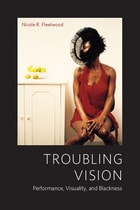
Troubling Vision addresses American culture’s fixation on black visibility, exploring how blackness is persistently seen as a problem in public culture and even in black scholarship that challenges racist discourse. Through trenchant analysis, Nicole R. Fleetwood reorients the problem of black visibility by turning attention to what it means to see blackness and to the performative codes that reinforce, resignify, and disrupt its meaning. Working across visual theory and performance studies, Fleetwood asks, How is the black body visualized as both familiar and disruptive? How might we investigate the black body as a troubling presence to the scopic regimes that define it as such? How is value assessed based on visible blackness?
Fleetwood documents multiple forms of engagement with the visual, even as she meticulously underscores how the terms of engagement change in various performative contexts. Examining a range of practices from the documentary photography of Charles “Teenie” Harris to the “excess flesh” performances of black female artists and pop stars to the media art of Fatimah Tuggar to the iconicity of Michael Jackson, Fleetwood reveals and reconfigures the mechanics, codes, and metaphors of blackness in visual culture.
“Troubling Vision is a path-breaking book that examines the problem of seeing blackness—the simultaneous hyper-visibility and invisibility of African Americans—in US visual culture in the last half century. Weaving together critical modes and methodologies from performance studies, art history, critical race studies, visual culture analysis, and gender theory, Fleetwood expands Du Bois’s idea of double vision into a broad questioning of whether ‘representation itself will resolve the problem of the black body in the field of vision.’ With skilled attention to historical contexts, documentary practices, and media forms, she takes up the works of a broad variety of cultural producers, from photographers and playwrights to musicians and visual artists and examines black spectatorship as well as black spectacle. In chapters on the trope of ‘non-iconicity’ in the photographs of Charles (Teenie) Harris, the ‘visible seams’ in the digital images of the artist Fatimah Tuggar, and a coda on the un-dead Michael Jackson, Fleetwood's close analyses soar. Troubling Vision is a beautifully written, original, and important addition to the field of American Studies.”—Announcement of the American Studies Association for the 2012 Lora Romero First Book Publication Prize
Trucks
Recent Works by John HimmelfarbJohn Himmelfarb
The Artist Book Foundation, 2014
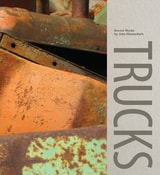
With sculpture, paintings, prints, and drawings, award-winning artist John Himmelfarb explores the iconic American truck. An in-depth consideration of the vehicles that are intrinsically and culturally significant to the American landscape, Trucks: Recent Works by John Himmelfarb showcases the artist's diverse and lighthearted approach, adeptly shifting between mediums, style, and message during his decade-long contemplation of trucks and their specific functions. Under his skillful hands, the utilitarian vehicles of commerce and construction become unique and provocative art forms.
In 2005 and 2006, the truck as narrative becomes center stage for Himmelfarb's work. With his seamless, animated traverse of multiple mediums, viewers cannot help but smile as they appreciate the common truck through unique perspectives. In 2007, another tectonic change occurs in Himmelfarb's pursuit of his theme: as a result of a three-month residency at the John Michael Kohler Arts Center's Arts/Industry program, he begins his first meaningful foray into three-dimensional works.
True Faith, True Light
The Devotional Art of Ed StilleyKelly Mulhollan
University of Arkansas Press, 2015
But one day Ed’s life was permanently altered. While plowing his field, he became convinced he was having a heart attack. Ed stopped his work and lay down on the ground. Staring at the sky, he saw himself as a large tortoise struggling to swim across a river. On his back were five small tortoises—his children—clinging to him for survival. And then, as he lay there in the freshly plowed dirt, Ed received a vision from God, telling him that he would be restored to health if he would agree to do one thing: make musical instruments and give them to children.
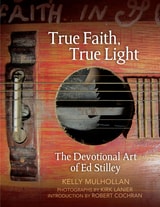
And so he did. Beginning with a few simple hand tools, Ed worked tirelessly for twenty-five years to create over two hundred instruments, each a crazy quilt of heavy, rough-sawn wood scraps joined with found objects. A rusty door hinge, a steak bone, a stack of dimes, springs, saw blades, pot lids, metal pipes, glass bottles, aerosol cans—Ed used anything he could to build a working guitar, fiddle, or dulcimer. On each instrument Ed inscribed “True Faith, True Light, Have Faith in God.”
True Faith, True Light: The Devotional Art of Ed Stilley documents Ed Stilley’s life and work, giving us a glimpse into a singular life of austere devotion.
True Grit
American Prints from 1900 to 1950Stephanie Schrader
J. Paul Getty Trust, The, 2019
In the first half of the twentieth century, a group of American artists influenced by the painter and teacher Robert Henri aimed to reject the pretenses of academic fine art and polite society. Embracing the democratic inclusiveness of the Progressive movement, these artists turned to making prints, which were relatively inexpensive to produce and easy to distribute. For their subject matter, the artists mined the bustling activity and stark realities of the urban centers in which they lived and worked. Their prints feature sublime towering skyscrapers and stifling city streets, jazzy dance halls and bleak tenement interiors—intimate and anonymous everyday scenes that addressed modern life in America.
True Grit examines a rich selection of prints by well-known figures like George Bellows, Edward Hopper, Joseph Pennell, and John Sloan as well as lesser-known artists such as Ida Abelman, Peggy Bacon, Miguel Covarrubias, and Mabel Dwight. Written by three scholars of printmaking and American art, the essays present nuanced discussions of gender, class, literature, and politics, contextualizing the prints in the rapidly changing milieu of the first decades of twentieth-century America.
This volume is published to accompany an exhibition on view at the J. Paul Getty Museum at the Getty Center October 15, 2019, to January 19, 2020.

Truth or Dare
Art and DocumentaryEdited by Gail Pearce and Cahal McLaughlin
Intellect Books, 2007
Tsuchi
Earthy Materials in Contemporary Japanese ArtBert Winther-Tamaki
University of Minnesota Press, 2022
An examination of Japanese contemporary art through the lens of ecocriticism and environmental history
Collectively referred to by the word tsuchi, earthy materials such as soil and clay are prolific in Japanese contemporary art. Highlighting works of photography, ceramics, and installation art, Bert Winther-Tamaki explores the many aesthetic manifestations of tsuchi and their connection to the country’s turbulent environmental history, investigating how Japanese artists have continually sought a passionate and redemptive engagement with earth.
In the seven decades following 1955, Japan has experienced severe environmental degradation as a result of natural disasters, industrial pollution, and nuclear irradiation. Artists have responded to these ongoing catastrophes through modes of “mudlarking” and “muckracking,” utilizing raw elements from nature to establish deeper contact with the primal resources of their world and expose its unfettered contamination. Providing a comparative assessment of more than seventy works of art, this study reveals Japanese artists’ engagement with a richly diverse repertoire of earthy materialities, elucidating their aesthetic properties, changing conditions, and cultural significance.
By focusing on the role of tsuchi as a convergence point for a wide range of creative practices, this book offers a critical reassessment of contemporary art in Japan and its intrinsic relationship to the environment. Situating art within the context of ecology and urbanization, Tsuchi shows artists striving to explore and reprocess raw forms of earth beneath the corruptions of human activity.
Turning Away
The Poetics of an Ancient GestureBenjamin A. Saltzman
University of Chicago Press, 2026
A sweeping account of how we are at our most human when we turn away from the pains of the world.
Why do we look away from the suffering of others? Why do we cover our faces in shame? Why do we lower our heads in grief? Few gestures are as universal as the averted gaze. Fewer still are as ambivalent and inscrutable. In this incisive study, Benjamin A. Saltzman reveals how the kaleidoscopic appearance of these gestures in art, poetry, and philosophy has turned them into an essential language for our uncomfortable engagements with the world, challenging us to reflect on the ways we fundamentally relate to others.
Into the horizon of contemporary discourse, Turning Away sets out from five influential scenes in which figures avert their gaze: Timanthes’s Sacrifice of Iphigenia, Plato’s Republic, Augustine’s Confessions, Christ’s Crucifixion, and the Fall and Expulsion of Adam and Eve. The gestures of aversion in these scenes refract across visual media, through philosophy and politics, into modernity and the present day, having been reimagined along the way by thinkers like Hannah Arendt, artists like Marc Chagall and Salvador Dalí, poets like Langston Hughes, and many others. Saltzman offers a timely critique of the privilege of turning away and of the too-easy condemnation of our tendencies to do so.
Turntables and Tropes
A Rhetoric of RemixScott Haden Church
Michigan State University Press, 2022
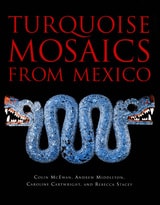
Turquoise Mosaics from Mexico
Colin McEwan, Andrew Middleton, Caroline Cartwright, and Rebecca Stacey
Duke University Press, 2006
Illustrated with more than 160 color images, this book describes the recent scientific findings about the mosaics in detail, revealing them to be rich repositories of information about ancient Mexico. The materials used to construct the mosaics demonstrate their makers’ deep knowledge of the natural world and its resources. The effort that would have been involved in procuring the materials testifies to the mosaics’ value and significance in a society imbued with myths and religious beliefs. The British Museum’s analyses have provided evidence of the way that the materials were prepared and assembled, the tools used, and the choices that were made by artisans. In addition, by drawing on historical accounts including early codices, as well as recent archaeological discoveries, specialists have learned more about the place of the mosaics in ancient Mexican culture.
Filled with information about the religion, art, and natural and cultural history as well as the extraordinary ability of modern science to enable detailed insight into past eras, Turquoise Mosaics from Mexico offers an overview of the production, utilization, and eventual fate of these beautiful and mysterious objects.
Twelve Films about Love and Heaven
Pete Fraser
St. Augustine's Press, 2023
Twelve Prophets of Aleijadinho
Hans Mann
University of Texas Press, 1967
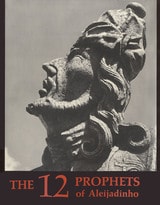
They stand on a hilltop in the mountains of Minas Gerais in Brazil—twelve dramatic figures, twelve Old Testament prophets soundlessly crying their warnings to mankind. There they have stood for over two centuries, masterpieces by that strange, unhappy sculptor, Antonio Francisco Lisboa—or, as he is better known, Aleijadinho, "The Little Cripple."
These figures, some mirroring in their faces the calm certainty of their prophesies and some reflecting the desperation of their warnings, have an impact upon the mind and the emotions of the modern viewer fully as great as their effect must have been upon those for whom they were originally carved—the adventurers of the lusty goldmining region which was eighteenth-century Minas Gerais. Their impact draws added depth from the realization that they bear also the mark of the anguish of their creator.
Aleijadinho, the mulatto son of a local builder, grew up untutored amid the building fever of the mining centers, grew up to endure throughout the last half of his long life the physical torment and the mental suffering of a painful and mutilating disease. Yet, developing his self-schooled talent, he stamped the hallmark of his creativity upon the religious art of the whole region.
In this volume the late artist photographer Hans Mann provides a sensitive pictorial study of the Twelve Prophets, of the six scenes of the Crucifixion which stand just below the Prophets on that windy hillside at Congonhas do Campo, and of other representative examples of the sculpture of Aleijadinho. A brief text by the photographer's wife, Graciela Mann, provides the information and background needed for the fullest enjoyment of the pictures.
The prose poem "When the Statues Speak," by Carlos Drummond de Andrade, sets the dramatic mood for the photographs of the Prophets themselves.

Twelve-Cent Archie
Beaty, Bart
Rutgers University Press, 2015
Twelve-Cent Archie
New edition with full color illustrationsBeaty, Bart
Rutgers University Press, 2017
Twelve-Cent Archie is not only the first scholarly study of the Archie comic, it is an innovative creative work in its own right. Inspired by Archie’s own concise storytelling format, renowned comics scholar Bart Beaty divides the book into a hundred short chapters, each devoted to a different aspect of the Archie comics. Fans of the comics will be thrilled to read in-depth examinations of their favorite characters and motifs, including individual chapters devoted to Jughead’s hat and Archie’s sweater-vest. But the book also has plenty to interest newcomers to Riverdale, as it recounts the behind-the-scenes history of the comics and analyzes how Archie helped shape our images of the American teenager.
As he employs a wide range of theoretical and methodological approaches, Beaty reveals that the Archie comics themselves were far more eclectic, creative, and self-aware than most critics recognize. Equally comfortable considering everything from the representation of racial diversity to the semiotics of Veronica’s haircut, Twelve-Cent Archie gives a fresh appreciation for America’s most endearing group of teenagers.
Twin Peaks
Unwrapping the PlasticFranck Boulègue
Intellect Books, 2016
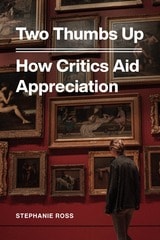
Two Thumbs Up
How Critics Aid AppreciationStephanie Ross
University of Chicago Press, 2020
In Two Thumbs Up, philosopher Stephanie Ross tackles these questions, revealing the ways that critics influence our decisions, and why that’s a good thing. Starting from David Hume’s conception of ideal critics, Ross refines his position and makes the case that review-based journalistic or consumer reporting criticism proves the best model for helping us find and appreciate quality. She addresses and critiques several other positions and, in the process, she demonstrates how aesthetic and philosophical concerns permeate our lives, choices, and culture. Ultimately, whether we’re searching for the right wine or the best concert, Ross encourages us all to find and follow critics whose taste we share.
Two Twelfth-Century Texts on Chinese Painting
Robert J. Maeda, Translator
University of Michigan Press, 1970
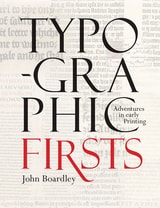
Typographic Firsts
John Boardley
Bodleian Library Publishing, 2018
Many of the standard features of printed books were designed by pioneering typographers and printers in the latter half of the fifteenth century. Johannes Gutenberg is credited with printing the first books in Europe with moveable type in the fifteenth century, but many different European printers and publishers went on to find innovative solutions to replicate the appearance of manuscript books in print and improve on them throughout the Renaissance. The illustrated examples in Typographic Firsts originate in those early decades, bringing into focus the influences and innovations that shaped the printed book and established a Western typographic canon.
From the practical challenges of polychromatic printing and sheet music printing to the techniques for illustrating books with woodcuts and producing books for children to the design of the first fonts, these stories chart the invention of the printed book, the world’s first means of mass communication. Also covering title pages, maps, printing in gold, and printing in color, this book shows how a mixture of happenstance and brilliant technological innovation came together to form the typographic and design conventions of the book.