Results by title
2706 books match the query 'European' and 622 start with t
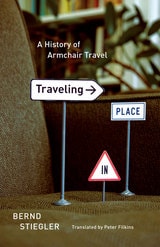
Traveling in Place
A History of Armchair TravelBernd Stiegler
University of Chicago Press, 2013
Organized into twenty-one “legs”—or short chapters—Traveling in Place begins with a consideration of Xavier de Maistre’s 1794 Voyage autour de ma chambre, an account of the forty-two-day “journey around his room” Maistre undertook as a way to entertain himself while under house arrest. Stiegler is fascinated by the notion of exploring the familiar as though it were completely new and strange. He engages writers as diverse as Roussel, Beckett, Perec, Robbe-Grillet, Cortázar, Kierkegaard, and Borges, all of whom show how the everyday can be brilliantly transformed. Like the best guidebooks, Traveling in Place is more interested in the idea of travel as a state of mind than as a physical activity, and Stiegler reflects on the different ways that traveling at home have manifested themselves in the modern era, from literature and film to the virtual possibilities of the Internet, blogs, and contemporary art.
Reminiscent of the pictorial meditations of Sebald, but possessed of the intellectual playfulness of Calvino, Traveling in Place offers an entertaining and creative Baedeker to journeying at home.
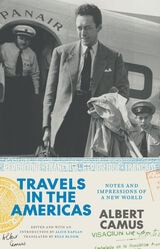
Travels in the Americas
Notes and Impressions of a New WorldAlbert Camus
University of Chicago Press, 2023
In March 1946, the young Albert Camus crossed from Le Havre to New York. Though he was virtually unknown to American audiences at the time, all that was about to change—The Stranger, his first book translated into English, would soon make him a literary star. By 1949, when he set out on a tour of South America, Camus was an international celebrity. Camus’s journals offer an intimate glimpse into his daily life during these eventful years and showcase his thinking at its most personal—a form of observational writing that the French call choses vues (things seen).
Camus’s journals from these travels record his impressions, frustrations, joys, and longings. Here are his unguarded first impressions of his surroundings and his encounters with publishers, critics, and members of the New York intelligentsia. Long unavailable in English, the journals have now been expertly retranslated by Ryan Bloom, with a new introduction by Alice Kaplan. Bloom’s translation captures the informal, sketch-like quality of Camus’s observations—by turns ironic, bitter, cutting, and melancholy—and the quick notes he must have taken after exhausting days of travel and lecturing. Bloom and Kaplan’s notes and annotations allow readers to walk beside the existentialist thinker as he experiences changes in his own life and the world around him, all in his inimitable style.
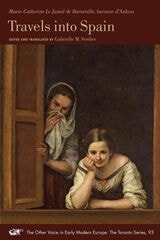
Travels into Spain
Marie-Catherine Le Jumel de Barneville, baronne d'Aulnoy
Iter Press, 2022
While mysteries remain in her biography, Madame d’Aulnoy’s tremendous literary talent is finally being rediscovered. Marie-Catherine Le Jumel de Barneville, baronne d’Aulnoy (1652–1705) was the first Frenchwoman to write, publicize, and publish the account of her travels into Spain as an independent woman. Considered the authority on Spain for nearly two centuries until historiographers labeled them as disreputable, Travels into Spain can now be appreciated for its ironic gaze on realities concealed from male travelers and Madame d’Aulnoy’s unabashedly female and often playful voice. Her writing casts a unique light on gender relations, the condition of women, cultural biases, national rivalries, and religious superstitions at a critical time in early modern cultural and literary history. The first modern translation of Travels into Spain, this book situates Madame d’Aulnoy’s account in its historical context. Travels into Spain is a masterpiece of ethnographic observation, expressing a woman’s view on gender relations, marriage, religion, fashion, food, bullfights, and the Inquisition.
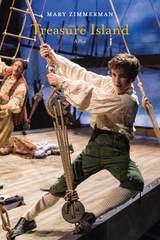
Treasure Island
A PlayMary Zimmerman
Northwestern University Press, 2019
In Treasure Island, Tony Award winner and inventive adapter-director Mary Zimmerman has penned a spirited, energetic adaptation of Robert Louis Stevenson’s most beloved novel, proving again that “a strong story full of larger-than-life characters and the quest for filthy lucre has no age barrier” (Chicago Sun-Times).
Enlivened by rum, mutiny, and buried treasure, Treasure Island is the classic pirates’ tale, widely regarded as the forerunner of this genre. After discovering a treasure map, young Jim Hawkins sets off to sea as cabin boy aboard the Hispaniola, where he encounters one of the most unforgettable characters in literary history—peg-legged buccaneer Long John Silver, a malicious mutineer and charismatic father figure.
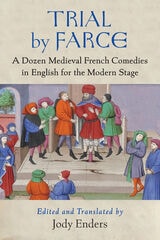
Trial by Farce
A Dozen Medieval French Comedies in English for the Modern StageEdited and Translated by Jody Enders
University of Michigan Press, 2023
Was there more to comedy than Chaucer, the Second Shepherds’ Play, or Shakespeare? Of course! But, for a real taste of medieval and Renaissance humor and in-your-face slapstick, one must cross the Channel to France, where over two hundred extant farces regularly dazzled crowds with blistering satires. Dwarfing all other contemporaneous theatrical repertoires, the boisterous French corpus is populated by lawyers, lawyers everywhere. No surprise there. The lion’s share of mostly anonymous farces was written by barristers, law students, and legal apprentices. Famous for skewering unjust judges and irreligious ecclesiastics, they belonged to a 10,000-member legal society known as the Basoche, which flourished between 1450 and 1550. What is more, their dramatic send-ups of real and fictional court cases were still going strong on the eve of Molière, resilient against those who sought to censor and repress them. The suspenseful wait to see justice done has always made for high drama or, in this case, low drama. But, for centuries, the scripts for these outrageous shows were available only in French editions gathered from scattered print and manuscript sources.
In Trial by Farce, prize-winning theater historian Jody Enders brings twelve of the funniest legal farces to English-speaking audiences in a refreshingly uncensored but philologically faithful vernacular. Newly conceived as much for scholars as for students and theater practitioners, this repertoire and its familiar stock characters come vividly to life as they struggle to negotiate the limits of power, politics, class, gender, and, above all, justice. Through the distinctive blend of wit, social critique, and breathless boisterousness that is farce, we gain a new understanding of comedy itself as form of political correction. In ways presciently modern and even postmodern, farce paints a different cultural picture of the notoriously authoritarian Middle Ages with its own vision of liberty and justice for all. Theater eternally offers ways for new generations to raise their voices and act.
Trial by Theatre
Reports on Czech DramaBarbara Day
Karolinum Press, 2019
Drawing on a range of oral and written sources, as well as her unique personal experience of cultural and historical events in Czechoslovakia from the 1960s to the 1980s, Day offers a sweeping view of Czech theater, its colorful personalities, and international connections. Her story details: the days of the National Awakening in the nineteenth century, when theater took the place of politics, becoming an instrument of national identity in the hands of the revivalists; theater as a symbol of independence during the Nazi occupation; its survival of Socialist Realism and Stalinism and subsequent blossoming in the “Golden Sixties”; and theater’s essential role in Prague Spring and beyond, when for two decades theater operated in provisional spaces like gymnasiums, bars, trade union halls, art galleries, and living rooms. Trial by Theatre culminates in the Velvet Revolution of 1989, a year that saw the installation of Václav Havel—a playwright—as the first post-Communist president of Czechoslovakia.
Tristan's Shadow
Sexuality and the Total Work of Art after WagnerAdrian Daub
University of Chicago Press, 2013
Das Rheingold, Die Walküre, and Siegfried. Parsifal. Tristan und Isolde. Both revered and reviled, Richard Wagner conceived some of the nineteenth century’s most influential operas—and created some of the most indelible characters ever to grace the stage. But over the course of his polarizing career, Wagner also composed volumes of essays and pamphlets, some on topics seemingly quite distant from the opera house. His influential concept of Gesamtkunstwerk—the “total work of art”—famously and controversially offered a way to unify the different media of an opera into a coherent whole. Less well known, however, are Wagner’s strange theories on sexuality—like his ideas about erotic acoustics and the metaphysics of sexual difference.
Drawing on the discourses of psychoanalysis, evolutionary biology, and other emerging fields of study that informed Wagner’s thinking, Adrian Daub traces the dual influence of Gesamtkunstwerk and eroticism from their classic expressions in Tristan und Isolde into the work of the generation of composers that followed, including Zemlinsky, d’Albert, Schreker, and Strauss. For decades after Wagner’s death, Daub writes, these composers continued to grapple with his ideas and with his overwhelming legacy, trying in vain to write their way out from Tristan’s shadow.

Trollope and Comic Pleasure
Christopher Herbert
University of Chicago Press, 1987
The comic mode as Herbert describes it was antagonistic to the repressive moral ethos widely prevalent in Victorian England. Herbert shows how Trollope, under a mask of self-proclaimed conventionality, employed this mode in a steady, sometimes scandalous critique of the Victorian subversion of pleasure. Drawing on Trollope's unpublished notes on seventeenth-century drama and bringing to light many instances in the novels of direct borrowings from old plays, Herbert demonstrates the inventiveness and subtlety of Trollope's deployment of comic materials. Thematically organized around such subjects as Trollope's investigations of sex, his formal structures, and his principles of "realism," Herbert's study includes detailed readings of two of the nineteenth century's most ambitious exercises in comedy: The Way We Live Now and Trollope's neglected masterpiece, Ayala's Angel.
Of primary importance for readers of Trollope and students of comedy, Herbert's study will also prove valuable to those interested more generally in Victorian and modern fiction and the cultural history of the Victorian age.
Tropes, Parables, and Performatives
J. Hillis Miller
Duke University Press, 1991
Throughout these essays Miller is fascinated with the tropological dimension of literary language, with the way figures of speech turn aside the telling of a story or the presentation of a literary theme. The exploration of this turning leads to the recognition that all works of literature are parabolic, “thrown beside” their real meaning. They tell one story but call forth something else.
Miller further agrees that all parables are fundamentally performative. They do not merely name something or give knowledge, but rather use words to make something happen, to get the reader from here to there. Each essay here attempts to formulate what, in a given case, the reader perfomatively enters by way of parabolic trope.
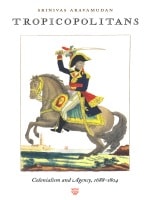
Tropicopolitans
Colonialism and Agency, 1688–1804Srinivas Aravamudan
Duke University Press, 1999
“Tropicalization” is the central metaphor of this analysis, a term that incorporates both the construction of various dynamic tropes by which the colonized are viewed and the site of the study, primarily the tropics. Tropicopolitans, then, are those people who bear and resist the representations of colonialist discourse. In readings that expose new relationships between literary representation and colonialism in the eighteenth century, Aravamudan considers such texts as Behn’s Oroonoko, Defoe’s Robinson Crusoe and Captain Singleton, Addison’s Cato, and Swift’s Gulliver’s Travels and The Drapier’s Letters. He extends his argument to include analyses of Johnson’s Rasselas, Beckford’s Vathek, Montagu’s travel letters, Equiano’s autobiography, Burke’s political and aesthetic writings, and Abbé de Raynal’s Histoire des deux Indes. Offering a radical approach to literary history, this study provides new mechanisms for understanding the development of anticolonial agency.
Introducing eighteenth-century studies to a postcolonial hermeneutics, Tropicopolitans will interest scholars engaged in postcolonial studies, eighteenth-century literature, and literary theory.

Troubled Mirror
A Study Of Yeats's "The Tower"David Young
University of Iowa Press, 1987
Despite the extensive critical attention that has been paid to the work of W. B. Yeats, we are still very much in the process of understanding both the greatness and the modernity of this poet. The assessment of his poetry has rested primarily on the scope, intensity, and memorability of his lyrics, but his romantic beginnings have made it problematic to acknowledge him as a modernist, while his failure to produce a long poem has for some time raised questions about his greatness. Don’t major poets, the argument runs, produce major poems?
In this meticulous analysis of The Tower, David Young addresses both these issues, showing that this powerful volume represents Yeats at his best and most modern, and that its careful construction makes it the deliberate equivalent to the long poems of tradition.
By tracing the careful ordering of the poems in The Tower, Young demonstrates the volume’s overall vision, giving careful readings of each poem and illustrating the growing repetition of images that create a whole which is both emotionally and dramatically greater than the sum of its parts. Young contends that the best way to read Yeat’s lyrics is through attention to the context he created for them. Their interdependence, he asserts, is the true key to their modernity.
This eminently readable study appears at a time when most readers are in danger of losing touch with the particular achievement of Yeat’s individual volumes as he conceived them. Most students and readers now encounter Yeats in anthologies, in a volume of selected poems, or in a somewhat misleadingly presented complete Poems. Young convinces us that by persisting in this approach we will lose sight of a significant aspect of a foremost modern poet and the very elements that make him a true modern.
Truth in Public Life
Vernon White, Stephen Lamport, and Claire Foster-Gilbert
Haus Publishing, 2020
Tsing
David Albahari
Northwestern University Press, 1997
Tudor Autobiography
Listening for InwardnessMeredith Anne Skura
University of Chicago Press, 2008
In the past such texts have not been called autobiographies because they do not reveal much of the inwardness of their subject, a requisite of most modern autobiographies. But, according to Meredith Anne Skura, writers reveal themselves not only by what they say but by how they say it. Borrowing methods from affective linguistics, narratology, and psychoanalysis, Skura shows that a writer’s thoughts and feelings can be traced in his or her language. Rejecting the search for “the early modern self” in life writing, Tudor Autobiography instead asks what authors said about themselves, who wrote about themselves, how, and why. The result is a fascinating glimpse into a range of lived and imagined experience that challenges assumptions about life and autobiography in the early modern period.
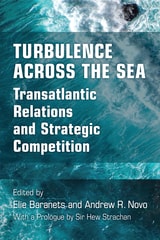
Turbulence Across the Sea
Transatlantic Relations and Strategic CompetitionEdited by Elie Baranets and Andrew Novo
University of Michigan Press, 2024
With a mix of research methodologies applied by scholars from both sides of the Atlantic, Turbulence Across the Sea offers a comprehensive analysis of relations among European and North American actors in the context of strategic competition among the United States, Europe, Russia, and China. In doing so, it demonstrates that a reaffirmation of transatlantic cooperation is necessary to maintain security in the face of aggressive moves by both Russia and China. By analyzing attitudes from the perspective of both the various actors (Britain, France, Germany, and the European Union) and various sectors (intelligence cooperation, foreign direct investments, technology, and the defense industry), this book provides readers with a comprehensive perspective on the challenges and opportunities in the shifting landscape of security in the twenty-first century.
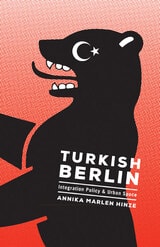
Turkish Berlin
Integration Policy and Urban SpaceAnnika Marlen Hinze
University of Minnesota Press, 2013
The integration of immigrants into a larger society begins at the local level. Turkish Berlin reveals how integration has been experienced by second-generation Turkish immigrant women in two neighborhoods in Berlin, Germany. While the neighborhoods are similar demographically, the lived experience of the residents is surprisingly different.
Informed by first-person interviews with both public officials and immigrants, Annika Marlen Hinze makes clear that local integration policies—often created by officials who have little or no contact with immigrants—have significant effects on the assimilation of outsiders into a community and a society. Focusing on the Turkish neighborhoods of Kreuzberg and Neukölln, Hinze shows how a combination of local policy making and grassroots organizing have contributed to one neighborhood earning a reputation as a hip, multicultural success story and the other as a rougher neighborhood featuring problem schools and high rates of unemployment. Aided by her interviews, she describes how policy makers draw from their imaginations of urban space, immigrants, and integration to develop policies that do not always take social realities into consideration. She offers useful examples of how official policies can actually exacerbate the problems they are trying to help solve and demonstrates that a powerful history of grassroots organizing and resistance can have an equally strong impact on political outcomes.
Employing spatial theory as a tool for understanding the complex processes of integration, Hinze asks two related questions: How do immigrants perceive themselves and their experiences in a new culture? And how are immigrants conceived of by politicians and policy makers? Although her research highlights the German–Turk experience in Berlin, her answers have implications that resonate far beyond the city’s limits.
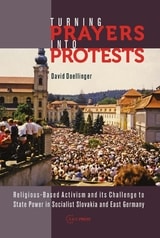
Turning Prayers into Protests
Religious-based Activism and its Challenge to State Power in Socialist Slovakia and East GermanyDavid Doellinger
Central European University Press, 2013
Twelfth Night
William Shakespeare
Arizona Center for Medieval and Renaissance Studies, 2023
Shakespeare’s Twelfth Night centers on power and love. One of the most perennially produced of Shakespeare’s comedies, it talks about shipwrecked twins, gender-bending romance, and a bumper crop of fools, from the wise to the ridiculous. Modernizing the language of the play, Alison Carey’s translation revives the joy of this comedy, taking the archaic humor and renewing it for a contemporary audience.
This translation of Twelfth Night was written as part of the Oregon Shakespeare Festival’s Play On! project, which commissioned new translations of thirty-nine Shakespeare plays. These translations present the work of “The Bard” in language accessible to modern audiences while never losing the beauty of Shakespeare’s verse. Enlisting the talents of a diverse group of contemporary playwrights, screenwriters, and dramaturges from diverse backgrounds, this project reenvisions Shakespeare for the twenty-first century. These volumes make these works available for the first time in print—a new First Folio for a new era.
Twenty-Five Sides of a Post-Communist Mafia State
Bálint Magyar
Central European University Press, 2017
Twisted Words
Torture and Liberalism in Imperial BritainKatherine Judith Anderson
The Ohio State University Press, 2022
Two Plays of Weimar Germany
Youth Is a Sickness and CriminalsFerdinand Bruckner, Translated from the German by Laurence Senelick
Northwestern University Press, 2018
Though his fame was later eclipsed by peers such as Bertolt Brecht, Bruckner was the celebrity dramatist of his time, and a new generation of readers is discovering his groundbreaking plays known for their strong cultural critique and unflinching portrayals of social ills, outcasts, and misfits. Youth Is a Sickness (1924) explores the lives of Germany's "lost generation," those who grew up during and after the cataclysm of the First World War, devoid of hope and ideals, lost in a haze of sex and drugs. Criminals (1926) traces several court cases about a failed double suicide, theft, abortion, and homosexual blackmail, controversial topics for the audience of its time and even today. Its innovative staging and interwoven storylines illuminate the imposed social tensions and legal injustice faced by the characters.
In this expert translation, readers can see Bruckner as a public intellectual, a man committed to commenting on the fate of Germany; humane values; and the past, present, and future in his work. With an introduction by the translator, this volume will be the definitive version for readers, actors, playwrights, and scholars.
Two Stories of Prague
King Bohush The SiblingsRainer Maria Rilke
Brandeis University Press, 1996