Results by title
5448 books match the query 'History and criticism' and 1116 start with t

The Power of Genre
Adena Rosmarin
University of Minnesota Press, 1986
The Power of Genre was first published in 1986. Minnesota Archive Editions uses digital technology to make long-unavailable books once again accessible, and are published unaltered from the original University of Minnesota Press editions.
The Power of Genre is a radical and systematic rethinking of the relationship between literary genre and critical explanation. Adene Rosmarin shows how traditional theories of genre—whether called "historical," "intrinsic," or "theoretical"—are necessarily undone by their attempts to define genre representationally. Rather, Rosmarin argues, the opening premise of critical argument is always critical purpose or, as E. H. Gombrich has said, function, and the genre or "form" follows the reform. The goal is a relational model that works.
Rosemarin analyzes existing theories of genre — those of Hirsch, Crane, Frye, Todorov, Jauss, and Rader are given particular attention—before proposing her own. These analyses uncover the illogic that plagues even sophisticated attempts to treat genre as a preexistent entity. Rosmarin shows how defining genre pragmatically – as explicitly chosen or devised to serve explicitly critical purposes – solves this problem: a pragmatic theory of genre builds analysis of its metaphors and motives into its program, thereby eliminating theory's traditional need to deny the invented and rhetorical nature of its schemes. A pragmatic theory, however, must be tested not only by its internal cohesion but also by its power to enable practice, and Rosmarin chooses the dramatic monologue, an infamously problematic genre, and its recent relative, the mask lyric, as testing grounds. Both genres—variously exemplified by poems of Browning, Thennyson, Eliot, and Pound—are ex post facto critical constructs that, when defined as such, make closely reasoned sense not only of particular poems but also of their perplexed interpretive histories. Moreover, both genres dwell on the historicity, textuality, and redemptive imperfection of the speaking self. This generic obsession ties the poems to their reception and, finally, to the openended, processes of hermeneutic question-and-answer stressed in Rosmarin's framing theory.
The Power of Patristic Preaching
The Word in Our FleshAndrew Hofer, OP
Catholic University of America Press, 2023
The Power of Words
Anglo-Saxon Studies Presented to Donald G. Scragg on his Seventieth BirthdayANGLO-SAXON STUDIES PRESENTED TO DONALD G. SCRAGG ON HIS SEVENTIETH BIRTHDAYHugh Magennis
West Virginia University Press, 2006
The Power of Words: Anglo-Saxon Studies Presented to Donald G. Scragg on his Seventieth Birthday edited by Jonathan Wilcox and Hugh Magennis will find its place on the same shelf with these and other such valuable tomes in the discipline. This is a complex and carefully edited book, that showcases the work of some of Professor Scragg’s best students and most admiring professional friends. The contents range from several studies in homiletic literature, one of Professor Scragg’s own passions, to other of his pursuits, including editing theory and orthography. These are not, however, derivative essays that recommend a single adjustment in a reading or to a source study; instead, they are studies that do what Professor Scragg himself did: they observe clues to larger realities, and they point the way to a broader comprehension of our discipline and its several methodologies.
The Power of the Steel-tipped Pen
Reconstructing Native Hawaiian Intellectual HistoryNoenoe K. Silva
Duke University Press, 2017
The Powers of the False
Reading, Writing, Thinking beyond Truth and FictionDoro Wiese
Northwestern University Press, 2014
The Practical Past
Hayden White
Northwestern University Press, 2014
Hayden White borrows the title for The Practical Past from philosopher Michael Oakeshott, who used the term to describe the accessible material and literary-artistic artifacts that individuals and institutions draw on for guidance in quotidian affairs. The Practical Past, then, forms both a summa of White’s work to be drawn upon and a new direction in his thinking about the writing of history.
White’s monumental Metahistory: The Historical Imagination in Nineteenth-Century Europe (1973) challenged many of the commonplaces of professional historical writing and wider assumptions about the ontology of history itself. It formed the basis of his argument that we can never recover “what actually happened”in the past and cannot really access even material culture in context. Forty years on, White sees “professional history" as falling prey to narrow specialization, and he calls upon historians to take seriously the practical past of explicitly “artistic” works, such as novels and dramas, and literary theorists likewise to engage historians.
The Pragmatic Whitman
Reimaining American DemocracyStephen John Mack
University of Iowa Press, 2002
In this surprisingly timely book, Stephen Mack examines Whitman’s particular and fascinating brand of patriotism: his far-reaching vision of democracy. For Whitman, loyalty to America was loyalty to democracy. Since the idea that democracy is not just a political process but a social and cultural process as well is associated with American pragmatism, Mack relies on the pragmatic tradition of Emerson, James, Dewey, Mead, and Rorty to demonstrate the ways in which Whitman resides in this tradition.
Mack analyzes Whitman's democratic vision both in its parts and as a whole; he also describes the ways in which Whitman's vision evolved throughout his career. He argues that Whitman initially viewed democratic values such as individual liberty and democratic processes such as collective decision-making as fundamental, organic principles, free and unregulated. But throughout the 1860s and 1870s Whitman came to realize that democracy entailed processes of human agency that are more deliberate and less natural—that human destiny is largely the product of human effort, and a truly humane society can be shaped only by intelligent human efforts to govern the forces that would otherwise govern us.
Mack describes the foundation of Whitman’s democracy as found in the 1855 and 1856 editions of Leaves of Grass, examines the ways in which Whitman’s 1859 sexual crisis and the Civil War transformed his democratic poetics in “Sea-Drift,” “Calamus,” Drum-Taps,and Sequel to Drum-Taps, and explores Whitman’s mature vision in Democratic Vistas, concluding with observations on its moral and political implications today. Throughout, he illuminates Whitman's great achievement—learning that a full appreciation for the complexities of human life meant understanding that liberty can take many different and conflicting forms—and allows us to contemplate the relevance of that achievement at the beginning of the twenty-first century.
The Presidents We Imagine
Two Centuries of White House Fictions on the Page, on the Stage, Onscreen, and OnlineJeff Smith
University of Wisconsin Press, 2009
In The Presidents We Imagine, Jeff Smith examines the presidency’s ever-changing place in the American imagination. Ranging across different media and analyzing works of many kinds, some familiar and some never before studied, he explores the evolution of presidential fictions, their central themes, the impact on them of new and emerging media, and their largely unexamined role in the nation’s real politics.
Smith traces fictions of the presidency from the plays and polemics of the eighteenth century—when the new office was born in what Alexander Hamilton called “the regions of fiction”—to the digital products of the twenty-first century, with their seemingly limitless user-defined ways of imagining the world’s most important political figure. Students of American culture and politics, as well as readers interested in political fiction and film, will find here a colorful, indispensable guide to the many surprising ways Americans have been “representing” presidents even as those presidents have represented them.
“Especially timely in an era when media image-mongering increasingly shapes presidential politics.”—Paul S. Boyer, series editor
“Smith's understanding of the sociopolitical realities of US history is impressive; likewise his interpretations of works of literature and popular culture. . . .In addition to presenting thoughtful analysis, the book is also fun. Readers will enjoy encounters with, for example, The Beggar's Opera, Duck Soup, Edward Bellamy's Looking Backward, Philip Roth's Plot against America, the comedic campaigns of W. C. Fields for President and Pogo for President, and presidential fictions that continue up to the last President Bush. . . . His writing is fluid and conversational, but every page reveals deep understanding and focus. Summing Up: Highly recommended. All readers.”—CHOICE
The Price of Literature
The French Novel's Theoretical TurnPatrick M. Bray
Northwestern University Press, 2019
Literary thought, or the theory produced by the text, can only function by exploring what escapes dominant representations. The Price of Literature analyzes how certain iconic texts from the nineteenth century (by Mme de Staël, Hugo, Balzac, Flaubert, and Proust) perform a theoretical turn to claim the freedom to represent anything in the world, but also literature’s ability to transform the world it represents. The conclusion advances a new way of thinking about literary scholarship—one based on how literature redistributes ways of writing by lending form to thought.
The Primacy of Vision in Virgil's Aeneid
By Riggs Alden Smith
University of Texas Press, 2006
One of the masterpieces of Latin and, indeed, world literature, Virgil's Aeneid was written during the Augustan "renaissance" of architecture, art, and literature that redefined the Roman world in the early years of the empire. This period was marked by a transition from the use of rhetoric as a means of public persuasion to the use of images to display imperial power. Taking a fresh approach to Virgil's epic poem, Riggs Alden Smith argues that the Aeneid fundamentally participates in the Augustan shift from rhetoric to imagery because it gives primacy to vision over speech as the principal means of gathering and conveying information as it recounts the heroic adventures of Aeneas, the legendary founder of Rome.
Working from the theories of French phenomenologist Maurice Merleau-Ponty, Smith characterizes Aeneas as a voyant-visible, a person who both sees and is seen and who approaches the world through the faculty of vision. Engaging in close readings of key episodes throughout the poem, Smith shows how Aeneas repeatedly acts on what he sees rather than what he hears. Smith views Aeneas' final act of slaying Turnus, a character associated with the power of oratory, as the victory of vision over rhetoric, a triumph that reflects the ascendancy of visual symbols within Augustan society. Smith's new interpretation of the predominance of vision in the Aeneid makes it plain that Virgil's epic contributes to a new visual culture and a new mythology of Imperial Rome.
The Primitive, the Aesthetic, and the Savage
An Enlightenment ProblematicTony C. Brown
University of Minnesota Press, 2012
Tony C. Brown examines “the inescapable yet infinitely troubling figure of the not-quite-nothing” in Enlightenment attempts to think about the aesthetic and the savage. The various texts Brown considers—including the writings of Addison, Rousseau, Kant, and Defoe—turn to exotic figures in order to delimit the aesthetic, and to aesthetics in order to comprehend the savage.
In his intriguing exploration Brown discovers that the primitive introduces into the aesthetic and the savage an element that proves necessary yet difficult to conceive. At its most profound, Brown explains, this element engenders a loss of confidence in one’s ability to understand the human’s relation to itself and to the world. That loss of confidence—what Brown refers to as a breach in anthropological security—traces to an inability to maintain a sense of self in the face of the New World. Demonstrating the impact of the primitive on the aesthetic and the savage, he shows how the eighteenth-century writers he focuses on struggle to define the human’s place in the world. As Brown explains, these authors go back again and again to “exotic” examples from the New World—such as Indian burial mounds and Maori tattooing practice—making them so ubiquitous that they come to underwrite, even produce, philosophy and aesthetics.
The Printed Reader
Gender, Quixotism, and Textual Bodies in Eighteenth-Century BritainAmelia Dale
Bucknell University Press, 2019
The Printed Reader explores the transformative power of reading in the eighteenth century, and how this was expressed in the fascination with Don Quixote and in a proliferation of narratives about quixotic readers, readers who attempt to reproduce and embody their readings. Through intersecting readings of quixotic narratives, including work by Charlotte Lennox, Laurence Sterne, George Colman, Richard Graves, and Elizabeth Hamilton, Amelia Dale argues that literature was envisaged as imprinting—most crucially, in gendered terms—the reader’s mind, character, and body. The Printed Reader brings together key debates concerning quixotic narratives, print culture, sensibility, empiricism, book history, and the material text, connecting developments in print technology to gendered conceptualizations of quixotism. Tracing the meanings of quixotic readers’ bodies, The Printed Reader claims the social and political text that is the quixotic reader is structured by the experiential, affective, and sexual resonances of imprinting and impressions.
Published by Bucknell University Press. Distributed worldwide by Rutgers University Press.
The Problem of American Realism
Studies in the Cultural History of a Literary IdeaMichael Davitt Bell
University of Chicago Press, 1993
In chapters on William Dean Howells, Frank Norris, Mark Twain, Henry James, Stephen Crane, Theodore Dreiser, and Sarah Orne Jewett, Bell examines the effects that ideas about realism and naturalism had on writers. He demonstrates that, for many of them, claiming to be a realist or a naturalist was a way to provide assurance that one was a "real" man rather than an "effeminate" artist.
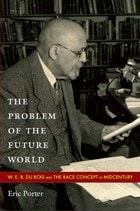
The Problem of the Future World
W. E. B. Du Bois and the Race Concept at MidcenturyEric Porter
Duke University Press, 2010
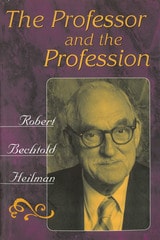
The Professor and the Profession
Robert Bechtold Heilman
University of Missouri Press, 1999
Robert Bechtold Heilman is one of the last survivors of a remarkable generation of American critics that included such literary giants as Cleanth Brooks, Allen Tate, and Edmund Wilson, men to whom literary criticism was not a profession or an academic necessity but a calling. In a distinguished career that has spanned nearly six decades, Heilman has influenced generations of scholars and critics through his exquisitely written commentaries on subjects ranging from William Shakespeare to Thomas Hardy.
In The Professor and the Profession, Heilman looks back over his life and times from his perspective as both an academic and an American. Differing in theme and subject matter, the essays included in this collection are ultimately unified by the author himself. Whether the topic is football, Robert Penn Warren, or education, Heilman's generous and intelligent voice emerges on every page. Yet this collection is more than one academic's personal reminiscences; it is a reflection upon American literary history itself.
In the first section of essays, "The Self Displayed," Heilman reveals how he developed from a small-town boy into a distinguished critic and teacher, touching upon his participation in baseball and love of football along the way. "Writers Portrayed" and "Literary Types and Problems Inspected," the following sections, offer his opinions on the past and on the current state of American literary criticism, including personal portraits of such renowned friends as Eric Voegelin, Robert Penn Warren, Theodore Roethke, and Malcolm Cowley. The final section, "Education Examined," is an enlightening inquiry into the development of American universities in the twentieth century.
A fascinating chronicle of a significant academic life, The Professor and the Profession will appeal to a broad array of scholars, from young academics wanting to know where they came from to those of Heilman's generation who can appreciate this personal reminiscence into the world of letters.
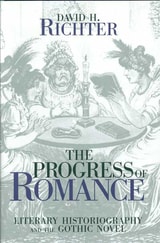
The Progress of Romance
Literary Historiography and the Gothic NovelDavid H. Richter
The Ohio State University Press, 1900
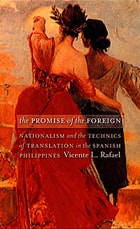
The Promise of the Foreign
Nationalism and the Technics of Translation in the Spanish PhilippinesVicente L. Rafael
Duke University Press, 2005
Through close readings of nationalist newspapers and novels, the vernacular theater, and accounts of the 1896 anticolonial revolution, Rafael traces the deep ambivalence with which elite nationalists and lower-class Filipinos alike regarded Castilian. The widespread belief in the potency of Castilian meant that colonial subjects came in contact with a recurring foreignness within their own language and society. Rafael shows how they sought to tap into this uncanny power, seeing in it both the promise of nationhood and a menace to its realization. Tracing the genesis of this promise and the ramifications of its betrayal, Rafael sheds light on the paradox of nationhood arising from the possibilities and risks of translation. By repeatedly opening borders to the arrival of something other and new, translation compels the nation to host foreign presences to which it invariably finds itself held hostage. While this condition is perhaps common to other nations, Rafael shows how its unfolding in the Philippine colony would come to be claimed by Filipinos, as would the names of the dead and their ghostly emanations.
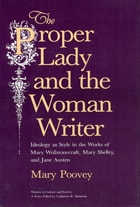
The Proper Lady and the Woman Writer
Ideology as Style in the Works of Mary Wollstonecraft, Mary Shelley, and Jane AustenMary Poovey
University of Chicago Press, 1984
"The proper lady was a handy concept for a developing bourgeois patriarchy, since it deprived women of worldly power, relegating them to a sanctified domestic sphere that, in complex ways, nourished and sustained the harsh 'real' world of men. With care and subtle intelligence, Poovey examines this 'guardian and nemesis of the female self' through the ways it is implicated in the style and strategies of three very different writers."—Rachel M. Brownstein, The Nation
"The Proper Lady and the Woman Writer is a model of . . . creative discovery, providing a well-researched, illuminating history of women writers at the turn of the nineteenth century. [Poovey] creates sociologically and psychologically persuasive accounts of the writers: Wollstonecraft, who could never fully transcend the ideology of propriety she attacked; Shelley, who gradually assumed a mask of feminine propriety in her social and literary styles; and Austen, who was neither as critical of propriety as Wollstonecraft nor as accepting as Shelley ultimately became."—Deborah Kaplan, Novel
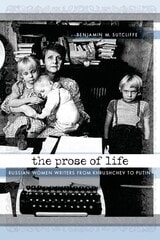
The Prose of Life
Russian Women Writers from Khrushchev to PutinBenjamin M. Sutcliffe
University of Wisconsin Press, 2009
A focus on the representation of everyday life in women’s prose reveals that a first generation of female writers (Natal’ia Baranskaia, Irina Grekova) both legitimated and limited their successors (Liudmila Petrushevskaia, Tat’iana Tolstaia, Liudmila Ulitskaia, and Svetlana Vasilenko) in their choice of literary topics. The Prose of Life traces the development, and intriguing ruptures, of recent Russian women’s prose, becoming a must-read for readers interested in Russian literature and gender studies.
2009 Outstanding Academic Title, Choice Magazine
The Prose of Things
Transformations of Description in the Eighteenth CenturyCynthia Sundberg Wall
University of Chicago Press, 2006
In The Prose of Things, Wall analyzes literary works in the contexts of natural science, consumer culture, and philosophical change to show how and why the perception and representation of space in the eighteenth-century novel and other prose narratives became so textually visible. Wall examines maps, scientific publications, country house guides, and auction catalogs to highlight the thickening descriptions of domestic interiors. Considering the prose works of John Bunyan, Samuel Pepys, Aphra Behn, Daniel Defoe, Samuel Richardson, David Hume, Ann Radcliffe, and Sir Walter Scott, The Prose of Things is the first full account of the historic shift in the art of describing.
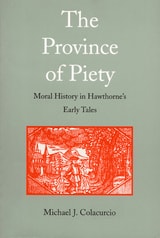
The Province of Piety
Moral History in Hawthorne's Early TalesMichael J. Colacurcio
Duke University Press, 1995
Informed by comprehensive historical research, the author shows that Hawthorne was steeped in New England historiography, particularly the sermon literature of the seventeenth century. But, as Colacurcio shows, Hawthorne did not merely borrow from the historical texts he deliberately studied; rather, he is best understood as having written history. In The Province of Piety, originally published in 1984 (Harvard University Press), Hawthorne is seen as a moral historian working with fictional narratives—a writer brilliantly involved in examining the moral and political effects of Puritanism in America and recreating the emotional and cultural contexts in which earlier Americans had lived.
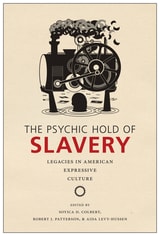
The Psychic Hold of Slavery
Legacies in American Expressive CultureSoyica Diggs Colbert, Robert J. Patterson, and Aida Levy-Hussen
Rutgers University Press, 2016
The Public Life of Privacy in Nineteenth-Century American Literature
Stacey Margolis
Duke University Press, 2005
Margolis provides readings of fiction by Hawthorne and James as well as Susan Warner, Mark Twain, Charles Chesnutt, and Pauline Hopkins. In these writers’ works, she traces a distinctive novelistic tradition that viewed social developments—such as changes in political partisanship and childhood education and the rise of new politico-legal forms like negligence law—as means for understanding how individuals were shaped by their interactions with society. The Public Life of Privacy in Nineteenth-Century American Literature adds a new level of complexity to understandings of nineteenth-century American culture by illuminating a literary tradition full of accidents, mistakes, and unintended consequences—one in which feelings and desires were often overshadowed by all that was external to the self.
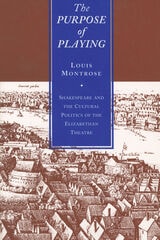
The Purpose of Playing
Shakespeare and the Cultural Politics of the Elizabethan TheatreLouis Montrose
University of Chicago Press, 1996
Montrose first locates the public and professional theater within the ideological and material framework of Elizabethan culture. He considers the role of the professional theater and theatricality in the cultural transformation that was concurrent with religious and socio-political change, and then concentrates upon the formal means by which Shakespeare's Elizabethan plays called into question the absolutist assertions of the Elizabethan state. Drawing dramatic examples from the genres of tragedy and history, Montrose finally focuses his cultural-historical perspective on A Midsummer Night's Dream.
The Purpose of Playing elegantly demonstrates how language and literary imagination shape cultural value, belief, and understanding; social distinction and interaction; and political control and contestation.
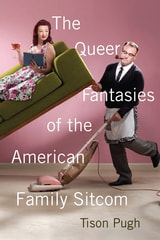
The Queer Fantasies of the American Family Sitcom
Pugh, Tison
Rutgers University Press, 2018
The Queer Fantasies of the American Family Sitcom examines the evasive depictions of sexuality in domestic and family-friendly sitcoms. Tison Pugh charts the history of increasing sexual depiction in this genre while also unpacking how sitcoms use sexuality as a source of power, as a kind of camouflage, and as a foundation for family building. The book examines how queerness, at first latent, became a vibrant yet continually conflicted part of the family-sitcom tradition.
Taking into account elements such as the casting of child actors, the use of and experimentation with plot traditions, the contradictory interpretive valences of comedy, and the subtle subversions of moral standards by writers and directors, Pugh points out how innocence and sexuality conflict on television. As older sitcoms often sit on a pedestal of nostalgia as representative of the Golden Age of the American Family, television history reveals a deeper, queerer vision of family bonds.
Download open access ebook here.
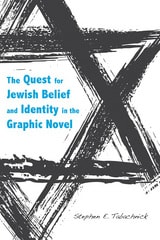
The Quest for Jewish Belief and Identity in the Graphic Novel
Stephen E. Tabachnick
University of Alabama Press, 2014
The creators of Superman (Jerry Siegel and Joe Shuster), Batman (Bob Kane and Bill Finger), and the Marvel superheroes (Stan Lee and Jack Kirby), were Jewish, as was the founding editor of Mad magazine (Harvey Kurtzman). They often adapted Jewish folktales (like the Golem) or religious stories (such as the origin of Moses) for their comics, depicting characters wrestling with supernatural people and events. Likewise, some of the most significant graphic novels by Jews or about Jewish subject matter deal with questions of religious belief and Jewish identity. Their characters wrestle with belief—or nonbelief—in God, as well as with their own relationship to the Jews, the historical role of the Jewish people, the politics of Israel, and other issues related to Jewish identity.
In The Quest for Jewish Belief and Identity in the Graphic Novel, Stephen E. Tabachnick delves into the vivid kaleidoscope of Jewish beliefs and identities, ranging from Orthodox belief to complete atheism, and a spectrum of feelings about identification with other Jews. He explores graphic novels at the highest echelon of the genre by more than thirty artists and writers, among them Harvey Pekar (American Splendor), Will Eisner (A Contract with God), Joann Sfar (The Rabbi’s Cat), Miriam Katin (We Are On Our Own), Art Spiegelman (Maus), J. T. Waldman (Megillat Esther), Aline Kominsky Crumb (Need More Love), James Sturm (The Golem’s Mighty Swing), Leela Corman (Unterzakhn), Ari Folman and David Polonsky (Waltz with Bashir), David Mairowitz and Robert Crumb’s biography of Kafka, and many more. He also examines the work of a select few non-Jewish artists, such as Robert Crumb and Basil Wolverton, both of whom have created graphic adaptations of parts of the Hebrew Bible.
Among the topics he discusses are graphic novel adaptations of the Bible; the Holocaust graphic novel; graphic novels about the Jews in Eastern and Western Europe and Africa, and the American Jewish immigrant experience; graphic novels about the lives of Jewish women; the Israel-centered graphic novel; and the Orthodox graphic novel. The book concludes with an extensive bibliography.
No study of Jewish literature and art today can be complete without a survey of the graphic novel, and scholars, students, and graphic novel fans alike will delight in Tabachnick’s guide to this world of thought, sensibility, and artfulness.

The Reader and the Detective Story
George N. Dove
University of Wisconsin Press, 1997
George Dove demonstrates how the English soft-boiled mystery and the American private-eye story, although they have different settings and develop different plots, belong in the same subgenre and follow the same formula, inherited directly from Poe’s “The Murders in the Rue Morgue.”
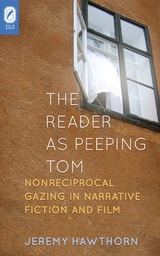
The Reader as Peeping Tom
Nonreciprocal Gazing in Narrative Fiction and FilmJeremy Hawthorn
The Ohio State University Press, 2014
Hawthorn suggests that while some literary and film narratives use the reader’s or viewer’s sense of all-seeing invulnerability to underwrite the various systems of control and surveillance that are depicted in the work, others associate such forms of nonreciprocal observation with impotence and impoverishment and thus critique political systems that legitimize surveillance. Hawthorn concludes that critics have underestimated the extent to which reader’s or viewer’s sense of disempowerment adds meaning to the experience of fiction and film and may encourage acceptance or criticism of spying and surveillance in the real world. The book questions benign views of the reader’s or spectator’s role as passive observer, and offers original and exciting readings of some key narrative texts.

The Reader's Repentance
Women Preachers, Women Writers, and Nineteenth-Century Social DiscourseChristine L. Krueger
University of Chicago Press, 1992
Christine L. Krueger persuasively argues that Evangelical Christianity, by assuming the spiritual equality of women and men and the moral superiority of middle-class women, opened a space for the linguistic empowerment of women and fostered the emergence of women orators and writers who, in complex and contradictory ways, became powerful public figures. In the light of unpublished or long out-of-print writing by eighteenth- and nineteenth-century women preachers, Krueger shows how these women drew on religious language to critique forms of male domination, promote female political power, establish communities of women, and, most significantly, feminize social discourse. She traces the legacy of these preachers through the work of writers as diverse as Hannah More, Charlotte Elizabeth Tonna, Elizabeth Gaskell, and George Eliot—women who, despite political differences, shared an evangelical strategy for placing women's concerns on the social agenda of their time.
Documenting and analyzing the tradition of women's preaching as a powerful and distinctly feminist force in the development of nineteenth-century social fiction, The Reader's Repentance reconstitutes a significant chapter in the history of women and culture. This original work will be of interest to students of women's history, literature, and eighteenth- and nineteenth-century society.
The Reader, the Text, the Poem
The Transactional Theory of the Literary WorkLouise M. Rosenblatt
Southern Illinois University Press, 1994
Louise M. Rosenblatt’s award-winning work continues increasingly to be read in a wide range of academic fields—literary criticism, reading theory, aesthetics, composition, rhetoric, speech communication, and education. Her view of the reading transaction as a unique event involving reader and text at a particular time under particular circumstances rules out the dualistic emphasis of other theories on either the reader or the text as separate and static entities. The transactional concept accounts for the importance of factors such as gender, ethnicity, culture, and socioeconomic context. Essential reading for the specialist, this book is also well suited for courses in criticism, critical theory, rhetoric, and aesthetics.
Starting from the same nonfoundationalist premises, Rosenblatt avoids the extreme relativism of postmodern theories derived mainly from Continental sources. A deep understanding of the pragmatism of Dewey, James, and Peirce and of key issues in the social sciences is the basis for a view of language and the reading process that recognizes the potentialities for alternative interpretations and at the same time provides a rationale for the responsible reading of texts.
The book has been praised for its lucid explanation of the multidimensional character of the reading process—evoking, interpreting, and evaluating the work. The nonliterary (efferent) and the literary (aesthetic) are shown not to be opposites but to represent a continuum of reading behaviors. The author amply illustrates her theoretical points with interpretations of varied texts. The epilogue carries further her critique of rival contemporary theories.

The Readers' Advisory Guide to Street Literature
Vanessa Irvin Morris
American Library Association, 2011
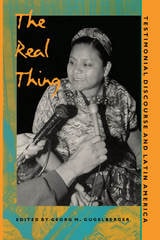
The Real Thing
Testimonial Discourse and Latin AmericaGeorg M. Gugelberger, ed.
Duke University Press, 1996
Although the literature of testimony arose on the margins of institutional power and its ends were in large part political change, the canonization of testimonio by the academic Left has moved it from margin to center, ironically bringing about the institutionalization of its transgressive and counter-hegemonic qualities. Discussing Latin American works ranging from Salvadorian writer Roque Dalton’s Miguel Marmol to I . . . Rigoberta Menchu, a work that earned its author a Nobel Prize, this collection explores how critical writing about testimonio has turned into discourse about the institution of academia, the canon, postmodernism and postcolonialism, and the status of Latin American studies generally.
Contributors. John Beverley, Santiago Colás, Georg M. Gugelberger, Barbara Harlow, Fredric Jameson, Alberto Moreiras, Margaret Randall, Javier Sanjines, Elzbieta Sklodowska, Doris Sommer, Gareth Williams, George Yúdice, Marc Zimmerman
The Real and the Sacred
Picturing Jesus in Nineteenth-Century FictionJefferson J. A. Gatrall
University of Michigan Press, 2014
The Real, the True, and the Told
Postmodern Historical Narrative and the Ethics of RepresentationEric L. Berlatsky
The Ohio State University Press, 2011
The Realistic Imagination
English Fiction from Frankenstein to Lady ChatterlyGeorge Levine
University of Chicago Press, 1983
The Recurrence of Fate
Theatre and Memory in Twentieth-Century RussiaSpencer Jay Golub
University of Iowa Press, 1994
How, why, and according to whose definitions and requirements does a culture self-consciously create memory and project its fate? In this remarkable book—the first in English to treat Russian history as theatre and cultural performance—Spencer Golub reveals the performative nature of Russian history in the twentieth century and the romantic imprisonment/self-imprisonment of the creative intelligentsia within this scenario.
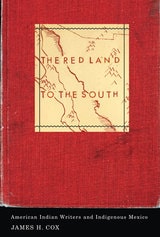
The Red Land to the South
American Indian Writers and Indigenous MexicoJames H. Cox
University of Minnesota Press, 2012
The forty years of American Indian literature taken up by James H. Cox—the decades between 1920 and 1960—have been called politically and intellectually moribund. On the contrary, Cox identifies a group of American Indian writers who share an interest in the revolutionary potential of the indigenous peoples of Mexico—and whose work demonstrates a surprisingly assertive literary politics in the era.
By contextualizing this group of American Indian authors in the work of their contemporaries, Cox reveals how the literary history of this period is far more rich and nuanced than is generally acknowledged. The writers he focuses on—Todd Downing (Choctaw), Lynn Riggs (Cherokee), and D’Arcy McNickle (Confederated Salish and Kootenai)—are shown to be on par with writers of the preceding Progressive and the succeeding Red Power and Native American literary renaissance eras.
Arguing that American Indian literary history of this period actually coheres in exciting ways with the literature of the Native American literary renaissance, Cox repudiates the intellectual and political border that has emerged between the two eras.
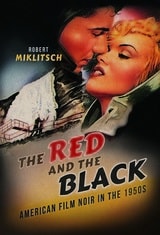
The Red and the Black
American Film Noir in the 1950sRobert Miklitsch
University of Illinois Press, 2017
Mixing scholarship with a fan's devotion to the crooked roads of critique, Miklitsch autopsies marquee films like D.O.A., Niagara, and Kiss Me Deadly plus a number of lesser-known classics. Throughout, he addresses the social and technological factors that dealt deuce after deuce to the genre--its celebrated style threatened by new media and technologies such as TV and 3-D, color and widescreen, its born losers replaced like zombies by All-American heroes, the nation rocked by the red menace and nightmares of nuclear annihilation. But against all odds, the author argues, inventive filmmakers continued to make formally daring and socially compelling pictures that remain surprisingly, startlingly alive.
Cutting-edge and entertaining, The Red and the Black reconsiders a lost period in the history of American movies.
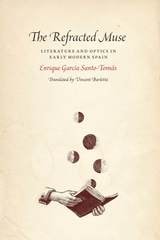
The Refracted Muse
Literature and Optics in Early Modern SpainEnrique Garcia Santo-Tomas
University of Chicago Press, 2017
While Spain is often thought to have taken little notice of the Scientific Revolution, García Santo-Tomás tells a different story, one that reveals Golden Age Spanish literature to be in close dialogue with the New Science. Drawing on the work of writers such as Cervantes, Lope de Vega, Calderón de la Barca, and Quevedo, he helps us trace the influence of science and discovery on the rapidly developing and highly playful genre of the novel. Indeed, García Santo-Tomás makes a strong case that the rise of the novel cannot be fully understood without taking into account its relationship to the scientific discoveries of the period.

The Reframing of Realism
Galdós & the Discourses of the 19th-Century Spanish NovelHazel Gold
Duke University Press, 1993
A close look at Galdós's novels reveals the artist at pains to contain and interpret what he perceived to be the distinctive and often disheartening experience of bourgeois liberalism of his day. At the same time, he can be seen here undermining or negating the accepted conventions of realist fiction. Looking beyond text to context, Gold examines the ways in which Galdós's work itself has been framed by readers and critics in accordance with changing allegiances to contemporary literary theory and the canon.
The highly ambiguous status of the frame in Galdós's fictions confirms the author's own signal position as a writer poised at the limits between realism and modernity. Gold's work will command the interest of students of Spanish and comparative literature, narrative theory, and the novel, as well as all those for whom realism and representation are at issue.
The Reinvention of Mexico in Contemporary Spanish Travel Writing
Jane Hanley
Vanderbilt University Press, 2021
To frame the analysis of contemporary travel writing, author Jane Hanley examines key moments in the history of Mexican-Spanish relations, including the origins of narratives regarding Spaniards' sense of Mexico's similarity to and difference from Spain. This history underpins the discussion of the role of Spanish travelers in their encounters with Mexican peoples and places and their reflection on their own role as communicators of cultural meaning and participants in the tourist economy with its impact—both negative and positive—on places.
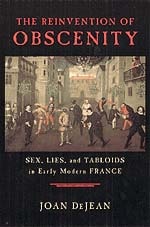
The Reinvention of Obscenity
Sex, Lies, and Tabloids in Early Modern FranceJoan DeJean
University of Chicago Press, 2002
The Reinvention of Obscenity casts a fresh light on the mythical link between sexual impropriety and things French. Exploring the complicity between censorship, print culture, and obscenity, DeJean argues that mass market printing and the first modern censorial machinery came into being at the very moment that obscenity was being reinvented—that is, transformed from a minor literary phenomenon into a threat to society. DeJean's principal case in this study is the career of Moliére, who cannily exploited the new link between indecency and female genitalia to found his career as a print author; the enormous scandal which followed his play L'école des femmes made him the first modern writer to have his sex life dissected in the press.
Keenly alert to parallels with the currency of obscenity in contemporary America, The Reinvention of Obscenity will concern not only scholars of French history, but anyone interested in the intertwined histories of sex, publishing, and censorship.
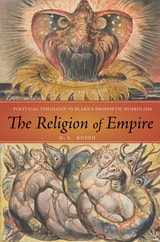
The Religion of Empire
Political Theology in Blake's Prophetic SymbolismG. A. Rosso
The Ohio State University Press, 2016
The Religion of Empire also reevaluates Blake’s relationship with Milton, whose influence Blake both affirms and contests in a unique appropriation of Milton’s prophetic legacy. In this context, Rosso challenges recent views of Blake as complicit with the nationalism and sexism of his time, expanding the religion-empire nexus to include Blake’s esoteric understanding of gender. Foregrounding the role of female characters in the longer prophecies, Rosso discloses the variegated and progressive nature of Blake’s apocalyptic humanism.
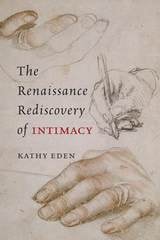
The Renaissance Rediscovery of Intimacy
Kathy Eden
University of Chicago Press, 2012
In 1345, when Petrarch recovered a lost collection of letters from Cicero to his best friend Atticus, he discovered an intimate Cicero, a man very different from either the well-known orator of the Roman forum or the measured spokesman for the ancient schools of philosophy. It was Petrarch’s encounter with this previously unknown Cicero and his letters that Kathy Eden argues fundamentally changed the way Europeans from the fourteenth through the sixteenth centuries were expected to read and write.
The Renaissance Rediscovery of Intimacy explores the way ancient epistolary theory and practice were understood and imitated in the European Renaissance.Eden draws chiefly upon Aristotle, Cicero, and Seneca—but also upon Plato, Demetrius, Quintilian, and many others—to show how the classical genre of the “familiar” letter emerged centuries later in the intimate styles of Petrarch, Erasmus, and Montaigne. Along the way, she reveals how the complex concept of intimacy in the Renaissance—leveraging the legal, affective, and stylistic dimensions of its prehistory in antiquity—pervades the literary production and reception of the period and sets the course for much that is modern in the literature of subsequent centuries. Eden’s important study will interest students and scholars in a number of areas, including classical, Renaissance, and early modern studies; comparative literature; and the history of reading, rhetoric, and writing.
The Repeating Island
The Caribbean and the Postmodern PerspectiveAntonio Benitez-Rojo
Duke University Press, 1996
The Republic of Love
Cultural Intimacy in Turkish Popular MusicMartin Stokes
University of Chicago Press, 2010
At the heart of The Republic of Love are the voices of three musicians—queer nightclub star Zeki Müren, arabesk originator Orhan Gencebay, and pop diva Sezen Aksu—who collectively have dominated mass media in Turkey since the early 1950s. Their fame and ubiquity have made them national icons—but, Martin Stokes here contends, they do not represent the official version of Turkish identity propagated by anthems or flags; instead they evoke a much more intimate and ambivalent conception of Turkishness.
Using these three singers as a lens, Stokes examines Turkey’s repressive politics and civil violence as well as its uncommonly vibrant public life in which music, art, literature, sports, and journalism have flourished. However, Stokes’s primary concern is how Müren, Gencebay, and Aksu’s music and careers can be understood in light of theories of cultural intimacy. In particular, he considers their contributions to the development of a Turkish concept of love, analyzing the ways these singers explore the private matters of intimacy, affection, and sentiment on the public stage.
The Rescue of Romanticism
Walter Pater and John RuskinKenneth Daley
Ohio University Press, 2001
Valuable and timely in its long historical and critical perspective on the legacy of romanticism to Victorian art and thought, The Rescue of Romanticism is the first book-length study of the close intellectual relationship between Walter Pater and John Ruskin, the two most important Victorian critics of art. Kenneth Daley explores the work and thought of both writers in context with other Victorian writers, and enlarges the issues at stake between them, connecting these issues to ongoing artistic, cultural, and political concerns of the modern world.
Professor Daley gives a more finely honed picture than ever before of romanticism’s emergence as a literary concept in Victorian England, detailing the political differences that characterize the opposition between John Ruskin and his younger contemporary, Walter Pater, over the nature of romanticism. Individual chapters reassess the Victorian reception of such romantic figures as Wordsworth, Dante Gabriel Rossetti, Leonardo, and Michelangelo.
Daley demonstrates how Pater’s “modern” reading of romanticism emerged from Ruskin’s distrust of romanticism and from Ruskin’s arguments and examples defining pathetic fallacy. His discussion of Ruskin’s Oxford lectures and their timing in Pater’s developing career refresh the intersections of the two bodies of work and the portrait of the Victorian period in general.
The Resistance to Poetry
James Longenbach
University of Chicago Press, 2005
But the resistance to poetry is quite specifically the wonder of poetry. Considering a wide array of poets, from Virgil and Milton to Dickinson and Glück, Longenbach suggests that poems convey knowledge only inasmuch as they refuse to be vehicles for the efficient transmission of knowledge. In fact, this self-resistance is the source of the reader's pleasure: we read poetry not to escape difficulty but to embrace it.
An astute writer and critic of poems, Longenbach makes his case through a sustained engagement with the language of poetry. Each chapter brings a fresh perspective to a crucial aspect of poetry (line, syntax, figurative language, voice, disjunction) and shows that the power of poetry depends less on meaning than on the way in which it means—on the temporal process we negotiate in the act of reading or writing a poem. Readers and writers who embrace that process, Longenbach asserts, inevitably recoil from the exaggeration of the cultural power of poetry in full awareness that to inflate a poem's claim on our attention is to weaken it.
A graceful and skilled study, The Resistance to Poetry honors poetry by allowing it to be what it is. This book arrives at a critical moment—at a time when many people are trying to mold and market poetry into something it is not.
The Resounding Revolution
Freedom Song after 1968Stephen Stacks
University of Illinois Press, 2025
Stacks’s analysis shifts the focus of attention from genre--freedom song--to process and practice--freedom singing. As he shows, freedom singing after 1968 generates multilayered meanings. It can reinforce, or resist, consensus memories or dominant narratives. Stacks illuminates freedom singing’s diversity by examining it in three contexts: performance, protest, and within documentary sound recording/film.
Insightful and vividly detailed, The Resounding Revolution examines sixty years of Black music to challenge and reshape the entrenched story of the Civil Rights Movement.
The Restoration of Gregorian Chant
Solesmes and the Vatican EditionDom Pierre Combe, O.S.B.
Catholic University of America Press, 2003