4127 books match the query 'Science' and 980 start with t

cover of The Politics of Disease Control: Sleeping Sickness in Eastern Africa, 1890–1920

The Politics of Disease Control

Sleeping Sickness in Eastern Africa, 1890–1920

Mari K. Webel

Ohio University Press, 2019

A history of epidemic illness and political change, The Politics of Disease Control focuses on epidemics of sleeping sickness (human African trypanosomiasis) around Lake Victoria and Lake Tanganyika in the early twentieth century as well as the colonial public health programs designed to control them. Mari K. Webel prioritizes local histories of populations in the Great Lakes region to put the successes and failures of a widely used colonial public health intervention—the sleeping sickness camp—into dialogue with African strategies to mitigate illness and death in the past.

Webel draws case studies from colonial Burundi, Tanzania, and Uganda to frame her arguments within a zone of vigorous mobility and exchange in eastern Africa, where African states engaged with the Belgian, British, and German empires. Situating sleeping sickness control within African intellectual worlds and political dynamics, The Politics of Disease Control connects responses to sleeping sickness with experiences of historical epidemics such as plague, cholera, and smallpox, demonstrating important continuities before and after colonial incursion. African strategies to mitigate disease, Webel shows, fundamentally shaped colonial disease prevention programs in a crucial moment of political and social change.
[more]
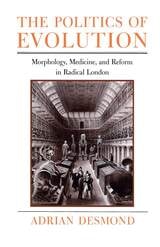
cover of The Politics of Evolution: Morphology, Medicine, and Reform in Radical London

The Politics of Evolution

Morphology, Medicine, and Reform in Radical London

Adrian Desmond

University of Chicago Press, 1990

Looking for the first time at the cut-price anatomy schools rather than genteel Oxbridge, Desmond winkles out pre-Darwinian evolutionary ideas in reform-minded and politically charged early nineteenth-century London. In the process, he reveals the underside of London intellectual and social life in the generation before Darwin as it has never been seen before.

"The Politics of Evolution is intellectual dynamite, and certainly one of the most important books in the history of science published during the past decade."—Jim Secord, Times Literary Supplement

"One of those rare books that not only stakes out new territory but demands a radical overhaul of conventional wisdom."—John Hedley Brooke, Times Higher Education Supplement

[more]
cover of The Politics of Hazardous Waste Management

The Politics of Hazardous Waste Management

James P. Lester and Ann O M. Bowman, eds.

Duke University Press, 1983

One of the most critical areas of environmental controls is the regulation and management of hazardous wastes. This book examines the political context in which policy and management decisions in this are are made (state and federal, public and private), discusses implementation of the current policy mandate (the Resource Conservation and Recovery Act), and its financing (the Superfund). The contributors analyze specific cases and assess the evolution of hazardous waste regulation at federal, state, and local levels.
[more]
cover of The Politics of Pure Science

The Politics of Pure Science

Daniel S. Greenberg

University of Chicago Press, 1999

The Politics of Pure Science, a pioneering and controversial work, set a new standard for the realistic examination of the place of science in American politics and society. Dispelling the myth of scientific purity and detachment, Daniel S. Greenberg documents in revealing detail the political processes that underpinned government funding of science from the 1940s to the 1970s.

While the book's hard-hitting approach earned praise from a broad audience, it drew harsh fire from many scientists, who did not relish their turn under the microscope. The fact that this dispute is so reminiscent of today's acrimonious "Science Wars" demonstrates that although science has changed a great deal since The Politics of Pure Science first appeared, the politics of science has not—which is why this book retains its importance.

For this new edition, John Maddox (Nature editor emeritus) and Steven Shapin have provided introductory essays that situate the book in broad social and historical context, and Greenberg has written a new afterword taking account of recent developments in the politics of science.

"[A] book of consequence about science as one of the more consequential social institutions in the modern world. It is one that could be understood and should be read by the President, legislators, scientists and the rest of us ordinary folk. . . . Informative and perceptive."—Robert K. Merton, New York Times Book Review
[more]
cover of The Politics of Scale: A History of Rangeland Science

The Politics of Scale

A History of Rangeland Science

Nathan F. Sayre

University of Chicago Press, 2017

Rangelands are vast, making up one quarter of the United States and forty percent of the Earth’s ice-free land. And while contemporary science has revealed a great deal about the environmental impacts associated with intensive livestock production—from greenhouse gas emissions to land and water degradation—far less is known about the historic role science has played in rangeland management and politics. Steeped in US soil, this first history of rangeland science looks to the origins of rangeland ecology in the late nineteenth-century American West, exploring the larger political and economic forces that—together with scientific study—produced legacies focused on immediate economic success rather than long-term ecological well being.

During the late 1880s and early 1890s, a variety of forces—from the Homestead Act of 1862 to the extermination of bison, foreign investment, and lack of government regulation—promoted free-for-all access to and development of the western range, with disastrous environmental consequences. To address the crisis, government agencies turned to scientists, but as Nathan F. Sayre shows, range science grew in a politically fraught landscape. Neither the scientists nor the public agencies could escape the influences of bureaucrats and ranchers who demanded results, and the ideas that became scientific orthodoxy—from fire suppression and predator control to fencing and carrying capacities—contained flaws and blind spots that plague public debates about rangelands to this day. Looking at the global history of rangeland science through the Cold War and beyond, The Politics of Scale identifies the sources of past conflicts and mistakes and helps us to see a more promising path forward, one in which rangeland science is guided less by capital and the state and more by communities working in collaboration with scientists.
[more]
cover of The Politics of Water in Arizona

The Politics of Water in Arizona

Dean E. Mann

University of Arizona Press, 1963
“Mann’s book is timely, and its central theme, the role of legal, political, and scientific institutions in the utilization of water in Arizona, is appropriate. It is appropriate, moreover, for the greater region of California and the Southwest, where exist similar problems. . . . The Politics of Water in Arizona ranks along with Richard Cooley’s prize winning Politics and Conservation: The Decline of the Alaska Salmon as an outstanding contribution of a political science to the field of conservation and resource utilization.”—California Historical Society Quarterly
[more]
cover of The Politics of Women's Biology

The Politics of Women's Biology

Hubbard, Ruth

Rutgers University Press, 1990
For a range of historical and contemporary issues in eugenics, human evolution, and procreative technology, Ruth Hubbard explains why scientific descriptions and choices should not generalize human, or female, attributes without acknowledging the realities of people's lives. Sophisticated in its analysis, yet not at all technical in its exposition, this book will find a wide readership among feminists, the general public, and the scientific community.
[more]
cover of The Polkinghorne Reader: Science, Faith, and the Search for Meaning

The Polkinghorne Reader

Science, Faith, and the Search for Meaning

John C. Polkinghorne

Templeton Press, 2010

The Revd. Dr. John Polkinghorne is a world-renowned authority in the field of science and religion. His numerous books in this area, written over the past three decades, have been hugely influential. The Polkinghorne Reader brings together key extracts from his writings on core issues such as the nature of science, the physical world, human nature, love, theology, creation, providence, prayer and miracle, time, evil, Jesus, the resurrection, the Trinity, eschatology, and world faiths.
Ideal for readers who are new to Polkinghorne or who are just beginning to explore the interplay between science and religion, this collection will also be welcomed by all who have read his earlier works but would like one handy resource that presents the major facets of his thought in an accessible and systematic fashion.

[more]
cover of The Pontecorvo Affair: A Cold War Defection and Nuclear Physics

The Pontecorvo Affair

A Cold War Defection and Nuclear Physics

Simone Turchetti

University of Chicago Press, 2012

In the fall of 1950, newspapers around the world reported that the Italian-born nuclear physicist Bruno Pontecorvo and his family had mysteriously disappeared while returning to Britain from a holiday trip. Because Pontecorvo was known to be an expert working for the UK Atomic Energy Research Establishment, this raised immediate concern for the safety of atomic secrets, especially when it became known in the following months that he had defected to the Soviet Union. Was Pontecorvo a spy? Did he know and pass sensitive information about the bomb to Soviet experts? At the time, nuclear scientists, security personnel, Western government officials, and journalists assessed the case, but their efforts were inconclusive and speculations quickly turned to silence. In the years since, some have downplayed Pontecorvo’s knowledge of atomic weaponry, while others have claimed him as part of a spy ring that infiltrated the Manhattan Project.
           
The Pontecorvo Affair draws from newly disclosed sources to challenge previous attempts to solve the case, offering a balanced and well-documented account of Pontecorvo, his activities, and his possible motivations for defecting. Along the way, Simone Turchetti reconsiders the place of nuclear physics and nuclear physicists in the twentieth century and reveals that as the discipline’s promise of military and industrial uses came to the fore, so did the enforcement of new secrecy provisions on the few experts in the world specializing in its application.
[more]
cover of The Portable Radio in American Life

The Portable Radio in American Life

Michael Brian Schiffer

University of Arizona Press, 1991
As an artifact of culture, the portable radio is an unusual but perfect subject for investigation by archaeologist Schiffer. Seeing the history of everyday objects as the history of the life of a people, he shows how the portable radio has reflected changes in American society as surely as clay pots have for ancient cultures.
[more]
cover of The Positive Mind: Its Development and Impact on Modernity and Postmodernity

The Positive Mind

Its Development and Impact on Modernity and Postmodernity

Evaldas Nekrašas

Central European University Press, 2016
This book is a radical reappraisal of positivism as a major movement in philosophy, science and culture. In examining positivist movement and its contemporary impact, I had the following goals. First, to provide a more precise and systematic definition of the notion of positivism. Second, to describe positivism as a trend of thought concerned not only with the theory of knowledge and philosophy of science, but also with problems of ethics, social, and political philosophy, and show that its representatives usually thought that the problems of the latter cannot be solved without solving the former first. Third, to examine the development of positivism as a movement which preserves a certain tradition and hence possesses some coherence, although the forms of this movement changed in different historical circumstances: it was born in the eighteenth century during the Enlightenment, took the form of social positivism in the nineteenth century, was transformed at the turn of the twentieth century with the emergence of empirio-criticism, and became logical positivism (or logical empiricism) in the twentieth century. Fourth, to reveal the external and internal factors of this evolution. Fifth, to disclose the relation of positivism to other trends of philosophy. Sixth, to determine the influence the positive mind had not only upon philosophy, but upon other cultural phenomena, such as the natural and social sciences, law, politics, arts, religion, and everyday life.
[more]
cover of The Postcolonial Science and Technology Studies Reader

The Postcolonial Science and Technology Studies Reader

Sandra Harding, ed.

Duke University Press, 2011

For twenty years, the renowned philosopher of science Sandra Harding has argued that science and technology studies, postcolonial studies, and feminist critique must inform one another. In The Postcolonial Science and Technology Studies Reader, Harding puts those fields in critical conversation, assembling the anthology that she has long wanted for classroom use. In classic and recent essays, international scholars from a range of disciplines think through a broad array of science and technology philosophies and practices. The contributors reevaluate conventional accounts of the West’s scientific and technological projects in the past and present, rethink the strengths and limitations of non-Western societies’ knowledge traditions, and assess the legacies of colonialism and imperialism. The collection concludes with forward-looking essays, which explore strategies for cultivating new visions of a multicultural, democratic world of sciences and for turning those visions into realities. Feminist science and technology concerns run throughout the reader and are the focus of several essays. Harding provides helpful background for each essay in her introductions to the reader’s four sections.

Contributors
Helen Appleton
Karen Bäckstrand
Lucille H. Brockway
Stephen B. Brush
Judith Carney
Committee on Women, Population, and the Environment
Arturo Escobar
Maria E. Fernandez
Ward H. Goodenough
Susantha Goonatilake
Sandra Harding
Steven J. Harris
Betsy Hartmann
Cori Hayden
Catherine L. M. Hill
John M. Hobson
Peter Mühlhäusler
Catherine A. Odora Hoppers
Consuelo Quiroz
Jenny Reardon
Ella Reitsma
Ziauddin Sardar
Daniel Sarewitz
Londa Schiebinger
Catherine V. Scott
Colin Scott
Mary Terrall
D. Michael Warren
[more]
cover of The Postgenomic Condition: Ethics, Justice, and Knowledge after the Genome

The Postgenomic Condition

Ethics, Justice, and Knowledge after the Genome

Jenny Reardon

University of Chicago Press, 2017

Now that we have sequenced the human genome, what does it mean? In The Postgenomic Condition, Jenny Reardon critically examines the decade after the Human Genome Project, and the fundamental questions about meaning, value and justice this landmark achievement left in its wake.

Drawing on more than a decade of research—in molecular biology labs, commercial startups, governmental agencies, and civic spaces—Reardon demonstrates how the extensive efforts to transform genomics from high tech informatics practiced by a few to meaningful knowledge beneficial to all exposed the limits of long-cherished liberal modes of knowing and governing life. Those in the American South challenged the value of being included in genomics when no hospital served their community.  Ethicists and lawyers charged with overseeing Scottish DNA and data questioned how to develop a system of ownership for these resources when their capacity to create things of value—new personalized treatments—remained largely unrealized. Molecular biologists who pioneered genomics asked whether their practices of thinking could survive the deluge of data produced by the growing power of sequencing machines. While the media is filled with grand visions of precision medicine, The Postgenomic Condition shares these actual challenges of the scientists, entrepreneurs, policy makers, bioethicists, lawyers, and patient advocates who sought to leverage liberal democratic practices to render genomic data a new source of meaning and value for interpreting and caring for life. It brings into rich empirical focus the resulting hard on-the-ground questions about how to know and live on a depleted but data-rich, interconnected yet fractured planet, where technoscience garners significant resources, but deeper questions of knowledge and justice urgently demand attention.
[more]
cover of The Potentials About a Point Electrode and Apparent Resistivity Curves for a Two-, Three-, and Four-Layer Earth

The Potentials About a Point Electrode and Apparent Resistivity Curves for a Two-, Three-, and Four-Layer Earth

Harold M. Mooney and W. W. Wetzel

University of Minnesota Press, 1956

The Potentials About a Point Electrode and Apparent Resistivity Curves for a Two-, Three-, and Four-Layer Earth was first published in 1956. Minnesota Archive Editions uses digital technology to make long-unavailable books once again accessible, and are published unaltered from the original University of Minnesota Press editions.

This publication will be useful to geophysicists, geologists, and others engaged in exploration for minerals by electrical methods, and may be used in theoretical studies of electrical prospecting. It makes available for the first time a comprehensive collection of 2268 master resistivity curves for a two-, three-, and four-layer earth. All previous collections of curves for Wenner electrode configuration are included, so the user will not need to refer elsewhere to complete his set of working curves. In addition, the basic potential data used in computing the curves is given in tables. Auxiliary tables are provided to reduce the graphic integration procedures to simple arithmetic. The integral in question occurs widely in solutions to Laplace's equation.

[more]
cover of The Powers That Be: Global Energy for the Twenty-first Century and Beyond

The Powers That Be

Global Energy for the Twenty-first Century and Beyond

Scott L. Montgomery

University of Chicago Press, 2010

Thirty years ago, our global energy landscape did not look remarkably different from what it does today. Three or four decades from now, it certainly will: dwindling oil reserves will clash with skyrocketing demand, as developing nations around the world lead their citizens into the modern energy economy, and all the while, the grave threat of catastrophic climate change looms ever larger. Energy worries are at an all-time high—just how will we power our future?

With The Powers That Be, Scott L. Montgomery cuts through the hype, alarmism, and confusion to give us a straightforward, informed account of where we are now, and a map of where we’re going. Starting with the inescapable fact of our current dependence on fossil fuels—which supply 80% of all our energy needs today—Montgomery clearly and carefully lays out the many alternative energy options available, ranging from the familiar, like water and solar, to such nascent but promising sources as hydrogen and geothermal power. What is crucial, Montgomery explains, is understanding that our future will depend not on some single, wondrous breakthrough; instead, we should focus on developing a more diverse, adaptable energy future, one that draws on a variety of sources—and is thus less vulnerable to disruption or failure.

An admirably evenhanded and always realistic guide, Montgomery enables readers to understand the implications of energy funding, research, and politics at a global scale. At the same time, he doesn’t neglect the ultimate connection between those decisions and the average citizen flipping a light switch or sliding behind the wheel of a car, making The Powers That Be indispensible for our ever-more energy conscious age.

[more]
cover of The Prairie Garden: Seventy Native Plants You Can Grow in Town or Country

The Prairie Garden

Seventy Native Plants You Can Grow in Town or Country

J. Robert Smith with Beatrice S. Smith

University of Wisconsin Press, 1980

Prairie plants are among the toughest of all ornamentals. While they fascinate gardeners with their beauty and versatility, they require little maintenance. They are highly resistant to insect and disease damage, and they need not be replanted every year.


    In recent years, the idea of growing prairie plants has gained increasing appeal among gardeners. Bob and Beatrice Smith have prepared this practical growing guide—based on their more than fourteen years of experience and experimentation—for all people who wish to grow prairie plants. The Smiths, who have grown all the plants they discuss here, share their wealth of experience with the reader. They recommend the best sites, tell how to plan and prepare the site and how to treat and plant seeds, and share important tips on propagation, transplanting, and managing the prairie garden or landscape. To aid in both planning and identification, the book includes full-color illustrations of all seventy plants.  
[more]
cover of The Prehispanic Ethnobotany of Paquimé and Its Neighbors

The Prehispanic Ethnobotany of Paquimé and Its Neighbors

Paul E. Minnis and Michael E. Whalen

University of Arizona Press, 2020

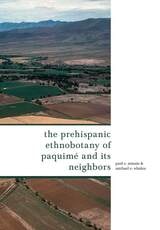
Paquimé (also known as Casas Grandes) and its antecedents are important and interesting parts of the prehispanic history in northwestern Mexico and the U.S. Southwest. Not only is there a long history of human occupation, but Paquimé is one of the better examples of centralized influence. Unfortunately, it is also an understudied region compared to the U.S. Southwest and other places in Mesoamerica.

This volume is the first large-scale investigation of the prehispanic ethnobotany of this important ancient site and its neighbors. The authors examine ethnobotanical relationships during Medio Period, AD 1200–1450, when Paquimé was at its most influential. Based on two decades of archaeological research, this book examines uses of plants for food, farming strategies, wood use, and anthropogenic ecology. The authors show that the relationships between plants and people are complex, interdependent, and reciprocal. This volume documents ethnobotanical relationships and shows their importance to the development of the Paquimé polity.

How ancient farmers made a living in an arid to semi-arid region and the effects their livelihood had on the local biota, their relations with plants, and their connection with other peoples is worthy of serious study. The story of the Casas Grandes tradition holds valuable lessons for humanity.
[more]
cover of The Price of Nuclear Power: Uranium Communities and Environmental Justice

The Price of Nuclear Power

Uranium Communities and Environmental Justice

Malin, Stephanie A.

Rutgers University Press, 2015
Rising fossil fuel prices and concerns about greenhouse gas emissions are fostering a nuclear power renaissance and a revitalized uranium mining industry across the American West. In The Price of Nuclear Power, environmental sociologist Stephanie Malin offers an on-the-ground portrait of several uranium communities caught between the harmful legacy of previous mining booms and the potential promise of new economic development. Using this context, she examines how shifting notions of environmental justice inspire divergent views about nuclear power’s sustainability and equally divisive forms of social activism. 
 
Drawing on extensive fieldwork conducted in rural isolated towns such as Monticello, Utah, and Nucla and Naturita, Colorado, as well as in upscale communities like Telluride, Colorado, and incorporating interviews with community leaders, environmental activists, radiation regulators, and mining executives, Malin uncovers a fundamental paradox of the nuclear renaissance: the communities most hurt by uranium’s legacy—such as high rates of cancers, respiratory ailments, and reproductive disorders—were actually quick to support industry renewal. She shows that many impoverished communities support mining not only because of the employment opportunities, but also out of a personal identification with uranium, a sense of patriotism, and new notions of environmentalism. But other communities, such as Telluride, have become sites of resistance, skeptical of industry and government promises of safe mining, fearing that regulatory enforcement won’t be strong enough. Indeed, Malin shows that the nuclear renaissance has exacerbated social divisions across the Colorado Plateau, threatening social cohesion. Malin further illustrates ways in which renewed uranium production is not a socially sustainable form of energy development for rural communities, as it is utterly dependent on unstable global markets. 
 
The Price of Nuclear Power is an insightful portrait of the local impact of the nuclear renaissance and the social and environmental tensions inherent in the rebirth of uranium mining.
 
 
[more]
cover of The Prison House of the Circuit: Politics of Control from Analog to Digital

The Prison House of the Circuit

Politics of Control from Analog to Digital

Jeremy Packer

University of Minnesota Press, 2023

Has society ceded its self-governance to technogovernance?

The Prison House of the Circuit presents a history of digital media using circuits and circuitry to understand how power operates in the contemporary era. Through the conceptual vocabulary of the circuit, it offers a provocative model for thinking about governance and media.

The authors, writing as a collective, provide a model for collective research and a genealogical framework that interrogates the rise of digital society through the lens of Foucault’s ideas of governance, circulation, and power. The book includes five in-depth case studies investigating the transition from analog media to electronic and digital forms: military telegraphy and human–machine incorporation, the establishment of national electronic biopolitical governance in World War I, media as the means of extending spatial and temporal policing, automobility as the mechanism uniting mobility and media, and visual augmentation from Middle Ages spectacles to digital heads-up displays. The Prison House of the Circuit ultimately demonstrates how contemporary media came to create frictionless circulation to maximize control, efficacy, and state power.
[more]
cover of The Probiotic Planet: Using Life to Manage Life

The Probiotic Planet

Using Life to Manage Life

Jamie Lorimer

University of Minnesota Press, 2020

Assesses a promising new approach to restoring the health of our bodies and our planet

Most of us are familiar with probiotics added to milk or yogurt to improve gastrointestinal health. In fact, the term refers to any intervention in which life is used to manage life—from the microscopic, like consuming fermented food to improve gut health, to macro approaches such as biological pest control and natural flood management. In this ambitious and original work, Jamie Lorimer offers a sweeping overview of diverse probiotic approaches and an insightful critique of their promise and limitations. 

During our current epoch—the Anthropocene—human activity has been the dominant influence on climate and the environment, leading to the loss of ecological abundance, diversity, and functionality. Lorimer describes cases in which scientists and managers are working with biological processes to improve human, environmental, and even planetary health, pursuing strategies that stand in contrast to the “antibiotic approach”: Big Pharma, extreme hygiene, and industrial agriculture. The Probiotic Planet focuses on two forms of “rewilding” occurring on vastly different scales. The first is the use of keystone species like wolves and beavers as part of landscape restoration. The second is the introduction of hookworms into human hosts to treat autoimmune disorders. In both cases, the goal is to improve environmental health, whether the environment being managed is planetary or human. Lorimer argues that, all too often, such interventions are viewed in isolation, and he calls for a rethinking of artificial barriers between science and policy. He also describes the stark and unequal geographies of the use of probiotic approaches and examines why these patterns exist. 

The author’s preface provides a thoughtful discussion of the COVID-19 pandemic as it relates to the probiotic approach. Informed by deep engagement with microbiology, immunology, ecology, and conservation biology as well as food, agriculture, and waste management, The Probiotic Planet offers nothing less than a new paradigm for collaboration between the policy realm and the natural sciences. 
[more]
cover of The Profit of the Earth: The Global Seeds of American Agriculture

The Profit of the Earth

The Global Seeds of American Agriculture

Courtney Fullilove

University of Chicago Press, 2017

While there is enormous public interest in biodiversity, food sourcing, and sustainable agriculture, romantic attachments to heirloom seeds and family farms have provoked misleading fantasies of an unrecoverable agrarian past. The reality, as Courtney Fullilove shows, is that seeds are inherently political objects transformed by the ways they are gathered, preserved, distributed, regenerated, and improved. In The Profit of the Earth, Fullilove unearths the history of American agricultural development and of seeds as tools and talismans put in its service.
 
Organized into three thematic parts, The Profit of the Earth is a narrative history of the collection, circulation, and preservation of seeds. Fullilove begins with the political economy of agricultural improvement, recovering the efforts of the US Patent Office and the nascent US Department of Agriculture to import seeds and cuttings for free distribution to American farmers. She then turns to immigrant agricultural knowledge, exploring how public and private institutions attempting to boost midwestern wheat yields drew on the resources of willing and unwilling settlers. Last, she explores the impact of these cereal monocultures on biocultural diversity, chronicling a fin-de-siècle Ohio pharmacist’s attempt to source Purple Coneflower from the diminishing prairie. Through these captivating narratives of improvisation, appropriation, and loss, Fullilove explores contradictions between ideologies of property rights and common use that persist in national and international development—ultimately challenging readers to rethink fantasies of global agriculture’s past and future.

[more]
cover of The Projectionists: Eadweard Muybridge and the Future Projections of the Moving Image

The Projectionists

Eadweard Muybridge and the Future Projections of the Moving Image

Stephen Barber

Diaphanes, 2020

Eadweard Muybridge is among the seminal originators of the contemporary world’s visual form. Projectionists examines mostly unknown aspects of Muybridge’s work: his period as a touring projectionist who enthralled audiences with unprecedented moving-images and his creation of a moving-image auditorium—long before cinemas—in which to project his work at the 1893 World’s Columbian Exposition. That auditorium was both a catastrophe and a vital precursor for the following century’s manias for projection. Based on new research into his travels, audiences, auditoria, and projectors, Projectionists explores Muybridge’s initiating role in moving-image projection and also maps his driving inspiration for subsequent filmmakers preoccupied with the volatile entity of projection, from 1890s Berlin to contemporary Japan, via further World’s Exposition events and cinemas’ overheated projection-boxes.
[more]
cover of The Promise of Multispecies Justice

The Promise of Multispecies Justice

Sophie Chao, Karin Bolender, and Eben Kirksey, editors

Duke University Press, 2022

What are the possibilities for multispecies justice? How do social justice struggles intersect with the lives of animals, plants, and other creatures? Leading thinkers in anthropology, geography, philosophy, speculative fiction, poetry, and contemporary art answer these questions from diverse grounded locations. In America, Indigenous peoples and prisoners are decolonizing multispecies relations in unceded territory and carceral landscapes. Small justices are emerging in Tanzanian markets, near banana plantations in the Philippines, and in abandoned buildings of Azerbaijan as people navigate relations with feral dogs, weeds, rats, and pesticides. Conflicts over rights of nature are intensifying in Colombia’s Amazon. Specters of justice are emerging in India, while children in Micronesia memorialize extinct bird species. Engaging with ideas about environmental justice, restorative justice, and other species of justice, The Promise of Multispecies Justice holds open the possibility of flourishing in multispecies worlds, present and to come.

Contributors. Karin Bolender, Sophie Chao, M. L. Clark, Radhika Govindrajan, Zsuzsanna Dominika Ihar, Noriko Ishiyama, Eben Kirksey, Elizabeth Lara, Jia Hui Lee, Kristina Lyons, Michael Marder, Alyssa Paredes, Craig Santos Perez, Kim TallBear
[more]
cover of The Pseudoscience Wars: Immanuel Velikovsky and the Birth of the Modern Fringe

The Pseudoscience Wars

Immanuel Velikovsky and the Birth of the Modern Fringe

Michael D. Gordin

University of Chicago Press, 2012
Properly analyzed, the collective mythological and religious writings of humanity reveal that around 1500 BC, a comet swept perilously close to Earth, triggering widespread natural disasters and threatening the destruction of all life before settling into solar orbit as Venus, our nearest planetary neighbor.
 
Sound implausible? Well, from 1950 until the late 1970s, a huge number of people begged to differ, as they devoured Immanuel Velikovsky’s major best-seller, Worlds in Collision, insisting that perhaps this polymathic thinker held the key to a new science and a new history. Scientists, on the other hand, assaulted Velikovsky’s book, his followers, and his press mercilessly from the get-go. In The Pseudoscience Wars, Michael D. Gordin resurrects the largely forgotten figure of Velikovsky and uses his strange career and surprisingly influential writings to explore the changing definitions of the line that separates legitimate scientific inquiry from what is deemed bunk, and to show how vital this question remains to us today. Drawing on a wealth of previously unpublished material from Velikovsky’s personal archives, Gordin presents a behind-the-scenes history of the writer’s career, from his initial burst of success through his growing influence on the counterculture, heated public battles with such luminaries as Carl Sagan, and eventual eclipse. Along the way, he offers fascinating glimpses into the histories and effects of other fringe doctrines, including creationism, Lysenkoism, parapsychology, and more—all of which have surprising connections to Velikovsky’s theories.
 
Science today is hardly universally secure, and scientists seem themselves beset by critics, denialists, and those they label “pseudoscientists”—as seen all too clearly in battles over evolution and climate change. The Pseudoscience Wars simultaneously reveals the surprising Cold War roots of our contemporary dilemma and points readers to a different approach to drawing the line between knowledge and nonsense.

[more]
cover of The Pursuit of Harmony: Kepler on Cosmos, Confession, and Community

The Pursuit of Harmony

Kepler on Cosmos, Confession, and Community

Aviva Rothman

University of Chicago Press, 2017

A committed Lutheran excommunicated from his own church, a friend to Catholics and Calvinists alike, a layman who called himself a “priest of God,” a Copernican in a world where Ptolemy still reigned, a man who argued at the same time for the superiority of one truth and the need for many truths to coexist—German astronomer Johannes Kepler was, to say the least, a complicated figure. With The Pursuit of Harmony, Aviva Rothman offers a new view of him and his achievements, one that presents them as a story of Kepler’s attempts to bring different, even opposing ideas and circumstances into harmony.
 
Harmony, Rothman shows, was both the intellectual bedrock for and the primary goal of Kepler’s disparate endeavors. But it was also an elusive goal amid the deteriorating conditions of his world, as the political order crumbled and religious war raged. In the face of that devastation, Kepler’s hopes for his theories changed: whereas he had originally looked for a unifying approach to truth, he began instead to emphasize harmony as the peaceful coexistence of different views, one that could be fueled by the fundamentally nonpartisan discipline of mathematics. 
 
[more]
cover of The Quality of the Archaeological Record

The Quality of the Archaeological Record

Charles Perreault

University of Chicago Press, 2019

Paleobiology struggled for decades to influence our understanding of evolution and the history of life because it was stymied by a focus on microevolution and an incredibly patchy fossil record. But in the 1970s, the field took a radical turn, as paleobiologists began to investigate processes that could only be recognized in the fossil record across larger scales of time and space. That turn led to a new wave of macroevolutionary investigations, novel insights into the evolution of species, and a growing prominence for the field among the biological sciences.

In The Quality of the Archaeological Record, Charles Perreault shows that archaeology not only faces a parallel problem, but may also find a model in the rise of paleobiology for a shift in the science and theory of the field. To get there, he proposes a more macroscale approach to making sense of the archaeological record, an approach that reveals patterns and processes not visible within the span of a human lifetime, but rather across an observation window thousands of years long and thousands of kilometers wide. Just as with the fossil record, the archaeological record has the scope necessary to detect macroscale cultural phenomena because it can provide samples that are large enough to cancel out the noise generated by micro-scale events. By recalibrating their research to the quality of the archaeological record and developing a true macroarchaeology program, Perreault argues, archaeologists can finally unleash the full contributive value of their discipline.
[more]
cover of The Quarterly Review of Biology, volume 100 number 1 (March 2025)

The Quarterly Review of Biology, volume 100 number 1 (March 2025)

The University of Chicago Press

University of Chicago Press Journals, 2025
This is volume 100 issue 1 of The Quarterly Review of Biology. The Quarterly Review of Biology (QRB) has presented insightful historical, philosophical, and technical treatments of important biological topics since 1926. As the premier review journal in biology, the QRB publishes outstanding review articles of generous length that are guided by an expansive, inclusive, and often humanistic understanding of biology. Beyond the core biological sciences, the QRB is also an important review journal for scholars in related areas, including policy studies and the history and philosophy of science. A comprehensive section of reviews on new biological books provides educators and researchers with information on the latest publications in the life sciences.
[more]
cover of The Quarterly Review of Biology, volume 100 number 2 (June 2025)

The Quarterly Review of Biology, volume 100 number 2 (June 2025)

The University of Chicago Press

University of Chicago Press Journals, 2025
This is volume 100 issue 2 of The Quarterly Review of Biology. The Quarterly Review of Biology (QRB) has presented insightful historical, philosophical, and technical treatments of important biological topics since 1926. As the premier review journal in biology, the QRB publishes outstanding review articles of generous length that are guided by an expansive, inclusive, and often humanistic understanding of biology. Beyond the core biological sciences, the QRB is also an important review journal for scholars in related areas, including policy studies and the history and philosophy of science. A comprehensive section of reviews on new biological books provides educators and researchers with information on the latest publications in the life sciences.
[more]
cover of The Quarterly Review of Biology, volume 100 number 3 (September 2025)

The Quarterly Review of Biology, volume 100 number 3 (September 2025)

The University of Chicago Press

University of Chicago Press Journals, 2025
This is volume 100 issue 3 of The Quarterly Review of Biology. The Quarterly Review of Biology (QRB) has presented insightful historical, philosophical, and technical treatments of important biological topics since 1926. As the premier review journal in biology, the QRB publishes outstanding review articles of generous length that are guided by an expansive, inclusive, and often humanistic understanding of biology. Beyond the core biological sciences, the QRB is also an important review journal for scholars in related areas, including policy studies and the history and philosophy of science. A comprehensive section of reviews on new biological books provides educators and researchers with information on the latest publications in the life sciences.
[more]
cover of The Quarterly Review of Biology, volume 100 number 4 (December 2025)

The Quarterly Review of Biology, volume 100 number 4 (December 2025)

The University of Chicago Press

University of Chicago Press Journals, 2025
This is volume 100 issue 4 of The Quarterly Review of Biology. The Quarterly Review of Biology (QRB) has presented insightful historical, philosophical, and technical treatments of important biological topics since 1926. As the premier review journal in biology, the QRB publishes outstanding review articles of generous length that are guided by an expansive, inclusive, and often humanistic understanding of biology. Beyond the core biological sciences, the QRB is also an important review journal for scholars in related areas, including policy studies and the history and philosophy of science. A comprehensive section of reviews on new biological books provides educators and researchers with information on the latest publications in the life sciences.
[more]
cover of The Quarterly Review of Biology, volume 101 number 1 (March 2026)

The Quarterly Review of Biology, volume 101 number 1 (March 2026)

The University of Chicago Press

University of Chicago Press Journals, 2026
This is volume 101 issue 1 of The Quarterly Review of Biology. The Quarterly Review of Biology (QRB) has presented insightful historical, philosophical, and technical treatments of important biological topics since 1926. As the premier review journal in biology, the QRB publishes outstanding review articles of generous length that are guided by an expansive, inclusive, and often humanistic understanding of biology. Beyond the core biological sciences, the QRB is also an important review journal for scholars in related areas, including policy studies and the history and philosophy of science. A comprehensive section of reviews on new biological books provides educators and researchers with information on the latest publications in the life sciences.
[more]
cover of The Quarterly Review of Biology, volume 101 number 2 (June 2026)

The Quarterly Review of Biology, volume 101 number 2 (June 2026)

The University of Chicago Press

University of Chicago Press Journals, 2026
This is volume 101 issue 2 of The Quarterly Review of Biology. The Quarterly Review of Biology (QRB) has presented insightful historical, philosophical, and technical treatments of important biological topics since 1926. As the premier review journal in biology, the QRB publishes outstanding review articles of generous length that are guided by an expansive, inclusive, and often humanistic understanding of biology. Beyond the core biological sciences, the QRB is also an important review journal for scholars in related areas, including policy studies and the history and philosophy of science. A comprehensive section of reviews on new biological books provides educators and researchers with information on the latest publications in the life sciences.
[more]
cover of The Quarterly Review of Biology, volume 101 number 3 (September 2026)

The Quarterly Review of Biology, volume 101 number 3 (September 2026)

The University of Chicago Press

University of Chicago Press Journals, 2026
This is volume 101 issue 3 of The Quarterly Review of Biology. The Quarterly Review of Biology (QRB) has presented insightful historical, philosophical, and technical treatments of important biological topics since 1926. As the premier review journal in biology, the QRB publishes outstanding review articles of generous length that are guided by an expansive, inclusive, and often humanistic understanding of biology. Beyond the core biological sciences, the QRB is also an important review journal for scholars in related areas, including policy studies and the history and philosophy of science. A comprehensive section of reviews on new biological books provides educators and researchers with information on the latest publications in the life sciences.
[more]
cover of The Quarterly Review of Biology, volume 96 number 3 (September 2021)

The Quarterly Review of Biology, volume 96 number 3 (September 2021)

The University of Chicago Press

University of Chicago Press Journals, 2021
This is volume 96 issue 3 of The Quarterly Review of Biology. The Quarterly Review of Biology (QRB) has presented insightful historical, philosophical, and technical treatments of important biological topics since 1926. As the premier review journal in biology, the QRB publishes outstanding review articles of generous length that are guided by an expansive, inclusive, and often humanistic understanding of biology. Beyond the core biological sciences, the QRB is also an important review journal for scholars in related areas, including policy studies and the history and philosophy of science. A comprehensive section of reviews on new biological books provides educators and researchers with information on the latest publications in the life sciences.
[more]
cover of The Quarterly Review of Biology, volume 96 number 4 (December 2021)

The Quarterly Review of Biology, volume 96 number 4 (December 2021)

The University of Chicago Press

University of Chicago Press Journals, 2021
This is volume 96 issue 4 of The Quarterly Review of Biology. The Quarterly Review of Biology (QRB) has presented insightful historical, philosophical, and technical treatments of important biological topics since 1926. As the premier review journal in biology, the QRB publishes outstanding review articles of generous length that are guided by an expansive, inclusive, and often humanistic understanding of biology. Beyond the core biological sciences, the QRB is also an important review journal for scholars in related areas, including policy studies and the history and philosophy of science. A comprehensive section of reviews on new biological books provides educators and researchers with information on the latest publications in the life sciences.
[more]
cover of The Quarterly Review of Biology, volume 97 number 1 (March 2022)

The Quarterly Review of Biology, volume 97 number 1 (March 2022)

The University of Chicago Press

University of Chicago Press Journals, 2022
This is volume 97 issue 1 of The Quarterly Review of Biology. The Quarterly Review of Biology (QRB) has presented insightful historical, philosophical, and technical treatments of important biological topics since 1926. As the premier review journal in biology, the QRB publishes outstanding review articles of generous length that are guided by an expansive, inclusive, and often humanistic understanding of biology. Beyond the core biological sciences, the QRB is also an important review journal for scholars in related areas, including policy studies and the history and philosophy of science. A comprehensive section of reviews on new biological books provides educators and researchers with information on the latest publications in the life sciences.
[more]
cover of The Quarterly Review of Biology, volume 97 number 2 (June 2022)

The Quarterly Review of Biology, volume 97 number 2 (June 2022)

The University of Chicago Press

University of Chicago Press Journals, 2022
This is volume 97 issue 2 of The Quarterly Review of Biology. The Quarterly Review of Biology (QRB) has presented insightful historical, philosophical, and technical treatments of important biological topics since 1926. As the premier review journal in biology, the QRB publishes outstanding review articles of generous length that are guided by an expansive, inclusive, and often humanistic understanding of biology. Beyond the core biological sciences, the QRB is also an important review journal for scholars in related areas, including policy studies and the history and philosophy of science. A comprehensive section of reviews on new biological books provides educators and researchers with information on the latest publications in the life sciences.
[more]
cover of The Quarterly Review of Biology, volume 97 number 3 (September 2022)

The Quarterly Review of Biology, volume 97 number 3 (September 2022)

The University of Chicago Press

University of Chicago Press Journals, 2022
This is volume 97 issue 3 of The Quarterly Review of Biology. The Quarterly Review of Biology (QRB) has presented insightful historical, philosophical, and technical treatments of important biological topics since 1926. As the premier review journal in biology, the QRB publishes outstanding review articles of generous length that are guided by an expansive, inclusive, and often humanistic understanding of biology. Beyond the core biological sciences, the QRB is also an important review journal for scholars in related areas, including policy studies and the history and philosophy of science. A comprehensive section of reviews on new biological books provides educators and researchers with information on the latest publications in the life sciences.
[more]
cover of The Quarterly Review of Biology, volume 97 number 4 (December 2022)

The Quarterly Review of Biology, volume 97 number 4 (December 2022)

The University of Chicago Press

University of Chicago Press Journals, 2022
This is volume 97 issue 4 of The Quarterly Review of Biology. The Quarterly Review of Biology (QRB) has presented insightful historical, philosophical, and technical treatments of important biological topics since 1926. As the premier review journal in biology, the QRB publishes outstanding review articles of generous length that are guided by an expansive, inclusive, and often humanistic understanding of biology. Beyond the core biological sciences, the QRB is also an important review journal for scholars in related areas, including policy studies and the history and philosophy of science. A comprehensive section of reviews on new biological books provides educators and researchers with information on the latest publications in the life sciences.
[more]
cover of The Quarterly Review of Biology, volume 98 number 1 (March 2023)

The Quarterly Review of Biology, volume 98 number 1 (March 2023)

The University of Chicago Press

University of Chicago Press Journals, 2023
This is volume 98 issue 1 of The Quarterly Review of Biology. The Quarterly Review of Biology (QRB) has presented insightful historical, philosophical, and technical treatments of important biological topics since 1926. As the premier review journal in biology, the QRB publishes outstanding review articles of generous length that are guided by an expansive, inclusive, and often humanistic understanding of biology. Beyond the core biological sciences, the QRB is also an important review journal for scholars in related areas, including policy studies and the history and philosophy of science. A comprehensive section of reviews on new biological books provides educators and researchers with information on the latest publications in the life sciences.
[more]
cover of The Quarterly Review of Biology, volume 98 number 2 (June 2023)

The Quarterly Review of Biology, volume 98 number 2 (June 2023)

The University of Chicago Press

University of Chicago Press Journals, 2023
This is volume 98 issue 2 of The Quarterly Review of Biology. The Quarterly Review of Biology (QRB) has presented insightful historical, philosophical, and technical treatments of important biological topics since 1926. As the premier review journal in biology, the QRB publishes outstanding review articles of generous length that are guided by an expansive, inclusive, and often humanistic understanding of biology. Beyond the core biological sciences, the QRB is also an important review journal for scholars in related areas, including policy studies and the history and philosophy of science. A comprehensive section of reviews on new biological books provides educators and researchers with information on the latest publications in the life sciences.
[more]
cover of The Quarterly Review of Biology, volume 98 number 3 (September 2023)

The Quarterly Review of Biology, volume 98 number 3 (September 2023)

The University of Chicago Press

University of Chicago Press Journals, 2023
This is volume 98 issue 3 of The Quarterly Review of Biology. The Quarterly Review of Biology (QRB) has presented insightful historical, philosophical, and technical treatments of important biological topics since 1926. As the premier review journal in biology, the QRB publishes outstanding review articles of generous length that are guided by an expansive, inclusive, and often humanistic understanding of biology. Beyond the core biological sciences, the QRB is also an important review journal for scholars in related areas, including policy studies and the history and philosophy of science. A comprehensive section of reviews on new biological books provides educators and researchers with information on the latest publications in the life sciences.
[more]
cover of The Quarterly Review of Biology, volume 98 number 4 (December 2023)

The Quarterly Review of Biology, volume 98 number 4 (December 2023)

The University of Chicago Press

University of Chicago Press Journals, 2023
This is volume 98 issue 4 of The Quarterly Review of Biology. The Quarterly Review of Biology (QRB) has presented insightful historical, philosophical, and technical treatments of important biological topics since 1926. As the premier review journal in biology, the QRB publishes outstanding review articles of generous length that are guided by an expansive, inclusive, and often humanistic understanding of biology. Beyond the core biological sciences, the QRB is also an important review journal for scholars in related areas, including policy studies and the history and philosophy of science. A comprehensive section of reviews on new biological books provides educators and researchers with information on the latest publications in the life sciences.
[more]
cover of The Quarterly Review of Biology, volume 99 number 1 (March 2024)

The Quarterly Review of Biology, volume 99 number 1 (March 2024)

The University of Chicago Press

University of Chicago Press Journals, 2024
This is volume 99 issue 1 of The Quarterly Review of Biology. The Quarterly Review of Biology (QRB) has presented insightful historical, philosophical, and technical treatments of important biological topics since 1926. As the premier review journal in biology, the QRB publishes outstanding review articles of generous length that are guided by an expansive, inclusive, and often humanistic understanding of biology. Beyond the core biological sciences, the QRB is also an important review journal for scholars in related areas, including policy studies and the history and philosophy of science. A comprehensive section of reviews on new biological books provides educators and researchers with information on the latest publications in the life sciences.
[more]
cover of The Quarterly Review of Biology, volume 99 number 2 (June 2024)

The Quarterly Review of Biology, volume 99 number 2 (June 2024)

The University of Chicago Press

University of Chicago Press Journals, 2024
This is volume 99 issue 2 of The Quarterly Review of Biology. The Quarterly Review of Biology (QRB) has presented insightful historical, philosophical, and technical treatments of important biological topics since 1926. As the premier review journal in biology, the QRB publishes outstanding review articles of generous length that are guided by an expansive, inclusive, and often humanistic understanding of biology. Beyond the core biological sciences, the QRB is also an important review journal for scholars in related areas, including policy studies and the history and philosophy of science. A comprehensive section of reviews on new biological books provides educators and researchers with information on the latest publications in the life sciences.
[more]
cover of The Quarterly Review of Biology, volume 99 number 3 (September 2024)

The Quarterly Review of Biology, volume 99 number 3 (September 2024)

The University of Chicago Press

University of Chicago Press Journals, 2024
This is volume 99 issue 3 of The Quarterly Review of Biology. The Quarterly Review of Biology (QRB) has presented insightful historical, philosophical, and technical treatments of important biological topics since 1926. As the premier review journal in biology, the QRB publishes outstanding review articles of generous length that are guided by an expansive, inclusive, and often humanistic understanding of biology. Beyond the core biological sciences, the QRB is also an important review journal for scholars in related areas, including policy studies and the history and philosophy of science. A comprehensive section of reviews on new biological books provides educators and researchers with information on the latest publications in the life sciences.
[more]
cover of The Quarterly Review of Biology, volume 99 number 4 (December 2024)

The Quarterly Review of Biology, volume 99 number 4 (December 2024)

The University of Chicago Press

University of Chicago Press Journals, 2024
This is volume 99 issue 4 of The Quarterly Review of Biology. The Quarterly Review of Biology (QRB) has presented insightful historical, philosophical, and technical treatments of important biological topics since 1926. As the premier review journal in biology, the QRB publishes outstanding review articles of generous length that are guided by an expansive, inclusive, and often humanistic understanding of biology. Beyond the core biological sciences, the QRB is also an important review journal for scholars in related areas, including policy studies and the history and philosophy of science. A comprehensive section of reviews on new biological books provides educators and researchers with information on the latest publications in the life sciences.
[more]
cover of The Quest for Cortisone

The Quest for Cortisone

Thom Rooke

Michigan State University Press, 2012

In 1948, when “Mrs. G.,” hospitalized with debilitating rheumatoid arthritis, became the first person to receive a mysterious new compound—cortisone—her physicians were awestruck by her transformation from enervated to energized. After eighteen years of biochemical research, the most intensively hunted biological agent of all time had finally been isolated, identified, synthesized, and put to the test. And it worked. But the discovery of a long-sought “magic bullet” came at an unanticipated cost in the form of strange side effects. This fascinating history recounts the discovery of cortisone and pulls the curtain back on the peculiar cast of characters responsible for its advent, including two enigmatic scientists, Edward Kendall and Philip Hench, who went on to receive the Nobel Prize. The book also explores the key role the Mayo Clinic played in fostering cortisone’s development, and looks at drugs that owe their heritage to the so-called “King of Steroids.”
[more]
cover of The Quill and the Scalpel: Nabokov's Art and the Worlds of Science

The Quill and the Scalpel

Nabokov's Art and the Worlds of Science

Stephen H. Blackwell

The Ohio State University Press, 2009
Most famous as a literary artist, Vladimir Nabokov was also a professional biologist and a lifelong student of science. By exploring the refractions of physics, psychology, and biology within his art and thought, The Quill and the Scalpel: Nabokov’s Art and the Worlds of Science,by Stephen H. Blackwell, demonstrates how aesthetic sensibilities contributed to Nabokov’s scientific work, and how his scientific passions shape, inform, and permeate his fictions.
            Nabokov’s attention to holistic study and inductive empirical work gradually reinforced his underlying suspicion of mechanistic explanations of nature. He perceived chilling parallels between the overconfidence of scientific progress and the dogmatic certainty of the Soviet regime. His scientific work and his artistic transfigurations of science underscore the limitations of human knowledge as a defining element of life. In provocative novels like Lolita,Pale Fire,The Gift,Ada, and others, Nabokov advances a surprisingly modest epistemology, urging skepticism toward all portrayals of nature, artistic and scientific. Simultaneously, he challenges his readers to recognize in the arts a vital branch of human discovery, one that both complements and informs traditional scientific research.
 
 
[more]
cover of The Raptors of Arizona

The Raptors of Arizona

Edited by Richard L. Glinski, with full-color illustrations by Richard Sloan

University of Arizona Press, 1998

Thousands of birdwatchers come to Arizona each year seeking rare or intriguing species, and for those watching the skies the additional sighting of a bird of prey is a reward in itself. The Grand Canyon state boasts the most dramatic assortment of raptors in North America: hawks, eagles, falcons, kites, and owls, plus vultures and condors. Here can be found nearly all the raptor species of the continental United States and also established populations of species associated with Mexico, such as the Gray Hawk, Common Black-Hawk, Zone-tailed Hawk, and Whiskered Screech-Owl.

Arizona's raptors are found in an unrivaled diversity of habitats, from saguaro cactus forests where tiny Elf Owls nest to the Vermilion Cliffs, where the gigantic California Condor was introduced in 1996. Yet many species live in habitats that are now jeopardized by degradation or development, making an understanding and appreciation of raptors crucial to their survival.

The Raptors of Arizona brings together the knowledge and insights of 29 raptor and wildlife authorities who provide original information and syntheses on Arizona's 42 raptor species, with an emphasis on aspects of their natural history in Arizona. A chapter on each bird includes its description, a range map, and information on its distribution, habitat, life history, and status. Additional chapters cover conservation, habitats, where and when to watch raptors, and the sport of falconry. The book is enhanced by 42 full-color illustrations by Richard Sloan, one of the premier wildlife artists in North America, whose paintings were commissioned by the Arizona Wildlife Foundation specifically for this project. Co-published with the Arizona Game and Fish Department.
[more]