4531 books match the query 'Cultural & Ethnic Studies' and 804 start with t
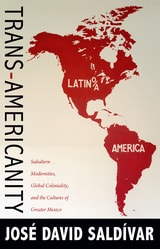
cover of Trans-Americanity: Subaltern Modernities, Global Coloniality, and the Cultures of Greater Mexico

Trans-Americanity

Subaltern Modernities, Global Coloniality, and the Cultures of Greater Mexico

José David Saldívar

Duke University Press, 2012
A founder of U.S.-Mexico border studies, José David Saldívar is a leading figure in efforts to expand the scope of American studies. In Trans-Americanity, he advances that critical project by arguing for a transnational, antinational, and "outernational" paradigm for American studies. Saldívar urges Americanists to adopt a world-system scale of analysis. "Americanity as a Concept," an essay by the Peruvian sociologist Aníbal Quijano and Immanuel Wallerstein, the architect of world-systems analysis, serves as a theoretical touchstone for Trans-Americanity. In conversation not only with Quijano and Wallerstein, but also with the theorists Gloria Anzaldúa, John Beverley, Ranajit Guha, Walter D. Mignolo, and Gayatri Chakravorty Spivak, Saldívar explores questions of the subaltern and the coloniality of power, emphasizing their location within postcolonial studies. Analyzing the work of José Martí, Sandra Cisneros, Toni Morrison, Arundhati Roy, and many other writers, he addresses concerns such as the "unspeakable" in subalternized African American, U.S. Latino and Latina, Cuban, and South Asian literature; the rhetorical form of postcolonial narratives; and constructions of subalternized identities. In Trans-Americanity, Saldívar demonstrates and makes the case for Americanist critique based on a globalized study of the Américas.
[more]
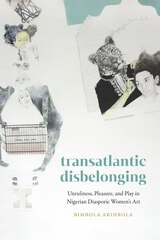
cover of Transatlantic Disbelonging: Unruliness, Pleasure, and Play in Nigerian Diasporic Women's Art

Transatlantic Disbelonging

Unruliness, Pleasure, and Play in Nigerian Diasporic Women's Art

Bimbola Akinbola

Duke University Press, 2025
In Transatlantic Disbelonging, Bimbola Akinbola redirects the focus in diaspora studies from questions of loss and longing to acts of unapologetic self-definition through the study of Nigerian diasporic women artists navigating disparate geographies, allegiances, and identities. Drawing on the work of contemporary visual and performance artists, experimental filmmakers, and writers—including Wura-Natasha Ogunji, Njideka Akunyili Crosby, Zina Saro-Wiwa, ruby onyinyechi amanze, and Nnedi Okorafor—Akinbola articulates how these artists use their experiences as cultural outsiders to redefine home and national belonging on their own terms. Taking a capacious interdisciplinary approach, she explores how these women employ anti-respectability, taboo, the erotic, and play to challenge oppressive colonial legacies and expectations pertaining to gender and morality. For the artists in this book, their artmaking is a form of homemaking that embraces ambivalence and reinvents alienation as possibility. Theorizing these practices as acts of “disbelonging,” Akinbola radically reimagines diasporic identity formation, illustrating how artists use creative practices to enact and embody belonging and community in expansive ways.
[more]
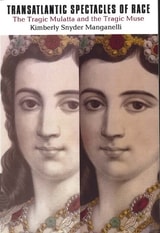
cover of Transatlantic Spectacles of Race: The Tragic Mulatta and the Tragic Muse

Transatlantic Spectacles of Race

The Tragic Mulatta and the Tragic Muse

Manganelli, Kimberly Snyder

Rutgers University Press, 2012

The tragic mulatta was a stock figure in nineteenth-century American literature, an attractive mixed-race woman who became a casualty of the color line. The tragic muse was an equally familiar figure in Victorian British culture, an exotic and alluring Jewish actress whose profession placed her alongside the “fallen woman.”

In Transatlantic Spectacles of Race, Kimberly Manganelli argues that the tragic mulatta and tragic muse, who have heretofore been read separately, must be understood as two sides of the same phenomenon. In both cases, the eroticized and racialized female body is put on public display, as a highly enticing commodity in the nineteenth-century marketplace. Tracing these figures through American, British, and French literature and culture, Manganelli constructs a host of surprising literary genealogies, from Zelica to Daniel Deronda, from Uncle Tom’s Cabin to Lady Audley’s Secret. Bringing together an impressive array of cultural texts that includes novels, melodramas, travel narratives, diaries, and illustrations, Transatlantic Spectacles of Race reveals the value of transcending literary, national, and racial boundaries.
[more]
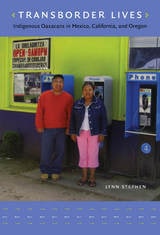
cover of Transborder Lives: Indigenous Oaxacans in Mexico, California, and Oregon

Transborder Lives

Indigenous Oaxacans in Mexico, California, and Oregon

Lynn Stephen

Duke University Press, 2007

Lynn Stephen’s innovative ethnography follows indigenous Mexicans from two towns in the state of Oaxaca—the Mixtec community of San Agustín Atenango and the Zapotec community of Teotitlán del Valle—who periodically leave their homes in Mexico for extended periods of work in California and Oregon. Demonstrating that the line separating Mexico and the United States is only one among the many borders that these migrants repeatedly cross (including national, regional, cultural, ethnic, and class borders and divisions), Stephen advocates an ethnographic framework focused on transborder, rather than transnational, lives. Yet she does not disregard the state: She assesses the impact migration has had on local systems of government in both Mexico and the United States as well as the abilities of states to police and affect transborder communities.

Stephen weaves the personal histories and narratives of indigenous transborder migrants together with explorations of the larger structures that affect their lives. Taking into account U.S. immigration policies and the demands of both commercial agriculture and the service sectors, she chronicles how migrants experience and remember low-wage work in agriculture, landscaping, and childcare and how gender relations in Oaxaca and the United States are reconfigured by migration. She looks at the ways that racial and ethnic hierarchies inherited from the colonial era—hierarchies that debase Mexico’s indigenous groups—are reproduced within heterogeneous Mexican populations in the United States. Stephen provides case studies of four grass-roots organizations in which Mixtec migrants are involved, and she considers specific uses of digital technology by transborder communities. Ultimately Stephen demonstrates that transborder migrants are reshaping notions of territory and politics by developing creative models of governance, education, and economic development as well as ways of maintaining their cultures and languages across geographic distances.
[more]
cover of Transcending Blackness: From the New Millennium Mulatta to the Exceptional Multiracial

Transcending Blackness

From the New Millennium Mulatta to the Exceptional Multiracial

Ralina L. Joseph

Duke University Press, 2012

Representations of multiracial Americans, especially those with one black and one white parent, appear everywhere in contemporary culture, from reality shows to presidential politics. Some depict multiracial individuals as mired in painful confusion; others equate them with progress, as the embodiment of a postracial utopia. In Transcending Blackness, Ralina L. Joseph critiques both depictions as being rooted in—and still defined by—the racist notion that blackness is a deficit that must be overcome.

Analyzing emblematic representations of multiracial figures in popular culture—Jennifer Beals's character in the The L Word; the protagonist in Danny Senza's novel Caucasia; the title character in the independent film Mixing Nia; and contestants in a controversial episode of the reality show America's Next Top Model, who had to "switch ethnicities" for a photo shoot—Joseph identifies the persistence of two widespread stereotypes about mixed-race African Americans, those of "new millennium mulattas" and "exceptional multiracials." The former inscribes multiracial African Americans as tragic figures whose blackness predestines them for misfortune; the latter rewards mixed-race African Americans for successfully erasing their blackness. Addressing questions of authenticity, sexuality, and privilege, Transcending Blackness refutes the idea that race no longer matters in American society.
[more]
cover of Transculturality and German Discourse in the Age of European Colonialism

Transculturality and German Discourse in the Age of European Colonialism

Chunjie Zhang

Northwestern University Press, 2017
In Transculturality and German Discourse in the Age of European Colonialism, Chunjie Zhang examines the South Pacific travel writings of George Forster and Adelbert von Chamisso, literary works by August von Kotzebue and Johann Joachim Campe, Herder’s philosophy of history, and Kant’s theory of geography from the perspective of non-European impact during the age of Europe’s colonial expansion. She explores what these texts show about German and European superiority, the critique of the slave trade, European moral debauchery, acknowledgments of non-European cultural achievements, and sympathy with colonized peoples. Moving beyond the question of empire versus enlightenment, Zhang’s book diligently detects global connections, offering much to scholars of literature, culture, and intellectual history.
[more]
cover of Transformation Now!: Toward a Post-Oppositional Politics of Change

Transformation Now!

Toward a Post-Oppositional Politics of Change

AnaLouise Keating

University of Illinois Press, 2013
In this lively, thought-provoking study, AnaLouise Keating writes in the traditions of radical U.S. women-of-color feminist/womanist thought and queer studies, inviting us to transform how we think about identity, difference, social justice and social change, metaphysics, reading, and teaching. Through detailed investigations of women of color theories and writings, indigenous thought, and her own personal and pedagogical experiences, Keating develops transformative modes of engagement that move through oppositional approaches to embrace interconnectivity as a framework for identity formation, theorizing, social change, and the possibility of planetary citizenship. Speaking to many dimensions of contemporary scholarship, activism, and social justice work, Transformation Now! calls for and enacts innovative, radically inclusionary ways of reading, teaching, and communicating.
[more]
cover of Transformations of Sensibility: The Phenomenology of Meiji Literature

Transformations of Sensibility

The Phenomenology of Meiji Literature

Kamei Hideo; Translated, edited, and with an introduction by Michael Bourdaghs

University of Michigan Press, 2002
First published in Japan in 1983, this book is now a classic in modern Japanese literary studies. Covering an astonishing range of texts from the Meiji period (1868–1912), it presents sophisticated analyses of the ways that experiments in literary language produced multiple new—and sometimes revolutionary—forms of sensibility and subjectivity. Along the way, Kamei Hideo carries on an extended debate with Western theorists such as Saussure, Bakhtin, and Lotman, as well as with such contemporary Japanese critics as Karatani Kōjin and Noguchi Takehiko.
Transformations of Sensibility deliberately challenges conventional wisdom about the rise of modern literature in Japan and offers highly original close readings of works by such writers as Futabatei Shimei, Tsubouchi Shōyō, Higuchi Ichiyō, and Izumi Kyōka, as well as writers previously ignored by most scholars. It also provides a new critical theorization of the relationship between language and sensibility, one that links the specificity of Meiji literature to broader concerns that transcend the field of Japanese literary studies. Available in English translation for the first time, it includes a new preface by the author and an introduction by the translation editor that explain the theoretical and historical contexts in which the work first appeared.
[more]
cover of Transforming Citizenship: Democracy, Membership, and Belonging in Latino Communities

Transforming Citizenship

Democracy, Membership, and Belonging in Latino Communities

Raymond A. Rocco

Michigan State University Press, 2014

In Transforming Citizenship Raymond Rocco studies the “exclusionary inclusion” of Latinos based on racialization and how the processes behind this have shaped their marginalized citizenship status, offering a framework for explaining this dynamic. Contesting this status has been at the core of Latino politics for more than 150 years. Pursuing the goal of full, equal, and just inclusion in societal membership has long been a major part of the struggle to realize democratic normative principles. This illuminating research demonstrates the inherent limitations of the citizenship regime in the United States for incorporating Latinos as full societal members and offers an alternative conception, “associative citizenship,” that provides a way to account for and challenge the pattern of exclusionary belonging that has defined the positions of the Latinos in U.S. society. Through a critical engagement with key theorists such as Rawls, Habermas, Kymlicka, Walzer, Taylor, and Young, Rocco advances an original analysis of the politics of Latino societal membership and citizenship, arguing that the specific processes of racialization that have played a determinative role in creating and maintaining the pattern of social and political exclusions of Latinos have not been addressed by the dominant theories of diversity and citizenship developed in the prevalent literature in political theory.
[more]
cover of Transforming Vòdún: Musical Change and Postcolonial Healing in Benin's Jazz and Brass Band Music

Transforming Vòdún

Musical Change and Postcolonial Healing in Benin's Jazz and Brass Band Music

Sarah Politz

University of Michigan Press, 2023
Transforming Vòdún examines how musicians from the West African Republic of Benin transform Benin’s cultural traditions, especially the ancestral spiritual practice of vòdún and its musical repertoires, as part of the process of healing postcolonial trauma through music and ritual. Based on fieldwork in Benin, France, and New York City, Sarah Politz uses historical ethnography, music analysis, and participant observation to examine three case studies of brass band and jazz musicians from Benin. The multi-sited nature of this study highlights the importance of mobility, and diasporic connections in musicians’ professional lives, while grounding these connections in the particularities of the African continent, its histories, its people, and its present.  
[more]
cover of Transforming the Academy: Faculty Perspectives on Diversity and Pedagogy

Transforming the Academy

Faculty Perspectives on Diversity and Pedagogy

Willie-LeBreton, Sarah

Rutgers University Press, 2016
In recent decades, American universities have begun to tout the “diversity” of their faculty and student bodies. But what kinds of diversity are being championed in their admissions and hiring practices, and what kinds are being neglected? Is diversity enough to solve the structural inequalities that plague our universities? And how might we articulate the value of diversity in the first place? 
 
Transforming the Academy begins to answer these questions by bringing together a mix of faculty—male and female, cisgender and queer, immigrant and native-born, tenured and contingent, white, black, multiracial, and other—from public and private universities across the United States. Whether describing contentious power dynamics within their classrooms or recounting protests that occurred on their campuses, the book’s contributors offer bracingly honest inside accounts of both the conflicts and the learning experiences that can emerge from being a representative of diversity. 
 
The collection’s authors are united by their commitment to an ideal of the American university as an inclusive and transformative space, one where students from all backgrounds can simultaneously feel intellectually challenged and personally supported. Yet Transforming the Academy also offers a wide range of perspectives on how to best achieve these goals, a diversity of opinion that is sure to inspire lively debate. 
 
[more]
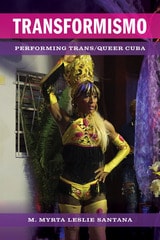
cover of Transformismo: Performing Trans/Queer Cuba

Transformismo

Performing Trans/Queer Cuba

M. Myrta Leslie Santana

University of Michigan Press, 2025
In Transformismo, M. Myrta Leslie Santana draws on years of embedded research within Cuban trans/queer communities to analyze how transformistas, or drag performers, understand their roles in the social transformation of the island. Once banned and censored in Cuba, drag performance is now a state-sponsored event. Transformismo suggests that these performances make critical interventions in Cuban trans/queer life and politics and in doing so, the volume offers critical insight into how Cuba’s postsocialist reform has exacerbated racial, sexual, and economic inequalities. Leslie Santana argues that mainstream trans/queer nightlife in Cuba is entangled with the island’s tourism economy and has shaped the aesthetics and social makeup of transformismo in coastal Havana, which largely caters to foreigners. Leslie Santana considers how Black lesbian and transgender transformistas are expanding understandings of sexual selfhood and politics on the island, particularly questioning the ways that Black women’s creativity is prominently featured in the aesthetics of tourism and trans/queer nightlife, while Black women themselves are denied social and material capital.
[more]
cover of Transitive Cultures: Anglophone Literature of the Transpacific

Transitive Cultures

Anglophone Literature of the Transpacific

Patterson, Christopher B

Rutgers University Press, 2018

Winner of the 2020 Shelley Fisher Fishkin Prize from the American Studies Association

Texts written by Southeast Asian migrants have often been read, taught, and studied under the label of multicultural literature. But what if the ideology of multiculturalism—with its emphasis on authenticity and identifiable cultural difference—is precisely what this literature resists?
 
Transitive Cultures offers a new perspective on transpacific Anglophone literature, revealing how these chameleonic writers enact a variety of hybrid, transnational identities and intimacies. Examining literature from Malaysia, Singapore, and the Philippines, as well as from Southeast Asian migrants in Canada, Hawaii, and the U.S. mainland, this book considers how these authors use English strategically, as a means for building interethnic alliances and critiquing ruling power structures in both Southeast Asia and North America. Uncovering a wealth of texts from queer migrants, those who resist ethnic stereotypes, and those who feel few ties to their ostensible homelands, Transitive Cultures challenges conventional expectations regarding diaspora and minority writers.
[more]
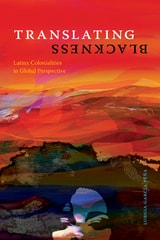
cover of Translating Blackness: Latinx Colonialities in Global Perspective

Translating Blackness

Latinx Colonialities in Global Perspective

Lorgia García Peña

Duke University Press, 2022
In Translating Blackness Lorgia García Peña considers Black Latinidad in a global perspective in order to chart colonialism as an ongoing sociopolitical force. Drawing from archives and cultural productions from the United States, the Caribbean, and Europe, García Peña argues that Black Latinidad is a social, cultural, and political formation—rather than solely a site of identity—through which we can understand both oppression and resistance. She takes up the intellectual and political genealogy of Black Latinidad in the works of Frederick Douglass, Gregorio Luperón, and Arthur Schomburg. She also considers the lives of Black Latina women living in the diaspora, such as Black Dominicana guerrillas who migrated throughout the diaspora after the 1965 civil war and Black immigrant and second-generation women like Mercedes Frías and Milagros Guzmán organizing in Italy with other oppressed communities. In demonstrating that analyses of Black Latinidad must include Latinx people and cultures throughout the diaspora, García Peña shows how the vaivén—or, coming and going—at the heart of migrant life reveals that the nation is not a sufficient rubric from which to understand human lived experiences.
[more]
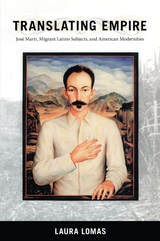
cover of Translating Empire: Jose Marti, Migrant Latino Subjects, and American Modernities

Translating Empire

Jose Marti, Migrant Latino Subjects, and American Modernities

Laura Lomas

Duke University Press, 2008

In Translating Empire, Laura Lomas uncovers how late nineteenth-century Latino migrant writers developed a prescient critique of U.S. imperialism, one that prefigures many of the concerns about empire, race, and postcolonial subjectivity animating American studies today. During the 1880s and early 1890s, the Cuban journalist, poet, and revolutionary José Martí and other Latino migrants living in New York City translated North American literary and cultural texts into Spanish. Lomas reads the canonical literature and popular culture of the United States in the Gilded Age through the eyes of Martí and his fellow editors, activists, orators, and poets. In doing so, she reveals how, in the process of translating Anglo-American culture into a Latino-American idiom, the Latino migrant writers invented a modernist aesthetics to criticize U.S. expansionism and expose Anglo stereotypes of Latin Americans.

Lomas challenges longstanding conceptions about Martí through readings of neglected texts and reinterpretations of his major essays. Against the customary view that emphasizes his strong identification with Ralph Waldo Emerson and Walt Whitman, the author demonstrates that over several years, Martí actually distanced himself from Emerson’s ideas and conveyed alarm at Whitman’s expansionist politics. She questions the association of Martí with pan-Americanism, pointing out that in the 1880s, the Cuban journalist warned against foreign geopolitical influence imposed through ostensibly friendly meetings and the promotion of hemispheric peace and “free” trade. Lomas finds Martí undermining racialized and sexualized representations of America in his interpretations of Buffalo Bill and other rituals of westward expansion, in his self-published translation of Helen Hunt Jackson’s popular romance novel Ramona, and in his comments on writing that stereotyped Latino/a Americans as inherently unfit for self-government. With Translating Empire, Lomas recasts the contemporary practice of American studies in light of Martí’s late-nineteenth-century radical decolonizing project.
[more]
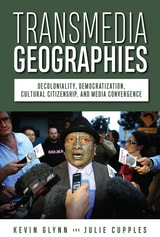
cover of Transmedia Geographies: Decoloniality, Democratization, Cultural Citizenship, and Media Convergence

Transmedia Geographies

Decoloniality, Democratization, Cultural Citizenship, and Media Convergence

Kevin Glynn

Rutgers University Press, 2025

Looking at the US, New Zealand, and Central America, this book considers how cultural politics has been deeply reworked in our contemporary media environment. The authors analyze how rampant technological convergence has allowed stories to spill across media platforms as well as geographical borders and how those stories reemerge as transmediated events.    

The authors explore the cultural politics that have developed within this new media environment by moving across the mediated landscapes of the first, third, and fourth (Indigenous people’s) worlds, which are deeply intertwined and interconnected under contemporary conditions of neoliberal globalization and emergent regimes of authoritarian postdemocracy. The book attends both to the platforms and digital networks of the new media environment and to the cultural forms and practices that have constituted television as the dominant medium of communication throughout the second half of the twentieth century. In the new media environment, transmediation works on behalf not only of those corporate megaconglomerates that have become all too familiar to media consumers around the world but also of many communities that have previously been excluded from access to the means of electronic textual production and circulation. For the latter, grassroots transmediation has become an important technique for the production of cultural citizenship.

 
[more]
cover of Transmedial Exposure: Toward an Experimental Humanities

Transmedial Exposure

Toward an Experimental Humanities

Erin Graff Zivin

Duke University Press, 2027
In Transmedial Exposure, Erin Graff Zivin analyzes how works of art are adapted, translated, reenacted, or distorted by works in other media. Taking as her conceptual point of departure philosopher Emmanuel Levinas’s notion of exposure as that which unsettles the sovereignty of the self and demands ethical responsibility, Graff Zivin investigates experimental works of art across a range of media from the Americas and Europe. She demonstrates that each ostensibly autonomous work, discipline, or sensory experience is constitutively relational, heteronomous, and exposed: philosophy to music, prose to film, performance to documentation, movement to montage, sound to touch. Exposing Latin American literary and cultural studies to continental philosophy, critical theory, Black thought, and media scholarship, Transmedial Exposure foregrounds the far-reaching ethical and political consequences of embodied, sensorial thought while imagining the possibility of a future experimental humanities.
[more]
cover of Transnational Asian American Literature: Sites and Transits

Transnational Asian American Literature

Sites and Transits

edited by Shirley Geok-lin Lim, John Blair Gamber, Stephen Hong Sohn and Gina Valentino

Temple University Press, 2005
Transnational Asian American Literature: Sites and Transits examines the diasporic and transnational aspects of Asian American literature and asserts the importance of a globalized imaginary in what has been considered an ethnic subgenre of American literature. The thirteen essays in this volume engage works of prose and poetry as aesthetic articulations of the fluid transnational identities formed by Asian American writers who move within and across national boundaries. With its emphasis on the transmigratory and flexible nature of Asian American literary production, the collection argues for an equally balanced mode of criticism that extends our readings of these works beyond the traditional limits of the American literary canon. Individual chapters feature such writers as Chang-rae Lee, Karen Tei Yamashita, Jhumpa Lahiri, Maxine Hong Kingston, and Ha Jin, with attention to such discourses as gender, space and mobility, transnationalism, identity, genre, and post-coloniality.
[more]
cover of Transnational Black Studies, Volume 2003

Transnational Black Studies, Volume 2003

Lisa Brock , Robin D. G. Kelley, and Karen Sotiropoulos, eds.

Duke University Press, 0

From its inception, black studies has been transnational. Pioneering intellectuals such as W. E. B. Du Bois, George Washington Williams, Anna Julia Cooper, Nicolas Guillen, C. L. R. James, Oliver Cox, and Zora Neale Hurston shared a transnational sensibility shaped by the antiracist and anti-imperialist politics of the nineteenth and twentieth centuries. In recent years, however, much scholarship regarding blackness has been presented under the rubric of pan-Africanism or the African diaspora, terms that imply an inquiry solely into what it means to be “of Africa.” Increasingly, in an era of globalization and postcolonialism, such terms have become insufficient for capturing what it means to be black in a global context. Transnational black studies—an interdisciplinary arena of knowledge rooted in political struggle—has reemerged to rectify this discursive insufficiency in contemporary scholarship.

The essays, interviews, and reviews in this special issue of Radical History Review represent the best of the new of this very old tradition of transnational black studies. One contributor explores how “racial citizenship”—the idea of belonging and solidarity across the black world, developed as a result of knowledge formed out of transnational linkages—is employed by Cubans of color fighting against racial discrimination in public spaces in Havana. Another, by outlining a research agenda for the study of African slavery in the Middle East and South Asia, reminds us that the Africa diaspora is global. In a discussion of a paradigm shift from the national to the global, yet another author makes a singular contribution to this collection by locating new spaces for identity formation “in transit.”

Contributors. Martha Biondi, Anthony Bogues, Ashley Dawson, James Early, Mary F. E. Ebeling, Kevin Gaines, Van Gosse, Frank A. Guridy, Joseph E. Harris, Douglas M. Haynes, Joseph Heathcott, Harvey Neptune, Michelle Stephens
[more]
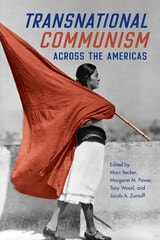
cover of Transnational Communism across the Americas

Transnational Communism across the Americas

Edited by Marc Becker, Margaret Power, Tony Wood, and Jacob A. Zumoff

University of Illinois Press, 2023

Transnational Communism across the Americas offers an innovative approach to the study of Latin American communism. It convincingly illustrates that communist parties were both deeply rooted in their own local realities and maintained significant relationships with other communists across the region and around the world. The essays in this collection use a transnational lens to examine the relationships of the region’s communist parties with each other, their international counterparts, and non-communist groups dedicated to anti-imperialism, women’s rights, and other causes. Topics include the shifting relationship between Mexican communists and the Comintern, Black migrant workers in the Caribbean, race relations in Cuba, Latin American communists in the USSR, Luís Carlos Prestes in Brazil, the U.S. and Puerto Rican communist and Nationalist parties, peace activist networks in Latin America, communist women in Guatemala, transnational student groups, and guerrillas in El Salvador.

Contributors: Marc Becker, Jacob Blanc, Tanya Harmer, Patricia Harms, Lazar Jeifets, Victor Jeifets, Adriana Petra, Margaret M. Power, Frances Peace Sullivan, Tony Wood, Kevin A. Young, and Jacob Zumoff
[more]
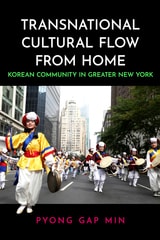
cover of Transnational Cultural Flow from Home: Korean Community in Greater New York

Transnational Cultural Flow from Home

Korean Community in Greater New York

Pyong Gap Min

Rutgers University Press, 2023

When the first wave of post-1965 Korean immigrants arrived in the New York-New Jersey area in the early 1970s, they were reliant on retail and service businesses in the minority neighborhoods where they were. This caused ongoing conflicts with customers in black neighborhoods of New York City, with white suppliers at Hunts Point Produce Market, and with city government agencies that regulated small business activities. In addition, because of the times, Korean immigrants had very little contact with their homeland. Korean immigrants in the area were highly segregated from both the mainstream New York society and South Korea. However, after the 1990 Immigration Act, Korean immigrants with professional and managerial backgrounds have found occupations in the mainstream economy. Korean community leaders also engaged in active political campaigns to get Korean candidates elected as city council members and higher levels of legislative positions in the area. The Korean community's integration into mainstream society also increasingly developed stronger transnational ties to their homeland and spurred the inclusion of "everyday Korean life" in the NY-NJ area.

Transnational Cultural Flow from Home examines New York Korean immigrants’ collective efforts to preserve their cultural traditions and cultural practices and their efforts to transmit and promote them to New Yorkers by focusing on the Korean cultural elements such as language, foods, cultural festivals, and traditional and contemporary performing arts.

This publication was supported by the 2022 Korean Studies Grant Program of the Academy of Korean Studies (AKS-2022-P-009).
 
[more]
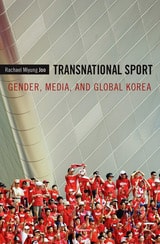
cover of Transnational Sport: Gender, Media, and Global Korea

Transnational Sport

Gender, Media, and Global Korea

Rachael Miyung Joo

Duke University Press, 2012
Based on ethnographic research in Seoul and Los Angeles, Transnational Sport tells how sports shape experiences of global Koreanness, and how those experiences are affected by national cultures. Rachael Miyung Joo focuses on superstar Korean athletes and sporting events produced for transnational media consumption. She explains how Korean athletes who achieve success on the world stage represent a powerful, globalized Korea for Koreans within the country and those in the diaspora. Celebrity Korean women athletes are highly visible in the Ladies Professional Golf Association. In the media, these young golfers are represented as daughters to be protected within the patriarchal Korean family and as hypersexualized Asian women with commercial appeal. Meanwhile, the hard-muscled bodies of male athletes, such as Korean baseball and soccer players, symbolize Korean masculine dominance in the global capitalist arena. Turning from particular athletes to a mega-event, Joo discusses the 2002 FIFA World Cup Korea/Japan, a watershed moment in recent Korean history. New ideas of global Koreanness coalesced around this momentous event. Women and youth assumed newly prominent roles in Korean culture, and, Joo suggests, new models of public culture emerged as thousands of individuals were joined by a shared purpose.
[more]
cover of Transnationalizing Viet Nam: Community, Culture, and Politics in the Diaspora

Transnationalizing Viet Nam

Community, Culture, and Politics in the Diaspora

Kieu-Linh Caroline Valverde

Temple University Press, 2013

Vietnamese diasporic relations affect—and are directly affected by—events in Viet Nam. In Transnationalizing Viet Nam, Kieu-Linh Caroline Valverde explores these connections, providing a nuanced understanding of this globalized community. Valverde draws on 250 interviews and almost two decades of research to show the complex relationship between Vietnamese in the diaspora and those back at the homeland.

Arguing that Vietnamese immigrant lives are inherently transnational, she shows how their acts form virtual communities via the Internet, organize social movements, exchange music and create art, find political representation, and even dissent. Valverde also exposes how generational, gender, class, and political tensions threaten to divide the ethnic community. 

Transnationalizing Viet Nam paints a vivid picture of the complex political and personal allegiances that exist within Vietnamese America and shape the relations between this heterogeneous community and its country of origin. 

In the series Asian American History and Culture, edited by Sucheng Chan, David Palumbo-Liu, Michael Omi, K. Scott Wong, and Linda Trinh Võ

[more]
cover of Transounding: Listening for Black Queer Lusophone Diasporas

Transounding

Listening for Black Queer Lusophone Diasporas

Daniel da Silva

Duke University Press, 2027
In Transounding, Daniel da Silva examines the work of popular music artists from Portugal, Brazil, and Angola whose singing and performances blur boundaries of gender and genre. These artists engage in collaborations that traverse uneven transatlantic Lusophone geographies and complicate North-South and South-South axes, composing, expressing, and performing modes of musical and affective political bonds across Luso-Afro-Brazilian cultures and transposing hegemonic cultural narratives into sites of Black queer and transfeminine possibility. Silva describes how transfeminine Brazilian artists complicate categories of gender and sexuality; how queer Portuguese fado performers inhabit and transform the genre's gendered conventions; and how queer, trans, and travesti Angolan and Lisbon-based Black queer artists produce resistant expressions within and against postcolonial and anti-Black contexts. Transounding traces queerness, Blackness, and diaspora across popular culture forms in the Lusophone world and explores the fundamental question of what listeners hear when transgressive voices sing.
[more]
cover of Transpacific Cartographies: Narrating the Contemporary Chinese Diaspora in the United States

Transpacific Cartographies

Narrating the Contemporary Chinese Diaspora in the United States

Melody Yunzi Li

Rutgers University Press, 2024
Transpacific Cartographies examines how contemporary Chinese diasporic narratives address the existential loss of home for immigrant communities at a time of global precarity and amid rising Sino-US tensions. Focusing on cultural productions of the Chinese diaspora from the 1990s to the present -- including novels by the Sinophone writers Yan Geling (The Criminal Lu Yanshi), Shi Yu (New York Lover), Chen Qian (Listen to the Caged Bird Sing), and Rong Rong (Notes of a Couple), as well as by the Anglophone writer Ha Jin (A Free Life; A Map of Betrayal), selected TV shows (Beijinger in New York; The Way We Were), and online literature -- Melody Yunzi Li argues that the characters in these stories create multilayered maps that transcend the territorial boundaries that make finding a home in a foreign land a seemingly impossible task. In doing so, these “maps” outline a transpacific landscape that reflects the psycho-geography of homemaking for diasporic communities. Intersecting with and bridging Sinophone studies, Chinese American studies, and diaspora studies and drawing on theories of literary cartography, Transpacific Cartographies demonstrates how these “maps” offer their readers different paths for finding a sense of home no matter where they are.
 
[more]
cover of Transpacific Experiments: Intermedia Art and Music in 1960s Japan

Transpacific Experiments

Intermedia Art and Music in 1960s Japan

Miki Kaneda

University of Michigan Press, 2026

Intermedia art—an avant-garde multimedia practice that combines sound and moving images—took root in Japan alongside other places in the 1960s. In Transpacific Experiments, Miki Kaneda analyzes intermedia as a practice that gives form to errant possibilities, unfolding in spaces of the everyday, to offer nuanced insights into the global flow of ideas, influence, and discourses of appropriation. The stories of intermedia art throughout the study offer feminist and transnational perspectives on experimental music and art that disorient existing narratives about the experimental and political in unexpected ways.

Transpacific Experiments contends that social, cultural, and political arrangements local to Japan had a greater influence on the transnational experimental music scene than previously acknowledged. Kaneda’s perspective extends, exceeds, and at times unsettles frameworks for experimental practices, revealing the limitations of any single political or aesthetic lens. 
[more]
cover of Transpacific Femininities: The Making of the Modern Filipina

Transpacific Femininities

The Making of the Modern Filipina

Denise Cruz

Duke University Press, 2012

In this groundbreaking study, Denise Cruz investigates the importance of the figure she terms the "transpacific Filipina" to Philippine nationalism, women's suffrage, and constructions of modernity. Her analysis illuminates connections between the rise in the number of Philippine works produced in English and the emergence of new social classes of transpacific women during the early to mid-twentieth century.

Through a careful study of multiple texts produced by Filipina and Filipino writers in the Philippines and the United States—including novels and short stories, newspaper and magazine articles, conduct manuals, and editorial cartoons—Cruz provides a new archive and fresh perspectives for understanding Philippine literature and culture. She demonstrates that the modern Filipina did not emerge as a simple byproduct of American and Spanish colonial regimes, but rather was the result of political, economic, and cultural interactions among the Philippines, Spain, the United States, and Japan. Cruz shows how the complex interplay of feminism, nationalism, empire, and modernity helped to shape, and were shaped by, conceptions of the transpacific Filipina.
[more]
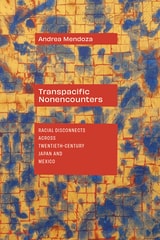
cover of Transpacific Nonencounters: Racial Disconnects Across Twentieth-Century Japan and Mexico

Transpacific Nonencounters

Racial Disconnects Across Twentieth-Century Japan and Mexico

Andrea Mendoza

Duke University Press, 2026
In Transpacific Nonencounters, Andrea Mendoza works across the seemingly unconnected histories of race and nation in modern Mexico and Japan, showing the commonalities in the way race figures in their state and social formations through a method Mendoza calls the theory of nonencounter. Intellectual and cultural productions of racial knowledge were important for the formation of the modernizing Mexican and Japanese states at the beginning of the twentieth century and helped conceive the project of national modernity through ideologies that promoted multiracial and multiethnic belonging—mestizaje and Pan-Asian co-prosperity. Despite the diasporic, economic, and political points of contact that connected these states throughout the twentieth century, however, traditional Eurocentric comparative and area-based studies treat the formations and legacies of Mexican mestizo nationalism and Japanese imperialism as wholly unrelated phenomena. Transpacific Nonencounters proposes a theory of nonencounter to formulate the logic of disciplinary disconnection, offering a framework and hermeneutic for a transpacific account of how Japanese imperialism and Mexican mestizo settler nationalism structured and reinforced one another through the modern formations of race and racism.
[more]
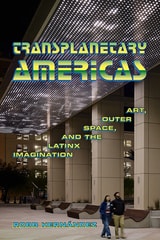
cover of Transplanetary Americas: Art, Outer Space, and the Latinx Imagination

Transplanetary Americas

Art, Outer Space, and the Latinx Imagination

Robb Hernández

Duke University Press, 2026
In Transplanetary Americas, Robb Hernández launches a propulsive pathway for Latinx cultural studies by exploring how the modern space race has driven artists to look upward and attune to expressions derived from the solar system and beyond. By advancing a theoretical and methodological framework he calls transplanetary relationality, Hernández shows how artists’ ascendant attentions unhinge Latinidades from their terrestrial bindings in an aerial pursuit of being with Earth and with other planets. Speculation, science, and technology fuel creative activities referencing the cosmos, taking Latinx art history into unexpected territory. Science fiction B-movie aesthetics empowers political statements of the third kind. NASA’s Apollo program sparks muralist imaginings about other planetary vistas. Private aerospace companies are prompting new generations of artist-activists to defend both land and sky. By showcasing visionaries who frustrate categories of time and place, Hernández’s investigation transcends the typical limits of border studies via a vertical scale, proving that the color of space is not only black but brown.
[more]
cover of Transport in Transition: The Evolution of Traditional Shipping in China

Transport in Transition

The Evolution of Traditional Shipping in China

Translated by Andrew Watson

University of Michigan Press, 1972
Water transport is a major feature of the traditional Chinese economy because of its magnitude and comparative efficiency. Yet this feature has all too often been ignored by scholars, with the notable exception of Japanese scholars. We cannot hope to gain any real conception of how the Chinese economy worked in the past, or works now, until we have a clearer picture of the circulation of men and commodities. In this circulation, water transport has been and is of crucial importance.
Transport in Transition collects and translates notable Japanese articles to throw some light on the evolution of traditional junk shipping during a key transitional phase, 1900–1940, when it was absorbing the influences of various forms of modernization and on the eve of its major organizational transformation under the direction of the Communisty Party. The articles chosen concentrate on two main themes: the institutional organization of the shipping business, and the forms of ownership and operation. They will be of value to business historians and economic sociologists generally as well as to economic historians interested in transport.
Several features of the Chinese economy are sharply illuminated. Most striking is the extent of regional variation. North and central Chinese shipping are shown to have differed both in their methods of operaiton and organization. Also noteworthy is the enduring strength of some traditional features of shipping operation and business practice. An unexpected feature of this endurance was the strength of traditional shipping in the face of steady competition from all forms of modern transport and from reputdely more efficient forms of business management.
[more]
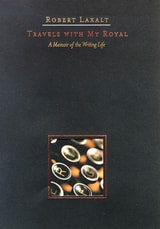
cover of Travels with My Royal: A Memoir of the Writing Life

Travels with My Royal

A Memoir of the Writing Life

Robert Laxalt

University of Nevada Press, 2001

Renowned Nevada writer Robert Laxalt has embraced a wide range of subjects in his nearly half-century career. In this candid memoir, he explores what is perhaps his most difficult subject ever—himself and his life as a writer.

The book opens with a series of vignettes about his youth in Carson City as the second son of an immigrant Basque family and his later experiences as a student at the University of Nevada in Reno.

The second part of the book tells of Laxalt's career as a writer—his early days as a reporter when his assignments included interviews with gangsters and obligatory attendance at executions; his later adventures as a contract writer for National Geographic, and his two stays in the Basque Country. He also recounts his days as director of the University of Nevada's news service and his role in the founding of the University of Nevada Press.

The third section discusses the writing of several of his major books—where the ideas came from, what he tried to accomplish in each book, the challenges he faced, and the ways he chose to resolve them. Foreword by Cheryll Glotfelty.
[more]
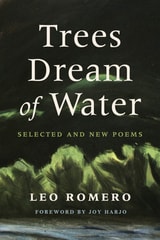
cover of Trees Dream of Water: Selected and New Poems

Trees Dream of Water

Selected and New Poems

Leo Romero; Foreword by Joy Harjo

University of Arizona Press, 2025

“The poems in this collection began as a search for a history of my ancestors in a small, isolated valley in northern New Mexico. But no one wrote it down, and I was left to construct a poetic history where there were no written records . . .”

Leo Romero stands as a foundational figure in Latino letters. With six books of poetry and a book of short fiction to his name, Romero’s contribution to the literary canon is profound and enduring.

Bringing together for the first time his new and selected poems, Trees Dream of Water reflects Romero’s journey from youth to maturity as a person and a poet, and his deep connection to New Mexico and its culture. Traversed by memory, myth, and observation of the natural world, these poems explore family, community belonging and conflict, life as an artist, and the cycles of life and death. This lyrical anthology includes accompanying essays to illuminate Romero’s life and work for longtime admirers and new readers alike.
 
[more]
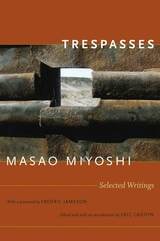
cover of Trespasses: Selected Writings

Trespasses

Selected Writings

Masao Miyoshi

Duke University Press, 2010

Trespasses presents key writings of the Tokyo-born literary scholar Masao Miyoshi, one of the most important postwar intellectuals to link culture with politics and a remarkable critical voice within the academy. For more than four decades, Miyoshi worked outside the mainstream, trespassing into new fields, making previously unseen connections, and upending naive assumptions. With an impeccable sense of when a topic or discussion had lost its critical momentum, he moved on to the next question, and then the next after that, taking on matters of literary form, cross-cultural relations, globalization, art and architecture, the corporatization of the university, and the threat of ecological disaster. Trespasses reveals the tremendous range of Miyoshi’s thought and interests, shows how his thinking transformed over time, and highlights his recurring concerns.

This volume brings together eleven selections of Miyoshi’s previously published writing, a major new essay, a critical introduction to his life and work, and an interview in which Miyoshi reflects on the trajectory of his thought and the institutional history of modern Japan studies. In the new essay, “Literary Elaborations,” he provides a masterful overview of the nature of the contemporary university, closing with a call for a global environmental protection studies that would radically reconfigure academic disciplines and merge the hard sciences with the humanities and the social sciences. In the other, chronologically arranged selections, Miyoshi addresses cross-culture relations between Japan and the United States, English literary studies in Japan, and Japan studies in the U.S., as well as the organization of urban space and the integrity of art and architecture in aggressively marketed-oriented environments. Trespasses is an invaluable introduction to the work of a fearless cultural critic.

[more]
cover of Triangulations: Narrative Strategies for Navigating Latino Identity

Triangulations

Narrative Strategies for Navigating Latino Identity

David J. Vázquez

University of Minnesota Press, 2011

Just as mariners use triangulation, mapping an imaginary triangle between two known positions and an unknown location, so, David J. Vázquez contends, Latino authors in late twentieth-century America employ the coordinates of familiar ideas of self to find their way to new, complex identities. Through this metaphor, Vázquez reveals how Latino autobiographical texts, written after the rise of cultural nationalism in the 1960s, challenge mainstream notions of individual identity and national belonging in the United States.

In a traditional autobiographical work, the protagonist frequently opts out of his or her community. In the works that Vázquez analyzes in Triangulations, protagonists instead opt in to collective groups—often for the express political purpose of redefining that collective. Reading texts by authors such as Ernesto Galarza, Jesús Colón, Piri Thomas, Oscar “Zeta” Acosta, Judith Ortiz Cofer, John Rechy, Julia Alvarez, and Sandra Cisneros, Vázquez engages debates about the relationship between literature and social movements, the role of cultural nationalism in projects for social justice, the gender and sexual problematics of 1960s cultural nationalist groups, the possibilities for interethnic coalitions, and the interpretation of autobiography. In the process, Triangulations considers the potential for cultural nationalism as a productive force for aggrieved communities of color in their struggles for equality.
[more]
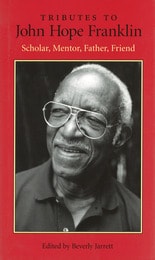
cover of Tributes to John Hope Franklin: Scholar, Mentor, Father, Friend

Tributes to John Hope Franklin

Scholar, Mentor, Father, Friend

Edited by Beverly Jarrett

University of Missouri Press, 2003

In 1947 John Hope Franklin, then a professor of history at North Carolina College for Negroes, wrote From Slavery to Freedom. Now in its eighth edition, that book, which redefined our understanding of American history, remains the preeminent record of the African American experience. With it and a dozen other books, Franklin has been established as the intellectual father of black studies.
Tributes to John Hope Franklin focuses on this esteemed scholar’s academic achievements, his humanitarian contributions, and his extraordinary legacy. This collection of comments by Franklin’s students, colleagues, family, and friends captures the man and his work for future generations. Tributes offered by Franklin’s admirers, Walter B. Hill Jr., David Levering Lewis, Alfred A. Moss Jr., Darlene Clark Hine, Loren Schweninger, Daryl Michael Scott, George M. Fredrickson, Mary Frances Berry, and many others, attest to Franklin’s commitment to his intellectual pursuits, to public service, and, most important, to his students.
Franklin’s dedication to mentoring those who sought his help, as well as providing for his family, is beyond compare. In one essay, John W. Franklin offers an inside view of growing up with John Hope and Aurelia Franklin, detailing the travels and associations that were a part of his experience as their son. Alfred Moss, coauthor of the last three editions of From Slavery to Freedom, shares special images of Franklin as mentor to a young Anglican priest.
Genna Rae McNeil shows us the quintessential teacher through the eyes of a passionate young scholar beginning her own voyage into the study of American history. George Fredrickson takes on the challenge of explaining the complexity of the work of this man who has been both a fervent proponent of racial equality and a practitioner of “detached, objective, dispassionate historical scholarship.”
Each of the pieces—by men and by women, by blacks and by whites, by several generations of participants in the twentieth century’s journey toward a better America—recalls for us what a vital role John Hope Franklin has played in that voyage. Tributes to John Hope Franklin is a joy to read and an incredible opportunity to celebrate a life and a body of historical work dedicated to achieving and sharing the wisdom that scholarly excellence provides.
[more]
cover of Triumph of the Fatherland: German Unification and the Marginalization of Women

Triumph of the Fatherland

German Unification and the Marginalization of Women

Brigitte Young

University of Michigan Press, 1999
The East German uprising of 1989 was not a male revolution. Indeed, one of the most significant aspects of the fall of East Germany, compared to that of other East European nations, was the presence of women demanding a political role in the newly emerging social order. As one slogan proclaimed, "Without Women There Is No State."
Yet despite the determination of these women--and of West German feminist groups--to help shape the future of the German state, their influence remained, in the end, very limited. In Triumph of the Fatherland, political scientist Brigitte Young draws on in-depth interviews, archival sources, newspapers, and her own observations from 1989 to 1991 to study the goals, strategies, and eventual fate of the German women's movements during this tumultuous period.
Young focuses on the relationship between the state and its citizenry, outlining the mobilization of women in four states: the East German and West German states before unification; the "stateless state" in East Germany after the collapse of the Wall, and the West German state during unification. Ultimately she finds that the political opportunity structures opened during the "stateless state" closed again with unification, resulting in what Young calls "double gender marginalization."
Brigitte Young is Associate Professor, Department of Political Science, Otto-Suhr-Institute, Free University Berlin, Germany.
[more]
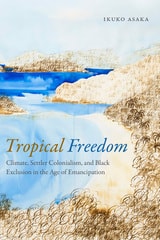
cover of Tropical Freedom: Climate, Settler Colonialism, and Black Exclusion in the Age of Emancipation

Tropical Freedom

Climate, Settler Colonialism, and Black Exclusion in the Age of Emancipation

Ikuko Asaka

Duke University Press, 2017

In Tropical Freedom Ikuko Asaka engages in a hemispheric examination of the intersection of emancipation and settler colonialism in North America. Asaka shows how from the late eighteenth century through Reconstruction, emancipation efforts in the United States and present-day Canada were accompanied by attempts to relocate freed blacks to tropical regions, as black bodies were deemed to be more physiologically compatible with tropical climates. This logic conceived of freedom as a racially segregated condition based upon geography and climate. Regardless of whether freed people became tenant farmers in Sierra Leone or plantation laborers throughout the Caribbean, their relocation would provide whites with a monopoly over the benefits of settling indigenous land in temperate zones throughout North America. At the same time, black activists and intellectuals contested these geographic-based controls by developing alternative discourses on race and the environment. By tracing these negotiations of the transnational racialization of freedom, Asaka demonstrates the importance of considering settler colonialism and black freedom together while complicating the prevailing frames through which the intertwined histories of British and U.S. emancipation and colonialism have been understood.
[more]
cover of Tropical Multiculturalism: A Comparative History of Race in Brazilian Cinema and Culture

Tropical Multiculturalism

A Comparative History of Race in Brazilian Cinema and Culture

Robert Stam

Duke University Press, 1997

Tropical Multiculturalism provides a major study of race in Brazilian culture through the most complete critical analysis of Brazilian cinema in any language. Focusing on representations of multicultural themes involving Euro- and Afro-Brazilians, other immigrants, and indigenous peoples in the rich tradition of Brazilian fictional feature film, Robert Stam puts Brazilian culture at the center of a wide-ranging analysis of race, representation, history, and film. Drawing parallels between the histories of colonialism, slavery, and immigration in Brazil and the United States, he also contends that questions of ethnic and racial representations are best viewed within the larger context of a comparative analysis of racially plural societies.
Stam examines the broad historical and cultural links that connect Brazil and the United States before considering multicultural imagery in Brazilian film as it has changed from the silent era to the present. His analysis moves through the comic chanchadas of the 1930s and 1940s, to the Hollywood-style films from Sao Paulo in the 1950s, and the diverse phases of Cinema Novo beginning in the 1960s. He explores a wealth of subjects, including the submerged "blackness" of Carmen Miranda, the anti-racist agenda of Orson Welles’s never-released Brazilian film It’s All True, the international background behind Black Orpheus, the career of Grande Otelo (Brazil’s greatest black film star), the allegorical "cannibalistic" films like How Tasty Was My Frenchman, and "indigenous media"—the attempt by Brazilian "indians" to use camcorders and VCRs for their own cultural and political purposes. Tropical Multiculturalism is simultaneously a history of Brazilian cinema from the standpoint of race, a history of Brazil itself through its cinematic representations, a comparative study of racial formations in Brazil and the United States, and a theorized analysis of racialized representations.
[more]
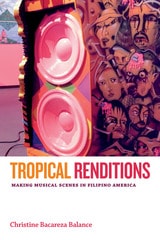
cover of Tropical Renditions: Making Musical Scenes in Filipino America

Tropical Renditions

Making Musical Scenes in Filipino America

Christine Bacareza Balance

Duke University Press, 2016
In Tropical Renditions Christine Bacareza Balance examines how the performance and reception of post-World War II Filipino and Filipino American popular music provide crucial tools for composing Filipino identities, publics, and politics. To understand this dynamic, Balance advocates for a "disobedient listening" that reveals how Filipino musicians challenge dominant racialized U.S. imperialist tropes of Filipinos as primitive, childlike, derivative, and mimetic. Balance disobediently listens to how the Bay Area turntablist DJ group the Invisibl Skratch Piklz bear the burden of racialized performers in the United States and defy conventions on musical ownership; to karaoke as affective labor, aesthetic expression, and pedagogical instrument; to how writer and performer Jessica Hagedorn's collaborative and improvisational authorial voice signals the importance of migration and place; and how Pinoy indie rock scenes challenge the relationship between race and musical genre by tracing the alternative routes that popular music takes. In each instance Filipino musicians, writers, visual artists, and filmmakers work within and against the legacies of the U.S./Philippine imperial encounter, and in so doing, move beyond preoccupations with authenticity and offer new ways to reimagine tropical places.
 
[more]
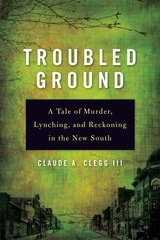
cover of Troubled Ground: A Tale of Murder, Lynching, and Reckoning in the New South

Troubled Ground

A Tale of Murder, Lynching, and Reckoning in the New South

Claude A. Clegg III

University of Illinois Press, 2010

In Troubled Ground, Claude A. Clegg III revisits a violent episode in his hometown's history that made national headlines in the early twentieth century but disappeared from public consciousness over the decades. Moving swiftly between memory and history, between the personal and the political, Clegg offers insights into southern history, mob violence, and the formation of American race ideology while coming to terms on a personal level with the violence of the past. Three black men were killed in front of a crowd of thousands in Salisbury, North Carolina, in 1906, following the ax murder of a local white family for whom the men had worked. One of the lynchers was prosecuted for his role in the execution, the first conviction of its kind in North Carolina and one of the earliest in the country. Yet Clegg, an academic historian who grew up in Salisbury, had never heard of the case until 2002 and could not find anyone else familiar with the case. In this book, Clegg mines newspaper accounts and government records and links the victims of the 1906 case to a double-lynching in 1902, suggesting a complex history of lynching in the area while revealing the determination of the city to rid its history of a shameful and shocking chapter. The result is a multi-layered, deeply personal exploration of lynching and lynching prosecutions in the United States.
[more]
cover of Troublesome Ground: Farming Trees and Green Policy in Rural Ireland

Troublesome Ground

Farming Trees and Green Policy in Rural Ireland

Jodie Asselin

University Press of Colorado, 2025

Troublesome Ground presents an ethnographic account of the relationship between land and Irish upland farmers in north County Cork, Ireland. Amid the colliding influences of agricultural professionalization, forestry expansion, a global environmental crisis, and the subsequent implementation and rotation of various politically motivated projects meant to spur economic growth and simultaneously better the environment, Asselin tells the story of challenges farmers in one region face in the conflicting worlds of program payments, shifting policy initiatives, and the joint cultural and economic requirements of farming. Like many marginal regions, the uplands of north County Cork serve as a catchall geography for nation-building dreams and economic development schemes. Asselin argues that this landscape has become conceptually stretched and oversaturated, containing numerous possible futures and their inherent contradictions. Recent pressures to address climate change and declining biodiversity have further saturated these areas with potential, resulting in unrealistic expectations for both people and land.
 
Through ethnographic description, Asselin illuminates how ephemeral worlds of green discourse and development plans manifest in rural areas, demonstrating the lived consequences of today’s competing demands on marginal regions. Troublesome Ground is a significant contribution to the anthropology of rural Ireland while offering insights into the wider realities of conflicting development and conservation strategies in global contemporary rural landscapes.
 
[more]
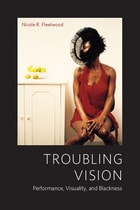
cover of Troubling Vision: Performance, Visuality, and Blackness

Troubling Vision

Performance, Visuality, and Blackness

Nicole R. Fleetwood

University of Chicago Press, 2010

Troubling Vision addresses American culture’s fixation on black visibility, exploring how blackness is persistently seen as a problem in public culture and even in black scholarship that challenges racist discourse. Through trenchant analysis, Nicole R. Fleetwood reorients the problem of black visibility by turning attention to what it means to see blackness and to the performative codes that reinforce, resignify, and disrupt its meaning. Working across visual theory and performance studies, Fleetwood asks, How is the black body visualized as both familiar and disruptive? How might we investigate the black body as a troubling presence to the scopic regimes that define it as such? How is value assessed based on visible blackness?


Fleetwood documents multiple forms of engagement with the visual, even as she meticulously underscores how the terms of engagement change in various performative contexts. Examining a range of practices from the documentary photography of Charles “Teenie” Harris to the “excess flesh” performances of black female artists and pop stars to the media art of Fatimah Tuggar to the iconicity of Michael Jackson, Fleetwood reveals and reconfigures the mechanics, codes, and metaphors of blackness in visual culture.


“Troubling Vision is a path-breaking book that examines the problem of seeing blackness—the simultaneous hyper-visibility and invisibility of African Americans—in US visual culture in the last half century. Weaving together critical modes and methodologies from performance studies, art history, critical race studies, visual culture analysis, and gender theory, Fleetwood expands Du Bois’s idea of double vision into a broad questioning of whether ‘representation itself will resolve the problem of the black body in the field of vision.’ With skilled attention to historical contexts, documentary practices, and media forms, she takes up the works of a broad variety of cultural producers, from photographers and playwrights to musicians and visual artists and examines black spectatorship as well as black spectacle. In chapters on the trope of ‘non-iconicity’ in the photographs of Charles (Teenie) Harris, the ‘visible seams’ in the digital images of the artist Fatimah Tuggar, and a coda on the un-dead Michael Jackson, Fleetwood's close analyses soar. Troubling Vision is a beautifully written, original, and important addition to the field of American Studies.”—Announcement of the American Studies Association for the 2012 Lora Romero First Book Publication Prize

[more]
cover of True Songs of Freedom: Uncle Tom’s Cabin in Russian Culture and Society

True Songs of Freedom

Uncle Tom’s Cabin in Russian Culture and Society

John MacKay

University of Wisconsin Press, 2013
Harriet Beecher Stowe's 1852 antislavery novel Uncle Tom's Cabin was the nineteenth century's best-selling novel worldwide; only the Bible outsold it. It was known not only as a book but through stage productions, films, music, and commercial advertising as well. But how was Stowe's novel—one of the watershed works of world literature—actually received outside of the American context?
            True Songs of Freedom explores one vital sphere of Stowe's influence: Russia and the Soviet Union, from the 1850s to the present day. Due to Russia's own tradition of rural slavery, the vexed entwining of authoritarianism and political radicalism throughout its history, and (especially after 1945) its prominence as the superpower rival of the United States, Russia developed a special relationship to Stowe's novel during this period of rapid societal change. Uncle Tom's Cabin prompted widespread reflections on the relationship of Russian serfdom to American slavery, on the issue of race in the United States and at home, on the kinds of writing appropriate for children and peasants learning to read, on the political function of writing, and on the values of Russian educated elites who promoted, discussed, and fought over the book for more than a century. By the time of the Soviet Union's collapse in 1991, Stowe's novel was probably better known by Russians than by readers in any other country.
            John MacKay examines many translations and rewritings of Stowe's novel; plays, illustrations, and films based upon it; and a wide range of reactions to it by figures famous (Leo Tolstoy, Ivan Turgenev, Marina Tsvetaeva) and unknown. In tracking the reception of Uncle Tom's Cabin across 150 years, he engages with debates over serf emancipation and peasant education, early Soviet efforts to adapt Stowe's deeply religious work of protest to an atheistic revolutionary value system, the novel's exploitation during the years of Stalinist despotism, Cold War anti-Americanism and antiracism, and the postsocialist consumerist ethos.
[more]
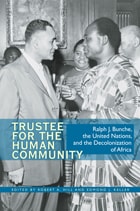
cover of Trustee for the Human Community: Ralph J. Bunche, the United Nations, and the Decolonization of Africa

Trustee for the Human Community

Ralph J. Bunche, the United Nations, and the Decolonization of Africa

Robert A. Hill

Ohio University Press, 2010

Ralph J. Bunche (1904–1971), winner of the Nobel Peace Prize in 1950, was a key U.S. diplomat in the planning and creation of the United Nations in 1945. In 1947 he was invited to join the permanent UN Secretariat as director of the new Trusteeship Department. In this position, Bunche played a key role in setting up the trusteeship system that provided important impetus for postwar decolonization ending European control of Africa as well as an international framework for the oversight of the decolonization process after the Second World War.

Trustee for the Human Community is the first volume to examine the totality of Bunche’s unrivalled role in the struggle for African independence both as a key intellectual and an international diplomat and to illuminate it from the broader African American perspective.

These commissioned essays examine the full range of Ralph Bunche’s involvement in Africa. The scholars explore sensitive political issues, such as Bunche’s role in the Congo and his views on the struggle in South Africa. Trustee for the Human Community stands as a monument to the profoundly important role of one of the greatest Americans in one of the greatest political movements in the history of the twentieth century.

Contributors: David Anthony, Ralph A. Austen, Abena P. A. Busia, Neta C. Crawford, Robert R. Edgar, Charles P. Henry, Robert A. Hill, Edmond J. Keller, Martin Kilson, Georges Nzongola-Ntalaja, Jon Olver, Pearl T. Robinson, Elliott P. Skinner, Crawford Young

[more]
cover of Trying to Get Over: African American Directors after Blaxploitation, 1977-1986

Trying to Get Over

African American Directors after Blaxploitation, 1977-1986

By Keith Corson

University of Texas Press, 2016

From 1972 to 1976, Hollywood made an unprecedented number of films targeted at black audiences. But following this era known as “blaxploitation,” the momentum suddenly reversed for black filmmakers, and a large void separates the end of blaxploitation from the black film explosion that followed the arrival of Spike Lee’s She's Gotta Have It in 1986. Illuminating an overlooked era in African American film history, Trying to Get Over is the first in-depth study of black directors working during the decade between 1977 and 1986.

Keith Corson provides a fresh definition of blaxploitation, lays out a concrete reason for its end, and explains the major gap in African American representation during the years that followed. He focuses primarily on the work of eight directors—Michael Schultz, Sidney Poitier, Jamaa Fanaka, Fred Williamson, Gilbert Moses, Stan Lathan, Richard Pryor, and Prince—who were the only black directors making commercially distributed films in the decade following the blaxploitation cycle. Using the careers of each director and the twenty-four films they produced during this time to tell a larger story about Hollywood and the shifting dialogue about race, power, and access, Corson shows how these directors are a key part of the continuum of African American cinema and how they have shaped popular culture over the past quarter century.
[more]
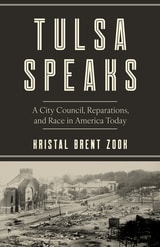
cover of Tulsa Speaks: A City Council, Reparations, and Race in America Today

Tulsa Speaks

A City Council, Reparations, and Race in America Today

Kristal Brent Zook

Rutgers University Press, 2026

In 2021, the international media descended upon Tulsa, Oklahoma, for the centennial commemoration of the May 31–June 1, 1921, massacre in which a white mob killed more than three hundred African American residents, burned homes and businesses, and decimated a thriving town once referred to as “Black Wall Street.” 

Tulsa Speaks is about the ongoing work of the Tulsa City Council, both before the Centennial and afterward, when the cameras were no longer trained on the city. It dives deep into the interpersonal dynamics among the nine councilors, exploring the continuing fight for reparations and racial justice and the long-running efforts of councilor, Vanessa Hall-Harper of District 1, to bring repair to Greenwood.

Tulsa, like many municipal bodies across the country, serves as a hopeful sign of what we might become, as Americans and as a microcosm of race relations in America today. 
[more]
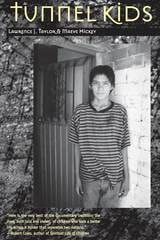
cover of Tunnel Kids

Tunnel Kids

Lawrence J. Taylor and Maeve Hickey

University of Arizona Press, 2001

Winner of the Southwest Book Award!

Beneath the streets of the U.S.-Mexico border, children are coming of age. They have come from all over Mexico to find shelter and adventure in the drainage tunnels that connect the twin cities of Nogales, Sonora, and Nogales, Arizona. This book opens up the world of the tunnel kids and tells how in this murky underworld of struggling immigrants, drug dealers, and thieves, these kids have carved out a place of their own. Two parallel tunnels— each fourteen feet wide and several miles long— drain the summer rains from Mexico to the United States. Here and in the crumbling colonias you'll meet the tunnel kids: streetwise El Boston, a six-year veteran of the tunnels; his little pal Jesús; Jesús' girlfriend, La Flor, and her six-month-old baby; wild Negra; poetic Guanatos; moody Romel and his beautiful girlfriend, La Fanta. They form an extended family of some two dozen young people who live hard-edged lives and answer to no one in El Barrio Libre— the free barrio.

Lawrence Taylor and Maeve Hickey met these kids at Mi Nueva Casa, the safe house built to draw the youths out of the tunnels and into a more normal life. The authors spent two summers with tunnel kids as they roamed all over Nogales and beyond in their struggle to survive. In the course of their adventures the kids described their lives, talking about what might tempt them to leave the tunnels— and what kept them there. Hickey's stunning portraits provide a heart-stopping counterpoint to Taylor's incisive prose. Story and photos together open a window into the life of the tunnel kids—a world like that of many homeless children, precarious and adaptive, albeit unique to the border. Where most people might see just another gang of doped-up, violent children, Taylor and Hickey discover displaced and sometimes heroic young people whose stories add a human dimension to the world of the U.S.-Mexico border.
[more]
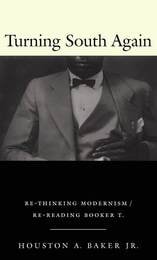
cover of Turning South Again: Re-Thinking Modernism/Re-Reading Booker T.

Turning South Again

Re-Thinking Modernism/Re-Reading Booker T.

Houston A. Baker Jr.

Duke University Press, 2001

In Turning South Again the distinguished and award-winning essayist, poet, and scholar of African American literature Houston A. Baker, Jr. offers a revisionist account of the struggle for black modernism in the United States. With a take on the work of Booker T. Washington and the Tuskegee Institute surprisingly different from that in his earlier book Modernism and the Harlem Renaissance, Baker combines historical considerations with psychoanalysis, personal memoir, and whiteness studies to argue that the American South and its regulating institutions—particularly that of incarceration—have always been at the center of the African American experience.
From the holds of slave ships to the peonage of Reconstruction to the contemporary prison system, incarceration has largely defined black life in the United States. Even Washington’s school at Tuskegee, Baker explains, housed and regulated black bodies no longer directly controlled by slave owners. He further implicates Washington by claiming that in enacting his ideas about racial “uplift,” Washington engaged in “mulatto modernism,” a compromised attempt at full citizenship. Combining autobiographical prose, literary criticism, psychoanalytic writing, and, occasionally, blues lyrics and poetry, Baker meditates on the consequences of mulatto modernism for the project of black modernism, which he defines as the achievement of mobile, life-enhancing participation in the public sphere and economic solvency for the majority of African Americans. By including a section about growing up in the South, as well as his recent return to assume a professorship at Duke, Baker contributes further to one of the book’s central concerns: a call to centralize the South in American cultural studies.

[more]
cover of Two Dreams in One Bed: Empire, Social Life, and the Origins of the North Korean Revolution in Manchuria

Two Dreams in One Bed

Empire, Social Life, and the Origins of the North Korean Revolution in Manchuria

Hyun Ok Park

Duke University Press, 2005

Rethinking a key epoch in East Asian history, Hyun Ok Park formulates a new understanding of early-twentieth-century Manchuria. Most studies of the history of modern Manchuria examine the turbulent relations of the Chinese state and imperialist Japan in political, military, and economic terms. Park presents a compelling analysis of the constitutive effects of capitalist expansion on the social practices of Korean migrants in the region.

Drawing on a rich archive of Korean, Japanese, and Chinese sources, Park describes how Koreans negotiated the contradictory demands of national and colonial powers. She demonstrates that the dynamics of global capitalism led the Chinese and Japanese to pursue capitalist expansion while competing for sovereignty. Decentering the nation-state as the primary analytic rubric, her emphasis on the role of global capitalism is a major innovation for understanding nationalism, colonialism, and their immanent links in social space.

Through a regional and temporal comparison of Manchuria from the late nineteenth century until 1945, Park details how national and colonial powers enacted their claims to sovereignty through the regulation of access to land, work, and loans. She shows that among Korean migrants, the complex connections among Chinese laws, Japanese colonial policies, and Korean social practices gave rise to a form of nationalism in tension with global revolution—a nationalism that laid the foundation for what came to be regarded as North Korea’s isolationist politics.

[more]
cover of Two Evenings in Saramaka

Two Evenings in Saramaka

Richard Price and Sally Price

University of Chicago Press, 1991

"Whatever has gotten into the Prices?" asks the apocryphal Professor Goodfellow in the opening lines of Two Evenings in Saramaka. "After all those books on history and ethnography," he muses, "why are they now turning to children's stories and nonsense songs—mere folklore?"

In this innovative work, Richard and Sally Price explore the fully adult world of Saramaka "folktale-land," where animals speak, the social order is inverted, customs have been only partially worked out, and the weak and clever triumph over the strong and arrogant. Joining the Saramaka of the Suriname rain forest for two tale-telling wakes, we witness mischievous Anasi the spider matching wits with lecherous devils, the scrawny little kid rescuing his nubile sisters in distress, and the bitchy white princess being tamed by the one-sided boy. As seas dry up, books speak out loud, and elephants assume human form, we are present at a whole sequence of world-shaping happenings such as the invention of sex, the discovery of drums, and the arrival of death among humans.

Set in the more general context of tale telling by the descendants of Africans throughout the Americas and of recent scholarship in performance studies, these Saramaka tales are presented as a dramatic script. With the help of nearly forty photographs, readers become familiar not only with the characters in folktale-land, but also with the men and women who so imaginatively bring them to life. And because music complements narration in Saramaka just as it does elsewhere in Afro-America, more than fifty songs are presented here in musical notation.

Narrative, song, dance, and social interaction merge in these two evenings of multimedia entertainment, bearing witness to an Afro-American cultural tradition that remains alive and vibrant, constantly renewed but always reflecting its links with the past.
[more]