Results by title
8642 books match the query '20th century' and 1764 start with t
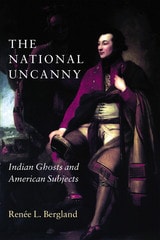
The National Uncanny
Indian Ghosts and American SubjectsRenée L. Bergland
Dartmouth College Press, 2000
The Nationalization of the Masses
Political Symbolism and Mass Movements in Germany from the Napoleonic Wars Through the Third ReichGeorge L. Mosse
University of Wisconsin Press, 2023

The Nature Way
Writings from a Western Shoshone ElderCorbin Harney
University of Nevada Press, 2009
Corbin Harney’s long life encompassed remarkable changes in the lives of Native Americans and in the technological and political development of the world. Born into an impoverished Western Shoshone family on the Nevada-Idaho border and orphaned as a newborn, he was brought up by grandparents who taught him the traditional ways of their people and the ancient spiritual beliefs that sustained their culture. As an adult, Harney found his calling as a traditional healer and spiritual leader. Soon he became involved in the Shoshone struggle for civil rights, including their efforts to protect and heal their traditional lands in what became the Nevada Test Site. This involvement led Harney to his eventual role as a leader of the international antinuclear movement.The Nature Way is a rich compendium of Corbin Harney’s experience and wisdom. His account of his life incorporates the tragic history of Native Americans in the Great Basin after the arrival of Euro-Americans, his realization of his own identity as a Native American, and his long study of his people’s traditions and spiritual practices. His summary of the Shoshone and Paiute use of indigenous plants for food and healing highlights their understanding that the Earth and her denizens and products must be respected and protected in order to preserve the connection that all creatures have with sacred Mother Earth. Finally, his account of his role as an antinuclear activist expands on his awareness of the human responsibility to protect the Earth, especially from the extreme danger posed by nuclear technology and nuclear weapons of mass destruction. Corbin Harney’s voice is one of the clearest expressions yet of the values, concerns, and spirituality of contemporary Native America. He offers all of us an eloquent plea that we respect and cooperate with Nature to ensure the survival of the planet.

The Nature and Nurture of Love
From Imprinting to Attachment in Cold War AmericaMarga Vicedo
University of Chicago Press, 2013
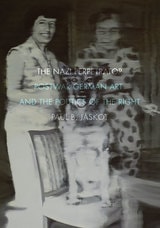
The Nazi Perpetrator
Postwar German Art and the Politics of the RightPaul B. Jaskot
University of Minnesota Press, 2012
Who was responsible for the crimes of the Nazis? Party leaders and members? Rank-and-file soldiers and bureaucrats? Ordinary Germans? This question looms over German disputes about the past like few others. It also looms over the art and architecture of postwar Germany in ways that have been surprisingly neglected. In The Nazi Perpetrator, Paul B. Jaskot fundamentally reevaluates pivotal developments in postwar German art and architecture against the backdrop of contentious contemporary debates over the Nazi past and the difficulty of determining who was or was not a Nazi perpetrator.
Like their fellow Germans, postwar artists and architects grappled with the Nazi past and the problem of defining the Nazi perpetrator—a problem that was thoroughly entangled with contemporary conservative politics and the explosive issue of former Nazis living in postwar Germany. Beginning with the formative connection between Nazi politics and art during the 1930s, The Nazi Perpetrator traces the dilemma of identifying the perpetrator across the entire postwar period. Jaskot examines key works and episodes from West Germany and, after 1989, reunified Germany, showing how the changing perception of the perpetrator deeply impacted art and architecture, even in cases where artworks and buildings seem to have no obvious relation to the Nazi past. The book also reinterprets important periods in the careers of such major figures as Gerhard Richter, Anselm Kiefer, and Daniel Libeskind.
Combining political history with a close analysis of specific works, The Nazi Perpetrator powerfully demonstrates that the ongoing influence of Nazi Germany after 1945 is much more central to understanding a wide range of modern German art and architecture than cultural historians have previously recognized.
The Nazi Symbiosis
Human Genetics and Politics in the Third ReichSheila Faith Weiss
University of Chicago Press, 2010
The Faustian bargain—in which an individual or group collaborates with an evil entity in order to obtain knowledge, power, or material gain—is perhaps best exemplified by the alliance between world-renowned human geneticists and the Nazi state. Under the swastika, German scientists descended into the moral abyss, perpetrating heinous medical crimes at Auschwitz and at euthanasia hospitals. But why did biomedical researchers accept such a bargain?
The Nazi Symbiosis offers a nuanced account of the myriad ways human heredity and Nazi politics reinforced each other before and during the Third Reich. Exploring the ethical and professional consequences for the scientists involved as well as the political ramifications for Nazi racial policies, Sheila Faith Weiss places genetics and eugenics in their larger international context. In questioning whether the motives that propelled German geneticists were different from the compromises that researchers from other countries and eras face, Weiss extends her argument into our modern moment, as we confront the promises and perils of genomic medicine today.
The Necessary Past
Revising History in Contemporary African American PoetryAnnette Debo
Northwestern University Press, 2024
“Poets are lyric historians,” proclaimed Langston Hughes. Today, historical poetry offers a lyric history necessary to our current moment—poetry with the power to correct the past, realign the present, and create a more hopeful, or even hoped-for, future. The Necessary Past: Revising History in Contemporary African American Poetry focuses on six of today’s most celebrated poets: Elizabeth Alexander, Natasha Trethewey, A. Van Jordan, Kevin Young, Frank X Walker, and Camille T. Dungy. Their works reimagine the interiority of Black historical figures like the so-called Venus Hottentot Sara Baartman and the would-be spelling champion MacNolia Cox, the African American Native Guard who fought in the Civil War and the unknown victims of domestic violence, Jack Johnson and Jean-Michel Basquiat, Medgar Evers and those freed and enslaved in the early nineteenth century. These poets shift the power dynamic in revising our shared history, reconfiguring who speaks and whose stories are told, and writing a past that frees readers to change the present and envision a more just future.
The Necropastoral
Poetry, Media, OccultsJoyelle McSweeney
University of Michigan Press, 2014
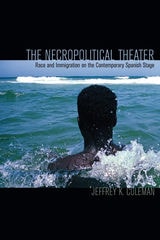
The Necropolitical Theater
Race and Immigration on the Contemporary Spanish StageJeffrey K. Coleman
Northwestern University Press, 2020
Coleman identifies an inherent racial hierarchy informed by the legacies of colonization and religious intolerance.
Drawing on theatrical texts, performances, legal documents, interviews, and critical reviews, this book challenges Spanish theater to develop a new theatrical space. Jeffrey K. Coleman proposes a “convivial theater” that portrays immigrants as contributors to the Spanish state and better represents the multicultural reality of the nation today.
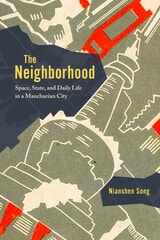
The Neighborhood
Space, State, and Daily Life in a Manchurian CityNianshen Song
University of Chicago Press, 2025
What can one neighborhood reveal about the making of a modern nation? The Neighborhood deciphers the unexpected significance of Xita, a half-square-mile quarter in Shenyang, in Northeast China. As the historian Nianshen Song shows, over nearly four centuries, Xita has been shaped and reshaped by empire, war, migration, and urban transformation. Remarkably, the history of this small area mirrors large-scale changes, including and especially China’s metamorphosis from a multiethnic Eurasian empire to a postindustrial society.
Song begins with Xita’s origins as a Qing-era Tibetan Buddhist center, following the lives of Mongol lamas and their imperial patrons. He tracks the neighborhood through the tumultuous twentieth century, when competing Russian and Japanese railway empires fueled its industrial growth, and Japanese colonizers turned it into a showcase for their imperial ambitions. Later, Xita became a vital enclave for Korea’s diaspora before emerging in the post-Mao era as a neon-lit hub of commerce and entertainment.
A thoroughly researched microhistory, The Neighborhood reveals how global forces play out in everyday spaces. By studying the emperors, warlords, merchants, laborers, and migrants who shaped Xita, Song presents a captivating and original perspective for understanding China’s past—not from the top down, but through the streets and people who lived it.

The Neighbors
By Ahmad Mahmoud
University of Texas Press, 2013
Ahmad Mahmoud sets The Neighbors against the backdrop of the oil nationalization crisis that gripped Iran in the early 1950s. His protagonist, Khaled, a young man from a rundown neighborhood in Ahvaz, a city in southern Iran, becomes involved in the struggle to wrest Iran’s oil industry from the British and, as the result of his political activities, comes to realize that there is more to life than the drudgery and poverty his parents and neighbors have experienced.
The Neighbors, published in 1974, cemented Mahmoud’s reputation as a novelist and captured the ethos of a generation—the generation that laid the groundwork for those who continue to struggle for democracy in Iran today. Though the novel received considerable praise and was read widely, its political nature earned the ire of Mohammad Reza Shah’s regime, and the Islamic Republic has objected to its sexually explicit content. This is the first time one of Ahmad Mahmoud’s novels has appeared in English translation.
The Neoliberal Age?
Britain Since the 1970sEdited by Aled Davies, Ben Jackson, and Florence Sutcliffe-Braithwaite
University College London, 2021
The rise of British neoliberalism—a renewed emphasis on privatization and market-oriented economics—over the last fifty years is often characterized as the product of right-wing political economists, think tanks, and politicians. The Neoliberal Age? argues that this pat narrative ignores broader forces in British left-wing culture that collaborated to transform twentieth-century social life. Through a variety of case studies, the authors demonstrate that our austere, individualistic age emerged from more complex sociopolitical negotiations than typically described.
The New Age of Franklin Roosevelt, 1932-1945
Dexter Perkins
University of Chicago Press, 1957
Scarcely had the New Deal become a part of American life, however, when World War II broke out, and America became a global power leading the Allies to victory, began development of the atomic bomb, and laid plans for the United Nations organization.
In the opinion of many historians, F.D.R.'s thirteen years are the most important era in twentieth-century American history. Now Dexter Perkins takes an objective look at Roosevelt and his times—the great depression, the great social experiment, the great war—and presents a balanced evaluation of America from the Blue Eagle days of NRA to the shocking April afternoon of Roosevelt's death.
"A fair-minded, clear, and brief guide to that complex man and even more complex era."—Frank Freidel, Christian Science Monitor
The New American Exceptionalism
Donald E. Pease
University of Minnesota Press, 2009
For a half century following the end of World War II, the seemingly permanent cold war provided the United States with an organizing logic that governed nearly every aspect of American society and culture, giving rise to an unwavering belief in the nation's exceptionalism in global affairs and world history. After the collapse of the Soviet Union, this cold war paradigm was replaced by a series of new ideological narratives that ultimately resulted in the establishment of another potentially endless war: the global war on terror.
In The New American Exceptionalism, pioneering scholar Donald E. Pease traces the evolution of these state fantasies and shows how they have shaped U.S. national identity since the end of the cold war, uncovering the ideological and cultural work required to convince Americans to surrender their civil liberties in exchange for the illusion of security. His argument follows the chronology of the transitions between paradigms from the inauguration of the New World Order under George H. W. Bush to the homeland security state that George W. Bush's administration installed in the wake of 9/11. Providing clear and convincing arguments about how the concept of American exceptionalism was reformulated and redeployed in this era, Pease examines a wide range of cultural works and political spectacles, including the exorcism of the Vietnam syndrome through victory in the Persian Gulf War and the creation of Islamic extremism as an official state enemy.
At the same time, Pease notes that state fantasies cannot altogether conceal the inconsistencies they mask, showing how such events as the revelations of prisoner abuse at Abu Ghraib and the exposure of government incompetence after Hurricane Katrina opened fissures in the myth of exceptionalism, allowing Barack Obama to challenge the homeland security paradigm with an alternative state fantasy that privileges fairness, inclusion, and justice.
The New Bostonians
How Immigrants Have Transformed the Metro Area since the 1960sMarilynn S. Johnson
University of Massachusetts Press, 2015
How immigrants helped rebuild a city—and redefined what it means to be American
Among the most consequential pieces of Great Society legislation, the Immigration Act of 1965 opened the nation's doors to large-scale immigration from Africa, Asia, and Latin America. A half century later, the impact of the "new immigration" is evident in the transformation of the country's demographics, economy, politics, and culture, particularly in urban America.
In The New Bostonians, Marilynn S. Johnson examines the historical confluence of recent immigration and urban transformation in greater Boston, a region that underwent dramatic decline after World War II. Since the 1980s, the Boston area has experienced an astounding renaissance—a development, she argues, to which immigrants have contributed in numerous ways. From 1970 to 2010, the percentage of foreign-born residents of the city more than doubled, representing far more diversity than earlier waves of immigration. Like the older Irish, Italian, and other European immigrant groups whose labor once powered the region's industrial economy, these newer migrants have been crucial in re-building the population, labor force, and metropolitan landscape of the New Boston, although the fruits of the new prosperity have not been equally shared.
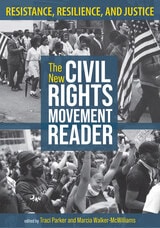
The New Civil Rights Movement Reader
Resistance, Resilience, and JusticeEdited by Traci Parker and Marcia Walker-McWilliams
University of Massachusetts Press, 2023
In the United States, the fight to secure full civil rights for African American people has endured for centuries. The movement has included many voices, among them, working people, charismatic activists, musicians and artists, the LGBTQIA community, veterans, suburbanites, and elected officials. Moving from the labor struggles of the 1930s to the sit-ins and boycotts of midcentury, and the Black Lives Matter protests of today, this expansive volume brings together first-person accounts, political documents and speeches, and historical photographs from each region of the country.
Designed for use in courses and engaging for general readers, this new compilation is the most diverse, most inclusive, and most comprehensive resource available for teaching and learning about the civil rights movement. With chronological and geographical depth, The New Civil Rights Movement Reader addresses a range of key topics, including youth activism, regional and local freedom struggles, voting rights, economic inequality, gender, sexuality, and culture, and the movement’s global reach.
The New Crusades, the New Holy Land
Conflict in the Southern Baptist Convention, 1969-1991David T. Morgan
University of Alabama Press, 1996
Examines the conflict between modern-day Southern Baptists and “liberal” Southern Baptists over control of the Southern Baptist Convention
David Morgan captures the essence of the conflict between some modern-day Southern Baptists, who saw themselves as crusaders for truth, as they sought to redeem a new holy land--the Southern Baptist Convention-- from the control of other Southern Baptists they viewed as "liberals." To the so-called liberals, the crusaders were "fundamentalists" on a mission, not to reclaim the SBC in the name of theological truth but to gain control and redirect its activities according to their narrow political, social, and theological perspectives. The New Crusades provides a comprehensive history of the conflict, taking the reader through the bitter and divisive struggles of the late 1980s, that culminated in the 1991 emergence of a moderate faction within the SBC. The fundamentalists had won.
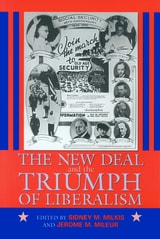
The New Deal and the Triumph of Liberalism
Sidney M. Milkis
University of Massachusetts Press, 2002
For scholars who have studied it, as for many Americans who experienced it firsthand, Franklin Roosevelt's New Deal has long represented a turning point in the modern history of the United States. More than simply a bold program of political change, it marked a critical departure in the governing principles, institutional arrangements, and policies that shape American life.
In this collection of original essays, a distinguished group of political scientists and historians reevaluate the legacy of the New Deal, showing how Roosevelt and his allies forged an enduring public philosophy—modern liberalism—that redefined the relationship of government and governed. Adapting broad principles from the past to the unprecedented circumstances of a worldwide depression, the New Dealers shifted American politics away from its traditional emphasis on self-reliance, private property, and decentralized power. In its place they advocated a new “economic constitutional order”—in effect, a new social contract—in which the government guaranteed protection to individuals against the uncertainties of the marketplace.
Although the contributors differ in their assessment of the successes and failures of New Deal liberalism, all agree that its implications for American political life were profound and far-reaching—in the realm of foreign as well as domestic affairs, for the theory as well as the practice of government. Taken together, the essays offer a fresh look at the many ways the New Deal, in Harry Hopkins's phrase, “made America over.”
In addition to the editors, contributors are William E. Leuchtenburg, Marc Landy, Nelson Lichtenstein, Donald R. Brand, Jyette Klausen, Suzanne Mettler, Ronald Story, Seyom Brown, and Morton Keller.
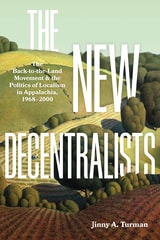
The New Decentralists
The Back-to-the-Land Movement and the Politics of Localism in Appalachia, 1968-2000Jinny A Turman
West Virginia University Press, 2026
How some “back-to-the-landers” fled alienating urban, bureaucratic places for rural Appalachia in pursuit of self-reliance, liberation, and community, only to later find themselves vulnerable to a rising tide of national conservatism that minted new political elites on the state and local level at odds with their progressive social ideas and environmental values.
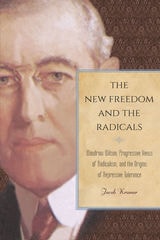
The New Freedom and the Radicals
Woodrow Wilson, Progressive Views of Radicalism, and the Origins of Repressive ToleranceJacob Kramer
Temple University Press, 2017
In The New Freedom and the Radicals, Jacob Kramer deftly examines how progressivism emerged at a time of critical transformation in American life. Using original archival sources, Kramer presents a study of Wilsonian-era politics to convey an understanding of the progressives’ views on radical America.
The New Freedom and the Radicals shows how the reactions of progressives to radicals accelerated the pace of reform in the United States, but how the movement was at times predisposed to repressing the radical elements to its left. In addition, Kramer asks to what extent progressives were responding to and influenced by those who opposed the state, capitalism, and the class structure altogether, as well as how progressives’ views of them changed in relation to events.
The New Hegemony in Literary Studies
Contradictions in TheoryTony Hilfer
Northwestern University Press, 2003
The problem Hilfer identifies is one of logical consistency, but also of moral and psychological implications, and it can be found operating across the whole spectrum of literary Theory. It is, however, as this book makes blindingly clear, not immune from scrutiny. With quiet erudition and consistent incisiveness, Hilfer shows how the various methods, while ostensibly at odds, actually fit together, all sharing the same peculiar structure and logic, and all wearing an identical set of ideological blinders. He offers examples of theorists-and assumptions-hard at work on particular texts, and again and again (often letting these theorists refute themselves) pinpoints the blindspots that have become endemic in the practice of Theory.
Written with great care and a deep commitment to the value and integrity of literary criticism and theory, this tonic work stands as a corrective to the misuse of theory, and a bracing reminder of how a critical approach works when it is well and judiciously applied.
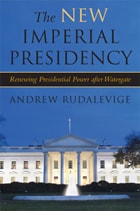
The New Imperial Presidency
Renewing Presidential Power after WatergateAndrew Rudalevige
University of Michigan Press, 2006
"Well written and, while indispensable for college courses, should appeal beyond academic audiences to anyone interested in how well we govern ourselves. . . . I cannot help regarding it as a grand sequel for my own The Imperial Presidency."
---Arthur Schlesinger, Jr.
Has the imperial presidency returned? This question has been on the minds of many contemporary political observers, as recent American administrations have aimed to consolidate power.
In The New Imperial Presidency, Andrew Rudalevige suggests that the congressional framework meant to advise and constrain presidential conduct since Watergate has slowly eroded. Rudalevige describes the evolution of executive power in our separated system of governance. He discusses the abuse of power that prompted what he calls the "resurgence regime" against the imperial presidency and inquires as to how and why---over the three decades that followed Watergate---presidents have regained their standing.
Chief executives have always sought to interpret constitutional powers broadly. The ambitious president can choose from an array of strategies for pushing against congressional authority; finding scant resistance, he will attempt to expand executive control. Rudalevige's important and timely work reminds us that the freedoms secured by our system of checks and balances do not proceed automatically but depend on the exertions of public servants and the citizens they serve. His story confirms the importance of the "living Constitution," a tradition of historical experiences overlaying the text of the Constitution itself.
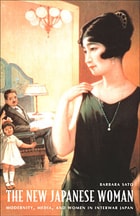
The New Japanese Woman
Modernity, Media, and Women in Interwar JapanBarbara Sato
Duke University Press, 2003
The New Japanese Woman is rich in descriptive detail and full of fascinating vignettes from Japan’s interwar media and consumer industries—department stores, film, radio, popular music and the publishing industry. Sato pays particular attention to the enormously influential role of the women’s magazines, which proliferated during this period. She describes the different kinds of magazines, their stories and readerships, and the new genres the emerged at the time, including confessional pieces, articles about family and popular trends, and advice columns. Examining reactions to the images of the modern girl, the housewife, and the professional woman, Sato shows that while these were not revolutionary figures, they caused anxiety among male intellectuals, government officials, and much of the public at large, and they contributed to the significant changes in gender relations in Japan following the Second World War.
The New Left and Labor in 1960s
Peter B. Levy
University of Illinois Press, 1994
It is a powerful story: the relationship between the 1960s New Left and organized labor was summed up by hardhats confronting students and others over US involvement in Vietnam. But the real story goes beyond the "Love It or Leave It" signs and melees involving blue-collar types attacking protesters.
Peter B. Levy challenges these images by exploring the complex relationship between the two groups. Early in the 1960s, the New Left and labor had cooperated to fight for civil rights and anti-poverty programs. But diverging opinions on the Vietnam War created a schism that divided these one-time allies. Levy shows how the war, combined with the emergence of the black power movement and the blossoming of the counterculture, drove a permanent wedge between the two sides and produced the polarization that remains to this day.
The New Math
A Political HistoryChristopher J. Phillips
University of Chicago Press, 2014
In this history, Christopher J. Phillips examines the rise and fall of the new math as a marker of the period’s political and social ferment. Neither the new math curriculum designers nor its diverse legions of supporters concentrated on whether the new math would improve students’ calculation ability. Rather, they felt the new math would train children to think in the right way, instilling in students a set of mental habits that might better prepare them to be citizens of modern society—a world of complex challenges, rapid technological change, and unforeseeable futures. While Phillips grounds his argument in shifting perceptions of intellectual discipline and the underlying nature of mathematical knowledge, he also touches on long-standing debates over the place and relevance of mathematics in liberal education. And in so doing, he explores the essence of what it means to be an intelligent American—by the numbers.
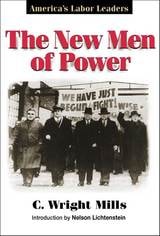
The New Men of Power
America's Labor LeadersC. Wright Mills
University of Illinois Press, 1948
thought labor leaders a new strategic elite and the unions a set of vanguard organizations that were crucial to "stopping the main drift towards war and slump." Today, as the unions once again seek to play a decisive role in American life, Mills' remarkable probe into the structure and ideology of mid-twentieth-century trade unionism remains essential reading. A new introduction by historian Nelson Lichtenstein offers insight into the Millsian political world at the time he wrote The New Men of Power.
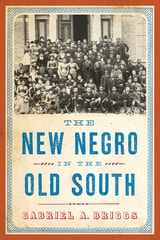
The New Negro in the Old South
Briggs, Gabriel A
Rutgers University Press, 2015
In this groundbreaking historical study, Gabriel A. Briggs makes the compelling case that the New Negro first emerged long before the Great Migration to the North. The New Negro in the Old South reconstructs the vibrant black community that developed in Nashville after the Civil War, demonstrating how it played a pivotal role in shaping the economic, intellectual, social, and political lives of African Americans in subsequent decades. Drawing from extensive archival research, Briggs investigates what made Nashville so unique and reveals how it served as a formative environment for major black intellectuals like Sutton Griggs and W.E.B. Du Bois.
The New Negro in the Old South makes the past come alive as it vividly recounts little-remembered episodes in black history, from the migration of Colored Infantry veterans in the late 1860s to the Fisk University protests of 1925. Along the way, it gives readers a new appreciation for the sophistication, determination, and bravery of African Americans in the decades between the Civil War and the Harlem Renaissance.
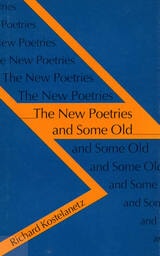
The New Poetries and Some Old
Richard Kostelanetz
Southern Illinois University Press, 1991
This collection of twenty-nine essays represents a summation of Kostelanetz’s thoughts on poetry since the publication of his earlier work The Old Poetries and the New.
In sections on “The New Poetries,” “Some Old,” and “Autobiographical Addenda,” the essays range from sketches of Kenneth Burke, John Berryman, and Northrop Frye through considerations of the latest sound-text poetry to Kostelanetz’s justification of his own work. These pieces reflect Kostelanetz’s ongoing commitment to the esthetics he ascribes to high modernism—innovation, abstraction, intelligence, and complexity in all the arts.
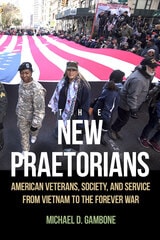
The New Praetorians
American Veterans, Society, and Service from Vietnam to the Forever WarMichael D. Gambone
University of Massachusetts Press, 2021
In an engrossing narrative that considers the military, economic, political, and social developments affecting military service after Vietnam, Michael D. Gambone investigates how successive generations have intentionally shaped their identity as veterans. The New Praetorians also highlights the impact of their homecoming, the range of educational opportunities open to veterans, the health care challenges they face, and the unique experiences of minority and women veterans. This groundbreaking study illustrates an important and often neglected group that is key to our understanding of American social history and civil-military affairs.
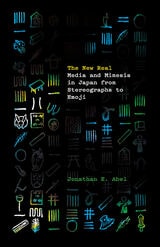
The New Real
Media and Mimesis in Japan from Stereographs to EmojiJonathan E. Abel
University of Minnesota Press, 2022
Unlocking a vital understanding of how literary studies and media studies overlap and are bound together
A synthetic history of new media reception in modern and contemporary Japan, The New Real positions mimesis at the heart of the media concept. Considering both mimicry and representation as the core functions of mediation and remediation, Jonathan E. Abel offers a new model for media studies while explaining the deep and ongoing imbrication of Japan in the history of new media.
From stereoscopy in the late nineteenth century to emoji at the dawn of the twenty-first, Abel presents a pioneering history of new media reception in Japan across the analog and digital divide. He argues that there are two realities created by new media: one marketed to us through advertising that proclaims better, faster, and higher-resolution connections to the real; and the other experienced by users whose daily lives and behaviors are subtly transformed by the presence and penetration of the content carried through new media. Intervening in contemporary conversations about virtuality, copyright, copycat violence, and social media, each chapter unfolds with a focus on a single medium or technology, including 3D photographs, the phonograph, television, videogames, and emoji.
By highlighting the tendency of the mediated to copy the world and the world to copy the mediated, The New Real provides a new path for analysis of media, culture, and their function in the world.
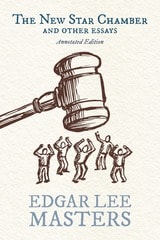
The New Star Chamber and Other Essays
Annotated EditionEdgar Lee Masters; edited by Jason Stacy
Southern Illinois University Press, 2023
Coedited by noted Masters scholar, Jason Stacy, and his class, “Editing History,” this annotated edition of Edgar Lee Masters’s The New Star Chamber and Other Essays reappears at a perilous time in US history, when large corporations and overseas conflicts once again threaten the integrity of American rights and liberties, and the United States still finds itself beholden to corporate power and the legacy of imperial hubris. In speaking to his times, Masters also speaks to ours.
These thirteen essays lay bare the political ideology that informed Spoon River Anthology. Masters argues that the dangerous imperialism championed by then-President Theodore Roosevelt was rooted in the Constitution itself. By debating the ethics of the Philippine-American War, criticizing Hamiltonian centralization of government, and extolling the virtues of Jeffersonian individualism, Masters elucidates the ways in which America had strayed from its constitutional morals and from democracy itself. The result is a compelling critique of corporate capitalism and burgeoning American imperialism, as well as an exemplary source for understanding its complicated author in the midst of his transformation from urban lawyer to poet of rural America.
In print again for the first time since 1904, this edition includes an introduction and historical annotations throughout. Edited and annotated by students at Southern Illinois University Edwardsville, and designed and illustrated by students at Southern Illinois University Carbondale, this volume traces economic and political pathologies to the origins of the American republic. The New Star Chamber and Other Essays is as vital now as it was over 100 years ago.
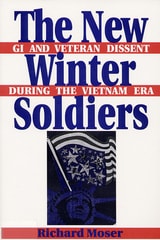
The New Winter Soldiers
GI and Veteran Dissent During the Vietnam EraMoser, Richard
Rutgers University Press, 1996
Richard Moser uses interviews and personal stories of Vietnam veterans to offer a fundamentally new interpretation of the Vietnam War and the antiwar movement. Although the Vietnam War was the most important conflict of recent American history, its decisive battle was not fought in the jungles of Vietnam, or even in the streets of the United States, but rather in the hearts and minds of American soldiers. To a degree unprecedented in American history, soldiers and veterans acted to oppose the very war they waged. Tens of thousands of soldiers and veterans engaged in desperate conflicts with their superiors and opposed the war through peaceful protest, creating a mass movement of dissident organizations and underground newspapers.
Moser shows how the antiwar soldiers lived out the long tradition of the citizen soldier first created in the American Revolution and Civil War. Unlike those great upheavals of the past, the Vietnam War offered no way to fulfill the citizen-soldier's struggle for freedom and justice. Rather than abandoning such ideals, however, tens of thousands abandoned the war effort and instead fulfilled their heroic expectations in the movements for peace and justice. According to Moser, this transformation of warriors into peacemakers is the most important recent development of our military culture.
The struggle for peace took these new winter soldiers into America rather than away from it. Collectively these men and women discovered the continuing potential of American culture to advance the values of freedom, equality, and justice on which the nation was founded.
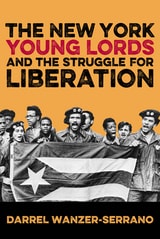
The New York Young Lords and the Struggle for Liberation
Darrel Wanzer-Serrano
Temple University Press, 2015
In The New York Young Lords and the Struggle for Liberation, Darrel Wanzer-Serrano details the numerous community initiatives that advanced decolonial sensibilities in El Barrio and beyond. Using archival research and interviews, he crafts an engaging account of the Young Lords’ discourse and activism. He rescues the organization from historical obscurity and makes an argument for its continued relevance, enriching and informing contemporary discussions about Latino/a politics.
The New Young American Poets
An AnthologyEdited by Kevin Prufer. Foreword by Richard Howard
Southern Illinois University Press, 2000
Poetry today holds mainstream attention as never before. From community workshops to reading groups, from coffee house poetry slams to small press lit mags, from universities to web 'zines, the world of poetry has become part of our everyday lives. Demonstrating the range and vitality of the new generation of American writers, The New Young American Poets features the work of forty poets born since 1960.
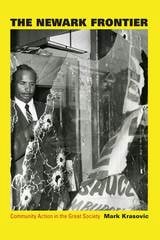
The Newark Frontier
Community Action in the Great SocietyMark Krasovic
University of Chicago Press, 2016
The Newark Frontier shows how, during the Great Society, urban liberalism adapted and grew, defining itself less by centralized programs and ideals than by administrative innovation and the small-scale, personal interactions generated by community action programs, investigative commissions, and police-community relations projects. Paying particular attention to the fine-grained experiences of Newark residents, Krasovic reveals that this liberalism was rooted in an ethic of experimentation and local knowledge. He illustrates this with stories of innovation within government offices, the dynamic encounters between local activists and state agencies, and the unlikely alliances among nominal enemies. Krasovic makes clear that postwar liberalism’s eventual fate had as much to do with the experiments waged in Newark as it did with the violence that rocked the city in the summer of 1967.
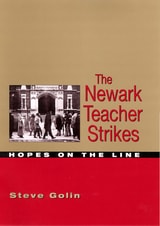
The Newark Teacher Strikes
Hopes on the LineGolin, Steve
Rutgers University Press, 2002
Winner of the Richard P. McCormick 2003 Prize for Scholarly Publication, given by the New Jersey Historical Commission
For three weeks in 1970 and for eleven weeks in 1971, the schools in Newark, New Jersey, were paralyzed as the teachers went on strike. In the wake of the 1971 strike, almost two hundred were arrested and jailed. The Newark Teachers Union said their members wanted improved education for students. The Board of Education claimed the teachers primarily desired more money. After interviewing more than fifty teachers who were on the front lines during these strikes, historian Steve Golin concludes that another, equally important agenda was on the table, and has been ignored until now. These professionals wanted power, to be allowed a voice in the educational agenda.
Through these oral histories, Golin examines the hopes of the teachers as they picketed, risking arrest and imprisonment. Why did they strike? How did the union represent them? How did their action—and incarceration—change them? Did they continue to teach in impoverished schools? Golin also discusses the tensions arising during that period. These include differences in attitudes toward unions among black, Jewish, and Italian teachers; different organizing strategies of men and women; and conflict between teachers’ professional and working-class identities.
The first part of the book sets the stage by exploring the experience of teachers in Newark from World War II to the 1970 strike. After covering both strikes, Golin brings the story up to 1995 in the epilogue, which traces the connection between educational reform and union democracy. Teacher Power enhances our understanding of what has worked and what hasn’t worked in attempts at reforming urban schools. Equally importantly, the teachers’ vivid words and the author’s perceptive analysis enables us to view the struggles of not just Newark, but the entire United States during a turbulent time.
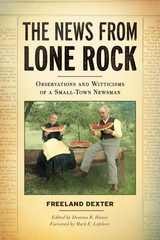
The News from Lone Rock
Observations and Witticisms of a Small-Town NewsmanFreeland Dexter
Wisconsin Historical Society Press, 2016
At the turn of the twentieth century, the bustling railroad town of Lone Rock, Wisconsin, was home to about a thousand residents, and Freeland Dexter seemed to know the business of every single one. Dexter reported all the news from Lone Rock—from the significant to the trivial, the tragic to the comical—for the Weekly Home News of neighboring Spring Green from 1884 to 1912.
This collection of Dexter’s most fascinating, amusing, and poignant stories and observations brings back to life the colorful characters of his time and takes readers on a journey to a world that was both simpler and changing fast. Whether he was reporting who grew the biggest watermelon, teasing the local lovebirds, or taking a side on the ever-controversial question of whether the town should go dry, Dexter wrote with a distinctive wit and an obvious affection for his town and its people. The News from Lone Rock also provides an illuminating window into a time period of rapid technological progress, showing how the introduction of electric light, telephones, and cars changed lives and connected this quaint village more and more to the outside world.
The Nixon Memo
Political Respectability, Russia, and the PressMarvin Kalb
University of Chicago Press, 1994
The story begins on March 10, 1992. Nixon had written a private memo critical of president George Bush's policy toward Russia. The memo leaked and exploded on the front page of The New York Times. Why would Nixon attack Bush, a fellow party member fighting for re-election? Why on an issue of foreign affairs, which was Bush's strength? The questions are as intriguing as the answers, and distinguished journalist and scholar Marvin Kalb offers a suspenseful, eye-opening account of how our conventional wisdom on United States foreign policy is shaped by the insider's game of press/politics.
This story of Nixon's Machiavellian efforts to pressure the White House, by way of the press, into helping Boris Yeltsin and Russia sheds new light on the inner workings of the world inside the government of the United States. Marvin Kalb read the documents behind the Nixon memo and interviewed scores of journalists, scholars, and officials in and from Washington and Moscow. Drawing on his years of experience as a diplomatic correspondent, he identifies and illuminates the intersection of press and politics in the fashioning of public policy.
"An absorbing and often compelling argument that Richard Nixon directed his own political rehabilitation on the world stage, using presidents, lesser politicians, and the press as his supporting cast. This is a first-class job of unraveling a complex and usually unseen tapestry."—Ted Koppel
"With Marvin Kalb's captivating account, Richard Nixon continues to fascinate us even in death."—Al Hunt
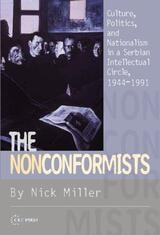
The Nonconformists
Culture, Politics, and Nationalism in a Serbian Intellectual Circle, 1944-1991Nick Miller
Central European University Press, 2007
The Normals
A People’s History of Modern America in Five Human ExperimentsLaura Stark
University of Chicago Press, 2027
How healthy control subjects in clinical research transformed the practice and labor of science, as told by the Normals themselves.
In the 1950s, the National Institutes of Health were in search of a large, replenishing stream of healthy people to participate in clinical studies. To establish legal sources of test subjects, the NIH signed unprecedented contracts with American colleges, church organizations, and other government agencies, and in the process gave rise to a new type of test subject: the “normal patient.” Thousands of them eventually moved into the NIH Clinical Center to live in hospital rooms, eat food prepared in a metabolic kitchen, and follow—or flout—the rules.
The Normals is a groundbreaking account of the NIH Normal Volunteer Patient Program, which has lasted into the twenty-first century. This program harnessed outside organizations in all areas of postwar American life—colleges and universities, labor unions, civic groups, federal prisons, and churches—to recruit research subjects for human experiments. Drawing on thousands of pages of unearthed government documents, oral histories, and personal materials shared by the patients themselves (collected in a new archive), Laura Stark follows five experiments and the people involved, delving into their biographies, their time at the Clinical Center, and the thorny problem of determining who counts as “normal.” The “Normals” were not passive objects of study, Stark shows, but active research participants who collaborated with scientists, maintained the laboratories where they served, informed official ethics policies, and bargained to meet their needs.
By taking seriously the pillow fights and the first kisses, the bible clubs and the movie nights that animated the Clinical Center as much as the medical experiments, The Normals brings to life a surprising true story of the origins of our present-day system of human experiment, one that at once explores what it means to work, to serve, to volunteer.
The Northeast Corridor
The Trains, the People, the History, the RegionDavid Alff
University of Chicago Press, 2024
Traversed by thousands of trains and millions of riders, the Northeast Corridor might be America’s most famous railway, but its influence goes far beyond the right-of-way. David Alff welcomes readers aboard to see how nineteenth-century train tracks did more than connect Boston to Washington, DC. They transformed hundreds of miles of Atlantic shoreline into a political capital, a global financial hub, and home to fifty million people. The Northeast Corridor reveals how freight trains, commuter rail, and Amtrak influenced—and in turn were shaped by—centuries of American industrial expansion, metropolitan growth, downtown decline, and revitalization.
Paying as much attention to Canton, Trenton, New Rochelle, and Providence as to New York City, Philadelphia, and Baltimore, Alff provides narrative thrills for history buffs, train enthusiasts, and adventurers alike. What’s more, he offers a glimpse into the future of the corridor. New infrastructural plans—supported by President Joe Biden, famously Amtrak’s biggest fan—envision ever-faster trains zipping along technologically advanced rails. Yet those tracks will literally sit atop a history that links the life of Frederick Douglass, who fled to freedom by boarding a train in Baltimore, to the Frederick Douglass Tunnel, which is expected to be the newest link in the corridor by 2032.
Trains have long made the places that make America, and they still do.
The Novel and the American Left
Critical Essays on Depression-Era FictionJanet Galligani Casey
University of Iowa Press, 2004
The first collection of critical essays to focus specifically on the fiction produced by American novelists of the Depression era, The Novel and the American Left contributes substantially to the newly emerging emphasis on twentieth-century American literary radicalism. Recent studies have recovered this body of work and redefined in historical and theoretical terms its vibrant contribution to American letters. Casey consolidates and expands this field of study by providing a more specific consideration of individual novels and novelists, many of which are reaching new contemporary audiences through reprints.
The Novel and the American Left focuses exclusively on left-leaning fiction of the Depression era, lending visibility and increased critical validity to these works and showing the various ways in which they contributed not only to theorizations of the Left but also to debates about the content and form of American fiction. In theoretical terms, the collection as a whole contributes to the larger reconceptualization of American modernity currently under way. More pragmatically, individual essays suggest specific authors, texts, and approaches to teachers and scholars seeking to broaden and/or complicate more traditional “American modernism” syllabi and research agendas.
The selected essays take up, among others, such “hard-core"” leftist writers as Mike Gold and Myra Page, who were associated with the Communist Party; the popular novels of James M. Cain and Kenneth Fearing, whose works were made into successful films; and critically acclaimed but nonetheless “lost” novelists such as Josephine Johnson, whose Now in November (Pulitzer Prize, 1936) anticipates and complicates the more popular agrarian mythos of Steinbeck’s The Grapes of Wrath.
This volume will be of interest not only to literary specialists but also to historians, social scientists, and those interested in American cultural studies.
The Novel of the Future
Anaïs Nin
Ohio University Press, 2014
In The Novel of the Future, Anaïs Nin explores the act of creation—in film, art, and dance as well as literature—to chart a new direction for the young artist struggling against what she perceived as the sterility, formlessness, and spiritual bankruptcy afflicting much of mid-twentieth-century fiction. Nin offers, instead, an argument for and synthesis of the poetic novel and discusses her own efforts in this genre as well as its influence on the development of such writers as D. H. Lawrence, Henry Miller, Lawrence Durrell, Marguerite Young, and Djuna Barnes. In chapters devoted to the pursuit of the hidden self, the genesis of fiction, and the relationship between the diary and fiction, she addresses the materials, techniques, and nourishment of the arts, and the functions of art itself.
Originally published in 1968, The Novel of the Future remains a classic among both creative writers and literary scholars. This new Swallow Press edition includes an introduction by Nin biographer Deirdre Bair.
The Novels of Nadine Gordimer
History from the InsideStephen Clingman
University of Massachusetts Press, 1986
In Nadine Gordimer's view, the novel can present history as historians cannot. Moreover, this presentation is not fictional in the sense of being “untrue.” Rather, fiction deals with an area of activity usually inaccessible to the sciences of greater externally: the area in which historical process is registered as the subjective experience of individuals in society; fiction give us “history from the inside.” Gordimer's novels give us an extraordinary and unique insight into historical experience in the period in which she writes.
The Nuremberg Fallacy
Eugene Davidson
University of Missouri Press, 1998
Available for the first time in paperback, The Nuremberg Fallacy examines the inherent shortcomings of the Nuremberg "rules of war" and the War Crimes Tribunal's impossible expectations. In 1946, the Tribunal declared all aggressive war, war crimes, and crimes against humanity illegal. Yet the period since World War II has witnessed an unprecedented number of armed conflicts. In light of recent crises, including those in Rwanda, Bosnia and Serbia, and the Middle East, it is clear that the issues explored in The Nuremberg Fallacy are as relevant today as they were at the time of the book's first publication a quarter century ago.
In this volume, Eugene Davidson continues his investigations begun in The Trial of the Germans (University of Missouri Press), which studied the Nuremberg trials themselves, by focusing on five major conflicts since the end of World War II: the Suez crisis of 1956; Algeria's war of independence; Israel's recurring (and ongoing) battles with its Arab neighbors, complicated and worsened by intervention of the superpowers; the wars in Southeast Asia; and the Soviet Union's suppression of Czechoslovakia and other border states of Eastern Europe.
By exploring the roots and ramifications of these five conflicts, Davidson is able to chart the crosscurrents between large and small states, between individual nations and the United Nations, between the rules of Nuremberg and the significantly older rules of self- interest. The result is a thoughtful and thought-provoking study of the dynamics of war and peace in the post-Nuremberg world.
The rules of war proclaimed at Nuremberg—observing the flag of truce, prohibiting attacks on surrendered enemies, treating prisoners of war and civilian populations humanely—have become virtually irrelevant in modern guerrilla warfare. If anything, Davidson suggests, conditions have actually become worse than they were before the Nuremberg War Crimes Tribunal.
The continuing importance and relevance of The Nuremberg Fallacy is best summarized in the final sentences of Davidson's text: "The survival of a nation cannot be successfully entrusted to simplistic formulae or to principles that reflect unworkable doctrines. No computers have been programmed for the wisdom that remains essential for survival. People still have to provide that from their own inner and outer resources, no matter how far the weapons may seem to have outdistanced them."
The Object of Performance
The American Avant-Garde since 1970Henry M. Sayre
University of Chicago Press, 1989
"Sayre has written one of the most intelligent, sensible, and readable accounts of the tenents of Postmodern artmaking published to date."—Jeff Abell, New Art Examiner
"No one can read The Object of Performance without gaining a far better idea than before of what has happened to art, and, in some measure, why. . . . I find this book consistently illuminating."—Arthur C. Danto
The Objectivist Nexus
Essays in Cultural PoeticsPeter Quartermain
University of Alabama Press, 1999
Outstanding poets and critics present cultural readings of the Objectivist poets, a group whose works have been largely unexamined.
"Objectivist" writers, conjoined through a variety of personal, ideological, and literary-historical links, have, from the late 1920s to the present, attracted emulation and suspicion. Representing a nonsymbolist, postimagist poetics and characterized by a historical, realist, antimythological worldview, Objectivists have retained their outsider status. Despite such status, however, the formal, intellectual, ideological, and ethical concerns of the Objectivist nexus have increasingly influenced poetry and poetics in the United States.
Thus, argue editors Rachel Blau DuPlessis and Peter Quartermain, the time has come for an anthology that unites essential works on Objectivist practices and presents Objectivist writing as an enlargement of the possibilities of poetry rather than as a determinable and definable literary movement. The authors' collective aim is to bring attention to this group of poets and to exemplify and specify cultural readings for poetic texts--readings alert to the material world, politics, society, and history, and readings concerned with the production, dissemination, and reception of poetic texts.
The contributors consider Basil Bunting, Lorine Niedecker, George Oppen, Carl Rakosi, Charles Reznikoff, and Louis Zukofsky within both their historical milieu and our own. The essays insist on poetry as a mode of thought; analyze and evaluate Objectivist politics; focus on the ethical, spiritual, and religious issues raised by certain Objectivist affiliations with Judaism; and explore the dissemination of poetic texts and the vagaries of Objectivist reception. Running throughout the book are two related threads: Objectivist writing as generally a practice aware of its own historical and social contingency and Objectivist writing as a site of complexity, contestation, interrogation, and disagreement.
The Obligation Toward the Difficult Whole
Postmodernist Long PoemsBrian McHale
University of Alabama Press, 2003
Addressing subjects as wide-ranging as angelology, the court masque, pop art, caricature, the cult of the ruin, hip-hop, Spense’'s Irish policy, and the aesthetics of silence, Brian McHale pulls varied threads together to identify a repertoire of postmodernist elements characteristic of the long poems he examines.
As critic Jed Rasula explains, “McHale is wonderfully resourceful in changing the subject from chapter to chapter to fit the poems discussed, and while his approach adheres to the conventions of textual exegesis, the chapters really shine as orchestrations of issues. For instance, James Merrill’s The Changing Light at Sandover works unexpectedly well in raising the subject of found poetry and procedural composition; Melvin Tolso’'s Harlem Gallery and Edward Dorn's Gunslinger are effectively paired to demonstrate the period flavor of pastiche; Geoffrey Hill’s Mercian Hymns and Armand Schwerner’s The Tablets explode the modernist fixation with depth; John Ashbery’s work is given a nuanced reading as proto-theory; Letter to an Imaginary Friend by Thomas McGrath provides a lucid backdrop to raise the question of political efficacy in approaching language poet Bruce Andrews; and Susan Howe's The Europe of Trusts is explored for its intertextual tapestry.”
McHale shows how elements from these long poems overlap, interfere, pull in different directions, jar against, and even contradict each other; and he demonstrates how they also echo, amplify, and reinforce each other. They do not slot smoothly together like pieces in a jigsaw puzzle, but they do form (what else?) a difficult whole.
The Occasions of Poetry
Essays in Criticism and AutobiographyThom Gunn
University of Michigan Press, 1999
Thom Gunn is well-known as a poet, and increasingly as a literary critic. The Occasions of Poetry includes insightful critical pieces on writers ranging from William Carlos Williams and Gary Snyder to Thomas Hardy and Robert Duncan. "The occasion in all cases," writes Gunn, "is the starting point, only, of a poem, but it should be a starting point to which the poet must in some sense stay true." The first loyalty of a writer who is "true to his occasions," he writes, must be to the facts of experience.
The book includes five autobiographical essays, which combine to form an engaging account of the author's development as a poet and to chronicle some of the most significant literary currents of recent decades, both in England and America.
Thom Gunn, born in England in 1929, has lived in America since 1954. His books include Shelf Life: Essays, Memoirs, and an Interview; The Man with Night Sweats; Collected Poems; and The Passages of Joy. The Occasions of Poetry was originally published by Faber and Faber.
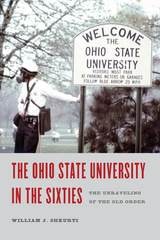
The Ohio State University in the Sixties
The Unraveling of the Old OrderWilliam J. Shkurti
The Ohio State University Press, 2016
Just a year earlier the campus seemed immune to such disruptions. President Nixon considered it safe enough to plan an address at commencement. Yet a year later the campus erupted into a spasm of violent protest exceeding even that of traditional hot spots like Berkeley and Wisconsin. How could conditions have changed so dramatically in just a few short months?
Using contemporary news stories, long overlooked archival materials, and first-person interviews, The Ohio State University in the Sixties explores how these tensions built up over years, why they converged when they did and how they forever changed the university.