Results by title
471 books match the query 'Aesthetics' and 125 start with t

The Multisensory Film Experience
A Cognitive Model of Experiental Film AestheticsLuis Rocha Antunes
Intellect Books, 2016
The Music between Us
Is Music a Universal Language?Kathleen Marie Higgins
University of Chicago Press, 2012
The Musician as Philosopher
New York’s Vernacular Avant-Garde, 1958–1978Michael Gallope
University of Chicago Press, 2024
The Musician as Philosopher explores the philosophical thought of avant-garde musicians in postwar New York: David Tudor, Ornette Coleman, the Velvet Underground, Alice Coltrane, Patti Smith, and Richard Hell. It contends that these musicians—all of whom are understudied and none of whom are traditionally taken to be composers—not only challenged the rules by which music is written and practiced but also confounded and reconfigured gendered and racialized expectations for what critics took to be legitimate forms of musical sound. From a broad historical perspective, their arresting music electrified a widely recognized social tendency of the 1960s: a simultaneous affirmation and crisis of the modern self.
The Nonsense of Kant and Lewis Carroll
Unexpected Essays on Philosophy, Art, Life, and DeathBen-Ami Scharfstein
University of Chicago Press, 2014
Scharfstein begins with essays on the nature of philosophy itself, moving from an autobiographical account of the trials of being a comparativist to philosophy’s function in the outside world to the fear of death in Kant and Hume. From there he explores an impressive array of art: from China and Japan to India and the West; from an essay on sadistic and masochistic body art to one on the epistemology of the deaf and the blind. He then returns to philosophy, writing on Machiavelli and political ruthlessness, then on the ineffable, and closes with a review of Walter Kaufmann’s multivolume look at the essence of humanity, Discovering the Mind. Altogether, these essays are a testament to adventurous thought, the kind that leaps to the furthest reaches of the possible.
The Objective Eye
Color, Form, and Reality in the Theory of ArtJohn Hyman
University of Chicago Press, 2006
This, in a nutshell, is the central problem in the theory of art. It has fascinated philosophers from Plato to Wittgenstein. And it fascinates artists and art historians, who have always drawn extensively on philosophical ideas about language and representation, and on ideas about vision and the visible world that have deep philosophical roots.
John Hyman’s The Objective Eye is a radical treatment of this problem, deeply informed by the history of philosophy and science, but entirely fresh. The questions tackled here are fundamental ones: Is our experience of color an illusion? How does the metaphysical status of colors differ from that of shapes? What is the difference between a picture and a written text? Why are some pictures said to be more realistic than others? Is it because they are especially truthful or, on the contrary, because they deceive the eye?
The Objective Eye explores the fundamental concepts we use constantly in our most innocent thoughts and conversations about art, as well as in the most sophisticated art theory. The book progresses from pure philosophy to applied philosophy and ranges from the metaphysics of color to Renaissance perspective, from anatomy in ancient Greece to impressionism in nineteenth-century France. Philosophers, art historians, and students of the arts will find The Objective Eye challenging and absorbing.
The One and the Others
Metaphysics, Poetry, and the Antinomies of Plato’s "Parmenides"Andrew Cutrofello
Northwestern University Press, 2026
At the end of Plato’s Parmenides, Parmenides concludes that “whether ‘the One’ is or is not, it and ‘the Others’ both are and are not, and both appear and do not appear, all things in all ways.” Throughout the history of philosophy various attempts have been made to make sense of Plato’s puzzling dialectical exercise. In this ambitious book Andrew Cutrofello shows how Kant and Hegel extended it, how contemporary philosophers, including Graham Priest and Alain Badiou, have reinterpreted it, and how poets such as Dante, Shakespeare, Blake, Wordsworth, and Susan Howe have channeled it. What emerges is an original conception of the history of metaphysics as a series of antinomies, and of metaphysical poetry as a type of antinomianism.
The Open Studio
Essays on Art and AestheticsSusan Stewart
University of Chicago Press, 2004
Gathering most of Stewart's writing on contemporary art—long and short pieces first published in small magazines, museum and gallery publications, and edited collections—The Open Studio illuminates work ranging from the installation art of Ann Hamilton to the sculptures and watercolors of Thomas Schütte, the prints and animations of William Kentridge to the films of Tacita Dean. Stewart's essays are often the record of studio conversations with living artists and curators, and of the afterlife of those experiences in the solitude of her own study. Considering a wide variety of art forms, Stewart finds pathbreaking ways to explore them. Whether she is following central traditions of painting, drawing, sculpture, film, photography, and printmaking or exploring the less well-known realms of portrait miniatures, collecting practices, doll-making, music boxes, and gardening, Stewart speaks to the creative process in general and to the relation between art and ethics.
The Open Studio will be read eagerly by scholars of art, poetry, and visual theory; by historians interested in the links between contemporary and classic literature and art; and by teachers, students, and practitioners of the visual arts.
The Outward Mind
Materialist Aesthetics in Victorian Science and LiteratureBenjamin Morgan
University of Chicago Press, 2017
The Pensive Image
Art as a Form of ThinkingHanneke Grootenboer
University of Chicago Press, 2020
While the philosophical dimension of painting has long been discussed, a clear case for painting as a form of visual thinking has yet to be made. Traditionally, vanitas still life paintings are considered to raise ontological issues while landscapes direct the mind toward introspection. Grootenboer moves beyond these considerations to focus on what remains unspoken in painting, the implicit and inexpressible that manifests in a quality she calls pensiveness. Different from self-aware or actively desiring images, pensive images are speculative, pointing beyond interpretation. An alternative pictorial category, pensive images stir us away from interpretation and toward a state of suspension where thinking through and with the image can start.
In fluid prose, Grootenboer explores various modalities of visual thinking— as the location where thought should be found, as a refuge enabling reflection, and as an encounter that provokes thought. Through these considerations, she demonstrates that artworks serve as models for thought as much as they act as instruments through which thinking can take place. Starting from the premise that painting is itself a type of thinking, The Pensive Image argues that art is capable of forming thoughts and shaping concepts in visual terms.
The Phenomenology of Aesthetic Experience
Mikel Dufrenne
Northwestern University Press, 1973
A perennial classic in the SPEP series, the work is rounded out by a detailed "Translator's Foreword" especially helpful to readers in aesthetics interested in the context and circumstances around which the original was published as well as the phenomenological background of the book.
The Philosophical Hitchcock
“Vertigo” and the Anxieties of UnknowingnessRobert B. Pippin
University of Chicago Press, 2017
A bold, brilliant exploration of one of the most admired works of cinema, The Philosophical Hitchcock will lead philosophers and cinephiles alike to a new appreciation of Vertigo and its meanings.
The Philosophy of Improvisation
Gary Peters
University of Chicago Press, 2009
Improvisation is usually either lionized as an ecstatic experience of being in the moment or disparaged as the thoughtless recycling of clichés. Eschewing both of these orthodoxies, The Philosophy of Improvisation ranges across the arts—from music to theater, dance to comedy—and considers the improvised dimension of philosophy itself in order to elaborate an innovative concept of improvisation.
Gary Peters turns to many of the major thinkers within continental philosophy—including Heidegger, Nietzsche, Adorno, Kant, Benjamin, and Deleuze—offering readings of their reflections on improvisation and exploring improvisational elements within their thinking. Peters’s wry, humorous style offers an antidote to the frequently overheated celebration of freedom and community that characterizes most writing on the subject. Expanding the field of what counts as improvisation, The Philosophy of Improvisation will be welcomed by anyone striving to comprehend the creative process.
The Place of the Symbolic
Essays on Art and PoliticsReiner Schürmann
Diaphanes, 2021
The Place of the Symbolic gathers Reiner Schürmann’s essays on the nexus of art and politics. In keeping with his translation of the destruction of metaphysics into an an-archic philosophy of practice, Schürmann develops a radical theory of the place of symbols, irreducible either to idealist theories of symbols or structuralist accounts of the symbolic. Symbols, Schürmann argues, may provide a bridge between ontological difference and politics. They resist being grasped metaphysically, in terms of representation. Instead, their understanding requires a specific way of existence: attending to the coming-to-presence of phenomena. As such, the understanding of symbols discloses a form of praxis that abandons ultimate grounds and opens onto the manifold.
Alongside Schürmann’s theory of symbols, the collection includes essays on the relation between metaphysics, tragedy, and technology; on the “there is” in poetry; as well as on judgment. Throughout these characteristically lucid interventions, Schürmann’s most urgent concern remains a consideration of singular and finite practices that enact a release from universal principles. Art and politics appear here as the unworking of ultimate grounds; that is, as practices attuned to a truly groundless form of life.
The Planetary Turn
Relationality and Geoaesthetics in the Twenty-First CenturyEdited by Amy J. Elias and Christian Moraru
Northwestern University Press, 2015
A groundbreaking essay collection that pursues the rise of geoculture as an essential framework for arts criticism, The Planetary Turn shows how the planet—as a territory, a sociopolitical arena, a natural space of interaction for all earthly life, and an artistic theme—is increasingly the conceptual and political dimension in which twenty-first-century writers and artists picture themselves and their work. In an introduction that comprehensively defines the planetary model of art, culture, and cultural-aesthetic interpretation, the editors explain how the living planet is emerging as distinct from older concepts of globalization, cosmopolitanism, and environmentalism and is becoming a new ground for exciting work in contemporary literature, visual and media arts, and social humanities. Written by internationally recognized scholars, the twelve essays that follow illustrate the unfolding of a new vision of potential planetary community that retools earlier models based on the nation-state or political “blocs” and reimagines cultural, political, aesthetic, and ethical relationships for the post–Cold War era.
The Poetics of Political Thinking
Davide Panagia
Duke University Press, 2006
Panagia not only illuminates the structure of much contemporary political theory but also shows why understanding the poetics of political thinking is vital to contemporary society. Drawing on Gilles Deleuze’s critique of negation and his privileging of paradox as the source of political thought, Panagia suggests that a non-teleological concept of difference might generate insight into pressing questions about foreignness and citizenship. Turning to the liberal/poststructural debate that dominates contemporary political theory, he compares John Rawls’s concept of justice to Rancière’s ideas about political disagreement in order to demonstrate how, despite their differences, both thinkers comprehend aesthetic and moral reasoning as part and parcel of political writing. Considering the writings of William Hazlitt and Jürgen Habermas, he describes how the essay has become the exemplary genre of what is considered rational political argument. The Poetics of Political Thinking is a compelling reappraisal of the role of representation within political thought.
The Political Sublime
Michael J. Shapiro
Duke University Press, 2018
The Porch
Meditations on the Edge of NatureCharlie Hailey
University of Chicago Press, 2021
Hailey writes from a modest porch on the Homosassa River in Florida. He sleeps there, studies the tides, listens for osprey and manatee, welcomes shipwrecked visitors, watches shadows on its screens, reckons with climate change, and reflects on his own acclimation to his environment. The profound connections he unearths anchor an armchair exploration of past porches and those of the future, moving from ancient Greece to contemporary Sweden, from the White House roof to the Anthropocene home. In his ruminations, he links up with other porch dwellers including environmentalist Rachel Carson, poet Wendell Berry, writers Eudora Welty and Zora Neale Hurston, philosopher John Dewey, architect Louis Kahn, and photographer Paul Strand.
As close as architecture can bring us to nature, the porch is where we can learn to contemplate anew our evolving place in a changing world—a space we need now more than ever. Timeless and timely, Hailey’s book is a dreamy yet deeply passionate meditation on the joy and gravity of sitting on the porch.
The Powers of Sensibility
Aesthetic Politics through Adorno, Foucault, and RancièreMichael Feola
Northwestern University Press, 2018
Feola provides insightful engagements with the works of Adorno, Foucault, and Rancière as well as a survey of contemporary debates on aesthetics and politics. He uses this aesthetic framework to develop a more robust account of political agency, demonstrating that politics is not reducible to the exchange of views or the building of institutions, but rather incorporates public modes of feeling, seeing, and hearing (or not-seeing and not-hearing). These sensory modes must themselves be transformed in the work of emancipatory politics.
The book explores the core question: what does the aesthetic offer that is missing from the official languages of politics, citizenship, and power? Of interest to readers in the fields of critical theory, political theory, continental philosophy, and aesthetics, The Powers of Sensibility roots itself within the classical tradition of critical theory and yet uses these resources to speak to a variety of contemporary political movements.
The Promise of Beauty
Mimi Thi Nguyen
Duke University Press, 2024
The Queer Aesthetics of Childhood
Asymmetries of Innocence and the Cultural Politics of Child DevelopmentHannah Dyer
Rutgers University Press, 2020
In The Queer Aesthetics of Childhood, Hannah Dyer offers a study of how children’s art and art about childhood can forecast new models of social life that redistribute care, belonging, and political value. Dyer suggests that childhood’s cultural expressions offer insight into the persisting residues of colonial history, nation building, homophobia, and related violence. Drawing from queer and feminist theory, psychoanalysis, settler-colonial studies, and cultural studies, this book helps to explain how some theories of childhood can hurt children. Dyer’s analysis moves between diverse sites and scales, including photographs and an art installation, children’s drawings after experiencing war in Gaza, a novel about gay love and childhood trauma, and debates in sex-education. In the cultural formations of art, she finds new theories of childhood that attend to the knowledge, trauma, fortitude and experience that children might possess. In addressing aggressions against children, ambivalences towards child protection, and the vital contributions children make to transnational politics, she seeks new and queer theories of childhood.
The Quiet Zone
Caribbean Expressive Cultures and the Feminist Aesthetics of DisturbancePetal Kimberly Samuel
Rutgers University Press, 2026
The Religion of Reality
Inquiry into the Self, Art, and TranscendenceDidier Maleuvre
Catholic University of America Press, 2006
The Retrieval of the Beautiful
Thinking Through Merleau-Ponty’s AestheticsGalen A. Johnson
Northwestern University Press, 2010
In this elegant new study Galen Johnson retrieves the concept of the beautiful through the framework of Merleau-Ponty’s aesthetics. Although Merleau-Ponty seldom spoke directly of beauty, his philosophy is essentially about the beautiful.
In Johnson’s formulation, the ontology of Flesh as element and the ontology of the Beautiful as elemental are folded together, for Desire, Love, and Beauty are part of the fabric of the world’s element, Flesh itself, the term at which Merleau-Ponty arrived to replace Substance, Matter, or Life as the name of Being.
Merleau-Ponty’s Eye and Mind is at the core of the book, so Johnson engages, as Merleau-Ponty did, the writings and visual work of Paul Cézanne, Auguste Rodin, and Paul Klee, as well as Rilke’s commentary on Cézanne and Rodin. From these widely varying aesthetics emerge the fundamental themes of the retrieval of the beautiful: desire, repetition, difference, rhythm, and the sublime. The third part of Johnson’s book takes each of these up in turn, bringing Merleau-Ponty’s aesthetic thinking into dialogue with classical philosophy as well as Sartre, Heidegger, Nietzsche, and Deleuze. Johnson concludes his final chapter with a direct dialogue with Kant and Merleau-Ponty, and also Lyotard, on the subject of the beautiful and the sublime. As we experience with Rodin’s Balzac, beauty and the sublime blend into one another when the beautiful grows powerful, majestic, mysterious, and transcendent.
The Rhythm of Thought
Art, Literature, and Music after Merleau-PontyJessica Wiskus
University of Chicago Press, 2013
The Scandal of Pleasure
Art in an Age of FundamentalismWendy Steiner
University of Chicago Press, 1995
"Stimulating. . . . A splendid rebuttal of those on the left and right who think that the pleasures induced by art are trivial or dangerous. . . . One of the most powerful defenses of the potentiality of art."—Andrew Delbanco, New York Times Book Review
"A concise and . . . readable account of recent contretemps that have galvanized the debate over the role and purposes of art. . . . [Steiner] writes passionately about what she believes in."—Michiko Kakutani, New York Times
"This is one of the few works of cultural criticism that is actually intelligible to the nonspecialist reader. . . . Steiner's perspective is fresh and her perceptions invariably shrewd, far-ranging, and reasonable. A welcome association of sense and sensibility."—Kirkus Reviews, starred review
"Steiner has succeeded so well in [the] task she has undertaken. The Scandal of Pleasure is itself characterized by many of the qualities Steiner demans of art, among them, complexity, tolerance and the pleasures of unfettered thought."—Eleanor Heartly, Art in America
"Steiner . . . provides the best and clearest short presentation of each of [the] debates."—Alexander Nehamas, Boston Book Review
"Steiner has done a fine job as a historian/reporter and as a writer of sophisticated, very clear, cultural criticism. Her reportage alone would be enough to make this a distinguished book."—Mark Edmundson, Lingua Franca
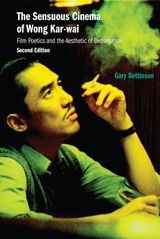
The Sensuous Cinema of Wong Kar-wai
Film Poetics and the Aesthetic of Disturbance, Second EditionGary Bettinson
Hong Kong University Press, 2025
The widely acclaimed films of Wong Kar-wai are characterized by their sumptuous yet complex visual and sonic style. This study of Wong’s filmmaking techniques uses a poetics approach to examine how form, music, narration, characterization, genre, and other artistic elements work together to produce certain effects on audiences. Bettinson argues that Wong’s films are permeated by an aesthetic of sensuousness and “disturbance” achieved through techniques such as narrative interruptions, facial masking, opaque cuts, and other complex strategies. The effect is to jolt the viewer out of complete aesthetic absorption. Each of the chapters focuses on a single aspect of Wong’s filmmaking.
This tenth-anniversary edition of The Sensuous Cinema of Wong Kar-wai includes a substantial new afterword bringing the story of Wong’s career up to date (including reflections on the Mainland Chinese drama Blossoms Shanghai). Bettinson revisits and extends the arguments of the first edition, surveys the recent key debates on Wong’s filmmaking, and introduces fresh lines of critical investigation. The book will appeal to all who are interested in authorship and aesthetics in film studies, to scholars in Asian studies, media, and cultural studies, and to anyone with an interest in Hong Kong cinema in general, and Wong’s films in particular.
The Silence of Goethe
Josef Pieper
St. Augustine's Press, 2009
But no matter how many astonishing things I saw in these unforgettable weeks of undisturbed inner focus, nothing was more surprising or unexpected than this: to realize how much of what was peculiar to this life occurred in carefully preserved seclusion; how much the seemingly communicative man who carried on a world-wide correspondence still never wanted to expose in words the core of his existence.
However manifold the forms of this silence and of their unconscious roots and conscious motives may have been, is it not always the possibility of hearing, the possibility of a purer perception of reality that is aimed at? And so, is not Goethe’s type of silence above all the silence of one who listens? . . .
The meaning of being silent is hearing – a hearing in which the simplicity of the receptive gaze at things is like the naturalness, simplicity, and purity of one receiving a confidence, the reality of which is creatura, God’s creation. And insofar as Goethe’s silence is in this sense a hearing silence, to that extent it has the status of the model and paradigm – however much, in individual instances, reservations and criticism are justified. One could remain circumspectly silent about this exemplariness after the heroic nihilism of our age has proclaimed the attitude of the knower to be by no means that of a silent listener but rather as that of self-affirmation over against being: insight and knowledge are naked defiance, the severest endangering of existence in the midst of the superior strength of concrete being. The resistance of knowledge opposes the oppressive superior power. However, that the knower is not a defiant rebel against concrete being, but above all else a listener who stays silent and, on the basis of his silence, a hearer – it is here that Goethe represents what, since Pythagoras, may be considered the silence tradition of the West.
The Singular Objects of Architecture
Jean Baudrillard
University of Minnesota Press, 2005
Among the topics the two speakers take up are the city of tomorrow and the ideal of transparency, the gentrification of New York City and Frank Gehry’s surprising Guggenheim Museum in Bilbao. As Nouvel prompts Baudrillard to reflect on some of his signature concepts (the virtual, transparency, fatal strategies, oblivion, and seduction, among others), the confrontation between such philosophical concerns and the specificity of architecture gives rise to novel and striking formulations—and a new way of establishing and understanding the connections between the practitioner and the philosopher, the object and the idea.
This wide-ranging conversation builds a bridge between the fields of architecture and philosophy. At the same time it offers readers an intimate view of the meeting of objects and ideas in which the imagined, constructed, and inhabited environment is endlessly changing, forever evolving.
Jean Baudrillard is one of the most influential thinkers of his generation and author of The Vital Illusion (2001).
Jean Nouvel has designed buildings throughout the world, including the new Guthrie Theater in Minneapolis, and is a recipient of France’s Grand Prix d’Architecture.
Robert Bononno, a translator and teacher, lives in New York City.
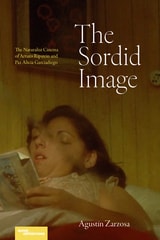
The Sordid Image
The Naturalist Cinema of Arturo Ripstein and Paz Alicia GarciadiegoAgustín Zarzosa
Northwestern University Press, 2026
Drawing on the cinematic oeuvre of Ripstein and Garciadiego to reconceptualize the idea of the sordid
The sordid is not an ideology, an affect, or even a form of taste or sensibility. It is, Agustín Zarzosa argues, an image and an evocation of the process of degradation. The Sordid Image: The Naturalist Cinema of Arturo Ripstein and Paz Alicia Garciadiego offers the first sustained study of this pivotal filmmaker-screenwriter pair, drawing on their multidecade collaborations to reframe an enduring problem of film theory: how to represent marginalized people.
Together, Ripstein and Garciadiego have constructed a recognizable cinematic world filled with social outcasts, characterized by self-degradation and unreason, and set within squalid environments. Inscribing the Ripsteinian universe within the literary and cinematic traditions of naturalism, this book theorizes the notion of the sordid to examine the partners’ unique and epoch-defining films. We can, Zarzosa contends, understand the sordid as a cinematic image, with its specific components and pleasures, recasting questions of authorship, mise-en-scène, spectatorship, genre, and language.
The Sovereign Self
Aesthetic Autonomy from the Enlightenment to the Avant-GardeGrant H. Kester
Duke University Press, 2023
The Sovereignty of Taste
James S. Hans
University of Illinois Press, 2002
Taste is everything, Hans says, for it produces the primary values that guide our lives. Taste is the fundamental organizing mechanism of human bodies, a lifelong effort to fit one's own rhythms to the rhythms and patterns of the natural world and the larger human community. It is an aesthetic sorting process by which one determines what belongs in--a conversation, a curriculum, a committee, a piece of art, a meal, a logical argument--and what should be left out. On the one hand, taste is the source of beauty, justice, and a sense of the good. On the other hand, as an arbiter of the laws of fair and free play, taste enters into more ominous and destructive patterns--but patterns nonetheless--of resentment and violence.
Hans develops his conception of taste through astute readings of five literary landmarks: Milan Kundera's The Unbearable Lightness of Being, Sophocles' Oedipus the King, William Faulkner's Light in August, and the poetry of Emily Dickinson and the Polish Nobel Laureate Czeslaw Milosz. These texts explore the art of soulmaking and the quest for personal expression: the costs as well as the fruits that come from acceding to the imperatives of one's being. They also reveal how the collision of personal and collective rhythms, whether in the Greek citadel or the Mississippi countryside, leads to violence and ritualized sacrifice.
Elegant, principled, and provocative, The Sovereignty of Taste is an essential book that restores taste to its rightful place of influence, shoring up the ground beneath civilization's feet and offering hope for the future of integrity, value, and aesthetic truth.
The Stranger's Welcome
Oral Theory and the Aesthetics of the Homeric Hospitality SceneSteve Reece
University of Michigan Press, 1993
The Subject and Other Subjects
On Ethical, Aesthetic, and Political IdentityTobin Siebers
University of Michigan Press, 1998
The Tears of Things
Melancholy and Physical ObjectsPeter Schwenger
University of Minnesota Press, 2005
Peter Schwenger deftly weaves together philosophical and psychoanalytical theory with artistic practice. Concerned in part with the act of collecting, The Tears of Things is itself a collection of exemplary art objects—literary and cultural attempts to control and possess things—including paintings by Georgia O’Keeffe and René Magritte; sculpture by Louise Bourgeois and Marcel Duchamp; Joseph Cornell’s boxes; Edward Gorey’s graphic art; fiction by Virginia Woolf, Georges Perec, and Louise Erdrich; the hallucinatory encyclopedias of Jorge Luis Borges and Luigi Serafini; and the corpse photographs of Joel Peter Witkin.
However, these representations of objects perpetually fall short of our aspirations. Schwenger examines what is left over—debris and waste—and asks what art can make of these. What emerges is not an art that reassembles but one that questions what it means to assemble in the first place. Contained in this catalog of waste is that ultimate still life, the cadaver, where the subject-object dichotomy receives its final ironic reconciliation.
Peter Schwenger is professor of English at Mount St. Vincent University in Halifax, Nova Scotia. He is the author of Fantasm and Fiction: On Textual Envisioning, Letter Bomb: Nuclear Holocaust and the Exploding Word, and Phallic Critiques: Masculinity and Twentieth-Century Literature.
The Things That Really Matter
Philosophical Conversations on the Cornerstones of LifeMichael Hauskeller
University College London, 2022
While rooted in academic discourse, The Things That Really Matter comprehensively explores the most fundamental aspects of human life in approachable, non-technical language, adding fresh perspectives and new arguments and considerations that are designed to stimulate further debate. It features a series of conversations about the things in our life that we all, in one way or another, wrestle with if we are at all concerned about what kind of world we live in and what our role in it is: things like birth, age, and death, good and evil, the meaning of life, the nature of the self and the role the body plays for our identity, our gendered existence, love and faith, free will, beauty, and our experience of the sacred.
Situating abstract ideas in concrete experience, The Things That Really Matter encourages the reader to participate in an open-ended dialogue involving a variety of thinkers with different backgrounds and orientations. Lively and accessible, it shows thinking as a process and a collaborative endeavor that benefits from our talking to each other rather than against each other, featuring real conversations, where ideas are explored, tested, changed, and occasionally dropped. It is thinking in motion, personal yet universal.

The Thinker As Artist
From Homer To Plato and AristotleGeorge Anastaplo
Ohio University Press, 1997
The Trace of Judaism
Dostoevsky, Babel, Mandelstam, LevinasVal Vinokur
Northwestern University Press, 2009
The defining quality of Russian literature, for most critics, is its ethical seriousness expressed through formal originality. The Trace of Judaism addresses this characteristic through the thought of the Lithuanian-born Franco-Jewish philosopher Emmanuel Levinas. Steeped in the Russian classics from an early age, Levinas drew significantly from Dostoevsky in his ethical thought. One can profitably read Russian literature through Levinas, and vice versa.
The Truth in Painting
Jacques Derrida
University of Chicago Press, 1987
The Truth in Painting
Jacques Derrida
University of Chicago Press, 1987
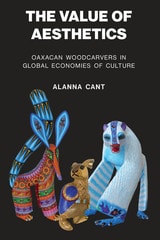
The Value of Aesthetics
Oaxacan Woodcarvers in Global Economies of CultureBy Alanna Cant
University of Texas Press, 2019
Unlike many other handicrafts in the Mexican state of Oaxaca, which have long cultural and historical trajectories, Oaxacan woodcarving began in the second half of the twentieth century and has always been done for the commercial market. In The Value of Aesthetics, Alanna Cant explores how one family’s workshop in the village of San Martín Tilcajete has become the most critically and economically successful, surpassing those of neighbors who use similar materials and techniques. The dominance of this family is tied to their ability to produce a new aesthetic that appeals to three key “economies of culture”: the tourist market for souvenirs, the national market for traditional Mexican artesanías, and the international market for indigenous art.
Offering a new analytical model by which anthropologists can approach visual aesthetics and conceptualize the power of artworks as socially active objects, The Value of Aesthetics shows how aesthetic practices produce and redefine social and political relationships. By investigating the links between aesthetics and issues of production, authorship, ownership, and identity, Cant shows aesthetic change to be a process that ultimately repackages everyday life into commodified objects in Oaxaca.
The Value of Critique
Exploring the Interrelations of Value, Critique, and Artistic LabourEdited by Isabelle Graw and Christoph Menke
Campus Verlag, 2019
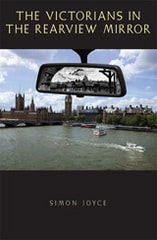
The Victorians in the Rearview Mirror
Simon Joyce
Ohio University Press, 2007
When Margaret Thatcher called in 1979 for a return to Victorian values such as hard work, self-reliance, thrift, and national pride, Labour Party leader Neil Kinnock responded that “Victorian values” also included “cruelty, misery, drudgery, squalor, and ignorance.”
The Victorians in the Rearview Mirror is an in-depth look at the ways that the twentieth century reacted to and reimagined its predecessor. It considers how the Victorian inheritance has been represented in literature, politics, film, and visual culture; the ways in which modernists and progressives have sought to differentiate themselves from an image of the Victorian; and how conservatives (and some liberals) have sought to revive elements of nineteenth-century life. Nostalgic and critical impulses combine to fix an understanding of the Victorians in the popular imagination.
Simon Joyce examines heritage culture, contemporary politics, and the “neo-Dickensian” novel to offer a more affirmative assessment of the Victorian legacy, one that lets us imagine a model of social interconnection and interdependence that has come under threat in today’s politics and culture.
Although more than one hundred years have passed since the death of Queen Victoria, the impact of her time is still fresh. The Victorians in the Rearview Mirror speaks to diverse audiences in literary and cultural studies, in addition to those interested in visual culture and contemporary politics, and situates detailed close readings of literary and cinematic texts in the context of a larger argument about the legacies of an era not as distant as we might like to think.
The Virtual Point of Freedom
Essays on Politics, Aesthetics, and ReligionLorenzo Chiesa
Northwestern University Press, 2016
The Vision of the Soul
James Matthew Wilson
Catholic University of America Press, 2017
Story-telling is foundational to the forms of the fine arts, but it is no less foundational to human reason. Human life in turn constitutes a specific kind of form—a story form. The ancient conception of human life as a pilgrimage to beauty itself is one that we can fully embrace only if we see the essential correlation between reason and story and the essential convertibility of truth, goodness and beauty in beauty. By turns a study in fundamental ontology, aesthetics, and political philosophy, Wilson’s book invites its readers to a renewal of the West’s intellectual tradition.
The Vital Lie
Reality and Illusion in Modern DramaAnthony S. Abbott
University of Alabama Press, 1988
The Vital Lie: Reality and Illusion in Modern Drama is a sweeping inquiry into the stories people tell themselves in order to endure, survive, and belong. Moving from Ibsen and Strindberg to Beckett, Pinter, and beyond, Anthony S. Abbott traces the uneasy traffic between actuality and self-invention that animates modern theater. Rather than offering a simple survey, he uncovers a recurring dramatic predicament: the cognitive dissonance that afflict people when the beliefs they hold about themselves collide with reality.
Anthony S. Abbott writes with the erudite observation of a critic and the curiosity of a participant. His book explores illusion, meaning, and human resilience, a perspective that lends unusual urgency to its readings of canonical playwrights. Abbott's scholarship is expansive without becoming academic in the pejorative sense; his arguments remain animated by large questions about purpose, dignity, and the imaginative structures that sustain ordinary lives.
Ideal for theater devotees, literary historians, students of modernism, philosophy-minded readers, directors, dramaturgs, and anyone fascinated by self-deception, mythmaking, and identity. Admirers of intellectual biography, cultural criticism, existential inquiry, and ambitious cross-author interpretation will find this volume especially rewarding. Those who relish fresh angles on familiar classics will discover a study that is probing, elegant, and unexpectedly memorable.
The World in a Frame
What We See in FilmsLeo Braudy
University of Chicago Press, 1976

The World in a Frame
What We See in Films, 25th Anniversary EditionLeo Braudy
University of Chicago Press, 2002
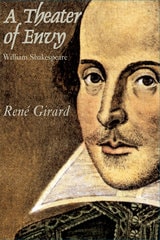
Theater Of Envy
William ShakespeareRene Girard
St. Augustine's Press, 2004
In this ground-breaking work, one of our foremost literary and cultural critics turns to the major figure in English literature, William Shakespeare, and proposes a dramatic new reading of nearly all his plays and poems. The key to A Theater of Envy is Girard's novel reinterpretation of "mimesis." For Girard, people desire objects not for their intrinsic value, but because they are desired by someone else - we mime or imitate their desires. This envy - or "mimetic desire" - he sees as one of the foundations of the human condition.
Bringing such proocative and iconoclastic insights to bear on Shakespeare, Girard reveals the previously overlooked coherence of problem plays like Troilus and Cressida, and makes a convincing argument for elevating A Midsummer Night's Dream from the status of a chaotic comedy to a masterpiece. The book abounds with novel and provocative interpretations: Shakespeare becomes "a prophet of modern advertising," and the threat of nuclear disaster is read in the light of Hamlet. Most intriguing of all, perhaps, is a brief, but brilliant aside in which an entirely new perspective is brought to the chapter on Joyce's Ulysses in which Stephen Dedalus gives a lecture on Shakespeare. In Girard's view only Joyce, perhaps the greatest of twentieth-century novelists, comes close to understanding the greatest of Renaissance playwrights.
Throughout this impressively sustained reading of Shakespeare, Girard's prose is sophisticated, but contemporary, and accessible to the general reader.
Theater of the Mind
Imagination, Aesthetics, and American Radio DramaNeil Verma
University of Chicago Press, 2012
For generations, fans and critics have characterized classic American radio drama as a “theater of the mind.” This book unpacks that characterization by recasting the radio play as an aesthetic object within its unique historical context. In Theater of the Mind, Neil Verma applies an array of critical methods to more than six thousand recordings to produce a vivid new account of radio drama from the Depression to the Cold War.
In this sweeping exploration of dramatic conventions, Verma investigates legendary dramas by the likes of Norman Corwin, Lucille Fletcher, and Wyllis Cooper on key programs ranging from The Columbia Workshop, The Mercury Theater on the Air, and Cavalcade of America to Lights Out!, Suspense, and Dragnet to reveal how these programs promoted and evolved a series of models of the imagination.
With close readings of individual sound effects and charts of broad trends among formats, Verma not only gives us a new account of the most flourishing form of genre fiction in the mid-twentieth century but also presents a powerful case for the central place of the aesthetics of sound in the history of modern experience.
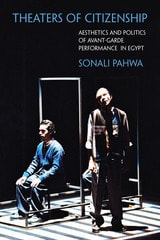
Theaters of Citizenship
Aesthetics and Politics of Avant-Garde Performance in EgyptSonali Pahwa
Northwestern University Press, 2020
In 2004, independent cultural institutions were sites for more democratic forms of youth organization and cultural participation than were Egyptian state theaters. Sonali Pahwa looks at identity formation within this infrastructure for new cultural production: festivals, independent troupes, workshops, and manifesto movements. Bringing institutional changes in dialogue with new performance styles on stages and streets, Pahwa conceptualizes performance culture as a school of citizenship. Independent theater incubated hope in times of despair and pointed to different futures for the nation’s youth than those seen in television and newspapers. Young dramatists countered their generation’s marginalization in the neoliberal economy, media, and political institutions as they performed alternative visions for the nation. An important contribution to the fields of anthropology and performance studies, Pahwa’s analysis will also interest students of sociology and Egyptian history.