Results by title
297 books match the query 'Alabama' and 68 start with t
The World through the Dime Store Door
A MemoirAileen Kilgore Henderson
University of Alabama Press, 2020
A coming-of-age memoir evoking farm, mining, and small-town life in Alabama’s Tuscaloosa County as the world transitions from the Great Depression to World War II.
In the 1930s, the rural South was in the throes of the Great Depression. Farm life was monotonous and hard, but a timid yet curious teenager thought it worth recording. Aileen Kilgore Henderson kept a chronicle of her family’s daily struggles in Tuscaloosa County alongside events in the wider world she gleaned from shortwave radio and the occasional newspaper. She wrote about Howard Hughes’s round-the-world flight and her horror at the rise to power in Germany of a bizarre politician named Adolf Hitler. Henderson longed to join the vast world beyond the farm, but feared leaving the refuge of her family and beloved animals.
Yet, with her father’s encouragement, she did leave, becoming a clerk in the Kress dime store in downtown Tuscaloosa. Despite long workdays and a lengthy bus commute, she continued to record her observations and experiences in her diary, for every day at the dime store was interesting and exciting for an observant young woman who found herself considering new ideas and different points of view.
Drawing on her diary entries from the 1930s and early 1940s, Henderson recollects a time of sweeping change for Tuscaloosa and the South. The World through the Dime Store Door is a personal and engaging account of a Southern town and its environs in transition told through the eyes of a poor young woman with only a high school education but gifted with a lively mind and an openness to life.
The Yellowhammer War
The Civil War and Reconstruction in AlabamaEdited by Kenneth W. Noe
University of Alabama Press, 2014
During the first winter of the war, Confederate soldiers derided the men of an Alabama Confederate unit for their yellow-trimmed uniforms that allegedly resembled the plumage of the yellow-shafted flicker or “yellowhammer” (now the Northern Flicker, Colaptes auratus, and the state bird of Alabama). The soldiers’ nickname, “Yellowhammers,” came from this epithet. After the war, Alabama veterans proudly wore yellowhammer feathers in their hats or lapels when attending reunions. Celebrations throughout the state have often expanded on that pageantry and glorified the figures, events, and battles of the Civil War with sometimes dubious attention to historical fact and little awareness of those who supported, resisted, or tolerated the war off the battlefield.
Many books about Alabama’s role in the Civil War have focused serious attention on the military and political history of the war. The Yellowhammer War likewise examines the military and political history of Alabama’s Civil War contributions, but it also covers areas of study usually neglected by centennial scholars, such as race, women, the home front, and Reconstruction. From Patricia A. Hoskins’s look at Jews in Alabama during the Civil War and Jennifer Ann Newman Treviño’s examination of white women’s attitudes during secession to Harriet E. Amos Doss’s study of the reaction of Alabamians to Lincoln’s Assassination and Jason J. Battles’s essay on the Freedman’s Bureau, readers are treated to a broader canvas of topics on the Civil War and the state.
CONTRIBUTORS
Jason J. Battles / Lonnie A. Burnett / Harriet E. Amos Doss / Bertis English / Michael W. Fitzgerald / Jennifer Lynn Gross / Patricia A. Hoskins / Kenneth W. Noe / Victoria E. Ott / Terry L. Seip / Ben H. Severance / Kristopher A. Teters / Jennifer Ann Newman Treviño / Sarah Woolfolk Wiggins / Brian Steel Wills
Published in Cooperation with the Frances S. Summersell Center for the Study of the South
There's Hope for the World
The Memoir of Birmingham, Alabama's First African American MayorRichard Arrington
University of Alabama Press, 2008
On a sultry September morning in 1955, a young African American man, the son of share croppers, boarded a Greyhound bus in Birmingham, Alabama, to leave his home state for the first time in his life. He was headed for the University of Detroit on a teaching scholarship from MilesCollege. Richard Arrington could not have guessed then that his future as a teacher would be postponed for decades by big-city politics--and that he would serve a record-setting five terms as chief executive of Alabama’s largest city.
Under Arrington’s leadership, Birmingham rebuilt itself from a foundering, steel-driven industrial center to one of the most diversified metropolitan areas in the Southeast, with an economy fueled by health care, biomedical research, engineering, telecommunications, and banking. As mayor, Arrington’s economic legacy is impressive. When he left office, Birmingham boasted a record number of jobs and the lowest unemployment rate in its history. Additionally, Birmingham had built the strongest tax base in Alabama, expanded its city limits by 60 square miles, reduced crime to its lowest level in 25 years, and funded a $260 million school construction program. Today Birmingham is financially sound and is the only city in the Southeast with a $100 million endowment fund.
These Rugged Days
Alabama in the Civil WarJohn S. Sledge
University of Alabama Press, 2017
Alabama’s Civil War story—told with grit, grace, and truth.
In These Rugged Days: Alabama in the Civil War, John S. Sledge offers a riveting and readable account of Alabama’s Civil War saga. Focused on the conflict’s turning points within the state’s borders, Sledge recounts residents’ experiences from secession’s early days to its tumultuous collapse, when 75,000 blue-coated soldiers were on the move statewide. Sledge brings these tumultuous years to life in an impressive array of primary and secondary sources, including official records, diaries, newspapers, memoirs, correspondence, sketches, and photographs. He also highlights such colorful personalities as John Pelham, the youthful Jacksonville artillerist who was shipped home in an iron casket with a glass faceplate; Gus Askew, a nine-year-old Barbour County slave who vividly recalled the day the Yankees marched in; Augusta Jane Evans, the Mobile novelist who was given a gold pen by a daring blockade runner; and Emma Sansom, a plucky Gadsden teenager who acted as a scout and guide to Nathan Bedford Forrest.
These Rugged Days is an enthralling tale of action, courage, pride, and tragedy. The Civil War has left indelible marks on Alabama’s land, culture, economy, and people, and Sledge offers a refreshing take on the state's role in the conflict. His narrative is a dramatic account that will be enjoyed by lay readers as well as students and scholars of Alabama and the Civil War.
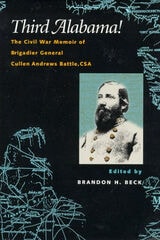
Third Alabama!
The Civil War Memoir of Brigadier General Cullen Andrews Battle, CSACullen Andrews Battle
University of Alabama Press, 2002
From Seven Pines to Sharpsburg and Chancellorsville to Spotsylvania, the Third Alabama Regiment played a key role in the Civil War. One of the first infantry units from the Deep South to make the journey to Virginia in 1861, the Third Alabama was the first to cross the Potomac into Maryland and to enter the streets of Gettysburg in 1863.
As the regiment’s leader and one of General Robert E. Lee’s brigade commanders, General Cullen Andrews Battle witnessed the extent of the many triumphs and sufferings of the Army of Northern Virginia. Trained as a journalist and lawyer, he records these events honestly and with compassion. Battle captures the courage of citizen soldiers fighting without prior military training, always paying tribute to the heroism of those under his command, while providing vivid accounts of some of the war’s bloodiest fights. He assesses Confederate mistakes, particularly at Seven Pines—and sheds light on the third Battle of Winchester, the only decisive defeat in which the regiment was involved.
Brandon Beck’s introductory notes provide a thorough review of Battle’s life and valuable biographical information on soldiers under his command as well as on other officers in the Army of Northern Virginia. A worthwhile addition to all Civil War libraries, public or private, Third Alabama! offers an informative, dramatic reading of the wartime activities of one of the Confederacy’s bravest fighting units.
Thirteen Alabama Ghosts and Jeffrey
Commemorative EditionKathryn Tucker Windham
University of Alabama Press, 1969
Step into Alabama’s haunted history—one story at a time.
One of the best-known and widely shared books about the South, Thirteen Alabama Ghosts and Jeffrey has haunted the imaginations of generations of delighted young readers since it was first published in 1969. Written by nationally acclaimed folklorists Kathryn Tucker Windham and Margaret Gillis Figh, the book recounts Alabama’s thirteen most ghoulish and eerie ghost legends.
Curated with loving expertise, these thirteen tales showcase both Windham and Figh’s masterful selection of stories and their artful and suspenseful writing style. In crafting stories treasured by children and adults alike, the authors tell much more than ghost tales. Embedded in each is a wealth of fact and folklore about Alabama history and the old South. “I don’t care whether you believe in ghosts,” Windham was fond of saying. “The good ghost stories do not require that you believe in ghosts.”
Millions of readers cherish memories of being chilled as teachers and parents read them unforgettable stories like “The Unquiet Ghost at Gaineswood,” about the ghost of Evelyn Carter, who fills this Demopolis antebellum mansion with midnight musical lamentations because her body wasn’t returned to her native Virginia, and “The Phantom Steamboat of the Tombigbee,” about the wreck of the steamboat Eliza Battle, which caught fire on the way to Mobile and sank one February night in 1858. People who live along the river say the flaming steamboat wreck still rises on cold nights, its cotton cargo blazing across the waves while its terrified survivors cry for help from the icy water.
The title’s “Jeffrey” refers to a friendly ghost who resides in the Windham home and who served as Windham’s unofficial collaborator in this work and the subsequent books in this popular series, all of which are now available in high-quality reproductions of their spooky originals.
Thirteen Loops
Race, Violence, and the Last Lynching in AmericaB. J. Hollars
University of Alabama Press, 2011
The death of Vaudine Maddox—and the lynchings that followed—serves as a cautionary tale about the violence that occurred in the same region nearly fifty-years later, highlighting the cowardice, ignorance, and happenstance that sustained a culture of racial intolerance far into the future.Nearly half a century later, after a black bank robber was acquitted for the murder of police Sergeant Gene Ballard, two Klansmen took it upon themselves to exact revenge on an innocent victim--nineteen-year-old African American Michael Donald. Donald's murder--deemed the last lynching in America--reignited the race debate in America and culminated in a courtroom drama in which the United Klans of America were at long last put on trial.
While tracing the relationships among these murders, B. J. Hollars's research led him deep into the heart of Alabama’s racial, political, and legal landscapes. A work of literary journalism, Thirteen Loops draws upon rarely examined primary sources, court documents, newspaper reports, and first-hand accounts in an effort to unravel the twisted tale of a pair of interconnected murders that forever altered United States' race relations.
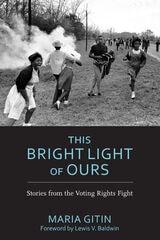
This Bright Light of Ours
Stories from the Voting Rights FightMaria Gitin
University of Alabama Press, 2014
Combining memoir with oral history, creates a vivid and searing portrait of the Freedom Summer of 1965.
This Bright Light of Ours offers a tightly focused insider’s view of the community-based activism that was the heart of the civil rights movement. A celebration of grassroots heroes, this book details through first-person accounts the contributions of ordinary people who formed the nonviolent army that won the fight for voting rights.
Combining memoir and oral history, Maria Gitin fills a vital gap in civil rights history by focusing on the neglected Freedom Summer of 1965 when hundreds of college students joined forces with local black leaders to register thousands of new black voters in the rural South. Gitin was an idealistic nineteen-year-old college freshman from a small farming community north of San Francisco who felt called to action when she saw televised images of brutal attacks on peaceful demonstrators during Bloody Sunday, in Selma, Alabama.
Atypical among white civil rights volunteers, Gitin came from a rural low-income family. She raised funds to attend an intensive orientation in Atlanta featuring now-legendary civil rights leaders. Her detailed letters include the first narrative account of this orientation and the only in-depth field report from a teenage Summer Community Organization and Political Education (SCOPE) project participant.
Gitin details the dangerous life of civil rights activists in Wilcox County, Alabama, where she was assigned. She tells of threats and arrests, but also of forming deep friendships and of falling in love. More than four decades later, Gitin returned to Wilcox County to revisit the people and places that she could never forget and to discover their views of the “outside agitators” who had come to their community. Through conversational interviews with more than fifty Wilcox County residents and former civil rights workers, she has created a channel for the voices of these unheralded heroes who formed the backbone of the civil rights movement.
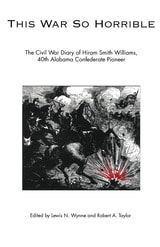
This War So Horrible
The Civil War Diary of Hiram Smith Williams, 40th Alabama Confederate PioneerHiram Smith Williams
University of Alabama Press, 1993
The Civil War diary of Hiram Smith Williams is extremely unusual. A carriage maker and native of New Jersey, Williams only arrived in the Deep South in 1959 and yet enlisted in the Confederate Army. As a middle-class craftsman, he represented neither wealthy Southern planters nor yeoman farmers. Part of the 40th Alabama Volunteer Regiment, he was first in Mobile, where he attempted to transfer to the CSA Navy. Failing that, he went with his regiment to Atlanta to engage in the great battle there.
A careful writer, Williams paid the same attention to his composition as he did to his carriages. Unlike many Civil War veterans, he never revised his diary to embellish his record or heroism. Prized by historians both for providing an unique point of view as well as an exceptionally articulate narrative, Williams' diary is an important addition to any Civil War library.
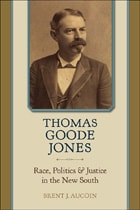
Thomas Goode Jones
Race, Politics, and Justice in the New SouthBrent J. Aucoin
University of Alabama Press, 2016
Thomas Goode Jones of Alabama is the first comprehensive biography of a key Alabama politician and federal jurist whose life and times embody the conflicts and transformations in the Deep South between the Civil War and World War I.
A man who both represented and differed from his class, Thomas Goode Jones offers contemporary readers and scholars an ideal subject of study to understand a period of southern history that still shapes American life today. Often overshadowed by the pharaonic antebellum period, the Civil War, and the luminous heights of the civil rights movement, the deceptively placid decades at the turn of the century were, in fact, a period when southerners fiercely debated the course of the South’s future. In tracing Jones’s career, Brent J. Aucoin offers vivid accounts of the great events and trends of that pivotal period: Reconstruction, the birth of the “Solid South,” the Populist Revolt, and the establishment of racial disenfranchisement and segregation.
Born in 1844, Jones served in the Confederate army and after the war identified as a conservative “Bourbon” Democrat. He served as Alabama's governor from 1890 to 1894 and as a federal judge from 1901 until his death in 1914. As a veteran, politician, and judge, Jones embodied numerous roles in the shifting political landscape of the South.
Jones was not, however, a reflexive conformist and sometimes pursued policies at odds with his party. Jones’s rhetoric and support of African American civil rights were exceptional and earned him truculent criticism from unrepentant racist factions in his party. His support was so fearless that it inspired Booker T. Washington to recommend Jones to Republican president Theodore Roosevelt as a federal judge. On the bench, Jones garnered national attention for his efforts to end peonage and lynching, and yet he also enabled the establishment of legalized segregation in Alabama, confounding attempts easily to categorize him as an odious reactionary or fearless progressive.
Tongues of Flame
Mary Ward Brown
University of Alabama Press, 1993
Winner of the PEN/Hemingway Foundation Award
These beautifully crafted stories depict the changing relationships between black and white southerners, the impact of the civil rights movement, and the emergence of the New South.
Mary Ward Brown is a storyteller in the tradition of such powerful 20th-century writers as William Faulkner, Harper Lee, Flannery O'Connor, and Eudora Welty-writers who have explored and dramatized the tension between the inherited social structure of the South and its contemporary dissolution. With Tongues of Flame, her first collection of short stories, Brown bares the awkward, sometimes hopeful, and often tragic suffering of people caught in changing times within a timeless setting.
Here we meet such memorable characters as a dying black woman who seeks the advice of a now-alcoholic white doctor whom she knew in better years; a young woman, jilted at the altar, driven crazy by an illuminated cross erected by the church opposite her house; and a 95-year-old woman buying a tombstone for her long-deceased husband only to discover that he had been adulterous throughout their marriage. Brown constructs her characters in a disarmingly plain style while breathing life into them with compassion and honesty as they confront the large moments of their lives.
First published by E. P. Dutton in 1986 to immediate critical acclaim, Tongues of Flame won the 1987 PEN/Ernest Hemingway Foundation Award. The judges commended Brown for "seeing life whole, without prejudice, without sentimentality, without histrionics. Her voice may be quiet-sometimes she speaks in a whisper-but her words are, nevertheless, always forceful, clear, and ultimately lasting." With this new publication of Tongues of Flame and its inclusion in the University of Alabama Press's Deep South Books series, a whole new generation of readers may once more discover Mary Ward Brown's profound stories of pain, loss, and hope.
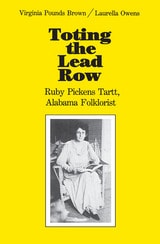
Toting the Lead Row
Ruby Pickens Tartt, Alabama FolkloristVirginia Pounds Brown
University of Alabama Press, 1981
Preserving voices from the back roads—Ruby Pickens Tartt and the folklore of Alabama’s Black Belt.
“You recall the expression ‘toting the lead row’, don’t you? In chopping cotton or corn there is always a leader, one who can chop the fastest of them all. When he finishes his row, he goes back and helps the other choppers finish theirs. The one who totes the lead row takes the lead place in the next row.”—Ruby Pickens Tartt
Toting the Lead Row is a powerful biographical and cultural tribute to Ruby Pickens Tartt, a white woman from Alabama’s Black Belt who devoted her life to preserving the oral traditions of rural Black communities. Born in 1880 in Livingston, Alabama, Tartt witnessed nearly a century of social transformation and made it her mission to document the songs, stories, and life histories of her African American neighbors. She believed that the soul of Sumter County resided not in its institutions, but in its cabins, fields, and voices.
During the Great Depression, Tartt worked with the Federal Writers’ Project, collaborating with renowned folklorists such as Carl Carmer and John Lomax. Her home became a hub for cultural preservation, attracting scholars and artists who recognized the depth of her fieldwork. The book’s title refers to a Southern agricultural phrase—“toting the lead row”—symbolizing leadership and support, a role Tartt embodied in her efforts to elevate the voices of those often overlooked.
This volume is divided into two parts: the first offers a detailed biography of Tartt and her work with the WPA, while the second presents a curated selection of her collected writings, including 18 life histories and 12 slave narratives. Through these stories, Tartt preserved a vital piece of Southern history and gave voice to generations whose experiences might otherwise have been lost.
Toting the Lead Row is both a celebration of a remarkable woman and a vital contribution to the study of folklore, race, and Southern identity.
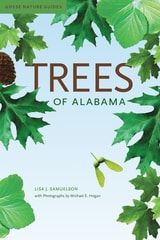
Trees of Alabama
Lisa J. Samuelson, with Photographs by Michael E. Hogan
University of Alabama Press, 2020
From acorns to canopy: Alabama’s trees revealed in vivid detail.
From the understory flowering dogwood presenting its showy array of white bracts in spring, to the stately, towering baldcypress anchoring swampland with their reddish buttresses; from aromatic groves of Atlantic white-cedar that grow in coastal bogs to the upland rarity of the fire-dependent montane longleaf pine, Alabama is blessed with a staggering diversity of tree species. Trees of Alabama offers an accessible guide to the most notable species occurring widely in the state, forming its renewable forest resources and underpinning its rich green blanket of natural beauty.
Lisa J. Samuelson provides a user-friendly identification guide featuring straightforward descriptions and vivid photographs of more than 140 common species of trees. The text explains the habitat and ecology of each species, including its forest associates, human and wildlife uses, common names, and the derivation of its botanical name. With more than 800 full-color photographs illustrating the general form and habitat of each, plus the distinguishing characteristics of its buds, leaves, flowers, fruit, and bark, readers will be able to identify trees quickly. Colored distribution maps detail the range and occurrence of each species grouped by county, and a quick guide highlights key features at a glance.
This book also features a map of forest types, chapters on basic tree biology and terminology (with illustrative line drawings), a spotlight on the plethora of oak species in the state, and a comprehensive index. This is an invaluable resource for biologists, foresters, and educators and a great reference for outdoorspeople and nature enthusiasts in Alabama and throughout the southeastern United States.
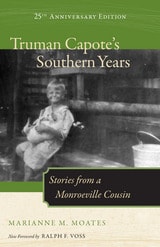
Truman Capote's Southern Years, 25th Anniversary Edition
Stories from a Monroeville CousinMarianne M. Moates, Foreword by Ralph F. Voss
University of Alabama Press, 2014
Readers are well acquainted with Truman Capote’s meteoric rise to fame and his metamorphosis from literary enfant terrible to literary genius, celebrity author, and dispenser of venomously comic witticisms. It is also well-known that he spent his formative years in the south Alabama hamlet of Monroeville, and that he was abandoned there by his mother to be cared for and then to care for elderly relatives. Yet details of those years have remained sketchy and vague.
In Monroeville young Capote formed significant bonds and played childhood games with his cousin, Jennings Faulk Carter, and next door neighbor, Nelle Harper Lee, author of "To Kill a Mockingbird" and "Go Set a Watchman." Through the tales told by Carter and spun into a fascinating and revealing narrative by Marianne M. Moates readers discover in Truman Capote's Southern Years the lively imagination and the early tragedies of a brilliant child.
A new foreword by Ralph F. Voss underscores the enduring relevance of Truman Capote’s work and the influence his Alabama childhood had on his work.
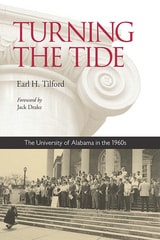
Turning the Tide
The University of Alabama in the 1960sEarl H. Tilford
University of Alabama Press, 2014
Earl H. Tilford details the origins of the student movement from within the Student Government Association, whose leaders included Ralph Knowles and future governor Don Siegelman, among others; the participation of key members of “The Machine,” the political faction made up of the powerful fraternities and sororities on campus; and the efforts of more radical non-Greek students like Jack Drake, Ed Still, and Sondra Nesmith. Tilford also details the political maneuverings that drove the cause of social change through multiple administrations at the university. Turning the Tide highlights the contributions of university presidents Frank A. Rose and David Mathews, as well as administrators like the dean of men John L. Blackburn, who supported the student leaders but also encouraged them to work within the system rather than against it.
Based on archival research, interviews with many of the principal participants, and the author’s personal experiences, Tilford’s Turning the Tide is a compelling portrait of a university in transition during the turbulence surrounding the civil rights and anti-war movements of the 1960s.
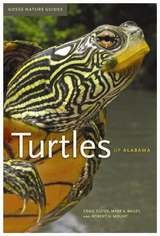
Turtles of Alabama
Craig Guyer, Mark A. Bailey, and Robert H. Mount
University of Alabama Press, 2015
From Riverbeds to Coastlines: The Ultimate Guide to Alabama’s Turtles.
For nearly 200 million years, Earth has been occupied by reptiles—a lineage of terrestrial vertebrates that includes some, like birds, that have invaded the aerial environment, and others, like turtles, that have invaded aquatic environments. With thirty-nine known species, Alabama harbors more turtle species than any other state in the nation, and its Mobile River basin is the center of the world's greatest biodiversity in turtles, surpassing all other river systems around the globe, including the Amazon and the Nile. Turtles of Alabama documents that extraordinary wealth and presents each species in full, describing its physical appearance, habitat and range, behavior, conservation and management, and taxonomy.
In addition to providing sixty-five full-color photographs of juveniles and adults along with forty-two colorfully detailed distribution maps, this volume features an introductory section explaining the physiography, climate, and habitats of the state, and offers illustrated taxonomic keys for all the species considered, including the oceanic behemoths that lay their eggs on Alabama's gulf beaches and the lumbering gopher tortoise that provides safe haven for countless other animals and arthropods in its underground burrows of the Coastal Plain. With fine line drawings to highlight various distinguishing attributes of the animals, this volume is the definitive guide to the state’s fascinating and diverse turtle populations—freshwater, marine, and terrestrial.
Although they are notoriously slow-moving, turtles still survive on Earth because of their remarkable adaptations—an exterior shell for body protection, long lives, high reproductive output, stamina, and a capacity for doing without. Turtles are cold-blooded reptiles that were here long before mammals, and they're still around, continuing to adapt to many different habitats and ecological niches, still interbreeding, evolving, and speciating. Turtles of Alabama is a fitting celebration of that phenomenal variety and strength.

Two Years on the Alabama
Arthur Sinclair
University of Alabama Press, 2003
Two-Party Politics in the One-Party South
Alabama's Hill Country, 1874–1920Samuel L. Webb
University of Alabama Press, 1997
A challenge to the long-held view that the only important and influential politicians in post-Reconstruction Deep South states were Democrats.
In this insightful and exhaustively researched volume, Samuel L. Webb presents new evidence that, contrary to popular belief, voters in at least one Deep South state did not flee en masse from the Republican party after Reconstruction. As Webb demonstrates conclusively, the party gained strength among white voters in Upcountry areas of northern Alabama between 1896 and 1920. Not only did GOP presidential candidates win more than a dozen area counties but Republican congressional candidates made progress in Democratic strongholds, and local GOP officials gained control of several county courthouses.
Nor were these new Republicans simply the descendants of anti-Confederate families, as some historians have claimed. Rather, they were former independents, Greenbackers, and Populists, who, in keeping with the 1890s Populist movement, were reacting against what they perceived as the control of the Democratic party by "moneyed elites" and planter landlords. Webb also breaks with previous historical opinion by showing that ex-Populists in the Hill Country, who had been radical reformers during the 1890s, remained reform minded after 1900.
Webb's ground-breaking reassessment of Alabama state politics from Reconstruction to the 1920s describes a people whose political culture had strong roots in the democratic and egalitarian Jacksonian ideology that dominated north Alabama in the antebellum period. These people carried forward elements of Jacksonianism into the late 19th century, with its tenets continuing to influence them well into the early 20th century.