Results by title
399 books match the query 'American fiction' and 69 start with t
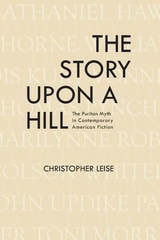
The Story upon a Hill
The Puritan Myth in Contemporary American FictionChristopher Leise
University of Alabama Press, 2017
The Story upon a Hill: The Puritan Myth in Contemporary American Fiction analyzes the work of several of the most important contemporary writers in the United States as reinterpreting commonplace narratives of the country’s origins with a keen eye on the effects of inclusion and exclusion that Puritan myths promote. In 1989, Ronald Reagan recalled the words of Massachusetts Bay Colony governor John Winthrop, who imagined the colony as a “city upon a hill” for future nations to emulate. In Reagan’s speech, Winthrop’s signature rhetoric became an emblem of American idealism, and for many Americans, the Puritans’ New England was the place where the United States forged its original identity.
But what if Winthrop never gave that speech? What if he did not even write it? Historians cannot definitively answer these questions. In fact, no group that we refer to as American Puritans thought of themselves as Puritans. Rather, they were a group of dissident Christians often better defined by their disagreements than their shared beliefs.
Literary scholars interested in Anglo-American literary production from the seventeenth century through the present, historians, and readers interested in how ideas about Christianity circulate in popular culture will find fascinating the ways in which William Gaddis, Kurt Vonnegut, Thomas Pynchon, and Marilynne Robinson repurpose so-called Puritan forms of expression to forge a new narrative of New England’s Congregationalist legacy in American letters. Works by Colson Whitehead, Paul Auster, Toni Morrison, and others are also considered. The Story upon a Hill raises a provocative question: if the Puritans never existed as we understand them, what might American history look like in that context?
The Tribe of Pyn
Literary Generations in the Postmodern PeriodDavid Cowart
University of Michigan Press, 2015
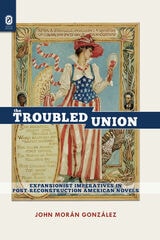
The Troubled Union
Expansionist Imperatives in Post-Reconstruction American NovelsJohn Morán González
The Ohio State University Press, 2010

The Voyage In
Fictions of Female DevelopmentEdited by Elizabeth Abel, Marianne Hirsch, and Elizabeth Langland
Dartmouth College Press, 1983
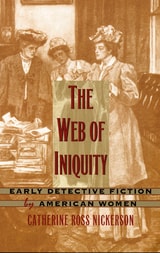
The Web of Iniquity
Early Detective Fiction by American WomenCatherine Ross Nickerson
Duke University Press, 1998
This subgenre allowed women writers to participate in postbellum culture and to critique other aspects of a rapidly changing society. Domestic detective fiction combined elements of sensationalist papers, popular nonfiction crime stories, and the domestic novel. Nickerson shows how it also incorporated the gothic tropes found in the work of Harriet Beecher Stowe, Louisa May Alcott, and Charlotte Brontë and influenced the work of Pauline Hopkins. Mid-nineteenth-century writer Metta Fuller Victor, who represented such important areas of cultural conflict as the role of professions in the formation of class identity and the possibility of women's independence and self-determination, paved the way for the appearance of women detectives in the late-nineteenth-century fiction of Anna Katharine Green. Nickerson credits Mary Roberts Rinehart, in particular, for bringing sophistication to the subgenre by amplifying the humorous, terrifying, and feminist elements inherent in earlier detective novels by women. Throughout the volume, Nickerson focuses on the narrative qualities of the domestic novel tradition and the ways in which it reflected ideologies of domesticity and gender. Also included are a discussion of various rewritings of the Lizzie Borden scandal in this tradition and an afterword on the relation of domestic detective fiction to the hard-boiled style.
The Web of Iniquity places the detective fiction written by women between 1850 and 1940 into ongoing discussions regarding women, culture, and literature and will appeal to scholars and students of women's studies, American studies, and literary history.
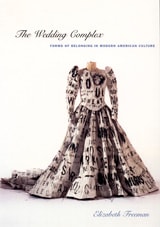
The Wedding Complex
Forms of Belonging in Modern American CultureElizabeth Freeman
Duke University Press, 2002
Freeman draws on queer theory and social history to focus on a range of texts where weddings do not necessarily lead to legal marriage but instead reflect yearnings for intimate arrangements other than long-term, state-sanctioned, domestic couplehood. Beginning with a look at the debates over gay marriage, she proceeds to consider literary works by Nathaniel Hawthorne, William Faulkner, Carson McCullers, Vladimir Nabokov, and Edgar Allan Poe, along with such Hollywood films as Father of the Bride, The Graduate, and The Godfather. She also discusses less well-known texts such as Su Friedrich’s experimental film First Comes Love and the off-Broadway, interactive dinner play Tony ‘n’ Tina’s Wedding.
Offering bold new ways to imagine attachment and belonging, and the public performance and recognition of social intimacy, The Wedding Complex is a major contribution to American studies, queer theory, and cultural studies.
The White Trash Menace and Hemispheric Fiction
Ramón E. Soto-Crespo
The Ohio State University Press, 2020
The Wilderness Within
American Women Writers and Spiritual QuestKristina K. Groover
University of Arkansas Press, 1999
Kristina K. Groover, in examining this question, finds that books by American women writers offer alternative patterns for seeking revelation—patterns which emphasize not solitary journeys, but the sacredness of everyday life. Drawing on the work of feminist theorists and theologians, including Carol Gilligan, Naomi Goldenberg, and Rosemary Ruether, Groover explores the spiritual nature and force of domesticity, community, storytelling, and the garden in the works of such writers as Toni Morrison, Katherine Anne Porter, Kaye Gibbons, and Alice Walker. Ordinary, personal experience in these works becomes a source for spiritual revelation. Wisdom is gained, lessons are learned, and lives are healed not in spite of home and communal ties, but because of them.
Thus, American women writers, Groover argues, make alternative literary and spiritual paradigms possible. Similarly, Kristina K. Groover, in this lucid and groundbreaking work, opens up new fields of exploration for any reader interested in women’s spirituality or in the rich, diverse field of American literature.
Theory and Practice of American Literary Naturalism
Selected Essay and ReviewsDonald Pizer
Southern Illinois University Press, 1993
In his first book devoted exclusively to naturalism, Donald Pizer brings together thirteen essays and four reviews written over a thirty-year period that in their entirety constitute a full-scale interpretation of the basic character and historical shape of naturalism in America.
The essays fall into three groups. Some deal with the full range of American naturalism, from the 1590s to the late twentieth century, and some are confined either to the 1890s or to the twentieth century. In addition to the essays, an introduction in which Pizer recounts the development of his interest in American naturalism, reviews of recent studies of naturalism, and a selected bibliography contribute to an understanding of Pizer’s interpretation of the movement.
One of the recurrent themes in the essays is that the interpretation of American naturalism has been hindered by the common view that the movement is characterized by a commitment to Emile Zola’s deterministic beliefs and that naturalistic novels are thus inevitably crude and simplistic both in theme and method. Rather than accept this notion, Pizer insists that naturalistic novels be read closely not for their success or failure in rendering obvious deterministic beliefs but rather for what actually does occur within the dynamic play of theme and form within the work.
Adopting this method, Pizer finds that naturalistic fiction often reveals a complex and suggestive mix of older humanistic faiths and more recent doubts about human volition, and that it renders this vital thematic ambivalence in increasingly sophisticated forms as the movement matures. In addition, Pizer demonstrates that American naturalism cannot be viewed monolithically as a school with a common body of belief and value. Rather, each generation of American naturalists, as well as major figures within each generation, has responded to threads within the naturalistic impulse in strikingly distinctive ways. And it is indeed this absence of a rigid doctrinal core and the openness of the movement to individual variation that are responsible for the remarkable vitality and longevity of the movement.
Because the essays have their origin in efforts to describe the general characteristics of American naturalism rather than in a desire to cover the field fully, some authors and works are discussed several times (though from different angles) and some referred to only briefly or notat all. But the essays as a collection are "complete" in the sense that they comprise an interpretation of American naturalism both in its various phases and as a whole. Those authors whose works receive substantial discussion include Stephen Crane, Frank Norris, Theodore Dreiser, Edith Wharton, James T. Farrell, Norman Mailer, Joyce Carol Oates, and William Kennedy. Of special interest is Pizer’s essay on Ironweed, which appears here for the first time.
Through the Window, Out the Door
Women's Narratives of Departure, from Austin and Cather to Tyler, Morrison, and DidionJanis P. Stout
University of Alabama Press, 1998
This informative and provocative study focuses on the centrality of departure in the texts of five major American women novelists.
An important moment in many novels and poems by American women writers occurs when a central character looks out a window or walks out the door of a house. These acts of departure serve to convey such values as the rejection of constraining social patterns, the search for individual fulfillment, and the entry into the political.
Janis Stout examines such moments and related patterns of venture and travel in the fiction of five major American novelists of the 20th century: Mary Austin, Willa Cather, Anne Tyler, Toni Morrison, and Joan Didion. Stout views these five writers within a spectrum of narrative engagements with issues of home and departure—a spectrum anchored at one end by Sarah Orne Jewett and at the other by Marilynne Robinson, whose Housekeeping posits a vision of female transience.
Through the Window, Out the Door ranges over an expansive territory. Moving between texts as well as between texts and contexts, Stout shows how women writers have envisioned the walls of physical and social structures (including genres) as permeable boundaries, drawing on both a rhetoric of liberation and a rhetoric of domesticity to construct narrative arguments for women's right to move freely between the two. Stout concludes with a personal essay on the dilemmas of domesticity and the ambivalence of departure.

Tight Spaces
Kesho Scott
University of Iowa Press, 1999
To Live and Die
Collected Stories of the Civil War, 1861–1876Kathleen Diffley, ed.
Duke University Press, 2002
The authors, who include Louisa May Alcott and Mark Twain, depict the horrors of the battlefield, the suffering in prison camps and field hospitals, and the privations of the home front. In these pages, bushwhackers carry the war to out-of-the-way homesteads, spies work households from the inside, journeying paymasters rely on the kindness of border women, and soldiers turn out to be girls. The stories are populated with nurses, officers, speculators, preachers, slaves, and black troops, and they take place in cities, along the frontier, and on battlefields from Shiloh to Gettysburg.
The book opens with a prewar vigilante attack on the Underground Railroad and a Kansas parson in Henry King’s “The Cabin at Pharoah’s Ford” and concludes with an ex-slave recalling the loss of her remaining son in Twain’s “A True Story.” In between are stories written by both women and men that were published in magazines from the South and West as well as the culturally dominant Northeast. Wartime wood engravings highlight the text. Kathleen Diffley’s introduction provides literary and historical background, and her commentary introduces readers to magazine authors as well as the deepening disruptions of a country at war.
Just as they did for nineteenth-century readers, these stories will bring the war home to contemporary readers, giving shape to a crisis that rocked the nation then and continues to haunt it now.
Tomboys
A Literary and Cultural HistoryMichelle Ann Abate
Temple University Press, 2008
Starting with the figure of the bold, boisterous girl in the mid-19th century and ending with the “girl power” movement of the 1990’s, Tomboys is the first full-length critical study of this gender-bending code of female conduct. Michelle Abate uncovers the origins, charts the trajectory, and traces the literary and cultural transformations that the concept of “tomboy” has undergone in the United States.
Abate focuses on literature including Louisa May Alcott's Little Women and Carson McCullers's The Member of the Wedding and films such as Peter Bogdanovich's Paper Moon and Jon Avnet's Fried Green Tomatoes. She also draws onlesser-known texts like E.D.E.N. Southworth's once wildly popular 1859 novel The Hidden Hand, Cold War lesbian pulp fiction, and New Queer Cinema from the 1990s.
Tomboys also explores the gender and sexual dynamics of tomboyism, and offers intriguing discussions of race and ethnicity's role in the construction of the enduring cultural archetype. Abate’s insightful analysis provides useful, thought-provoking connections between different literary works and eras. The result demystifies this cultural phenomenon and challenges readers to consider tomboys in a whole new light.
Tracing Southern Storytelling in Black and White
Sarah Gilbreath Ford
University of Alabama Press, 2014
Exploring the shared storytelling traditions that shaped Southern literature across racial lines.
Tracing Southern Storytelling in Black and White is a study of the historical use of oral storytelling by southern writers in written works. In each chapter, Sarah Gilbreath Ford pairs a white and an African American writer to highlight points of confluence in black and white southern oral traditions. She argues that the connections between white and African American southern writers run deeper than critics have yet explored, and she uses textual comparisons to examine the racial mixing of oral culture.
On porches, in kitchens, and on the pages of their work, black and white southerners exchanged not just stories but strategies for telling stories. As a boy, Joel Chandler Harris listened to the stories of African American slaves, and he devised a framework to turn the oral stories into written ones. Harris’s use of the frame structure influenced how Charles Chesnutt recorded oral stories, but it led Alice Walker to complain that her heritage had been stolen. Mark Twain listened to African American storytellers as a child. His use of oral dialects then impacts how Ralph Ellison and William Faulkner employ oral storytelling and how Toni Morrison later writes in response to Faulkner. The interactions are not linear, not a chain of influence, but a network of interactions, borrowings, and revisions.
Ford’s pairings lead to new readings that reveal how the writers employ similar strategies in their narratives, due in part to shared historical context. While Zora Neale Hurston and William Faulkner, for example, use oral storytelling in the 1930s to examine the fear of racial mixing, Ellen Douglas and Ernest Gaines use it in the 1970s to build bridges between the races. Exploring the cultural crossing that occurs in the use of oral storytelling, Ford offers a different view of this common strategy in southern narrative and a new perspective on how culture is shared.
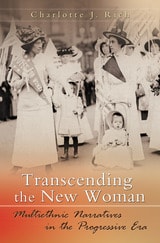
Transcending the New Woman
Multiethnic Narratives in the Progressive EraCharlotte J. Rich
University of Missouri Press, 2009

Translating Modernism
Fitzgerald and HemingwayRonald Berman
University of Alabama Press, 2009

Tremors
New Fiction by Iranian American WritersAnita Amirrezvani
University of Arkansas Press, 2013
Troublemakers
Power, Representation, and the Fiction of the Mass WorkerScott, William
Rutgers University Press, 2012
William Scott’s Troublemakers explores how a major change in the nature and forms of working-class power affected novels about U.S. industrial workers in the first half of the twentieth century. With the rise of mechanization and assembly-line labor from the 1890s to the 1930s, these laborers found that they had been transformed into a class of “mass” workers who, since that time, have been seen alternately as powerless, degraded victims or heroic, empowered icons who could rise above their oppression only through the help of representative organizations located outside the workplace.
Analyzing portrayals of workers in such novels as Upton Sinclair’s The Jungle, Ruth McKenney's Industrial Valley, and Jack London’s The Iron Heel, William Scott moves beyond narrow depictions of these laborers to show their ability to resist exploitation through their direct actions—sit-down strikes, sabotage, and other spontaneous acts of rank-and-file “troublemaking” on the job—often carried out independently of union leadership. The novel of the mass industrial worker invites us to rethink our understanding of modern forms of representation through its attempts to imagine and depict workers’ agency in an environment where it appears to be completely suppressed.

Twentieth-Century American Literary Naturalism
An InterpretationDonald Pizer
Southern Illinois University Press, 1982
Scorned by critics since birth, decreed dead by many, naturalism, according to Donald Pizer, is “one of the most persistent and vital strains in American fiction, perhaps the only modern literary form in America that has been both popular and significant.”
To define naturalism and explain its tenacious hold throughout the twentieth century on the American creative imagination, Pizer explores six novels: James T. Farrell’s Studs Lonigan, John Dos Passos’s U.S.A., John Steinbeck’s The Grapes of Wrath, Norman Mailer’s The Naked and the Dead, William Styron’s Lie Down in Darkness, and Saul Bellow’s The Adventures of Augie March.
Pizer’s approach to these novels is empirical; he does not wrench each novel awkwardly until it fits his framework of generalizations and principles; rather, he approaches the novels as fiction and arrives at his definition through his close reading of the works.
Establishing the background of naturalism, Pizer explains that it comes under attack because it is “sordid and sensational in subject matter,” it challenges “man’s faith in his innate moral sense and thus his responsibility for his actions,” and it is so full of “social documentation” that it is often dismissed as little more than a photographic record of a life or an era; thus the “aesthetic validity of the naturalistic novel has often been questioned.”
Pizer posits the 1890s, the 1930s,and the late 1940s as the decades when naturalism flourished in America. He concentrates on literary criticism, not on the philosophy ofnaturalism, to show that literary criticism can make a contribution to a particularly muddled area of literary history—a naturalism that is alive and changing, thus resisting the neat definitions reserved for the dead.