Results by title
653 books match the query 'Animals' and 140 start with t
The Demise of Diversity
Loss and ExtinctionJosef Reichholf
Haus Publishing, 2009
The Devil’s Cormorant
A Natural HistoryRichard J. King
University Press of New England, 2014

The Ecological Web
More on the Distribution and Abundance of AnimalsH. G. Andrewartha and L. C. Birch
University of Chicago Press, 1984
"The Ecological Web presents an entirely fresh look at ecology from the autecological perspective, and is a worthy successor to the authors' classic work, The Distribution and Abundance of Animals. The work is original—indeed unique—and the detailed coverage of case histories is unprecedented. The point of view will be controversial, but every ecologist will be impressed with the competence and completeness with which the arguments are mustered. A 'must' for every ecologist and environmental scientist."—Paul R. Ehrlich
"This book is the naturalist's vision of population ecology. The authors do not intend a formal description of the environment, but are seeking a way of functional analysis, a workable framework of theory within which to ask questions that will help us understand the distribution and abundance of animals in natural populations. The Ecological Web should be studied carefully by every population ecologist and should take a prominent place in the teaching of ecology. It marks a very significant period in our science as we change from one paradigm to another."—P. J. den Boer
The Economic Approach
Unpublished Writings of Gary S. BeckerGary S. Becker
University of Chicago Press, 2023
Now in paperback, a revealing collection from the intellectual titan whose work shaped the modern world.
As an economist and public intellectual, Gary S. Becker was a giant. The recipient of a Nobel Prize, a John Bates Clark Medal, and a Presidential Medal of Freedom, Becker is widely regarded as the greatest microeconomist in history.
After forty years at the University of Chicago, Becker left a slew of unpublished writings that used an economic approach to human behavior, analyzing such topics as preference formation, rational indoctrination, income inequality, drugs and addiction, and the economics of family.
These papers unveil the process and personality—direct, critical, curious—that made him a beloved figure in his field and beyond. The Economic Approach examines these extant works as a capstone to the Becker oeuvre—not because the works are perfect, but because they offer an illuminating, instructive glimpse into the machinations of an economist who wasn’t motivated by publications. Here, and throughout his works, an inquisitive spirit remains remarkable and forever resonant.

The Edible and the Endangered
Animals, Empire, ExtinctionJohn Levi Barnard
Duke University Press, 2027
The Elephant's Secret Sense
The Hidden Life of the Wild Herds of AfricaCaitlin O'Connell
University of Chicago Press, 2008
This compelling odyssey of scientific discovery is also a frank account of fieldwork in a poverty-stricken, war-ravaged country. In her attempts to study an elephant community, O’Connell encounters corrupt government bureaucrats, deadly lions and rhinos, poachers, farmers fighting for arable land, and profoundly ineffective approaches to wildlife conservation. The Elephant’s Secret Sense is ultimately a story of intellectual courage in the face of seemingly insurmountable obstacles.
“I was transported by the author’s superbly sensuous descriptions of her years spent studying the animals. . . . Conjures a high-class nature documentary film in prose.”—Steven Poole, Guardian
“A ride as rough and astonishing as the roads of the African floodplain.”—Joan Keener, Entertainment Weekly
“A successful combination of science and soulfulness, explaining her groundbreaking theory of how elephants use seismic communication. . . . O’Connell’s account is studded with sympathetic insights and well-turned phrases.”—Publishers Weekly
“This fascinating book reads like a fast-paced detective story of a scientific discovery and adventure set in contemporary Africa. . . . By the end, O’Connell takes her rightful place among the leading biographers of the African elephant.”—Iain Douglas-Hamilton, author of Among the Elephants
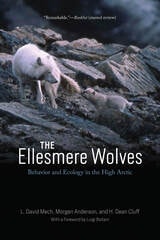
The Ellesmere Wolves
Behavior and Ecology in the High ArcticL. David Mech, Morgan Anderson, and H. Dean Cluff
University of Chicago Press, 2025
For parts of twenty-four summers, wolf biologist L. David Mech lived with a group of wolves on Ellesmere Island, some six hundred miles from the North Pole. Elsewhere, most wolves flee from even the scent of humans, but these animals, evolving relatively free from human persecution, are unafraid. Having already spent twenty-eight years studying other populations of wolves more remotely by aircraft, snow-tracking, live-trapping, and radio-tracking, Mech was primed to join their activities up close and record their interactions with each other. This book tells the remarkable story of what Mech—and the researchers who followed him—have learned while living among the wolves.
The Ellesmere wolves were so unconcerned with Mech’s presence that they allowed him to camp near their den and to sit on his all-terrain vehicle as he observed them, watching packs as large as seven adults and six pups go about their normal activities. In these extraordinarily close quarters, a pup untying his bootlace or an adult sniffing his gloved hand was just part of daily life. Mech accompanied the wolves on their travels and watched as they hunted muskoxen and arctic hares. By achieving the same kind of intimacy with his wild hosts’ every action that we might experience living with domesticated dogs, Mech gained new insights into common but rarely studied behaviors like pup feeding, food caching, howling, and scent-marking. After Mech’s time at Ellesmere ended, his coauthors and fellow wolf researchers Morgan Anderson and H. Dean Cluff spent parts of four summers studying the wolves via radio collars, further illuminating the creatures’ movements and ecology. This book synthesizes their findings, offering both a compelling scientific overview of the animals’ behavior—from hunting to living in packs to rearing pups—and a tale of adventure and survival in the Arctic.
The Evolution of Cetacean Societies
Uncovering the Social Complexity of Whales and DolphinsEdited by Darren P. Croft, Andrew D. Foote, Ellen C. Garland, and Stephanie L. King
University of Chicago Press, 2026
Cetaceans—whales, dolphins, and porpoises—represent an evolutionary peak with respect to their advanced cognitive capacities; flexible communication systems; and structured, multilevel societies. Indeed, the social lives of whales and dolphins have long fascinated scientists and the public alike. The Evolution of Cetacean Societies provides a comprehensive overview of the significant advancements made in studying cetacean behavior and ecology over the last twenty-five years, focusing on our growing understanding of these animals’ complex social lives.
Bringing together scientists from multiple disciplines, the volume summarizes key innovations and progress related to studying cetacean societies’ cultural and genetic basis, their complex social structures, their use of cooperation and patterns of social conflict, and their significant interactions with humans. Each chapter provides an in-depth account of the social lives of whales and dolphins, incorporating the latest cutting-edge research from genomics, communication, network analysis, and animal culture to explain how these animals form societies, maintain relationships, and share information. The final chapters focus on the existential threats facing these diverse and charismatic species, how human-cetacean interactions have shaped our perceptions, and what scientists can learn from their diverse social lives by championing researcher diversity in marine mammal science. The result is an essential and forward-looking book that both contextualizes the lessons of the past two decades and questions the challenges these enigmatic species might face in the future.
Published in 2000 by Chicago, Cetacean Societies: Field Studies of Dolphins and Whales, edited by Janet Mann, Richard C. Connor, Peter Tyack, and Hal Whitehead, inspired a generation of marine biologists. In this new volume, Darren P. Croft, Andrew D. Foote, Ellen C. Garland, and Stephanie L. King—all respected cetacean researchers—offer a worthy successor.
The Expression of the Emotions in Man and Animals
Charles Darwin
University of Chicago Press, 1965
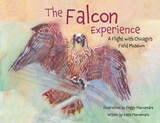
The Falcon Experience
A Flight with Chicago’s Field MuseumIllustrations by Peggy Macnamara; Written by Katie Macnamara
Northwestern University Press, 2026
A joyful, educational flight from the halls of Chicago’s Field Museum to the nests of mighty peregrine falcons
Rosie the Tarantula, famous for her adventure in the corridors and collections of Chicago’s celebrated Field Museum of Natural History, is back. This time, Rosie is focused not on spiders, but on falcons! The Falcon Experience brings us with Rosie as she follows Mary Hennen, the museum’s real-life peregrine program director, giving children and parents alike a front-row seat to the lives of these majestic birds and the scientist who cares for them. Rosie learns how falcons fly, hunt, eat, mate, construct nests and raise chicks (via the peregrine webcam!) in unexpected and challenging places in the city. Mary’s teachings also show how humans can be the key to helping our natural environment.
Beautifully illustrated with watercolors by renowned Field Museum artist-in-residence Peggy Macnamara, The Falcon Experience is told by Peggy’s daughter, author and educator Katie Macnamara, in rhyme ideal for reading aloud to children. This keepsake-quality book will delight budding young scientists and their families while providing a colorful, interactive experience with one of Chicago’s foremost cultural institutions.
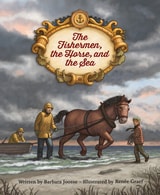
The Fishermen, the Horse, and the Sea
Barbara Joosse
Wisconsin Historical Society Press, 2021
This beautifully illustrated children’s book based on a true story recounts a dramatic rescue on Lake Michigan and introduces young readers to Lester Smith and his family, who founded Port Washington’s long-running and beloved Smith Bros. Fish Shanty. Educational materials including definitions, an illustrated map of Lake Michigan, and short biographies of the story’s featured characters supplement this engaging story for elementary-age readers.
The Flight Across The Ice
The Escape of the East Prussian HorsesPatricia Clough
Haus Publishing, 2010
The Freshwater Mussels of Ohio
G. Thomas Watters, Michael A. Hoggarth, and David H. Stansbery
The Ohio State University Press, 2009
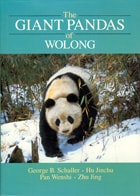
The Giant Pandas of Wolong
George B. Schaller, Hu Jinchu, Pan Wenshi, and Zhu Jing
University of Chicago Press, 1985
Although giant pandas have few natural enemies, the periodic die-off of bamboo, their main food, threatens their survival. In order to understand the panda's vital link to bamboo, the research team has explored many aspects of the animal's life, collecting information on both wild and captive pandas. Though a herbivore, the panda retains the simple digestive tract of a carnivore. Unable to digest cellulose in plants, it receives relatively little nutrition from the bamboo it eats. As a result, it must eat many kilograms of bamboo each day, foraging for fourteen hours or more throughout a day and night.
Known to the Chinese for several thousand years as daxiongmao, "large bear-cat," the giant panda has defied easy classification. The authors review anatomical, biochemical, behavioral, and paleontological evidence, concluding that the animal is neither bear nor raccoon but belongs in a separate family, perhaps with the small red panda.
The giant panda has captured the imagination of the public more than any other animal. By presenting their groundbreaking and crucial research to the public, the authors of The Giant Pandas of Wolong hope to spur further research and action that will help this precious animal survive.
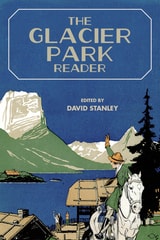
The Glacier Park Reader
David Stanley
University of Utah Press, 2017
Soon after the park was established in 1910, visitors began to arrive, often with pen in hand. They included such well-known authors as mystery writer Mary Roberts Rinehart, historian Agnes C. Laut, fiction writer Dorothy Johnson, humorist Irvin S. Cobb, poet Vachel Lindsay, and artist Maynard Dixon—all featured in the book. Readers will encounter colorful characters who lived in and around the park in its early days, including railroad magnate and conservationist Louis Hill, renegade ranger and poacher Joe Cosley, bootlegger Josephine Doody, and old-time cowboy guide Jim Whilt. Blackfeet and Kalispel myths, politically charged descriptions by early explorers such as John Muir and George Bird Grinnell, and full-color reproductions of the illustrated letters of cowboy artist and Glacier resident Charles M. Russell are also included.
Copublished with the Glacier National Park Conservancy.
The Glacier National Park Conservancy preserves the Park for generations to come. Learn more about our work at www.glacier.org
Part of the National Park Reader series, edited by Lance Newman and David Stanley
The Global Guide to Animal Protection
Edited by Andrew Linzey
University of Illinois Press, 2013
The Global Pigeon
Colin Jerolmack
University of Chicago Press, 2013
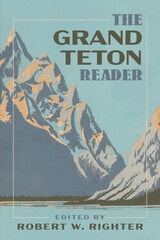
The Grand Teton Reader
Robert W. Righter
University of Utah Press, 2021
Editor Robert Righter has selected thirty-five contributors whose work takes readers from the Tetons’ geological origins to the time of Euro-American encroachment and the park’s politically tumultuous creation. Selections range from Laine Thom’s Shoshone legend of the Snake River and Owen Wister’s essay “Great God! I’ve Just Killed a Bear,” to Grace Gallatin Seton-Thompson’s humorous yet fearful account of crossing the Snake River, and William Owen’s first attempt to climb the Grand Teton. Conservationists, naturalists, and environmentalists are also represented: Terry Tempest Williams chronicles her multiyear encounter with her “Range of Memory,” and Olaus and Mardy Murie recount the difficulties of “park-making” in an often-hostile human environment.
Anyone seeking a deeper understanding of the park’s wild beauty and controversial past will want to read these stories by people who lived it.
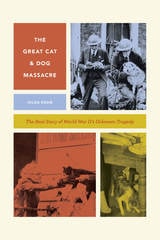
The Great Cat and Dog Massacre
The Real Story of World War Two's Unknown TragedyHilda Kean
University of Chicago Press, 2017
In The Great Cat and Dog Massacre, Hilda Kean unearths the history, piecing together the compelling story of the life—and death—of Britain’s wartime animal companions. She explains that fear of imminent Nazi bombing and the desire to do something to prepare for war led Britons to sew blackout curtains, dig up flower beds for vegetable patches, send their children away to the countryside—and kill the family pet, in theory sparing them the suffering of a bombing raid. Kean’s narrative is gripping, unfolding through stories of shared experiences of bombing, food restrictions, sheltering, and mutual support. Soon pets became key to the war effort, providing emotional assistance and helping people to survive—a contribution for which the animals gained government recognition.
Drawing extensively on new research from animal charities, state archives, diaries, and family stories, Kean does more than tell a virtually forgotten story. She complicates our understanding of World War II as a “good war” fought by a nation of “good” people. Accessibly written and generously illustrated, Kean’s account of this forgotten aspect of British history moves animals to center stage—forcing us to rethink our assumptions about ourselves and the animals with whom we share our homes.
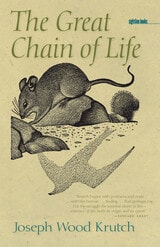
The Great Chain of Life
Krutch, Joseph Wood
University of Iowa Press, 1956
Whether anticipating the arguments of biologists who now ascribe high levels of cognition to the so-called lower animals, recognizing the importance of nature for a well-lived life, or seeing nature as an elaborately interconnected, interdependent network, Krutch’s seminal work contains lessons just as resonant today as they were when the book was first written.
Lavishly illustrated with thirteen beautiful woodcuts by Paul Landacre, an all-but-lost yet important Los Angeles artist whom Rockwell Kent called “the best American wood engraver working,” The Great Chain of Life will be cherished by new generations of readers.
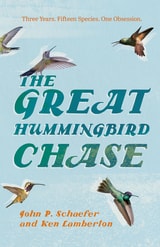
The Great Hummingbird Chase
John P. Schaefer and Ken Lamberton
University of Arizona Press, 2027
Southern Arizona is a world-renown hummingbird destination. The Great Hummingbird Chase chronicles John P. Schaefer and Ken Lamberton’s passionate quest to photograph all fifteen of Arizona’s hummingbird species.
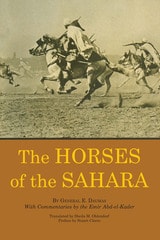
The Horses of the Sahara
By General E. Daumas
University of Texas Press, 1968
The Arabs created one of the world's finest breeds of saddle horses, the Arabian, and they have long possessed an immense store of knowledge regarding the care, training, and breeding of this splendid horse. In the nineteenth century, General Melchior Joseph Eugene Daumas had access to their knowledge even though, as he pointed out, "it requires a great deal of patience and tact for a Christian to obtain from the Mohammedans even the most insignificant of details . . ." General Daumas was, because of his unique relationship with the Arabs, probably the first European to produce a comprehensive study of Arabian horses. And to add even greater value to The Horses of the Sahara, he was able to secure for the ninth edition, here translated, extended commentaries on all aspects of Arabian horsemanship by the Emir Abd-el-Kadar, one of the most important nineteenth-century Arab leaders and certainly one of the foremost authorities on the subject.
The Horses of the Sahara will be of interest not only to equestrians but also to historians and other scholars interested in the customs of the North African desert tribes and in the complex backgrounds of European–North African relations. General Daumas took part in the conquest of Algeria by France, so distinguishing himself that he was named Director of the Bureau of Algerian Affairs in the French Ministry of War. During the campaigns and the occupation that followed, he studied and attempted to understand the native peoples, with an objectivity and sympathy unusual among the colonialists of the period. His book provides fascinating sidelights on many aspects of Arab life, including customs, superstitions, religion, and family life.
Sheila M. Ohlendorf was uniquely suited to translate The Horses of the Sahara. An excellent rider herself, thoroughly experienced with the animals and the techniques being discussed, she also spoke fluent French, having received her B.A. degree in languages from Texas Western University (now the University of Texas at El Paso). As curator of the Hall of the Horsemen, the large collection at the University of Texas at Austin, she had access to a wide variety of supplementary authorities, which enriched both her translation and the notes that accompany the book.
The Human Animal in Western Art and Science
Martin Kemp
University of Chicago Press, 2007
From the lazy, fiddling grasshopper to the sneaky Big Bad Wolf, children’s stories and fables enchant us with their portrayals of animals who act like people. But the comparisons run both ways, as metaphors, stories, and images—as well as scientific theories—throughout history remind us that humans often act like animals, and that the line separating them is not as clear as we’d like to pretend.
Here Martin Kemp explores a stunning range of images and ideas to demonstrate just how deeply these underappreciated links between humans and other fauna are embedded in our culture. Tracing those interconnections among art, science, and literature, Kemp leads us on a dazzling tour of Western thought, from Aristotelian physiognomy and its influence on phrenology to the Great Chain of Being and Darwinian evolution. We learn about the racist anthropology underlying a familiar Degas sculpture, see paintings of a remarkably simian Judas, and watch Mowgli, the man-child from Kipling’s The Jungle Book, exhibit the behaviors of the beasts who raised him. Like a kaleidoscope, Kemp uses these stories to refract, reconfigure, and echo the essential truth that the way we think about animals inevitably inflects how we think about people, and vice versa.
Loaded with vivid illustrations and drawing on sources from Hesiod to La Fontaine, Leonardo to P. T. Barnum, The Human Animal in Western Art and Science is a fascinating, eye-opening reminder of our deep affinities with our fellow members of the animal kingdom.
The Hungry Goat
Alan Mills
Bodleian Library Publishing, 2018
Whimsical illustrations and beautifully paced rhymes bring this greedy animal to life. Originally published in 1964, The Hungry Goat brings a comic cautionary tale to a new generation of children.
The Kirtland's Warbler
The Story of a Bird's Fight Against Extinction and the People Who Saved ItWilliam Rapai
University of Michigan Press, 2013
At a time when the world is seeing its species rapidly go extinct, the Kirtland's warbler is not just a survivor, it's a rock star. The Kirtland's warbler is the rarest warbler species in North America and will always be rare because of its persnickety nesting preferences. But when the total population fell below 400 birds in the 1970s and 1980s---driven largely by a loss of habitat and the introduction of a parasite---a small group of dedicated biologists, researchers, and volunteers vowed to save the Kirtland's warbler despite long odds. This is the story of the warbler's survival and gradual recovery, the people and policies that kept it from extinction, and the ongoing challenges that may again jeopardize the bird's future.
In The Kirtland's Warbler, William Rapai explores the bird's fascinating natural history as well as the complex and evolving relationships between the warbler, its environment, its human protectors, and state and federal policies that today threaten to eradicate decades of work done on the species' behalf. Beginning with an account of the warbler's discovery in the mid-nineteenth century and ornithologists' desperate hunt for information on the elusive new species, the book goes on to examine the dramatic events that quickly led to the warbler's precarious status and its eventual emergence as a lightning rod for controversy.
The Kirtland's warbler is often described as a "bird of fire" for its preference for nesting in areas cleared by wildfire. But it also warrants the name for the passion it ignites in humans. Both tragic and uplifting, the story of this intriguing bird is a stirring example of how strong leadership, vision, commitment, sustained effort, and cooperation can come together to protect our natural world.

The Last Dinosaur Book
The Life and Times of a Cultural IconW. J. T. Mitchell
University of Chicago Press, 1998
Mitchell aims to trace the cultural family tree of the dinosaur, and what he discovers is a creature of striking flexibility, linked to dragons and mammoths, skyscrapers and steam engines, cowboys and Indians. In the vast territory between the cunning predators of Jurassic Park and the mawkishly sweet Barney, from political leviathans to corporate icons, from paleontology to Barnum and Bailey, Mitchell finds a cultural symbol whose plurality of meaning and often contradictory nature is emblematic of modern society itself. As a scientific entity, the dinosaur endured a near-eclipse for over a century, but as an image it is enjoying its widest circulation. And it endures, according to Mitchell, because it is uniquely malleable, a figure of both innovation and obsolescence, massive power and pathetic failure—the totem animal of modernity.
Drawing unforeseen and unusual connections at every turn between dinosaurs real and imagined, The Last Dinosaur Book is the first to delve so deeply, so insightfully, and so enjoyably into our modern dino-obsession.
The Last Grizzly and Other Southwestern Bear Stories
Edited by David E. Brown and John A. Murray
University of Arizona Press, 1988
The Last Panda
George B. Schaller
University of Chicago Press, 1993
"No scientist is better at letting the rest of us in on just how the natural world works; no poet sees the world with greater clarity or writes about it with more grace. . . . Anyone who genuinely cares for wildlife cannot help being grateful to Schaller—both for his efforts to understand the panda and for the candor with which he reports what has gone so badly wrong in the struggle to save it from extinction."—Geoffrey C. Ward, New York Times Book Review
"Schaller's book is a unique mix of natural history and the politics of conservation, and it makes for compelling reading. . . . Having been in giant panda country myself, I found some of the descriptions of the animals and habitats breathtaking. Schaller describes the daily routines and personalities of the giant pandas he studied (as well as their fates thereafter) as though they were his blood relatives. . . . Schaller's brilliant presentation of the complexities of conservation makes his book a milestone for the conservation movement."—Devra G. Kleiman, Washington Post Book World
"George Schaller's most soulful work, written in journal style with many asides about a creature who evolved only two to three million years ago (about the same time as humans). . . . Here, conservation biology confronts an evil that grinds against hope and shatters the planet's diversity. Written with hope."—Whole Earth Catalog
"A nicely crafted blend of wildlife observation and political-cultural analysis. . . . The Last Panda is a sad chronicle of our failure, so far, to stem the decline of the animal that may be the most beloved on the planet."—Donald Dale Jackson, Smithsonian
The Life of the Lakes, 4th Ed.
A Guide to the Great Lakes FisheryBrandon C. Schroeder, Dan M. O'Keefe, and Shari L. Dann
University of Michigan Press, 2019
Now in its fourth edition, The Life of the Lakes examines the complex portrait of the Great Lakes fishery, including the history of the fishery’s exploitation and management, the current health of the Lakes, and the outlook for the future. Featuring more graphics, photos, and illustrations than ever, all printed in full color, the new edition of this engaging book is a perfect resource for general readers, teachers, and students looking for an easy-to-follow guide to the Great Lakes fishery. This book is published in collaboration with Michigan Sea Grant (www.michiganseagrant.org), a cooperative program of the University of Michigan and Michigan State University.
The Lion's Historian
Africa's Animal PastSandra Swart
Ohio University Press, 2025
“Until the lion has a historian of his own, the tale of the hunt will always glorify the hunter.” Sandra Swart takes up the challenge of that African proverb and, with this book, becomes the lion’s historian. As a species, humans are not alone; but our history has been written as though we were. Swart insists on a multispecies retelling of our more-than-human past as she reconstructs a shifting series of significant interspecies relationships, from quirky, idiosyncratic connections to others that triggered major changes. Embracing a radical interdisciplinarity informed by a background in history and environmental studies, Swart combines the natural sciences with the social sciences, oral history, indigenous knowledge, and archival research. She blends current thinking about animal sentience, agency, cognition, and emotion to offer a new way to understand animals’ role in our shared history. The animals in this book—baboons, cows, elephants, hippos, horses, jackals, lions, Nazi cattle, okapi, police dogs, quagga, sheep, and white ants—exemplify different facets of our shared past. With this animal-centric lens, decades of research are brought together in a collection that takes animals seriously. It is a book with claws and fangs, tearing through conventional narratives to ask, Are we prepared to move beyond the convention that “history” is the story of only our own species? The entanglements between humans and other animals have shaped our past, but they suggest something more. The possibility of our shared future pivots on a reckoning with our shared pasts. Swart shows what human-animal history can do, not only to understand our place in the world better but to make our world—however slightly—a better place.
The Lizard Man Speaks
By Eric R. Pianka
University of Texas Press, 1994
Alone on the endless red-sand desert in the Australian outback, tracking Varanus giganteus, the perentie lizard that grows to be more than six feet long...for desert rat Eric Pianka, such adventures have led to a satisfying, if unusual, way of life, as well as a distinguished career as a field biologist.
In The Lizard Man Speaks, Pianka recounts more than thirty years of adventures in reptile studies. He tells of "lizarding" in the North American deserts, the Kalahari Desert of southern Africa, and the Great Victoria Desert in Western Australia. His vivid imagery draws the reader into a world where lions lurk in the darkness beyond a gecko hunter's lights, where being stranded by car trouble miles from the last outpost is a constant danger, and where the wilderness still deserves to be called wild.
Along the way, Pianka provides much general information about lizard ecology, the fire succession cycle, and the interaction of humans with the landscape. And he reveals the springs of his own determined spirit and love of solitude, describing a near-fatal boyhood accident and its shaping and character-building effect on the life that followed.
The Lone Wolverine
Tracking Michigan's Most Elusive AnimalElizabeth Philips Shaw and Jeff Ford
University of Michigan Press, 2012
It began in late winter of 2004. Almost 100 years had passed since the last spotting of a wild wolverine in Michigan when coyote hunters caught a glimpse of one of the animals in a frozen farm field in the northern thumb region. For the next six years, Jeff Ford, a local science teacher and amateur naturalist, devoted himself to locating and filming the wolverine that had unexpectedly and inexplicably appeared in the Wolverine State. By the time hikers found the animal dead in early 2010, Ford had taken hundreds of rare live action photos and shot numerous hours of video, with the story of the "Wolverine Guy" attracting national attention through countless newspaper and magazine articles and appearances on Animal Planet and PBS Nature.
This is the tale of Ford's quest as he uncovered answers to mysteries surrounding the animal's territory and movement patterns, while sparking a flurry of controversy surrounding the elusive predator's origin, much of which remains unresolved today. It's an intimate look at research in the raw, from DNA samples stuck on barbed wire to a sophisticated, motion-sensing infrared camera unit strategically placed to observe nocturnal behavior.
The Lone Wolverine brings to vivid life this unforgettable piece of American wildlife lore, using candid interviews, public records, and Ford's own vast storehouse of notes, personal writings, correspondence, and images, offering an extraordinary chronicle of a wild wolverine in its natural habitat, at play and in fierce competition for food and survival. This is a wildlife detective story, recounting years of study and fierce debate as researchers pondered the riddles of Michigan's last wolverine---her origins, habits, and ultimately the cause of her untimely death.
The Mammals of Minnesota
Harvey L. Gunderson and James R. Beer
University of Minnesota Press, 1953
The Mammals of Minnesota was first published in 1953. Minnesota Archive Editions uses digital technology to make long-unavailable books once again accessible, and are published unaltered from the original University of Minnesota Press editions.
For the many Minnesotans interested in the wildlife of their state and for anyone with a special interest in the fur or game animals or in the control of harmful species, this is a practical source of information. Schools will find the book useful in teaching natural history. All the mammal species identified within Minnesota are described, and keys to the classification are given, with careful instructions on how to use the keys. Step- by step directions include photographs of animals, diagrams of the methods described, and 70 maps showing the geographical distribution of species. The material is based primarily on the collections in the Museum of Natural history and the Division of Entomology and Economic Zoology at the University of Minnesota.
The Mammals of Texas
By David J. Schmidly and Robert D. Bradley
University of Texas Press, 2016
From reviews of previous editions:
“This is the standard reference about Texas mammals.” —Wildlife Activist
“A must for anyone seriously interested in the wildlife of Texas.” —Texas Outdoor Writers Association News
“[This book] easily fills the role of both a field guide and a desk reference, and is written in a style that appeals to the professional biologist and amateur naturalist alike. . . . [It] should prove useful to anyone with an interest in the mammal fauna of Texas or the southern Great Plains.” —Prairie Naturalist
The Mammals of Texas has been the standard reference since the first edition was coauthored by William B. Davis and Walter P. Taylor in 1947. Revised several times over the succeeding decades, it remains the most authoritative source of information on the mammalian wildlife of Texas, with physical descriptions and life histories for 202 species, abundant photographs and drawings, and distribution maps.
In this new edition, David J. Schmidly is joined by one of the most active researchers on Texas mammals, Robert D. Bradley, to provide a thorough update of the taxonomy, distribution, and natural history of all species of wild mammals that inhabit Texas today. Using the most recent advances in molecular biology and in wildlife ecology and management, the authors include the most current information about the scientific nomenclature, taxonomy, and identification of species, while also covering significant advances in natural history and conservation.

The Mayflies of North and Central America
George F. Edmunds Jr., Steven L. Jensen, and Lewis Berner
University of Minnesota Press, 1976
The Mayflies of North and Central America was first published in 1976. Minnesota Archive Editions uses digital technology to make long-unavailable books once again accessible, and are published unaltered from the original University of Minnesota Press editions.
Mayflies have fascinated man for centuries because of the brief span of their adult lives. These aquatic insects spend most of their lives as nymphs in water, then develop into winged stages and soon die, most species having an adult life of only two or three days. This brevity is implied in the very name of the order, Ephemeroptera.
The mayflies are almost worldwide in distribution, being found everywhere except in Antarctica, the extreme Arctic, and many small oceanic islands. All by three of the twenty families in the world occur in North or Central America, the regions covered in this volume. The book provides a modern, useful, and well-illustrated key to the adults and nymphs. Data on habitats, behavior, and life history are given for each genus. Characteristics of nymphs and adults are given for families, subfamilies, and genera, with brief accounts for extralimital families.
A discussion of methods of collecting and preserving specimens precedes the main portion of the text. The book is generously illustrated with drawings, photographs, and a map.
The role of aquatic insects as indicators of water pollution has received increasing attention, and in this connection this book will be of special interest to those concerned with pollution problems. Mayflies, besides indicating the presence of pollutants, also help remove such substances from the waters, the authors explain.
As a basic reference work, the book is essential for all biological science libraries. Many fly-fishermen are amateur students of mayflies, since the nymphs of larger species are used as bait. With the help of this volume the fisherman can acquire a greater knowledge of aquatic entomology and relate to his sport.
The Michigan Roadside Naturalist
J. Alan Holman and Margaret B. Holman
University of Michigan Press, 2003
Did you know . . . ?
- Michigan is seventeenth in oil production in the United States.
- The Great Lakes are said to be the only glacially produced structures that can be seen from the moon.
- Michigan was once part of a coral reef.
- The wood frog is one of the commonest true frogs of moist woodland floors in Michigan today and is able to freeze solid during the winter without harmful effects.
These and many more amazing facts await the curious traveler in The Michigan Roadside Naturalist, J. Alan and Margaret B. Holman's captivating guide to the natural treasures of Michigan. A perfect accompaniment to the classic Michigan Trees and The Forests of Michigan, this user-friendly guide offers a Who's Who of the geology, biology, and archaeology of the Great Lakes State, as well as highway adventures along the state's major routes.
The book begins with an educational yet accessible tour of important points in Michigan's natural and archaeological history, followed by seven road trips based on commonly traveled state routes, moving from south to north in the Lower Peninsula and east to west in the Upper Peninsula. Readers can proceed directly to the road trips or familiarize themselves with the state's treasure trove of fascinating features before embarking. Either way, an informative and fun odyssey awaits the passionate naturalist, amateur or otherwise.
J. Alan Holman is Curator Emeritus of Vertebrate Paleontology at the Michigan State University Museum and Emeritus Professor of Geology and Zoology at Michigan State University. Margaret B. Holman is Research Associate at Michigan State University Museum and Department of Anthropology, Michigan State University.
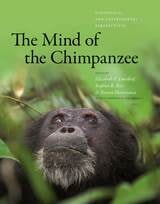
The Mind of the Chimpanzee
Ecological and Experimental PerspectivesEdited by Elizabeth V. Lonsdorf, Stephen R. Ross, and Tetsuro Matsuzawa
University of Chicago Press, 2010
Understanding the chimpanzee mind is akin to opening a window onto human consciousness. Many of our complex cognitive processes have origins that can be seen in the way that chimpanzees think, learn, and behave. The Mind of the Chimpanzee brings together scores of prominent scientists from around the world to share the most recent research into what goes on inside the mind of our closest living relative.
Intertwining a range of topics—including imitation, tool use, face recognition, culture, cooperation, and reconciliation—with critical commentaries on conservation and welfare, the collection aims to understand how chimpanzees learn, think, and feel, so that researchers can not only gain insight into the origins of human cognition, but also crystallize collective efforts to protect wild chimpanzee populations and ensure appropriate care in captive settings. With a breadth of material on cognition and culture from the lab and the field, The Mind of the Chimpanzee is a first-rate synthesis of contemporary studies of these fascinating mammals that will appeal to all those interested in animal minds and what we can learn from them.
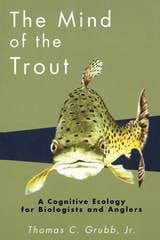
The Mind of the Trout
A Cognitive Ecology for Biologists and AnglersThomas C. Grubb, Jr.
University of Wisconsin Press, 2003
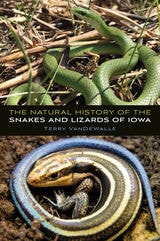
The Natural History of the Snakes and Lizards of Iowa
Terry VanDeWalle
University of Iowa Press, 2022
While readers will be able to identify Iowa’s snakes and lizards through its species accounts, identification keys, and beautiful photographs and illustrations, this book is intended to be more than a field guide. What makes it truly unique is the comparison of historic data collected by Iowa herpetologists in the 1930s and 1940s with data collected by the author, along with James L. Christiansen and others, since 1960. Custom maps show the reader how species’ distributions have changed over time.
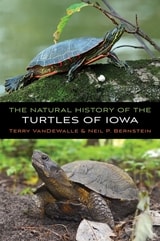
The Natural History of the Turtles of Iowa
Terry VanDeWalle
University of Iowa Press, 2024
While readers will be able to identify Iowa’s turtles through its species accounts, identification keys, and beautiful photographs and illustrations, this book is intended to be more than a field guide. What makes it truly unique is the comparison of historic data collected by Iowa herpetologists in the 1930s and 1940s with data collected by the authors, along with James L. Christiansen and others, since 1960. Custom maps show the reader how species’ distributions have changed over time. This book contains Iowa-specific data found nowhere else and is essential to all who study turtles in the Midwest.
The Next Social Contract
Animals, the Anthropocene, and BiopoliticsWayne Gabardi
Temple University Press, 2017
In his provocative book The Next Social Contract, Wayne Gabardi rigorously considers the fate of animals in the twenty-first century. He claims that if we are to address the challenges raised by the Anthropocene—the period where nonhuman beings tend to be mere extras, often subsumed under the umbrella notion of “nature”—we need to radically rethink our basic ethical outlook and develop a new, “more-than-human” social contract.
Gabardi’s wide-ranging and multidisciplinary analysis focuses on four principal battlegrounds of animal biopolitics in the twenty first century: the extinction of wild animals, the crisis of oceanic animals, industrialized farm animals and the future of industrial agribusiness, and the situation of contact-zone animals moving into human-occupied habitats.
In his recasting of the social contract, Gabardi envisions a culture shift in human-animal relations toward posthumanism that features the ethical and political prioritization of animal life so it is on par with that of human well-being.
The Nighthawk's Evening
Notes of a Field BiologistGretchen N. Newberry
Oregon State University Press, 2021
This acrobatic, night-flying bird nests on rooftops and flocks in the thousands as it migrates from Alaska to Argentina and back every year. Nighthawks are strange animals, reptiles with feathers, sleepy during the day, but quick, agile, and especially adept at survival. They have the ability to withstand extreme temperatures and adapt to many habitats, but they are struggling for survival in the Anthropocene.
Newberry’s story focuses on the bird itself—its complex conservation status and cultural significance—and the larger, often hidden world of nocturnal animals. Along the way, she gives readers insight into the daily life of a scientist, especially one who works primarily at night. The Nighthawk’s Evening uses one scientist and one species to explore the challenges, disappointments, and successes of scientific research and conservation efforts. An accessible work of science, it will appeal to birders, students, wildlife managers, and anyone who is fascinated by urban wildlife.
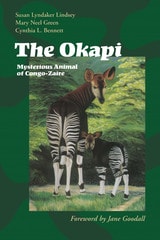
The Okapi
Mysterious Animal of Congo-ZaireBy Susan Lyndaker Lindsey, Mary Neel Green, and Cynthia L. Bennett
University of Texas Press, 1999
Congo-Zaire contains Africa's largest remaining tracts of intact rain forest, making it one of the most important regions for biodiversity conservation. Its Ituri Forest is home to plants and animals native to nowhere else on earth, including the elusive and little-known okapi.
In this popularly written book, three long-time observers of the okapi present a complete, contemporary natural history of this appealing relative of the giraffe. They recount its discovery by European explorers and describe its appearance and life cycle. They also discuss current efforts to preserve the species, both in the wild and at zoos around the world.
Illustrated with charming line drawings, The Okapi will be a valuable resource for conservationists and zoo visitors alike-indeed anyone fascinated by the mysterious animal of Congo-Zaire.
The Origin and Distribution of Birds in Coastal Alaska and British Columbia
The Lost Manuscript of Ornithologist Harry S. SwarthChristopher W. Swarth
Oregon State University Press, 2022
In 2019, Christopher Swarth, Harry’s grandson and a scientist in his own right, discovered the forgotten manuscript. This book includes the original unpublished manuscript, accompanied by contextual essays from contemporary ornithologists who examine the impact and relevance of Swarth’s research on coastal bird diversity, fox sparrow migration, and the systematic puzzle of the timberline sparrow. Expedition maps display field camps and exploration routes, and species checklists illustrate the variety of birds observed at key field sites. To bring additional color and insight, The Origin and Distribution of Birds in Coastal Alaska and British Columbia also includes excerpts from Harry Swarth’s field notes, a comprehensive list of Harry Swarth’s publications, and a glossary with historic and contemporary bird names. Naturalists, ornithologists, birders, and all those who want to learn more about the natural history of the region will delight in the rediscovery of this long-lost treasure.
The Owls Are Not What They Seem
Artist as EthologistArnaud Gerspacher
University of Minnesota Press, 2022
Toward a posthumanist art and ethology
The Owls Are Not What They Seem is a selective history of modern and contemporary engagements with animals in the visual arts and how these explorations relate to the evolution of scientific knowledge regarding animals. Arnaud Gerspacher argues that artistic knowledge, with its experimental nature, ability to contain contradictions, and more capacious understanding of truth-claims, presents a valuable supplement to scientific knowledge when it comes to encountering and existing alongside nonhuman animals and life worlds.
Though critical of art works involving animals that are unreflective and exploitative, Gerspacher’s exploration of aesthetic practices by Allora & Calzadilla, Pierre Huyghe, Agnieszka Kurant, Araya Rasdjarmrearnsook, Martin Roth, David Weber-Krebs, and others suggests that, alongside scientific practices, art has much to offer in revealing the otherworldly qualities of animals and forging ecopolitical solidarities with fellow earthlings.
The Paper Zoo
500 Years of Animals in ArtCharlotte Sleigh
University of Chicago Press, 2017
In this stunning book, historian of science Charlotte Sleigh draws on the ultimate bibliophile’s menagerie—the collections of the British Library—to present a lavishly illustrated homage to this historical collaboration between art and science. Gathering together a breathtaking range of nature illustrations from manuscripts, prints, drawings, and rare printed books from across the world, Sleigh brings us face to face (or face to tentacle) with images of butterflies, beetles, and spiders, of shells, fish, and coral polyps. Organized into four themed sections—exotic, native, domestic, and paradoxical—the images introduce us to some of the world’s most renowned natural history illustrators, from John James Audubon to Mark Catesby and Ernst Haeckel, as well as to lesser-known artists. In her accompanying text, Sleigh traces the story of the art of natural history from the Renaissance through the great age of exploration and into the nineteenth century, offering insight into the changing connections between the natural and human worlds.
But the story does not end there. From caterpillars to crabs, langurs to dugongs, stick insects to Old English pigs; from the sinuous tail feathers of birds of paradise to the lime-green wings of New Zealand’s enormous flightless parrot, the kakapo; from the crenellated plates of a tortoise’s shell to imagined likenesses of unicorns, mermaids, and dinosaurs, the story continues in this book. It is a Paper Zoo for all time.
The Peregrine Returns
The Art and Architecture of an Urban Raptor RecoveryMary Hennen with Peggy Macnamara
University of Chicago Press, 2017
In The Peregrine Returns, Mary Hennen gives wings to this extraordinary conservation success story. Drawing on the beautiful watercolors of Field Museum artist-in-residence Peggy Macnamara and photos by Field Museum research assistant Stephanie Ware, as well as her own decades of work with peregrines, Hennen uses a program in Chicago as a case study for the peregrines’ journey from their devastating decline to the discovery of its cause (a thinning of eggshells caused by a by-product of DDT), through to recovery, revealing how the urban landscape has played an essential role in enabling falcons to return to the wild—and how people are now learning to live in close proximity to these captivating raptors.
Both a model for conservation programs across the country and an eye-opening look at the many creatures with which we share our homes, this richly illustrated story is an inspiring example of how urban architecture can serve not only our cities’ human inhabitants, but also their wild ones.
The Perfection of Nature
Animals, Breeding, and Race in the RenaissanceMackenzie Cooley
University of Chicago Press, 2022
The Renaissance is celebrated for the belief that individuals could fashion themselves to greatness, but there is a dark undercurrent to this fêted era of history. The same men and women who offered profound advancements in European understanding of the human condition—and laid the foundations of the Scientific Revolution—were also obsessed with controlling that condition and the wider natural world.
Tracing early modern artisanal practice, Mackenzie Cooley shows how the idea of race and theories of inheritance developed through animal breeding in the shadow of the Spanish Empire. While one strand of the Renaissance celebrated a liberal view of human potential, another limited it by biology, reducing man to beast and prince to stud. “Race,” Cooley explains, first referred to animal stock honed through breeding. To those who invented the concept, race was not inflexible, but the fragile result of reproductive work. As the Spanish empire expanded, the concept of race moved from nonhuman to human animals. Cooley reveals how, as the dangerous idea of controlled reproduction was brought to life again and again, a rich, complex, and ever-shifting language of race and breeding was born.
Adding nuance and historical context to discussions of race and human and animal relations, The Perfection of Nature provides a close reading of undertheorized notions of generation and its discontents in the more-than-human world.
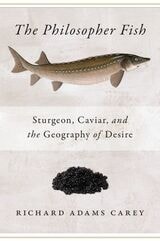
The Philosopher Fish
Sturgeon, Caviar, and the Geography of DesireRichard Adams Carey
Brandeis University Press, 2024
From the acclaimed eco-journalist Rick Carey comes a fascinating chronicle of a fast-disappearing fish—and of the people whose lives and livelihoods depend on it. Since the days of the Persian Empire, caviar has trumpeted status, wealth, prestige, and sex appeal. In this remarkable journey to caviar’s source, Carey immerses himself in the world of the sturgeon, the fish that lays these golden eggs. The sturgeon has a fascinating biological past—and a very uncertain future. Sturgeon populations worldwide have declined seventy percent in the last twenty years. Meanwhile, the beluga sturgeon, producer of the most coveted caviar, has climbed to number four on the World Wildlife Fund’s most-endangered species list. A high-stakes cocktail of business, crime, diplomacy, technology, and the dilemmas of conservation, The Philosopher Fish is the epic story of a 250-million-year-old fish struggling to survive.
This new edition includes new chapters bringing up to date the story of this elusive and mysterious fish, and the people involved with both preserving and exploiting it.
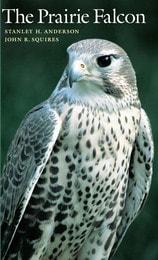
The Prairie Falcon
By Stanley H. Anderson and John R. Squires
University of Texas Press, 1997
Skillful hunters beautiful in flight, Prairie Falcons inhabit the rocky cliffs of the American West. These raptors range from southern Canada and northern North Dakota to Baja California, Arizona, New Mexico, western and northern Texas, and southeastern Coahuila, Mexico.
This is the first book for a wide audience devoted exclusively to the Prairie Falcon. Stanley Anderson and John Squires cover all aspects of the falcon's life history from mating and rearing young to hunting behaviors and the yearly migration cycle. They provide complete descriptive characteristics for identifying Prairie Falcons and also compare them to other raptors, especially the closely related Peregrine Falcon.
In addition, the authors recount the long association of falcons with people, which may extend back as far as 2000 BC. They describe the practice of falconry from the Middle Ages until today. And they assess the threats to Prairie Falcons posed by human activities, from pesticide use and destruction of habitat to disruption of the breeding cycle by careless birdwatchers.