Results by title
277 books match the query 'Biology' and 96 start with t
The Middle Path
Avoiding Environmental CatastropheEric Lambin
University of Chicago Press, 2007
In The Middle Path, noted geographer Eric Lambin provides a concise, readable summary of the present state of the environment and considers what must be done if environmental catastrophe is to be avoided. Finding merit in the arguments of both optimists and pessimists, Lambin argues that it is not too late to exploit the inherent tendency toward equilibrium of large-scale systems such as the earth’s environment. By relying upon a combination of remedies as global as international cap-and-trade emission treaties and as local as municipal programs promoting the use of bicycles rather than cars, it may yet be possible to rescue humanity from a potentially fatal crisis of its own making.
Based on rigorous scientific analysis, and strikingly free of ideological prejudice, The Middle Path presents a fresh view of our troubled future, brilliantly balancing tough-minded realism with humanitarian ideals of cooperation and ingenuity.
The Mind of the Chimpanzee
Ecological and Experimental PerspectivesEdited by Elizabeth V. Lonsdorf, Stephen R. Ross, and Tetsuro Matsuzawa
University of Chicago Press, 2010
Understanding the chimpanzee mind is akin to opening a window onto human consciousness. Many of our complex cognitive processes have origins that can be seen in the way that chimpanzees think, learn, and behave. The Mind of the Chimpanzee brings together scores of prominent scientists from around the world to share the most recent research into what goes on inside the mind of our closest living relative.
Intertwining a range of topics—including imitation, tool use, face recognition, culture, cooperation, and reconciliation—with critical commentaries on conservation and welfare, the collection aims to understand how chimpanzees learn, think, and feel, so that researchers can not only gain insight into the origins of human cognition, but also crystallize collective efforts to protect wild chimpanzee populations and ensure appropriate care in captive settings. With a breadth of material on cognition and culture from the lab and the field, The Mind of the Chimpanzee is a first-rate synthesis of contemporary studies of these fascinating mammals that will appeal to all those interested in animal minds and what we can learn from them.
The Myth of Human Races
Alain F. Corcos
Michigan State University Press, 1997
The idea that human races exist is a socially constructed myth that has no grounding in science. Regardless of skin, hair, or eye color, stature or physiognomy, we are all of one species. Nonetheless, scientists, social scientists, and pseudo-scientists have, for three centuries, tried vainly to prove that distinctive and separate "races" of humanity exist. These protagonists of race theory have based their flawed research on one or more of five specious assumptions:
- humanity can be classified into groups using identifiable physical characteristics,
- human characteristics are transmitted "through the blood,"
- distinct human physical characteristics are inherited together,
- physical features can be linked to human behavior,
- human groups or "races" are by their very nature unequal and, therefore, they can be ranked in order of intellectual, moral, and cultural superiority.
The Myth of Human Races systematically dispels these fallacies and unravels the web of flawed research that has been woven to demonstrate the superiority of one group of people over another.
The Nazi Symbiosis
Human Genetics and Politics in the Third ReichSheila Faith Weiss
University of Chicago Press, 2010
The Faustian bargain—in which an individual or group collaborates with an evil entity in order to obtain knowledge, power, or material gain—is perhaps best exemplified by the alliance between world-renowned human geneticists and the Nazi state. Under the swastika, German scientists descended into the moral abyss, perpetrating heinous medical crimes at Auschwitz and at euthanasia hospitals. But why did biomedical researchers accept such a bargain?
The Nazi Symbiosis offers a nuanced account of the myriad ways human heredity and Nazi politics reinforced each other before and during the Third Reich. Exploring the ethical and professional consequences for the scientists involved as well as the political ramifications for Nazi racial policies, Sheila Faith Weiss places genetics and eugenics in their larger international context. In questioning whether the motives that propelled German geneticists were different from the compromises that researchers from other countries and eras face, Weiss extends her argument into our modern moment, as we confront the promises and perils of genomic medicine today.
The Organism Is a Theory
Giuseppe Longo on Biology, Mathematics, and AIGiuseppe Longo
University of Minnesota Press, 2026
A bold reimagining of life that bridges science, philosophy, cybernetics, and the complexities of biological existence
The Organism Is a Theory is an intriguing synthesis of decades of interdisciplinary research by eminent mathematician and biological scientist Giuseppe Longo. A unique collaboration between Longo and philosopher of technology Adam Nocek, the volume confronts foundational issues in the history of mathematics, computer science, physics, and theoretical biology.
Challenging conventional approaches that apply computational and formalist models to the biological world, Longo reveals how the limitations of these models hinder the understanding of organismic complexity, development, and evolution. Through a critique of dominant scientific paradigms, he emphasizes the need for a new biological theory that accounts for the temporal and spatial intricacies of life. Enhanced by Nocek’s comprehensive introduction and a fascinating three-part interview with Longo, The Organism Is a Theory offers a bold rethinking of the biosciences, integrating the work of Alan Turing, Bernhard Riemann, Henri Poincaré, Kurt Gödel, and others into Longo’s vision of critical biology.
Bridging scientific and philosophical discourses, this book creatively applies insights from mathematics, physics, and computing into the study of the organism to present a new theoretical approach to understanding biological complexity that resists reductive mechanistic and informatic explanations.
Retail e-book files for this title are screen-reader friendly with image accompanied by short alt text and/or extended description.
The Origin of Higher Taxa
Palaeobiological, Developmental, and Ecological PerspectivesT. S. Kemp
University of Chicago Press, 2015
Looking beyond the microevolutionary force of Darwinian natural selection, Kemp enters the realm of macroevolution, or evolution above the species level. From the origin of mammals to the radiation of flowering plants, these large-scale patterns—such as the rise of novel organismal design, adaptive radiations, and lineage extinctions—encompass the most significant trends and transformations in evolution. As macroevolution cannot be studied by direct observation and experiment, scientists have to rely on the outcome of evolution as evidence for the processes at work, in the form of patterns of species appearances and extinctions in a spotty fossil record, and through the nature of species extant today. Marshalling a wealth of new fossil and molecular evidence and increasingly sophisticated techniques for their study, Kemp here offers a timely and original reinterpretation of how higher taxa such as arthropods, mollusks, mammals, birds, and whales evolved—a bold new take on the history of life.
The Pale Blue Data Point
An Earth-Based Perspective on the Search for Alien LifeJon Willis
University of Chicago Press, 2025
“Here is Willis’s fundamental argument: The more we learn about Earth—our one ‘pale blue data point’ for a planet on which life has definitively arisen—the more qualified we will be to recognize signs of life elsewhere. . . . [A] joyful account.”—Steven Poole, The Wall Street Journal
A thrilling tour of Earth that shows the search for extraterrestrial life starts in our own backyard.
Is there life off Earth? Bound by the limitations of spaceflight, a growing number of astrobiologists investigate the question by studying life on our planet. Astronomer and author Jon Willis shows us how it’s done, allowing readers to envision extraterrestrial landscapes by exploring their closest Earth analogs. With Willis, we dive into the Pacific Ocean from the submersible-equipped E/V Nautilus to ponder the uncharted seas of Saturn’s and Jupiter’s moons; search the Australian desert for some of Earth’s oldest fossils and consider the prospects for a Martian fossil hunt; visit mountaintop observatories in Chile to search for the telltale twinkle of extrasolar planets; and eavesdrop on dolphins in the Bahamas to imagine alien minds.
With investigations ranging from meteorite hunting to exoplanet detection, Willis conjures up alien worlds and unthought-of biological possibilities, speculating what life might look like on other planets by extrapolating from what we can see on Earth, our single “pale blue dot”—as Carl Sagan famously called it—or, in Willis’s reframing, scientists’ “pale blue data point.”

The Pancreas
Biology and PhysiologyJohn A. Williams
Michigan Publishing Services, 2021
This book provides comprehensive and definitive coverage of the current understanding of the structure and function of the exocrine pancreas. While emphasis is on normal physiology, the relevant cell biological, developmental and biochemical information is also provided. Where appropriate, chapters also include material on functional changes in pancreatitis. All chapters are fully referenced and provide up to date information.
The book has been overseen and published by the American Pancreatic Association with Fred S. Gorelick and John A. Williams as Editors. It includes 26 chapters written by an international group of authorities; completed chapters are also presented in open access format on the Pancreapedia (www.pancreapedia.org). The book contains full-color images and summary diagrams that enhance readability and extend the detail provided in the text.
The Pancreas: Biology and Physiology is divided into four sections:
- Pancreatic Exocrine Structure and Function Anatomy, Bioenergetics, Cytoskeleton, Intracellular Signaling
- Acinar Cells Digestive enzyme synthesis, intracellular transport, Zymogen granules, Exocytosis
- Exocrine Pancreas Integrative Responses Hormonal and Neural Control of Protein and Fluid Secretion, Molecular mechanisms of fluid and bicarbonate secretion, regulation of growth and regeneration
- Pancreatic Islet and Stellate Cell Structure and Function Structure and vasculature of islets, regulation of islet secretion, Stellate Cells in health and disease
The book is designed to be a reference book for pancreas researchers but its clear and readable text will appeal to teachers, students and all individuals interested in the exocrine pancreas.
The Politics of Women's Biology
Hubbard, Ruth
Rutgers University Press, 1990
The Quarterly Review of Biology, volume 100 number 1 (March 2025)
The University of Chicago Press
University of Chicago Press Journals, 2025
The Quarterly Review of Biology, volume 100 number 2 (June 2025)
The University of Chicago Press
University of Chicago Press Journals, 2025
The Quarterly Review of Biology, volume 100 number 3 (September 2025)
The University of Chicago Press
University of Chicago Press Journals, 2025
The Quarterly Review of Biology, volume 100 number 4 (December 2025)
The University of Chicago Press
University of Chicago Press Journals, 2025
The Quarterly Review of Biology, volume 101 number 1 (March 2026)
The University of Chicago Press
University of Chicago Press Journals, 2026
The Quarterly Review of Biology, volume 101 number 2 (June 2026)
The University of Chicago Press
University of Chicago Press Journals, 2026
The Quarterly Review of Biology, volume 101 number 3 (September 2026)
The University of Chicago Press
University of Chicago Press Journals, 2026

The Quarterly Review of Biology, volume 96 number 2 (June 2021)
The University of Chicago Press
University of Chicago Press Journals, 2021
The Quarterly Review of Biology, volume 96 number 3 (September 2021)
The University of Chicago Press
University of Chicago Press Journals, 2021
The Quarterly Review of Biology, volume 96 number 4 (December 2021)
The University of Chicago Press
University of Chicago Press Journals, 2021
The Quarterly Review of Biology, volume 97 number 1 (March 2022)
The University of Chicago Press
University of Chicago Press Journals, 2022
The Quarterly Review of Biology, volume 97 number 2 (June 2022)
The University of Chicago Press
University of Chicago Press Journals, 2022
The Quarterly Review of Biology, volume 97 number 3 (September 2022)
The University of Chicago Press
University of Chicago Press Journals, 2022
The Quarterly Review of Biology, volume 97 number 4 (December 2022)
The University of Chicago Press
University of Chicago Press Journals, 2022
The Quarterly Review of Biology, volume 98 number 1 (March 2023)
The University of Chicago Press
University of Chicago Press Journals, 2023
The Quarterly Review of Biology, volume 98 number 2 (June 2023)
The University of Chicago Press
University of Chicago Press Journals, 2023
The Quarterly Review of Biology, volume 98 number 3 (September 2023)
The University of Chicago Press
University of Chicago Press Journals, 2023
The Quarterly Review of Biology, volume 98 number 4 (December 2023)
The University of Chicago Press
University of Chicago Press Journals, 2023
The Quarterly Review of Biology, volume 99 number 1 (March 2024)
The University of Chicago Press
University of Chicago Press Journals, 2024
The Quarterly Review of Biology, volume 99 number 2 (June 2024)
The University of Chicago Press
University of Chicago Press Journals, 2024
The Quarterly Review of Biology, volume 99 number 3 (September 2024)
The University of Chicago Press
University of Chicago Press Journals, 2024
The Quarterly Review of Biology, volume 99 number 4 (December 2024)
The University of Chicago Press
University of Chicago Press Journals, 2024
The Quest for Cortisone
Thom Rooke
Michigan State University Press, 2012
In 1948, when “Mrs. G.,” hospitalized with debilitating rheumatoid arthritis, became the first person to receive a mysterious new compound—cortisone—her physicians were awestruck by her transformation from enervated to energized. After eighteen years of biochemical research, the most intensively hunted biological agent of all time had finally been isolated, identified, synthesized, and put to the test. And it worked. But the discovery of a long-sought “magic bullet” came at an unanticipated cost in the form of strange side effects. This fascinating history recounts the discovery of cortisone and pulls the curtain back on the peculiar cast of characters responsible for its advent, including two enigmatic scientists, Edward Kendall and Philip Hench, who went on to receive the Nobel Prize. The book also explores the key role the Mayo Clinic played in fostering cortisone’s development, and looks at drugs that owe their heritage to the so-called “King of Steroids.”
The Silent Deep
The Discovery, Ecology, and Conservation of the Deep SeaTony Koslow
University of Chicago Press, 2007
The Silent Deep tells the story of the exploration and discovery of the deep sea, the ecology of its diverse environments, and the impact of humans, highlighting the importance of global stewardship in keeping this delicate ecosystem alive and well. Written by world renowned deep-sea ecologist Tony Koslow, this book is a comprehensive and authoritative overview of the state of the deep sea today, accessible to anyone interested in ocean science, the story of scientific discovery, and conservation of the earth’s most threatened ecosystems.
“Koslow deals a decisive blow to the notion that the deep sea can ever be immune from unregulated human activities. . . . The historical review of deep-sea biology is the most comprehensive I have ever read.”—Adrian Glover, Times Literary Supplement
“Deeply informed by history and rendered in straightforward, careful prose.”—Anthony Doerr, Boston Globe
“This beautifully produced book tells an urgent story with clarity and grace.”—Choice
“Stands apart from other books about life in the abyss due to Tony Koslow’s thoughtful accounts. . . . [He] succeeds in painting a picture of the deep sea as an environment with inherent and threatened value.”—Science
“Textbook depth on all aspects of deep-sea science and conservation. . . . [An] exhaustively researched and referenced volume with a historical review stretching back to Socrates.”—Mark Schrope, Nature
“An important textbook and viewpoint that is highly recommended for anyone with a professional or personal interest in deep-sea ecosystems.”—Quarterly Review of Biology
The Simian Tongue
The Long Debate about Animal LanguageGregory Radick
University of Chicago Press, 2007
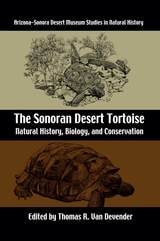
The Sonoran Desert Tortoise
Natural History, Biology, and ConservationThomas R. Van Devender
University of Arizona Press, 2002
This book presents the first comprehensive summary of the natural history, biology, and conservation of the Sonoran and Sinaloan desert tortoises, reviewing the current state of knowledge of these creatures with appropriate comparisons to Mohave tortoises. It condenses a vast amount of information on population ecology, activity, and behavior based on decades of studying tortoise populations in Arizona and Sonora, Mexico, and also includes important material on the care and protection of tortoises. Thirty-two contributors address such topics as tortoise fossil records, DNA analysis, and the mystery of secretive hatchlings and juveniles. Tortoise health is discussed in chapters on the care of captives, and original data are presented on the diets of wild and captive tortoises, the nutrient content of plant foods, and blood parameters of healthy tortoises. Coverage of conservation issues includes husbandry methods for captive tortoises, an overview of protective measures, and an evaluation of threats to tortoises from introduced grass and wildfires. A final chapter on cultural knowledge presents stories and songs from indigenous peoples and explores their understanding of tortoises.
As the only comprehensive book on the desert tortoise, this volume gathers a vast amount of information for scientists, veterinarians, and resource managers while also remaining useful to general readers who keep desert tortoises as backyard pets. It will stand as an enduring reference on this endearing creature for years to come.
The Strategy of Life
Teleology and Mechanics in Nineteenth-Century German BiologyTimothy Lenoir
University of Chicago Press, 1989
Strongly influenced by Immanuel Kant, the biologists' approach combined a sophisticated teleology with mechanistic theories and sparked bitter controversies with the rival programs, mechanistic reductionism and Darwinism. Although temporarily eclipsed by these two approaches, the morphological tradition, Lenoir argues, was not vanquished in the field of scientific debate. It contributed to pathbreaking research in areas such as comparative anatomy, embryology, paleontology, and biogeography.
The Theory of Evolution
Principles, Concepts, and AssumptionsEdited by Samuel M. Scheiner and David P. Mindell
University of Chicago Press, 2019
This book gives us that framework and synthesis for the twenty-first century. The Theory of Evolution presents a series of chapters by experts seeking this integration by addressing the current state of affairs across numerous fields within evolutionary biology, ranging from biogeography to multilevel selection, speciation, and macroevolutionary theory. By presenting current syntheses of evolution’s theoretical foundations and their growth in light of new datasets and analyses, this collection will enhance future research and understanding.
The Use and Abuse of Biology
An Anthropological Critique of SociobiologyMarshall D. Sahlins
University of Michigan Press, 1976
The Use and Abuse of Biology: An Anthropological Critique of Sociobiology is Marshall Sahlins's fierce intellectual takedown of genetic determinism and the then-emerging field of sociobiology popularized by E.O. Wilson. Writing from his then-position at the University of Chicago, Sahlins argues that human behavior cannot be reduced to evolutionary biology, selfish genes, or a simple drive to maximize reproductive success. Instead, he demonstrates how human social structures—particularly kinship systems, which form the bedrock of many traditional societies—are defined by arbitrary cultural rules and symbolic meanings rather than biological or genetic proximity. By showing that culture dictates human action far more than animal instincts do, Sahlins's critique remains a foundational text in anthropological theory, warning against the dangers of importing Western capitalist concepts of competition and individualism into the study of human evolution. Sahlins argues that human behavior cannot be reduced to mere biological imperatives because culture interposes itself as a unique, symbolic meaning system between human genetics and social practice. He takes aim at "vulgar sociobiology," demonstrating through vast cross-cultural examples that fundamental social structures—especially human kinship systems—are constructed on variable cultural rules rather than calculated genetic or evolutionary self-interest. Furthermore, Sahlins provides an ideological critique, revealing that sociobiological models often reflect Western capitalist frameworks mistakenly projected onto nature. Ultimately, this foundational text remains an indispensable defense of the autonomy of cultural anthropology, asserting that while biology sets physical limits, it is the symbolic faculty of culture that dictates human society.
The Year of the Gorilla
George B. Schaller
University of Chicago Press, 1988
The Year of the Gorilla
George B. Schaller
University of Chicago Press, 2010
This seminal work chronicles George B. Schaller’s two years of travel and observation of gorillas in East and Central Africa in the late 1950s, high in the Virunga volcanoes on the Zaire-Rwanda-Uganda border. There, he learned that these majestic animals, far from being the aggressive apes of film and fiction, form close-knit societies of caring mothers and protective fathers watching over playful young. Alongside his observations of gorilla society, Schaller celebrates the enforced yet splendid solitude of the naturalist, recounts the adventures he experienced along the way, and offers a warning against poaching and other human threats against these endangered creatures. This edition features a postscript detailing Schaller’s more recent visits with gorillas, current to 2009.
“Whether the author is tracking gorillas, slipping past elephant herds on narrow jungle paths, avoiding poachers’ deadfalls, or routing Watusi invaders, this is an exciting book. Although Schaller feels that this is ‘not an adventure book,’ few readers will be able to agree.”—Irven DeVore, Science
This Land Is Your Land
The Story of Field Biology in AmericaMichael J. Lannoo
University of Chicago Press, 2018
Lannoo illuminates characters such as John Wesley Powell, William Temple Hornaday, and Olaus and Adolph Murie—homegrown midwestern field biologists who either headed east to populate major research centers or went west to conduct their fieldwork along the frontier. From the pioneering work of Victor Shelford, Henry Chandler Cowles, and Aldo Leopold to contemporary insights from biologists such as Jim Furnish and historians such as William Cronon, Lannoo’s unearthing of American—and particularly midwestern—field biologists reveals how these scientists influenced American ecology, conservation biology, and restoration ecology, and in turn drove global conservation efforts through environmental legislation and land set-asides. This Land Is Your Land reveals the little-known legacy of midwestern field biologists, whose ethos and discoveries have enabled us to preserve and understand not just their land, but all lands.
Timber Rattlesnakes in Vermont & New York
Biology, History, and the Fate of an Endangered SpeciesJon Furman
University Press of New England, 2007
Tracing Expression in Merleau-Ponty
Aesthetics, Philosophy of Biology, and OntologyVéronique M. Fóti
Northwestern University Press, 2012
The French philosopher Renaud Barbaras remarked that late in Maurice Merleau-Ponty’s career, “The phenomenology of perception fulfills itself as a philosophy of expression.” In Tracing Expression in Merleau-Ponty: Aesthetics, Philosophy of Biology, and Ontology, Véronique M. Fótiaddresses the guiding yet neglected theme of expression in Merleau-Ponty’s thought. She traces Merleau-Ponty’s ideas about how individuals express creative or artistic impulses through his three essays on aesthetics, his engagement with animality and the “new biology” in the second of his lecture courses on nature of 1957–58, and in his late ontology, articulated in 1964 in the fragmentary text of Le visible et l’invisible (The Visible and the Invisible). With the exception of a discussion of Merleau-Ponty’s 1945 essay “Cezanne’s Doubt,” Fóti engages with Merleau-Ponty’s late and final thought, with close attention to both his scientific and philosophical interlocutors, especially the continental rationalists. Expression shows itself, in Merleau-Ponty’s thought, to be primordial, and this innate and fundamental nature of expression has implications for his understanding of artistic creation, science, and philosophy.
Trees, Truffles, and Beasts
How Forests FunctionMaser, Chris
Rutgers University Press, 2008
Because today's decisions are tomorrow's consequences, every small effort makes a difference, but a broader understanding of our environmental problems is necessary to the development of sustainable ecosystem policies. In Trees, Truffles, and Beasts, Chris Maser, Andrew W. Claridge, and James M. Trappe make a compelling case that we must first understand the complexity and interdependency of species and habitats from the microscopic level to the gigantic. Comparing forests in the Pacific Northwestern United States and Southeastern mainland of Australia, the authors show how easily observable speciesùtrees and mammalsùare part of a complicated infrastructure that includes fungi, lichens, and organisms invisible to the naked eye, such as microbes.
Eminently readable, this important book shows that forests are far more complicated than most of us might think, which means simplistic policies will not save them. Understanding the biophysical intricacies of our life-support systems just might.
Tropical Visions in an Age of Empire
Edited by Felix Driver and Luciana Martins
University of Chicago Press, 2005
Bringing together a group of distinguished contributors from disciplines across the arts and humanities, this volume contains eleven beautifully illustrated essays—arranged in three sections devoted to voyages, mappings, and sites—that consider the ways that tropical places were encountered, experienced, and represented in visual form. Covering a wide range of tropical sites in the Pacific, South Asia, West Africa, the Caribbean, and Latin America, the book will appeal to a broad readership: scholars of postcolonial studies, art history, literature, imperial history, history of science, geography, and anthropology.
Trying Biology
The Scopes Trial, Textbooks, and the Antievolution Movement in American SchoolsAdam R. Shapiro
University of Chicago Press, 2013