Results by title
330 books match the query 'Brazil' and 76 start with t
The Rio de Janeiro Reader
History, Culture, PoliticsDaryle Williams, Amy Chazkel, and Paulo Knauss, editors
Duke University Press, 2016
The Sanitation of Brazil
Nation, State, and Public Health, 1889-1930Gilberto Hochman
University of Illinois Press, 2016
The Scramble for the Amazon and the "Lost Paradise" of Euclides da Cunha
Susanna B. Hecht
University of Chicago Press, 2013
The Sea and the Jungle
H.M. Tomlinson
Northwestern University Press, 1996
The Security Archipelago
Human-Security States, Sexuality Politics, and the End of NeoliberalismPaul Amar
Duke University Press, 2013
The Seduction of Brazil
The Americanization of Brazil during World War IIBy Antonio Pedro Tota
University of Texas Press, 2009
Following completion of the U.S. air base in Natal, Brazil, in 1942, U.S. airmen departing for North Africa during World War II communicated with Brazilian mechanics with a thumbs-up before starting their engines. This sign soon replaced the Brazilian tradition of touching the earlobe to indicate agreement, friendship, and all that was positive and good—yet another indication of the Americanization of Brazil under way during this period.
In this translation of O Imperialismo Sedutor, Antonio Pedro Tota considers both the Good Neighbor Policy and broader cultural influences to argue against simplistic theories of U.S. cultural imperialism and exploitation. He shows that Brazilians actively interpreted, negotiated, and reconfigured U.S. culture in a process of cultural recombination. The market, he argues, was far more important in determining the nature of this cultural exchange than state-directed propaganda efforts because Brazil already was primed to adopt and disseminate American culture within the framework of its own rapidly expanding market for mass culture. By examining the motives and strategies behind rising U.S. influence and its relationship to a simultaneous process of cultural and political centralization in Brazil, Tota shows that these processes were not contradictory, but rather mutually reinforcing.
The Seduction of Brazil brings greater sophistication to both Brazilian and American understanding of the forces at play during this period, and should appeal to historians as well as students of Latin America, culture, and communications.
The Sorcery of Color
Identity, Race, and Gender in BrazilElisa Larkin Nascimento
Temple University Press, 2009
Originally published in 2003 in Portuguese, The Sorcery of Color argues that there are longstanding and deeply-rooted relationships between racial and gender inequalities in Brazil. In this pioneering book, Elisa Larkin Nascimento examines the social and cultural movements that have attempted, since the early twentieth century, to challenge and eradicate these conjoined inequalities.
The book's title describes the social sleight-of-hand that disguises the realities of Brazilian racial inequity. According to Nascimento, anyone who speaks of racism—or merely refers to another person as black—traditionally is seen as racist. The only acceptably non-racist attitude is silence. At the same time, Afro-Brazilian culture and history have been so overshadowed by the idea of a general "Brazilian identity" that to call attention to them is also to risk being labeled racist.
Incorporating leading international scholarship on Pan Africanism and Afrocentric philosophy with the writing of Brazilian scholars, Nascimento presents a compelling feminist argument against the prevailing policy that denies the importance of race in favor of a purposefully vague concept of ethnicity confused with color.
The São Paulo Neo-Avant-Garde
Radical Art and Mass Print Media in Cold War BrazilMari Rodríguez Binnie
University of Texas Press, 2024
How artists challenged a military dictatorship through mass print technologies in 1970s and 1980s São Paulo.
Throughout the 1970s and into the 1980s, during Brazil's military dictatorship, artists shifted their practices to critique the government and its sanitized images of Brazil, its use of torture, and its targeted persecutions. Mari Rodríguez Binnie's The São Paulo Neo-Avant-Garde examines these artworks and their engagement with politics and mainstream art institutions and practices.
As Binnie skillfully shows, artists appropriated processes like photocopy, offset lithography, and thermal and heliographic printing, making newly available technologies of mass production foundational to their work of resistance against both the dictatorship and the established art world. Often working collaboratively, these artists established alternative networks of exchange locally and internationally to circulate their work. As democracy was reestablished in Brazil, and in the decades that followed, their works largely fell out of sight. Here, in the first English-language book to focus entirely on conceptual practices in São Paulo in the 1970s and 1980s, Binnie unearths a scene critical to the development of contemporary Brazilian Art.
The Three Marias
By Rachel de Queiroz
University of Texas Press, 1963
Through this translation of As Três Marias the literary achievements of Rachel de Queiroz may at last be judged and appreciated by the English-reading public. Since none of her four novels has previously been translated into English, The Three Marias will be, for many non-Brazilians, an introduction to this nationally known South American author whose books have been widely praised for their artistic merits. Her literary works are colored by her projected personality, by an intense feeling for her own people, by an omnipresent social consciousness, and by personal experiences in the arid backlands of her native state of Ceará.
Basing this story on certain of her own recollections from the nineteen-twenties, Rachel de Queiroz tells of a girl growing up in the seaport town of Fortaleza, in northeastern Brazil. Fred P. Ellison, whose special field is Brazilian and Spanish-American literature, has captured in his translation the author's graceful style and simplicity of language, and has successfully retained the perspective of an idealistic and gradually maturing girl.
The Tribute of Blood
Army, Honor, Race, and Nation in Brazil, 1864–1945Peter M. Beattie
Duke University Press, 2001
Beattie looks through sociological, anthropological, and historical lenses to analyze archival sources such as court-martial cases, parliamentary debates, published reports, and the memoirs and correspondence of soldiers and officers. Combining these materials with a colorful array of less traditional sources—such as song lyrics, slang, grammatical evidence, and tattoo analysis—he reveals how the need to reform military recruitment with a conscription lottery became increasingly apparent in the wake of the Paraguayan War of 1865–1870 and again during World War I. Because this crucial reform required more than changing the army’s institutional roles and the conditions of service, The Tribute of Blood is ultimately the story of how entrenched conceptions of manhood, honor, race, citizenship, and nation were transformed throughout Brazil.
Those interested in social, military, and South American history, state building and national identity, and the sociology of the poor will be enriched by this pathbreaking study.
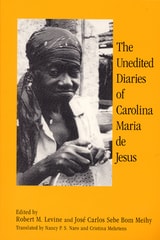
The Unedited Diaries of Carolina Maria De Jesus
Levine, Robert M
Rutgers University Press, 1998
Carolina Maria de Jesus' book, Quarto de Despejo (The Trash Room), depicted the harsh life of the slums, but it also spoke of the author's pride in her blackness, her high moral standards, and her patriotism. More than a million copies of her diary are believed to have been sold worldwide. Yet many Brazilians refused to believe that someone like de Jesus could have written such a diary, with its complicated words (some of them misused) and often lyrical phrasing as she discussed world events. Doubters prefer to believe the book was either written by Audáulio Dantas, the enterprising newspaper reporter who discovered her, or that Dantas rewrote it so substantially that her book is a fraud. With the cooperation of de Jesus' daughter, recent research shows that although Dantas deleted considerable portions of the diary (as well as a second one), every word was de Jesus'.
But Dantas did "create" a different Carolina from the woman who coped with her harsh life by putting things down on paper. This book sets the record straight by providing detailed translations of de Jesus' unedited diaries and explains why Brazilian elites were motivated to obscure her true personality and present her as something she was not. It is not only about the writer but about Brazil as recorded by her sarcastic pen. The diary entries in this book span from 1958 to 1966, five years beyond text previously known to exist. They show de Jesus as she was, preserving her Joycean stream-of-consciousness language and her pithy characterizations.

The Unfinished Art of Theater
Avant-Garde Intellectuals in Mexico and BrazilSarah J. Townsend
Northwestern University Press, 2018
A certain idea of the avant-garde posits the possibility of a total rupture with the past. The Unfinished Art of Theater pulls back on this futuristic impulse by showing how theater became a key site for artists on the semiperiphery of capitalism to reconfigure the role of the aesthetic between 1917 and 1934. The book argues that this “unfinished art”—precisely because of its historic weakness as a representative institution in Mexico and Brazil, where the bourgeois stage had not (yet) coalesced—was at the forefront of struggles to redefine the relationship between art and social change.
Drawing on extensive archival research, Sarah J. Townsend reveals the importance of projects and texts that belie the rhetoric of rupture and immediacy associated with the avant-garde: ethnographic operas with ties to the recording industry, populist puppet plays, children’s radio programs about the wonders of technology, a philosophical drama about the birth of a new race, and an antifascist spectacle written for (but never performed at) a theater shut down by the police. Ultimately, the book makes the case that the very category of avant-garde art is bound up in the experience of dependency, delay, and the uneven development of capitalism.
The Unpast
Elite Violence and Social Control in Brazil, 1954–2000R. S. Rose
Ohio University Press, 2005
Portuguese and Brazilian slave-traders shipped at least four million slaves to Brazil—in contrast to the five hundred thousand slaves that English vessels brought to the Americas. Controlling the vast number of slaves in Brazil became of primary importance. The Unpast: Elite Violence and Social Control in Brazil, 1954–2000 documents the ways in which the brutal methods used on plantations led directly to the phenomenon of Brazilian death squads.
The Unpast examines how and why, after the abolition of slavery, elites in Brazil imported new methods of killing, torturing, or disfiguring dissidents and the poor to maintain dominance. Bringing a critical-historical analysis to events following the 1954 suicide of President Getúlio Vargas, R. S. Rose takes the reader along a fifty-year path that helped to shape a nation’s morals. He covers the misunderstood presidency of João Goulart; the overthrow of his government by a U.S.-assisted military; the appalling dictatorship that followed; the efforts to rid the countryside of troublemakers; and the ongoing attempt to cleanse the urban environment of the needy, an endeavor that produced 32,675 victims in just two Brazilian states between 1954 and 2000.
The largest and most comprehensive documentation of suspected death-squad victims ever undertaken, The Unpast is an exposé of practices and attitudes toward the poor in Latin America’s largest country.
The Washington Dissensus
A Privileged Observer's Perspective on US-Brazil RelationsRubens Barbosa
Vanderbilt University Press, 2014
In this memoir, translated from the Portuguese, Barbosa recounts the most significant regional and global issues that arose, alongside the domestic political conflicts within a divided North American society. Barbosa provides sophisticated analysis of economic relations during these changing times, and also explores the many US misconceptions about Brazil and the Latin American region.
From the privileged post of observation that an ambassadorship in the American capital represents, Barbosa had the exceptional opportunity over a considerable length of time to closely follow relations between Brazil and the United States. He witnessed relations evolve under two governments as they developed distinct foreign policies, which at times led to a breakdown in understanding between the two countries.
This Land Is Ours Now
Social Mobilization and the Meanings of Land in BrazilWendy Wolford
Duke University Press, 2010
Drawing on extensive ethnographic research, Wolford compares the development of the movement in Brazil’s southern state of Santa Catarina and its northeastern state of Pernambuco. As she explains, in the south, most of the movement’s members were sons and daughters of small peasant farmers; in the northeast, they were almost all former plantation workers, who related awkwardly to the movement’s agenda of accessing “land for those who work it.” The MST became an effective presence in Pernambuco only after the local sugarcane economy had collapsed. Worldwide sugarcane prices dropped throughout the 1990s, and by 1999 the MST was a prominent political organizer in the northeastern plantation region. Yet fewer than four years later, most of the region’s workers had dropped out of the movement. By delving into the northeastern workers’ motivations for joining and then leaving the MST, Wolford adds nuance and depth to accounts of a celebrated grassroots social movement, and she highlights the contingent nature of social movements and political identities more broadly.
Through Amazonian Eyes
The Human Ecology of Amazonian PopulationsEmilio F. Moran
University of Iowa Press, 1993
In this well-written, comprehensive, reasonable yet passionate volume, Emilio Moran introduces us to the range of human and ecological diversity in the Amazon Basin. By describing the complex heterogeneity on the Amazon's ecological mosaic and its indigenous populations' conscious adaptations to this diversity, he leads us to realize that there are strategies of resource use which do not destroy the structure and function of ecosystems. Finally, and most important, he examines ways in which we might benefit from the study of human ecology to design and implement a balance between conservation and use.
Titles, Conflict, and Land Use
The Development of Property Rights and Land Reform on the Brazilian Amazon FrontierLee J. Alston, Gary D. Libecap, and Bernardo Mueller
University of Michigan Press, 1999
To Be A Slave in Brazil
1550-1888Mattoso, Katia M de Queiros
Rutgers University Press, 1986

Torture in Brazil
A Shocking Report on the Pervasive Use of Torture by Brazilian Military Governments, 1964-1979, Secretly Prepared by the Archiodese of São PauloArchdiocese of São Paulo, Brazil
University of Texas Press, 1998
Winner, A Choice Outstanding Academic Book
From 1964 until 1985, Brazil was ruled by a military regime that sanctioned the systematic use of torture in dealing with its political opponents. The catalog of what went on during that grim period was originally published in Portuguese as Brasil: Nunca Mais (Brazil: Never Again) in 1985.
The volume was based on the official documentation kept by the very military that perpetrated the horrific acts. These extensive documents include military court proceedings of actual trials, secretly photocopied by lawyers associated with the Catholic Church and analyzed by a team of researchers. Their daring project—known as BNM for Brasil: Nunca Mais—compiled more than 2,700 pages of testimony by political prisoners documenting close to three hundred forms of torture.
The BNM project proves conclusively that torture was an essential part of the military justice system and that judicial authorities were clearly aware of the use of torture to extract confessions. Still, it took more than a decade after the publication of Brasil: Nunca Mais for the armed forces to admit publicly that such torture had ever taken place. Torture in Brazil, the English version of the book re-edited here, serves as a timely reminder of the role of Brazil's military in past repression.
Tourist Attractions
Performing Race and Masculinity in Brazil's Sexual EconomyGregory Mitchell
University of Chicago Press, 2015
Mitchell takes us into the bath houses of Rio de Janeiro, where rent boys cruise for clients, and to the beaches of Salvador da Bahia, where African American gay men seek out hustlers while exploring cultural heritage tourist sites. His ethnography stretches into the Amazon, where indigenous fantasies are tinged with the erotic at eco-resorts, and into the homes of “kept men,” who forge long-term, long-distance, transnational relationships that blur the boundaries of what counts as commercial sex. Mitchell asks how tourists perceive sex workers’ performances of Brazilianness, race, and masculinity, and, in turn, how these two groups of men make sense of differing models of racial and sexual identity across cultural boundaries. He proposes that in order to better understand how people experience difference sexually, we reframe prostitution—which Marxist feminists have long conceptualized as sexual labor—as also being a form of performative labor. Tourist Attractions is an exceptional ethnography poised to make an indelible impact in the fields of anthropology, gender, and sexuality, and research on prostitution and tourism.
Traces of the Unseen
Photography, Violence, and Modernization in Early Twentieth-Century Latin AmericaCarolina Sá Carvalho
Northwestern University Press, 2023
Winner of the 2024 Roberto Reis Book Award
Winner of the LASA Environment Section Best Book of 2023
Winner of the LASA Amazonian Studies Section Best Book of 2024
Co-Winner of the LASA Book Award for the Visual Culture Studies 2024
A richly illustrated examination of photography as a technology for documenting, creating, and understanding the processes of modernization in turn-of-the-century Brazil and the Amazon
Photography at the turn of the twentieth century was not only a product of modernity but also an increasingly available medium to chronicle the processes of modernization. Traces of the Unseen: Photography, Violence, and Modernization in Early Twentieth-Century Latin America situates photography’s role in documenting the destruction wrought by infrastructure development and extractive capitalist expansion in the Amazon and outside the Brazilian metropole. Combining formal analysis of individual photographs with their inclusion in larger multimedia assemblages, Carolina Sá Carvalho explores how this visual evidence of violence was framed, captioned, cropped, and circulated. As she explains, this photographic creation and circulation generated a pedagogy of the gaze with which increasingly connected urban audiences were taught what and how to see: viewers learned to interpret the traces of violence captured in these images within the larger context of modernization.
Traces of the Unseen draws on works by Flavio de Barros, Euclides da Cunha, Roger Casement, Claude Lévi-Strauss, and Mario de Andrade to situate an unruly photographic body at the center of modernity, in all its disputed meanings. Moreover, Sá Carvalho locates historically specific practices of seeing within the geopolitical peripheries of capitalism. What emerges is a consideration of photography as a technology through which modern aspirations, moral inclinations, imagined futures, and lost pasts were represented, critiqued, and mourned.
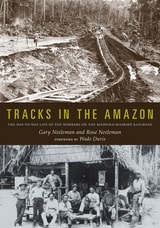
Tracks in the Amazon
The Day-to-Day Life of the Workers on the Madeira-Mamoré RailroadGary Neeleman
University of Utah Press, 2014
Although there have been many brief chronicles and writings about the Madeira-Mamoré Railroad over the years, most barely scratch the surface of this incredible story. Of particular import in Tracks in the Amazon are the photographs—which until now have rarely been seen—taken by Dana Merrill, a New York photographer hired to document the construction of the railroad. It also includes reproductions of the Porto Velho Marconigram, an English-language newspaper written for and by the American expatriates who lived in the construction headquarters at Porto Velho. Because this unique railroad traversed the densest tropical jungle on earth, more than 10,000 workers lost their lives laying the first five miles of track. The images and descriptions of the life of the workers on the railroad illustrate the challenges of working in the jungles—the unforgiving climate, malaria and yellow feverbearing mosquitoes, and the threat of wild animals—which made conditions for the workers next to impossible.
Finalist for the International Latino Book Awards: Best Book in Nonfiction in Portuguese.
Transnational Desires
Brazilian Erotic Dancers in New YorkSuzana Maia
Vanderbilt University Press, 2012
Their motivation to migrate and to work as erotic dancers can also be understood in the context of a representational system, inaugurated in colonial times, that emphasizes the exoticism of Brazilian womentheir bodies, their skin tone, their sexuality. These stereotypes are the props that Brazilian women use to construct their performances in Manhattan and Queens gentlemen's bars and the language through which they negotiate their relationships to society at large.
Transnational Desires focuses on the lives of nine Brazilian dancers with whom the author, herself a middleclass Brazilian, developed close relationships over the years. Maia examines their social relations both in the bar scene and with family, friends, and lovers outside. She shows that for these women erotic dancing is part of a life trajectory that involves negotiating their social position and life prospects in a fundamentally transnational social universe.
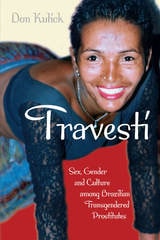
Travesti
Sex, Gender, and Culture among Brazilian Transgendered ProstitutesDon Kulick
University of Chicago Press, 1998
Kulick analyzes the various ways travestis modify their bodies, explores the motivations that lead them to choose this particular gendered identity, and examines the complex relationships that they maintain with one another, their boyfriends, and their families. Kulick also looks at how travestis earn their living through prostitution and discusses the reasons prostitution, for most travestis, is a positive and affirmative experience.
Arguing that transgenderism never occurs in a "natural" or arbitrary form, Kulick shows how it is created in specific social contexts and assumes specific social forms. Furthermore, Kulick suggests that travestis—far from deviating from normative gendered expectations—may in fact distill and perfect the messages that give meaning to gender throughout Brazilian society and possibly throughout much of Latin America.
Through Kulick's engaging voice and sharp analysis, this elegantly rendered account is not only a landmark study in its discipline but also a fascinating read for anyone interested in sexuality and gender.

Tropical Multiculturalism
A Comparative History of Race in Brazilian Cinema and CultureRobert Stam
Duke University Press, 1997
Stam examines the broad historical and cultural links that connect Brazil and the United States before considering multicultural imagery in Brazilian film as it has changed from the silent era to the present. His analysis moves through the comic chanchadas of the 1930s and 1940s, to the Hollywood-style films from Sao Paulo in the 1950s, and the diverse phases of Cinema Novo beginning in the 1960s. He explores a wealth of subjects, including the submerged "blackness" of Carmen Miranda, the anti-racist agenda of Orson Welles’s never-released Brazilian film It’s All True, the international background behind Black Orpheus, the career of Grande Otelo (Brazil’s greatest black film star), the allegorical "cannibalistic" films like How Tasty Was My Frenchman, and "indigenous media"—the attempt by Brazilian "indians" to use camcorders and VCRs for their own cultural and political purposes. Tropical Multiculturalism is simultaneously a history of Brazilian cinema from the standpoint of race, a history of Brazil itself through its cinematic representations, a comparative study of racial formations in Brazil and the United States, and a theorized analysis of racialized representations.
Tropical Travels
Brazilian Popular Performance, Transnational Encounters, and the Construction of RaceBy Lisa Shaw
University of Texas Press, 2018
Brazilian popular culture, including music, dance, theater, and film, played a key role in transnational performance circuits—inter-American and transatlantic—from the latter nineteenth century to the middle of the twentieth century. Brazilian performers both drew inspiration from and provided models for cultural production in France, Portugal, Argentina, the United States, and elsewhere. These transnational exchanges also helped construct new ideas about, and representations of, “racial” identity in Brazil. Tropical Travels fruitfully examines how perceptions of “race” were negotiated within popular performance in Rio de Janeiro and how these issues engaged with wider transnational trends during the period.
Lisa Shaw analyzes how local cultural forms were shaped by contact with imported performance traditions and transnational vogues in Brazil, as well as by the movement of Brazilian performers overseas. She focuses specifically on samba and the maxixe in Paris between 1910 and 1922, teatro de revista (the Brazilian equivalent of vaudeville) in Rio in the long 1920s, and a popular Brazilian female archetype, the baiana, who moved to and fro across national borders and oceans. Shaw demonstrates that these transnational encounters generated redefinitions of Brazilian identity through the performance of “race” and ethnicity in popular culture. Shifting the traditional focus of Atlantic studies from the northern to the southern hemisphere, Tropical Travels also contributes to a fuller understanding of inter-hemispheric cultural influences within the Americas.