Results by title
324 books match the query 'Comparative literature' and 71 start with t

Theatricality Beyond Disciplines
Amin Erfani
Intellect Books, 2025
In Theatricality Beyond Disciplines, Amin Erfani expands the concept of theatricality beyond the stage, tracing its destabilizing power through literature, psychoanalysis, media, and philosophy. Drawing on Artaud’s vision of theater as an unpredictable, contagious force—what he called “the return of the repressed”—the book rejects the Aristotelian idea of theater as a space of healing. Instead, it frames it as an unsettling intervention into systems of power and meaning.
Through close readings of Artaud, Genet, Novarina, Koltès, and theorists like Freud, Barthes, and Derrida, Erfani reveals how theatricality operates primarily in the aural rather than the visual mode, inciting paranoia, psychic contamination, and ruptures in language. A provocative challenge to disciplinary boundaries, this book suits any student or scholar interested in examining the relationship between theater and theoretical discourse, posing theatricality as a site of radical otherness and transformation.
Theory and Practice in Eighteenth-Century Dance
The German-French ConnectionTilden Russell
University of Delaware Press, 2017
This book is about the intersection of two evolving dance-historical realms—theory and practice—during the first two decades of the eighteenth century. France was the source of works on notation, choreography, and repertoire that dominated European dance practice until the 1780s. While these French inventions were welcomed and used in Germany, German dance writers responded by producing an important body of work on dance theory. This book examines consequences in Germany of this asymmetrical confrontation of dance perspectives.
Between 1703 and 1717 in Germany, a coherent theory of dance was postulated that called itself dance theory, comprehended why it was a theory, and clearly, rationally distinguished itself from practice. This flowering of dance-theoretical writing was contemporaneous with the appearance of Beauchamps-Feuillet notation in the Chorégraphie of Raoul Auger Feuillet (Paris, 1700, 1701). Beauchamps-Feuillet notation was the ideal written representation of the dance style known as la belle danse and practiced in both the ballroom and the theater. Its publication enabled the spread of belle danse to the French provinces and internationally. This spread encouraged the publication of new practical works (manuals, choreographies, recueils) on how to make steps and how to dance current dances, as well as of new dance treatises, in different languages.
The Rechtschaffener Tantzmeister, by Gottfried Taubert (Leipzig, 1717), includes a translated edition of Feuillet’s Chorégraphie. Theory and Practice in Eighteenth-Century Dance addresses how Taubert and his contemporary German authors of dance treatises (Samuel Rudolph Behr, Johann Pasch, Louis Bonin) became familiar with Beauchamps-Feuillet notation and acknowledged the Chorégraphie in their own work, and how Taubert’s translation of the Chorégraphie spread its influence northward and eastward in Europe. This book also examines the personal and literary interrelationships between the German writers on dance between 1703 and 1717 and their invention of a theoria of dance as a counterbalance to dance praxis, comparing their dance-theoretical ideas with those of John Weaver in England, and assimilating them all in a cohesive and inclusive description of dance theory in Europe by 1721.
Published by University of Delaware Press. Distributed worldwide by Rutgers University Press.
Theory’s Autoimmunity
Skepticism, Literature, and PhilosophyZahi Zalloua
Northwestern University Press, 2018
Openness to change comes with risks, and the self-protective temptation to immunize oneself or one's community against these risks is strong. Yet without such risks, without openness to otherness, no encounter with the new, with difference, can ever take place. Without autoimmunity, theory becomes stagnant and programmatic, unable to receive and respond to the other or the event, to address, revise, and produce new meanings.
Taking up the challenge of thinking theory as skepticism, with and against philosophy, this study turns to literature as an interlocutor, investigating the ways theory, like the literary works of Montaigne, Baudelaire, Stendhal, Morrison, or Duras, declines to put on the interpretive brakes, to stop reading at a point of understanding. Undoing and remaking itself, theory—those critical interpretive practices that revel in the creation and proliferation of meaning—becomes autoimmune.
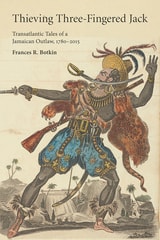
Thieving Three-Fingered Jack
Transatlantic Tales of a Jamaican Outlaw, 1780-2015Botkin, Frances R.
Rutgers University Press, 2018
The fugitive slave known as “Three-Fingered Jack” terrorized colonial Jamaica from 1780 until vanquished by Maroons, self-emancipated Afro-Jamaicans bound by treaty to police the island for runaways and rebels. A thief and a killer, Jack was also a freedom fighter who sabotaged the colonial machine until his grisly death at its behest. Narratives about his exploits shed light on the problems of black rebellion and solutions administered by the colonial state, creating an occasion to consider counter-narratives about its methods of divide and conquer. For more than two centuries, writers, performers, and storytellers in England, Jamaica, and the United States have “thieved" Three Fingered Jack's riveting tale, defining black agency through and against representations of his resistance.
Frances R. Botkin offers a literary and cultural history that explores the persistence of stories about this black rebel, his contributions to constructions of black masculinity in the Atlantic world, and his legacies in Jamaican and United States popular culture.
Times of Mobility
Transnational Literature and Gender in TranslationJasmina Lukic
Central European University Press, 2020
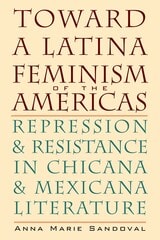
Toward a Latina Feminism of the Americas
Repression and Resistance in Chicana and Mexicana LiteratureBy Anna Marie Sandoval
University of Texas Press, 2008
Weaving strands of Chicana and Mexicana subjectivities, Toward a Latina Feminism of the Americas explores political and theoretical agendas, particularly those that undermine the patriarchy, across a diverse range of Latina authors. Within this range, calls for a coalition are clear, but questions surrounding the process of these revolutionary dialogues provide important lines of inquiry. Examining the works of authors such as Sandra Cisneros, Laura Esquivel, Carmen Boullosa, and Helena María Viramontes, Anna Sandoval considers resistance to traditional cultural symbols and contemporary efforts to counteract negative representations of womanhood in literature and society.
Offering a new perspective on the oppositional nature of Latina writers, Sandoval emphasizes the ways in which national literatures have privileged male authors, whose viewpoint is generally distinct from that of women—a point of departure rarely acknowledged in postcolonial theory. Applying her observations to the disciplinary, historical, and spatial facets of literary production, Sandoval interrogates the boundaries of the Latina experience. Building on the dialogues begun with such works as Sonia Saldivar-Hull's Feminism on the Border and Ellen McCracken's New Latina Narrative, this is a concise yet ambitious comparative approach to the historical and cultural connections (as well as disparities) found in Chicana and Mexicana literature.
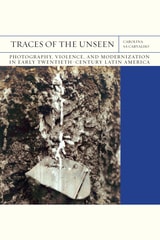
Traces of the Unseen
Photography, Violence, and Modernization in Early Twentieth-Century Latin AmericaCarolina Sá Carvalho
Northwestern University Press, 2023
Winner of the 2024 Roberto Reis Book Award
Winner of the LASA Environment Section Best Book of 2023
Winner of the LASA Amazonian Studies Section Best Book of 2024
Co-Winner of the LASA Book Award for the Visual Culture Studies 2024
A richly illustrated examination of photography as a technology for documenting, creating, and understanding the processes of modernization in turn-of-the-century Brazil and the Amazon
Photography at the turn of the twentieth century was not only a product of modernity but also an increasingly available medium to chronicle the processes of modernization. Traces of the Unseen: Photography, Violence, and Modernization in Early Twentieth-Century Latin America situates photography’s role in documenting the destruction wrought by infrastructure development and extractive capitalist expansion in the Amazon and outside the Brazilian metropole. Combining formal analysis of individual photographs with their inclusion in larger multimedia assemblages, Carolina Sá Carvalho explores how this visual evidence of violence was framed, captioned, cropped, and circulated. As she explains, this photographic creation and circulation generated a pedagogy of the gaze with which increasingly connected urban audiences were taught what and how to see: viewers learned to interpret the traces of violence captured in these images within the larger context of modernization.
Traces of the Unseen draws on works by Flavio de Barros, Euclides da Cunha, Roger Casement, Claude Lévi-Strauss, and Mario de Andrade to situate an unruly photographic body at the center of modernity, in all its disputed meanings. Moreover, Sá Carvalho locates historically specific practices of seeing within the geopolitical peripheries of capitalism. What emerges is a consideration of photography as a technology through which modern aspirations, moral inclinations, imagined futures, and lost pasts were represented, critiqued, and mourned.
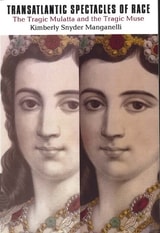
Transatlantic Spectacles of Race
The Tragic Mulatta and the Tragic MuseManganelli, Kimberly Snyder
Rutgers University Press, 2012
The tragic mulatta was a stock figure in nineteenth-century American literature, an attractive mixed-race woman who became a casualty of the color line. The tragic muse was an equally familiar figure in Victorian British culture, an exotic and alluring Jewish actress whose profession placed her alongside the “fallen woman.”
In Transatlantic Spectacles of Race, Kimberly Manganelli argues that the tragic mulatta and tragic muse, who have heretofore been read separately, must be understood as two sides of the same phenomenon. In both cases, the eroticized and racialized female body is put on public display, as a highly enticing commodity in the nineteenth-century marketplace. Tracing these figures through American, British, and French literature and culture, Manganelli constructs a host of surprising literary genealogies, from Zelica to Daniel Deronda, from Uncle Tom’s Cabin to Lady Audley’s Secret. Bringing together an impressive array of cultural texts that includes novels, melodramas, travel narratives, diaries, and illustrations, Transatlantic Spectacles of Race reveals the value of transcending literary, national, and racial boundaries.

Transforming Contagion
Risky Contacts among Bodies, Disciplines, and NationsFahs, Breanne
Rutgers University Press, 2018
Moving from viruses, vaccines, and copycat murder to gay panics, xenophobia, and psychopaths, Transforming Contagion energetically fuses critical humanities and social science perspectives into a boundary-smashing interdisciplinary collection on contagion. The contributors provocatively suggest contagion to be as full of possibilities for revolution and resistance as it is for the descent into madness, malice, and extensive state control. The infectious practices rooted in politics, film, psychological exchanges, social movements, the classroom, and the circulation of a literary text or meme on social media compellingly reveal patterns that emerge in those attempts to re-route, quarantine, define, or even exacerbate various contagions.
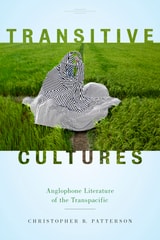
Transitive Cultures
Anglophone Literature of the TranspacificPatterson, Christopher B
Rutgers University Press, 2018
Texts written by Southeast Asian migrants have often been read, taught, and studied under the label of multicultural literature. But what if the ideology of multiculturalism—with its emphasis on authenticity and identifiable cultural difference—is precisely what this literature resists?
Transitive Cultures offers a new perspective on transpacific Anglophone literature, revealing how these chameleonic writers enact a variety of hybrid, transnational identities and intimacies. Examining literature from Malaysia, Singapore, and the Philippines, as well as from Southeast Asian migrants in Canada, Hawaii, and the U.S. mainland, this book considers how these authors use English strategically, as a means for building interethnic alliances and critiquing ruling power structures in both Southeast Asia and North America. Uncovering a wealth of texts from queer migrants, those who resist ethnic stereotypes, and those who feel few ties to their ostensible homelands, Transitive Cultures challenges conventional expectations regarding diaspora and minority writers.
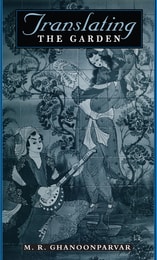
Translating the Garden
By M. R. Ghanoonparvar
University of Texas Press, 2002
Translating a work of literature from one language to another is an art form, in which the translated work becomes a "conduit" through which the reader of one language may pass into the cultural world of another. For the translator, the process of translation offers an intimate experience of the text that is perhaps unavailable even to the author. And yet, as M. R. Ghanoonparvar observes at the outset of this book, "every translation is inevitably a failure, with occasional moments of success."
In Translating the Garden, Ghanoonparvar allows readers to watch him in the process of translating Shahrokh Meskub's Goftogu dar Bagh(Dialogue in the Garden) from Persian into English. This short philosophical work uses a conversation between a writer and a painter to explore Persian perceptions of art, literature, nature, identity, and spirituality. As he translates the text, Ghanoonparvar discusses the myriad decisions that a literary translator faces, from word choices to the problems of conveying cultural concepts and deciphering authorial intent. He also compares some of his translated passages with those of other translators to highlight the uniqueness of each act of translation. The complete English translation of Dialogue in the Garden rounds out the volume.

Translation Studies before ‘Translation Studies’
Nothing Happened?Edited by Kathryn Batchelor and Iryna Odrekhivska
University College London, 2026
A critical reassessment of the origins and development of translation studies.
This volume challenges the established historical narratives of “translation studies” by showcasing some of the rich traditions of debate, research, and theory that unfolded around the world in the centuries before the supposed beginnings of the discipline. Bringing together essays from leaders in the field of translation history, Translation Studies before ‘Translation Studies’ decenters the modern-day discipline by giving access to overlooked theoretical reflections, most of them translated into English for the first time, from languages such as Latin, Sanskrit, Chinese, Arabic, Swahili, Ukrainian, French, and Brazilian Portuguese.
Translation, Resistance, Activism
Maria Tymoczko
University of Massachusetts Press, 2010
From silence to radical manipulation of texts, translation strategies are instrumental in significant historical interventions and cultural change. Translation plays a pivotal role in ideological dialogue and struggle, including resistance to oppression and cultural straitjackets of all types, from sexual puritanism to military dictatorships. Situated in their own space, time, history, and political contexts, translators promote ideological agendas by creating new cultural narratives, pragmatically adjusting tactics so as to maximize the social and political impact.
The essays in this volume explore ways to read translations as records of cultural contestation and ideological struggle; as means of fighting censorship, physical coercion, cultural repression, and political dominance; and as texts that foster a wide variety of goals from cultural nationalism to armed confrontation. Translations are set in relief as central cultural documents rather than derivative, peripheral, or marginalized productions. They are seen as forms of ethical, political, and ideological activity rather than as mere communicative transactions or creative literary exercises.
The contributors demonstrate that engaged and activist translations are performative acts within broader political and ideological contexts. The essays detail the initiative, resourcefulness, and courage of individual translators, whose willingness to put themselves on the line for social change can sometimes move the world.
In addition to Maria Tymoczko, contributors include Pua'ala'okalani D. Aiu, Brian James Baer, Mona Baker, Paul F. Bandia, Georges L. Bastin, Nitsa Ben-Ari, Ãngela Campo, Antonia Carcelen-Estrada, Ãlvaro Echeverri, Denise Merkle, John Milton, and Else R.P. Vieira.
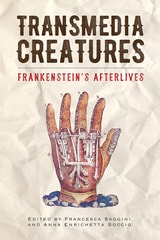
Transmedia Creatures
Frankenstein’s AfterlivesSaggini, Francesca
Bucknell University Press, 2018
Published by Bucknell University Press. Distributed worldwide by Rutgers University Press.
Transpacific Nonencounters
Racial Disconnects Across Twentieth-Century Japan and MexicoAndrea Mendoza
Duke University Press, 2026
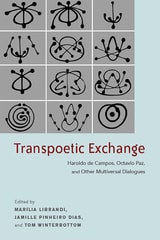
Transpoetic Exchange
Haroldo de Campos, Octavio Paz, and Other Multiversal DialoguesMarília Librandi
Bucknell University Press, 2020
The volume is divided into three parts. “Essays” unites seven texts by renowned scholars who focus on the relationship between the two authors, their impact and influence, and their cultural resonance by exploring explore the historical background and the different stylistic and cultural influences on the authors, ranging from Latin America and Europe to India and the U.S. The second section, “Remembrances,” collects four experiences of interaction with Haroldo de Campos in the process of transcreating Paz’s poem and working on Transblanco and Galáxias. In the last section, “Poems,” five poets of international standing--Jerome Rothenberg, Antonio Cicero, Keijiro Suga, André Vallias, and Charles Bernstein.
Paz and Campos, one from Mexico and the other from Brazil, were central figures in the literary history of the second half of the 20th century, in Latin America and beyond. Both poets signal the direction of poetry as that of translation, understood as the embodiment of otherness and of a poetic tradition that every new poem brings back as a Babel re-enacted.
This volume is a print corollary to and expansion of an international colloquium and poetic performance held at Stanford University in January 2010 and it offers a discussion of the role of poetry and translation from a global perspective. The collection holds great value for those interested in all aspects of literary translation and it enriches the ongoing debates on language, modernity, translation and the nature of the poetic object.
Published by Bucknell University Press. Distributed worldwide by Rutgers University Press.

Travelers, Immigrants, Inmates
Essays in EstrangementFrances Bartkowski
University of Minnesota Press, 1995
Travelers, Immigrants, Inmates was first published in 1995. Minnesota Archive Editions uses digital technology to make long-unavailable books once again accessible, and are published unaltered from the original University of Minnesota Press editions.
Identities are always mistaken; yet they are as necessary as air to sustain life in and among communities. Frances Bartkowski uses travel writings, U.S. immigrant autobiographies, and concentration camp memoirs to illustrate how tales of dislocation present readers with a picture of the complex issues surrounding mistaken identities. In turn, we learn much about the intimate relation between language and power.
Combining psychoanalytic and political modes of analysis, Bartkowski explores the intertwining of place and the construction of identities. The numerous writings she considers include André Gide's Voyage to the Congo, Eva Hoffman's Lost in Translation, Sandra Cisneros's House on Mango Street, Zora Neale Hurston's Dust Tracks on a Road and Tell My Horse, and Primo Levi's Survival in Auschwitz.
Elegantly written and incisive, Travelers, Immigrants, Inmates stands at the crossroads of contemporary discussions about ethnicity, race, gender, nationalism, and the politics and poetics of identity. It has much to offer readers interested in questions of identity and cultural differences.
Frances Bartkowski is associate professor of English and director of women's studies at Rutgers University in Newark. She is the author of Feminist Utopias (1989).

Travels and Revelations
23 Essays by Zhang ChengzhiChengzhi Zhang
Hong Kong University Press, 2026
This is an English translation of twenty-three essays written by the Chinese author Zhang Chengzhi, spanning over twenty years. The collection of prose covers Zhang’s memories when living in Inner Mongolia, his perception of the Western part of China, his views on several figures, and events in modern Chinese history and contemporary China.
Trespasses
Selected WritingsMasao Miyoshi
Duke University Press, 2010
This volume brings together eleven selections of Miyoshi’s previously published writing, a major new essay, a critical introduction to his life and work, and an interview in which Miyoshi reflects on the trajectory of his thought and the institutional history of modern Japan studies. In the new essay, “Literary Elaborations,” he provides a masterful overview of the nature of the contemporary university, closing with a call for a global environmental protection studies that would radically reconfigure academic disciplines and merge the hard sciences with the humanities and the social sciences. In the other, chronologically arranged selections, Miyoshi addresses cross-culture relations between Japan and the United States, English literary studies in Japan, and Japan studies in the U.S., as well as the organization of urban space and the integrity of art and architecture in aggressively marketed-oriented environments. Trespasses is an invaluable introduction to the work of a fearless cultural critic.
Troublemakers
Power, Representation, and the Fiction of the Mass WorkerScott, William
Rutgers University Press, 2012
William Scott’s Troublemakers explores how a major change in the nature and forms of working-class power affected novels about U.S. industrial workers in the first half of the twentieth century. With the rise of mechanization and assembly-line labor from the 1890s to the 1930s, these laborers found that they had been transformed into a class of “mass” workers who, since that time, have been seen alternately as powerless, degraded victims or heroic, empowered icons who could rise above their oppression only through the help of representative organizations located outside the workplace.
Analyzing portrayals of workers in such novels as Upton Sinclair’s The Jungle, Ruth McKenney's Industrial Valley, and Jack London’s The Iron Heel, William Scott moves beyond narrow depictions of these laborers to show their ability to resist exploitation through their direct actions—sit-down strikes, sabotage, and other spontaneous acts of rank-and-file “troublemaking” on the job—often carried out independently of union leadership. The novel of the mass industrial worker invites us to rethink our understanding of modern forms of representation through its attempts to imagine and depict workers’ agency in an environment where it appears to be completely suppressed.
Twentieth-Century Sentimentalism
Narrative Appropriation in American LiteratureWilliamson, Jennifer A.
Rutgers University Press, 2013
Today’s critical establishment assumes that sentimentalism is an eighteenth- and nineteenth-century literary mode that all but disappeared by the twentieth century. In this book, Jennifer Williamson argues that sentimentalism is alive and well in the modern era. By examining working-class literature that adopts the rhetoric of “feeling right” in order to promote a proletarian or humanist ideology as well as neo-slave narratives that wrestle with the legacy of slavery and cultural definitions of African American families, she explores the ways contemporary authors engage with familiar sentimental clichés and ideals.
Williamson covers new ground by examining authors who are not generally read for their sentimental narrative practices, considering the proletarian novels of Grace Lumpkin, Josephine Johnson, and John Steinbeck alongside neo-slave narratives written by Margaret Walker, Octavia Butler, and Toni Morrison. Through careful close readings, Williamson argues that the appropriation of sentimental modes enables both sympathetic thought and systemic action in the proletarian and neo-slave novels under discussion. She contrasts appropriations that facilitate such cultural work with those that do not, including Kathryn Stockett’s novel and film The Help. The book outlines how sentimentalism remains a viable and important means of promoting social justice while simultaneously recognizing and exploring how sentimentality can further white privilege.
Sentimentalism is not only alive in the twentieth century. It is a flourishing rhetorical practice among a range of twentieth-century authors who use sentimental tactics in order to appeal to their readers about a range of social justice issues. This book demonstrates that at stake in their appeals is who is inside and outside of the American family and nation.