Results by title
123 books match the query 'Courts' and 59 start with t
The Supreme Court Review, 2022
Edited by David A. Strauss, Geoffrey R. Stone, Justin Driver, and William Baude
University of Chicago Press Journals, 2023
Since it first appeared in 1960, the Supreme Court Review has won acclaim for providing a sustained and authoritative survey of the implications of the Court's most significant decisions. SCR is an in-depth annual critique of the Supreme Court and its work, analyzing the origins, reforms, and modern interpretations of American law. SCR is written by and for legal academics, judges, political scientists, journalists, historians, economists, policy planners, and sociologists.
The Supreme Court Review, 2023
Edited by David A. Strauss, Geoffrey R. Stone, Justin Driver, and William Baude
University of Chicago Press Journals, 2024
Since it first appeared in 1960, the Supreme Court Review (SCR) has won acclaim for providing a sustained and authoritative survey of the implications of the Court’s most significant decisions. SCR is an in-depth annual critique of the Supreme Court and its work, analyzing the origins, reforms, and modern interpretations of American law. SCR is written by and for legal academics, judges, political scientists, journalists, historians, economists, policy planners, and sociologists.
The Supreme Court Review, 2024
Edited by David A. Strauss, Geoffrey R. Stone, Justin Driver, and William Baude
University of Chicago Press Journals, 2025
Since it first appeared in 1960, The Supreme Court Review (SCR) has won acclaim for providing a sustained and authoritative survey of the implications of the Court’s most significant decisions. SCR is an in-depth annual critique of the Supreme Court and its work, analyzing the origins, reforms, and modern interpretations of American law. SCR is written by and for legal academics, judges, political scientists, journalists, historians, economists, policy planners, and sociologists.
The Supreme Court Review, 2025
Edited by David A. Strauss, Geoffrey R. Stone, Justin Driver, and William Baude
University of Chicago Press Journals, 2026
An annual peer-reviewed law journal covering the legal implications of decisions by the Supreme Court of the United States.
Since it first appeared in 1960, the Supreme Court Review (SCR) has won acclaim for providing a sustained and authoritative survey of the implications of the Court’s most significant decisions. SCR is an in-depth annual critique of the Supreme Court and its work, analyzing the origins, reforms, and modern interpretations of American law. SCR is written by and for legal academics, judges, political scientists, journalists, historians, economists, policy planners, and sociologists.
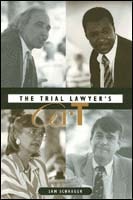
The Trial Lawyer's Art
Sam Schrager
Temple University Press, 2000
Drawn from fieldwork in the Philadelphia courts and at the Smithsonian Institution's American Trial Lawyers program, The Trial Lawyer's Art gives a remarkable, in-depth look at this craft of performance. It examines how lawyers exploit a case's dramatic potential, how they enact mythically potent themes, how they project personal authority, and how they use cultural identity -- their own and their opponents' racial, gender, class, and local affiliations -- all to make themselves and their stories persuasive to a jury. Schrager depicts the performance styles of some of the nation's most artful criminal and civil advocates: in Philadelphia, prosecutor Roger King, defender Robert Mozenter, and the legendary Cecil B. Moore; from around the country, such litigating stars as Roy Barrera, Penny Cooper, Jo Ann Harris, Tony Serra, and Michael Tigar. These lawyers reflect candidly on their courtroom calculations and share revealing "war stories" about their work.
Integrating performance insights with evocative portrayals of unfolding trials, The Trial Lawyer's Art offers a no-holds-barred analysis of the place of skill versus evidence in the American justice system. In doing so, it raises vital questions about the moral challenges that legal and other professions now face and sheds new light on the role of stories in American life.
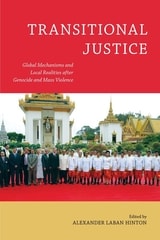
Transitional Justice
Global Mechanisms and Local Realities after Genocide and Mass ViolenceHinton, Alexander Laban
Rutgers University Press, 2011
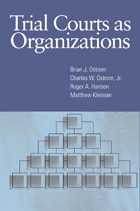
Trial Courts as Organizations
Brian J Ostrom, Charles W Ostrom, Jr., Roger A Hanson and Matthew Kleiman
Temple University Press, 2007
Court administrators and judges have long acknowledged that culture plays an important role in the function of trial courts. Trial Courts as Organizations provides a comprehensive framework for understanding this organizational culture, along with a set of steps and tools to assess and measure the current and preferred culture.
The authors examine how courts operate, what characteristics they may display, and how they function as a unit to preserve judicial independence, strengthen organizational leadership, and influence court performance. They identify four different types of institutional cultures using a systematic analysis of alternative values on how work is done. Each culture is shown to have its own strengths and weaknesses in achieving values, such as timely case resolution, access to court services, and procedural justice. Accordingly, the authors find judges and administrators prefer a definite pattern of different cultures, called a "mosaic," to guide how their courts operate in the future.
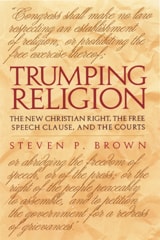
Trumping Religion
The New Christian Right, the Free Speech Clause, and the CourtsSteven P. Brown
University of Alabama Press, 2004
The first scholarly treatment of the strategies employed by the New Christian Right in redefining religious freedom in the courtroom.
Trumping Religion provides a detailed analysis of the five major public-interest law firms that have litigated religion cases in the federal courts between 1980 and 2000. Allied with several highly vocal, evangelical ministries, such as those of Jerry Falwell and Pat Robinson, these legal organizations argue that religious expression is a form of protected speech and thereby gain a greater latitude of interpretation in the courts. The long-term agenda of the New Christian Right as illuminated by this study is to shape church-state jurisprudence in a way that permits free course for the Christian gospel.
Steven P. Brown presents his research and conclusions from a balanced viewpoint. In filling a distinct void in the literature, this book will be of considerable interest to political scientists, legal scholars, law schools and seminaries, and anyone concerned with the intersection of religion and judicial politics.
Trust in the Law
Encouraging Public Cooperation with the Police and CourtsTom R. Tyler
Russell Sage Foundation, 2002