Results by title
244 books match the query 'Crime' and 58 start with t

The Spider
Aurko Maitra
Seagull Books, 2025
In the largely undocumented sphere of political violence in eastern India, Qadir the Spider is a mythological killer and casanova, known for the various assassinations and liaisons he carries out across the region. His oldest son Rahim is the latest entry to the field. A 13-year-old killer, the boy bides his time like his father—killing, farming, and getting high as the battles go on around him. In this world where they only follow orders, mutilation becomes their only expression, the nature of violence their only meaningful form of autonomy in the various power struggles of interior Bengal.
After his first year in the field, as the child is groomed by his father to carry on the ways of their mercenary clan, he begins to confront the various legends surrounding the Spider. However, while roaming the strange, spectral forests surrounding the town, his chance encounter with a pair of wandering musicians leads him to question the killings that pattern his life. As he searches for the answers around him, he is slowly led to confront the man his father truly is, as well as the man he knows he will become.
A gripping tale of inherited violence and identity in politically volatile Bengal, Aurko Maitra’s The Spider contains powerful, disturbing parallels to modern-day conflicts. Boldly interrogating our concepts of autonomy and survival in chaos, this revelatory novel explores the impact of political violence and timeless issues of legacy and intergenerational violence.

The Tango Player
Christoph Hein
Northwestern University Press, 1994
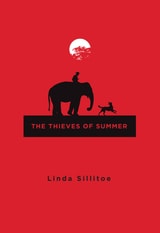
The Thieves of Summer
Linda Sillitoe
Signature Books, 2014
Prin-cess Al-ice in Liberty Park
Munch-es ba-nan-as ’til way after dark.
Princess Alice is an elephant the children of Utah purchased by donating nickels and dimes to a circus. The girls don’t know this, but her handler takes the mammoth princess out on late-night strolls around the park when the moon is out. What they do know is that the elephant sometimes escapes and goes on a rampage, crashing through front-yard fences and collecting collars of clothesline laundry around her neck, a persistent train of barking dogs following behind. The girls’ father is a police officer who is investigating a boy’s disappearance. As the case unfolds, the perception of the park, with its eighty acres of trees and grass, will change from the epitome of freedom to a place to be avoided, even as Princess Alice moves to a secure confinement at a new zoo at the mouth of Emigration Canyon. The story is loosely based on the exploits of a real live elephant that lived in Liberty Park a decade before Sillitoe’s childhood in the neighborhood.
The Truth about Crime
Sovereignty, Knowledge, Social OrderJean Comaroff and John L. Comaroff
University of Chicago Press, 2016
To do so, the Comaroffs draw on their vast knowledge of South Africa, especially, and its struggle to build a democracy founded on the rule of law out of the wreckage of long years of violence and oppression. There they explore everything from the fascination with the supernatural in policing to the extreme measures people take to prevent home invasion, drawing illuminating comparisons to the United States and United Kingdom. Going beyond South Africa, they offer a global criminal anthropology that attests to criminality as the constitutive fact of contemporary life, the vernacular by which politics are conducted, moral panics voiced, and populations ruled.
The result is a disturbing but necessary portrait of the modern era, one that asks critical new questions about how we see ourselves, how we think about morality, and how we are going to proceed as a global society.
The Willow Pattern
A Judge Dee MysteryRobert van Gulik
University of Chicago Press, 1965
An exceptionally clever, cozy mystery that will thrill all fans of Judge Dee, whom the Los Angeles Times ranked with Sherlock Holmes
Judge Dee has been appointed emergency governor of the plague- and drought-ridden Imperial City. As his guards help the city fend off a popular uprising, an aristocrat from one of the oldest families in China suffers an "accident" in a deserted mansion.
In The Willow Pattern, the illustrious judge uses his trademark expertise to unravel the mysteries of the nobleman, a shattered vase, and a dead bondmaid. Along the way he encounters a woman who fights with loaded sleeves, a nearly drowned courtesan, and an elaborate trap set for a murderer. Packed with suspense, violence, and romance, The Willow Pattern won’t disappoint Judge Dee’s legions of loyal fans.

Threadbare
Class and Crime in Urban AlaskaMary Kudenov
University of Alaska Press, 2017
Journalist Mary Kudenov set out to find the true stories behind this “end-of-the-road” culture. Through her essays, we meet Alaskans who live outside the common adventurer narrative: a recent graduate of a court-sponsored sobriety program, a long-timer in the Hiland Mountain Correctional Center for women, a slum-landlord’s emancipated teenage daughter, and even a post-rampage spree killer. Her subjects struggle with poverty and middle-class aspirations, education and minimum wage work, God and psychology. The result is a raw and startling collection of direct, ground-level reporting that will leave you deeply moved.
Transformation and Trouble
Crime, Justice and Participation in Democratic South AfricaDiana Gordon
University of Michigan Press, 2006
Crime is one of the major challenges to any new democracy. Violence often increases after the lifting of authoritarian control, or in the aftermath of regime change. But how can a fledgling democracy fight crime without violating the fragile rights of its citizens? In Transformation and Trouble, accomplished theorist and criminal justice scholar Diana Gordon critically examines South Africa's efforts to strike the perilous balance between democratic participation and social control.
South Africa has made great progress in pursuing the Western ideals of participatory justice and due process. Yet Gordon finds that popular concerns about crime have fostered the growth of a punitive criminal justice system that undermines the country's rights-oriented political culture. Transformation and Trouble calls for South Africa to reaffirm its commitment to public empowerment by reforming its criminal justice system-an approach, she argues, that would strengthen the country's new democracy.
"An eloquent, critical, but ultimately optimistic, analysis of the democratization of crime and justice in post-apartheid South Africa."
--Bill Dixon, School of Criminology, Education, Sociology and Social Work, Keele University
"A must read for understanding contemporary South Africa's agonizing dilemmas as it struggles to reconcile crime control with democratic values."
--Jerome H. Skolnick, New York University School of Law
"Gordon's vast experience with criminal justice illuminates her cautionary tale of the search for a new way in south Africa."
--Paul Chevigny, New York University
Diana Gordon is Professor Emerita of Political Science and Senior Research Scholar, City University of New York.
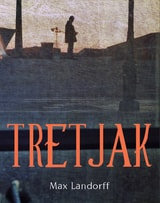
Tretjak
Max Landorff
Haus Publishing, 2014