Results by title
230 books match the query 'Doctrines' and 69 start with t
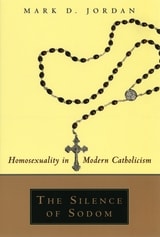
The Silence of Sodom
Homosexuality in Modern CatholicismMark D. Jordan
University of Chicago Press, 2000
"[Jordan] has offered glimpses, anecdotal stories, and scholarly observations that are a whole greater than the sum of its parts. . . . If homosexuality is the guest that refuses to leave the table, Jordan has at least shed light on why that is and in the process made the whole issue, including a conflicted Catholic Church, a little more understandable."—Larry B. Stammer, Los Angeles Times
"[Jordan] knows how to present a case, and with apparently effortless clarity he demonstrates the church's double bind and how it affects Vatican rhetoric, the training of priests, and ecclesiastical protectiveness toward an army of closet cases. . . . [T]his book will interest readers of every faith."—Daniel Blue,
Lambda Book Report
A 2000 Lambda Literary Award Finalist
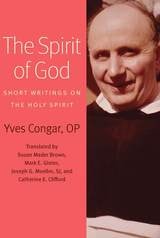
The Spirit of God
Short Writings on the Holy SpiritYves Congar
Catholic University of America Press, 2017
The Spirit of God brings together for the first time eight of Yves Congar’s previously untranslated writings on the Holy Spirit composed after Vatican II (from 1969 to 1985). Two of these selections offer general overviews of Congar’s pneumatology, a pneumatology based upon Scripture and the Tradition of the Church, but articulated in conversation with philosophers, ecumenical partners and non-believers. Other articles make clear the historical context of Vatican II’s pneumatology and the Holy Spirit’s crucial influence upon the unfolding of history and upon the moral life, the efficacy of the sacraments and, especially, upon ecclesial life.
The writings in The Spirit of God have been translated and edited by a team of scholars familiar with the work of the French Dominican theologian. An introduction situates each of the writings historically and highlights its theological significance. A bibliography lists Congar’s publications on the Holy Spirit, the major articles and books written about his pneumatology, and the major scholarly resources to which Congar made reference in the notes that accompanied these writings. An index of biblical references and of personal names is also included.
The Texture of Being
Essays in First PhilosophyKenneth L. Schmitz
Catholic University of America Press, 2007
The Theology of Marriage
Cormac Burke
Catholic University of America Press, 2015
The Three Dynamisms of Faith
Searching for Meaning, Fulfillment, and TruthLouis Roy
Catholic University of America Press, 2017
The Three Treasures
A Revised and Illustrated Study and Translation of Minamoto no Tamenori's SanboeEdward Kamens and Ethan Bushelle
University of Michigan Press, 2023
When the young Princess Sonshi became a Buddhist nun in the year 984, a scholar-official of the royal court was commissioned to create a guide to the Buddhist religion that would be accessible for her. He did so in the form of the illustrated works of fiction (monogatari) that appealed to women readers of her time and class. The text has survived in later manuscripts; the illustrations, if they ever existed, have not. This revised translation recreates Sonshi’s experience of receiving this multimedia presentation, with illustrations selected to help contemporary readers visualize its content and essays that provide context on the religious and cultural experience of the author. The Three Jewels is a unique document that opens a window onto the world of Buddhist religious experience—especially for women—in high classical Japan, the time of Sei Shōnagon’s Pillow Book and Murasaki Shikibu’s Tale of Genji.
The Trinitarian Shape of the Eucharist in Medieval Cistercian Theology
Nathaniel Peters
Catholic University of America Press, 2026
The Trinity
An Introduction to Catholic Doctrine on the Triune GodGilles Emery
Catholic University of America Press, 2011
The Trinity
On the Nature and Mystery of the One GodThomas Joseph White, OP
Catholic University of America Press, 2021
The Two Churches
Catholicism and Capitalism in the World SystemMichael L. Budde
Duke University Press, 1992
Budde's argument here is twofold. He contends that world Catholicism, led by its Third World majority (most notably in Latin America), will continue to develop in an increasingly anticapitalist direction; and he suggests that once-dominant First World Catholic churches (exemplified by the U.S. Catholic church), are poorly placed to respond in solidarity with their coreligionists from the Third World.
Covering a wide range of theoretical and substantive matters, The Two Churches examines religion as a source of both social legitimation and social rebellion. It demonstrates the importance of ecclesiology, a branch of theology dealing with "theories of the church," and it highlights the effect of capitalism on world Catholicism, as well as the latter's influence on the development of the capitalist order.
In his original, far-reaching analysis of the Catholic church's role in world affairs, Budde revises current views of religious institutions as subordinate social phenomena. By relating developments in the world political economy to material conditions in the Third World and in turn to the practice of Catholicism, he reveals how the Catholic church functions as a worldwide institution. He also shows how core-periphery conflicts within the church affect transnational capitalism.
As the Third World becomes more and more volatile, and as its relations with the First World further complicate the politics of the Catholic church, the questions addressed in The Two Churches demand attention with increasing urgency. Timely, thoughtful, and lucid, this book will inform and enhance our understanding of this complex, pressing issue.
The Two Wings of Catholic Thought
Essays on Fides et RatioDavid Ruel Foster
Catholic University of America Press, 2003
The Unification Church
Studies in Contemporary ReligionMassimo Introvigne
Signature Books, 2000
Where they depart from traditional Christianity is in their acceptance of the Divine Principle as a companion to the Bible and in their assertion that founder Rev. Sun Myung Moon is Lord of the Second Advent, that with his wife (together the “True Parents”), Original Sin is conquered through special blessings.
Since 1954 Unificationism has evolved toward a more normative approach to worship and lifestyle, if not belief—a point that Italian scholar Massimo Introvigne emphasizes in his balanced overview of the church’s history, doctrine, spirituality, missionary activities, and controversies. He notes that in doctrine Unificationism has moved away from mainstream churches toward increased emphasis on contact with the spirit world, numerology, and construction of a modern “Garden of Eden” in Brazil.
The Universe We Think In
James V. Schall
Catholic University of America Press, 2018
The Unspeakable Vice
The Catholic Church and Homosexuality in the Twentieth CenturyFrancesco Torchiani, Translated by Johanna Bishop
University of Wisconsin Press, 2026
As gay men and lesbian women increasingly gained recognition and acceptance in twentieth-century literature and film, and subsequently in social and political movements, the Catholic Church reacted by subtly moving away from its overt condemnation of homosexuality as an urgent moral problem and toward tacitly shunning homosexuality as an “unspeakable vice.” In this revealing history, Francesco Torchiani reconstructs the Catholic Church’s shifting attitudes toward homosexuality during this period by drawing on a vast array of internal documents and external accounts. This monograph expands the scholarship on the relationship between Catholicism and homosexuality in terms of both method and content, ultimately concluding that the Catholic Church continues to wholeheartedly condemn homosexuality despite making genuine efforts to reflect on and understand its social and cultural impact. The Unspeakable Vice therefore sheds new light on and places into historical perspective the questions the Catholic Church continues to reckon with regarding its role in contemporary society.
The person and the polis
faith and values within the secular stateCraig Steven Titus
Catholic University of America Press, 2006

Thomas Aquinas as Spiritual Teacher
Michael A. Dauphinais
Sapientia Press of Ave Maria University, 2023
Tibetan Buddhism and Modern Physics
Toward a Union of Love and KnowledgeVic Mansfield
Templeton Press, 2008
Tibetan Buddhism and Modern Physics: Toward a Union of Love and Knowledge addresses the complex issues of dialogue and collaboration between Buddhism and science, revealing connections and differences between the two. While assuming no technical background in Buddhism or physics, this book strongly responds to the Dalai Lama’s “heartfelt plea” for genuine collaboration between science and Buddhism. The Dalai Lama has written a foreword to the book and the Office of His Holiness will translate it into both Chinese and Tibetan.
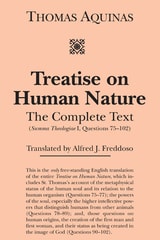
Treatise on Human Nature
The Complete Text (Summa Theologiae I, Questions 75-102)Thomas Aquinas
St. Augustine's Press, 2010
St. Thomas Aquinas’s Treatise on Human Nature occupies questions 75-102 of Part 1 of the Summa Theologiae. It contains St. Thomas’s most mature statement of his philosophical and theological anthropology, i.e., his account of what human beings are and of their origin as distinctive creatures made in the image of God. This translation, moreover, is the only complete edition of all the material St. Thomas envisaged as being part of the Treatise.
The treatise begins with two long and complex questions on the metaphysical status of the human soul and its relation to the human organism. Here St. Thomas tries to show how the human being is both an animal and an animal who transcend the other animals. In doing so he marks out a distinctive Christian/Aristotelian conceptual space between “materialist” accounts of human nature that reduce human beings to mere collections of physical or chemical or biological components and “dualistic” accounts of human nature, such as those propounded by Plato and, later on, Descartes, that identify human beings with their immaterial souls.
The next thirteen questions deal with the powers of the soul, especially those higher intellective powers of understanding and willing that distinguish human beings from the other animals. Here we are given a philosophical framework for the findings of the human sciences.
Finally, the last thirteen questions have to do with human origins, the creation of the first man and first woman, the state of our first parents, and their status as beings created in the image of God. In essence, this is St. Thomas’s philosophically attuned commentary on the parts of Genesis 1–2 that deal specifically with the creation of the human species. These thirteen questions, though an integral part of the Treatise, are not included in other translations of the Treatise on Human Nature.
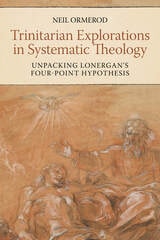
Trinitarian Explorations in Systematic Theology
Unpacking Lonergan's Four-Point HypothesisNeil Ormerod
Catholic University of America Press, 2026