Results by title
917 books match the query 'Economics' and 233 start with t
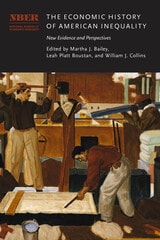
The Economic History of American Inequality
New Evidence and PerspectivesEdited by Martha J. Bailey, Leah Platt Boustan, and William J. Collins
University of Chicago Press, 2025
A meticulous examination of the history and roots of economic inequality within the United States.
This volume refines and extends the economic history literature on economic inequality in the United States. Economic inequality manifests itself on various dimensions, including access to resources and economic security, as well as access to education and opportunities for migration, marriage, and other important life decisions. Measuring inequality and studying its variation over time and in response to economic shocks such as recessions and wars deepen our understanding of how the economy operates and can inform the design of public policies. The studies in this compendium present comprehensive evidence on income distribution during the nineteenth and early twentieth centuries, drawing on new data on wages and prices. They also consider disparities in economic well-being that are reflected in outcomes other than wage and salary income, such as homeownership and marriage. The volume also presents new evidence on the effects of income inequality on social outcomes. It concludes with an intellectual history of “human capital,” a core concept in the economic analysis of the underpinnings of labor market inequality.
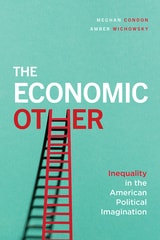
The Economic Other
Inequality in the American Political ImaginationMeghan Condon and Amber Wichowsky
University of Chicago Press, 2020
Through an astute blend of experiments, surveys, and descriptions people offer in their own words, The Economic Other reveals that when less-advantaged Americans compare with the rich, they become more accurate about their own status and want more from government. But American society is structured to prevent upward comparison. In an increasingly divided, anxious nation, opportunities to interact with the country’s richest are shrinking, and people prefer to compare to those below to feel secure. Even when comparison with the rich does occur, many lose confidence in their power to effect change.
Laying bare how social comparisons drive political attitudes, The Economic Other is an essential look at the stubborn plight of inequality and the measures needed to solve it.
The Economic Sociology of Immigration
Essays on Networks, Ethnicity, and EntrepreneurshipAlejandro Portes
Russell Sage Foundation, 1995
The Economics and the Ethics of Constitutional Order
James M. Buchanan
University of Michigan Press, 1991
The Ecosystem Approach in Anthropology serves as a foundational methodology guide for modern ecological and environmental anthropology. The book advocates for a rigorous, integrative approach to studying human societies by framing them as deeply interconnected components of larger biological ecosystems. Moran gathers a diverse cohort of leading researchers to demonstrate how abstract ecosystem concepts can be translated into concrete, empirical field practices across varying environments, ranging from tropical rainforests to arid landscapes. By bridging the gap between cultural anthropology and natural sciences like ecology, soil science, and demography, the volume offers critical frameworks for quantifying energy flows, resource consumption, and human-environmental feedback loops, making it an indispensable resource for analyzing complex social-ecological systems and anthropogenic environmental changes.

The Economics and the Ethics of Constitutional Order
James M. Buchanan
University of Michigan Press, 1991
The Economics of Aging
Edited by David A. Wise
University of Chicago Press, 1988
The Economics of Aging presents results from an ongoing National Bureau of Economic Research project. Contributors consider the housing mobility and living arrangements of the elderly, their labor force participation and retirement, the economics of their health care, and their financial status. The goal of the research is to further our understanding both of the factors that determine the well-being of the elderly and of the consequences that follow from an increasingly older population with longer individual life spans. Each paper is accompanied by critical commentary.
The Economics of Agriculture, Volume 1
Selected Papers of D. Gale JohnsonEdited by John M. Antle and Daniel A. Sumner
University of Chicago Press, 1995
Volume 1 collects for the first time in one source Johnson's most important work. These classic papers explore the consequences of government intervention in United States and world agriculture; the economics of agricultural supply and of rural labor and human capital issues; and the analysis of agricultural productivity in poor countries, including the centrally planned economies of China and Eastern Europe. Models of precise reasoning and powerful empirical research, the papers cover a wide range of topics—from U.S. commodity price policy to the economics of population control and farm policy reform in China. Volume 1 includes a definitive bibliography of Johnson's published writings.
Volume 2 presents twenty-two papers by Johnson's former students and colleagues. International in scope, these papers explore themes and topics inspired by Johnson's work, including agricultural policy and U.S. farm prices; European Common Agricultural Policy; and agricultural and rural development in the Third World. Contributors to Volume 2 are David G. Abler, John M. Antle, Richard R. Barichello, Andrew P. Barkley, Karen Brooks, David S. Bullock, Robert E. Evenson, B. Delworth Gardner, Bruce L. Gardner, Dale M. Hoover, Wallace E. Huffman, Paul R. Johnson, Yoav Kislev, Justin Yifu Lin, Yair Mundlak, John Nash, Keijuro Otsuka, Willis Peterson, Todd E. Petzel, Vernon W. Ruttan, Maurice Schiff, G. Edward Schuh, Theodore W. Schultz, James Snyder, Vasant Sukhatme, Daniel A. Sumner, Vinod Thomas, George Tolley, and Alberto Valdes.
The Economics of Agriculture, Volume 2
Papers in Honor of D. Gale JohnsonEdited by John M. Antle and Daniel A. Sumner
University of Chicago Press, 1995
Volume 1 collects for the first time in one source Johnson's most important work. These classic papers explore the consequences of government intervention in United States and world agriculture; the economics of agricultural supply and of rural labor and human capital issues; and the analysis of agricultural productivity in poor countries, including the centrally planned economies of China and Eastern Europe. Models of precise reasoning and powerful empirical research, the papers cover a wide range of topics—from U.S. commodity price policy to the economics of population control and farm policy reform in China. Volume 1 includes a definitive bibliography of Johnson's published writings.
Volume 2 presents twenty-two papers by Johnson's former students and colleagues. International in scope, these papers explore themes and topics inspired by Johnson's work, including agricultural policy and U.S. farm prices; European Common Agricultural Policy; and agricultural and rural development in the Third World. Contributors to Volume 2 are David G. Abler, John M. Antle, Richard R. Barichello, Andrew P. Barkley, Karen Brooks, David S. Bullock, Robert E. Evenson, B. Delworth Gardner, Bruce L. Gardner, Dale M. Hoover, Wallace E. Huffman, Paul R. Johnson, Yoav Kislev, Justin Yifu Lin, Yair Mundlak, John Nash, Keijuro Otsuka, Willis Peterson, Todd E. Petzel, Vernon W. Ruttan, Maurice Schiff, G. Edward Schuh, Theodore W. Schultz, James Snyder, Vasant Sukhatme, Daniel A. Sumner, Vinod Thomas, George Tolley, and Alberto Valdes.
The Economics of Art Museums
Edited and with an Introduction by Martin Feldstein
University of Chicago Press, 1991
This volume brings together nontechnical essays on these issues by economists associated with the NBER and personal statements by leaders of America's major national art museums and related foundations. It can be read not only by economists but also by museum officials and trustees. Museum directors generally come to their responsibilities with a background in art history and curatorial work but without experience in thinking about the management and public policy aspects of museum administration. Trustees who serve on museum boards generally have a background in business or law but have not previously tried to apply their experience to the unusual economic problems of museums. The background papers, the panelists' remarks, and the summary of the discussion will help them to approach their responsibilities with a better understanding of the problems and possibilities of the museum.
The Economics of Artificial Intelligence
An AgendaEdited by Ajay Agrawal, Joshua Gans, and Avi Goldfarb
University of Chicago Press, 2019
Contributors:
Daron Acemoglu, Massachusetts Institute of Technology
Philippe Aghion, Collège de France
Ajay Agrawal, University of Toronto
Susan Athey, Stanford University
James Bessen, Boston University School of Law
Erik Brynjolfsson, MIT Sloan School of Management
Colin F. Camerer, California Institute of Technology
Judith Chevalier, Yale School of Management
Iain M. Cockburn, Boston University
Tyler Cowen, George Mason University
Jason Furman, Harvard Kennedy School
Patrick Francois, University of British Columbia
Alberto Galasso, University of Toronto
Joshua Gans, University of Toronto
Avi Goldfarb, University of Toronto
Austan Goolsbee, University of Chicago Booth School of Business
Rebecca Henderson, Harvard Business School
Ginger Zhe Jin, University of Maryland
Benjamin F. Jones, Northwestern University
Charles I. Jones, Stanford University
Daniel Kahneman, Princeton University
Anton Korinek, Johns Hopkins University
Mara Lederman, University of Toronto
Hong Luo, Harvard Business School
John McHale, National University of Ireland
Paul R. Milgrom, Stanford University
Matthew Mitchell, University of Toronto
Alexander Oettl, Georgia Institute of Technology
Andrea Prat, Columbia Business School
Manav Raj, New York University
Pascual Restrepo, Boston University
Daniel Rock, MIT Sloan School of Management
Jeffrey D. Sachs, Columbia University
Robert Seamans, New York University
Scott Stern, MIT Sloan School of Management
Betsey Stevenson, University of Michigan
Joseph E. Stiglitz. Columbia University
Chad Syverson, University of Chicago Booth School of Business
Matt Taddy, University of Chicago Booth School of Business
Steven Tadelis, University of California, Berkeley
Manuel Trajtenberg, Tel Aviv University
Daniel Trefler, University of Toronto
Catherine Tucker, MIT Sloan School of Management
Hal Varian, University of California, Berkeley

The Economics of Artificial Intelligence
Health Care ChallengesEdited by Ajay Agrawal, Joshua Gans, Avi Goldfarb, and Catherine E. Tucker
University of Chicago Press, 2024
A timely investigation of the potential economic effects, both realized and unrealized, of artificial intelligence within the United States healthcare system.
In sweeping conversations about the impact of artificial intelligence on many sectors of the economy, healthcare has received relatively little attention. Yet it seems unlikely that an industry that represents nearly one-fifth of the economy could escape the efficiency and cost-driven disruptions of AI.
The Economics of Artificial Intelligence: Health Care Challenges brings together contributions from health economists, physicians, philosophers, and scholars in law, public health, and machine learning to identify the primary barriers to entry of AI in the healthcare sector. Across original papers and in wide-ranging responses, the contributors analyze barriers of four types: incentives, management, data availability, and regulation. They also suggest that AI has the potential to improve outcomes and lower costs. Understanding both the benefits of and barriers to AI adoption is essential for designing policies that will affect the evolution of the healthcare system.
The Economics of Attention
Style and Substance in the Age of InformationRichard A. Lanham
University of Chicago Press, 2006
With all the verve and erudition that have established his earlier books as classics, Richard A. Lanham here traces our epochal move from an economy of things and objects to an economy of attention. According to Lanham, the central commodity in our new age of information is not stuff but style, for style is what competes for our attention amidst the din and deluge of new media. In such a world, intellectual property will become more central to the economy than real property, while the arts and letters will grow to be more crucial than engineering, the physical sciences, and indeed economics as conventionally practiced. For Lanham, the arts and letters are the disciplines that study how human attention is allocated and how cultural capital is created and traded. In an economy of attention, style and substance change places. The new attention economy, therefore, will anoint a new set of moguls in the business world—not the CEOs or fund managers of yesteryear, but new masters of attention with a grounding in the humanities and liberal arts.
Lanham’s The Electronic Word was one of the earliest and most influential books on new electronic culture. The Economics of Attention builds on the best insights of that seminal book to map the new frontier that information technologies have created.
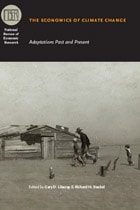
The Economics of Climate Change
Adaptations Past and PresentEdited by Gary D. Libecap and Richard H. Steckel
University of Chicago Press, 2011
While debates over the consequences of climate change are often pessimistic, historical data from the past two centuries indicate many viable opportunities for responding to potential changes. This volume takes a close look at the ways in which economies—particularly that of the United States—have adjusted to the challenges climate change poses, including institutional features that help insulate the economy from shocks, new crop varieties, irrigation, flood control, and ways of extending cultivation to new geographic areas. These innovations indicate that people and economies have considerable capacity to acclimate, especially when private gains complement public benefits. Options for adjusting to climate change abound, and with improved communication and the emergence of new information and technologies, the potential for adaptation will be even greater in the future.

The Economics of Crime
Lessons For and From Latin AmericaEdited by Rafael Di Tella, Sebastian Edwards, and Ernesto Schargrodsky
University of Chicago Press, 2010
The Economics of Discrimination
Gary S. Becker
University of Chicago Press, 1971
Mr. Becker's work confronts the economic effects of discrimination in the market place because of race, religion, sex, color, social class, personality, or other non-pecuniary considerations. He demonstrates that discrimination in the market place by any group reduces their own real incomes as well as those of the minority.
The original edition of The Economics of Discrimination was warmly received by economists, sociologists, and psychologists alike for focusing the discerning eye of economic analysis upon a vital social problem—discrimination in the market place.
"This is an unusual book; not only is it filled with ingenious theorizing but the implications of the theory are boldly confronted with facts. . . . The intimate relation of the theory and observation has resulted in a book of great vitality on a subject whose interest and importance are obvious."—M.W. Reder, American Economic Review
"The author's solution to the problem of measuring the motive behind actual discrimination is something of a tour de force. . . . Sociologists in the field of race relations will wish to read this book."—Karl Schuessler, American Sociological Review
The Economics of Food Price Volatility
Edited by Jean-Paul Chavas, David Hummels, and Brian D. Wright
University of Chicago Press, 2014
The researchers who contributed to The Economics of Food Price Volatility address these and other questions. They examine the forces driving both recent and historical patterns in food price volatility, as well as the effects of various public policies in affecting this volatility. The chapters include studies of the links between food and energy markets, the impact of biofuel policy on the level and variability of food prices, and the effects of weather-related disruptions in supply. The findings shed light on the way price volatility affects the welfare of farmers, traders, and consumers.

The Economics of François Quesnay
Gianni Vaggi
Duke University Press, 1987

The Economics of Information and Uncertainty
Edited by John J. McCall
University of Chicago Press, 1982

The Economics of Killing
How the West Fuels War and Poverty in the Developing WorldVijay Mehta
Pluto Press, 2012
Globalisation has created an interconnected world, but has not diminished violence, militarism and inequality. The Economics of Killing describes how the power of global elites, entrenched under globalisation, has created a deadly cycle of violence.
In this groundbreaking work, Vijay Mehta shows how attempts at peaceful national development are routinely blocked by Western powers. He locates the 2008 financial crisis in US attempts to block China's model of development. He shows how Europe and the US conspire with regional dictators to prevent countries from developing advanced industries, and how this system has fed terrorism.
Mehta argues that a different world is possible, based on policies of disarmament, demilitarisation and sustainable development. This original and thought-provoking book will be of great interest to anyone concerned about the consequences of endless war fuelled by the West.
The Economics of Marine Resources and Conservation Policy
The Pacific Halibut Case Study with CommentaryEdited by James A. Crutchfield and Arnold Zellner
University of Chicago Press, 2002
This book presents a complete reprint of Crutchfield and Zellner's pioneering study, together with a new introduction by the authors and four new papers by other scholars. These new studies cover the history of the Pacific halibut industry as well as the general and specific contributions of the original work—such as price-oriented conservation policy—to the fields of resource economics and management. The resulting volume integrates theory and practice in a clear, well-contextualized case study that will be important not just for environmental and resource economists, but also for leaders of industries dependent on any natural resource.
The Economics of New Goods
Edited by Timothy F. Bresnahan and Robert J. Gordon
University of Chicago Press, 1997
The lead article in Part I contains a striking analysis of the history of light over two millenia. Other essays in Part I develop new price indexes for automobiles back to 1906; trace the role of the air conditioner in the development of the American south; and treat the germ theory of disease as an economic innovation. In Part II essays measure the economic impact of more recent innovations, including anti-ulcer drugs, new breakfast cereals, and computers. Part III explores methods and defects in the treatment of quality change in the official price data of the United States, Canada, and Japan.
This pathbreaking volume will interest anyone who studies economic growth, productivity, and the American standard of living.
The Economics of Place-Based Policies
Edited by Cecile Gaubert, Gordon H. Hanson, and David Neumark
University of Chicago Press, 2026
A wide-ranging collection of research examining the intricate economics of place-based policies.
After decades of skepticism about place-based policies, recent initiatives such as Opportunity Zones and elements of the Inflation Reduction Act signal renewed policy interest in targeting economically distressed areas. This volume surveys empirical findings from the US and Europe on the effectiveness of these policies, explores new theoretical rationales for geographic targeting, and examines the institutional contexts that shape policy design and implementation. The contributors evaluate major place-based initiatives and consider nontraditional approaches to supporting regional economies, including large-scale industrial interventions, public employment reallocation, and economic development on Native American reservations.
This collection is not limited to empirical policy impact evaluations as it takes a broader-ranging perspective. The contributors present evaluation evidence while also emphasizing the features, implementation processes, and institutional settings that shape policy effectiveness. They address critical questions such as: What new insights from economic theory can inform the design of place-based policies? What lessons from past policies are reflected—or ignored—in current approaches? How does US policymaking compare with European practices, and what takeaways can be derived from the comparison of the two?
The Economics of Place-Based Policies provides policymakers with evidence-based guidance on the design of effective interventions while offering researchers a comprehensive foundation for future study of how public policy can address geographic economic disparities.
The Economics of Poverty Traps
Edited by Christopher B. Barrett, Michael R. Carter, and Jean-Paul Chavas
University of Chicago Press, 2018
The research in this volume explores the hypothesis that poverty is self-reinforcing because the equilibrium behaviors of the poor perpetuate low standards of living. Contributions explore the dynamic, complex processes by which households accumulate assets and increase their productivity and earnings potential, as well as the conditions under which some individuals, groups, and economies struggle to escape poverty. Investigating the full range of phenomena that combine to generate poverty traps—gleaned from behavioral, health, and resource economics as well as the sociology, psychology, and environmental literatures—chapters in this volume also present new evidence that highlights both the insights and the limits of a poverty trap lens.
The framework introduced in this volume provides a robust platform for studying well-being dynamics in developing economies.

The Economics of Privacy
Edited by Avi Goldfarb and Catherine E. Tucker
University of Chicago Press, 2024
A foundational new collection examining the mechanics of privacy in the digital age.
The falling costs of collecting, storing, and processing data have allowed firms and governments to improve their products and services, but have also created databases with detailed individual-level data that raise privacy concerns. This volume summarizes the research on the economics of privacy and identifies open questions on the value of privacy, the roles of property rights and markets for privacy and data, the relationship between privacy and inequality, and the political economy of privacy regulation.
Several themes emerge across the chapters. One is that it may not be possible to solve privacy concerns by creating a market for the right to privacy, even if property rights are well-defined and transaction costs are low. Another is that it is difficult to measure and value the benefits of privacy, particularly when individuals have an intrinsic preference for privacy. Most previous attempts at valuation have focused only on quantifiable economic outcomes, such as innovation. Finally, defining privacy through an economic lens is challenging. The broader academic and legal literature includes many distinct definitions of privacy, and different definitions may be appropriate in different contexts. The chapters explore a variety of frameworks for examining these questions and provide a range of new perspectives on the role of economics research in understanding the benefits and costs of privacy and of data flows. As the digital economy continues to expand the scope of economic theory and research, The Economics of Privacy provides the most comprehensive survey to date of this field and its next steps.
The Economics of Property-Casualty Insurance
Edited by David F. Bradford
University of Chicago Press, 1998
The first paper, on external financing and insurance cycles, contains a wealth of information on trends and patterns in the industry's financial structure. The last essay, which compares performance of stock and mutual insurance companies, takes a fresh look at the way a company's organizational structure affects its responses to different economic situations. Two papers focus on rate regulation in the auto insurance industry, and provide broad overviews of the structure and economics of the insurance industry as a whole. Also addressed are the system of regulating insurance companies in the United States, who insures the insurers, and the effects of tax law changes in the 1980s on the prices of insurance policies.
The Economics of School Choice
Edited by Caroline M. Hoxby
University of Chicago Press, 2003
Combining the results of empirical research with analyses of the basic economic forces underlying local education markets, The Economics of School Choice presents evidence concerning the impact of school choice on student achievement, school productivity, teachers, and special education. It also tackles difficult questions such as whether school choice affects where people decide to live and how choice can be integrated into a system of school financing that gives children from different backgrounds equal access to resources. Contributors discuss the latest findings on Florida's school choice program as well as voucher programs and charter schools in several other states.
The resulting volume not only reveals the promise of school choice, but examines its pitfalls as well, showing how programs can be designed that exploit the idea's potential but avoid its worst effects. With school choice programs gradually becoming both more possible and more popular, this book stands out as an essential exploration of the effects such programs will have, and a necessary resource for anyone interested in the idea of school choice.
The Economics of Trade Unions
Albert Rees
University of Chicago Press, 1989
The Economics of Transformative AI
Edited by Ajay Agrawal, Erik Brynjolfsson, and Anton Korinek
University of Chicago Press, 2026
A thought-provoking examination of how AI might either spur or harm human economic progress.
What happens to an economy when machines can think as well as, or even better than, humans? The Economics of Transformative AI tackles this issue, which is one of the most consequential economic questions of our time. This book brings together sixteen research studies from top economists that look closely at how transformative AI reshapes everything from innovation and market structure to employment, inequality, and human purpose. They explore both opportunities, such as personalized algorithmic assistance, accelerated scientific discovery, and new forms of organization, and profound challenges, including potential labor displacement, rising concentration of power, changes in the information ecosystem, and even possible existential risks to humanity.
The studies in this volume develop economic frameworks for understanding the conditions under which AI might enhance or undermine human flourishing. They offer policymakers, researchers, and business leaders the analytical tools needed to prepare for the potential economic transformations ahead.
The Economics of the Mishnah
Jacob Neusner
University of Chicago Press, 1990
The Economics of the Mishnah is the first book to examine the place of economic theory generally in the Judaic system of the Mishnah. Jacob Neusner begins by surveying previous work on economics and Judaism, the best known being Werner Sombart's The Jews and Modern Capitalism. The mistaken notion that Jews have had a common economic history has outlived the demise of Sombart's argument, and it is a notion that Neusner overturns before discussing the Mishnaic economics.
Only in Aristotle, Neusner argues, do we find an equal to the Mishnah's accomplishment in engaging economics in the service of a larger systemic statement. Neusner shows that the framers of the Mishnah imagined a distributive economy functioning through the Temple and priesthood, while also legislating for the action of markets. The economics of the Mishnah, then, is to some extent a mixed economy. The dominant, distributive element in this mixed economy, Neusner contends, derives from the belief that the Temple and its designated castes on earth exercise God's claim to the ownership of the holy land. He concludes by considering the implications of the derivation of the Mishnah's economics from the interests of the undercapitalized and overextended farmer.
The Economist as Public Intellectual, Volume 45
Steven G. Medema and Tiago Mata, special issue editors
Duke University Press, 0
Subscribers to History of Political Economy will receive a copy of The Economist as Public Intellectual.
Tiago Mata is Senior Research Associate in the Department of History and Philosophy of Science at the University of Cambridge. Steven G. Medema is Professor of Economics at the University of Colorado at Denver.
The End Of Capitalism (As We Knew It)
A Feminist Critique of Political EconomyJ. K. Gibson-Graham
University of Minnesota Press, 2006
“Paralyzing problems are banished by this dazzlingly lucid, creative, and practical rethinking of class and economic transformation.” —Meaghan Morris, Lingnan University, Hong Kong
“Profoundly imaginative.” —Eve Kosofsky Sedgwick, City University of New York “Filled with insights, it is clearly written and well supported with good examples of actual, deconstructive practices.” —International Journal of Urban and Regional Research
J. K. Gibson-Graham is the pen name of Katherine Gibson and Julie Graham, feminist economic geographers who work, respectively, at the Australian National University in Canberra and the University of Massachusetts Amherst.
The Fama Portfolio
Selected Papers of Eugene F. FamaEugene F. Fama
University of Chicago Press, 2017
Published soon after the fiftieth anniversary of Fama’s appointment to the University of Chicago and his receipt of the Nobel Prize in Economics, The Fama Portfolio offers an authoritative compilation of Fama’s central papers. Many are classics, including his now-famous essay on efficient capital markets. Others, though less famous, are even better statements of the central ideas. Fama’s research considers key questions in finance, both as an academic field and an industry: How is information reflected in asset prices? What is the nature of risk that scares people away from larger returns? Does lots of buying and selling by active managers produce value for their clients? The Fama Portfolio provides for the first time a comprehensive collection of his work and includes introductions and commentary by the book’s editors, John H. Cochrane and Tobias Moskowitz, as well as by Fama’s colleagues, themselves top scholars and successful practitioners in finance. These essays emphasize how the ideas presented in Fama’s papers have influenced later thinking in financial economics, often for decades.
The Family and Inheritance
Marvin Sussman
Russell Sage Foundation, 1970
The Fatal Conceit
The Errors of SocialismF. A. Hayek
University of Chicago Press, 1988
"The achievement of The Fatal Conceit is that it freshly shows why socialism must be refuted rather than merely dismissed—then refutes it again."—David R. Henderson, Fortune.
"Fascinating. . . . The energy and precision with which Mr. Hayek sweeps away his opposition is impressive."—Edward H. Crane, Wall Street Journal
F. A. Hayek is considered a pioneer in monetary theory, the preeminent proponent of the libertarian philosophy, and the ideological mentor of the Reagan and Thatcher "revolutions."
The Feeling of Letting Die
Necroeconomics and Victorian FictionJennifer MacLure
The Ohio State University Press, 2023
In The Feeling of Letting Die, Jennifer MacLure explores how Victorian novels depict the feelings that both fuel and are produced by an economic system that lets some people die in service of the free market. MacLure argues that Victorian authors present capitalism’s death function as a sticking point, a series of contradictions, and a problem to solve as characters grapple with systems that allow, demand, and cause the deaths of their less fortunate fellows.
Utilizing Achille Mbembe’s theorization of necropolitics, MacLure uses the term “necroeconomics,” positioning Victorian authors—even those who were deeply committed to liberal capitalism—as hyperaware of capitalism’s death function. Examining both canonical and lesser-known works by Elizabeth Gaskell, Harriet Martineau, Charles Dickens, William Morris, and George Eliot, The Feeling of Letting Die shows capitalism as not straightforwardly imposed via economic policy but instead as a system functioning through the emotions and desires of the human beings who enact it. In doing so, MacLure reveals how emotion functions as both the legitimating epistemic mode of capitalism and its most salient threat.
The Firm, the Market, and the Law
R. H. Coase
University of Chicago Press, 1987
A Nobel Prize winner's most important, groundbreaking work, collected in one volume
The Firm, the Market, and the Law gathers the most important and lasting works by Nobel Prize-winning economist Ronald Coase. Awarded the Nobel Prize in 1991 for his groundbreaking work on the significance of transaction costs and property rights, Coase continually urged his fellow economists to examine the real-world foundations on which their theories rest. This volume collects some of his classic articles probing those very foundations. "The Nature of the Firm" (1937) introduced the then-revolutionary concept of transaction costs into economic theory. "The Problem of Social Cost" (1960) further developed this concept, emphasizing the effect of the law on the working of the economic system. The remaining papers and new introductory essay clarify and extend Coarse's arguments and address his critics.
The Firm, the Market, and the Law
R. H. Coase
University of Chicago Press, 1987
Few other economists have been read and cited as often as R.H. Coase has been, even though, as he admits, "most economists have a different way of looking at economic problems and do not share my conception of the nature of our subject." Coase's particular interest has been that part of economic theory that deals with firms, industries, and markets—what is known as price theory or microeconomics. He has always urged his fellow economists to examine the foundations on which their theory exists, and this volume collects some of his classic articles probing those very foundations. "The Nature of the Firm" (1937) introduced the then-revolutionary concept of transaction costs into economic theory. "The Problem of Social Cost" (1960) further developed this concept, emphasizing the effect of the law on the working of the economic system. The remaining papers and new introductory essay clarify and extend Coarse's arguments and address his critics.
"These essays bear rereading. Coase's careful attention to actual institutions not only offers deep insight into economics but also provides the best argument for Coase's methodological position. The clarity of the exposition and the elegance of the style also make them a pleasure to read and a model worthy of emulation."—Lewis A. Kornhauser, Journal of Economic Literature
Ronald H. Coase was awarded the Nobel Prize in Economic Science in 1991.
The Five Life Decisions
How Economic Principles and 18 Million Millennials Can Guide Your ThinkingRobert T. Michael
University of Chicago Press, 2016
Economist Robert T. Michael won’t tell you what to choose. Instead, he’ll show you how to make smarter choices. Michael focuses on five critical decisions we all face about college, career, partners, health, and parenting. He uses these to demonstrate how the science of scarcity and choice—concepts used to guide major business decisions and shape national legislation—can offer a solid foundation for our own lives. Employing comparative advantage can have a big payoff when picking a job. Knowing how to work the marketplace can minimize uncertainty when choosing a partner. And understanding externalities—the ripple of results from our actions—can clarify the if and when of having children.
Michael also brings in data from the National Longitudinal Survey of Youth, a scientific sample of 18 million millennials in the United States that tracks more than a decade of young adult choices and consequences. As the survey’s longtime principal investigator and project director, Michael shows that the aggregate decisions can help us understand what might lie ahead along many possible paths—offering readers insights about how their own choices may turn out.
There’s no singular formula for always making the right choice. But the adaptable framework and rich data at the heart of The Five Life Decisions will help you feel confident in whatever you decide.
The Fortunes of Liberalism
Essays on Austrian Economics and the Ideal of FreedomF. A. Hayek
University of Chicago Press, 1991
The Reagan and Thatcher "revolutions." The collapse of Eastern Europe dramatically captured in the tearing down of the Berlin Wall. F. A. Hayek, "grand old man of capitalism" and founder of the classical liberal, free-market revival which ignited and inspired these world events, forcefully predicted their occurrence in writings such as The Road to Serfdom, first published in 1944.
Hayek's well-known social and political philosophy—in particular his long-held pessimistic view of the prospects of socialism, irrefutably vindicated by the recent collapse of the Eastern bloc—is fully grounded in the Austrian approach to economics. In this new collection, Hayek traces his intellectual roots to the Austrian school, the century-old tradition founded at the University of Vienna by Carl Menger, and links it to the modern rebirth of classical liberal or libertarian thought.
As Hayek reminds us, the cornerstone of modern economics—the theory of value and price—"represents a consistent continuation of the fundamental principles handed down by the Vienna school." Here, in this first modern collection of essays on the Austrian school by one of its preeminent figures, is the genesis of this tradition and its place in intellectual history.
Reflections on Hayek's days as a young economic theorist in Vienna, his opening address to the inaugural meeting of the Mont Pèlerin Society, and essays on former teachers and other leading figures in the Austrian school are included in volume 4. Two hitherto unavailable memoirs, "The Economics of the 1920s as Seen from Vienna," published here for the first time, and "The Rediscovery of Freedom: Personal Recollections," available for the first time in English, make this collection invaluable for Hayek scholars.
Hayek's writings continue to provide an invaluable education in a subject which is nothing less than the development of the modern world.
The Gender Impact of Social Security Reform
Estelle James, Alejandra Cox Edwards, and Rebeca Wong
University of Chicago Press, 2008
The Gender Impact of Social Security Reform compares the gendered outcomes of social security systems in Chile, Argentina, and Mexico, and presents empirical findings from Eastern and Central European transition economies as well as several OECD countries. Women’s positions have improved relative to men in countries where joint pensions have been required, widows who have worked can keep the joint pension in addition to their own benefit, the public benefit has been targeted toward low earners, and women’s retirement age has been raised to equality with that of men. The Gender Impact of Social Security Reform will force economists and policy makers to reexamine the design features that enable social security systems to achieve desirable gender outcomes.
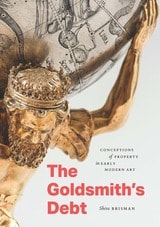
The Goldsmith's Debt
Conceptions of Property in Early Modern ArtShira Brisman
University of Chicago Press, 2026
In the sixteenth century, German goldsmiths played a unique role in articulating property claims and social values. These artisans shaped precious metals into visible expressions of domination, subordination, and obligation. The objects they crafted played a major role in the practices of exchange and inheritance that were reconfiguring a tumultuous economic landscape. Cities commissioned goldsmiths to transform revenue into goblets that could be given as diplomatic gifts or reconverted into currency in times of war, and courts used serving implements as promises of credit.
With The Goldsmith’s Debt, art historian Shira Brisman offers the first book-length study of the Nuremberg goldsmith Christoph Jamnitzer (1563–1618), who created elaborate gilded silver drinking cups that he crafted into unexpected forms, with designs ranging from racialized heads to mining scenes. Considering how works of art can shape a social order, Brisman explores what Jamnitzer’s etchings and goblets reveal about how goldsmiths shared ideas and how their patrons used commissioned works to legitimize their claims over land and the rights of others. Drawing on a range of textual and material evidence—including commentaries on Roman and customary laws, wills and civic statutes, printed designs, and firsthand study of lidded cups in dozens of major European institutions—this unprecedented study places the goldsmith at the heart of the era’s arguments about how people and lands should be subjugated. Brisman reveals the insidious side of these objects that were often used to advance socially conservative agendas, and she presents radical proposals for addressing inequity in the world of ornament prints.
The Gratis Economy
Privately Provided Public GoodsAndrás Kelen
Central European University Press, 2002
The Great Depression
An International Disaster of Perverse Economic PoliciesThomas E. Hall and J. David Ferguson
University of Michigan Press, 1998
The Great Global Transformation
The United States, China, and the Remaking of the World Economic OrderBranko Milanovic
University of Chicago Press, 2026
The world’s two great economic powers are on opposite trajectories. In the United States, decades of neoliberal policies produced a small class of rich elites and gutted the middle class. In China, the same global forces have created a massive new upper class. The result is the greatest reshuffling of global incomes since the Industrial Revolution—a dramatic shakeup of each country’s political order. As the two powers retreat from one another, the implications for their futures, and for the world economy, are uncertain.
In The Great Global Transformation, acclaimed economist Branko Milanovic draws on original research to chart how these seismic shifts will shape the next century of the global economy. As both the US and China retreat into protectionism, Milanovic shows how a new and multipolar world order will follow—and how rising nationalism will have dramatically different effects on the two countries. And he shows us the fight ahead: as plutocracy returns, global war threatens, and a new system silently shapes our nations, driving populist discontent to the breaking point.
A worthy successor to Capitalism, Alone and his other landmark works, Milanovic’s new book announces the arrival of a new era he terms “national market liberalism,” in which liberalism survives in domestic economies, but not necessarily in the social arena. The Great Global Transformation is Milanovic’s indispensable account of the new twenty-first century now underway.
The Great Global Transformation
The United States, China, and the Remaking of the World Economic OrderBranko Milanovic
University of Chicago Press, 2026
From the essential chronicler of the world economy, a portrait of the Great Powers in transition.
The world’s two great economic powers are on opposite trajectories. In the United States, decades of neoliberal policies produced a small class of rich elites and gutted the middle class. In China, the same global forces have created a massive new upper class. The result is the greatest reshuffling of global incomes since the Industrial Revolution—a dramatic shakeup of each country’s political order. As the two powers retreat from one another, the implications for their futures, and for the world economy, are uncertain.
In The Great Global Transformation, acclaimed economist Branko Milanovic draws on original research to chart how these seismic shifts will shape the next century of the global economy. As both the US and China retreat into protectionism, Milanovic shows how a new and multipolar world order will follow—and how rising nationalism will have dramatically different effects on the two countries. And he shows us the fight ahead: as plutocracy returns, global war threatens, and a new system silently shapes our nations, driving populist discontent to the breaking point.
A worthy successor to Capitalism, Alone and his other landmark works, Milanovic’s new book announces the arrival of a new era he terms “national market liberalism,” in which liberalism survives in domestic economies, but not necessarily in the social arena. The Great Global Transformation is Milanovic’s indispensable account of the new twenty-first century now underway.
The Great Inflation
The Rebirth of Modern Central BankingEdited by Michael D. Bordo and Athanasios Orphanides
University of Chicago Press, 2013
The Great Recession
David B. Grusky
Russell Sage Foundation, 2012
The Growth of Economic Thought, 3rd ed.
Henry W. Spiegel
Duke University Press, 1991
From reviews of previous editions:
“The history of economic thought to end all histories of economic thought.”—Robert D. Patton, Journal of Economic Literature
“The book is in the grand tradition of the history of doctrines. It is a history of economic thought broadly conceived—and superbly written to boot. It is not to much to say that Spiegel’s book will become and remain a leading text in the field.”—Warren J. Samuels, Social Science
The author conveys the essence of an idea simply and clearly, yet in a graceful style.”—William F. Kennedy, Journal of Economic Literature
The Heretic's Guide to Global Finance
Hacking the Future of MoneyBrett Scott
Pluto Press, 2013
Popular anger against the financial system has never been higher, yet the practical workings of the system remain opaque to many people. The Heretic's Guide to Global Finance aims to bridge the gap between protest slogans and practical proposals for reform.
Brett Scott is a campaigner and former derivatives broker who has a unique understanding of life inside and outside the financial sector. He builds up a framework for approaching it based on the three principles of 'Exploring', 'Jamming' and 'Building', offering a practical guide for those who wish to deepen their understanding of, and access to, the inner workings of financial institutions.
Scott covers aspects frequently overlooked, such as the cultural dimensions of the financial system, and considers major issues such as agricultural speculation, carbon markets and tar-sands financing. Crucially, it also showcases the growing alternative finance movement, showing how everyday people can get involved in building a new, democratic, financial system.
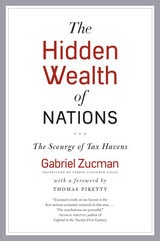
The Hidden Wealth of Nations
The Scourge of Tax HavensGabriel Zucman
University of Chicago Press, 2015
In The Hidden Wealth of Nations, Zucman offers an inventive and sophisticated approach to quantifying how big the problem is, how tax havens work and are organized, and how we can begin to approach a solution. His research reveals that tax havens are a quickly growing danger to the world economy. In the past five years, the amount of wealth in tax havens has increased over 25%—there has never been as much money held offshore as there is today. This hidden wealth accounts for at least $7.6 trillion, equivalent to 8% of the global financial assets of households. Fighting the notion that any attempts to vanquish tax havens are futile, since some countries will always offer more advantageous tax rates than others, as well the counter-argument that since the financial crisis tax havens have disappeared, Zucman shows how both sides are actually very wrong. In The Hidden Wealth of Nations he offers an ambitious agenda for reform, focused on ways in which countries can change the incentives of tax havens. Only by first understanding the enormity of the secret wealth can we begin to estimate the kind of actions that would force tax havens to give up their practices.
Zucman’s work has quickly become the gold standard for quantifying the amount of the world’s assets held in havens. In this concise book, he lays out in approachable language how the international banking system works and the dangerous extent to which the large-scale evasion of taxes is undermining the global market as a whole. If we are to find a way to solve the problem of increasing inequality, The Hidden Wealth of Nations is essential reading.